 Skip to content
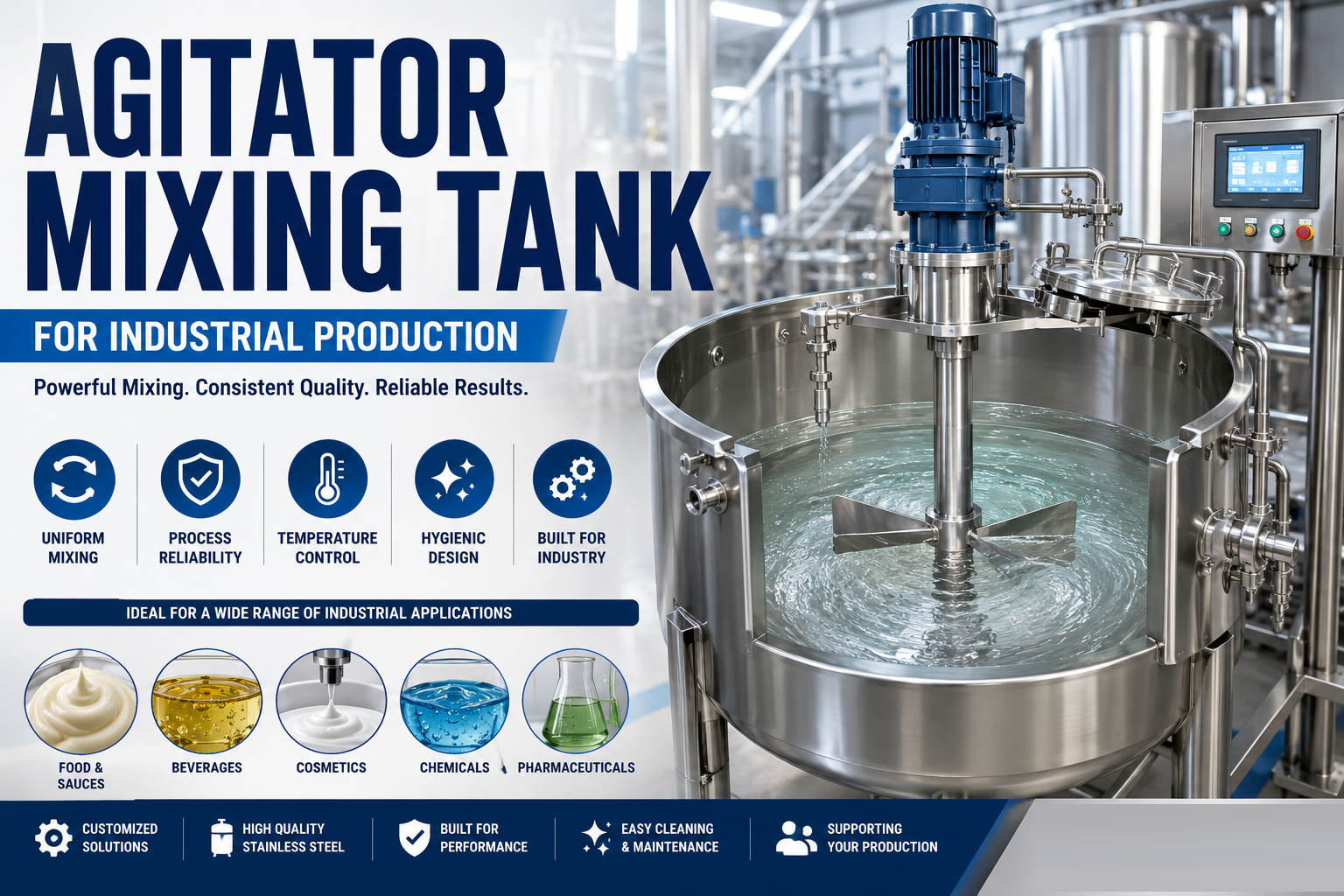
An agitator mixing tank is the workhorse vessel used to blend, dissolve, suspend and maintain product uniformity before filling. Unlike a high-shear emulsifier, it focuses on bulk circulation with low to medium shear, which protects sensitive ingredients while ensuring batch repeatability.
Its role in blending, dissolving, suspending and maintaining product uniformity makes it essential for sauces, syrups, shampoos, detergents, and pharmaceutical liquids. Food and beverage manufacturers, cosmetic manufacturers, sauce and condiment producers, and chemical plants use it as both a process tank and a buffer before the filler. The key is matching agitator type and tank geometry to viscosity and process goal.
A propeller that works at 1,000 cP will stall at 80,000 cP. King-Pack’s customized mixing tank solutions are configured around actual product viscosity, batch size, and downstream filling requirements rather than a one-size-fits-all design. This guide explores the different types of agitator mixing tanks, their applications, and key considerations when selecting equipment for industrial production.
What Is an Agitator Mixing Tank?
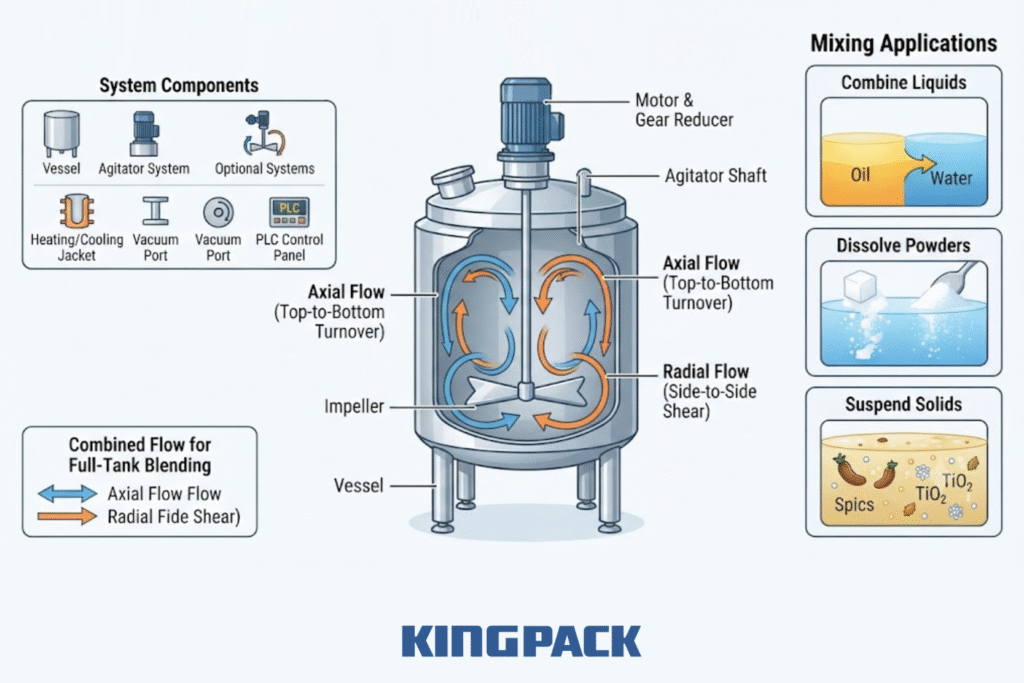
A mixing tank with agitator consists of a vessel that stores and processes material and an agitated mixing system that moves it. The motor drives the shaft and impeller. The impeller creates fluid circulation — axial flow for top-to-bottom turnover, radial flow for side-to-side shear, or combined flow for full-tank blending.
Mixing can combine liquids, dissolve powders like sugar or salt, or keep solids suspended like spices or TiO2. Optional systems provide heating, cooling, vacuum and automatic control via PLC.
A standard agitated mixing tank is mainly used for blending and circulation. Products requiring intense particle reduction or stable emulsification — such as cream, lotion, mayonnaise — may need a high shear mixer or vacuum emulsifying mixer. Using the wrong tool either damages the product or fails to create a stable emulsion.
How Does an Agitator Mixing Tank Work?
Typical process in an industrial mixing tank:
Raw Material Feeding → Agitator Start-Up → Bulk Material Circulation → Ingredient Blending or Dissolution → Heating or Cooling if Required → Quality Inspection → Discharge or Transfer
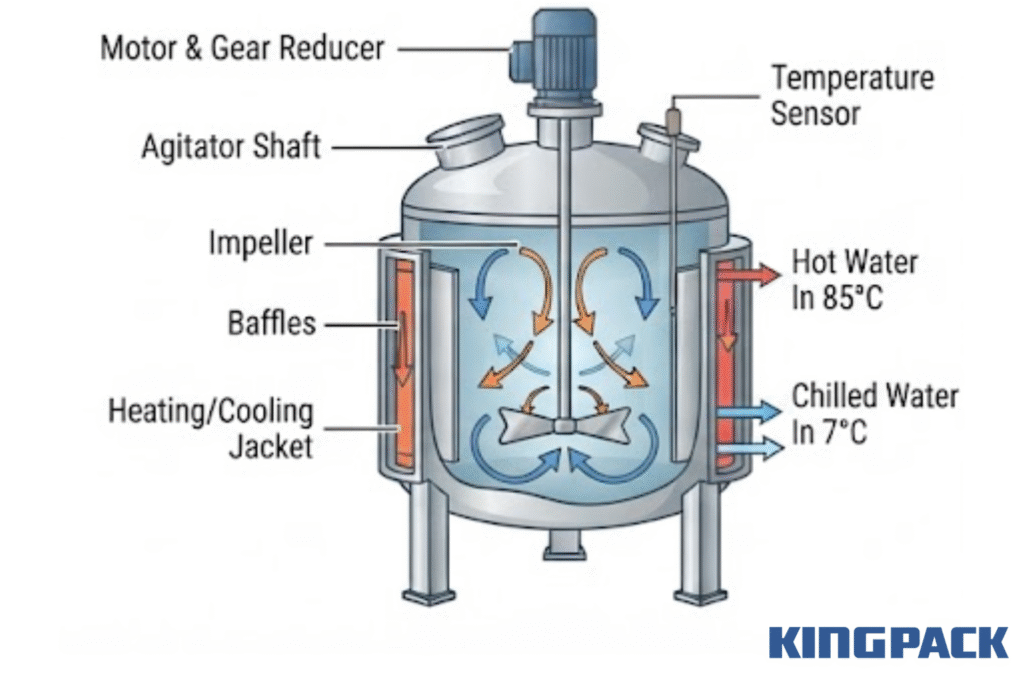
The motor rotates the agitator shaft through a gear reducer. The impeller generates flow patterns based on its design. Baffles may be used to reduce vortex formation and improve top-to-bottom mixing, especially with low-viscosity liquids.
Mixing speed and time depend on viscosity, tank size and product requirements. For example, a 1,000 L liquid mixing tank with 5,000 cP syrup may run at 60 rpm for 15 minutes, while a 500 L sanitary mixing tank with 50,000 cP gel needs an anchor agitator at 20 rpm for 40 minutes.
For food plants, heating is often via jacket with hot water at 85°C; cooling via chilled water at 7°C. Temperature sensors ensure the batch never exceeds the heat sensitivity limit.
Main Components of an Agitator Mixing Tank
A complete stainless steel mixing tank system includes:
- Stainless steel tank body, single-wall or jacketed
- Electric motor and gear reducer
- Mixing shaft and agitator or impeller
- Tank cover with hinged manhole
- Inlet and outlet with sanitary valves
- Heating and cooling jacket, dimple or half-pipe
- Temperature sensor and level sensor
- Control panel with variable-frequency drive
- Spray ball for CIP
- Sanitary valves and pipelines, tri-clamp connections
King-Pack builds tanks with load cells and level transmitters as options for automated batching.
Types of Agitators for Mixing Tanks
Choosing agitator type is the most important decision for an industrial agitator tank. Multiple agitators may be combined in one tank, for example anchor plus high-speed disperser, depending on process.
Propeller Agitator
Suitable for low-viscosity liquids below 2,000 cP, rapid circulation, liquid-to-liquid blending. Used for beverages and cleaning liquids, water-like chemical blending.
Paddle Agitator
Suitable for gentle mixing, medium-viscosity products up to 10,000 cP, products requiring limited shear such as fragrances added to shampoo.
Turbine Agitator
Suitable for liquid blending, solid suspension, gas-liquid dispersion, processes requiring stronger turbulence. Generates both radial and axial flow.
Anchor Agitator
Suitable for creams, sauces, gels, medium- and high-viscosity products 10,000–80,000 cP. Scrapes near wall, prevents dead zones.
Frame Agitator
Suitable for thick liquids, pastes, products requiring full-tank circulation. Larger diameter than paddle, better turnover for 50,000–150,000 cP.
Scraper Agitator
Suitable for products that stick to the tank wall, heated creams and sauces, high-viscosity materials. PTFE scrapers maintain contact during heating.
| Agitator Type | Suitable Viscosity | Typical Application | Main Function |
| Propeller Agitator | <2,000 cP | Beverage blending, CIP solution, thin solvents | High-speed axial circulation |
| Paddle Agitator | 1,000–15,000 cP | Syrup mixing, light lotion, flavor blending | Gentle bulk blending |
| Turbine Agitator | 1,000–20,000 cP | Solid suspension, neutralization, chemical blending | Turbulent mixing and dispersion |
| Anchor Agitator | 10,000–80,000 cP | Sauce, cream base, gel | Wall scraping and full turnover |
| Frame Agitator | 20,000–150,000 cP | Paste, thick detergent, ketchup base | Full-tank circulation |
| Scraper Agitator | 30,000–200,000 cP | Heated sauce, cosmetic cream, caramel | Prevents burning and wall buildup |
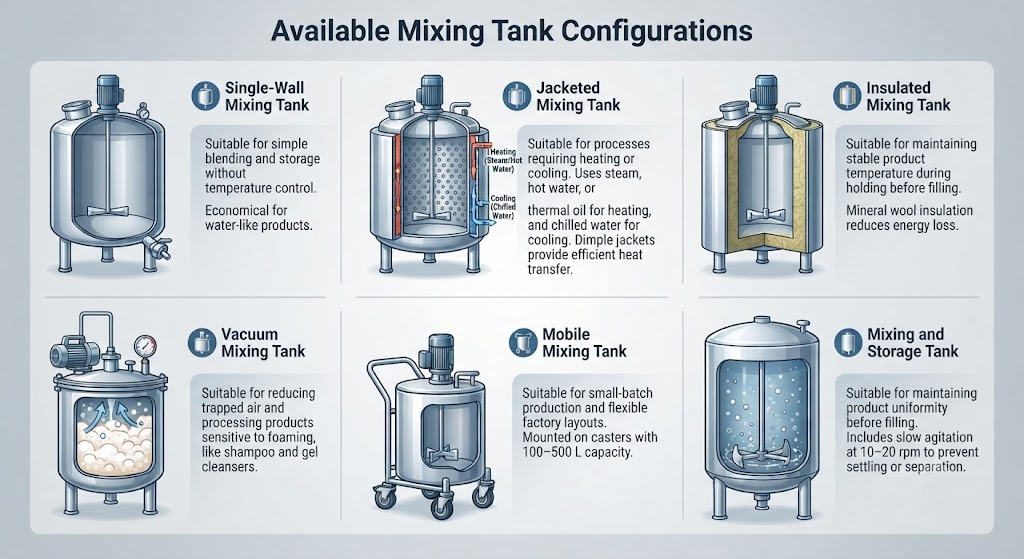
For mixing vessel with agitator designs, anchor plus disperser combination is common when you need both viscosity handling and powder wetting.
Mixing Tank Bottom and Vessel Design
Tank geometry affects drainage, cleaning, and mixing efficiency.
Flat Bottom
Simple structure, suitable for general liquid blending, economical configuration. Harder to drain fully.
Sloped Bottom
Improves drainage, guides product toward discharge valve, reduces residue to <0.5%.
Cone Bottom
Suitable for complete discharge, useful for products containing solids or sediment like dressings with herbs.
Dished Bottom
Supports smooth circulation, reduces material accumulation in corners, suitable for sanitary applications and CIP. Most sanitary mixing tank designs use 2B or electropolished interior Ra<0.8 μm.
Stainless Steel Mixing Tank Materials
Commonly available options for stainless steel mixing tank construction:
SS304
Suitable for many general food, beverage, cosmetic and industrial liquid applications. Cost-effective, good corrosion resistance for neutral pH products.
SS316L
Suitable when greater corrosion resistance or stricter hygienic requirements are needed, such as salty sauces, acidic dressings, chloride-containing detergents.
Material selection depends on product composition, acidity, salt content, cleaning chemicals, production standards, and corrosion risk. For pH <4 or chloride >200 ppm, SS316L is recommended. For more information on stainless steel grades, refer to the British Stainless Steel Association.
Applications of Agitator Mixing Tanks
Food and Beverage
Examples: sauces, syrups, marinades, dressings, beverages, dairy products, liquid seasonings. A jacketed mixing tank with scraper agitator handles tomato sauce at 30,000–60,000 cP.
Cosmetics and Personal Care
Examples: shampoo, conditioner, liquid soap, lotion, gel, cleanser. Requires foam control and often vacuum to avoid bubbles.
Pharmaceutical Products
Examples: syrups, liquid preparations, suspensions, gels, cleaning solutions. Needs 316L and documentation for GMP.
Chemical Products
Examples: detergents, lubricants, paints, coatings, solvents, fertilizers, industrial chemicals. May need explosion-proof motors and ATEX rating.
Agitator Mixing Tank vs Emulsifying Mixer
The main difference is the type of mixing each machine performs. An agitator mixing tank is designed for blending, dissolving, and maintaining product uniformity, while an emulsifying mixer uses high shear to create stable emulsions from immiscible liquids. The table below compares their key differences.
| Comparison | Agitator Mixing Tank | Emulsifying Mixer |
| Main function | Blending and circulation | High-shear emulsification and homogenization |
| Shear level | Low to medium | High, rotor-stator at 3,000 rpm |
| Suitable products | Liquids and blended products, shampoo, syrup, detergent | Creams, emulsions and fine dispersions |
| Droplet reduction | Limited, >50 μm | Strong, 2–10 μm |
| Vacuum option | Optional | Commonly integrated |
| Typical applications | Shampoo, syrup, detergent | Cream, lotion, mayonnaise, ointment |
Choose an agitator mixing tank when objective is blending, dissolving or maintaining uniformity. Choose an emulsifying mixer, like a Vacuum Emulsifying Mixer or High Shear Mixer, when product requires fine droplet reduction, strong dispersion or stable oil-water emulsion. King-Pack offers both lines so the upstream tank matches downstream filling.
Recommended Reading: Tube Filling and Sealing Machine Guide: How Advanced Temperature Control Creates a Perfect Seal
Benefits of an Industrial Agitator Mixing Tank
- Consistent product blending with repeatable rpm and time control
- Improved batch repeatability via PLC recipe management
- Reduced manual mixing and operator exposure
- Controlled heating and cooling via jacket and sensors
- Better solid suspension with turbine or anchor
- Flexible agitator configurations for different viscosities
- Easier transfer to downstream equipment with sanitary pumps
- Suitable for automated production with level and temperature interlocks
- Customizable tank capacity from 100 L to 10,000 L
How to Choose an Agitator Mixing Tank
Product Characteristics
Consider the type of materials being processed, including liquids, powders, solids, density, foaming tendency, corrosion resistance, and heat sensitivity. Foaming products may require low-speed mixing or vacuum operation. Agitator mixing tanks are widely used in pharmaceuticals for preparing drug formulations and sterile solutions.
Product Viscosity
Viscosity affects agitator selection, motor power, shaft design, and mixing speed. Low-viscosity mixing liquids can use propeller or turbine agitators, while high-viscosity materials need stronger top entry mixer designs with anchor or scraper systems.
High-shear agitators are available for systems ranging from 1 liter to 10,000 gallons, making them suitable for a variety of industrial applications.
Batch Capacity
Choose tank size based on working volume, production needs, and future expansion. Agitators are available in different sizes, from small 5-liter systems to large industrial tanks. Some customized mixers can handle volumes up to 20,000 gallons.
Mixing Purpose
Define whether the process requires simple blending, powder dissolution, solid suspension, heat transfer, viscosity control, or high-shear dispersion. A top entry mixer is ideal for many applications, while high-shear systems are better for demanding processes such as pigment dispersion and coatings production.
Temperature Control
Confirm whether the tank requires electric heating, steam heating, hot-water circulation, cooling, or insulation. Proper temperature control improves mixing performance and helps materials maintain the desired quality.
Cleaning Requirements
Consider cleaning methods such as manual cleaning, spray balls, CIP connections, and full drainage systems. Modern agitator systems are designed to reduce dead zones and improve cleaning efficiency. Some modular agitator designs help reduce water and cleaning media use.
Automation Level
Options include manual controls, variable-speed operation, PLC touchscreen control, temperature monitoring, timers, and recipe management. Advanced systems provide better energy efficiency, reliable performance, and precise control for different production requirements.
Top entry mixer designs are commonly used across various industries because they offer flexibility, easy customization, and efficient mixing performance. Brands such as Alfa Laval and Dynamix provide agitator solutions designed for different industrial needs.
How Does a Top Entry Mixing Tank Connect to a Filling Machine?
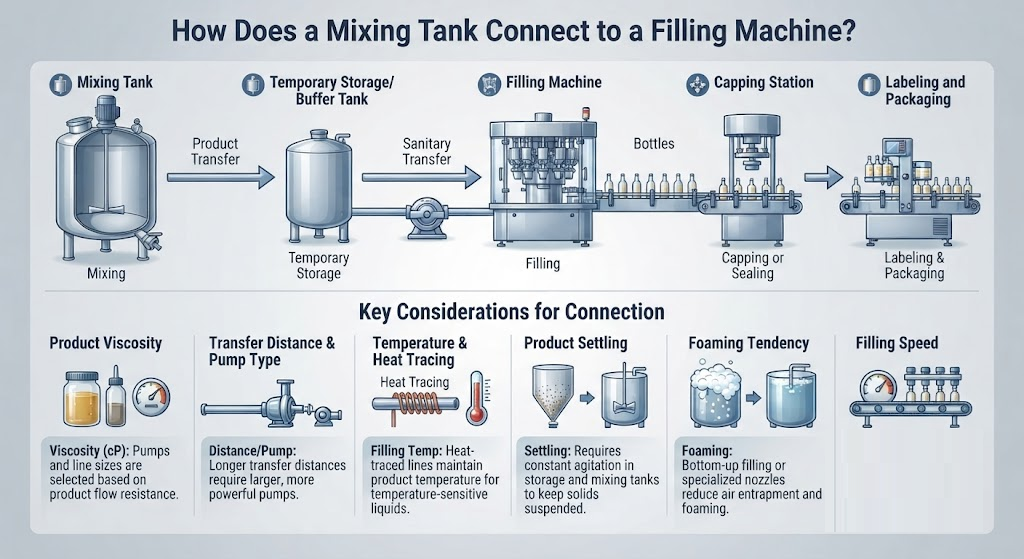
The downstream process for a mixing and filling production line is:
Mixing → Temporary Storage → Sanitary Transfer → Filling → Capping or Sealing → Labeling and Packaging
Low-Viscosity Products
- Examples: beverages, cleaning liquids, toners, thin chemical liquids.
- Possible filling equipment: gravity filling machine, flowmeter filling machine, pump filling machine.
- A Liquid Filling Machine with flowmeter accuracy ±0.5% works well.
Medium-Viscosity Products
- Examples: shampoo, liquid soap, syrup, salad dressing.
- Possible filling equipment: servo pump filling machine, piston filling machine, volumetric filling machine.
- A Shampoo Filling Machine or Sauce Filling Machine with servo pump handles 5,000–50,000 cP without dripping.
High-Viscosity Products
- Examples: thick sauces, creams, gels, pastes.
- Possible filling equipment: servo piston filling machine, positive-displacement filling machine, heated hopper filling system where appropriate.
- The mixing tank may include slow agitation before filling to prevent settling or separation.
Complete Mixing and Filling Production Line
Suggested line configuration:
Raw Material Tank → Agitator Mixing Tank → Buffer or Storage Tank → Transfer Pump → Automatic Filling Machine → Capping Machine → Labeling Machine → Cartoning or Case Packing
Naturally introduce King-Pack as provider of customized agitator mixing tanks, storage tanks, transfer systems, filling machines, capping machines, and complete filling and packaging lines. A custom mixing tank can be integrated with a Filling and Capping Line and Complete Packaging Line to ensure stable viscosity from mixing to pack.
As a professional mixing tank manufacturer, King-Pack engineers tank, agitator, and filler as one system to avoid re-aeration and temperature loss. Contact us for more details.
Customization Options
Include: tank capacity 100–10,000 L, SS304 or SS316L construction, agitator type, mixing speed 0–120 rpm, variable-frequency control, motor and reducer SEW or ABB, heating and cooling jacket, thermal insulation, vacuum system, load cells, level sensors, mobile wheels, working platform, CIP spray ball, PLC control, filling machine connection flange.
Frequently Asked Questions
Q1: What is an agitator mixing tank?
An agitator mixing tank is a stainless steel vessel with a motor-driven impeller that blends liquids, dissolves powders, and keeps solids suspended. It is a core type of industrial mixing tank used before filling.
Q2: What is the difference between an agitator and a mixer?
Agitator refers to the impeller inside the tank; mixer refers to the whole system including tank, motor, and controls. All agitator tanks are mixers, but not all mixers are agitator tanks.
Q3: Which agitator is suitable for high-viscosity products?
Anchor, frame, or scraper agitator with large gearbox and low rpm. For >80,000 cP, scraper with PTFE blades prevents wall burning.
Q4: Can a mixing tank heat and cool the product?
Yes. A jacketed mixing tank provides steam, hot water, or electric heating and chilled water cooling with PID temperature control.
Q5: What is the difference between a mixing tank and an emulsifying tank?
Mixing tank does bulk blending with low shear. Emulsifying tank uses high-shear rotor-stator to reduce droplets to 2–10 microns for stable emulsions.
Q6: Should I choose SS304 or SS316L?
Choose SS304 for neutral pH products. Choose SS316L for acidic, salty, or chloride-containing products and for pharma/cosmetics needing higher corrosion resistance.
Q7: How do I choose the correct mixing tank capacity?
Base it on working volume at 70–80% fill, batches per day, and growth plan. For 2,000 L/day with 500 L batches, a 600–700 L total volume tank gives headspace.
Q8: Can powders be added directly into a mixing tank?
Yes if equipped with disperser or high-shear head, but add slowly to avoid lumps. Pre-mixing in a small powder hopper is better for >5% solids.
Q9: Can an agitator mixing tank connect directly to a filling machine?
Yes. Via sanitary lobe pump and pipeline to an automatic filling machine. Include slow agitation in buffer tank to prevent settling before the filler.
Q10: Can the entry mixers tank be customized for CIP cleaning?
Yes. Options include spray ball, CIP return line, sanitary design with Ra<0.8 μm, and full drainability.
Looking for a Customized Agitator Mixing Tank?
King-Pack provides customized agitator mixing tanks, storage vessels, transfer systems and filling equipment for food, cosmetics, pharmaceutical and chemical manufacturers.
Solutions can be configured according to product type, viscosity, batch capacity, mixing purpose, heating and cooling requirements, cleaning method, filling container, and required production output.
As a professional manufacturer of customized mixing tanks, filling machines and complete packaging lines, King-Pack supplies industrial mixing tank solutions from 100 L pilot custom mixing tank to full mixing and filling production line. Contact us today for a customized mixing and filling solution.
Content ScoreSEOAI SearchAuto-Optimize
#1Research & Create Outline
#2Write & Optimize
#3Internal Links
#4Pre-Publish Review
#5Publish or Export
words2495548-630
headings519-26
paragraphs6617+
Agitator Mixing Tank for Industrial Production
An agitator mixing tank is the workhorse vessel used to blend, dissolve, suspend and maintain product uniformity before filling. Unlike a high-shear emulsifier, it focuses on bulk circulation with low to medium shear, which protects sensitive ingredients while ensuring batch repeatability.
Its role in blending, dissolving, suspending and maintaining product uniformity makes it essential for sauces, syrups, shampoos, detergents, and pharmaceutical liquids. Food and beverage manufacturers, cosmetic manufacturers, sauce and condiment producers, and chemical plants use it as both a process tank and a buffer before the filler. The key is matching agitator type and tank geometry to viscosity and process goal.
A propeller that works at 1,000 cP will stall at 80,000 cP. King-Pack’s customized mixing tank solutions are configured around actual product viscosity, batch size, and downstream filling requirements rather than a one-size-fits-all design. This guide explores the different types of agitator mixing tanks, their applications, and key considerations when selecting equipment for industrial production.
What Is an Agitator Mixing Tank?
A mixing tank with agitator consists of a vessel that stores and processes material and an agitated mixing system that moves it. The motor drives the shaft and impeller. The impeller creates fluid circulation — axial flow for top-to-bottom turnover, radial flow for side-to-side shear, or combined flow for full-tank blending.
Mixing can combine liquids, dissolve powders like sugar or salt, or keep solids suspended like spices or TiO2. Optional systems provide heating, cooling, vacuum and automatic control via PLC.
A standard agitated mixing tank is mainly used for blending and circulation. Products requiring intense particle reduction or stable emulsification — such as cream, lotion, mayonnaise — may need a high shear mixer or vacuum emulsifying mixer. Using the wrong tool either damages the product or fails to create a stable emulsion.
How Does an Agitator Mixing Tank Work?
Typical process in an industrial mixing tank:
Raw Material Feeding → Agitator Start-Up → Bulk Material Circulation → Ingredient Blending or Dissolution → Heating or Cooling if Required → Quality Inspection → Discharge or Transfer
The motor rotates the agitator shaft through a gear reducer. The impeller generates flow patterns based on its design. Baffles may be used to reduce vortex formation and improve top-to-bottom mixing, especially with low-viscosity liquids.
Mixing speed and time depend on viscosity, tank size and product requirements. For example, a 1,000 L liquid mixing tank with 5,000 cP syrup may run at 60 rpm for 15 minutes, while a 500 L sanitary mixing tank with 50,000 cP gel needs an anchor agitator at 20 rpm for 40 minutes.
For food plants, heating is often via jacket with hot water at 85°C; cooling via chilled water at 7°C. Temperature sensors ensure the batch never exceeds the heat sensitivity limit.
Main Components of an Agitator Mixing Tank
A complete stainless steel mixing tank system includes:
- Stainless steel tank body, single-wall or jacketed
- Electric motor and gear reducer
- Mixing shaft and agitator or impeller
- Tank cover with hinged manhole
- Inlet and outlet with sanitary valves
- Heating and cooling jacket, dimple or half-pipe
- Temperature sensor and level sensor
- Control panel with variable-frequency drive
- Spray ball for CIP
- Sanitary valves and pipelines, tri-clamp connections
King-Pack builds tanks with load cells and level transmitters as options for automated batching.
Types of Agitators for Mixing Tanks
Choosing agitator type is the most important decision for an industrial agitator tank. Multiple agitators may be combined in one tank, for example anchor plus high-speed disperser, depending on process.
Propeller Agitator
Suitable for low-viscosity liquids below 2,000 cP, rapid circulation, liquid-to-liquid blending. Used for beverages and cleaning liquids, water-like chemical blending.
Paddle Agitator
Suitable for gentle mixing, medium-viscosity products up to 10,000 cP, products requiring limited shear such as fragrances added to shampoo.
Turbine Agitator
Suitable for liquid blending, solid suspension, gas-liquid dispersion, processes requiring stronger turbulence. Generates both radial and axial flow.
Anchor Agitator
Suitable for creams, sauces, gels, medium- and high-viscosity products 10,000–80,000 cP. Scrapes near wall, prevents dead zones.
Frame Agitator
Suitable for thick liquids, pastes, products requiring full-tank circulation. Larger diameter than paddle, better turnover for 50,000–150,000 cP.
Scraper Agitator
Suitable for products that stick to the tank wall, heated creams and sauces, high-viscosity materials. PTFE scrapers maintain contact during heating.
| Agitator Type | Suitable Viscosity | Typical Application | Main Function |
| Propeller Agitator | <2,000 cP | Beverage blending, CIP solution, thin solvents | High-speed axial circulation |
| Paddle Agitator | 1,000–15,000 cP | Syrup mixing, light lotion, flavor blending | Gentle bulk blending |
| Turbine Agitator | 1,000–20,000 cP | Solid suspension, neutralization, chemical blending | Turbulent mixing and dispersion |
| Anchor Agitator | 10,000–80,000 cP | Sauce, cream base, gel | Wall scraping and full turnover |
| Frame Agitator | 20,000–150,000 cP | Paste, thick detergent, ketchup base | Full-tank circulation |
| Scraper Agitator | 30,000–200,000 cP | Heated sauce, cosmetic cream, caramel | Prevents burning and wall buildup |
For mixing vessel with agitator designs, anchor plus disperser combination is common when you need both viscosity handling and powder wetting.
Mixing Tank Bottom and Vessel Design
Tank geometry affects drainage, cleaning, and mixing efficiency.
Flat Bottom
Simple structure, suitable for general liquid blending, economical configuration. Harder to drain fully.
Sloped Bottom
Improves drainage, guides product toward discharge valve, reduces residue to <0.5%.
Cone Bottom
Suitable for complete discharge, useful for products containing solids or sediment like dressings with herbs.
Dished Bottom
Supports smooth circulation, reduces material accumulation in corners, suitable for sanitary applications and CIP. Most sanitary mixing tank designs use 2B or electropolished interior Ra<0.8 μm.
Stainless Steel Mixing Tank Materials
Commonly available options for stainless steel mixing tank construction:
SS304
Suitable for many general food, beverage, cosmetic and industrial liquid applications. Cost-effective, good corrosion resistance for neutral pH products.
SS316L
Suitable when greater corrosion resistance or stricter hygienic requirements are needed, such as salty sauces, acidic dressings, chloride-containing detergents.
Material selection depends on product composition, acidity, salt content, cleaning chemicals, production standards, and corrosion risk. For pH <4 or chloride >200 ppm, SS316L is recommended. For more information on stainless steel grades, refer to the .
Applications of Agitator Mixing Tanks
Food and Beverage
Examples: sauces, syrups, marinades, dressings, beverages, dairy products, liquid seasonings. A jacketed mixing tank with scraper agitator handles tomato sauce at 30,000–60,000 cP.
Cosmetics and Personal Care
Examples: shampoo, conditioner, liquid soap, lotion, gel, cleanser. Requires foam control and often vacuum to avoid bubbles.
Pharmaceutical Products
Examples: syrups, liquid preparations, suspensions, gels, cleaning solutions. Needs 316L and documentation for GMP.
Chemical Products
Examples: detergents, lubricants, paints, coatings, solvents, fertilizers, industrial chemicals. May need explosion-proof motors and ATEX rating.
Agitator Mixing Tank vs Emulsifying Mixer
The main difference is the type of mixing each machine performs. An agitator mixing tank is designed for blending, dissolving, and maintaining product uniformity, while an emulsifying mixer uses high shear to create stable emulsions from immiscible liquids. The table below compares their key differences.
| Comparison | Agitator Mixing Tank | Emulsifying Mixer |
| Main function | Blending and circulation | High-shear emulsification and homogenization |
| Shear level | Low to medium | High, rotor-stator at 3,000 rpm |
| Suitable products | Liquids and blended products, shampoo, syrup, detergent | Creams, emulsions and fine dispersions |
| Droplet reduction | Limited, >50 μm | Strong, 2–10 μm |
| Vacuum option | Optional | Commonly integrated |
| Typical applications | Shampoo, syrup, detergent | Cream, lotion, mayonnaise, ointment |
Choose an agitator mixing tank when objective is blending, dissolving or maintaining uniformity. Choose an emulsifying mixer, like a or , when product requires fine droplet reduction, strong dispersion or stable oil-water emulsion. King-Pack offers both lines so the upstream tank matches downstream filling.
Recommended Reading:
Benefits of an Industrial Agitator Mixing Tank
- Consistent product blending with repeatable rpm and time control
- Improved batch repeatability via PLC recipe management
- Reduced manual mixing and operator exposure
- Controlled heating and cooling via jacket and sensors
- Better solid suspension with turbine or anchor
- Flexible agitator configurations for different viscosities
- Easier transfer to downstream equipment with sanitary pumps
- Suitable for automated production with level and temperature interlocks
- Customizable tank capacity from 100 L to 10,000 L
How to Choose an Agitator Mixing Tank
Product Characteristics
Consider the type of materials being processed, including liquids, powders, solids, density, foaming tendency, corrosion resistance, and heat sensitivity. Foaming products may require low-speed mixing or vacuum operation. Agitator mixing tanks are widely used in pharmaceuticals for preparing drug formulations and sterile solutions.
Product Viscosity
Viscosity affects agitator selection, motor power, shaft design, and mixing speed. Low-viscosity mixing liquids can use propeller or turbine agitators, while high-viscosity materials need stronger top entry mixer designs with anchor or scraper systems.
High-shear agitators are available for systems ranging from 1 liter to 10,000 gallons, making them suitable for a variety of industrial applications.
Batch Capacity
Choose tank size based on working volume, production needs, and future expansion. Agitators are available in different sizes, from small 5-liter systems to large industrial tanks. Some customized mixers can handle volumes up to 20,000 gallons.
Mixing Purpose
Define whether the process requires simple blending, powder dissolution, solid suspension, heat transfer, viscosity control, or high-shear dispersion. A top entry mixer is ideal for many applications, while high-shear systems are better for demanding processes such as pigment dispersion and coatings production.
Temperature Control
Confirm whether the tank requires electric heating, steam heating, hot-water circulation, cooling, or insulation. Proper temperature control improves mixing performance and helps materials maintain the desired quality.
Cleaning Requirements
Consider cleaning methods such as manual cleaning, spray balls, CIP connections, and full drainage systems. Modern agitator systems are designed to reduce dead zones and improve cleaning efficiency. Some modular agitator designs help reduce water and cleaning media use.
Automation Level
Options include manual controls, variable-speed operation, PLC touchscreen control, temperature monitoring, timers, and recipe management. Advanced systems provide better energy efficiency, reliable performance, and precise control for different production requirements.
Top entry mixer designs are commonly used across various industries because they offer flexibility, easy customization, and efficient mixing performance. Brands such as Alfa Laval and Dynamix provide agitator solutions designed for different industrial needs.
How Does a Top Entry Mixing Tank Connect to a Filling Machine?
The downstream process for a mixing and filling production line is:
Mixing → Temporary Storage → Sanitary Transfer → Filling → Capping or Sealing → Labeling and Packaging
Low-Viscosity Products
- Examples: beverages, cleaning liquids, toners, thin chemical liquids.
- Possible filling equipment: gravity filling machine, flowmeter filling machine, pump filling machine.
- A with flowmeter accuracy ±0.5% works well.
Medium-Viscosity Products
- Examples: shampoo, liquid soap, syrup, salad dressing.
- Possible filling equipment: servo pump filling machine, piston filling machine, volumetric filling machine.
- A or with servo pump handles 5,000–50,000 cP without dripping.
High-Viscosity Products
- Examples: thick sauces, creams, gels, pastes.
- Possible filling equipment: servo piston filling machine, positive-displacement filling machine, heated hopper filling system where appropriate.
- The mixing tank may include slow agitation before filling to prevent settling or separation.
Complete Mixing and Filling Production Line
Suggested line configuration:
Raw Material Tank → Agitator Mixing Tank → Buffer or Storage Tank → Transfer Pump → → Capping Machine → Labeling Machine → Cartoning or Case Packing
Naturally introduce King-Pack as provider of customized agitator mixing tanks, storage tanks, transfer systems, filling machines, capping machines, and complete filling and packaging lines. A custom mixing tank can be integrated with a and to ensure stable viscosity from mixing to pack.
As a professional mixing tank manufacturer, King-Pack engineers tank, agitator, and filler as one system to avoid re-aeration and temperature loss. Contact us for more details.
Customization Options
Include: tank capacity 100–10,000 L, SS304 or SS316L construction, agitator type, mixing speed 0–120 rpm, variable-frequency control, motor and reducer SEW or ABB, heating and cooling jacket, thermal insulation, vacuum system, load cells, level sensors, mobile wheels, working platform, CIP spray ball, PLC control, filling machine connection flange.
Frequently Asked Questions
Q1: What is an agitator mixing tank?
An agitator mixing tank is a stainless steel vessel with a motor-driven impeller that blends liquids, dissolves powders, and keeps solids suspended. It is a core type of industrial mixing tank used before filling.
Q2: What is the difference between an agitator and a mixer?
Agitator refers to the impeller inside the tank; mixer refers to the whole system including tank, motor, and controls. All agitator tanks are mixers, but not all mixers are agitator tanks.
Q3: Which agitator is suitable for high-viscosity products?
Anchor, frame, or scraper agitator with large gearbox and low rpm. For >80,000 cP, scraper with PTFE blades prevents wall burning.
Q4: Can a mixing tank heat and cool the product?
Yes. A jacketed mixing tank provides steam, hot water, or electric heating and chilled water cooling with PID temperature control.
Q5: What is the difference between a mixing tank and an emulsifying tank?
Mixing tank does bulk blending with low shear. Emulsifying tank uses high-shear rotor-stator to reduce droplets to 2–10 microns for stable emulsions.
Q6: Should I choose SS304 or SS316L?
Choose SS304 for neutral pH products. Choose SS316L for acidic, salty, or chloride-containing products and for pharma/cosmetics needing higher corrosion resistance.
Q7: How do I choose the correct mixing tank capacity?
Base it on working volume at 70–80% fill, batches per day, and growth plan. For 2,000 L/day with 500 L batches, a 600–700 L total volume tank gives headspace.
Q8: Can powders be added directly into a mixing tank?
Yes if equipped with disperser or high-shear head, but add slowly to avoid lumps. Pre-mixing in a small powder hopper is better for >5% solids.
Q9: Can an agitator mixing tank connect directly to a filling machine?
Yes. Via sanitary lobe pump and pipeline to an automatic filling machine. Include slow agitation in buffer tank to prevent settling before the filler.
Q10: Can the entry mixers tank be customized for CIP cleaning?
Yes. Options include spray ball, CIP return line, sanitary design with Ra<0.8 μm, and full drainability.
Looking for a Customized Agitator Mixing Tank?
King-Pack provides customized agitator mixing tanks, storage vessels, transfer systems and filling equipment for , , pharmaceutical and chemical manufacturers.
Solutions can be configured according to product type, viscosity, batch capacity, mixing purpose, heating and cooling requirements, cleaning method, filling container, and required production output.
As a professional manufacturer of customized mixing tanks, filling machines and complete packaging lines, King-Pack supplies industrial mixing tank solutions from 100 L pilot custom mixing tank to full mixing and filling production line. today for a customized mixing and filling solution.
Agitator Mixing Tank for Industrial Production
An agitator mixing tank is the workhorse vessel used to blend, dissolve, suspend and maintain product uniformity before filling. Unlike a high-shear emulsifier, it focuses on bulk circulation with low to medium shear, which protects sensitive ingredients while ensuring batch repeatability.
Its role in blending, dissolving, suspending and maintaining product uniformity makes it essential for sauces, syrups, shampoos, detergents, and pharmaceutical liquids. Food and beverage manufacturers, cosmetic manufacturers, sauce and condiment producers, and chemical plants use it as both a process tank and a buffer before the filler. The key is matching agitator type and tank geometry to viscosity and process goal.
A propeller that works at 1,000 cP will stall at 80,000 cP. King-Pack’s customized mixing tank solutions are configured around actual product viscosity, batch size, and downstream filling requirements rather than a one-size-fits-all design. This guide explores the different types of agitator mixing tanks, their applications, and key considerations when selecting equipment for industrial production.
What Is an Agitator Mixing Tank?
A mixing tank with agitator consists of a vessel that stores and processes material and an agitated mixing system that moves it. The motor drives the shaft and impeller. The impeller creates fluid circulation — axial flow for top-to-bottom turnover, radial flow for side-to-side shear, or combined flow for full-tank blending.
Mixing can combine liquids, dissolve powders like sugar or salt, or keep solids suspended like spices or TiO2. Optional systems provide heating, cooling, vacuum and automatic control via PLC.
A standard agitated mixing tank is mainly used for blending and circulation. Products requiring intense particle reduction or stable emulsification — such as cream, lotion, mayonnaise — may need a high shear mixer or vacuum emulsifying mixer. Using the wrong tool either damages the product or fails to create a stable emulsion.
How Does an Agitator Mixing Tank Work?
Typical process in an industrial mixing tank:
Raw Material Feeding → Agitator Start-Up → Bulk Material Circulation → Ingredient Blending or Dissolution → Heating or Cooling if Required → Quality Inspection → Discharge or Transfer
The motor rotates the agitator shaft through a gear reducer. The impeller generates flow patterns based on its design. Baffles may be used to reduce vortex formation and improve top-to-bottom mixing, especially with low-viscosity liquids.
Mixing speed and time depend on viscosity, tank size and product requirements. For example, a 1,000 L liquid mixing tank with 5,000 cP syrup may run at 60 rpm for 15 minutes, while a 500 L sanitary mixing tank with 50,000 cP gel needs an anchor agitator at 20 rpm for 40 minutes.
For food plants, heating is often via jacket with hot water at 85°C; cooling via chilled water at 7°C. Temperature sensors ensure the batch never exceeds the heat sensitivity limit.
Main Components of an Agitator Mixing Tank
A complete stainless steel mixing tank system includes:
- Stainless steel tank body, single-wall or jacketed
- Electric motor and gear reducer
- Mixing shaft and agitator or impeller
- Tank cover with hinged manhole
- Inlet and outlet with sanitary valves
- Heating and cooling jacket, dimple or half-pipe
- Temperature sensor and level sensor
- Control panel with variable-frequency drive
- Spray ball for CIP
- Sanitary valves and pipelines, tri-clamp connections
King-Pack builds tanks with load cells and level transmitters as options for automated batching.
Types of Agitators for Mixing Tanks
Choosing agitator type is the most important decision for an industrial agitator tank. Multiple agitators may be combined in one tank, for example anchor plus high-speed disperser, depending on process.
Propeller Agitator
Suitable for low-viscosity liquids below 2,000 cP, rapid circulation, liquid-to-liquid blending. Used for beverages and cleaning liquids, water-like chemical blending.
Paddle Agitator
Suitable for gentle mixing, medium-viscosity products up to 10,000 cP, products requiring limited shear such as fragrances added to shampoo.
Turbine Agitator
Suitable for liquid blending, solid suspension, gas-liquid dispersion, processes requiring stronger turbulence. Generates both radial and axial flow.
Anchor Agitator
Suitable for creams, sauces, gels, medium- and high-viscosity products 10,000–80,000 cP. Scrapes near wall, prevents dead zones.
Frame Agitator
Suitable for thick liquids, pastes, products requiring full-tank circulation. Larger diameter than paddle, better turnover for 50,000–150,000 cP.
Scraper Agitator
Suitable for products that stick to the tank wall, heated creams and sauces, high-viscosity materials. PTFE scrapers maintain contact during heating.
| Agitator Type | Suitable Viscosity | Typical Application | Main Function |
| Propeller Agitator | <2,000 cP | Beverage blending, CIP solution, thin solvents | High-speed axial circulation |
| Paddle Agitator | 1,000–15,000 cP | Syrup mixing, light lotion, flavor blending | Gentle bulk blending |
| Turbine Agitator | 1,000–20,000 cP | Solid suspension, neutralization, chemical blending | Turbulent mixing and dispersion |
| Anchor Agitator | 10,000–80,000 cP | Sauce, cream base, gel | Wall scraping and full turnover |
| Frame Agitator | 20,000–150,000 cP | Paste, thick detergent, ketchup base | Full-tank circulation |
| Scraper Agitator | 30,000–200,000 cP | Heated sauce, cosmetic cream, caramel | Prevents burning and wall buildup |
For mixing vessel with agitator designs, anchor plus disperser combination is common when you need both viscosity handling and powder wetting.
Mixing Tank Bottom and Vessel Design
Tank geometry affects drainage, cleaning, and mixing efficiency.
Flat Bottom
Simple structure, suitable for general liquid blending, economical configuration. Harder to drain fully.
Sloped Bottom
Improves drainage, guides product toward discharge valve, reduces residue to <0.5%.
Cone Bottom
Suitable for complete discharge, useful for products containing solids or sediment like dressings with herbs.
Dished Bottom
Supports smooth circulation, reduces material accumulation in corners, suitable for sanitary applications and CIP. Most sanitary mixing tank designs use 2B or electropolished interior Ra<0.8 μm.
Stainless Steel Mixing Tank Materials
Commonly available options for stainless steel mixing tank construction:
SS304
Suitable for many general food, beverage, cosmetic and industrial liquid applications. Cost-effective, good corrosion resistance for neutral pH products.
SS316L
Suitable when greater corrosion resistance or stricter hygienic requirements are needed, such as salty sauces, acidic dressings, chloride-containing detergents.
Material selection depends on product composition, acidity, salt content, cleaning chemicals, production standards, and corrosion risk. For pH <4 or chloride >200 ppm, SS316L is recommended. For more information on stainless steel grades, refer to the British Stainless Steel Association.
Applications of Agitator Mixing Tanks
Food and Beverage
Examples: sauces, syrups, marinades, dressings, beverages, dairy products, liquid seasonings. A jacketed mixing tank with scraper agitator handles tomato sauce at 30,000–60,000 cP.
Cosmetics and Personal Care
Examples: shampoo, conditioner, liquid soap, lotion, gel, cleanser. Requires foam control and often vacuum to avoid bubbles.
Pharmaceutical Products
Examples: syrups, liquid preparations, suspensions, gels, cleaning solutions. Needs 316L and documentation for GMP.
Chemical Products
Examples: detergents, lubricants, paints, coatings, solvents, fertilizers, industrial chemicals. May need explosion-proof motors and ATEX rating.
Agitator Mixing Tank vs Emulsifying Mixer
The main difference is the type of mixing each machine performs. An agitator mixing tank is designed for blending, dissolving, and maintaining product uniformity, while an emulsifying mixer uses high shear to create stable emulsions from immiscible liquids. The table below compares their key differences.
| Comparison | Agitator Mixing Tank | Emulsifying Mixer |
| Main function | Blending and circulation | High-shear emulsification and homogenization |
| Shear level | Low to medium | High, rotor-stator at 3,000 rpm |
| Suitable products | Liquids and blended products, shampoo, syrup, detergent | Creams, emulsions and fine dispersions |
| Droplet reduction | Limited, >50 μm | Strong, 2–10 μm |
| Vacuum option | Optional | Commonly integrated |
| Typical applications | Shampoo, syrup, detergent | Cream, lotion, mayonnaise, ointment |
Choose an agitator mixing tank when objective is blending, dissolving or maintaining uniformity. Choose an emulsifying mixer, like a Vacuum Emulsifying Mixer or High Shear Mixer, when product requires fine droplet reduction, strong dispersion or stable oil-water emulsion. King-Pack offers both lines so the upstream tank matches downstream filling.
Recommended Reading: Tube Filling and Sealing Machine Guide: How Advanced Temperature Control Creates a Perfect Seal
Benefits of an Industrial Agitator Mixing Tank
- Consistent product blending with repeatable rpm and time control
- Improved batch repeatability via PLC recipe management
- Reduced manual mixing and operator exposure
- Controlled heating and cooling via jacket and sensors
- Better solid suspension with turbine or anchor
- Flexible agitator configurations for different viscosities
- Easier transfer to downstream equipment with sanitary pumps
- Suitable for automated production with level and temperature interlocks
- Customizable tank capacity from 100 L to 10,000 L
How to Choose an Agitator Mixing Tank
Product Characteristics
Consider the type of materials being processed, including liquids, powders, solids, density, foaming tendency, corrosion resistance, and heat sensitivity. Foaming products may require low-speed mixing or vacuum operation. Agitator mixing tanks are widely used in pharmaceuticals for preparing drug formulations and sterile solutions.
Product Viscosity
Viscosity affects agitator selection, motor power, shaft design, and mixing speed. Low-viscosity mixing liquids can use propeller or turbine agitators, while high-viscosity materials need stronger top entry mixer designs with anchor or scraper systems.
High-shear agitators are available for systems ranging from 1 liter to 10,000 gallons, making them suitable for a variety of industrial applications.
Batch Capacity
Choose tank size based on working volume, production needs, and future expansion. Agitators are available in different sizes, from small 5-liter systems to large industrial tanks. Some customized mixers can handle volumes up to 20,000 gallons.
Mixing Purpose
Define whether the process requires simple blending, powder dissolution, solid suspension, heat transfer, viscosity control, or high-shear dispersion. A top entry mixer is ideal for many applications, while high-shear systems are better for demanding processes such as pigment dispersion and coatings production.
Temperature Control
Confirm whether the tank requires electric heating, steam heating, hot-water circulation, cooling, or insulation. Proper temperature control improves mixing performance and helps materials maintain the desired quality.
Cleaning Requirements
Consider cleaning methods such as manual cleaning, spray balls, CIP connections, and full drainage systems. Modern agitator systems are designed to reduce dead zones and improve cleaning efficiency. Some modular agitator designs help reduce water and cleaning media use.
Automation Level
Options include manual controls, variable-speed operation, PLC touchscreen control, temperature monitoring, timers, and recipe management. Advanced systems provide better energy efficiency, reliable performance, and precise control for different production requirements.
Top entry mixer designs are commonly used across various industries because they offer flexibility, easy customization, and efficient mixing performance. Brands such as Alfa Laval and Dynamix provide agitator solutions designed for different industrial needs.
How Does a Top Entry Mixing Tank Connect to a Filling Machine?
The downstream process for a mixing and filling production line is:
Mixing → Temporary Storage → Sanitary Transfer → Filling → Capping or Sealing → Labeling and Packaging
Low-Viscosity Products
- Examples: beverages, cleaning liquids, toners, thin chemical liquids.
- Possible filling equipment: gravity filling machine, flowmeter filling machine, pump filling machine.
- A Liquid Filling Machine with flowmeter accuracy ±0.5% works well.
Medium-Viscosity Products
- Examples: shampoo, liquid soap, syrup, salad dressing.
- Possible filling equipment: servo pump filling machine, piston filling machine, volumetric filling machine.
- A Shampoo Filling Machine or Sauce Filling Machine with servo pump handles 5,000–50,000 cP without dripping.
High-Viscosity Products
- Examples: thick sauces, creams, gels, pastes.
- Possible filling equipment: servo piston filling machine, positive-displacement filling machine, heated hopper filling system where appropriate.
- The mixing tank may include slow agitation before filling to prevent settling or separation.
Complete Mixing and Filling Production Line
Suggested line configuration:
Raw Material Tank → Agitator Mixing Tank → Buffer or Storage Tank → Transfer Pump → Automatic Filling Machine → Capping Machine → Labeling Machine → Cartoning or Case Packing
Naturally introduce King-Pack as provider of customized agitator mixing tanks, storage tanks, transfer systems, filling machines, capping machines, and complete filling and packaging lines. A custom mixing tank can be integrated with a Filling and Capping Line and Complete Packaging Line to ensure stable viscosity from mixing to pack.
As a professional mixing tank manufacturer, King-Pack engineers tank, agitator, and filler as one system to avoid re-aeration and temperature loss. Contact us for more details.
Customization Options
Include: tank capacity 100–10,000 L, SS304 or SS316L construction, agitator type, mixing speed 0–120 rpm, variable-frequency control, motor and reducer SEW or ABB, heating and cooling jacket, thermal insulation, vacuum system, load cells, level sensors, mobile wheels, working platform, CIP spray ball, PLC control, filling machine connection flange.
Frequently Asked Questions
Q1: What is an agitator mixing tank?
An agitator mixing tank is a stainless steel vessel with a motor-driven impeller that blends liquids, dissolves powders, and keeps solids suspended. It is a core type of industrial mixing tank used before filling.
Q2: What is the difference between an agitator and a mixer?
Agitator refers to the impeller inside the tank; mixer refers to the whole system including tank, motor, and controls. All agitator tanks are mixers, but not all mixers are agitator tanks.
Q3: Which agitator is suitable for high-viscosity products?
Anchor, frame, or scraper agitator with large gearbox and low rpm. For >80,000 cP, scraper with PTFE blades prevents wall burning.
Q4: Can a mixing tank heat and cool the product?
Yes. A jacketed mixing tank provides steam, hot water, or electric heating and chilled water cooling with PID temperature control.
Q5: What is the difference between a mixing tank and an emulsifying tank?
Mixing tank does bulk blending with low shear. Emulsifying tank uses high-shear rotor-stator to reduce droplets to 2–10 microns for stable emulsions.
Q6: Should I choose SS304 or SS316L?
Choose SS304 for neutral pH products. Choose SS316L for acidic, salty, or chloride-containing products and for pharma/cosmetics needing higher corrosion resistance.
Q7: How do I choose the correct mixing tank capacity?
Base it on working volume at 70–80% fill, batches per day, and growth plan. For 2,000 L/day with 500 L batches, a 600–700 L total volume tank gives headspace.
Q8: Can powders be added directly into a mixing tank?
Yes if equipped with disperser or high-shear head, but add slowly to avoid lumps. Pre-mixing in a small powder hopper is better for >5% solids.
Q9: Can an agitator mixing tank connect directly to a filling machine?
Yes. Via sanitary lobe pump and pipeline to an automatic filling machine. Include slow agitation in buffer tank to prevent settling before the filler.
Q10: Can the entry mixers tank be customized for CIP cleaning?
Yes. Options include spray ball, CIP return line, sanitary design with Ra<0.8 μm, and full drainability.
Looking for a Customized Agitator Mixing Tank?
King-Pack provides customized agitator mixing tanks, storage vessels, transfer systems and filling equipment for food, cosmetics, pharmaceutical and chemical manufacturers.
Solutions can be configured according to product type, viscosity, batch capacity, mixing purpose, heating and cooling requirements, cleaning method, filling container, and required production output.
As a professional manufacturer of customized mixing tanks, filling machines and complete packaging lines, King-Pack supplies industrial mixing tank solutions from 100 L pilot custom mixing tank to full mixing and filling production line. Contact us today for a customized mixing and filling solution.
