
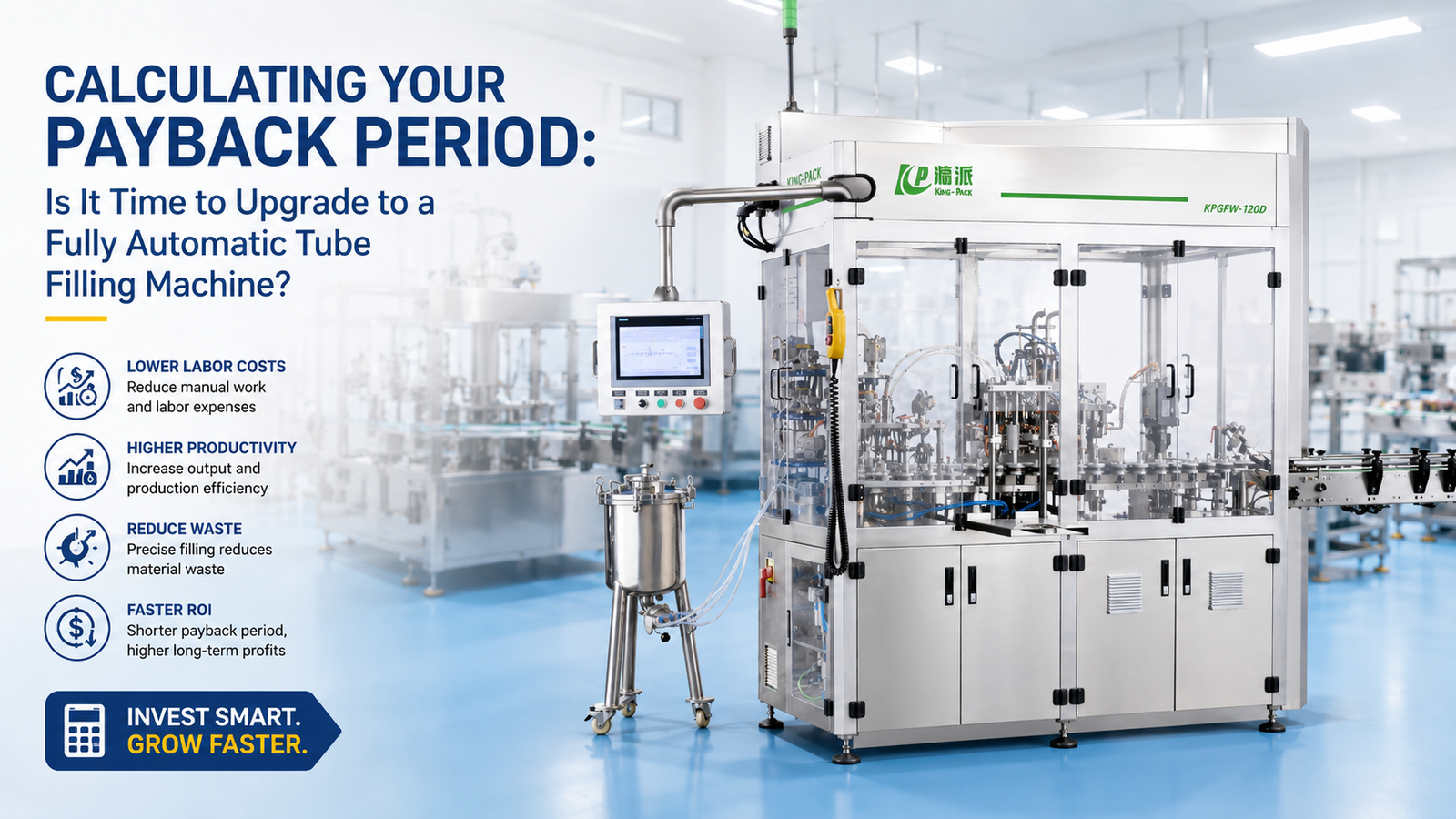
In pharmaceutical, cosmetic, food, and chemical manufacturing, upgrading from manual or semi-automatic production to a fully automatic tube filling machine is no longer only a technical decision. It is a financial decision that affects labor planning, filling accuracy, sealing quality, production costs, and long-term competitiveness. For manufacturers handling creams, gels, pastes, ointments, adhesives, or skincare packaging products, the tube filling and sealing process is often where profit is either protected or lost.
The key question is not simply, “Can we afford this machine?” A better question is, “How quickly will this tube filling machine pay for itself?” A fully automatic tube filling and sealing machine can reduce manual intervention, improve tube output, stabilize sealing quality, and support continuous production. When calculated correctly, the payback period helps procurement managers, technical directors, and supply chain decision-makers justify the investment with measurable financial logic.
A modern filling and sealing machine is designed to load tubes, orient the tube by eye mark, dose product accurately, close the tail, code the batch, trim the end, and discharge finished tubes with minimal human input. Compared with manual tube filling, this level of automation can transform a production line from a labor-dependent process into a controlled, scalable packaging system.
Why More Manufacturers Are Upgrading to a Fully Automatic Tube Filling and Sealing Machine
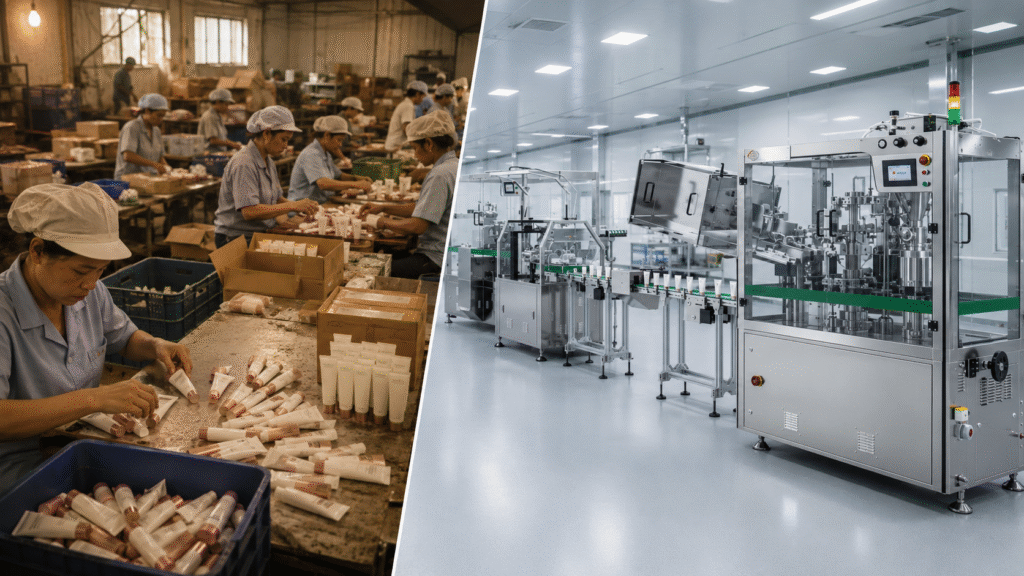
Manufacturers are moving toward automation because the market now demands speed, precision, and repeatability. Manual tube filling may work for early-stage production, but it becomes costly when orders increase. Workers become tired, output fluctuates between shifts, and sealing quality depends heavily on operator skill. A fully automatic tube filling and sealing machine reduces these variables through mechanical positioning, PLC control, servo filling, stable sealing stations, and sensor-based inspection.
Labor shortages and wage pressure also make automation more attractive. In many factories, labor costs can account for 30–40% of manufacturing costs in non-automated facilities. If one line requires several workers for tube loading, filling supervision, sealing inspection, carton handling, and rework, the cost per tube rises quickly. A fully automatic tube filling machine allows manufacturers to move workers from repetitive tasks to higher-value roles such as quality control, maintenance, scheduling, and process management.
The upgrade is also about production stability. A machine does not slow down late in a shift, does not apply inconsistent sealing pressure, and does not overfill because it is trying to “be safe.” With the correct filling machine configuration, output, filling volume, and sealing performance remain more predictable throughout the day.
What Is a Fully Automatic Tube Filling Machine?
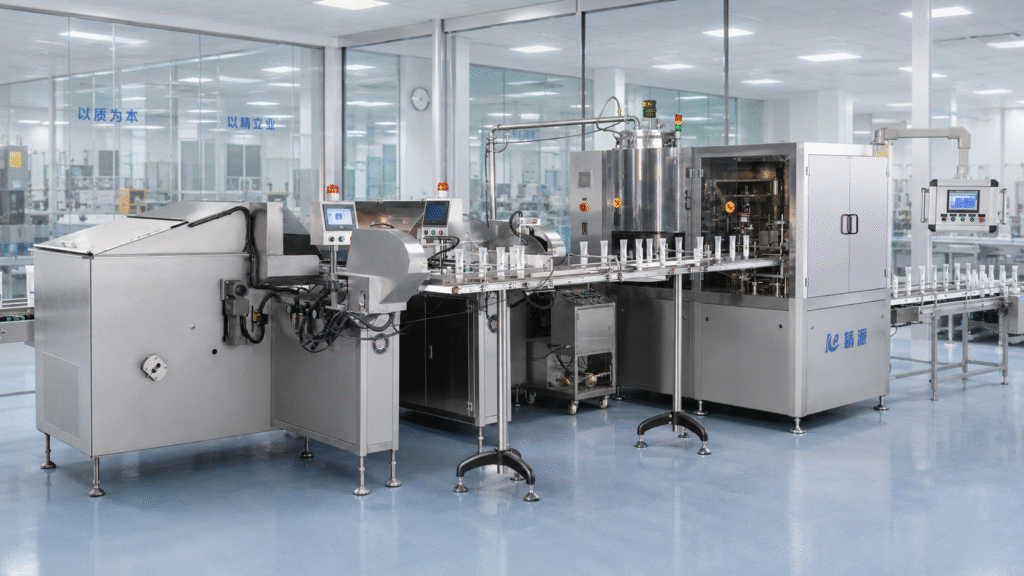
A fully automatic tube filling machine is an industrial machine used to complete tube loading, orientation, filling, sealing, coding, trimming, and discharge in one continuous cycle. It is suitable for plastic tube, laminate tube, aluminum tube, and other soft tubes used in cosmetics, pharmaceuticals, food pastes, daily chemicals, and specialty chemical products.
The core value of the machine comes from its ability to combine filling and sealing in a controlled sequence. Empty tubes enter through a hopper, cassette, or automatic tube feeding system. The machine positions each tube, detects the printed eye mark, fills the product into the tube, closes the tail with the correct sealing method, trims the tail if required, and sends finished tubes to downstream packaging.
Common technical modules include rotary indexing tables, servo-driven filling heads, anti-drip filling nozzles, hot-air sealing units, ultrasonic sealing systems, aluminum tube folding stations, coding devices, trimming units, “no tube, no fill” sensors, PLC control, and HMI touchscreens. For high-standard production, product contact parts should use SS316L stainless steel, while the machine frame can use SS304 stainless steel. Contact surfaces may be polished to Ra ≤ 0.4 μm to support easier cleaning and GMP-oriented hygiene.
How a Tube Filling and Sealing Machine Works
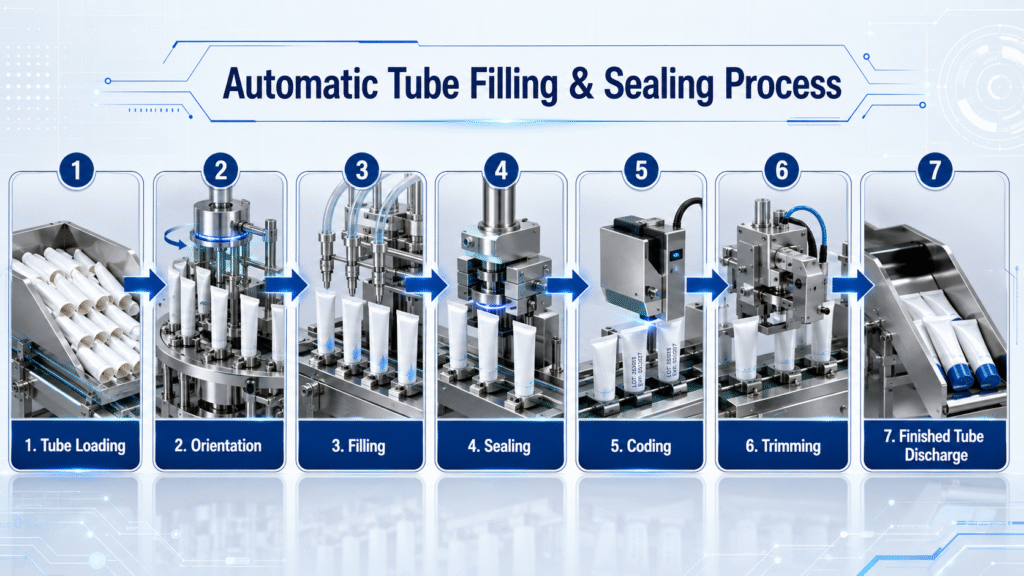
The working principle of a tube filling and sealing machine starts with automatic tube feeding. Empty tubes are separated one by one and inserted into holders on the rotary table or linear transport system. Sensors confirm tube presence before the filling station activates, preventing material waste and protecting the machine from accidental discharge.
The next step is orientation. Printed tubes usually have an eye mark, and the machine rotates each tube until the mark is detected. This ensures that the printed design, sealing line, batch code, and final appearance remain consistent. For skincare packaging and pharmaceutical products, correct orientation supports both brand presentation and compliance.
After orientation, the filling machine doses product into the tube. Servo-driven piston systems are widely used for creams, gels, ointments, and pastes because they offer strong control over filling volume. With proper setup and maintenance, filling accuracy can reach ±0.5% or better. This accuracy reduces overfill, lowers product giveaway, and improves batch consistency.
Finally, the sealing station closes the tube tail. For plastic tube and laminate tube formats, hot-air sealing or ultrasonic sealing is commonly used. An aluminum tube normally requires mechanical folding and crimping. After sealing, the machine may emboss or print batch information, trim the tail, and discharge finished tubes to a conveyor, cartoner, or other packaging machine.
Plastic Tube vs. Aluminum Tube Sealing Technology
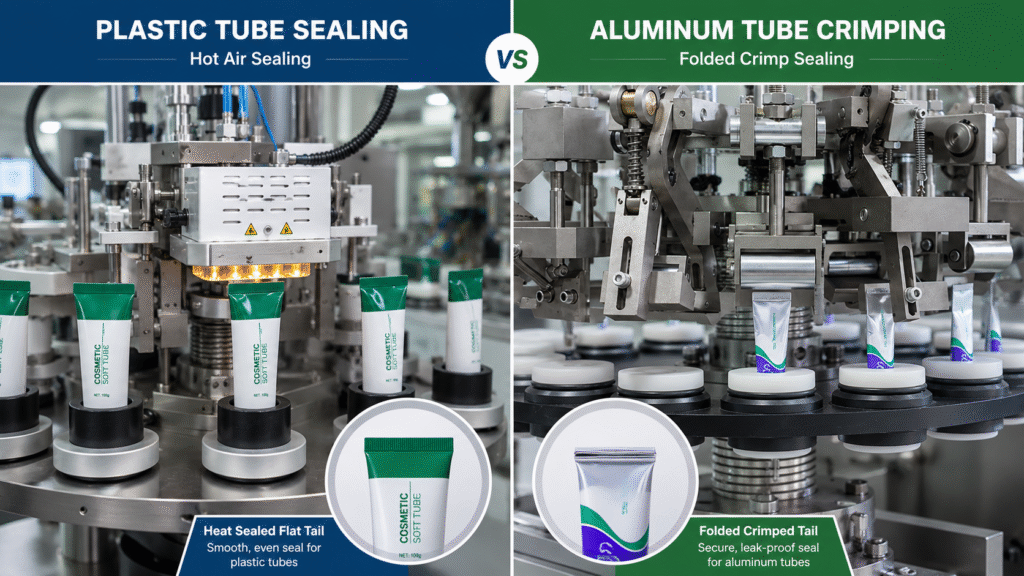
Tube material directly affects sealing machine configuration. A plastic tube is usually closed by controlled heat, ultrasonic energy, or high-frequency technology. Hot-air sealing is common in cosmetic and daily chemical applications because it creates a clean, strong, and attractive tail. Ultrasonic sealing is useful when a formula or tube structure requires a more localized sealing method with less heat exposure.
An aluminum tube cannot be heat-fused in the same way as plastic. Instead, the sealing machine folds, presses, and crimps the end of the aluminum tube to create a tight closure. Aluminum tube packaging is often used for ointments, adhesives, and formulas that need strong barrier protection. The machine must apply stable folding force and accurate mechanical alignment to avoid tail cracks, leakage, or poor appearance.
Choosing the correct tube filling and sealing machine depends on more than output speed. Buyers must consider tube material, tube diameter, filling volume, product viscosity, sealing method, coding requirement, and downstream packaging format. A machine designed only for plastic tube sealing may not be suitable for aluminum tube production without specific changeover parts or dedicated stations.
Manual vs. Semi-Automatic vs. Fully Automatic Tube Filling Machine
Manual tube filling systems rely heavily on the operator. The worker places each tube, activates the filling process, and often transfers the tube to a separate sealing station. Output is usually around 5–10 tubes per minute, and filling accuracy may vary with operator skill.
Semi-automatic systems improve the filling step but still require manual tube loading and handling. The machine may dose product automatically, but workers must place tubes into holders, move them through the sealing process, or collect finished tubes. Typical output may reach 20–30 tubes per minute.
A fully automatic tube filling machine completes the entire cycle without manual handling during production. Tubes are fed automatically, oriented by sensors, filled, sealed, trimmed, coded, and discharged. Depending on tube size, filling volume, viscosity, and sealing method, output can reach 60–120+ tubes per minute. For high-volume production, this difference can decide whether a factory can accept large orders or remain limited by labor capacity.
What Is Payback Period and Why Does It Matter?
The payback period is the time required to recover the total cost of an investment through savings and additional profit. For a fully automatic tube filling and sealing machine, payback usually comes from labor reduction, lower waste, better filling accuracy, fewer rejected tubes, higher output, and stronger production stability.
The basic formula is:
Payback Period = Total Investment Cost / Annual Financial Gain
Total investment cost includes the machine price, installation, shipping, duties, training, power or compressed-air preparation, and line integration. Annual financial gain includes labor savings, material savings, waste reduction, lower reject rates, reduced downtime, and additional profit from extra units produced.
Return on investment, or ROI, looks at the longer-term value after the payback period. A high-quality automatic tube filling machine may operate for 10–15 years with proper maintenance. If the payback period is 18 months, the remaining operating years can generate significant value beyond the initial recovery point.
Example ROI Calculation for a Fully Automatic Tube Filling and Sealing Machine
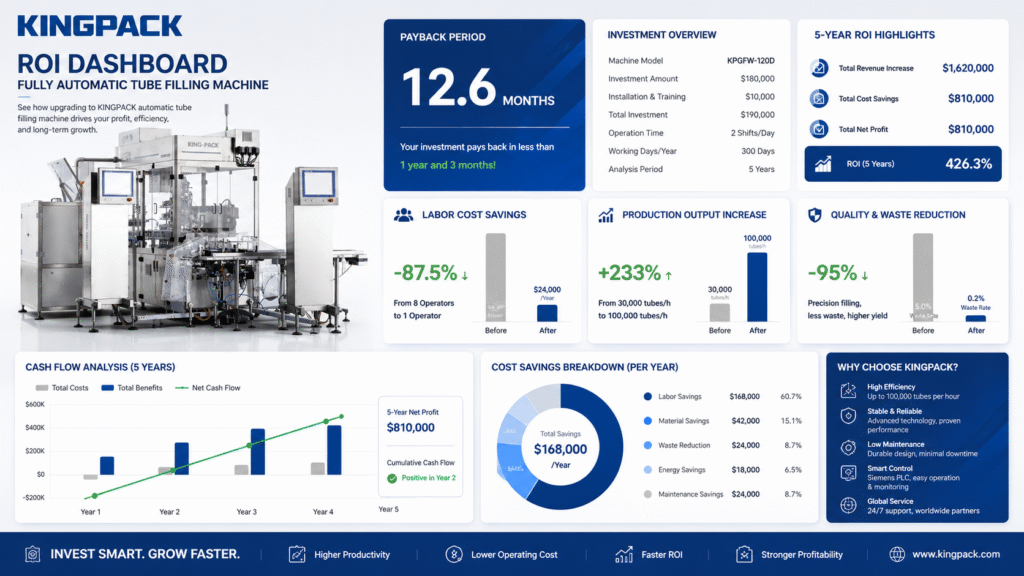
Consider a cosmetic manufacturer called “Bio-Glow” that currently uses semi-automatic tube filling equipment.
Current output: 15,000 tubes per month
New output after upgrade: 60,000 tubes per month
Investment in a fully automatic machine: $80,000
Labor savings: $4,000 per month by reducing two manual positions
Waste reduction: $500 per month
Additional profit from increased production capacity: $3,000 per month
Total monthly gain: $7,500
Payback period: $80,000 / $7,500 = 10.6 months
In this example, the filling and sealing machine pays for itself in less than one year. After that point, the machine continues to support higher output, lower labor dependency, more stable sealing quality, and better production planning. For factories that process high-value cosmetic cream, pharmaceutical ointment, or specialty chemical paste, the reduction in product giveaway alone can be a major financial benefit.
Comparison Table: Manual, Semi-Automatic, and Fully Automatic Tube Filling
| Feature | Manual Filling | Semi-Automatic Filling | Fully Automatic Tube Filling Machine |
|---|---|---|---|
| Output | 300–500 tubes/hour | 1,200–1,800 tubes/hour | 3,600–7,200+ tubes/hour |
| Labor Requirement | 2–3 people | 1–2 people | Supervisor-focused operation |
| Filling Accuracy | ±2–5% | ±1–2% | ±0.5% |
| Sealing Quality | Inconsistent | Moderate | Highly consistent |
| Waste Percentage | High, often >3% | Moderate, around 1–2% | Low, often <0.5% |
| Best Application | Startup or R&D | Small batch growth | High-volume production |
This comparison shows why the fully automatic tube filling machine has a stronger financial case when demand becomes stable. Manual production may look cheaper at the beginning, but labor, waste, reject rates, and missed orders can make it more expensive over time.
Signs It Is Time to Upgrade Your Tube Filling Machine
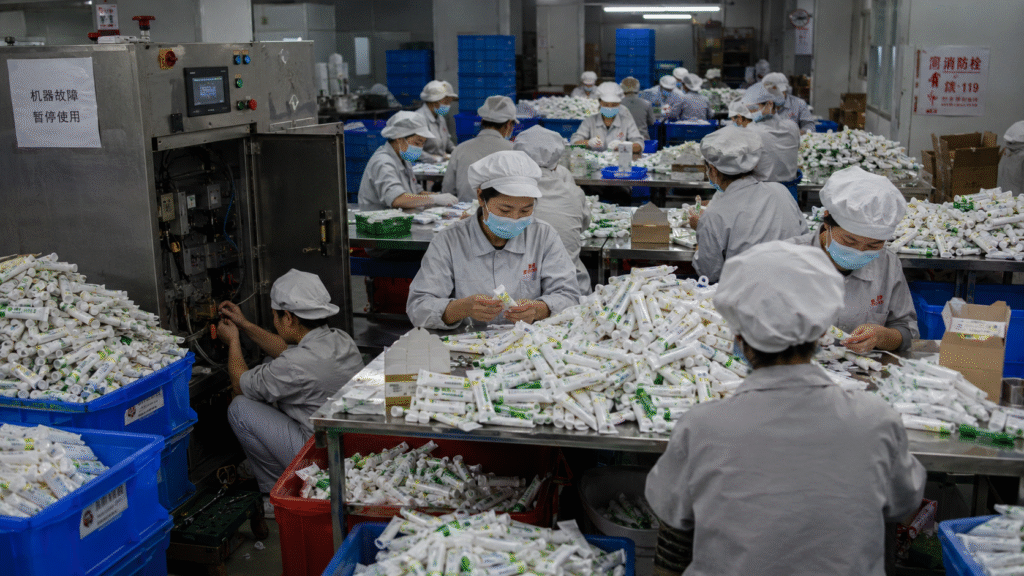
The first sign is rising order volume. If your production team works overtime but still cannot meet delivery schedules, your existing machine may be limiting revenue. When overtime, rework, and delayed shipments become normal, automation deserves serious consideration.
The second sign is inconsistent tube quality. If sealing defects, leakers, underfilled tubes, overfilled tubes, or crooked batch codes appear regularly, the process may depend too much on operator judgment. A controlled filling and sealing machine reduces this variability.
The third sign is increasing maintenance cost. If an old machine requires frequent repair or annual maintenance cost exceeds 15% of the machine value, replacement may be more economical than continued repair.
The fourth sign is difficulty scaling. Large distributors and private-label buyers often require reliable delivery schedules, consistent packaging appearance, and documented quality control. A fully automatic tube filling machine gives manufacturers the confidence to accept larger contracts.
Integration with Mixer, Capping Machine, and Packaging Line
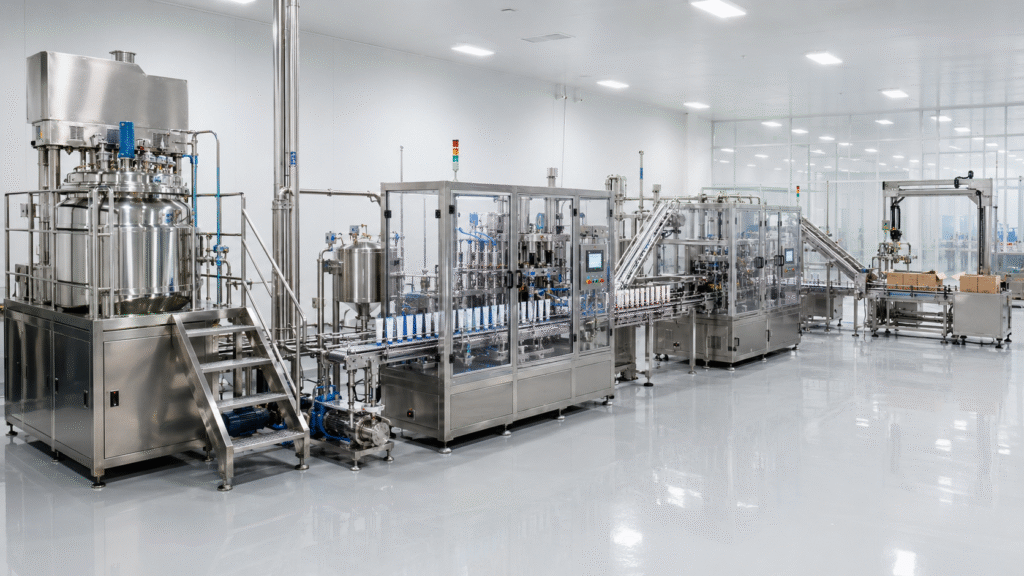
A fully automatic tube filling and sealing machine becomes more valuable when it connects with upstream and downstream equipment. Upstream, a mixer or emulsifier prepares creams, gels, ointments, and pastes before filling. The product transfer system between the mixer and filling machine must control viscosity, air bubbles, pressure, and cleanliness. If feeding is unstable, filling accuracy will suffer.
Downstream, the machine can connect with a conveyor, capping machine, labeling machine, cartoning machine, checkweigher, case packer, or palletizing system. Although tubes usually require tail sealing rather than bottle capping, a capping machine may still be part of a mixed packaging line where the same facility handles both bottles and tubes. A flexible system allows manufacturers to integrate different packaging formats under one production strategy.
Line integration also reduces labor. Instead of asking operators to move tubes from filling to packing, the system transfers products automatically. PLC communication helps synchronize speed between machines. If the cartoner slows down, the tube filling machine can adjust output to prevent jams. This coordination improves workflow and lowers production costs.
Maintenance and Reliability for Long-Term Payback
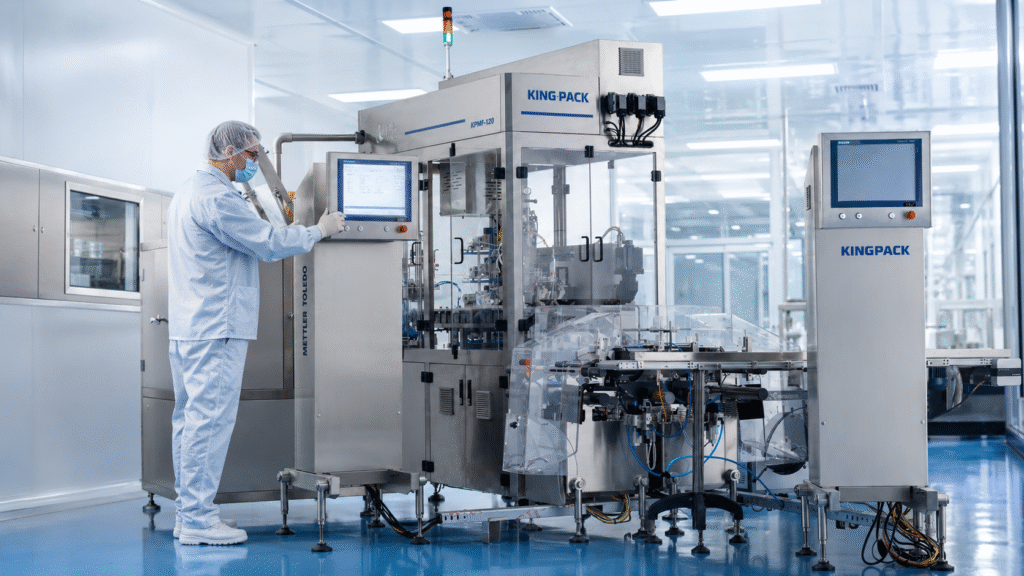
Payback depends on reliable daily operation. Preventive maintenance should include cleaning product contact parts, checking filling nozzles, inspecting sealing jaws or hot-air nozzles, verifying temperature control, checking sensors, lubricating moving parts, and replacing worn seals or gaskets.
Different products require different parameters. A high-viscosity paste may need slower filling speed and a larger nozzle, while a light gel may require anti-drip control. A plastic tube may require a specific hot-air temperature, while an aluminum tube needs stable folding pressure. Operators should record parameters for each tube and product combination to shorten changeover time and protect sealing quality.
Modern PLC and HMI systems make maintenance easier by showing alarms, production data, parameter recipes, and fault records. With proper training, most operators can learn basic operation within 2–3 days. For multi-size production, rapid changeover design can help switch between tube formats in under 20 minutes, reducing downtime and improving ROI.
How to Choose the Right Fully Automatic Tube Filling Machine
Buyers should not select a machine only by price. The correct choice depends on expected capacity, tube size range, product viscosity, sealing technology, hygiene requirements, factory layout, and future expansion.
For pharmaceutical-grade production, the machine should support GMP-oriented design, clean product paths, SS316L contact parts, smooth surfaces, and clear documentation. For daily chemical-grade production, the priority may be speed, tube compatibility, changeover efficiency, and cost control. For skincare packaging, both appearance and filling accuracy matter because the tube is part of the brand experience.
Capacity should also be selected with future growth in mind. A machine that only meets today’s demand may become a bottleneck within one or two years. At the same time, oversizing the machine can increase CAPEX unnecessarily. The best solution balances current demand, forecast growth, labor savings, and payback period.
Why Choose King-Pack’s Automatic Tube Filling Machines?
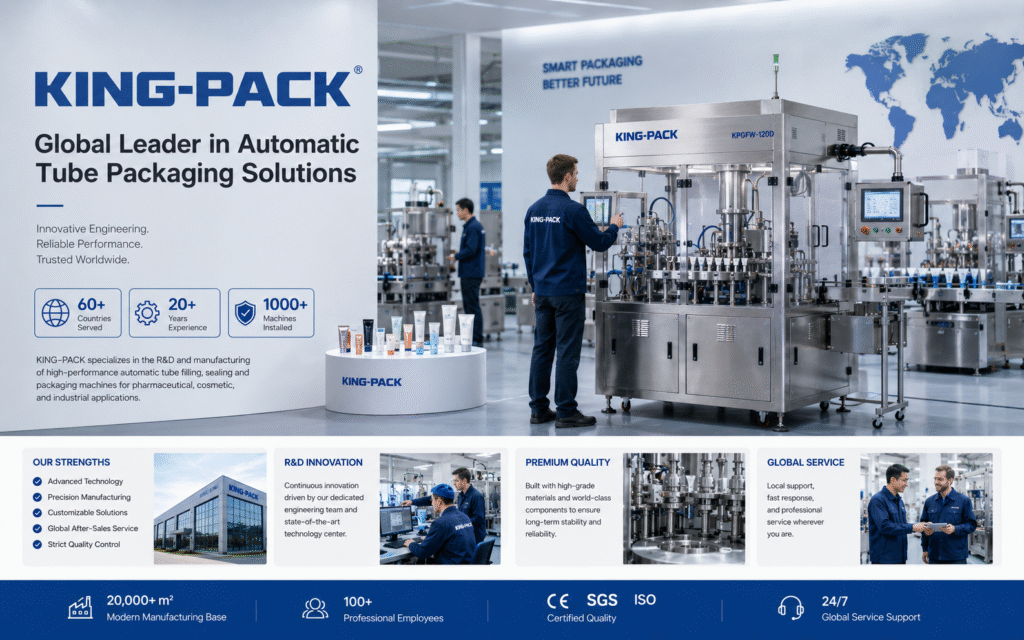
King-Pack provides automatic tube filling machine solutions for manufacturers that need stable filling, professional sealing, and practical payback. Established in 2009, King-Pack has 17 years of experience in high-end packaging machinery, serving pharmaceutical, cosmetic, food, chemical, and daily chemical manufacturers with customized equipment and complete line integration.
King-Pack machines can be configured with SS316L product contact parts, SS304 frames, servo-driven filling systems, hot-air sealing, ultrasonic sealing, aluminum tube folding, “no tube, no fill” protection, PLC/HMI control, multilingual interfaces, and fast changeover design. For factories upgrading from manual or semi-automatic production, King-Pack engineers evaluate product characteristics, tube material, capacity targets, hygiene needs, and available floor space before recommending a machine.
The value is not only the machine itself. King-Pack supports engineering customization, installation guidance, operator training, spare parts, and global service support. For buyers focused on long-term production stability, this project-based approach helps shorten payback and reduce technical risk.
FAQs About Fully Automatic Tube Filling Machines
Q: Can one machine handle both plastic and aluminum tubes?
A: Yes, but it depends on configuration. Plastic tube sealing usually uses hot-air or ultrasonic sealing, while aluminum tube sealing requires folding and crimping. Some projects need changeover tools or dedicated stations.
Q: How much floor space is required?
A: A standard rotary fully automatic tube filling machine may require approximately 1.5 m × 1.5 m, but the full footprint depends on tube feeding, conveyors, downstream packaging, and access space.
Q: How fast can a fully automatic machine run?
A: Depending on tube diameter, filling volume, viscosity, and sealing method, fully automatic systems can reach 60–120+ tubes per minute.
Q: How long does staff training take?
A: With modern HMI controls, many operators can learn basic operation within 2–3 days, although maintenance and advanced troubleshooting require deeper training.
Q: What is the typical payback period?
A: Many projects recover investment within 12–24 months, but the exact period depends on labor cost, output increase, waste reduction, reject rate, and machine utilization.
Request a Quote for a Fully Automatic Tube Filling Machine
A fully automatic tube filling machine is not just a piece of equipment. It is a financial tool for reducing labor dependency, improving filling accuracy, stabilizing sealing quality, expanding tube output, and lowering long-term production costs. When the payback period is calculated correctly, automation becomes a measurable investment rather than a risky expense.
If your factory is ready to move from manual or semi-automatic tube filling to a more scalable system, King-Pack can help you evaluate the right filling and sealing machine for your product, tube material, capacity, and packaging line.
Visit kpfillingmachine.com to request a customized quote and calculate the payback period for your next tube filling machine project.
Plan Your Automatic Tube Filling Investment
Compare KING PACK’s automatic tube filling and sealing machines and complete filling lines, then request a project assessment based on output, labor and packaging format.