
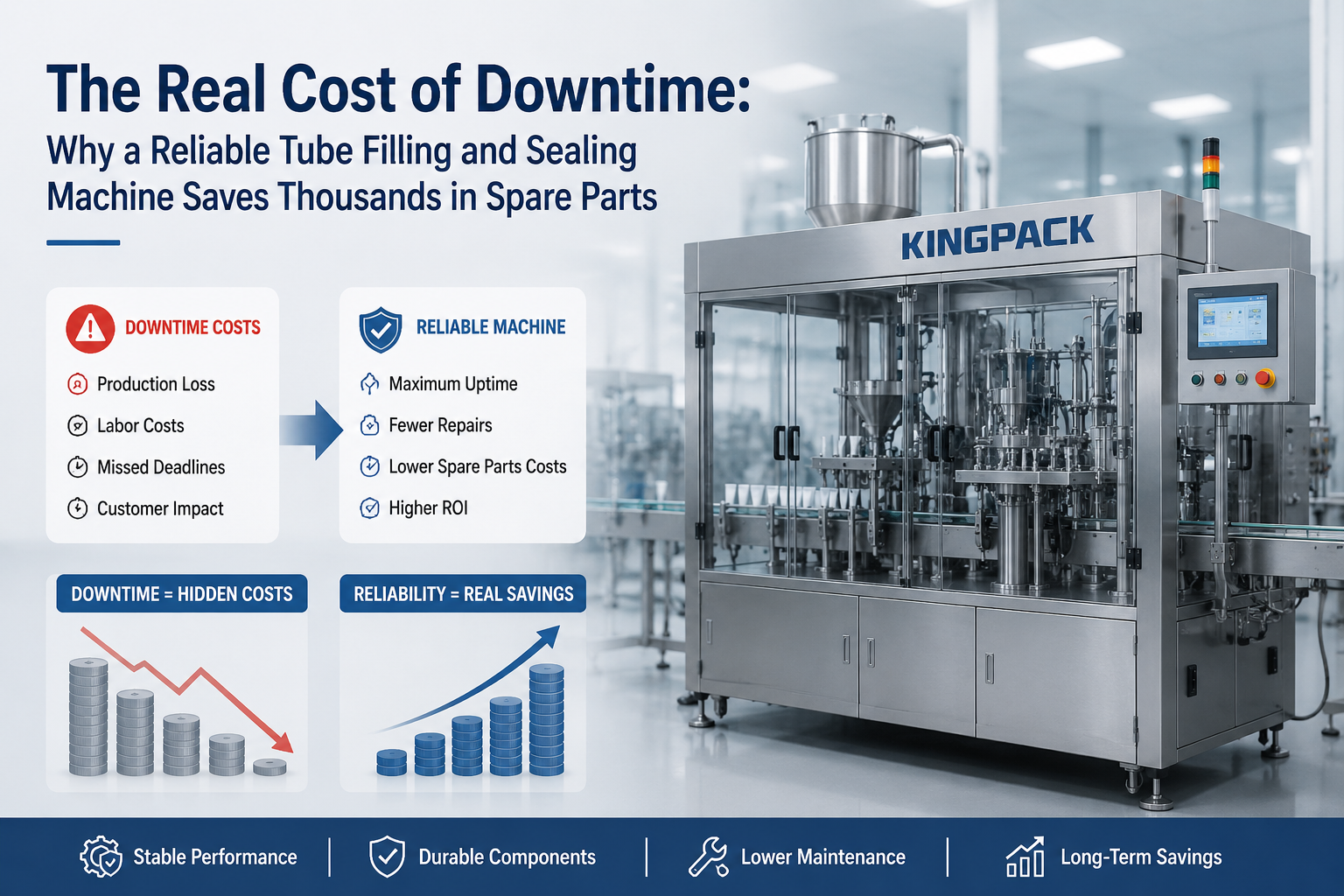
In pharmaceutical, cosmetic, food, and chemical manufacturing, downtime can affect more than the stopped machine. A tube filling line may leave upstream product waiting, operators idle, and downstream equipment underused. The actual impact depends on line design, batch value, staffing, and recovery procedures.
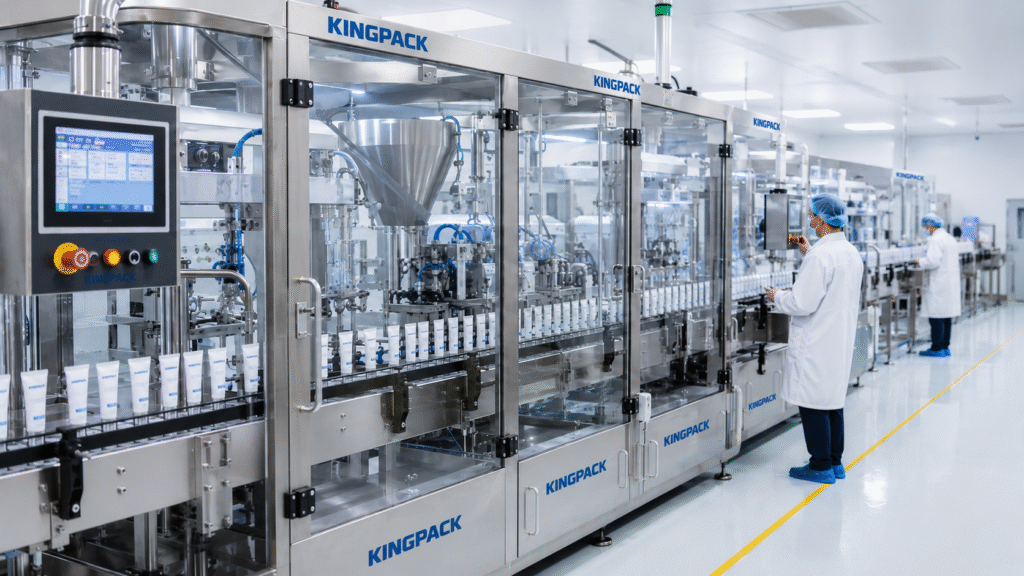
For creams, gels, ointments, adhesives, skincare products, and chemical pastes, filling and sealing reliability should be assessed against the formulation, tube material, target speed, cleaning method, and maintenance plan. A low purchase price does not by itself predict total cost of ownership.
A well-configured tube filling and sealing machine may reduce unplanned stops and help stabilize filling and sealing, but the result depends on the selected components, operating conditions, preventive maintenance, and validation data.
Why Downtime Is More Expensive Than Most Manufacturers Realize
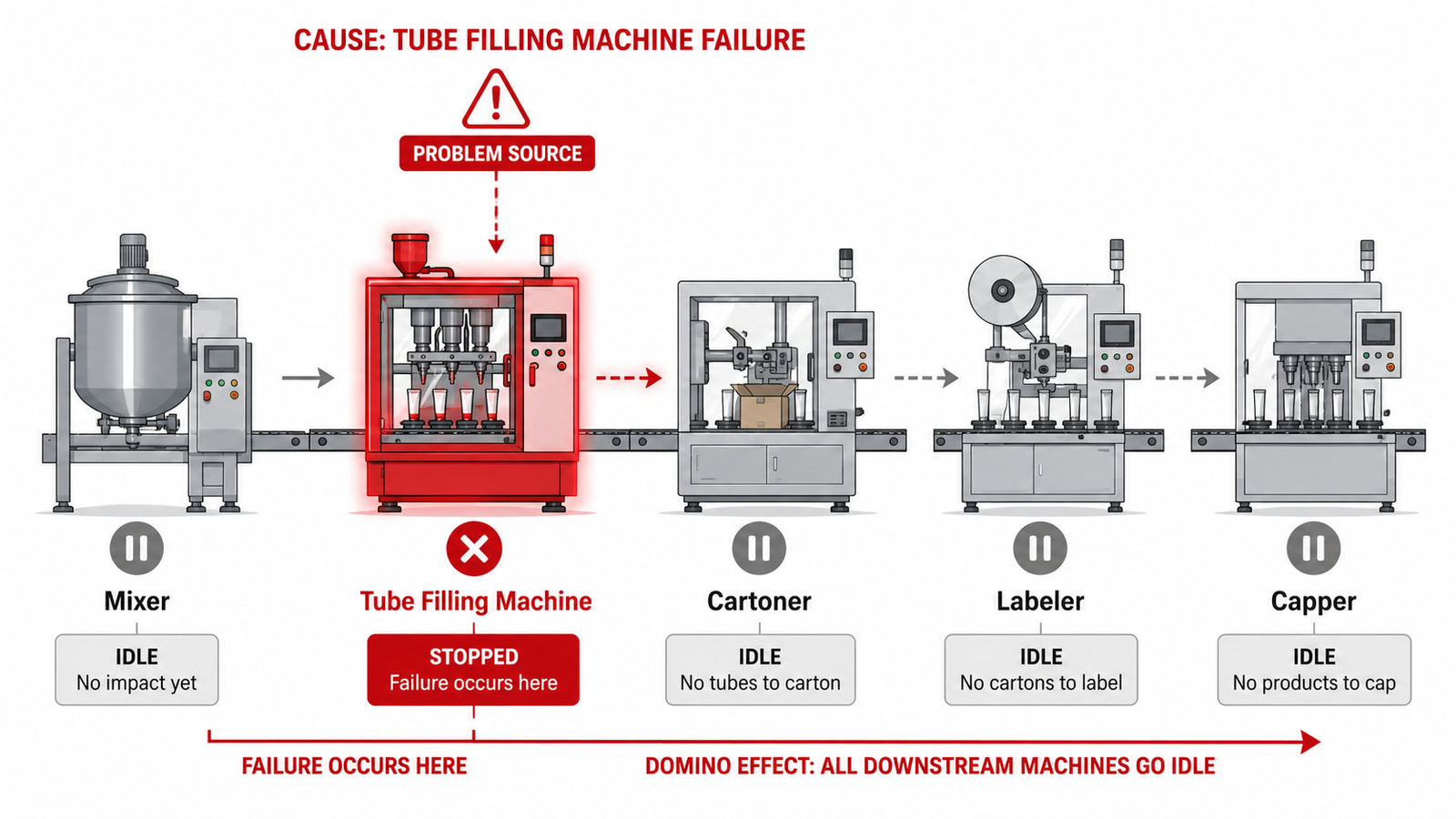
Many managers estimate downtime by calculating how many tubes were not produced during the stop. That number matters, but it only shows the visible part of the loss. In a real production environment, a stopped tube filling machine creates upstream and downstream costs that are harder to see.
Upstream, the mixer or emulsifier may continue consuming energy to maintain temperature, viscosity, agitation, or vacuum conditions. If the product is a high-value cosmetic cream or pharmaceutical ointment, long waiting time may affect texture, air content, or batch quality. Downstream, packaging equipment such as a cartoner, case packer, labeler, or capping machine may also sit idle while labor, depreciation, and overhead continue.
There is also a restart cost. Every stop-and-start cycle adds mechanical stress to the machine. Heating systems must recover sealing temperature, filling nozzles may require cleaning, and tubes already inside the rotary table may need inspection or rejection. A reliable filling and sealing machine reduces these interruptions by maintaining stable operation and preventing small faults from becoming full line stoppages.
Understanding the Real Cost of Tube Filling Machine Downtime
Downtime cost can include lost production, labor, maintenance support, emergency freight, product handling, and schedule disruption. Quantify each component using the site’s own operating data rather than applying a generic savings assumption.
Missed delivery schedules are another serious risk. Many pharmaceutical, cosmetic, and daily chemical manufacturers operate under strict delivery windows. If tube filling and sealing stops for several hours, a planned shipment may be delayed. For contract manufacturers and private-label suppliers, this can lead to penalties, lost orders, or damage to long-term customer trust.
Spare-parts risk depends on component quality, duty cycle, service support, and availability. Standardized documentation and a planned critical-spares list can reduce procurement uncertainty, but the required list should be built for the selected machine.
Common Causes of Downtime in a Tube Filling Machine
The first cause is wear from low-quality components. The drive system, indexing table, bearings, cams, filling piston, tube holders, and sealing tools must work together with precise timing. If one component wears, the tube may become misaligned. Misalignment affects filling position, sealing pressure, coding location, and discharge reliability.
Worn pistons, valves, drives, or sensors can affect fill volume. The acceptable range should be defined by the product specification and confirmed with calibrated in-process checks.
Sealing performance depends on tube material, sealing method, temperature, pressure, alignment, cooling, and tooling condition. Confirm leak and seal-strength criteria through product-specific testing.
How a Tube Filling and Sealing Machine Works
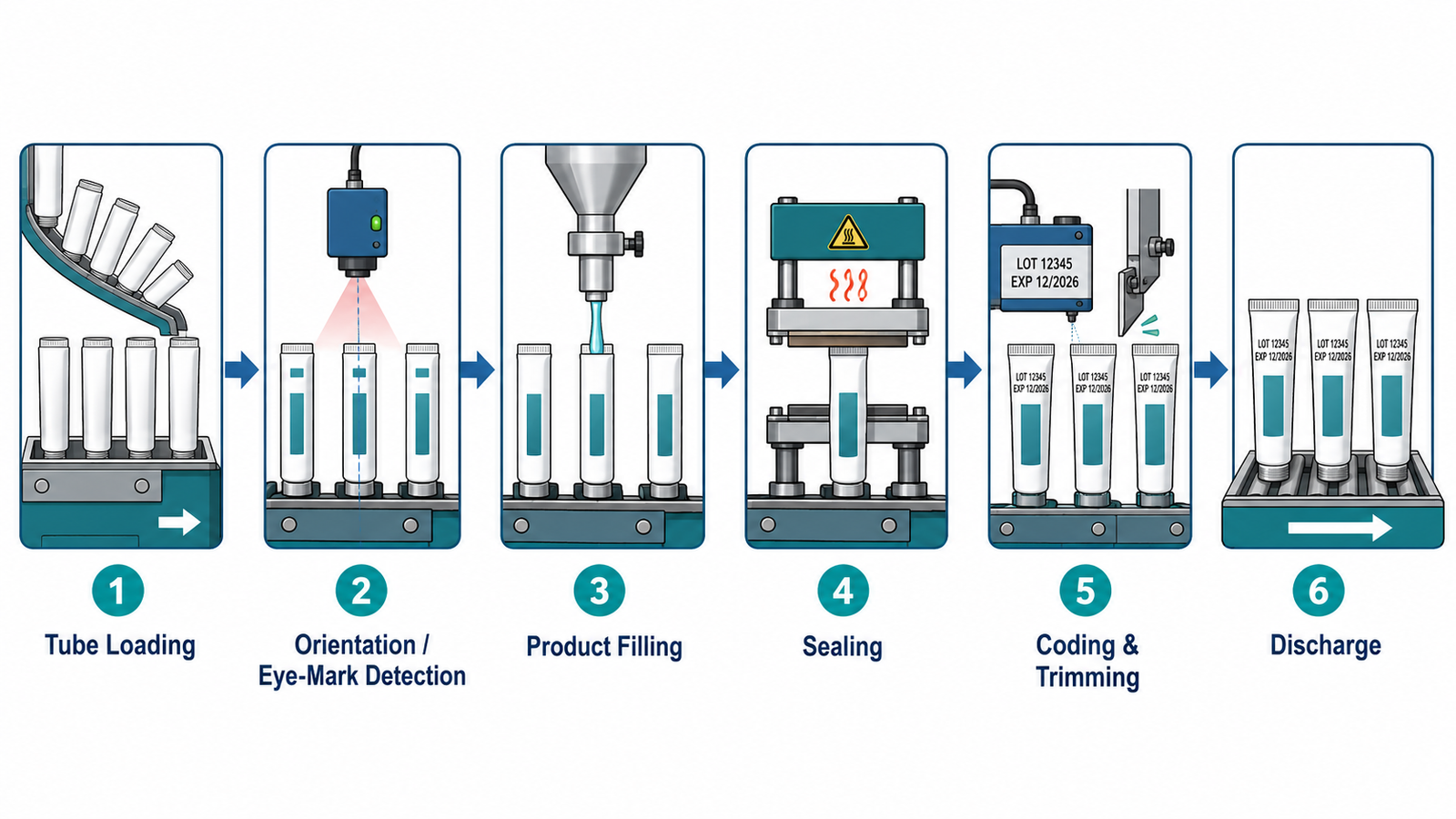
A “no tube, no fill” function may reduce product waste where included and correctly configured. Confirm the sensor logic and interlocks on the selected machine.
The next step is orientation. Printed tubes are rotated until the eye mark is detected. Correct orientation ensures that the brand design, batch code, sealing line, and final display position are consistent. This step is especially important for skincare packaging, where visual appearance affects shelf value and brand trust.
Servo pistons, rotary valves, anti-drip nozzles, or flow-meter systems may be used depending on viscosity, fill volume, and machine design. Any accuracy figure should be confirmed with representative product and containers at the target speed.
The sealing station then closes the tube tail. For plastic tube and laminate tube production, hot-air or ultrasonic sealing is commonly used. For aluminum tube production, the machine folds and crimps the tail mechanically. After sealing, the machine can print or emboss batch data, trim the tail, and discharge finished tubes to the next packaging process.
Plastic Tube vs. Aluminum Tube Sealing: Why Material Matters
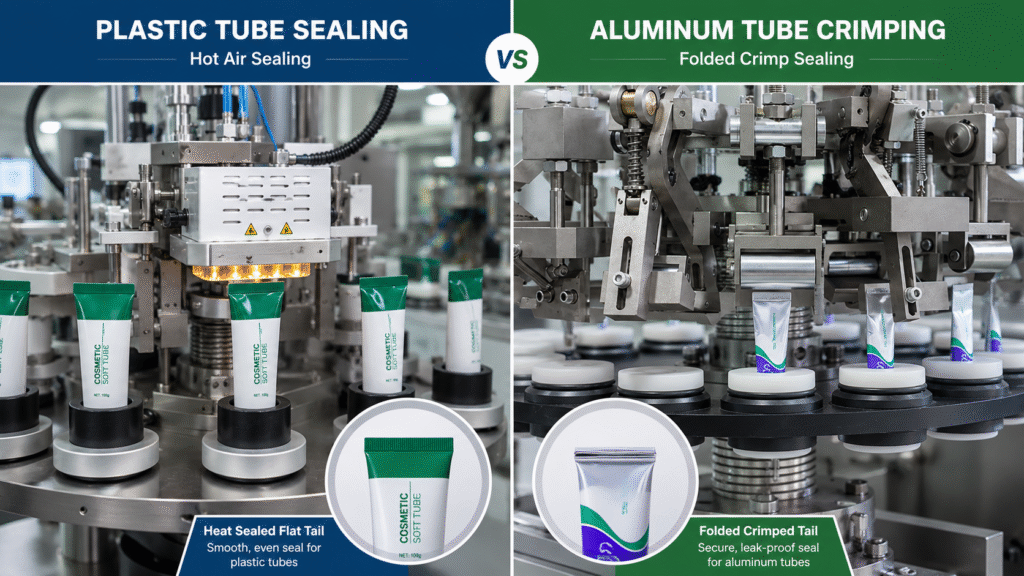
A plastic tube is normally sealed by controlled heat or ultrasonic energy. Hot-air sealing melts the inner layer of the tube tail and presses it together to form a strong closure. The sealing machine must control air temperature, flow, pressure, cooling time, and jaw alignment. If temperature is too high, the tail may burn or deform. If temperature is too low, the tube may leak.
An aluminum tube does not seal by melting. It requires folding, pressing, and crimping. The machine must apply stable mechanical force while maintaining accurate tube alignment. Poor alignment can create tail cracks, uneven folds, or weak closure. Aluminum tube packaging is often selected for pharmaceutical ointments, adhesives, and formulas requiring stronger barrier protection.
Machine selection should consider tube material, diameter, wall thickness, fill volume, viscosity, sealing method, coding, cleaning, and validation requirements. One configuration may not be suitable for every format.
Standard Tube Filling Machine vs. Reliable King-Pack Tube Filling Machine
| Feature | Standard / Budget Tube Filling Machine | Reliable King-Pack Solution | Impact on ROI |
|---|---|---|---|
| Main Material | Standard SS304 structure | AISI 316L contact parts with SS304 frame | Improved corrosion resistance and service life may result from the selected material and surface finish, but compatibility should be confirmed for the product and cleaning chemistry. |
| Filling Accuracy | ±1.5% to ±2.0% | To be validated with representative product and container | Less product giveaway and waste |
| Component Quality | Generic parts | Siemens, Festo, SMC or equivalent premium components | Support and failure risk depend on component selection, documentation, service coverage, and spare-parts availability. |
| Sealing Technology | Basic heating elements | Advanced hot-air or ultrasonic sealing | More stable sealing quality |
| Maintenance Cycle | Every 500–800 hours | Maintenance interval to be defined from duty cycle and supplier guidance | Reduced unplanned downtime |
| Changeover Time | 2–4 hours with tools | Changeover time to be measured for the selected format and procedure | Higher daily production throughput |
Purchase price is only one part of total cost of ownership. Compare maintenance, spare parts, energy, product loss, labor, validation, and service support for the actual configuration.
How Spare Parts Costs Grow Over Time
Spare parts cost is not only the price of each component. It includes procurement time, inventory space, supplier communication, emergency freight, and the production loss that happens while waiting for parts. If a heating element fails during peak season, the cost of express delivery may be small compared with the loss of finished tubes.
Plants using unstable equipment often overstock spare parts because they cannot predict the next failure. This creates inventory carrying cost and ties up working capital. Worse, if the supplier changes parts frequently or uses non-standard components, the purchasing team may struggle to source replacements quickly.
A reliable tube filling and sealing machine reduces this burden by using proven components, clear documentation, accessible machine design, and predictable maintenance intervals. When spare parts replacement becomes planned instead of urgent, the factory can reduce both cost and stress.
Maintenance Design That Reduces Downtime
Good maintenance starts with access. Operators and technicians should be able to reach filling nozzles, sealing tools, tube holders, sensors, and product contact parts without unnecessary disassembly. Tool-less changeover also helps reduce planned downtime when switching tube sizes or product batches.
Surface finish and roughness should be specified and confirmed for the wetted parts, cleaning method, and applicable GMP requirements; a generic Ra value should not be assumed.
PLC/HMI diagnostics and predictive-maintenance options vary by configuration. Confirm the alarm, event-log, sensor, and service features included in the selected line.
Integration with Mixer, Capping Machine, and Packaging Equipment
A tube filling machine rarely works alone in a modern factory. Upstream, the mixer or emulsifier prepares creams, gels, ointments, and pastes. If product transfer from the mixer is unstable, filling accuracy can suffer. Proper pump selection, hopper design, and pipeline layout help maintain flow consistency and reduce air bubbles.
Downstream, the filling and sealing machine may connect with a conveyor, checkweigher, cartoner, labeling machine, case packer, or capping machine. A capping machine may be used in the same flexible system when the facility handles both bottles and tubes. This matters for manufacturers that operate mixed packaging lines for skincare packaging, pharmaceutical liquids, or daily chemical products.
Integration can reduce manual transfers, but the actual benefit depends on communication interfaces, line balancing, guards, interlocks, and downstream equipment.
Capacity Selection: Choosing the Right Tube Filling Machine
A small factory or R&D lab may only need a semi-automatic tube filling machine for pilot runs. This type of machine supports basic filling and sealing but still depends on operators for tube loading, inspection, and collection.
A growing manufacturer may need an automatic filling and sealing machine that handles multiple tube sizes, stores recipes, and reduces manual intervention. This level is suitable for medium-volume production where consistency and labor savings are becoming more important.
Capacity should be selected using tube diameter, fill volume, viscosity, sealing method, shift schedule, target OEE, and future demand. Avoid choosing solely on nominal speed.
Why a Reliable Tube Filling and Sealing Machine Is a Smart Long-Term Investment
A reliable machine may improve total cost of ownership, but the effect must be demonstrated with maintenance records, reject data, downtime history, and service terms.
A simple payback example is only illustrative. Use the customer’s quotation, downtime baseline, spare-parts cost, reject rate, and production value before making an investment decision.
Reliability also protects operators. A stable machine with proper guarding, safety interlocks, and clear HMI controls reduces unsafe manual intervention. When the line runs smoothly, operators can focus on monitoring, quality checks, and preventive maintenance instead of emergency troubleshooting.
Why Choose King-Pack’s Tube Filling Solutions?
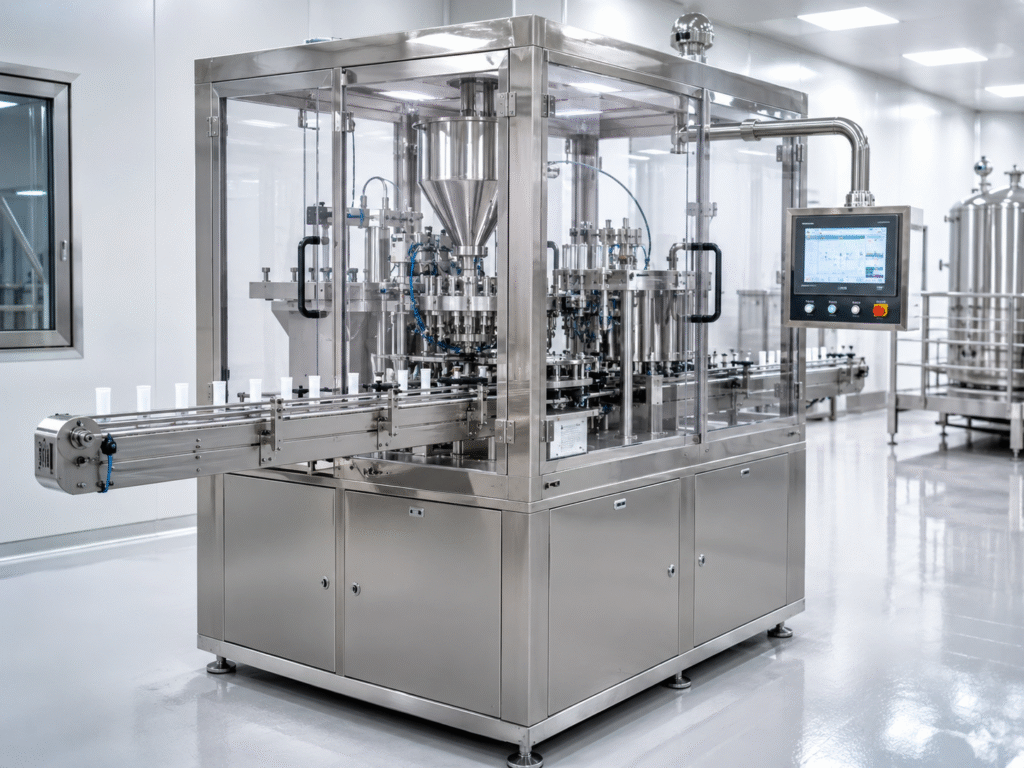
King-Pack designs tube filling and sealing solutions for pharmaceutical, cosmetic, food, chemical, and daily-chemical applications. Final performance depends on the agreed machine configuration and validation scope.
Available features such as 316L product-contact parts, servo dosing, hot-air or ultrasonic sealing, aluminum-tube folding, interlocks, PLC/HMI, pneumatics, predictive-maintenance options, and tool-less change parts should be confirmed in the quotation and technical specification.
The engineering focus is not only on selling a machine. King-Pack evaluates tube material, product viscosity, target capacity, cleaning requirements, factory layout, spare parts strategy, and future expansion before recommending a solution. This project-based approach helps manufacturers reduce downtime, control production costs, and build a flexible system that can grow with demand.
FAQs About Tube Filling Machine Downtime and Spare Parts Costs
Higher speed can increase friction, heat, and mechanical load. The effect depends on the machine design, lubrication, duty cycle, and maintenance plan.
OEM or approved equivalent parts may reduce compatibility risk, but the correct choice depends on the supplier specification, dimensions, materials, and service policy.
Q: Can a reliable tube filling machine improve sustainability?
A: Yes. Better filling accuracy reduces overfill, stable sealing reduces rejected tubes, and fewer breakdowns reduce wasted product and packaging materials.
Maintenance intervals depend on product, speed, cleaning, environment, and duty cycle. Use the supplier’s maintenance schedule and site data rather than assuming a fixed number of operating hours.
One machine may handle plastic and aluminum tubes when configured with the appropriate filling, sealing, and change parts. Confirm the exact format range and validation requirements.
Conclusion: Stop Paying for Downtime
The cheapest tube filling machine is often the most expensive machine to own. Downtime creates lost production, emergency labor, wasted product, higher spare parts inventory, delayed shipments, and customer dissatisfaction. A reliable tube filling and sealing machine helps prevent these losses by delivering stable filling, consistent sealing, easier maintenance, and predictable operation.
For manufacturers that want to reduce production costs, protect tube quality, and improve long-term packaging performance, investing in reliability is not optional. It is the foundation of profitable production.
Visit kpfillingmachine.com to request a quote for a King-Pack reliable tube filling machine and discuss a solution built for your product, tube material, capacity, and packaging line.
Reduce Tube Filling Line Downtime
Review KING PACK’s tube filling and sealing machines, planned after-sales support, and broader machine services to protect output and simplify maintenance planning.