
An automatic honey sachet packing machine can help food and beverage manufacturers portion and seal thick liquids such as honey, jams, sauces and fruit purees. King Pack can configure forming, filling, sealing and cutting around the customer’s product, film, sachet size and output target. This guide explains the VFFS workflow and the checks needed to select a suitable liquid sachet solution; exact performance must be confirmed with product trials and the approved specification.
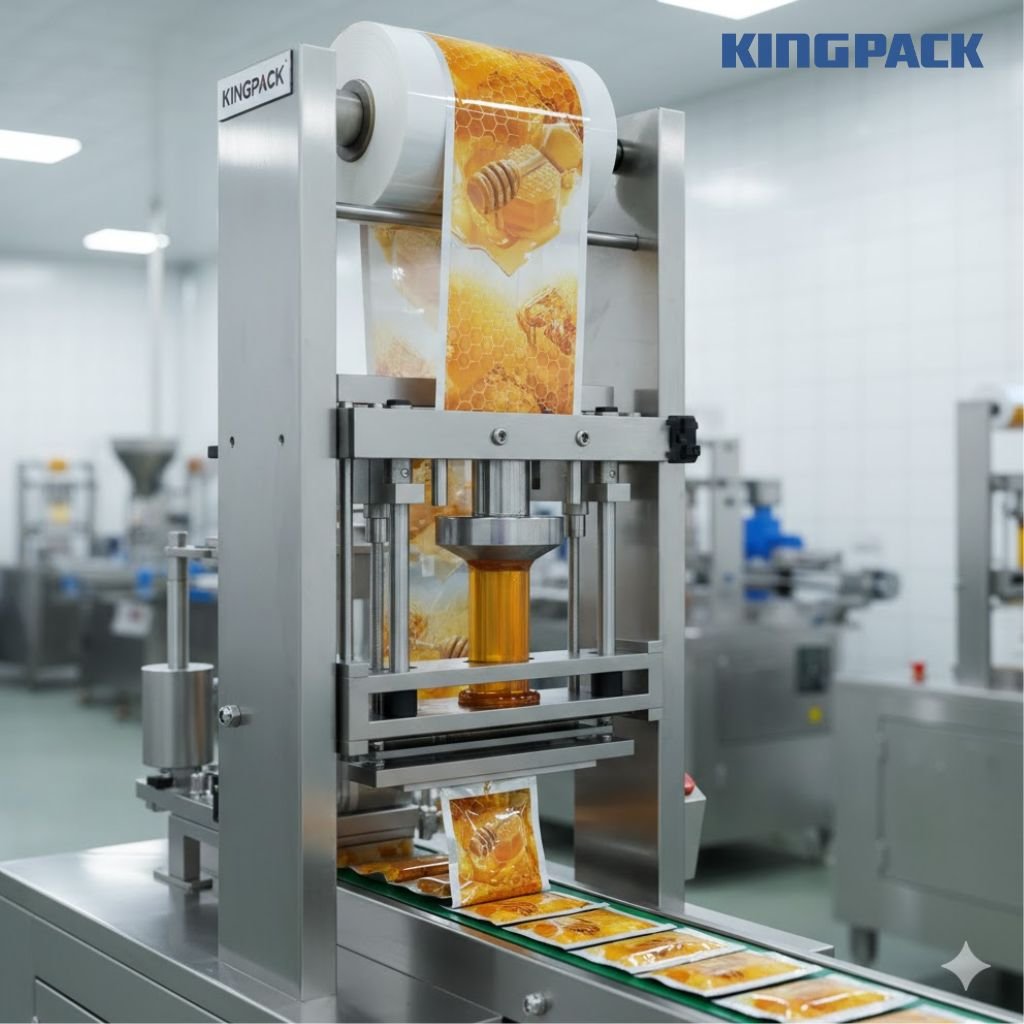
Overview of Automatic Honey Sachet Packing Machines
What is a VFFS Sachet Packing Machine for Honey and Viscous Liquids?
A VFFS sachet machine forms a bag from roll-fed film, fills it and seals it in sequence. For honey and other viscous liquids, the metering method, valve and nozzle are selected from product viscosity, temperature, particulates and target dose. A piston or other suitable dosing system may be used when confirmed by trials. The platform can be configured for compatible products such as sauces or purees, but each recipe and cleaning method must be assessed separately.
Why Automated Sachet Packaging is Essential for Food and Beverage Producers
Automation can improve repeatability and reduce manual handling, but it is not universally essential. Benefits depend on product, volume, staffing, hygiene controls and the required quality system. A PLC-controlled line may reduce repetitive intervention and help manage settings, while labor, yield and profitability should be measured against the customer’s baseline.
Typical Industries & Applications
| Industry / Segment | Typical Products Packaged in Sachets |
| Food processing | Honey, jam, sauces, fruit purees, dessert toppings |
| Bakeries | Single‑serve honey sachets, portion‑packed jams and spreads, and small condiment sachets for bakery use |
| Condiment & flavor manufacturers | Ketchup, mayonnaise, mustard, dressings, flavored butters, and seasoning sauces |
| Non‑food | Shampoos, hair oils, creams, lotions, lubricants, household and personal care liquids |
Machine Capabilities & Technical Specifications
The technical parameters of a sachet machine should be matched to the customer’s product, portion size, film, target output and available utilities. The ranges below are illustrative configuration examples, not universal specifications for every King Pack model.
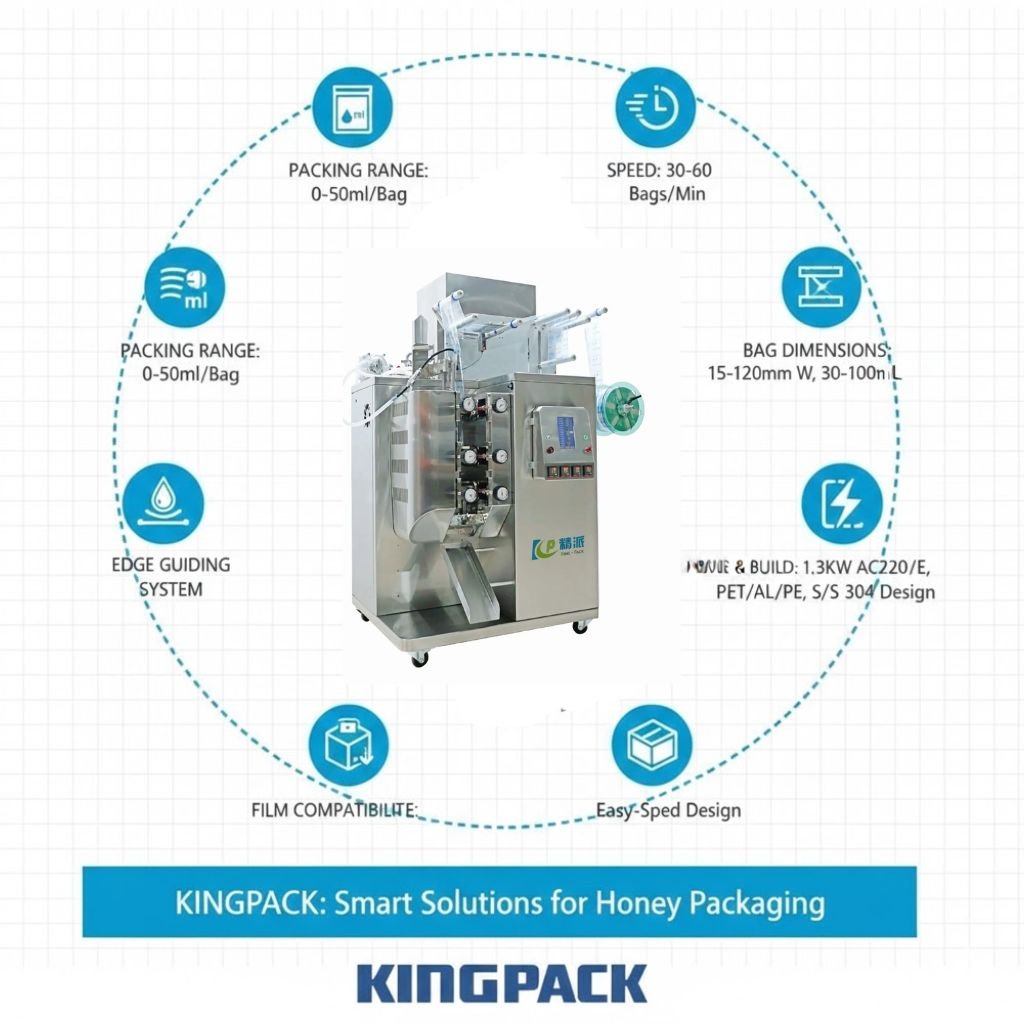
Packing Range, Speed, and Bag Dimensions
A configured machine may cover a specified fill range and bag-size range, with actual speed determined by film, bag dimensions, viscosity, temperature, dosing method and lane count. Confirm the usable range and acceptance criteria from the selected model and representative product.
Power & Build
Power, footprint and stainless-steel grade depend on the selected configuration and site requirements. Confirm the electrical supply, utility load, access, drainage and contact-material requirements before ordering; do not assume the illustrative values apply to every machine.
Film Compatibility
Film compatibility depends on film structure, sealant layer, thickness, print registration and the required barrier. Candidate films such as PET/PE or PET/AL/PE should be tested for seal integrity, machinability and product compatibility before production.
Core Functions & Workflow
The workflow normally starts with roll-fed film and ends with sealed sachets. Film handling, forming, dosing, sealing, coding, cutting and discharge are synchronized by the control system according to the selected configuration and acceptance criteria.
Film Feeding & Bag Forming
- Roll Stock Unwinding: The process starts with a roll of packaging film, unwound and pulled via servo-driven belts.
- Tube Forming: Film passes around a forming collar and tube, where back (vertical) sealing bonds the film edge.
- Custom Sachet Sizes and Shapes: Machines can be configured for flat, stick, round-corner, or even shaped sachets to enhance visual appeal and utility.
Precise Filling & Metering
- Piston Pump Filler: Specialized piston or peristaltic pumps dose viscous honeys with high accuracy, preventing blockage and ensuring clean fill, even with sticky products.
- Photoelectric Tracking: Sensors read eye-marks or registration marks on the film, aligning every cut and fill cycle for minimal waste and high accuracy.
Sealing, Cutting, Date Printing & Discharge
- Digital Temperature Control: Both horizontal and vertical thermal sealing jaws are digitally regulated for robust, leak-proof seals, crucial for sticky liquids.
- Date Coding: An integrated printer can stamp batch numbers and expiry dates directly on each sachet.
- Cutting: Sachets are cut with sharp blades or rotary knives, resulting in uniform bags.
- Discharge: Finished sachets are counted and delivered via conveyor—ready for secondary packaging.
Hygiene, Material Handling & Design Features
Hygiene and cleanability are core concerns in any honey or condiment packaging environment, and the King Pack sachet packaging machine addresses these through thoughtful material and design choices.
Food-Grade Stainless Steel Construction for Rust/Heat Resistance & Easy Cleaning
Food-contact materials, surface finish, access and cleanability should be specified for the product and hygiene program. Stainless steel may be selected for contact parts, but grade, weld finish, drainage and cleaning method must be confirmed in the project documentation.
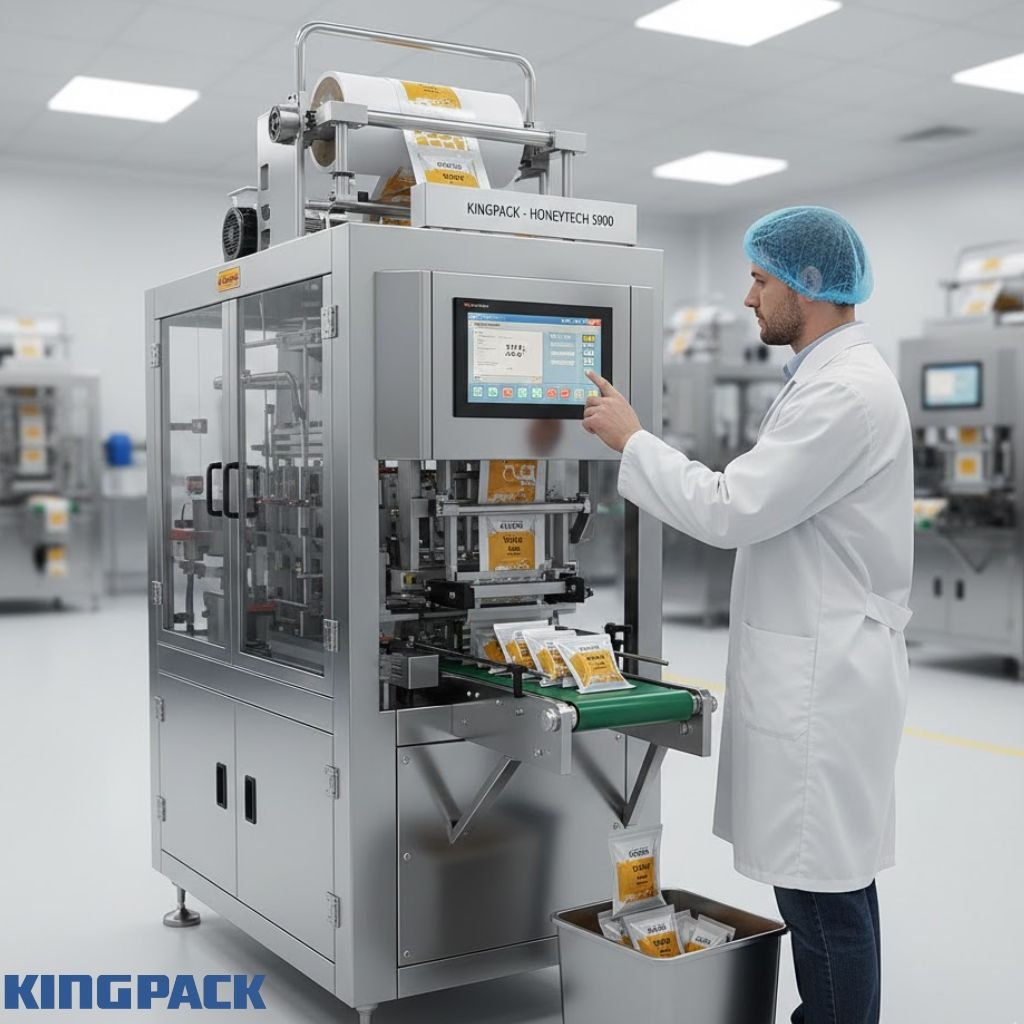
PLC Control with Touchscreen Interface, Servo Motors & No-Leak Filling System
The HMI can expose settings such as bag length, fill target, speed and sealing temperature when supported by the selected machine. Recipes, permissions, alarms and changeover steps should be defined and tested. Any anti-drip design or valve arrangement must be confirmed for the product’s viscosity and temperature.
Low Noise Operation, Quick Changeover & Minimal Floor Space for Easy Maintenance
Noise, changeover time and maintenance access depend on the drive system, enclosure, format range and site layout. Confirm the required noise level, tools, changeover parts and service clearances during specification and FAT.
Advantages of the King Pack Honey Sachet Packing Machine
King Pack’s automatic honey sachet packing machine offers economic, technical, and quality benefits. These advantages support stable production over the long term.
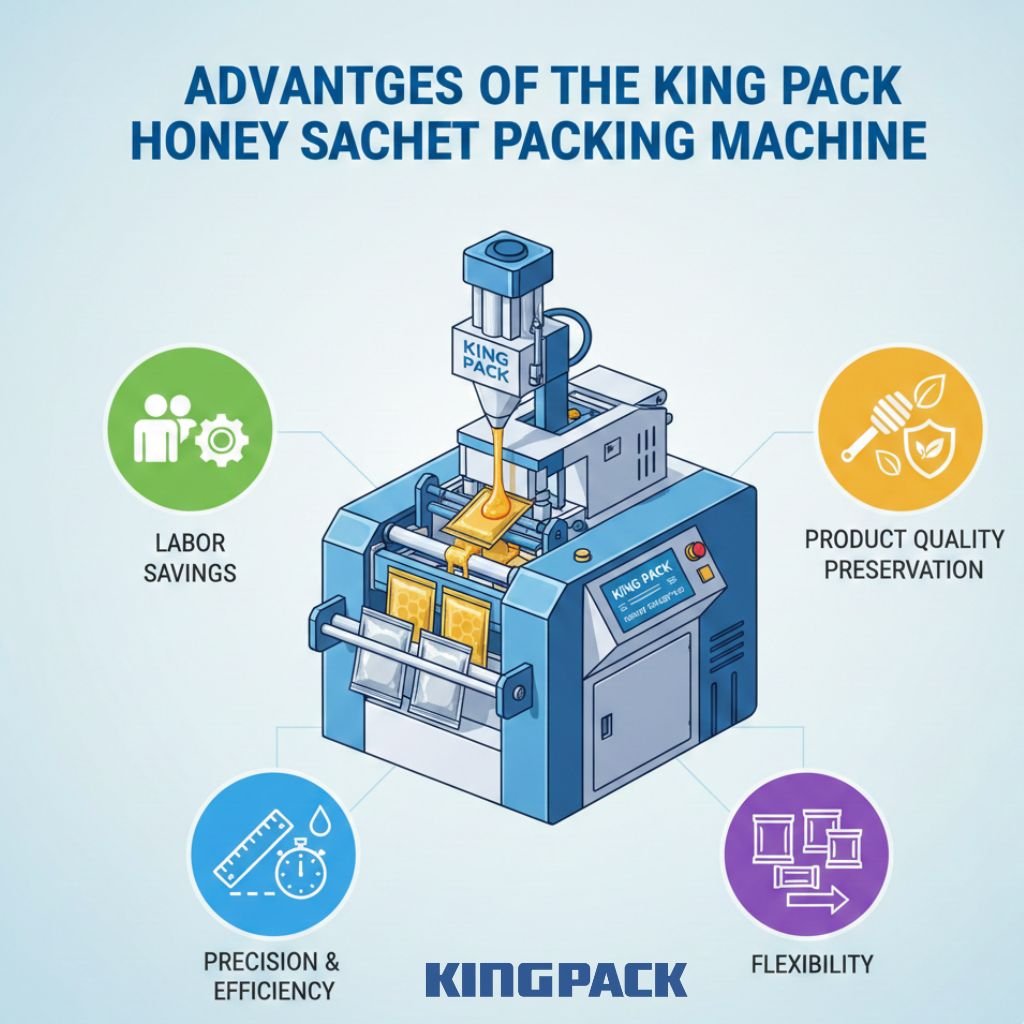
Labor Savings: Fully Automated – No Manual Intervention, Reduces Costs by Up to 70%
Automation can reduce the number of operators needed for a defined workflow, but staffing depends on line layout, material handling, inspection, replenishment and quality checks. Any labor saving should be calculated from the customer’s current staffing and validated production plan.
Precision and Efficiency: Dosing Repeatability, Waste Control and Detection
A piston or other selected dosing system can be tuned for repeatable filling on a suitable product. The achievable tolerance must be verified with the customer’s honey, dose, temperature, film and measurement method; do not assume ±0.5% for every machine or recipe. Empty-film or registration alarms are configuration-dependent.
Product Quality Preservation: Clean Seals Extend Shelf Life, No Contamination
Seals that meet the agreed integrity criteria help protect the packaged product. Shelf life and contamination control also depend on the product, film barrier, sanitation, environmental controls and the customer’s HACCP or quality program; the machine alone cannot guarantee shelf life.
Flexibility: Customizable for Liquids, Pastes, Granules; Scalable from Small to High-Volume Runs
A base platform may support more than one product family when the dosing system, contact parts, film and cleaning procedure are compatible. Liquids, pastes and granules normally require different dosing modules and validation. Lane count, printers and gas flushing are optional configurations, not assumed features.
Suitable Products & Use Cases
The machine may be suitable for a range of viscous food products when the filling, film and cleaning requirements are compatible. Confirm every application through product assessment and trials.
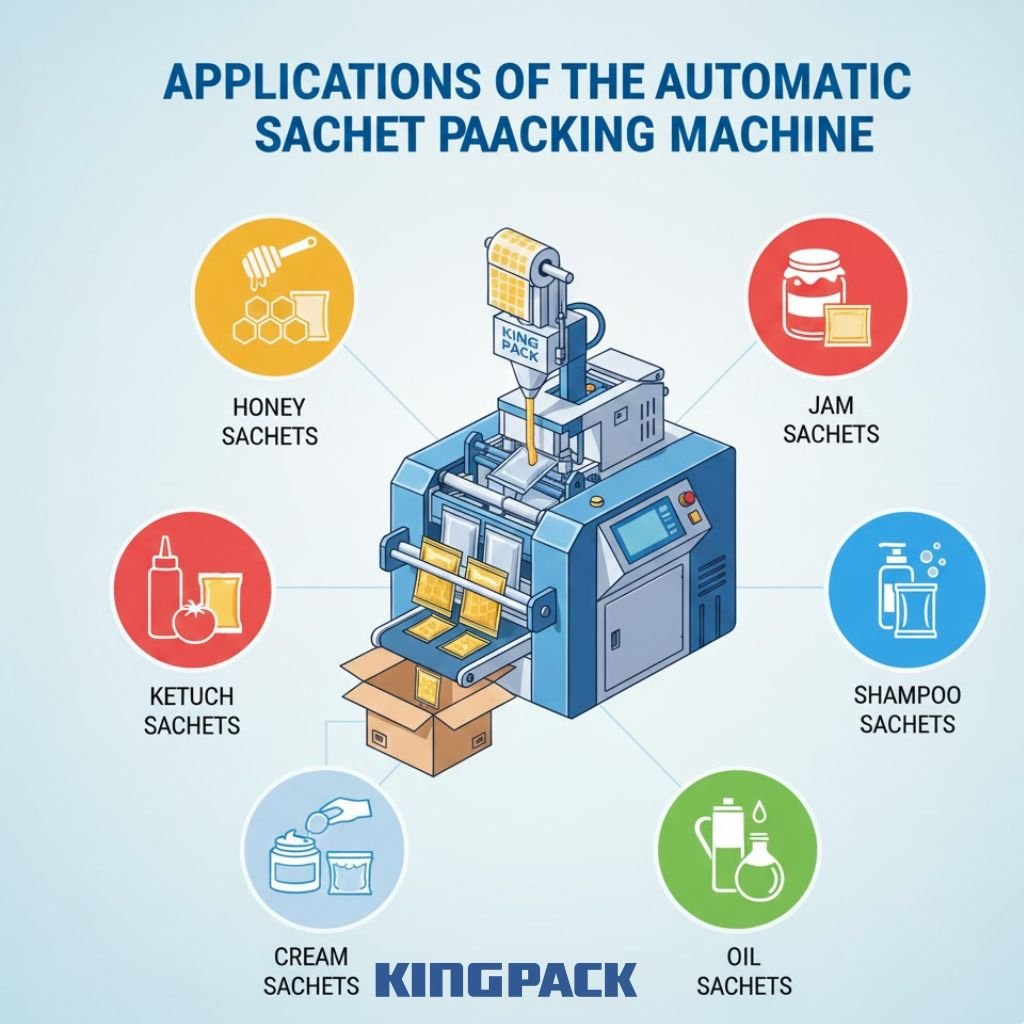
Honey, Jam, Ketchup, Fruit Purees, Sauces & Butters – Viscous Food Liquids
Typical food applications include mono-floral and blended honey, flavored honeys, strawberry or apricot jam, tomato ketchup, barbecue sauces, salad dressings, chocolate sauces, and nut or seed butters. Each product can be configured with dedicated filling parameters and sealing temperatures to ensure correct flow, accurate dose, and visually appealing sachet finish.
Non-Food: Shampoo, Creams, Oils, Lubricants & Chemicals in Sachet Format
In the personal care and household sector, the same automatic paste packer concept handles shampoo, hair conditioner, lotions, cosmetics, sample creams, engine oils, and small volumes of industrial lubricants. These products benefit from the same high-precision metering and robust seals, especially when sold as samples or travel packs.
Granules & Pastes: Spices, Jelly, Bath Foam – Multi-Material Versatility
Changing from liquid dosing to auger or volumetric-cup dosing is a separate configuration decision. Compatibility with powders, granules, gels or foaming products must be confirmed from the selected machine, contact parts, dust controls and cleaning procedure.
How to Choose the Right Automatic Honey Sachet Packing Machine
Choosing the right model and setup requires a careful review of product properties, performance needs, production capacity, and after-sales support.
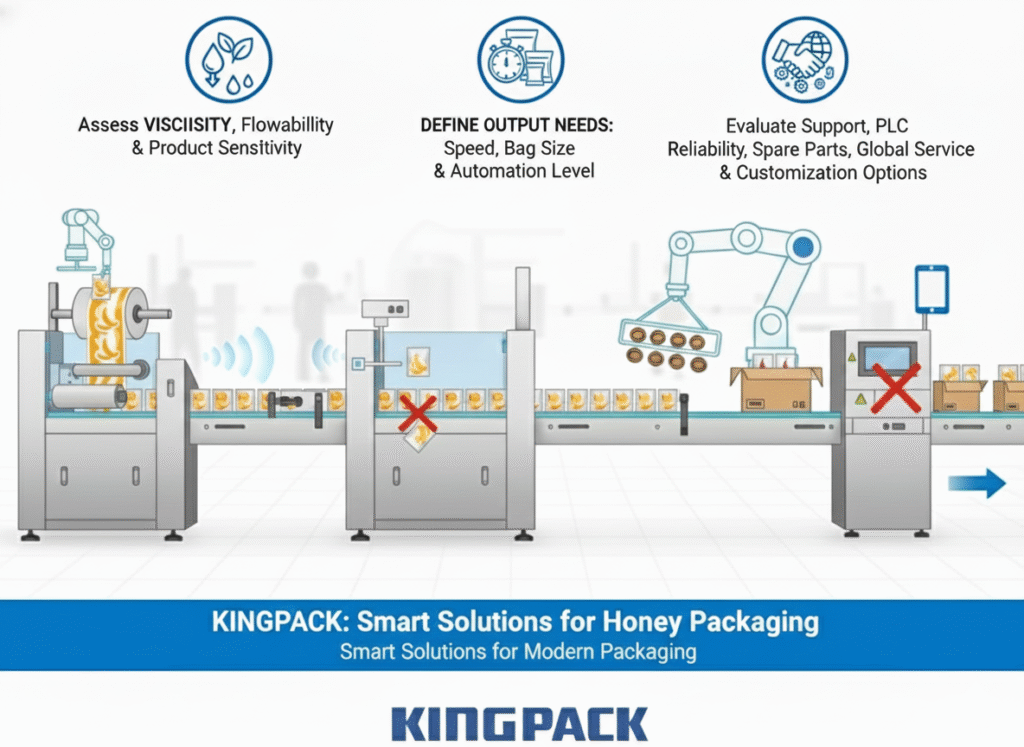
Assess Viscosity, Flowability & Product Sensitivity
Viscosity, flow behavior, temperature sensitivity and shear response determine the suitable pump, valve, nozzle and tank arrangement. Product trials should confirm dosing stability, cleaning and seal performance before final specification.
Define Output Needs: Speed, Bag Size & Automation Level
Define the target bags per minute, daily volume, bag sizes, shifts and integration points before selecting a lane count or automation level. The correct choice depends on the customer’s labor, budget, upstream preparation and downstream packing plan.
Evaluate Support, PLC Reliability, Spare Parts, Global Service & Customization Options
Evaluate the selected PLC and HMI, spare-parts plan, training, documentation and service coverage in the quotation. Custom features such as bag shape, coding or data interfaces must be confirmed as part of the project scope.
Conclusion & Call to Action
A configured honey sachet line may combine dosing, forming and sealing functions with hygienic contact parts and space-efficient handling. Suitability, accuracy, speed, certification and scalability must be confirmed for the selected model and customer’s product; avoid treating generic claims as a universal guarantee.
Contact King Pack for a product-specific review, representative sample trial and quotation. Share the product properties, target dose, film, bag format and required output so the proposed configuration can be evaluated against agreed criteria.
Get Your Free Sachet Packing Quote Now → Email: info@kingpack-cn.com
Related Industry and Solution Pages
For related equipment context, see our food packaging solutions and liquid packaging solutions for the relevant industry and packaging workflow.