
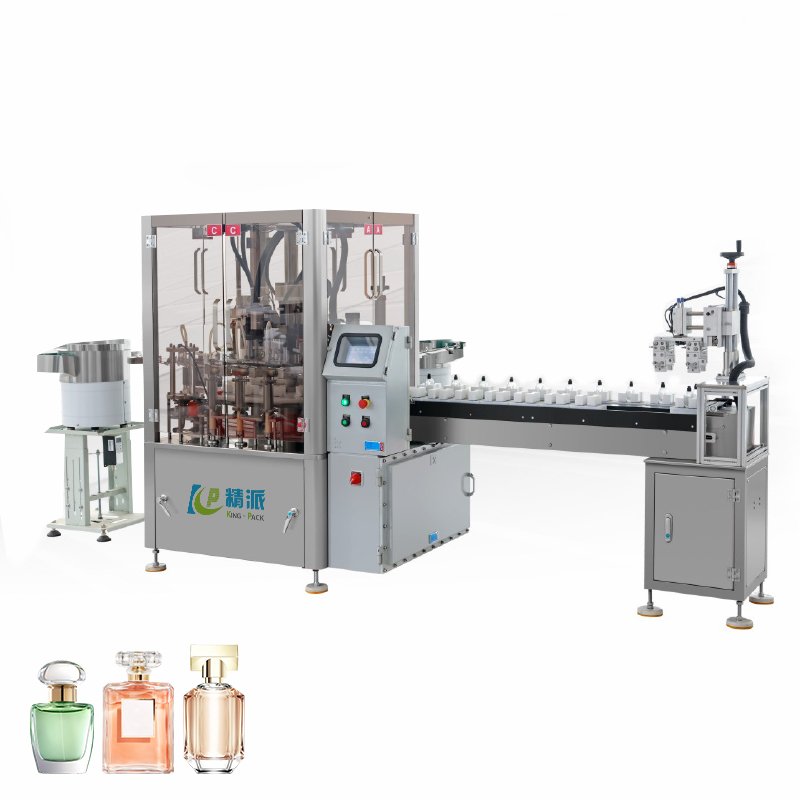
A perfume filling machine must do more than put liquid into a bottle. It has to control the visible fill level, protect an alcohol-based product, handle decorative glass bottles and apply the spray pump or closure without leaks or cosmetic damage. This guide explains how to choose the filling method, automation level and closure equipment for a dependable perfume bottling line. For a configured machine, see our filling and capping solutions.
Perfume Filling Machine Selection at a Glance
| Production requirement | Common starting point | What to verify |
|---|---|---|
| Premium glass bottles with a consistent visual level | Vacuum-level filling | Bottle neck finish, internal volume variation and return-product handling |
| Samples, short runs or frequent fragrance changes | Manual or semi-automatic filler | Cleaning time, tubing or seal compatibility and operator workload |
| Multiple bottle formats on one line | Flexible inline system with change parts | Actual bottle trials, changeover time and recipe control |
| High-volume perfume production | Automatic inline or rotary monobloc | Sustained output with the real bottle, pump, dip tube and collar |
| Crimp-on spray pumps | Filler plus pump insertion and crimping stations | Crimp diameter, height, profile, leak test and actuator function |
Why Perfume Packaging Needs a Purpose-Built Line
Perfume is often a low-viscosity liquid, but the package makes the application demanding. Ethanol can be volatile and flammable. Fragrance oils may challenge tubing, seals or elastomers. Glass bottles can vary internally even when their external dimensions look identical. Pumps, dip tubes, collars and overcaps also create more handling steps than a simple screw-cap package.
The best machine is therefore selected from the complete package and process—not from bottle volume alone. A useful supplier review covers the liquid, bottle drawing or samples, closure components, required output, cleaning method, installation environment and local safety requirements.
How a Perfume Filling and Crimping Line Works
A typical automatic perfume packaging line follows these stages:
- Bottle infeed and spacing: bottles are loaded manually or supplied by a suitable infeed system, then separated for accurate positioning.
- Filling: vacuum-level, peristaltic, piston, gear-pump or flowmeter technology delivers the fragrance according to the process requirement.
- Pump or valve placement: the spray pump and dip tube are inserted while guides protect the bottle neck and component.
- Crimping or capping: a crimp head forms the aluminum ferrule, or a capping station applies a screw-on or press-on closure.
- Collar and overcap placement: optional stations apply decorative components.
- Inspection and discharge: the line can check bottle presence, fill condition, closure presence and reject nonconforming packs before labeling or cartoning.
Vacuum Filling vs Volumetric Filling
Vacuum-level filling
Vacuum filling is widely used for rigid glass perfume bottles because it stops at a controlled liquid height. Excess liquid can be returned through the filling circuit, producing a visually consistent level across bottles. However, a consistent level is not automatically the same as an identical net volume: internal bottle-volume and neck-finish variation still matter. The acceptance test should check both appearance and declared net content.
Peristaltic and other volumetric methods
A peristaltic pump keeps the product within replaceable tubing, which can simplify small-batch changeovers and reduce the number of wetted machine parts. Tubing life, solvent compatibility and achievable flow rate must be validated. Piston, gear-pump and flowmeter systems can suit other formulas or line configurations, but the supplier should prove repeatability over the requested fill range with the actual product or an agreed test liquid.
Bottle and Closure Compatibility
Perfume equipment may need to handle standard glass spray bottles, miniature bottles, roller-ball packs, body-mist bottles or unusual decorative shapes. Each format can require different guides, starwheels, bottle supports, filling nozzles and closure tooling. Send representative samples from normal production—not only ideal samples—so trials include real dimensional variation.
For crimp-on pumps, specify the bottle neck, ferrule and pump as one matched system. A successful crimp is judged by the finished diameter, crimp height and profile, leak resistance, pull-off performance, actuator function and cosmetic appearance. These are more meaningful than quoting a generic crimping force.
Choosing the Automation Level
| Machine type | Best suited to | Main trade-off |
|---|---|---|
| Manual or bench-top | Laboratory work, sampling and very small batches | Low investment but high operator dependence |
| Semi-automatic | Growing brands and frequent format changes | Flexible, but bottle and closure handling may remain manual |
| Automatic inline | Medium-to-high production with several SKUs | Easier to expand, but line balance and transfers must be engineered |
| Rotary monobloc | High sustained output and stable packaging formats | Compact and fast, but usually more format-specific and capital intensive |
Do not compare suppliers using a maximum catalog speed alone. Ask for the sustained accepted output with your smallest and largest bottles, including pump insertion, crimping, stoppages and inspection. A filling machine running faster than the closure station does not increase sellable output.
Accuracy, Fill Level and Quality Control
There is no single accuracy figure that applies to every perfume filler. Performance depends on the filling principle, dose, liquid behavior, bottle variation, operating speed and test method. Define the acceptance criteria before purchase: target net content, permitted variation, visible fill-level tolerance, sample size and whether the test covers start-up, steady production and end-of-batch conditions.
- Use checkweighing or a validated gravimetric method when net content is critical.
- Inspect dripping, bottle wetting and foam after the nozzle leaves the container.
- Record results for every filling head, not only the line average.
- Confirm that recipe changes cannot place the wrong fill parameters on a new SKU.
Alcohol Handling and Machine Safety
Do not assume that every perfume project needs the same “explosion-proof” specification. The correct design starts with the product safety data sheet, flash point, processing temperature, ventilation, quantity handled and a site-specific hazardous-area assessment. That assessment determines zoning or classification and the required electrical, mechanical and pneumatic protection.
For European projects, review the European Commission’s official ATEX information. For U.S. installations, the owner and qualified safety professionals should evaluate applicable requirements such as OSHA 29 CFR 1910.106 on flammable liquids. Typical engineering discussions include ventilation, ignition-source control, grounding and bonding, electrical classification, spill control and safe shutdown. Local authorities and the end user’s safety team make the final compliance determination.
Product-Contact Materials and Changeover
Stainless steel grade alone does not establish compatibility. Review every wetted component: tubing, seals, valve seats, adhesives, filters and pumps. Compatibility should be confirmed against the actual fragrance concentrate, ethanol level, cleaning agents and contact time. If many fragrances share one line, define drainability, flushing volume, cleaning verification and the acceptable carryover between products.
What to Put in Your RFQ
- Bottle drawings and production samples for every planned size and shape
- Pumps, dip tubes, crimp collars, screw caps, overcaps and decorative components
- Fill-volume range, visible level requirement and net-content tolerance
- Required accepted output for each format, not only nominal machine speed
- Formula properties, temperature range, alcohol content, flash point and safety data sheet
- Utilities, available floor space, upstream and downstream equipment
- Number of daily or weekly changeovers and the target changeover time
- Inspection, data-recording, reject and traceability requirements
Factory Acceptance Test Checklist
A factory acceptance test should use the agreed bottle, closure and product, or a documented surrogate with similar relevant properties. Run enough material to expose transfer, filling and crimping problems rather than demonstrating a few hand-selected bottles. Record accepted output, fill results by head, reject causes, crimp measurements, leaks, component damage, changeover time, alarm recovery and cleaning observations. Close each deviation with an agreed action before shipment.
Frequently Asked Questions
Is vacuum filling more accurate than volumetric filling?
They control different things. Vacuum filling is especially useful for a consistent visible level in rigid bottles. Volumetric systems target a measured dose. Your bottle variation and acceptance criteria determine which method is more suitable.
Can one perfume filling machine handle many bottles?
Often yes, within a validated range. Different bottles may need change parts, height adjustments, recipes and closure tooling. Very unstable or highly decorative shapes should be tested before the machine design is finalized.
Why does a crimped perfume pump leak?
Possible causes include mismatched bottle and ferrule dimensions, incorrect crimp head geometry, inconsistent component supply, damaged necks, poor dip-tube alignment or an incorrect finished crimp profile. Inspect the complete packaging system rather than adjusting force alone.
Does an alcohol-based perfume line always require ATEX equipment?
Not as a universal rule. Requirements depend on the installation country, hazardous-area assessment, ventilation, product flash point and operating conditions. Supply the SDS and site classification to the machine manufacturer and involve qualified local safety professionals.
Plan Your Perfume Bottling Line
King Pack can configure filling, pump insertion, crimping, collar placement and downstream packaging around your actual containers and production target. Explore our packaging solutions, see the industries we support, or send your bottle and closure requirements for a technical proposal.