 Skip to content
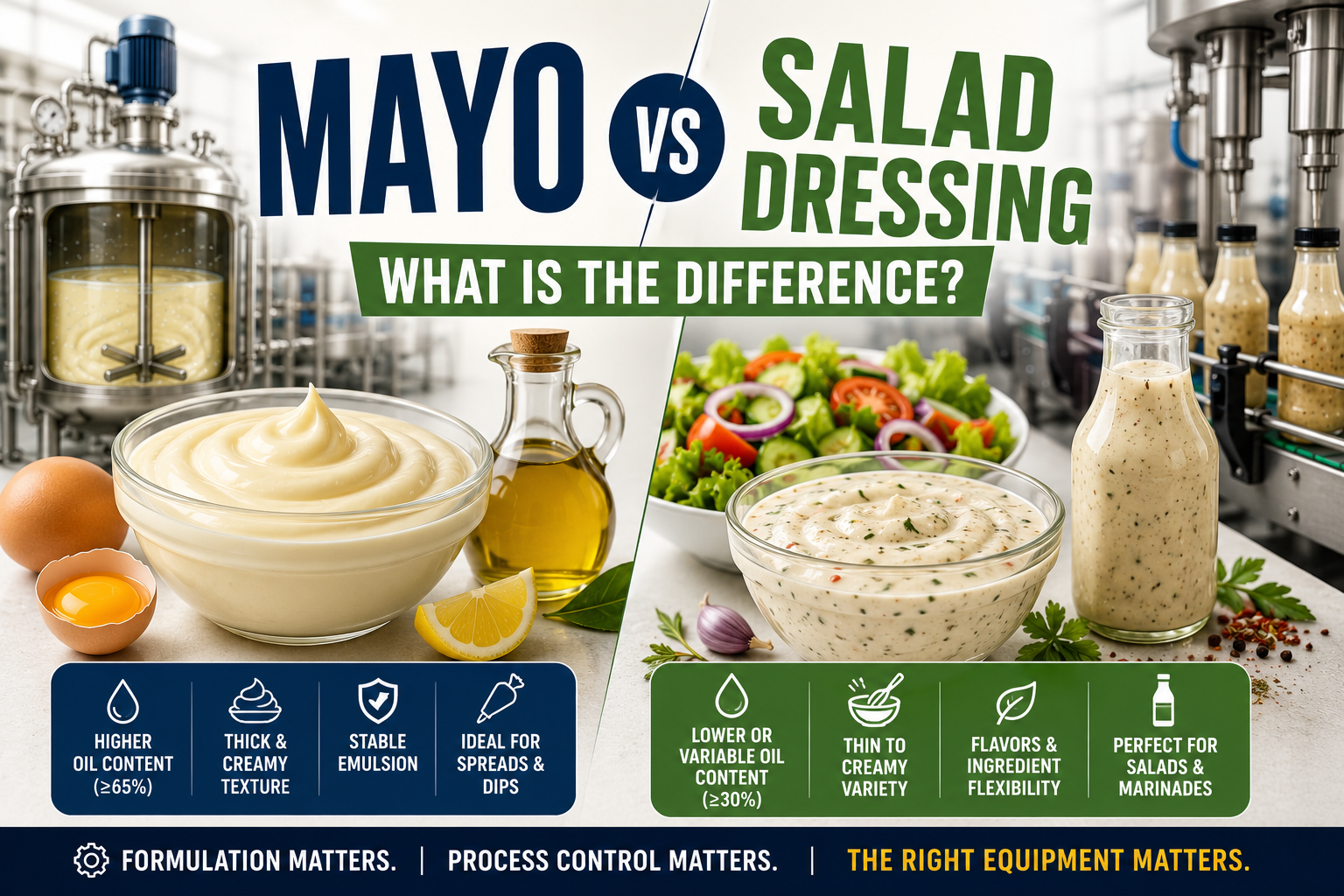
Mayonnaise and salad dressing can look similar on the shelf, and both may contain oil, acid and emulsifying ingredients. Yet they differ in formulation, oil content, taste, viscosity and regulatory identity, and those differences directly affect how they are mixed, emulsified and filled.
Is salad dressing the same as mayonnaise? No. The difference between mayo and salad dressing changes the entire process train, from shear rate in the homogenizer to nozzle selection on the filler.
This article compares both products from a food manufacturing and packaging perspective and explains how to choose a mayonnaise filling machine, salad dressing filling machine, and broader sauce filling machine platform for each type.
What Is Mayonnaise?
Mayonnaise is a thick, emulsified semisolid product formed as a stable oil-in-water emulsion. Its continuous phase is water and vinegar, its dispersed phase is vegetable oil broken into 2–10 micron droplets.
Main ingredients usually include vegetable oil, egg yolk and vinegar or lemon juice. Egg yolk supplies lecithin and lipoproteins that adsorb at the oil-water interface and help stabilize the oil-and-water emulsion. Salt, sugar and sometimes mustard are used for flavor and secondary stabilization.
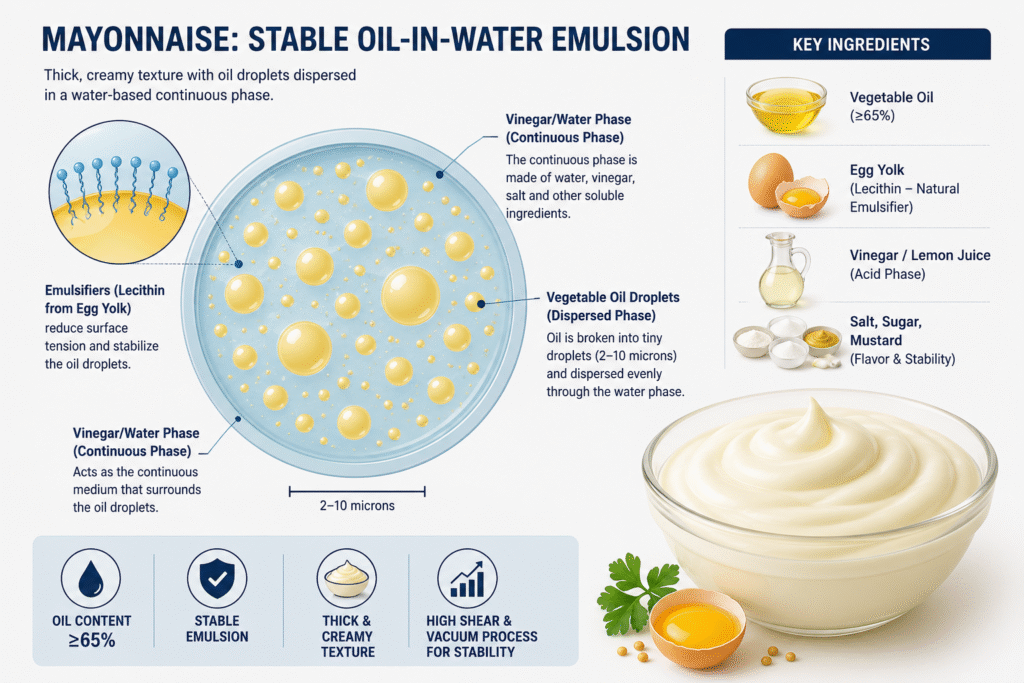
Mayonnaise normally has a high oil content and dense, creamy texture. Under the current US standard of identity, mayonnaise contains at least 65% vegetable oil by weight FDA standard. That high oil load is why mayonnaise manufacturing process requires controlled oil addition under high shear and vacuum. Without it, the emulsion inverts or shows oil separation.
What Is Salad Dressing?
“Salad dressing” has two meanings in the industry. As a broad category, it covers vinaigrettes, ranch, Caesar, Thousand Island and other dressings. As a standardized product, it refers to emulsified salad dressing under FDA 21 CFR 169.150, which contains at least 30% vegetable oil.
Common salad dressing ingredients include vegetable oil, vinegar or other acidifying ingredients, egg ingredients, water, sugar, salt, herbs, spices, stabilizers and thickeners. Unlike mayonnaise, salad dressings may range from thin vinaigrettes at 50 cP to thick creamy products at 150,000 cP.
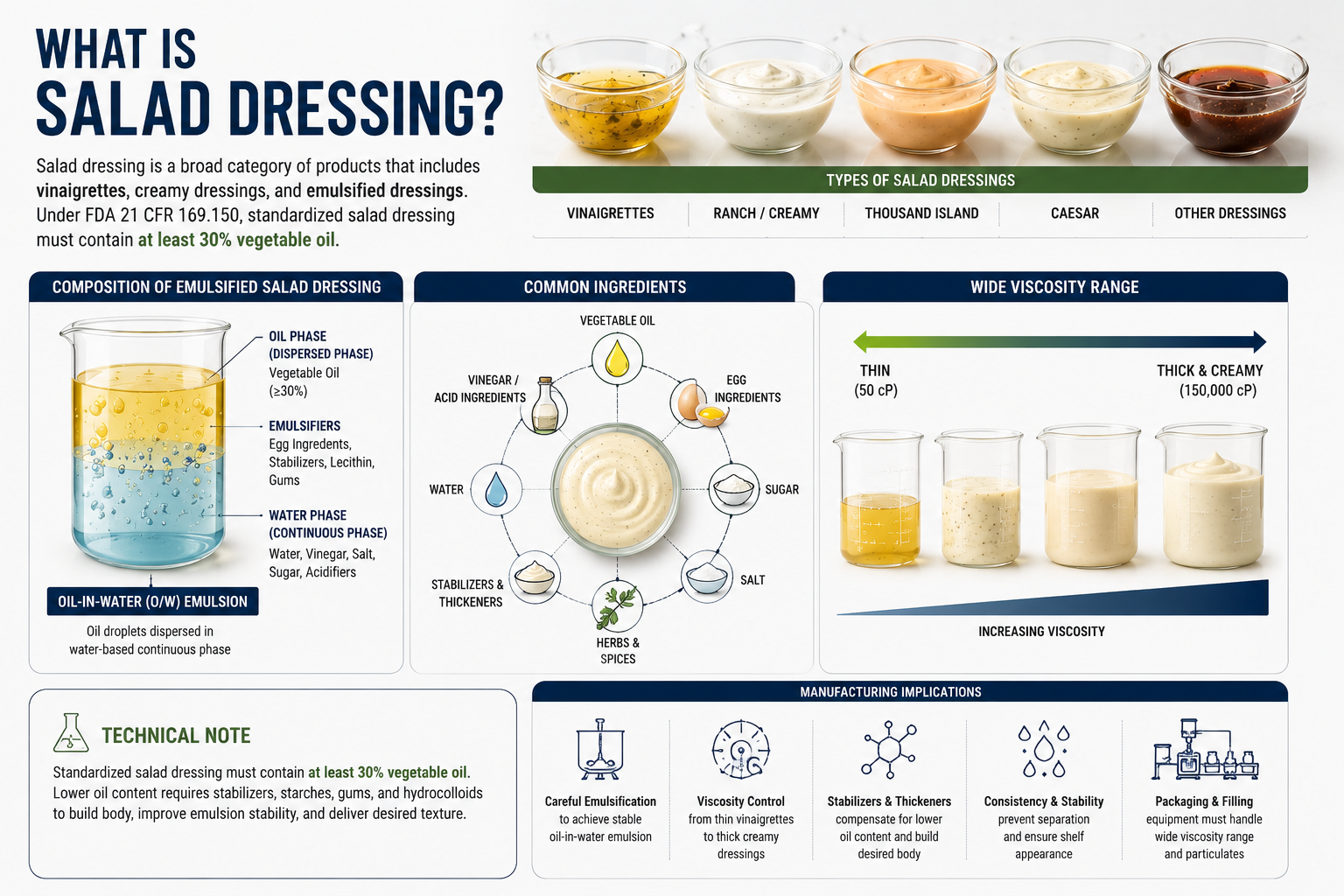
Technical note: Under the current US standard of identity, standardized salad dressing contains at least 30% vegetable oil. That lower oil content means the formula often relies on starches, gums and hydrocolloids to build body rather than oil fraction alone.
Mayo vs Salad Dressing: Key Differences
The difference between mayo and salad dressing affects more than flavor. Their viscosity, ingredients, and emulsion stability directly impact the filling process and equipment selection. The table below highlights the main differences.
Selecting the right filling equipment depends on factors such as viscosity, particle content, and required filling accuracy. In the mayonnaise industry, piston-based filling systems are commonly used for mayonnaise packaging applications, while salad dressings and products like hot sauce may require different pumps or fillers based on their consistency and flow characteristics.
Ingredient Differences Between Mayonnaise and Salad Dressing
Oil Content
Mayonnaise normally contains more oil. Higher oil content contributes to its dense texture and high caloric density. The oil phase must be metered at 20–25°C and added at <5% of batch volume per minute to avoid shocking the emulsion. Salad dressing formulations may contain more water or acid phase, which lowers viscosity but increases separation risk. Lower oil means the manufacturer must compensate with stabilizers to hit target texture.
Egg and Emulsifying Ingredients
Egg yolk is a key emulsifying ingredient in traditional mayonnaise. Liquid pasteurized yolk at 4–8% provides lecithin. Salad dressings may use egg, starch, gums or other stabilizing systems like xanthan, modified starch, or cellulose gum. Some vinaigrettes are not permanently emulsified and rely on shake-before-use.
Sweeteners, Herbs and Spices
In mayonnaise filling process, mayonnaise usually has a relatively neutral flavor with 1–2% salt and 1–4% sugar. Salad dressings often contain sugar, herbs, spices, cheese, garlic or vegetable particles for differentiation. Those inclusions affect shear sensitivity and filler wear.
High viscosity Stabilizers and Thickeners
Salad dressing often uses starches or hydrocolloids to improve thickness and texture while maintaining lower oil content. These stabilizers affect viscosity, flow behavior, and filling requirements for viscous liquid food products.
For example, xanthan gum at 0.2–0.4% helps suspend herbs and particles, but filling equipment may require larger nozzle sizes and controlled pump speeds to maintain high filling accuracy. Modern mayonnaise packaging machines with suitable pneumatic components can handle these changes effectively, while some formulations may also require hot filling conditions.
Recommended Reading: What Are The Health Benefits Of Mayonnaise, And Why Mayonnaise Making Machines Are Important – King Pack Machinery
Manufacturing & Filling Process of Mayonnaise vs Salad Dressing
Industrial Automatic Mayonnaise Manufacturing Process
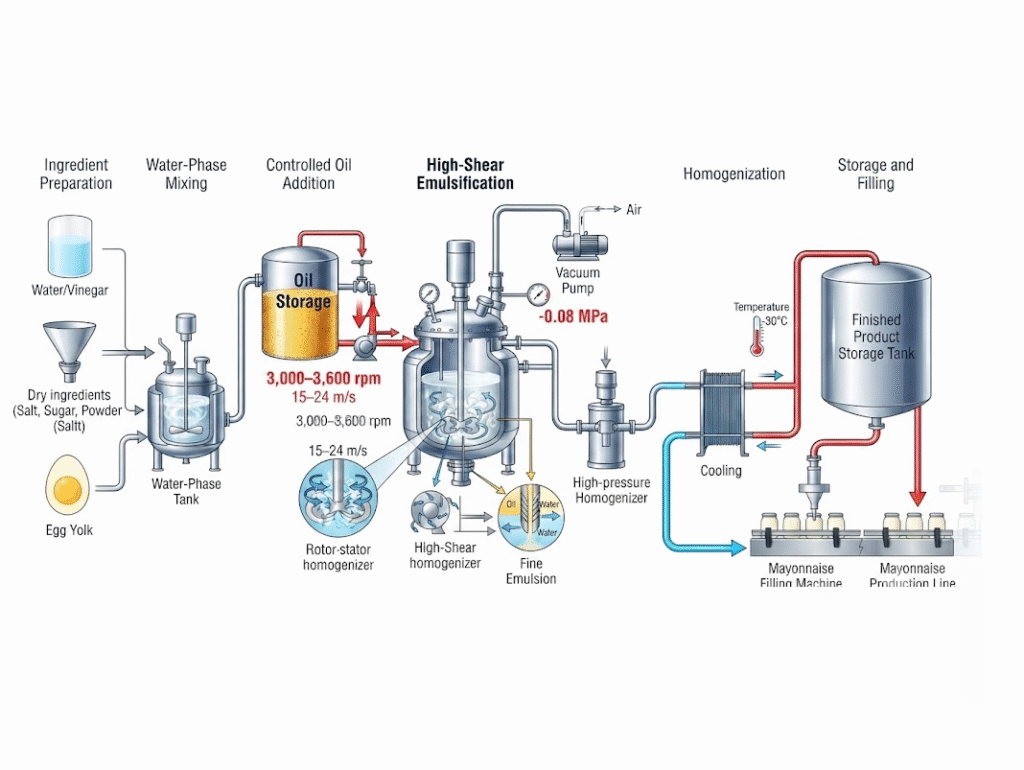
The industrial mayonnaise manufacturing process follows this sequence:
Ingredient Preparation → Water-Phase Mixing → Controlled Oil Addition → High-Shear Emulsification → Vacuum Deaeration → Homogenization → Cooling → Storage and Filling
Controlled oil addition is critical. If oil is added too fast, droplet size jumps from 5 μm to >20 μm and the emulsion breaks. High-shear emulsification with a rotor-stator at 3,000–3,600 rpm and tip speed 15–24 m/s creates the fine dispersion. Temperature control holds product below 30°C to avoid cooking egg. Vacuum removal of trapped air at -0.08 MPa prevents oxidation and air pockets that cause short fills. Stable viscosity is verified by inline viscometer before release to a Mayonnaise Filling Machine and Mayonnaise Production Line.
A Vacuum Emulsifying Mixer is standard here. King-Pack’s vacuum emulsifying mixer line uses SUS316L contact parts, dual jackets, and bottom homogenizer for high oil loading.
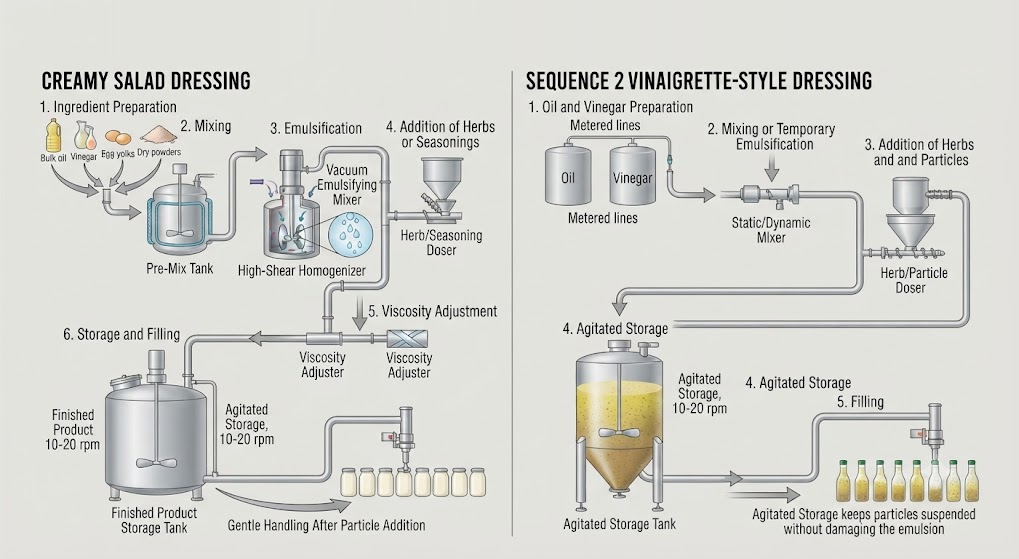
Industrial Salad Dressing Manufacturing Process
The salad dressing manufacturing process depends on dressing type.
For creamy salad dressing:
Ingredient Preparation → Mixing → Emulsification → Addition of Herbs or Seasonings → Viscosity Adjustment → Storage and Filling
For vinaigrette-style dressing:
Oil and Vinegar Preparation → Mixing or Temporary Emulsification → Addition of Herbs and Particles → Agitated Storage → Filling
Dressings containing herbs, spices or vegetable pieces require gentler handling after particle addition. Over-shearing after adding herbs breaks them and releases chlorophyll, which darkens the product. Agitated storage at 10–20 rpm keeps particles suspended without damaging the emulsion.
Texture and Viscosity Differences
Mayonnaise is usually thick, smooth and uniform, with limited natural flow. It can trap air during transfer and may string or drip from unsuitable filling nozzles. Apparent viscosity at 20°C is 150,000–250,000 cP at low shear.
Salad dressing may be thin and free-flowing, medium-viscosity, thick and creamy, or containing herbs, seeds or vegetable particles. It is often prone to phase separation during storage, especially vinaigrettes.
Because of this range, “salad dressing filling machine” is not one fixed machine type. A thin vinaigrette at 100 cP and a ranch with 10 mm herb particles need completely different dosing technologies. That’s why a viscous liquid filling machine must be specified by actual product data at filling temperature, not just by name.
How Is Mayonnaise Filled?
Main filling challenges for mayonnaise include:
- High viscosity that resists gravity flow
- Trapped air that creates voids and inaccurate volume
- Product stringing and dripping from the nozzle
- Inconsistent flow when temperature changes ±2°C
- Possible emulsion damage from unsuitable transfer equipment like centrifugal pumps
Recommended equipment direction for mayonnaise:
- Servo piston filling machine or volumetric piston filler with positive-displacement filling system
- Sanitary product hopper with slow-speed agitation at 5–10 rpm
- Anti-drip or shut-off filling nozzles with dive function
- Short and hygienic transfer pipelines, piggable, with tri-clamp fittings
- Low-speed hopper agitation where necessary to prevent syneresis without aeration
Suitable packaging includes glass jars, plastic jars, squeeze bottles, pouches, sachets, portion cups, and bulk food-service containers.
Piston-based systems are commonly suitable for thick, smooth sauces because they provide controlled volumetric dosing independent of viscosity. King-Pack currently presents piston and servo-controlled filling solutions for viscous sauces and paste products. Our KPF series automatic filling machine holds ±0.5% accuracy for mayonnaise at up to 400 bottles/min depending on fill volume.
Recommended Reading: How Food-Grade Tube Sealing Improves the Shelf Life of Mayonnaise – King Pack Machinery
How Is Salad Dressing Filled?
The filling method for salad dressing depends on viscosity, ingredients, and packaging requirements. Thin vinaigrettes, creamy dressings, and particle-based dressings need different filling equipment to maintain accuracy and product quality.
Filling Thin Vinaigrette Dressing
Thin vinaigrettes are usually filled with gravity fillers, flowmeter fillers, pump fillers, or servo-controlled liquid fillers. Key requirements include accurate dosing, drip prevention, gentle circulation, and agitation to reduce oil-and-water separation.
A sauce filling machine with a flowmeter system and mixing hopper agitation can provide stable filling performance. Automatic filling machines also help reduce labor costs and maintain consistent output.
Filling Creamy Salad Dressing
Creamy dressings require equipment designed for high viscosity products. Servo piston fillers, positive-displacement pump fillers, and sauce filling machines are common choices.
Products with 80,000–150,000 cP viscosity can often use a mayonnaise filling machine platform with adjusted machine parameters. Piston filling provides accurate dosing, smooth handling, and reliable performance for products such as creamy dressings, tartar sauce, and industrial mayonnaise.
Filling Salad Dressing with Herbs or Particles
Dressings with herbs, garlic, relish, or other particles need large-bore filling valves, wider filling nozzles, gentle pumps, and proper agitation to prevent blockages and uneven distribution.
A specialized machine designed for particle handling is recommended for textured products. Testing the actual formula before machine selection helps ensure stable filling performance.
Packaging System Considerations
A complete packaging system may include filling machines, sealing machines, capping machines, and labeling machines. Food-grade 304/316 stainless steel construction improves durability and hygiene.
Filling nozzles can be customized from 2 to 10 nozzles to match production speed and bottle sizes. Servo motors, touch screens, and programmable controls help operators adjust settings and maintain consistent output.
Mayonnaise vs Salad Dressing Filling Machine Selection
| Product Type | Product Characteristic | Recommended Filling Direction |
|---|---|---|
| Traditional mayonnaise | Thick and smooth, 150k–250k cP | Servo piston or positive-displacement filler |
| Light mayonnaise | Medium to high viscosity, 80k–150k cP | Adjustable piston or pump filler |
| Creamy salad dressing | Thick and emulsified, may contain herbs | Piston or positive-displacement filler |
| Vinaigrette | Thin and separable, 50–500 cP | Gravity, flowmeter or pump filler with agitation |
| Dressing with herbs | Liquid with small particles <3mm | Large-bore pump or piston system |
| Dressing with larger particles | Chunky and non-uniform >5mm | Specialized particulate sauce filling system |
| Single-serve mayonnaise | Thick paste, 10–50 ml | Sachet or pouch machine with piston dosing |
| Single-serve dressing | Thin or creamy, 10–30 ml | Sachet machine matched to viscosity |
Important Factors When Filling Mayo and Salad Dressing
Product Viscosity
The machine must be selected using the actual viscosity at filling temperature. A ranch that is 20,000 cP at 25°C may be 45,000 cP at 15°C, which changes pump size and fill time.
Product Temperature
Temperature changes can alter viscosity by 10–20% per 5°C. The holding tank and filling environment should maintain stable conditions within ±1–2°C. Heating should only be used when appropriate for the formulation, never for egg-based mayo above 35°C.
Emulsion Stability
Products may separate during prolonged holding. Gentle agitation at 10–20 rpm may be required, but excessive mixing after emulsification should be avoided to prevent shear damage.
Product Particles
Herbs, spices and vegetable pieces affect pump, valve and nozzle selection. Actual particle size, concentration, and firmness should be provided to the equipment manufacturer for testing.
Container Type
Select equipment based on the packaging format, including jars, bottles, squeeze bottles, pouches, sachets, and portion cups. Each container type requires the right filling nozzle, capping system, and sealing method to ensure clean, accurate filling.
Filling Volume and Output
Choose equipment that matches your required filling volume and production capacity. Whether producing single-serve sachets, retail bottles, or large food-service containers, the filling system should deliver consistent output while meeting production targets.
Hygiene and Cleaning
Food processing equipment should use food-grade SUS304 or SUS316L stainless steel with sanitary pipelines and hygienic components. Features such as easy disassembly, CIP compatibility, and food-grade seals help simplify cleaning and maintain food safety standards.
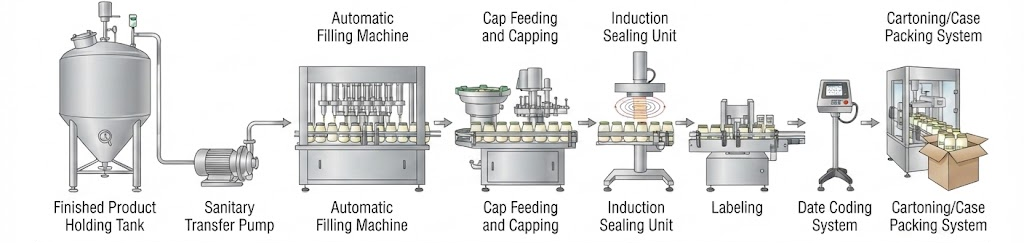
Complete Mayo and Salad Dressing Packaging Line
For bottles and jars, the typical line flow is:
Finished Product Holding Tank → Sanitary Transfer Pump → Automatic Filling Machine → Cap Feeding and Capping → Induction Sealing or Foil Sealing → Labeling → Date Coding → Cartoning or Case Packing
This configuration is sold as a Filling and Capping Line and can integrate with a Food Packaging Machinery system.
Common Filling Problems and Solutions
- Inaccurate filling volume from air pockets or unstable product supply — improve deaeration and hopper feeding with slow agitator
- Mayonnaise dripping from unsuitable nozzle design — use shut-off or anti-drip nozzles with back-suck
- Dressing separates in hopper from insufficient circulation — add controlled gentle agitation at 15 rpm
- Herbs settle at bottom — use slow-speed agitator and recirculation loop
- Nozzle blockage — use larger valves and nozzles, test with actual product
- Product foaming — reduce turbulence and inspect transfer system for air leaks
- Inconsistent viscosity from temperature variation — control storage and filling temperature to ±1°C
- Contaminated jar rim — adjust nozzle position and shut-off timing
Which Is Easier to Fill: Mayo or Salad Dressing?
Smooth mayonnaise is predictable but requires equipment capable of handling high viscosity and air removal. Its rheology is consistent, so once the piston filler is tuned, accuracy stays high.
Thin salad dressing is easier to pump but may separate quickly, requiring constant agitation and faster changeover to prevent oil rings. Creamy dressing can behave similarly to mayonnaise and often uses the same filler with different parameters.
Dressings containing solid ingredients are usually more demanding than both. Filling difficulty depends more on viscosity, particles and emulsion stability than on the product name alone.
How to Choose a Mayo and Salad Dressing Filling Machine Manufacturer
Evaluate suppliers on:
- Experience with food sauces and actual sample testing
- Viscosity and particle evaluation in their lab
- Suitable pump and dosing technology for your range
- Filling accuracy data at your volume, e.g., ±0.5% for 500 ml
- Container compatibility across jars, bottles, pouches
- Hygienic design with EHEDG principles
- Cleaning requirements and CIP
- Production line integration from emulsifier to case packer
- Customization capability and installation and after-sales service
King-Pack is top manufacturer of mayonnaise filling machines, sauce filling machines, pouch and sachet packaging machines, filling and capping lines, and customized food packaging systems. With 20+ years and 60+ countries, King-Pack provides turnkey lines from Emulsifying Machine and vacuum emulsifying mixer to Tube Filling and Sealing Machine and automatic capping.
For hygienic design guidance, refer to: https://www.ehedg.org/guidelines/
Frequently Asked Questions
Q1: Is mayonnaise the same as salad dressing?
No. Mayonnaise and salad dressings are different products with different formulations. Mayonnaise is a thick emulsion with a high oil content, while salad dressings cover a wider range of products with different textures, flavors, and viscosities.
Mayonnaise products usually contain ingredients such as egg yolk, oil, and vinegar or lemon juice, while salad dressings may include herbs, spices, dairy ingredients, or particles.
Q2: What is the main difference between mayo and salad dressing?
The main differences are oil content, texture, and emulsion stability. Industrial mayonnaise has a thick consistency and requires specialized mayonnaise filling equipment designed for high viscosity products.
Salad dressings can range from thin vinaigrettes to creamy dressings. Products such as tartar sauce, chili sauce, pepper sauce, and fry sauce may require different filling machines depending on their viscosity and particle size.
Q3: Does salad dressing contain less oil than mayonnaise?
Generally, yes. Standard mayonnaise usually contains at least 65% oil, while salad dressing often contains lower oil levels. Some vinaigrettes may contain much less oil and have a thinner consistency.
Because of these differences, manufacturers need to consider viscosity, filling volumes, and product characteristics when selecting filling machines.
Q4: Can mayonnaise be used as a salad dressing base?
Yes. Many creamy salad dressings start with a mayonnaise base and are adjusted with herbs, spices, dairy, or other ingredients. During the filling process, manufacturers need to consider particle handling, product texture, and accurate filling.
A complete system may include a mixing hopper, mayonnaise filling machine, capping machine, and labeling machine to handle the full packaging process.
Q5: What machine is suitable for filling mayonnaise?
A servo piston filling machine is commonly used for mayonnaise filling because piston pumps can handle high viscosity materials while maintaining texture and accuracy.
A specialized mayonnaise filling machine usually includes anti-drip filling nozzles, stainless steel material contact parts, and programmable controls for consistent output. These machines can fill hundreds to thousands of containers per hour, depending on the production speed and bottle sizes.
Q6: What machine is suitable for filling creamy salad dressing?
Creamy salad dressings are usually filled with servo piston fillers or positive-displacement pump fillers. The machine selection depends on viscosity, ingredients, and whether the product contains particles.
For thicker products such as light cream or thick gel-based dressings, piston filling provides accurate filling volumes without damaging the product structure.
Q7: How do manufacturers fill vinaigrette dressing?
Vinaigrettes are thinner than mayonnaise and usually require gravity fillers, flowmeter fillers, or pump filling machines. Continuous agitation may be needed to prevent separation during the filling process.
A mayonnaise filling machine is not always suitable for thin products because filling parameters, pump type, and filling head design must match the product viscosity.
Q8: Can one filling machine handle both mayonnaise and salad dressing?
In some cases, yes. An automatic filling machine can handle different products when it has adjustable machine parameters, suitable filling nozzles, flexible speed settings, and proper cleaning features.
However, manufacturers should test the actual products before final machine selection. A complete packaging system may also require a sealing machine, capping machine, and labeling machine to meet production goals.
Q9: How are herbs and particles handled during dressing filling?
Dressings containing herbs, spices, or particles require filling equipment designed for smooth product flow. Large-bore valves, wider filling nozzles, gentle agitators, and low-shear pumps help prevent blockages.
Products such as salsa golf, tartar sauce, and other textured salad dressings may need a specialized machine designed for particle handling and stable filling.
Q10: Can mayonnaise and salad dressing be packed in sachets?
Yes. Mayonnaise and salad dressings are commonly packed in sachets, pouches, and portion cups. Small bags are popular for convenience, especially in restaurants and quick-service food applications.
A mayonnaise packing machine can use piston dosing for thick products and pump dosing for thinner liquids. Multi-track machines can produce more than 150 mayonnaise sachets per minute, depending on the packaging material and machine configuration.
Looking for a Mayo or Salad Dressing Filling Solution?
King-Pack provides customized filling and packaging systems for mayonnaise, creamy dressings, vinaigrettes and other food sauces. Solutions can be configured according to product viscosity, particle size, filling volume, container type, required production capacity, capping or sealing method, and factory layout. Contact us to find the right solution for your production line.
