

A cosmetic homogenizer machine combines high-shear mixing, controlled agitation, temperature management and—when required—vacuum deaeration to produce consistent creams, lotions, gels and other personal-care formulations. The correct configuration depends on the formula and process, not on tank volume alone.
This guide explains the technical specifications buyers should define, how batch, inline and vacuum systems differ, and what must be verified before scaling a laboratory formula to production. If you already have a product and need a configured system, see our emulsifier mixer machine solutions.
Cosmetic Homogenizer Selection at a Glance
| Product or process need | Typical equipment direction | What to confirm in trials |
|---|---|---|
| Creams and lotions with oil and water phases | Batch rotor-stator homogenizer, often with anchor agitation and heating/cooling | Emulsion stability, texture, temperature profile and batch time |
| Air-sensitive or premium appearance products | Vacuum emulsifying homogenizer | Foam removal, product expansion under vacuum and condenser/load requirements |
| High-viscosity creams | High-torque wall-scraping anchor plus bottom or in-tank homogenizer | Wall turnover, motor load, heat transfer and discharge behavior |
| Large throughput or recirculation process | Inline rotor-stator system with a correctly sized loop | Flow rate, number of passes, temperature rise and residence time |
| Laboratory development | Small batch unit with recorded operating parameters | Whether the geometry and measurable process variables can transfer to production |
These are starting directions rather than universal rules. A supplier should review samples, ingredients, viscosity range, batch size and the required quality result before confirming a machine.
Technical Specifications to Put in Your RFQ
A useful request for quotation describes the process duty, not just “a 1,000-liter cosmetic mixer.” Ask the supplier to state the following items clearly in the proposal.
- Working and total vessel volume: give minimum, normal and maximum batch sizes. Homogenizer coverage and anchor performance can change at low fill levels.
- Product properties: identify density, viscosity or rheology range, solids, abrasive ingredients, heat sensitivity and whether the formulation foams.
- Rotor-stator duty: request rotor/stator geometry, speed range, motor power, expected product circulation and operating limits. RPM alone is not enough for comparison.
- Agitation system: define anchor, scraper and auxiliary mixing requirements, including torque at the highest expected viscosity.
- Vacuum performance: specify the required operating vacuum, leak-rate test method, condenser or separator arrangement and protection against product carryover.
- Heating and cooling: provide starting and target temperatures, permitted batch time, utilities and jacket pressure so heat-transfer area can be checked.
- Product-contact construction: state material grade, gasket compatibility, surface-finish requirement, drainability and any corrosion concerns.
- Cleaning and changeover: identify manual, COP or CIP expectations; cleaning chemicals; rinse verification; access needs and acceptable product hold-up.
- Controls and records: define recipe control, alarms, interlocks, parameter logging, user access, batch reporting and any system-integration requirement.
- Site conditions: confirm voltage, frequency, hazardous-area classification if applicable, compressed air, water, steam and installation constraints.
For broader terminology and equipment layouts, use our industrial emulsifying equipment guide.
How a Rotor-Stator Cosmetic Homogenizer Works
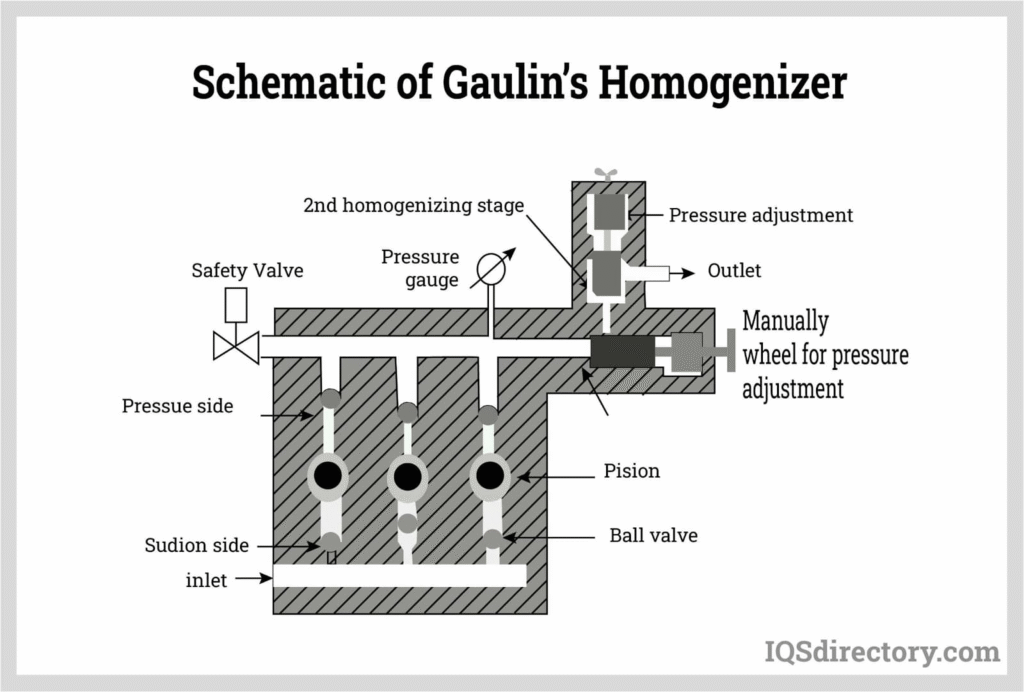
The rapidly rotating element draws product into the rotor-stator head and forces it through a narrow working zone. Local shear helps disperse powders, reduce agglomerates and create smaller droplets during emulsification. At the same time, a slower anchor or sweep agitator must move material from the vessel wall and surface back toward the high-shear zone.
Final droplet size and texture depend on the formulation, temperature, shear exposure, addition sequence and circulation pattern. A higher displayed speed does not automatically produce a better or more stable product. Read the detailed emulsifying machine working principle for a closer process explanation.
Batch, Inline and Vacuum Homogenizer Types
Batch Homogenizer
An in-vessel or bottom-mounted batch homogenizer treats the material inside one processing vessel. It is practical for multi-stage formulas where powders, oil phase and water phase are added at controlled times. The vessel can combine heating, cooling, anchoring and high shear in one unit.
Inline Homogenizer
An inline unit processes product flowing through a pipe. It may operate as a single-pass system or in a recirculation loop. It can support higher throughput and easier separation of mixing duties, but the pump, piping, valves and loop volume all influence the result.
Vacuum Emulsifying Homogenizer
A vacuum system can reduce entrained air during mixing and help transfer selected ingredients without opening the vessel. This is valuable when bubbles affect appearance, filling accuracy or oxidation-sensitive products. Vacuum must still be engineered around foaming behavior, condenser capacity and the process temperature.
Main Components and Their Selection Role
| Component | Selection question |
|---|---|
| Processing vessel | Can its working volume, proportions, baffles and outlet support the full batch range? |
| Homogenizer head | Is it suitable for the formulation, solids and cleaning method? |
| Anchor and scrapers | Will they turn over the most viscous product without excessive dead zones? |
| Jacket and utilities | Can heating and cooling meet the required temperature profile and batch time? |
| Vacuum assembly | How are air, condensate and accidental product carryover managed? |
| Discharge and transfer | Can the finished product reach the holding or filling system with low residual loss? |
| Control system | Which parameters, recipes, alarms and production records are required? |
Scaling from Laboratory to Production
Scale-up is not achieved by copying laboratory RPM to a larger vessel. Vessel diameter, rotor size, rotor-stator geometry, tip speed, power input, circulation time, heat transfer and addition sequence can all change. A successful scale-up plan records measurable process variables and links them to quality results.
- Define critical quality attributes such as appearance, viscosity, droplet-size distribution, pH and stability test results.
- Record the lab formula sequence, phase temperatures, addition rates, shear time and cooling profile.
- Run supplier trials using representative ingredients and a meaningful batch size.
- Compare samples using the same test methods and acceptance criteria.
- Confirm the acceptable operating window, not just one successful setting.
- Document the production recipe and operator checks before routine manufacture.
Where practical, ask for a trial report that records settings, time, temperature, observations and sample results. This creates a more reliable basis for equipment sizing than a catalog capacity figure.
Typical Production Sequence for Creams and Lotions
- Prepare and heat the water and oil phases according to the validated formulation.
- Start vessel agitation and add ingredients in the defined order while controlling temperature.
- Introduce one phase into the other at the required rate and apply high shear for the established time.
- Use vacuum when needed to limit entrained air, with controls that prevent excessive foaming or carryover.
- Cool under controlled agitation. Add heat-sensitive ingredients at their approved temperature.
- Check in-process quality, then discharge or transfer to a buffer vessel and filling line.
The best sequence is formulation-specific. A supplier trial should reproduce your actual ingredients and order of addition rather than relying on a generic water test.
Cleaning, Hygiene and Documentation
Cosmetic processing equipment should be designed so product-contact surfaces can be cleaned, maintained and inspected for the intended process. The official FDA cosmetic GMP inspection checklist addresses suitable equipment design and the cleaning and maintenance of product-contact surfaces. ISO 22716 provides guidelines for the production, control, storage and shipment of cosmetic products.
Your project requirement may differ by market, product and factory quality system. Define applicable standards with your quality team, then agree on weld treatment, surface finish, seals, drainability, sampling points, cleaning procedure and documentation with the supplier. Equipment alone does not make a process compliant.
FAT, SAT and Acceptance Tests
- Document review: approved drawings, component list, material certificates, manuals and control description.
- Mechanical checks: dimensions, workmanship, product-contact construction, seals, guards and access.
- Functional tests: motor direction, speed control, heating/cooling, vacuum, alarms, interlocks and recipes.
- Water or product trial: agreed batch size, time, temperature and performance criteria.
- Site acceptance: utilities, installation, safety functions, operator training and production verification.
Information to Send a Cosmetic Homogenizer Supplier
Send the product type, representative formulation or ingredient classes, viscosity range, batch sizes, daily output, process temperatures, current method, target quality, cleaning approach, utilities and required automation. Also provide container and downstream details if the mixing system must connect to a complete cosmetic packaging line.
For an example of mixing and packaging equipment delivered as an integrated project, see this emulsifying mixer and filling line installation.
Frequently Asked Questions
What size cosmetic homogenizer do I need?
Size the system from minimum and maximum working batch volume, product viscosity, required batch time and daily output. Total vessel volume alone does not prove that the homogenizer and anchor will work across your batch range.
Is a vacuum homogenizer necessary for every cosmetic product?
No. Vacuum is most useful when entrained air, foam, oxidation or appearance is a concern. A non-vacuum batch or inline system may be sufficient for other formulas. Product trials should confirm the benefit.
Can one machine make creams, lotions and gels?
Often it can cover several products, but the viscosity range, shear requirement, temperature process, seals and cleaning procedure must be compatible. Very different formulas may need separate heads, recipes or dedicated equipment.
What should be tested before purchase?
Test representative ingredients and batch conditions. Agree on measurable acceptance criteria such as processing time, temperature control, viscosity, appearance, product recovery, vacuum behavior and cleaning access before the test.
Configure Your Cosmetic Mixing Process
KING PACK can evaluate the homogenizer, vessel, vacuum system, controls, transfer and downstream filling requirements as one process. Review our broader processing and packaging solutions, or send your product and batch requirements for a technical proposal.