 Skip to content
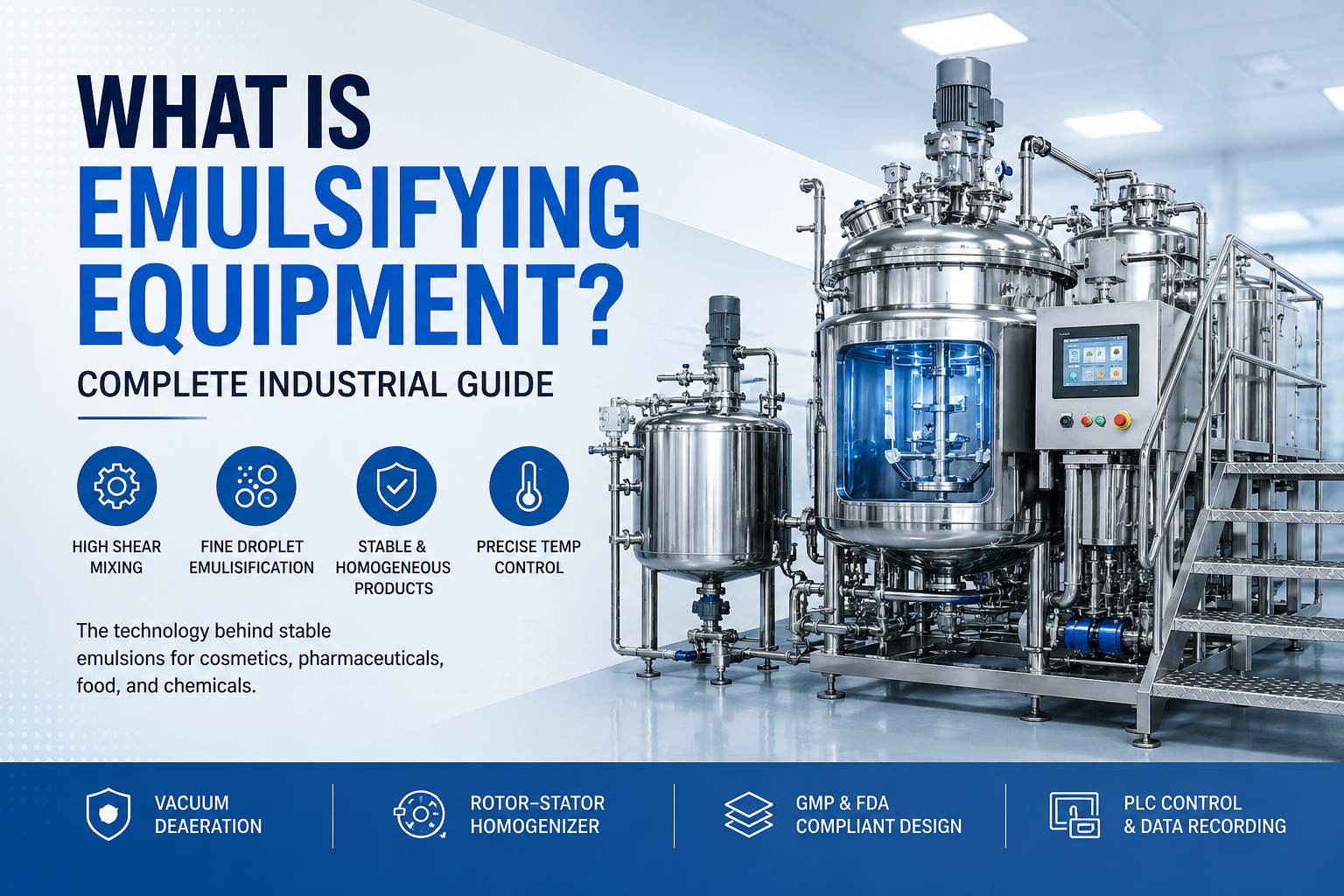
Industrial emulsifying equipment combines immiscible liquids such as oil and water into stable, repeatable products. This guide focuses on equipment types, applications, key components and selection criteria for cosmetics, pharmaceuticals, food and chemical production.
For a detailed explanation of rotor-stator mixing, vacuum deaeration and homogenization steps, read how an emulsifying machine works. If you are comparing machine capacities and configurations, review our vacuum emulsifier mixer models.
What Is Emulsification?
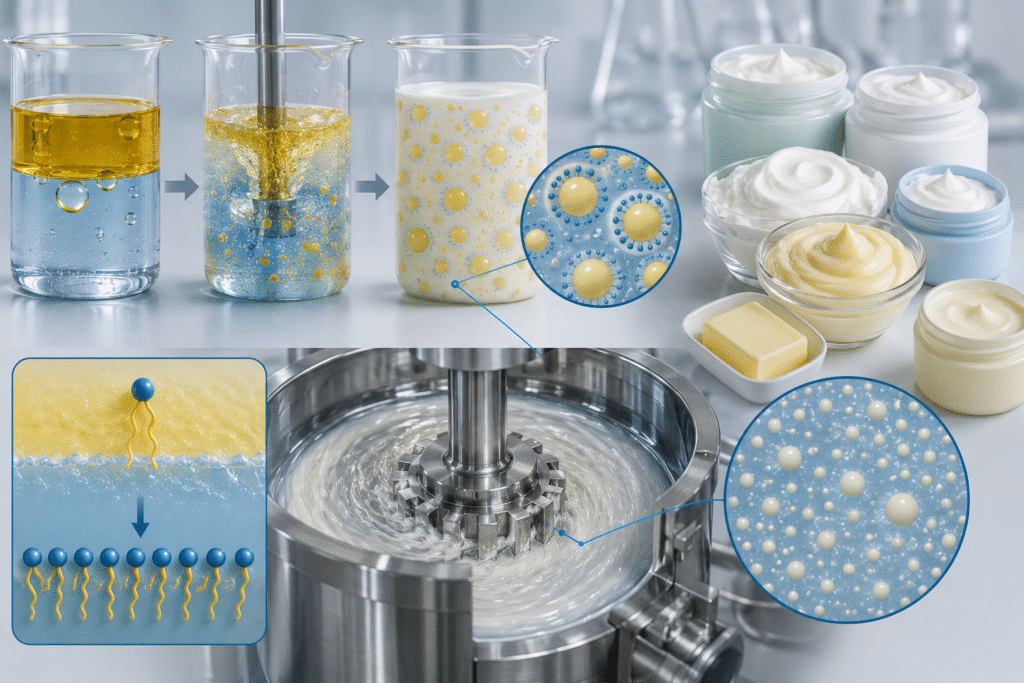
Emulsification is the process of dispersing one liquid into another immiscible liquid as tiny droplets to create stable emulsions. The liquid broken into droplets is called the dispersed phase, while the surrounding liquid is the continuous phase.
Most commercial products are either oil-in-water or water-in-oil emulsions. Oil-in-water emulsions, such as milk, mayonnaise, and many lotions, contain oil droplets suspended in water. Water-in-oil emulsions, such as butter, cold creams, and some ointments, contain water droplets dispersed in oil.
An emulsifier or emulsifying agent, such as lecithin or polysorbates, helps reduce interfacial tension and improves emulsion stability. However, the emulsifying process also requires mechanical forces. An emulsification mixer or emulsifying machine applies high shear to break liquids into smaller droplets, usually around 1–10 microns, creating a fine stable emulsion with better texture and shelf life.
What Is Emulsifying Equipment?
Emulsifying equipment is industrial machinery designed to combine immiscible liquids and create uniform, stable emulsions. Unlike standard mixers, these systems use controlled high shear mixing, temperature control, and vacuum to achieve consistent results.
The main functions of emulsifying equipment include:
- Mixing: Combining oil phase, water phase, and other materials into a pre-emulsion.
- High shear emulsification: Using rotor stator mixers or a homogenizer mixer to reduce droplet size and create fine emulsions.
- Dispersing: Breaking powder agglomerates and helping ingredients blend evenly.
- Vacuum deaeration: Removing air bubbles through a vacuum system to prevent oxidation and improve final product quality.
- Heating and cooling: Maintaining suitable temperatures for different materials. Vacuum emulsifying mixers often operate around 50–80°C for better processing performance.
- Particle size control: Adjusting parameters such as mixing speed and processing time to achieve the required droplet size.
Modern emulsifier mixers are used across multiple industries, including the cosmetics industry, food industry, pharmaceutical production, and chemical industries. They are suitable for products such as creams, lotions, ointments, gels, mayonnaise, salad dressings, detergents, and other emulsified products.
How Industrial Emulsifying Equipment Works
Most industrial systems combine four functions: bulk agitation, rotor-stator high shear, controlled heating or cooling, and optional vacuum deaeration. The best process sequence depends on the formulation, viscosity, batch size and target droplet size.
- Agitation combines the oil phase, water phase and powders into a pre-mix.
- High shear reduces droplet size and improves uniformity.
- Temperature control supports melting, hydration and controlled cooling.
- Vacuum helps remove entrained air when the formulation and process require it.
For the complete step-by-step process, see our dedicated emulsifying machine working principle guide.
Main Components of Emulsifying Equipment
A complete emulsifying machine integrates these parts:
- Main mixing vessel: SUS316L, 50–5,000 L, jacketed, pressure rated
- Rotor-stator homogenizer: Bottom or inline mounted, 5.5–55 kW motor
- Low-speed agitator: Anchor or frame type with PTFE scrapers, 0.75–7.5 kW
- Wall scraper: Prevents dead zones, ensures heat transfer
- Vacuum system: Water ring or dry claw pump, -0.095 MPa capacity
- Heating and cooling jacket: Dimple or half-pipe, steam/hot water/cold water
- Oil-phase tank: Smaller jacketed tank with agitator
- Water-phase tank: Jacketed with high-speed disperser for powders
- Pumps and pipelines: Sanitary lobe pumps, CIP-capable, tri-clamp fittings
- PLC control system: Recipe management, data logging, HMI touchscreen
KING PACK builds its vacuum emulsifying mixers with all 316L contact parts and CIP spray balls, which simplifies cleaning validation for pharmaceutical emulsifying machine applications.
Main Types of Emulsifying Equipment
Choosing the right emulsifying equipment depends on factors such as product viscosity, batch size, production volume, and whether the emulsification process requires batch or continuous operation. Different machines are designed for specific applications, from food production and cosmetics to chemical processing and other industries.
Batch Emulsifying Mixer
A batch emulsifying mixer is suitable for flexible emulsion production where manufacturers need to process different formulas in smaller or medium-sized batches. The complete mixing process takes place inside one vessel, making cleaning and product changeovers easier.
These mixers are commonly used for R&D facilities, multi-product plants, and products containing viscous materials with viscosities up to 500,000 cP. Capacities usually range from small batches of 5L to large systems of 2000L or more. Food-grade stainless steel construction is preferred for food applications to maintain hygiene and product safety.
Inline Emulsifier
An inline emulsifier is designed for continuous processing and high-volume production. Installed directly into pipelines, it uses mechanical shear to break down materials as they pass through the system.
This type of mixing system is often used for large-scale production runs or as a finishing step after batch mixing. Static mixers may also be combined with inline systems to improve blending consistency. They are widely used in food production, dairy products, and chemical applications where continuous output is required.
Vacuum Emulsifying Mixer
A vacuum emulsifying mixer combines mixing, homogenizing, heating, cooling, and vacuum functions in a single machine. It is commonly used for creams, lotions, gels, ointments, and other high viscosity substances.
During the emulsification process, the vacuum system removes air bubbles and helps prevent oxidation, improving the texture and stability of the final product. These machines are especially common in the cosmetics industry and personal care production.
King-Pack’s KPGZA Series vacuum emulsifying mixers are designed for high-performance emulsion production, including formulas with high oil content. Power options can be customized from 1.5KW to 55KW, depending on production needs.
High-Shear Mixer
A high-shear mixer is suitable for applications that require strong mixing forces to disperse powders, blend ingredients, and emulsify materials. It can be used with or without vacuum, depending on whether air removal is necessary.
These mixers are commonly found in food production, chemical industries, and many industries that process sauces, coatings, and other liquid products. They work well when manufacturers need efficient particle size reduction but do not require a full vacuum emulsifying system.
High-Pressure Homogenizer
A high-pressure homogenizer creates finer and more uniform emulsions by forcing materials through a narrow valve under extreme pressure. It can produce very small droplet sizes, making it suitable for specialized applications such as pharmaceuticals and nanoemulsions.
However, it is less suitable for extremely high viscosity products because very thick materials are harder to process under high pressure.
Planetary Vacuum Mixer
A planetary vacuum mixer is designed for extremely thick products such as toothpaste, adhesives, and other non-flowable materials. It uses planetary blades to knead high viscosity substances while the vacuum removes trapped air.
Unlike rotor stator mixers, planetary vacuum mixers focus on slow, powerful mixing rather than high-speed emulsification. They are ideal for materials that require careful handling and strong mixing performance.
Maintenance Considerations for Emulsifying Equipment
Regardless of the machine type, regular maintenance helps maintain product quality and extend equipment life. High-quality stainless steel construction improves durability, while routine inspections help identify issues early.
Manufacturers should regularly inspect seals and bearings to prevent leaks, clean emulsifier mixers between uses to avoid contamination, and maintain a maintenance log to track inspections and repairs. Proper maintenance supports stable operation and consistent results throughout the production process.
Emulsifier vs Mixer vs Homogenizer
These terms overlap but aren’t identical. Understanding the difference prevents buying the wrong machine.
A high shear emulsifying mixer is a type of emulsifier. A vacuum emulsifying mixer is an emulsifier with vacuum and thermal control. Most plants need an emulsifier, not just a mixer, if the product must not separate on the shelf.
Recommended Reading: Cosmetic Homogenizer Machine Guide: Working, Types, and Buying Tips – King Pack Machinery
Applications of Emulsifying Equipment
Cosmetics and Personal Care
The cosmetic emulsifying machine is the core of skin-care production. Examples: cream, lotion, sunscreen, conditioner, facial cleanser. These need vacuum to avoid bubbles that would look defective in a jar. Viscosity ranges from 5,000 cP for lotions to 300,000 cP for cold creams. EHEDG design is common.
Pharmaceutical Manufacturing
Pharmaceutical emulsifying machine units make ointment, medical cream, gel, and suspension. FDA 21 CFR Part 11 compliance, data integrity, and 3-A sanitary standards apply. Droplet size affects drug bioavailability. CIP/SIP is mandatory.
Food Manufacturing
Food emulsifying machine lines produce mayonnaise, salad dressing, sauce, and emulsified beverages. 3-A and USDA standards apply. Viscosity can exceed 250,000 cP. Acid and salt resistance requires 316L or better. More on food-grade standards.
Chemical Manufacturing
Examples: detergent, adhesive, coating, polish, chemical emulsion. These may need ATEX-rated explosion-proof motors if solvents are present. Viscosity and abrasiveness vary widely.
Benefits of Industrial Emulsifying Equipment
- More consistent product quality: PLC recipe control removes operator variability
- Better emulsion stability: Smaller droplets mean longer shelf life, per Stokes’ Law
- Smoother product texture: No gritty or oily feel from large droplets
- Reduced air bubbles: Vacuum prevents oxidation and filling errors
- Improved production efficiency: 30–60 min batch vs hours with low-shear
- Better temperature control: Jackets prevent overheating sensitive actives
- Lower manual labor: Automated lifting, vacuum, and CIP reduce handling
- Easier process management: Batch records, alarms, and trends on HMI
Factors Affecting Emulsification Quality
Emulsification equipment is critical, but process parameters matter too:
- Emulsifying agent: Type and % must match HLB of oil phase
- Mixing speed: Too low won’t break droplets; too high can break emulsion
- Homogenizing speed: Determines final droplet size; 3,000 vs 3,600 rpm is significant
- Processing time: 5 min may be insufficient; 30 min may over-process
- Temperature: Melt waxes, but avoid denaturing proteins
- Ingredient addition sequence: Oil into water vs water into oil changes emulsion type
- Product viscosity: >300,000 cP needs stronger agitator + homogenizer
- Vacuum level: -0.06 MPa removes 80% air; -0.09 MPa removes 95%
- Batch volume: Small batches overheat faster; large batches need longer times
Equipment alone cannot guarantee product stability. Formula, sequence, and control matter equally.
Recommended Reading: Recommended Pet Pharmaceutical Ointment & Cream Filling and Sealing Machines: Why Choose Modular Design – King Pack Machinery
How to Choose Emulsifying Equipment
Specify based on these factors before requesting a quote from an emulsifying equipment manufacturer:
Emulsifying Equipment Selection Table
Use the table below to compare the main equipment choices before confirming a quotation. Final sizing should be based on a product trial using the actual formula, because viscosity, solids, temperature and target droplet size can change the required mixer configuration.
| Equipment type | Best suited to | Key advantages | Check before selecting |
|---|---|---|---|
| Batch high-shear mixer | Flexible formulas and small-to-medium batches | Fast dispersion, simple changeover and broad application range | Batch volume, viscosity, rotor-stator design and cooling load |
| Inline emulsifier | Continuous or high-volume processing | Consistent recirculation and easy integration into a production line | Required flow rate, number of passes, pump capacity and pressure drop |
| Vacuum emulsifying mixer | Creams, lotions, gels and ointments that must be bubble-free | Combines mixing, homogenizing, heating, cooling and deaeration | Working volume, vacuum level, heating/cooling time, CIP and discharge method |
| High-pressure homogenizer | Fine emulsions and narrow droplet-size distribution | Produces very small, uniform droplets | Feed viscosity, operating pressure, heat generation and number of passes |
| Planetary vacuum mixer | Very high-viscosity or poorly flowing products | Strong kneading action with vacuum deaeration | Agitator torque, scraper design, discharge method and cleaning access |
Specifications to Give Your Equipment Supplier
- Formula and application: product type, oil/water phase, solids, abrasives and heat-sensitive ingredients.
- Process target: starting and final viscosity, required droplet or particle size, batch time and temperature range.
- Production requirement: minimum and maximum working volume, batches per shift or continuous flow rate.
- Hygiene and utilities: product-contact material, surface finish, CIP/SIP needs, vacuum, steam, chilled water, air and electrical supply.
- Line integration: transfer pump, buffer tank and connection to the downstream filling or packaging machine.
- Product type: Cream vs sauce vs ointment dictates shear and vacuum needs
- Product viscosity: 10,000 cP vs 400,000 cP changes motor power and agitator type
- Batch size: 50 L lab vs 2,000 L production affects heating/cooling time
- Required output: Kg/h determines if batch or inline is better
- Heating and cooling requirements: Steam at 3 bar or hot water at 90°C?
- Vacuum requirements: Cosmetic cream needs it; some sauces do not
- Contact material: 316L standard; Hastelloy for chlorides
- Cleaning method: CIP spray balls + sanitary design for allergen changeover
- Automation level: Manual valves vs full recipe control
- Factory layout: Ceiling height for lid lifting, floor loading
- Downstream filling equipment: Emulsifier discharge height must match cream filling machine or tube filling and sealing machine infeed
From Emulsification to Filling and Packaging
Emulsification is upstream. The finished emulsion must be transferred, filled, and packed without breaking. A typical process flow:
The filling machine must match product viscosity, filling volume, container type, and production speed. High-viscosity creams need piston fillers or servo pump fillers. Sauces can use gravity or pump fillers. Tubes need a tube filling and sealing machine with hot air sealing. Bottles need a filling and capping line with torque control.
Recommended Reading: How an Automatic Tube Filling and Sealing Machine Works – King Pack Machinery
Common Emulsification Problems
Even with good equipment, issues occur. Here’s how to troubleshoot:
| Problem | Possible Cause | Recommended Solution |
|---|---|---|
| Product separation | Droplet size too large; insufficient shear | Increase homogenizing speed/time; check rotor-stator gap |
| Excessive foam | No vacuum; high agitator speed during oil add | Apply vacuum before oil addition; reduce speed to 30 rpm |
| Air bubbles | Leak in shaft seal; incomplete deaeration | Replace seals; extend vacuum time to 10–15 min |
| Undispersed powder | Added too fast; no pre-mix | Use high-speed disperser in water tank; add slowly |
| Uneven viscosity | Poor temperature control; dead zones | Verify jacket flow; check wall scraper contact |
| Material sticking to tank wall | Scraper worn; product too cold | Replace PTFE scrapers; raise jacket temp 5°C |
| Unstable filling accuracy | Air in product; viscosity drift | Improve deaeration; control discharge temp ±1°C |
How to Choose an Emulsifying Equipment Manufacturer
Vet suppliers on more than price:
- Industry experience: Have they built for your product type before?
- Machine quality: Inspect welds, Ra finish, component brands like Siemens, ABB
- Sample testing: Can they run your formula in their lab?
- Customization capability: Can they add a second homogenizer or extra valve?
- Material and component quality: 316L, FDA gaskets, IP65 panels
- Production-line integration: Will they match emulsifier discharge to your filler?
- Installation support: On-site commissioning and IQ/OQ documentation
- After-sales service: 7×24 response, local technicians
- Spare parts availability: Stator, seals, gaskets in stock
King-Pack is a manufacturer of emulsifying, filling and packaging machinery with 20+ years serving cosmetic, pharmaceutical, food, and chemical plants. Our team provides sample testing, turnkey line integration, and global service.
Frequently Asked Questions
Q1: What is emulsifying equipment?
Emulsifying equipment is an industrial machine that uses high shear, temperature control, and often vacuum to disperse one immiscible liquid into another, creating a stable emulsion.
Q2: What is an emulsifying machine used for?
An emulsifying machine is used for cream, lotion, ointment, mayonnaise, sauce, and chemical emulsions where droplet size and stability are critical.
Q3: How does an emulsifying machine work?
It combines a low-speed agitator for bulk mixing and a high-speed rotor-stator homogenizer for droplet breakup, usually under vacuum with heating/cooling jackets.
Q4: What is the difference between an emulsifier and a homogenizer?
An emulsifier creates the emulsion using rotor-stator shear. A homogenizer, especially high-pressure type, reduces droplet size further and is often used after emulsification.
Q5: Why is vacuum used during emulsification?
Vacuum used during emulsification removes air to prevent oxidation, bubbles in the final pack, and pump cavitation. It also allows low-temperature processing.
Q6: What products can be made with emulsifying equipment?
Cosmetic cream, pharmaceutical ointment, food mayonnaise, chemical detergent, and many gels, suspensions, and adhesives.
Q7: Can emulsifying equipment process high-viscosity products?
Yes. With a strong anchor agitator, wall scraper, and high-torque homogenizer, a vacuum emulsifying mixer handles up to 500,000 cP. Planetary mixers go higher.
Q8: How do I choose the correct emulsifying machine size?
Base it on batch size, cooling time, and downstream filling speed. A 500 L mixer feeding a 60 bpm cream filling machine is a common balance.
Q9: Can an emulsifying machine connect directly to a filling machine?
Yes. With a discharge pump, heat-traced pipeline, and buffer hopper, the emulsifying machine can feed an automatic filling machine directly, reducing air pickup and microbial risk.
Looking for Emulsifying and Filling Equipment?
King-Pack provides customized emulsifying, mixing, filling, sealing and packaging equipment for cosmetic, pharmaceutical, food and chemical manufacturers. As a professional manufacturer of emulsifying, filling and customized packaging equipment, we integrate vacuum emulsifying mixers with cream filling machines, tube filling and sealing machines, and full filling and capping lines to ensure your emulsion stays stable from tank to package. Contact us for a Customized Emulsifying Equipment Solution.
