 Skip to content
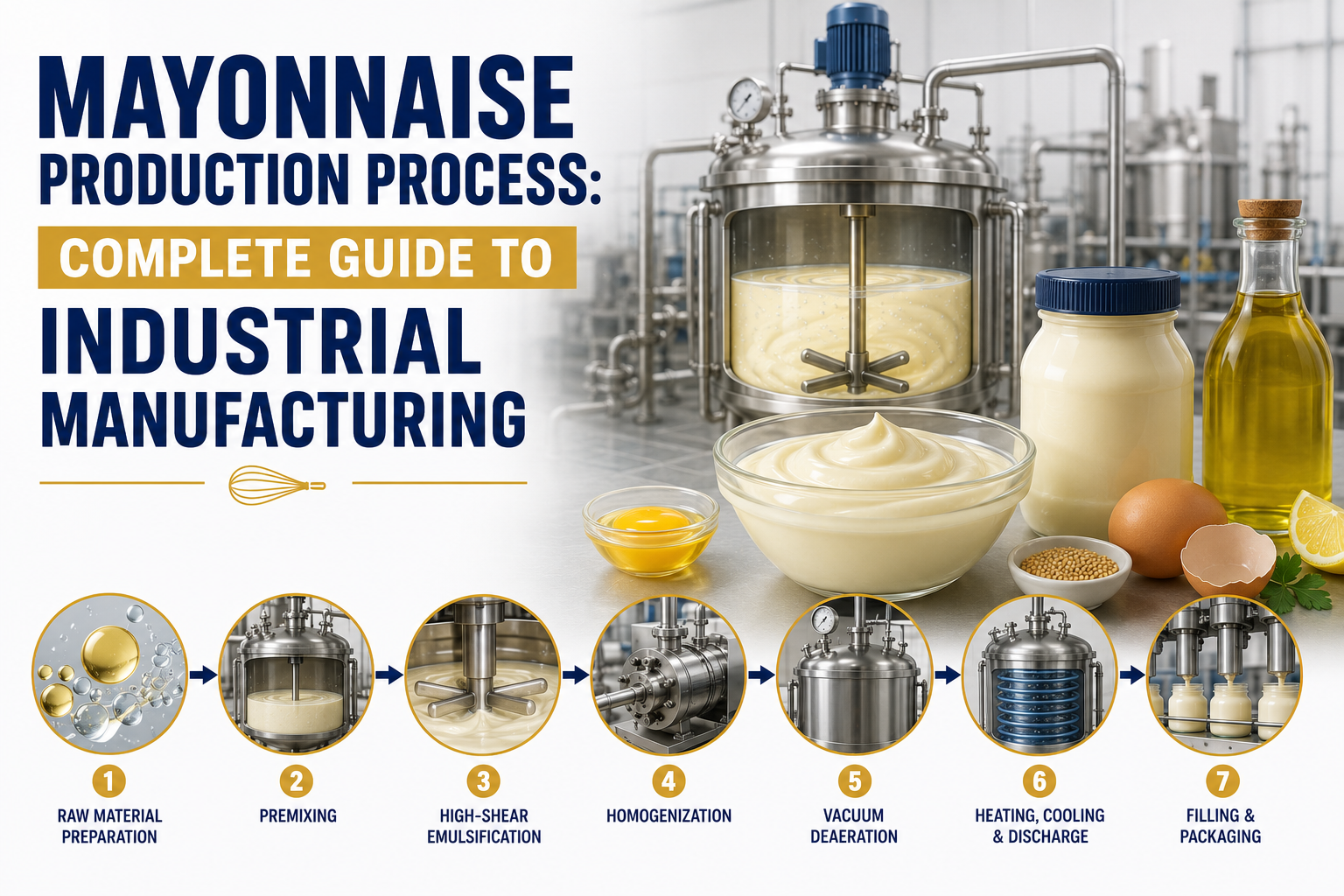
Mayonnaise is a semi-solid, oil-in-water emulsion that requires precise process control. Small mistakes in shear, temperature, or ingredient addition can break the emulsion, causing oil separation and inconsistent viscosity. This is why commercial mayonnaise production is far more controlled than making mayonnaise at home.
Industrial production lines use high-shear homogenizers, vacuum deaeration, inline viscosity monitoring, and CIP-compatible filling systems to deliver consistent quality, food safety, and shelf stability at high production volumes. Understanding these processes helps manufacturers choose the right mayonnaise production line and reduce downtime.
This guide explains the ingredients, the commercial mayonnaise manufacturing process, and the equipment used to produce and package mayonnaise efficiently, including automatic sauce filling machines.
What Is Mayonnaise Made Of?
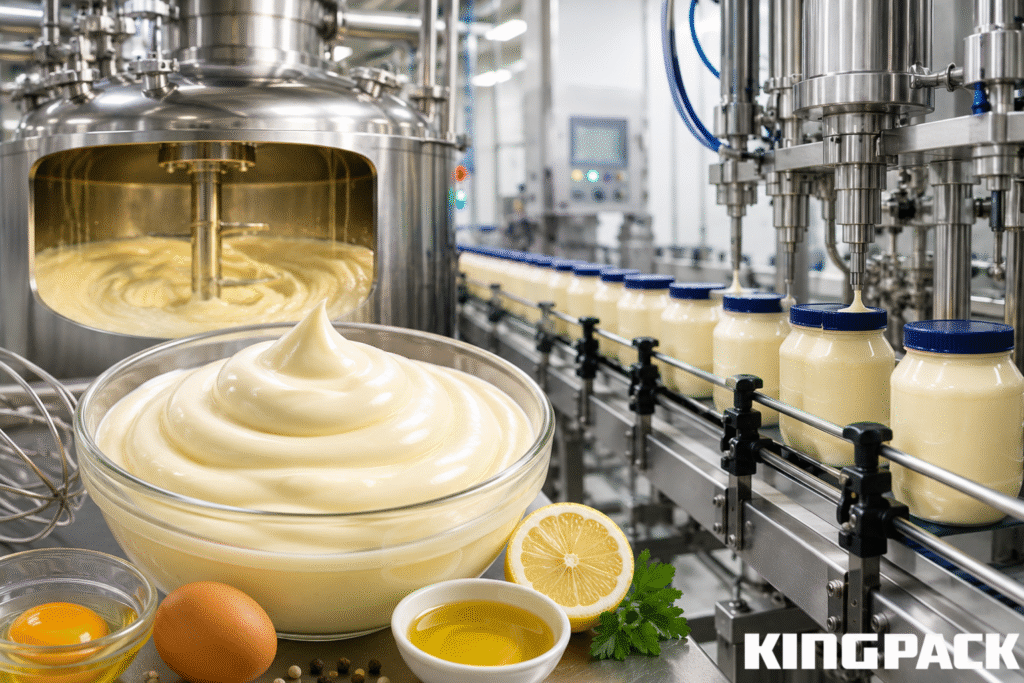
Codex Alimentarius defines mayonnaise as a product containing at least 65% vegetable oil by weight. Beyond oil, the formula balances emulsifiers, acids, and stabilizers to achieve texture and microbial control.
While ingredient ratios vary between manufacturers and product types, every commercial formula is designed to produce a stable, smooth emulsion that meets quality and food safety standards. Each ingredient has a specific role, from building viscosity and enhancing flavor to improving shelf life and preventing oil separation. Understanding these functions helps manufacturers optimize both product quality and production efficiency.
The table below outlines the primary ingredients used in commercial mayonnaise production, their typical proportions, and their role in the manufacturing process.
| Ingredient | Typical % in Commercial Formula | Function in Mayonnaise Production Process | Critical Control Point |
| Vegetable Oil | 70%–80% | Continuous phase; provides body, mouthfeel, viscosity | Oil temperature 20–25°C; filtered to 50–100 μm |
| Liquid Egg Yolk | 4%–8% | Natural emulsifier via lecithin; stabilizes oil-water interface | Pasteurized; pH <4.5; stored at 0–4°C |
| Vinegar (5% Acidity) | 2%–4% | Lowers pH to 3.6–4.1 for microbial safety; adds flavor | Final pH verification before filling |
| Water | 5%–10% | Disperses salt and sugar; forms water phase of emulsion | RO/UV treated; low hardness |
| Salt | 1%–2% | Flavor enhancement; reduces water activity | Fully dissolved in water phase |
| Sugar | 1%–4% | Balances acidity; contributes to browning if baked | Pre-hydrated to avoid lumps |
| Stabilizers | 0.1%–1% | Xanthan gum or modified starch for reduced-oil or freeze-thaw stability | Hydration time 15–30 minutes |
| EDTA | 50–75 ppm | Chelates metals; prevents oxidation and rancidity | Regulatory limit check |
The following subsections outline how each input affects the industrial mayonnaise manufacturing process.
1. Vegetable Oil
Oil makes up 70–80% of most commercial formulas. Soybean, rapeseed, and sunflower oil are common because they provide a neutral flavor and excellent oxidative stability. In homemade recipes, many people prefer avocado oil, canola oil, or another neutral oil because they emulsify easily without overpowering the other ingredients.
Some also choose light olive oil, while extra virgin olive oil or regular olive oil can produce a stronger flavor and may become slightly bitter after blending.
2. Egg Yolk
Egg yolk supplies lecithin and lipoproteins that act as natural emulsifiers. Liquid pasteurized yolk is standard in industrial mayonnaise manufacturing because it reduces Salmonella risk and allows pumpable dosing.
Typical usage is 4–8% of the formula. The phospholipids adsorb at the oil-water interface, preventing coalescence. Over-processing denatures yolk proteins, so shear and temperature are controlled during the high-shear stage.
A homemade mayo recipe typically starts with one large whole egg or raw egg, although pasteurized eggs are recommended for better food safety. Some specialty recipes separate the egg whites or combine egg and lemon juice before emulsification.
3. Vinegar or Lemon Juice
Acid lowers pH to 3.6–4.1, which inhibits pathogen growth and contributes to flavor. Distilled white vinegar at 5% acidity is common, but apple cider or lemon juice appear in specialty products. Acid is added to the water phase before emulsification to help pre-dissolve salt and sugar. The final pH is a critical control point audited in HACCP plans.
Besides distilled vinegar, recipes may also use white wine vinegar, apple cider vinegar, or other wine vinegar varieties. Some cooks substitute bottled lemon juice or add extra lemon juice to brighten the flavor.
4. Salt, Sugar and Other Additives
Salt at 1–2% enhances flavor and reduces water activity. Sugar balances acidity at 1–4%. Stabilizers like xanthan gum or modified starch are used in reduced-oil mayonnaise to maintain body. EDTA may be added at ppm levels as a metal chelator to prevent oxidation. All dry ingredients are pre-hydrated to avoid lumps that would clog a mayonnaise filling machine.
How Is Mayonnaise Made Commercially?
The commercial mayonnaise production sequence focuses on creating a stable emulsion and protecting it through filling. Here’s how is mayonnaise made at scale.
Step 1 — Raw Material Preparation
Ingredients are staged in temperature-controlled rooms. Oil is filtered to 50–100 microns to remove particulates that could damage pumps.
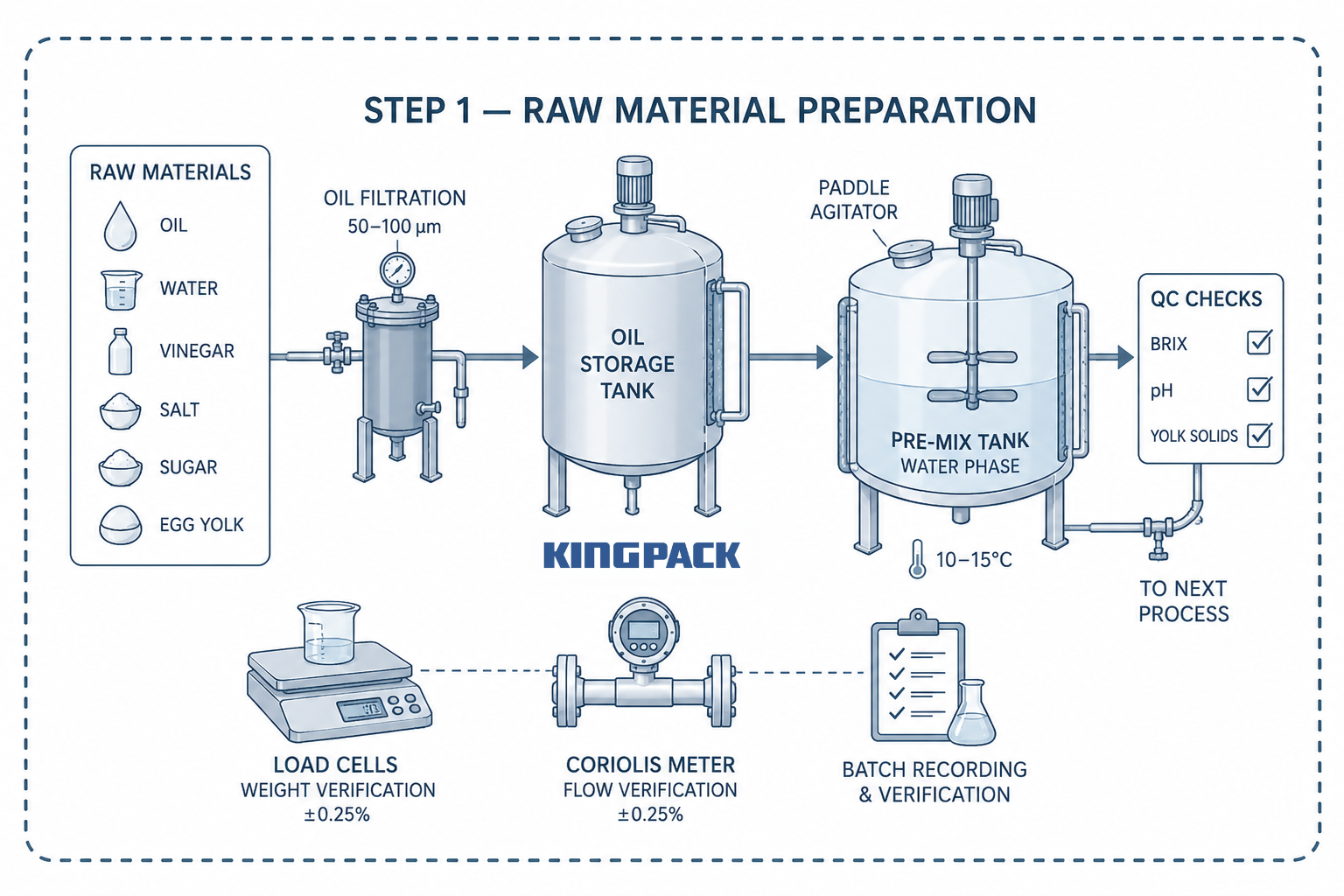
Water phase ingredients — water, vinegar, salt, sugar, yolk — are dissolved in a pre-mix tank with a paddle agitator. Tanks are jacketed for 10–15°C to control microbial growth. Load cells and Coriolis meters verify batch weights within ±0.25%. Before transfer, QC checks Brix, pH, and yolk solids.
Step 2 — Mixing and Emulsification
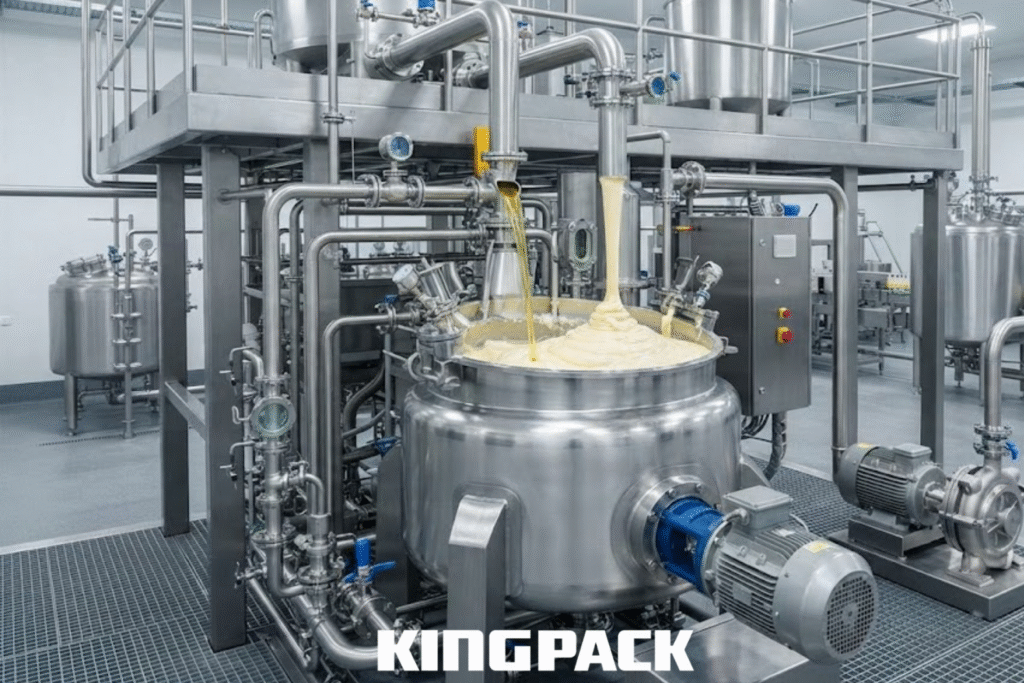
This is the heart of the mayonnaise production process. The water phase is pulled into a vacuum emulsifying mixer. Vacuum at -0.06 to -0.08 MPa removes entrained air that would cause oxidation and poor shelf appearance. Oil is then dosed into the mixer under high shear, typically via a rotor-stator at 3000–3600 rpm. Tip speed of 15–25 m/s creates droplets below 5 microns.
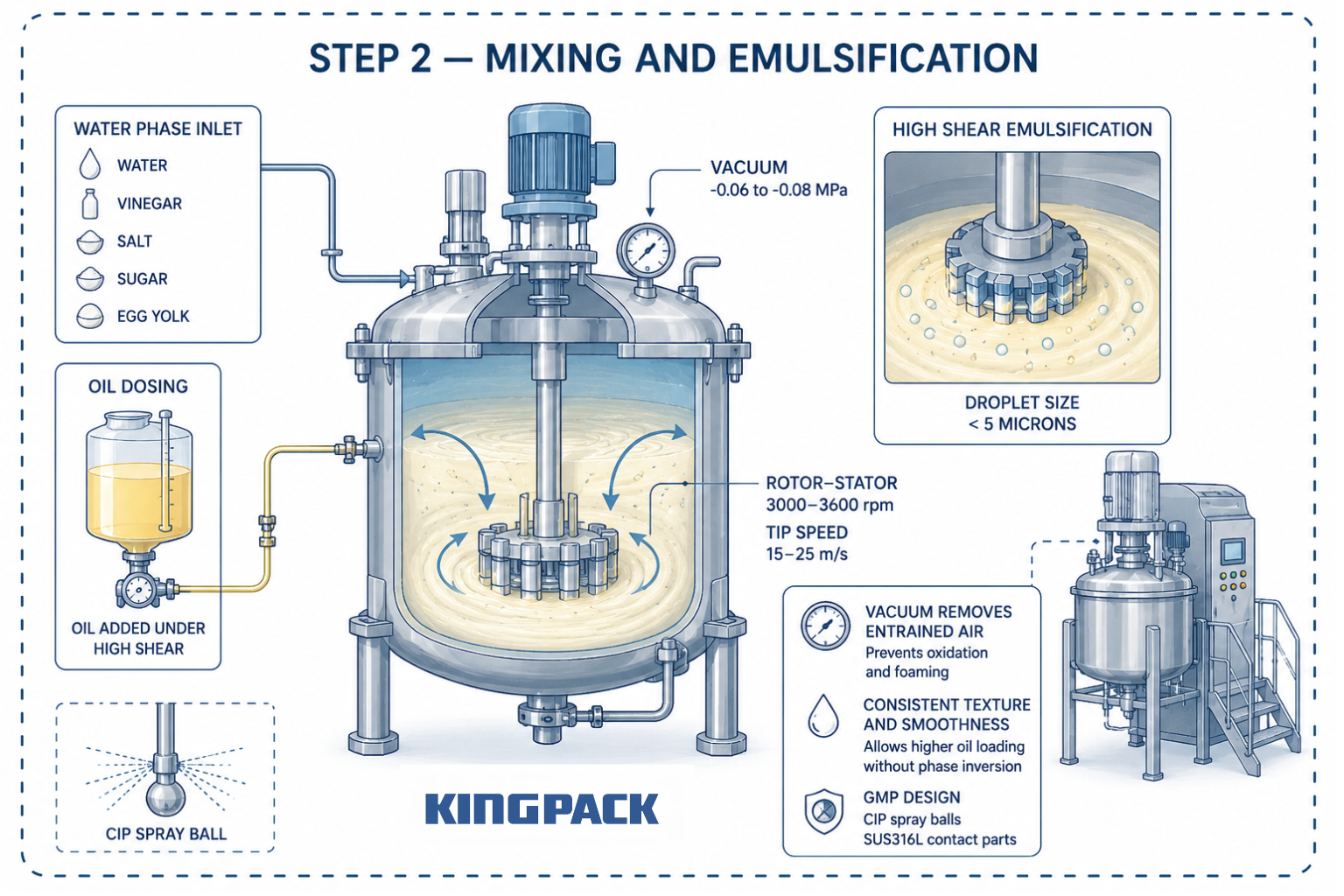
Industrial mayonnaise manufacturers often use vacuum emulsifying mixers to achieve consistent texture, smoothness, and stable product quality. The vacuum also prevents foaming and allows higher oil loading without phase inversion. Temperature is held below 30°C to avoid cooking the egg. Our vacuum emulsifying mixers are designed with CIP spray balls and SUS316L contact parts, which helps plants meet GMP sanitation requirements during this stage.
Step 3 — Homogenization and Quality Control
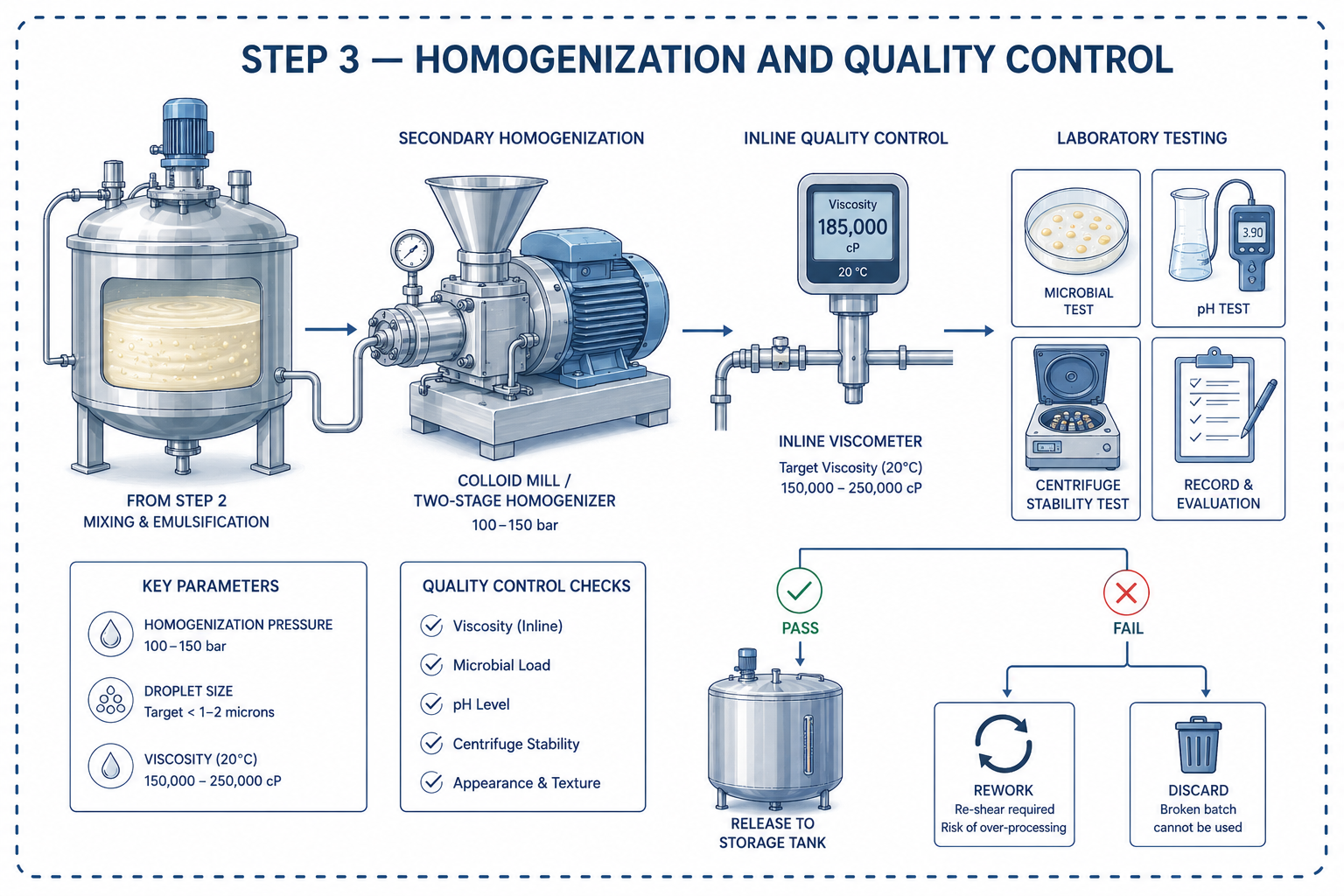
After primary emulsification, some lines pass the product through a secondary colloid mill or two-stage homogenizer at 100–150 bar to narrow droplet size distribution. Inline viscometers check viscosity, targeting 150,000–250,000 cP at 20°C for spoonable mayonnaise. Samples go to the lab for microbial testing, pH, and centrifuge stability tests. If the emulsion passes, it’s released to storage. A broken batch is reworked or discarded — reworking requires re-shearing and risks over-processing.
Step 4 — Storage and Transfer
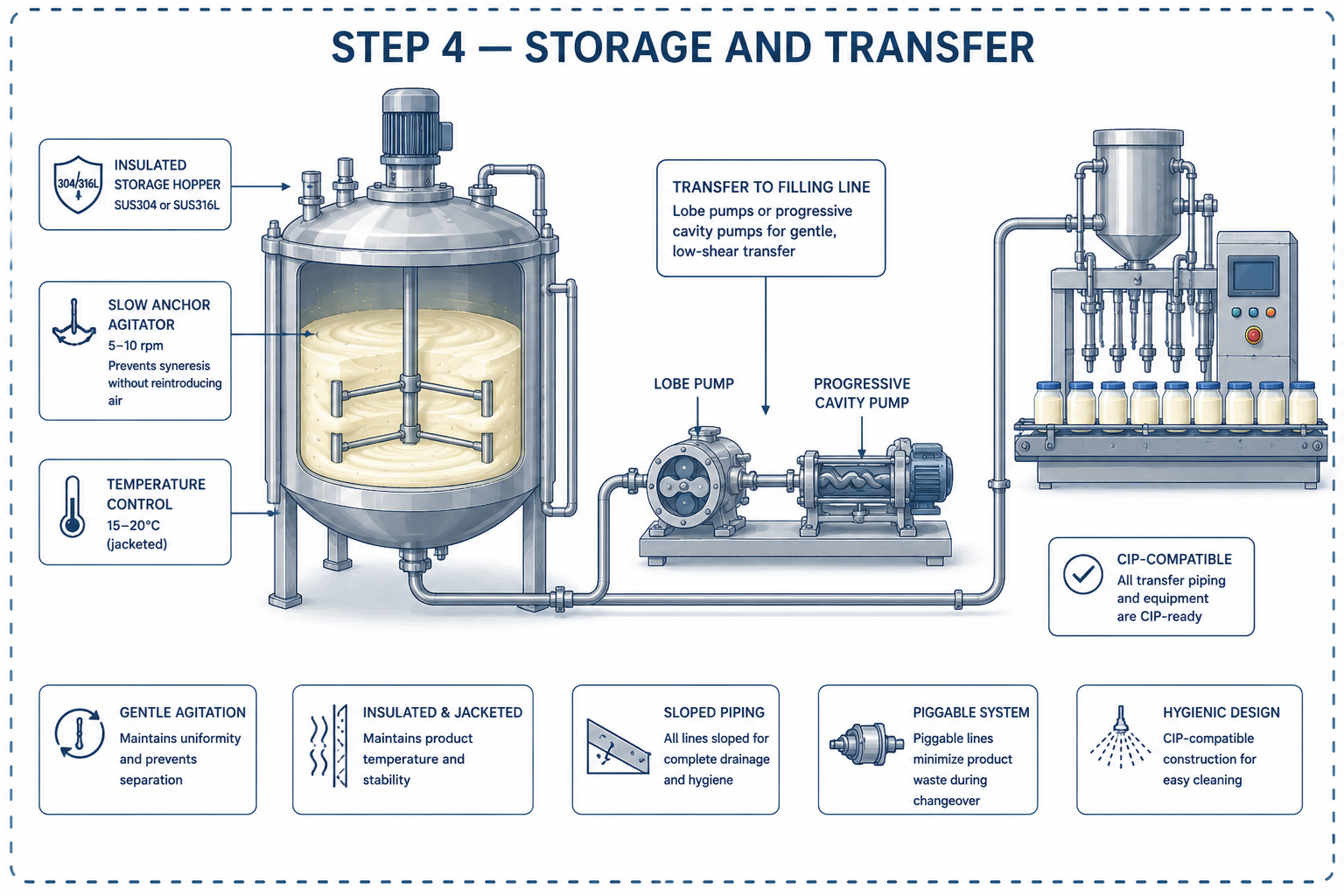
Finished mayonnaise moves to insulated SUS304 or SUS316L storage hoppers with slow anchor agitators at 5–10 rpm. Agitation prevents syneresis but must not reintroduce air. Jackets maintain 15–20°C. From here, lobe pumps or progressive cavity pumps transfer product to the filling line. Lines are piggable to minimize waste during changeover. All transfer piping is sloped and CIP-compatible.
Step 5 — Filling and Packaging
After production, mayonnaise needs accurate and hygienic filling into bottles, jars, tubes, or pouches. Viscosity ranges from 100,000 to 300,000 cP, so gravity fillers won’t work. Plants use piston, servo-pump, or auger fillers with nozzle shut-off to prevent dripping.
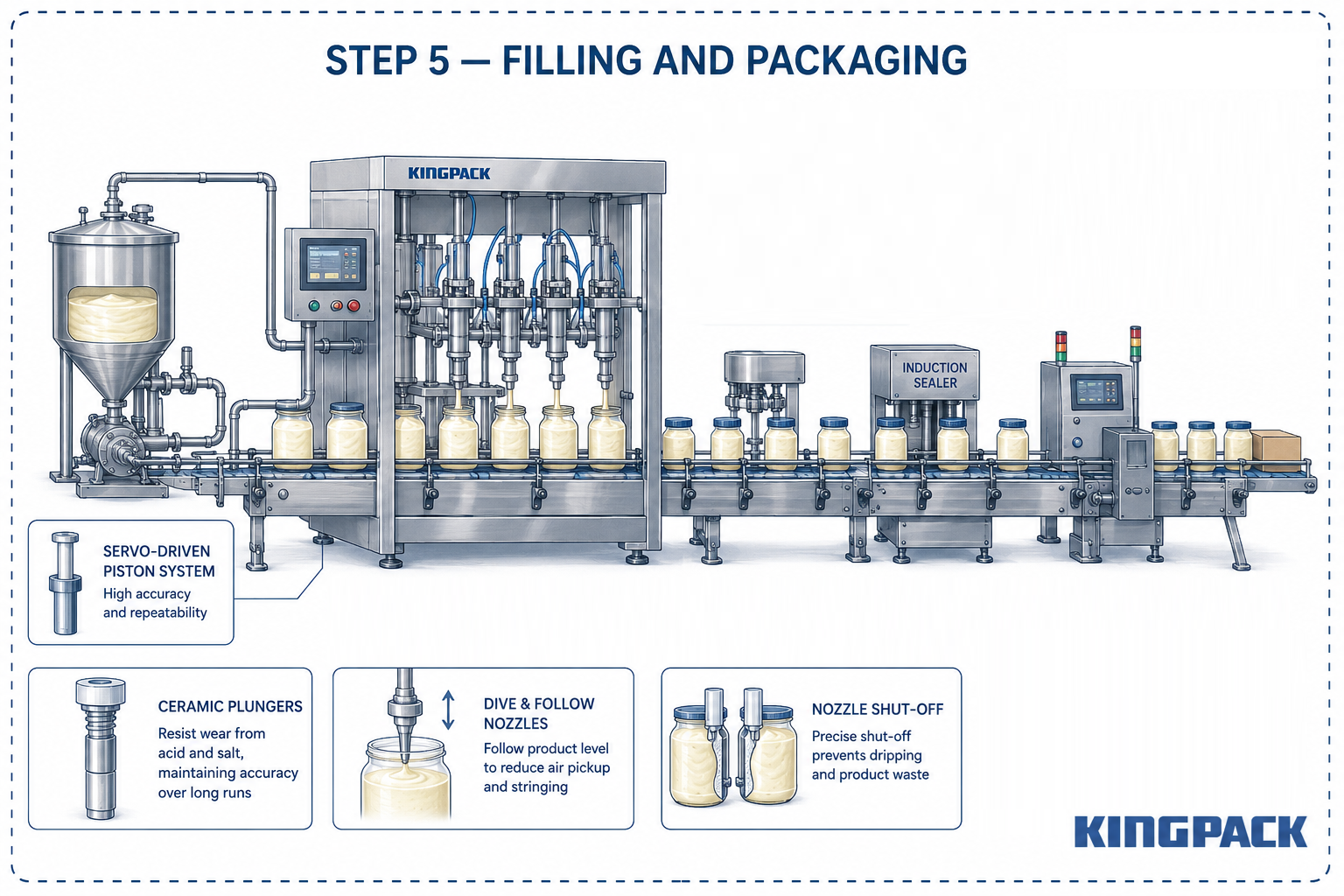
Automatic filling machines improve efficiency, accuracy, and hygiene standards. A mayonnaise filling machine typically holds fill accuracy to ±0.5%–1% using servo-driven pistons.
For example, King-Pack’s piston fillers use ceramic plungers that resist wear from acid and salt, maintaining accuracy over long runs. Nozzles dive and follow the product level to reduce air pickup and stringing. After filling, inline cappers, induction sealers, and X-ray checkweighers complete the pack.
Recommended Reading: How Food-Grade Tube Sealing Improves the Shelf Life of Mayonnaise – King Pack Machinery
Industrial Mayonnaise Manufacturing Process Flow
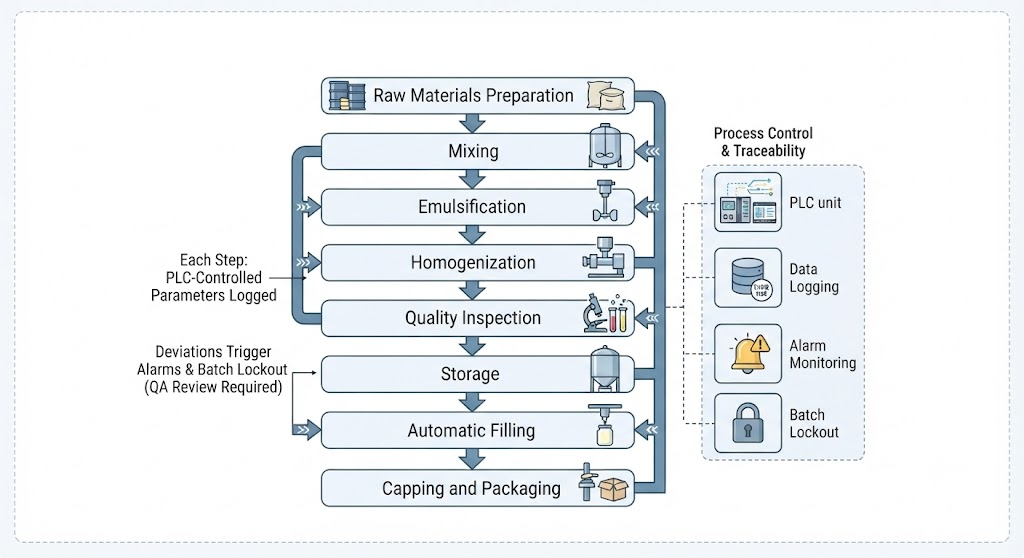
A typical mayonnaise production line follows this sequence:
Each step has PLC-controlled parameters logged for traceability. Deviations trigger alarms and lock out the batch until QA review.
What Equipment Is Used for Mayonnaise Production?
Commercial lines integrate several key machines. Sizing depends on target output, from 200 kg/h pilot systems to 5,000 kg/h continuous lines.
The table below maps each major unit in a mayonnaise production line to viscosity range, critical specs, and common applications. Use it to match equipment to your target output and container type before sizing pumps, nozzles, or CIP circuits.
| Equipment Type | Best For | Viscosity Range | Key Specs for Mayonnaise | King-Pack Example |
| Vacuum Emulsifying Mixer | Primary emulsification, batch process | 1,000–500,000 cP | Rotor-stator 3000–3600 rpm, vacuum -0.08 MPa, SUS316L, CIP | KPGZA Series Vacuum Emulsifier |
| Colloid Mill | Secondary size reduction after pre-mix | 10,000–300,000 cP | Gap 0.05–0.5 mm, 2900 rpm, sanitary design | Optional inline homogenizer |
| Piston Filling Machine | Jars, bottles, wide-mouth containers | 50,000–300,000 cP | Servo drive, ±0.5% accuracy, dive-fill nozzles, 316L ceramic | KPF Automatic Piston Filler |
| Servo Pump Filler | Bottles, squeeze tubes, pouches | 5,000–200,000 cP | Rotary lobe or gear pump, no-drip cut-off | King-Pack Sauce Filling Line |
| Premade Pouch Filling Machine | Stand-up pouches, spouted packs | 20,000–150,000 cP | Nitrogen flush, zipper sealer, GMP/HACCP compliant | KPGZ-200P Pouch Filler |
Each unit affects the next stage. A stable emulsion from the mixer prevents filling errors, while proper filler design protects the emulsion you just created. The next sections detail how each machine works.
Vacuum Emulsifying Mixer
This is the core unit for the industrial mayonnaise manufacturing process.
Key advantages: high shear mixing, uniform emulsification, stable product texture, and suitability for high viscosity products up to 500,000 cP. Units range from 50 L lab scale to 2,000 L production vessels. Look for dual jackets, vacuum to -0.095 MPa, and bottom-mounted homogenizer. CIP and SIP functions are critical for allergen changeover.
Recommended Reading: What Factors Affect the Shelf Life of Mayonnaise? – King Pack Machinery
Mayonnaise Filling Machine
Applications: mayonnaise, sauces, dressings, cream products. Key features to specify: accurate piston filling with servo control system, 316L stainless steel product path, sanitary tri-clamp fittings, easy cleaning design, and automatic operation with no-bottle-no-fill sensors.
For high output, rotary piston fillers reach 200–400 bottles/min with ±0.5% accuracy. Kpfilling’s food filling machine manufacturer division builds lines with dive-fill nozzles and anti-drip cut-off specifically for viscous sauces. Heated hoppers are optional for products that crystallize at room temp.
Automatic Sauce Packaging Machine
Suitable for ketchup, mayonnaise, salad dressing, and other viscous sauces. These lines integrate filling, capping, labeling, and case packing. For pouches, premade pouch filling machines use servo augers or pumps, nitrogen flushing, and zipper sealing.
Pouch formats save freight and shelf space compared to glass jars. Kpfilling supplies premade pouch systems that handle stand-up, 3-side seal, and spouted formats with GMP/HACCP compliant design.
Benefits of Using an Automatic Mayonnaise Production Line
- Higher Production Efficiency: Continuous or semi-continuous lines cut batch times. A 1,000 L vacuum mixer can output a batch in 20–30 minutes vs. 60+ minutes with low-shear methods.
- Consistent Product Quality: Closed-loop control of shear, vacuum, and temperature removes operator variability. Droplet size stays within a 2–8 micron target.
- Better Filling Accuracy: Servo piston fillers reduce giveaway. At ±0.5%, a plant running 10 million 500g jars/year saves 25 metric tons of product.
- Reduced Labor Requirements: A full line from mixer to palletizer can run with 2–4 operators, compared to 8–10 for manual lines.
- Improved Food Safety: Enclosed systems, CIP, and 316L contact surfaces reduce contamination risk. EHEDG guidelines recommend this for high-risk products.
- Easier Production Management: SCADA collects OEE, batch records, and traceability data for audits.
Homemade Mayonnaise Recipe vs Industrial Production
Commercial mayonnaise and homemade mayonnaise share the same principle: combining oil and water into a stable emulsion. Difference is equipment, production scale, and level of process control. A homemade mayonnaise recipe makes small batches, while industrial uses vacuum emulsifying mixers and high-shear homogenizers for consistent texture and quality at industrial scale.
Easy homemade mayonnaise recipe: one whole egg, 1 tablespoon of Dijon mustard, vinegar, 1 cup of oil. All traditional recipes use the same emulsification process for smooth, creamy mayonnaise.
For a stable emulsion, many use immersion blender, stick blender, or hand blender.
- A stick or immersion blender works best when blender head is fully submerged in a tall container or mason jar to emulsify evenly from bottom of the jar upward.
- A food processor suits larger batches, but a small bowl attachment is better for smaller quantities.
- A stand mixer works but takes longer for same consistency. Keep food processor running while gradually adding the oil.
As mixture begins to emulsify, mayonnaise starts forming at bottom of the container. Pour oil in a slow, steady stream – whether you pour the oil, slowly pour or slowly add, you must add oil gradually so emulsion remains stable. Rushing making mayo overwhelms the emulsifier and it will separate.
Some add herbs, spices, or other natural flavors for taste buds, others buy mayonnaise. Commercial manufacturers get smooth texture via automated metering systems that precisely control oil addition, mixing speed, temperature, and vacuum conditions, controlling droplet size, shelf stability, and quality standards without manual pouring.
Broken Mayonnaise: How to Fix Broken Mayonnaise
A broken mayonnaise occurs when the oil and water phases separate before a stable emulsion forms. At home, this usually happens when too much oil is added too quickly or when the ingredients are at very different temperatures, leaving a thin, runny mess instead of a smooth spread.
Fortunately, it’s often possible to fix broken mayonnaise. A common method is to place a fresh egg yolk in a clean bowl and slowly whisk the separated mixture into it a little at a time. The new yolk provides fresh emulsifying agents that help rebuild the emulsion and recover the broken mayo.
Industrial manufacturers reduce this risk by carefully controlling oil addition rates, mixing speed, temperature, and vacuum conditions throughout the emulsification process. Automated process controls make emulsion failure far less likely, which helps minimize product waste and maintain consistent quality from batch to batch.
How to Choose a Mayonnaise Production Equipment Manufacturer?
Selecting a mayonnaise production line manufacturer impacts uptime for the next 10–15 years. Evaluate these factors:
- Manufacturing experience: Look for 10+ years in sauces and emulsions. Ask for references in your region.
- Machine quality: Demand 316L contact parts, FDA-grade gaskets, and IP65 washdown controls.
- Production capacity: Match mixer and filler speeds. A 500 L mixer should feed a filler at 80–120 bpm for balance.
- Customization capability: Can they adjust nozzle diameter for your jar? Add nitrogen blanketing?
- After-sales support: 7×24 technical support and local spare parts matter. King-Pack, for example, provides on-site installation and operator training.
- Compliance requirements: CE, UL, GMP, and 3-A standards depending on market.
Frequently Asked Questions (FAQ)
Q1: How is mayonnaise manufactured commercially?
Commercial mayonnaise production uses a vacuum emulsifying mixer to combine oil and water phase under high shear. The process includes raw material prep, emulsification, homogenization, QC, storage, and automatic filling.
Q2: What machine is used to make mayonnaise?
The primary machine is a vacuum emulsifying mixer or high-shear homogenizer. It creates the fine oil droplets needed for a stable emulsion.
Q3: Can mayonnaise be filled automatically?
Yes. Automatic sauce filling machines with piston or servo pump technology handle high viscosity. They dose into bottles, jars, or pouches with minimal operator input.
Q4: What type of filling machine is suitable for high viscosity sauces?
Piston fillers, servo-driven pump fillers, and auger fillers are standard. Key is a positive displacement mechanism and drip-free nozzle. Time-pressure fillers are not recommended above 50,000 cP.
Q5: How Long Does Homemade Mayonnaise Last?
Homemade mayonnaise usually lasts 3 to 5 days in the refrigerator when made with raw eggs. If stored properly in an airtight container, some recipes recommend using it within up to one week for the best quality.
Q5: Can Homemade Mayonnaise Be Used in Other Recipes?
Homemade mayonnaise works well in egg salad, tuna salad, creamy coleslaw, potato salad, deviled eggs, and Maryland-style crab cakes. It is also a common base for ranch dressing and many other creamy sauces.
Looking for a Complete Mayonnaise Production Solution?
King-Pack provides customized food processing and packaging solutions, including vacuum emulsifying mixers, mayonnaise filling machines, and automatic sauce filling systems. As a professional manufacturer of filling machines and customized food packaging solutions, King-Pack helps plants specify equipment that matches viscosity, output, and hygiene targets.
Our solutions help food manufacturers improve production efficiency, product consistency, and packaging quality. We’ve delivered lines to 60+ countries and support GMP, ISO9001, and CE standards. Contact us today for a customized mayonnaise production solution.
Content ScoreSEOAI SearchAuto-Optimize
#1Research & Create Outline
#2Write & Optimize
#3Internal Links
#4Pre-Publish Review
#5Publish or Export
words28053.1K-3.6K
headings2812-17
paragraphs5558+
Mayonnaise Production Process: Complete Guide on Industrial Made Mayonnaise Manufacturing
Mayonnaise is a semi-solid, oil-in-water emulsion that requires precise process control. Small mistakes in shear, temperature, or ingredient addition can break the emulsion, causing oil separation and inconsistent viscosity. This is why commercial mayonnaise production is far more controlled than making mayonnaise at home.
Industrial production lines use high-shear homogenizers, vacuum deaeration, inline viscosity monitoring, and CIP-compatible filling systems to deliver consistent quality, food safety, and shelf stability at high production volumes. Understanding these processes helps manufacturers choose the right mayonnaise production line and reduce downtime.
This guide explains the ingredients, the commercial mayonnaise manufacturing process, and the equipment used to produce and package mayonnaise efficiently, including automatic sauce filling machines.
What Is Mayonnaise Made Of?
defines mayonnaise as a product containing at least 65% vegetable oil by weight. Beyond oil, the formula balances emulsifiers, acids, and stabilizers to achieve texture and microbial control.
While ingredient ratios vary between manufacturers and product types, every commercial formula is designed to produce a stable, smooth emulsion that meets quality and food safety standards. Each ingredient has a specific role, from building viscosity and enhancing flavor to improving shelf life and preventing oil separation. Understanding these functions helps manufacturers optimize both product quality and production efficiency.
The table below outlines the primary ingredients used in commercial mayonnaise production, their typical proportions, and their role in the manufacturing process.
| Ingredient | Typical % in Commercial Formula | Function in Mayonnaise Production Process | Critical Control Point |
| Vegetable Oil | 70%–80% | Continuous phase; provides body, mouthfeel, viscosity | Oil temperature 20–25°C; filtered to 50–100 μm |
| Liquid Egg Yolk | 4%–8% | Natural emulsifier via lecithin; stabilizes oil-water interface | Pasteurized; pH <4.5; stored at 0–4°C |
| Vinegar (5% Acidity) | 2%–4% | Lowers pH to 3.6–4.1 for microbial safety; adds flavor | Final pH verification before filling |
| Water | 5%–10% | Disperses salt and sugar; forms water phase of emulsion | RO/UV treated; low hardness |
| Salt | 1%–2% | Flavor enhancement; reduces water activity | Fully dissolved in water phase |
| Sugar | 1%–4% | Balances acidity; contributes to browning if baked | Pre-hydrated to avoid lumps |
| Stabilizers | 0.1%–1% | Xanthan gum or modified starch for reduced-oil or freeze-thaw stability | Hydration time 15–30 minutes |
| EDTA | 50–75 ppm | Chelates metals; prevents oxidation and rancidity | Regulatory limit check |
The following subsections outline how each input affects the industrial mayonnaise manufacturing process.
1. Vegetable Oil
Oil makes up 70–80% of most commercial formulas. Soybean, rapeseed, and sunflower oil are common because they provide a neutral flavor and excellent oxidative stability. In homemade recipes, many people prefer avocado oil, canola oil, or another neutral oil because they emulsify easily without overpowering the other ingredients.
Some also choose light olive oil, while extra virgin olive oil or regular olive oil can produce a stronger flavor and may become slightly bitter after blending.
2. Egg Yolk
Egg yolk supplies lecithin and lipoproteins that act as natural emulsifiers. Liquid pasteurized yolk is standard in industrial mayonnaise manufacturing because it reduces Salmonella risk and allows pumpable dosing.
Typical usage is 4–8% of the formula. The phospholipids adsorb at the oil-water interface, preventing coalescence. Over-processing denatures yolk proteins, so shear and temperature are controlled during the high-shear stage.
A homemade mayo recipe typically starts with one large whole egg or raw egg, although pasteurized eggs are recommended for better food safety. Some specialty recipes separate the egg whites or combine egg and lemon juice before emulsification.
3. Vinegar or Lemon Juice
Acid lowers pH to 3.6–4.1, which inhibits pathogen growth and contributes to flavor. Distilled white vinegar at 5% acidity is common, but apple cider or lemon juice appear in specialty products. Acid is added to the water phase before emulsification to help pre-dissolve salt and sugar. The final pH is a critical control point audited in .
Besides distilled vinegar, recipes may also use white wine vinegar, apple cider vinegar, or other wine vinegar varieties. Some cooks substitute bottled lemon juice or add extra lemon juice to brighten the flavor.
4. Salt, Sugar and Other Additives
Salt at 1–2% enhances flavor and reduces water activity. Sugar balances acidity at 1–4%. Stabilizers like xanthan gum or modified starch are used in reduced-oil mayonnaise to maintain body. EDTA may be added at ppm levels as a metal chelator to prevent oxidation. All dry ingredients are pre-hydrated to avoid lumps that would clog a mayonnaise filling machine.
How Is Mayonnaise Made Commercially?
The commercial mayonnaise production sequence focuses on creating a stable emulsion and protecting it through filling. Here’s how is mayonnaise made at scale.
Step 1 — Raw Material Preparation
Ingredients are staged in temperature-controlled rooms. Oil is filtered to 50–100 microns to remove particulates that could damage pumps.
Water phase ingredients — water, vinegar, salt, sugar, yolk — are dissolved in a pre-mix tank with a paddle agitator. Tanks are jacketed for 10–15°C to control microbial growth. Load cells and Coriolis meters verify batch weights within ±0.25%. Before transfer, QC checks Brix, pH, and yolk solids.
Step 2 — Mixing and Emulsification
This is the heart of the mayonnaise production process. The water phase is pulled into a vacuum emulsifying mixer. Vacuum at -0.06 to -0.08 MPa removes entrained air that would cause oxidation and poor shelf appearance. Oil is then dosed into the mixer under high shear, typically via a rotor-stator at 3000–3600 rpm. Tip speed of 15–25 m/s creates droplets below 5 microns.
Industrial mayonnaise manufacturers often use vacuum emulsifying mixers to achieve consistent texture, smoothness, and stable product quality. The vacuum also prevents foaming and allows higher oil loading without phase inversion. Temperature is held below 30°C to avoid cooking the egg. Our are designed with CIP spray balls and SUS316L contact parts, which helps plants meet GMP sanitation requirements during this stage.
Step 3 — Homogenization and Quality Control
After primary emulsification, some lines pass the product through a secondary colloid mill or two-stage homogenizer at 100–150 bar to narrow droplet size distribution. Inline viscometers check viscosity, targeting 150,000–250,000 cP at 20°C for spoonable mayonnaise. Samples go to the lab for microbial testing, pH, and centrifuge stability tests. If the emulsion passes, it’s released to storage. A broken batch is reworked or discarded — reworking requires re-shearing and risks over-processing.
Step 4 — Storage and Transfer
Finished mayonnaise moves to insulated SUS304 or SUS316L storage hoppers with slow anchor agitators at 5–10 rpm. Agitation prevents syneresis but must not reintroduce air. Jackets maintain 15–20°C. From here, lobe pumps or progressive cavity pumps transfer product to the filling line. Lines are piggable to minimize waste during changeover. All transfer piping is sloped and CIP-compatible.
Step 5 — Filling and Packaging
After production, mayonnaise needs accurate and hygienic filling into bottles, jars, tubes, or pouches. Viscosity ranges from 100,000 to 300,000 cP, so gravity fillers won’t work. Plants use piston, servo-pump, or auger fillers with nozzle shut-off to prevent dripping.
improve efficiency, accuracy, and hygiene standards. A typically holds fill accuracy to ±0.5%–1% using servo-driven pistons.
For example, King-Pack’s piston fillers use ceramic plungers that resist wear from acid and salt, maintaining accuracy over long runs. Nozzles dive and follow the product level to reduce air pickup and stringing. After filling, inline cappers, induction sealers, and X-ray checkweighers complete the pack.
Recommended Reading:
Industrial Mayonnaise Manufacturing Process Flow
A typical mayonnaise production line follows this sequence:
Each step has PLC-controlled parameters logged for traceability. Deviations trigger alarms and lock out the batch until QA review.
What Equipment Is Used for Mayonnaise Production?
Commercial lines integrate several key machines. Sizing depends on target output, from 200 kg/h pilot systems to 5,000 kg/h continuous lines.
The table below maps each major unit in a mayonnaise production line to viscosity range, critical specs, and common applications. Use it to match equipment to your target output and container type before sizing pumps, nozzles, or CIP circuits.
| Equipment Type | Best For | Viscosity Range | Key Specs for Mayonnaise | King-Pack Example |
| Vacuum Emulsifying Mixer | Primary emulsification, batch process | 1,000–500,000 cP | Rotor-stator 3000–3600 rpm, vacuum -0.08 MPa, SUS316L, CIP | KPGZA Series Vacuum Emulsifier |
| Colloid Mill | Secondary size reduction after pre-mix | 10,000–300,000 cP | Gap 0.05–0.5 mm, 2900 rpm, sanitary design | Optional inline homogenizer |
| Piston Filling Machine | Jars, bottles, wide-mouth containers | 50,000–300,000 cP | Servo drive, ±0.5% accuracy, dive-fill nozzles, 316L ceramic | KPF Automatic Piston Filler |
| Servo Pump Filler | Bottles, squeeze tubes, pouches | 5,000–200,000 cP | Rotary lobe or gear pump, no-drip cut-off | King-Pack Sauce Filling Line |
| Premade Pouch Filling Machine | Stand-up pouches, spouted packs | 20,000–150,000 cP | Nitrogen flush, zipper sealer, GMP/HACCP compliant | KPGZ-200P Pouch Filler |
Each unit affects the next stage. A stable emulsion from the mixer prevents filling errors, while proper filler design protects the emulsion you just created. The next sections detail how each machine works.
Vacuum Emulsifying Mixer
This is the core unit for the industrial mayonnaise manufacturing process.
Key advantages: high shear mixing, uniform emulsification, stable product texture, and suitability for high viscosity products up to 500,000 cP. Units range from 50 L lab scale to 2,000 L production vessels. Look for dual jackets, vacuum to -0.095 MPa, and bottom-mounted homogenizer. CIP and SIP functions are critical for allergen changeover.
Recommended Reading:
Mayonnaise Filling Machine
Applications: mayonnaise, sauces, dressings, cream products. Key features to specify: accurate piston filling with servo control system, 316L stainless steel product path, sanitary tri-clamp fittings, easy cleaning design, and automatic operation with no-bottle-no-fill sensors.
For high output, rotary piston fillers reach 200–400 bottles/min with ±0.5% accuracy. Kpfilling’s food filling machine manufacturer division builds lines with dive-fill nozzles and anti-drip cut-off specifically for viscous sauces. Heated hoppers are optional for products that crystallize at room temp.
Automatic Sauce Packaging Machine
Suitable for ketchup, mayonnaise, salad dressing, and other viscous sauces. These lines integrate filling, capping, labeling, and case packing. For pouches, premade pouch filling machines use servo augers or pumps, nitrogen flushing, and zipper sealing.
Pouch formats save freight and shelf space compared to glass jars. Kpfilling supplies premade pouch systems that handle stand-up, 3-side seal, and spouted formats with GMP/HACCP compliant design.
Benefits of Using an Automatic Mayonnaise Production Line
- Higher Production Efficiency: Continuous or semi-continuous lines cut batch times. A 1,000 L vacuum mixer can output a batch in 20–30 minutes vs. 60+ minutes with low-shear methods.
- Consistent Product Quality: Closed-loop control of shear, vacuum, and temperature removes operator variability. Droplet size stays within a 2–8 micron target.
- Better Filling Accuracy: Servo piston fillers reduce giveaway. At ±0.5%, a plant running 10 million 500g jars/year saves 25 metric tons of product.
- Reduced Labor Requirements: A full line from mixer to palletizer can run with 2–4 operators, compared to 8–10 for manual lines.
- Improved Food Safety: Enclosed systems, CIP, and 316L contact surfaces reduce contamination risk. EHEDG guidelines recommend this for high-risk products.
- Easier Production Management: collects OEE, batch records, and traceability data for audits.
Homemade Mayonnaise Recipe vs Industrial Production
Commercial mayonnaise and homemade mayonnaise share the same principle: combining oil and water into a stable emulsion. Difference is equipment, production scale, and level of process control. A homemade mayonnaise recipe makes small batches, while industrial uses vacuum emulsifying mixers and high-shear homogenizers for consistent texture and quality at industrial scale.
Easy homemade mayonnaise recipe: one whole egg, 1 tablespoon of Dijon mustard, vinegar, 1 cup of oil. All traditional recipes use the same emulsification process for smooth, creamy mayonnaise.
For a stable emulsion, many use immersion blender, stick blender, or hand blender.
- A stick or immersion blender works best when blender head is fully submerged in a tall container or mason jar to emulsify evenly from bottom of the jar upward.
- A food processor suits larger batches, but a small bowl attachment is better for smaller quantities.
- A stand mixer works but takes longer for same consistency. Keep food processor running while gradually adding the oil.
As mixture begins to emulsify, mayonnaise starts forming at bottom of the container. Pour oil in a slow, steady stream – whether you pour the oil, slowly pour or slowly add, you must add oil gradually so emulsion remains stable. Rushing making mayo overwhelms the emulsifier and it will separate.
Some add herbs, spices, or other natural flavors for taste buds, others buy mayonnaise. Commercial manufacturers get smooth texture via automated metering systems that precisely control oil addition, mixing speed, temperature, and vacuum conditions, controlling droplet size, shelf stability, and quality standards without manual pouring.
Broken Mayonnaise: How to Fix Broken Mayonnaise
A broken mayonnaise occurs when the oil and water phases separate before a stable emulsion forms. At home, this usually happens when too much oil is added too quickly or when the ingredients are at very different temperatures, leaving a thin, runny mess instead of a smooth spread.
Fortunately, it’s often possible to fix broken mayonnaise. A common method is to place a fresh egg yolk in a clean bowl and slowly whisk the separated mixture into it a little at a time. The new yolk provides fresh emulsifying agents that help rebuild the emulsion and recover the broken mayo.
Industrial manufacturers reduce this risk by carefully controlling oil addition rates, mixing speed, temperature, and vacuum conditions throughout the emulsification process. Automated process controls make emulsion failure far less likely, which helps minimize product waste and maintain consistent quality from batch to batch.
How to Choose a Mayonnaise Production Equipment Manufacturer?
Selecting a mayonnaise production line manufacturer impacts uptime for the next 10–15 years. Evaluate these factors:
- Manufacturing experience: Look for 10+ years in sauces and emulsions. Ask for references in your region.
- Machine quality: Demand 316L contact parts, FDA-grade gaskets, and IP65 washdown controls.
- Production capacity: Match mixer and filler speeds. A 500 L mixer should feed a filler at 80–120 bpm for balance.
- Customization capability: Can they adjust nozzle diameter for your jar? Add nitrogen blanketing?
- After-sales support: 7×24 technical support and local spare parts matter. King-Pack, for example, provides on-site installation and operator training.
- Compliance requirements: CE, UL, GMP, and 3-A standards depending on market.
Frequently Asked Questions (FAQ)
Q1: How is mayonnaise manufactured commercially?
Commercial mayonnaise production uses a vacuum emulsifying mixer to combine oil and water phase under high shear. The process includes raw material prep, emulsification, homogenization, QC, storage, and automatic filling.
Q2: What machine is used to make mayonnaise?
The primary machine is a vacuum emulsifying mixer or high-shear homogenizer. It creates the fine oil droplets needed for a stable emulsion.
Q3: Can mayonnaise be filled automatically?
Yes. Automatic sauce filling machines with piston or servo pump technology handle high viscosity. They dose into bottles, jars, or pouches with minimal operator input.
Q4: What type of filling machine is suitable for high viscosity sauces?
Piston fillers, servo-driven pump fillers, and auger fillers are standard. Key is a positive displacement mechanism and drip-free nozzle. Time-pressure fillers are not recommended above 50,000 cP.
Q5: How Long Does Homemade Mayonnaise Last?
Homemade mayonnaise usually lasts 3 to 5 days in the refrigerator when made with raw eggs. If stored properly in an airtight container, some recipes recommend using it within up to one week for the best quality.
Q5: Can Homemade Mayonnaise Be Used in Other Recipes?
Homemade mayonnaise works well in egg salad, tuna salad, creamy coleslaw, potato salad, deviled eggs, and Maryland-style crab cakes. It is also a common base for ranch dressing and many other creamy sauces.
Looking for a Complete Mayonnaise Production Solution?
King-Pack provides customized food processing and packaging solutions, including vacuum emulsifying mixers, mayonnaise filling machines, and automatic sauce filling systems. As a professional manufacturer of filling machines and customized food packaging solutions, King-Pack helps plants specify equipment that matches viscosity, output, and hygiene targets.
Our solutions help food manufacturers improve production efficiency, product consistency, and packaging quality. We’ve delivered lines to 60+ countries and support GMP, , and CE standards. for a customized mayonnaise production solution.
Mayonnaise Production Process: Complete Guide on Industrial Made Mayonnaise Manufacturing
Mayonnaise is a semi-solid, oil-in-water emulsion that requires precise process control. Small mistakes in shear, temperature, or ingredient addition can break the emulsion, causing oil separation and inconsistent viscosity. This is why commercial mayonnaise production is far more controlled than making mayonnaise at home.
Industrial production lines use high-shear homogenizers, vacuum deaeration, inline viscosity monitoring, and CIP-compatible filling systems to deliver consistent quality, food safety, and shelf stability at high production volumes. Understanding these processes helps manufacturers choose the right mayonnaise production line and reduce downtime.
This guide explains the ingredients, the commercial mayonnaise manufacturing process, and the equipment used to produce and package mayonnaise efficiently, including automatic sauce filling machines.
What Is Mayonnaise Made Of?
Codex Alimentarius defines mayonnaise as a product containing at least 65% vegetable oil by weight. Beyond oil, the formula balances emulsifiers, acids, and stabilizers to achieve texture and microbial control.
While ingredient ratios vary between manufacturers and product types, every commercial formula is designed to produce a stable, smooth emulsion that meets quality and food safety standards. Each ingredient has a specific role, from building viscosity and enhancing flavor to improving shelf life and preventing oil separation. Understanding these functions helps manufacturers optimize both product quality and production efficiency.
The table below outlines the primary ingredients used in commercial mayonnaise production, their typical proportions, and their role in the manufacturing process.
| Ingredient | Typical % in Commercial Formula | Function in Mayonnaise Production Process | Critical Control Point |
| Vegetable Oil | 70%–80% | Continuous phase; provides body, mouthfeel, viscosity | Oil temperature 20–25°C; filtered to 50–100 μm |
| Liquid Egg Yolk | 4%–8% | Natural emulsifier via lecithin; stabilizes oil-water interface | Pasteurized; pH <4.5; stored at 0–4°C |
| Vinegar (5% Acidity) | 2%–4% | Lowers pH to 3.6–4.1 for microbial safety; adds flavor | Final pH verification before filling |
| Water | 5%–10% | Disperses salt and sugar; forms water phase of emulsion | RO/UV treated; low hardness |
| Salt | 1%–2% | Flavor enhancement; reduces water activity | Fully dissolved in water phase |
| Sugar | 1%–4% | Balances acidity; contributes to browning if baked | Pre-hydrated to avoid lumps |
| Stabilizers | 0.1%–1% | Xanthan gum or modified starch for reduced-oil or freeze-thaw stability | Hydration time 15–30 minutes |
| EDTA | 50–75 ppm | Chelates metals; prevents oxidation and rancidity | Regulatory limit check |
The following subsections outline how each input affects the industrial mayonnaise manufacturing process.
1. Vegetable Oil
Oil makes up 70–80% of most commercial formulas. Soybean, rapeseed, and sunflower oil are common because they provide a neutral flavor and excellent oxidative stability. In homemade recipes, many people prefer avocado oil, canola oil, or another neutral oil because they emulsify easily without overpowering the other ingredients.
Some also choose light olive oil, while extra virgin olive oil or regular olive oil can produce a stronger flavor and may become slightly bitter after blending.
2. Egg Yolk
Egg yolk supplies lecithin and lipoproteins that act as natural emulsifiers. Liquid pasteurized yolk is standard in industrial mayonnaise manufacturing because it reduces Salmonella risk and allows pumpable dosing.
Typical usage is 4–8% of the formula. The phospholipids adsorb at the oil-water interface, preventing coalescence. Over-processing denatures yolk proteins, so shear and temperature are controlled during the high-shear stage.
A homemade mayo recipe typically starts with one large whole egg or raw egg, although pasteurized eggs are recommended for better food safety. Some specialty recipes separate the egg whites or combine egg and lemon juice before emulsification.
3. Vinegar or Lemon Juice
Acid lowers pH to 3.6–4.1, which inhibits pathogen growth and contributes to flavor. Distilled white vinegar at 5% acidity is common, but apple cider or lemon juice appear in specialty products. Acid is added to the water phase before emulsification to help pre-dissolve salt and sugar. The final pH is a critical control point audited in HACCP plans.
Besides distilled vinegar, recipes may also use white wine vinegar, apple cider vinegar, or other wine vinegar varieties. Some cooks substitute bottled lemon juice or add extra lemon juice to brighten the flavor.
4. Salt, Sugar and Other Additives
Salt at 1–2% enhances flavor and reduces water activity. Sugar balances acidity at 1–4%. Stabilizers like xanthan gum or modified starch are used in reduced-oil mayonnaise to maintain body. EDTA may be added at ppm levels as a metal chelator to prevent oxidation. All dry ingredients are pre-hydrated to avoid lumps that would clog a mayonnaise filling machine.
How Is Mayonnaise Made Commercially?
The commercial mayonnaise production sequence focuses on creating a stable emulsion and protecting it through filling. Here’s how is mayonnaise made at scale.
Step 1 — Raw Material Preparation
Ingredients are staged in temperature-controlled rooms. Oil is filtered to 50–100 microns to remove particulates that could damage pumps.
Water phase ingredients — water, vinegar, salt, sugar, yolk — are dissolved in a pre-mix tank with a paddle agitator. Tanks are jacketed for 10–15°C to control microbial growth. Load cells and Coriolis meters verify batch weights within ±0.25%. Before transfer, QC checks Brix, pH, and yolk solids.
Step 2 — Mixing and Emulsification
This is the heart of the mayonnaise production process. The water phase is pulled into a vacuum emulsifying mixer. Vacuum at -0.06 to -0.08 MPa removes entrained air that would cause oxidation and poor shelf appearance. Oil is then dosed into the mixer under high shear, typically via a rotor-stator at 3000–3600 rpm. Tip speed of 15–25 m/s creates droplets below 5 microns.
Industrial mayonnaise manufacturers often use vacuum emulsifying mixers to achieve consistent texture, smoothness, and stable product quality. The vacuum also prevents foaming and allows higher oil loading without phase inversion. Temperature is held below 30°C to avoid cooking the egg. Our vacuum emulsifying mixers are designed with CIP spray balls and SUS316L contact parts, which helps plants meet GMP sanitation requirements during this stage.
Step 3 — Homogenization and Quality Control
After primary emulsification, some lines pass the product through a secondary colloid mill or two-stage homogenizer at 100–150 bar to narrow droplet size distribution. Inline viscometers check viscosity, targeting 150,000–250,000 cP at 20°C for spoonable mayonnaise. Samples go to the lab for microbial testing, pH, and centrifuge stability tests. If the emulsion passes, it’s released to storage. A broken batch is reworked or discarded — reworking requires re-shearing and risks over-processing.
Step 4 — Storage and Transfer
Finished mayonnaise moves to insulated SUS304 or SUS316L storage hoppers with slow anchor agitators at 5–10 rpm. Agitation prevents syneresis but must not reintroduce air. Jackets maintain 15–20°C. From here, lobe pumps or progressive cavity pumps transfer product to the filling line. Lines are piggable to minimize waste during changeover. All transfer piping is sloped and CIP-compatible.
Step 5 — Filling and Packaging
After production, mayonnaise needs accurate and hygienic filling into bottles, jars, tubes, or pouches. Viscosity ranges from 100,000 to 300,000 cP, so gravity fillers won’t work. Plants use piston, servo-pump, or auger fillers with nozzle shut-off to prevent dripping.
Automatic filling machines improve efficiency, accuracy, and hygiene standards. A mayonnaise filling machine typically holds fill accuracy to ±0.5%–1% using servo-driven pistons.
For example, King-Pack’s piston fillers use ceramic plungers that resist wear from acid and salt, maintaining accuracy over long runs. Nozzles dive and follow the product level to reduce air pickup and stringing. After filling, inline cappers, induction sealers, and X-ray checkweighers complete the pack.
Recommended Reading: How Food-Grade Tube Sealing Improves the Shelf Life of Mayonnaise – King Pack Machinery
Industrial Mayonnaise Manufacturing Process Flow
A typical mayonnaise production line follows this sequence:
Each step has PLC-controlled parameters logged for traceability. Deviations trigger alarms and lock out the batch until QA review.
What Equipment Is Used for Mayonnaise Production?
Commercial lines integrate several key machines. Sizing depends on target output, from 200 kg/h pilot systems to 5,000 kg/h continuous lines.
The table below maps each major unit in a mayonnaise production line to viscosity range, critical specs, and common applications. Use it to match equipment to your target output and container type before sizing pumps, nozzles, or CIP circuits.
| Equipment Type | Best For | Viscosity Range | Key Specs for Mayonnaise | King-Pack Example |
| Vacuum Emulsifying Mixer | Primary emulsification, batch process | 1,000–500,000 cP | Rotor-stator 3000–3600 rpm, vacuum -0.08 MPa, SUS316L, CIP | KPGZA Series Vacuum Emulsifier |
| Colloid Mill | Secondary size reduction after pre-mix | 10,000–300,000 cP | Gap 0.05–0.5 mm, 2900 rpm, sanitary design | Optional inline homogenizer |
| Piston Filling Machine | Jars, bottles, wide-mouth containers | 50,000–300,000 cP | Servo drive, ±0.5% accuracy, dive-fill nozzles, 316L ceramic | KPF Automatic Piston Filler |
| Servo Pump Filler | Bottles, squeeze tubes, pouches | 5,000–200,000 cP | Rotary lobe or gear pump, no-drip cut-off | King-Pack Sauce Filling Line |
| Premade Pouch Filling Machine | Stand-up pouches, spouted packs | 20,000–150,000 cP | Nitrogen flush, zipper sealer, GMP/HACCP compliant | KPGZ-200P Pouch Filler |
Each unit affects the next stage. A stable emulsion from the mixer prevents filling errors, while proper filler design protects the emulsion you just created. The next sections detail how each machine works.
Vacuum Emulsifying Mixer
This is the core unit for the industrial mayonnaise manufacturing process.
Key advantages: high shear mixing, uniform emulsification, stable product texture, and suitability for high viscosity products up to 500,000 cP. Units range from 50 L lab scale to 2,000 L production vessels. Look for dual jackets, vacuum to -0.095 MPa, and bottom-mounted homogenizer. CIP and SIP functions are critical for allergen changeover.
Recommended Reading: What Factors Affect the Shelf Life of Mayonnaise? – King Pack Machinery
Mayonnaise Filling Machine
Applications: mayonnaise, sauces, dressings, cream products. Key features to specify: accurate piston filling with servo control system, 316L stainless steel product path, sanitary tri-clamp fittings, easy cleaning design, and automatic operation with no-bottle-no-fill sensors.
For high output, rotary piston fillers reach 200–400 bottles/min with ±0.5% accuracy. Kpfilling’s food filling machine manufacturer division builds lines with dive-fill nozzles and anti-drip cut-off specifically for viscous sauces. Heated hoppers are optional for products that crystallize at room temp.
Automatic Sauce Packaging Machine
Suitable for ketchup, mayonnaise, salad dressing, and other viscous sauces. These lines integrate filling, capping, labeling, and case packing. For pouches, premade pouch filling machines use servo augers or pumps, nitrogen flushing, and zipper sealing.
Pouch formats save freight and shelf space compared to glass jars. Kpfilling supplies premade pouch systems that handle stand-up, 3-side seal, and spouted formats with GMP/HACCP compliant design.
Benefits of Using an Automatic Mayonnaise Production Line
- Higher Production Efficiency: Continuous or semi-continuous lines cut batch times. A 1,000 L vacuum mixer can output a batch in 20–30 minutes vs. 60+ minutes with low-shear methods.
- Consistent Product Quality: Closed-loop control of shear, vacuum, and temperature removes operator variability. Droplet size stays within a 2–8 micron target.
- Better Filling Accuracy: Servo piston fillers reduce giveaway. At ±0.5%, a plant running 10 million 500g jars/year saves 25 metric tons of product.
- Reduced Labor Requirements: A full line from mixer to palletizer can run with 2–4 operators, compared to 8–10 for manual lines.
- Improved Food Safety: Enclosed systems, CIP, and 316L contact surfaces reduce contamination risk. EHEDG guidelines recommend this for high-risk products.
- Easier Production Management: SCADA collects OEE, batch records, and traceability data for audits.
Homemade Mayonnaise Recipe vs Industrial Production
Commercial mayonnaise and homemade mayonnaise share the same principle: combining oil and water into a stable emulsion. Difference is equipment, production scale, and level of process control. A homemade mayonnaise recipe makes small batches, while industrial uses vacuum emulsifying mixers and high-shear homogenizers for consistent texture and quality at industrial scale.
Easy homemade mayonnaise recipe: one whole egg, 1 tablespoon of Dijon mustard, vinegar, 1 cup of oil. All traditional recipes use the same emulsification process for smooth, creamy mayonnaise.
For a stable emulsion, many use immersion blender, stick blender, or hand blender.
- A stick or immersion blender works best when blender head is fully submerged in a tall container or mason jar to emulsify evenly from bottom of the jar upward.
- A food processor suits larger batches, but a small bowl attachment is better for smaller quantities.
- A stand mixer works but takes longer for same consistency. Keep food processor running while gradually adding the oil.
As mixture begins to emulsify, mayonnaise starts forming at bottom of the container. Pour oil in a slow, steady stream – whether you pour the oil, slowly pour or slowly add, you must add oil gradually so emulsion remains stable. Rushing making mayo overwhelms the emulsifier and it will separate.
Some add herbs, spices, or other natural flavors for taste buds, others buy mayonnaise. Commercial manufacturers get smooth texture via automated metering systems that precisely control oil addition, mixing speed, temperature, and vacuum conditions, controlling droplet size, shelf stability, and quality standards without manual pouring.
Broken Mayonnaise: How to Fix Broken Mayonnaise
A broken mayonnaise occurs when the oil and water phases separate before a stable emulsion forms. At home, this usually happens when too much oil is added too quickly or when the ingredients are at very different temperatures, leaving a thin, runny mess instead of a smooth spread.
Fortunately, it’s often possible to fix broken mayonnaise. A common method is to place a fresh egg yolk in a clean bowl and slowly whisk the separated mixture into it a little at a time. The new yolk provides fresh emulsifying agents that help rebuild the emulsion and recover the broken mayo.
Industrial manufacturers reduce this risk by carefully controlling oil addition rates, mixing speed, temperature, and vacuum conditions throughout the emulsification process. Automated process controls make emulsion failure far less likely, which helps minimize product waste and maintain consistent quality from batch to batch.
How to Choose a Mayonnaise Production Equipment Manufacturer?
Selecting a mayonnaise production line manufacturer impacts uptime for the next 10–15 years. Evaluate these factors:
- Manufacturing experience: Look for 10+ years in sauces and emulsions. Ask for references in your region.
- Machine quality: Demand 316L contact parts, FDA-grade gaskets, and IP65 washdown controls.
- Production capacity: Match mixer and filler speeds. A 500 L mixer should feed a filler at 80–120 bpm for balance.
- Customization capability: Can they adjust nozzle diameter for your jar? Add nitrogen blanketing?
- After-sales support: 7×24 technical support and local spare parts matter. King-Pack, for example, provides on-site installation and operator training.
- Compliance requirements: CE, UL, GMP, and 3-A standards depending on market.
Frequently Asked Questions (FAQ)
Q1: How is mayonnaise manufactured commercially?
Commercial mayonnaise production uses a vacuum emulsifying mixer to combine oil and water phase under high shear. The process includes raw material prep, emulsification, homogenization, QC, storage, and automatic filling.
Q2: What machine is used to make mayonnaise?
The primary machine is a vacuum emulsifying mixer or high-shear homogenizer. It creates the fine oil droplets needed for a stable emulsion.
Q3: Can mayonnaise be filled automatically?
Yes. Automatic sauce filling machines with piston or servo pump technology handle high viscosity. They dose into bottles, jars, or pouches with minimal operator input.
Q4: What type of filling machine is suitable for high viscosity sauces?
Piston fillers, servo-driven pump fillers, and auger fillers are standard. Key is a positive displacement mechanism and drip-free nozzle. Time-pressure fillers are not recommended above 50,000 cP.
Q5: How Long Does Homemade Mayonnaise Last?
Homemade mayonnaise usually lasts 3 to 5 days in the refrigerator when made with raw eggs. If stored properly in an airtight container, some recipes recommend using it within up to one week for the best quality.
Q5: Can Homemade Mayonnaise Be Used in Other Recipes?
Homemade mayonnaise works well in egg salad, tuna salad, creamy coleslaw, potato salad, deviled eggs, and Maryland-style crab cakes. It is also a common base for ranch dressing and many other creamy sauces.
Looking for a Complete Mayonnaise Production Solution?
King-Pack provides customized food processing and packaging solutions, including vacuum emulsifying mixers, mayonnaise filling machines, and automatic sauce filling systems. As a professional manufacturer of filling machines and customized food packaging solutions, King-Pack helps plants specify equipment that matches viscosity, output, and hygiene targets.
Our solutions help food manufacturers improve production efficiency, product consistency, and packaging quality. We’ve delivered lines to 60+ countries and support GMP, ISO9001, and CE standards. Contact us today for a customized mayonnaise production solution.
