
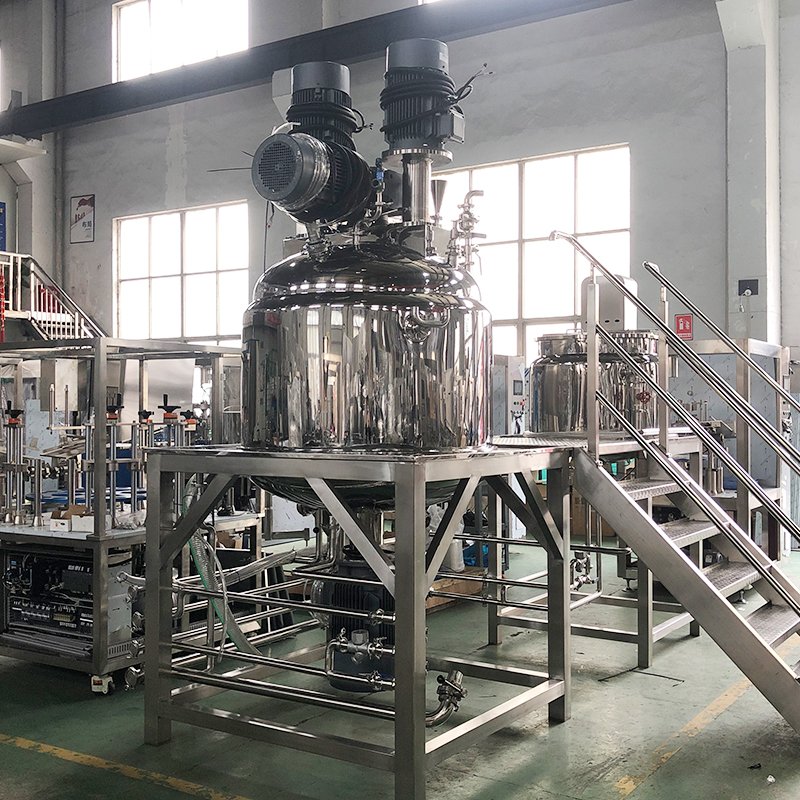
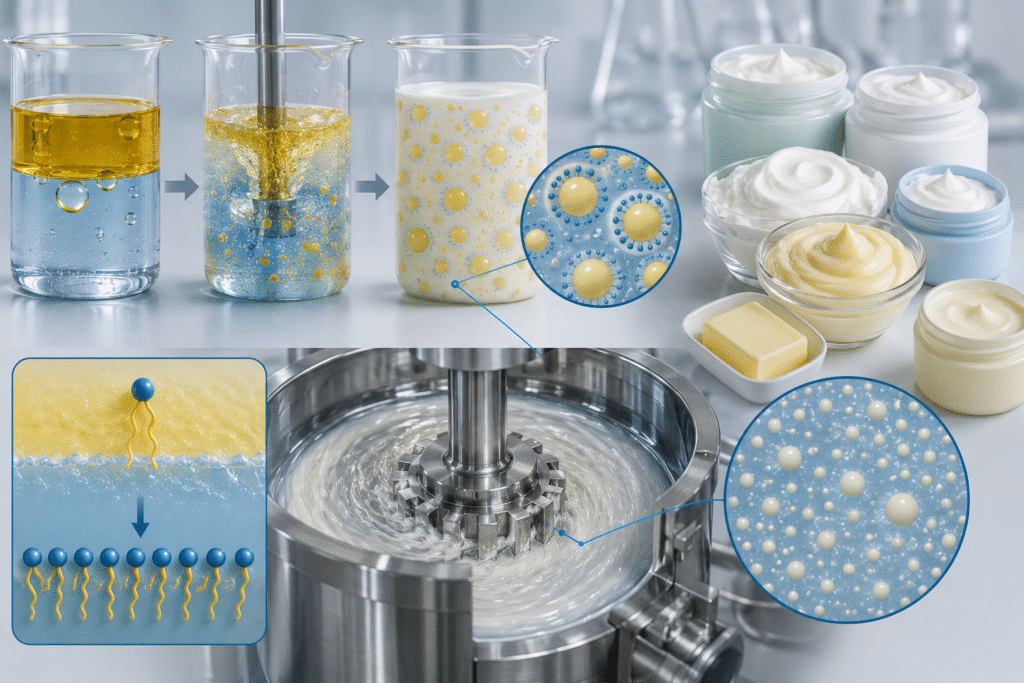
An emulsifying machine turns liquids that normally separate—such as oil and water—into a uniform, stable product. It combines controlled agitation, high-shear mixing, temperature control and, when needed, vacuum deaeration.
This article explains the working principle and production sequence. For a comparison of equipment types, components and selection criteria, see our industrial emulsifying equipment guide.
Emulsifying Machine Working Principle: The Short Answer
The machine first creates a coarse pre-mix with a low-speed agitator. A rotor-stator homogenizer then applies intense shear to break the dispersed phase into smaller droplets. Heating or cooling keeps the formulation within its required process range, while vacuum can remove entrained air. The finished batch is cooled and discharged to storage or filling equipment.
How an Emulsifying Machine Works Step by Step
1. Raw Material Preparation
Oil-phase and water-phase ingredients are measured separately. Materials that need melting or dissolving are brought to the formulation’s required temperature before they enter the main vessel. Correct preparation helps prevent undissolved solids, uneven viscosity and unnecessary processing time.
2. Bulk Mixing and Premixing
A slow-speed anchor or frame agitator moves the full batch through the vessel. Wall scrapers keep viscous material moving near the vessel surface and support even heat transfer. As the phases are combined, the mixer creates a coarse pre-emulsion that can be processed by the homogenizer.
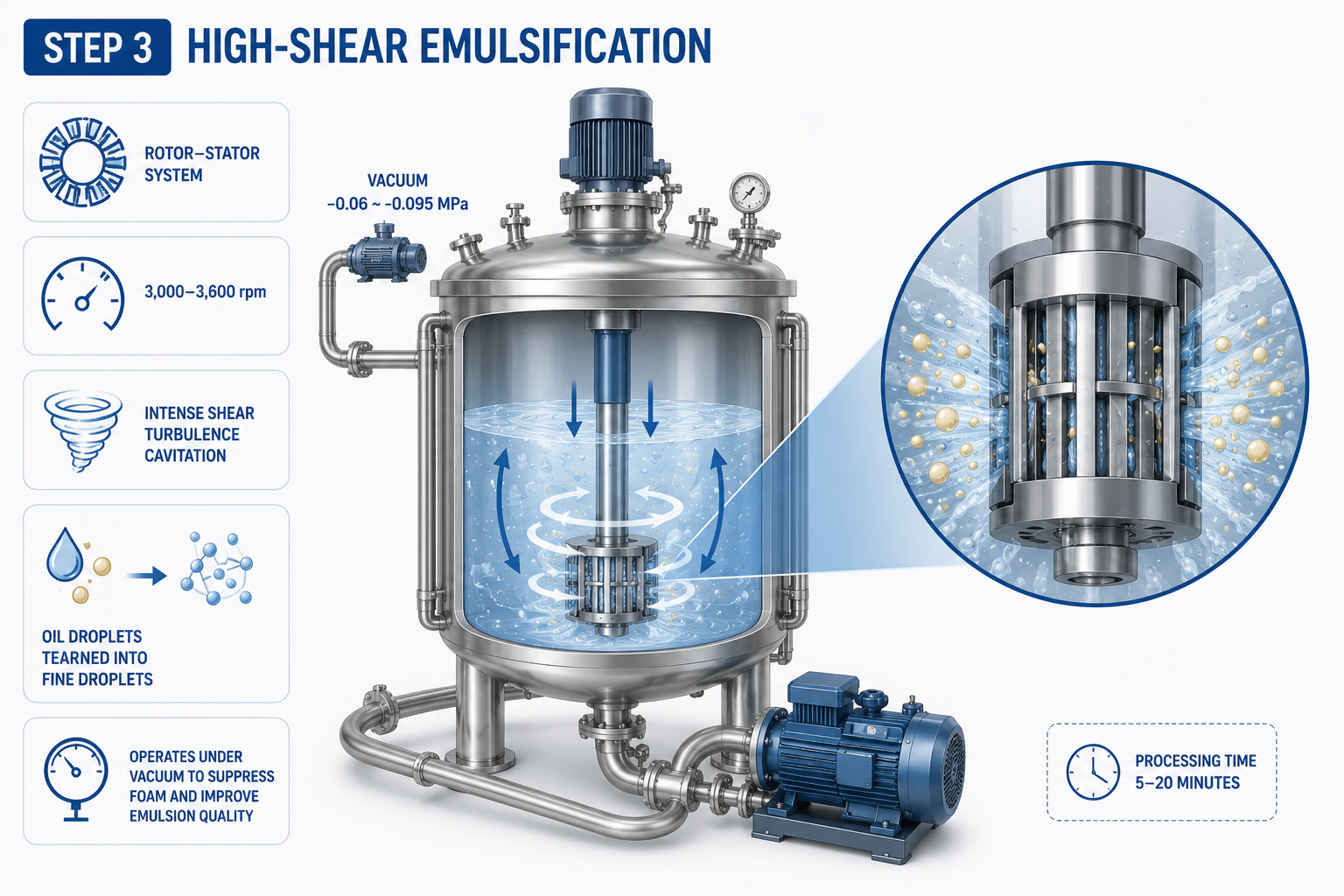
3. Rotor-Stator High-Shear Emulsification
The rotor spins inside a fixed stator and draws material into the mixing head. The narrow working gap creates strong shear and turbulence, breaking larger droplets into smaller ones and distributing them throughout the continuous phase. This is the main emulsification stage and has a direct effect on texture and uniformity.
4. Homogenization and Circulation
Depending on the machine design, material may circulate through a bottom-mounted or inline homogenizer. Repeated passes help narrow the droplet-size distribution and improve batch consistency. The required time depends on the formulation, viscosity, batch volume and target result.
5. Vacuum Deaeration
Vacuum is useful when the process introduces air or when bubbles would affect appearance, oxidation, pumping or filling accuracy. The vacuum system removes entrained air while the agitator keeps the product moving. Not every formulation requires vacuum, so the process should be chosen according to the product and quality target.
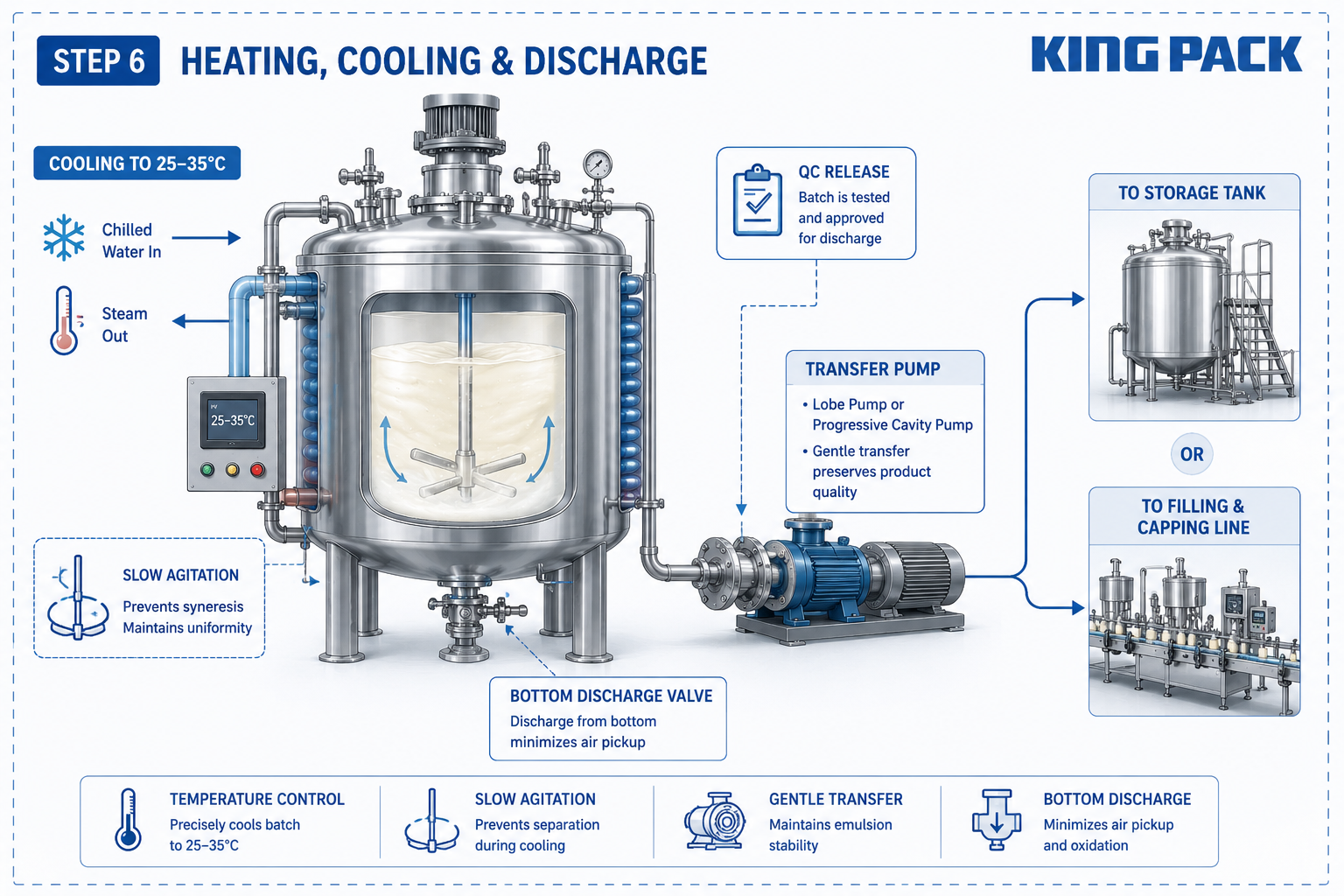
6. Cooling and Discharge
After emulsification, the jacket can cool the batch while gentle agitation maintains uniformity. Once the product reaches the required discharge condition, it is transferred through the bottom outlet to a storage tank or directly to downstream filling equipment.
What Each Main Component Does
| Component | Function |
|---|---|
| Main vessel | Contains the batch and supports controlled processing. |
| Anchor agitator | Moves the bulk product and reduces dead zones. |
| Wall scraper | Keeps viscous material moving near the vessel wall. |
| Rotor-stator homogenizer | Applies high shear to reduce droplet size and improve uniformity. |
| Heating/cooling jacket | Controls process temperature during preparation and cooling. |
| Vacuum system | Removes entrained air when the formulation requires deaeration. |
| PLC and controls | Manage speed, temperature, vacuum and repeatable recipes. |
What Controls Final Emulsion Quality?
- Formulation: The oil-to-water ratio, emulsifier system and ingredient order affect stability.
- Shear intensity and time: Too little processing may leave large droplets; excessive processing can waste energy or damage sensitive ingredients.
- Temperature: Each phase must be prepared and combined within the formulation’s suitable range.
- Viscosity: Thick products need sufficient bulk circulation so material reaches the homogenizing zone.
- Vacuum level: Deaeration should remove unwanted air without disrupting the product.
- Scale: A laboratory process must be adjusted when it is transferred to a larger production vessel.
Vacuum vs Non-Vacuum Emulsifying Systems
A non-vacuum high-shear mixer may be sufficient for low-viscosity products that tolerate air. A vacuum emulsifying mixer is better suited to products where bubbles, oxidation, surface finish or filling consistency are important. Creams, lotions, ointments and gels commonly benefit from vacuum processing, but the correct choice depends on the formulation and production goal.
To compare batch, inline, high-shear and vacuum systems, use the equipment types and selection guide.
Products Commonly Made with Emulsifying Machines
- Cosmetic creams, lotions, gels and conditioners
- Pharmaceutical ointments, creams and suspensions
- Mayonnaise, dressings, sauces and emulsified beverages
- Detergents, coatings, polishes and other chemical emulsions
Frequently Asked Questions
What is the difference between mixing and emulsifying?
Mixing distributes ingredients throughout a batch. Emulsifying specifically creates and stabilizes droplets of one immiscible liquid inside another, usually with higher shear and a suitable emulsifier system.
Why does an emulsifying machine use a rotor-stator head?
The rotor-stator head produces concentrated shear in a small working gap. This breaks larger droplets into smaller ones more efficiently than bulk agitation alone.
Does every emulsifying process need vacuum?
No. Vacuum is valuable when air bubbles, oxidation or downstream filling accuracy are concerns. Simpler products may only require high-shear mixing and temperature control.
Can an emulsifying machine connect to a filling line?
Yes. The discharge system can feed a buffer tank or compatible filling machine when the product temperature, viscosity, transfer method and required filling rate are considered together.
Compare Equipment for Your Process
Review the KING PACK vacuum emulsifier mixer range for machine configurations, or use these product examples for reference: KPZ-10L, KPZ-100L and KPZ-500L.
Contact our project team with your product, batch size, viscosity and target output. We can help match the emulsifying process to the downstream filling and packaging line.