
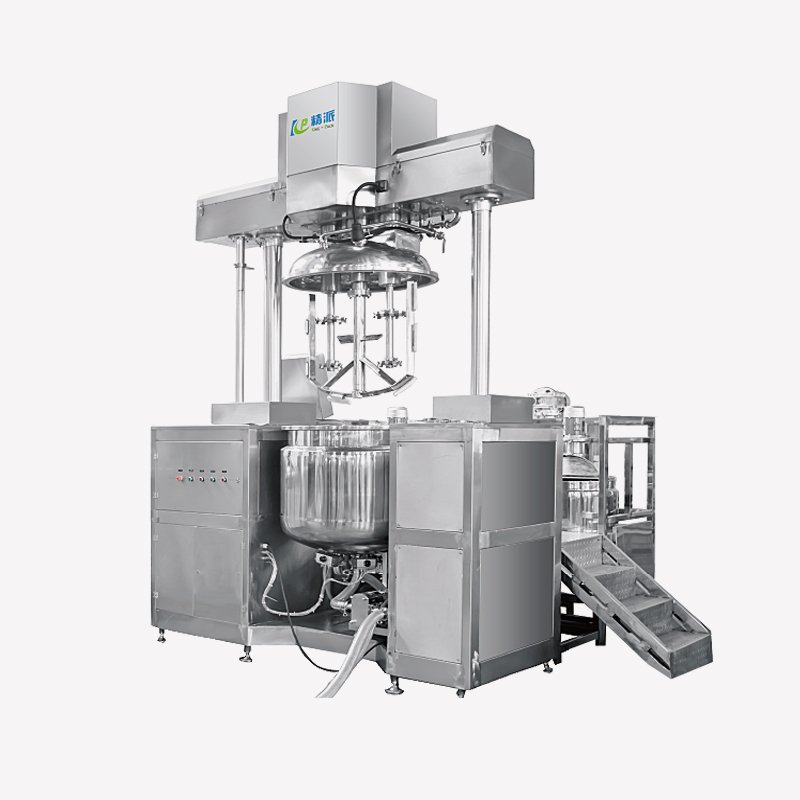
Emulsification creates a dispersion of one immiscible liquid in another, such as oil droplets in water. Homogenization is the broader operation of reducing and distributing particles or droplets more uniformly. The processes often overlap: a rotor-stator mixer or high-pressure homogenizer can refine an emulsion, but homogenization is also used for suspensions, dispersions and other liquid systems.
Homogenization vs Emulsification at a Glance
| Question | Emulsification | Homogenization |
|---|---|---|
| Primary goal | Create and distribute droplets of one immiscible liquid within another | Reduce and narrow the size distribution of droplets, particles or agglomerates |
| Typical system | Oil and water phases plus a suitable emulsifier or stabilizer | Emulsions, suspensions, dispersions, cell systems or other non-uniform fluids |
| Typical equipment | Agitated vessel, rotor-stator mixer, in-line emulsifier or vacuum emulsifying mixer | Rotor-stator homogenizer, high-pressure homogenizer, colloid mill or another size-reduction device |
| Does the equipment alone ensure stability? | No; formulation, phase ratio, emulsifier, process and storage conditions matter | No; smaller or more uniform particles do not by themselves guarantee long-term stability |
| Common quality measurements | Droplet size, distribution, viscosity, phase separation and appearance | Particle or droplet size distribution, uniformity, viscosity and functional performance |
The terminology is not always consistent between industries or equipment suppliers. An “emulsifying homogenizer” usually describes a high-shear device capable of both creating an emulsion and refining its droplet distribution. The process specification should therefore define the required result instead of relying on the machine name alone.
What Is Emulsification?
Emulsification combines two liquids that do not readily mix into a dispersed system. In an oil-in-water emulsion, oil forms droplets in a continuous water phase; in a water-in-oil emulsion, the arrangement is reversed. Mechanical energy breaks the dispersed phase into droplets, while the formulation and emulsifier help limit rapid recoalescence.
Typical products include creams, lotions, mayonnaise, dressings, flavor emulsions and some pharmaceutical preparations. The target droplet size is application-specific. It depends on the formulation, equipment, energy input, temperature, residence time and number of passes, so a universal micron range should not be promised.
What Is Homogenization?
Homogenization reduces non-uniformity by breaking droplets, particles or agglomerates and distributing them more consistently through the liquid. In an emulsion, homogenization can make the droplet population smaller and narrower. In a suspension, it may deagglomerate and redistribute solids. In other applications, high-pressure homogenization may be used for cell disruption or specialized dispersions.
Different machines use different energy mechanisms. A rotor-stator unit draws product through a narrow gap and applies high shear. IKA’s official rotor-stator dispersing guide illustrates this flow path. A high-pressure homogenizer instead forces product through a small valve gap under pressure; GEA’s homogenization guide describes that operating principle.
Why the Two Processes Overlap
An emulsion normally needs both phase incorporation and droplet-size control. A vessel agitator may first blend the bulk phases, while a rotor-stator mixer forms a pre-emulsion and refines it. Some products then pass through a high-pressure homogenizer for further size reduction. In other processes, the rotor-stator stage alone provides the required quality.
Therefore, asking whether a product needs “an emulsifier or a homogenizer” can be the wrong question. A better question is: what initial phases are being combined, what final droplet or particle distribution is required, and which sequence can deliver it at production scale without damaging the product?
Common Equipment Options
Agitated processing vessel
An anchor, propeller or other bulk agitator moves material through the vessel, supports heat transfer and keeps ingredients distributed. It may be sufficient for miscible liquids or easy blends, but often cannot create a fine emulsion by itself.
Rotor-stator homogenizer
A high-speed rotor inside a stationary stator draws product into the workhead and expels it through a narrow gap or openings. The resulting shear can disperse powders, deagglomerate solids, form emulsions and refine droplets. Head design, speed, viscosity, recirculation and processing time determine the result.
Vacuum emulsifying mixer
A vacuum emulsifying system combines a processing vessel, bulk agitation, high-shear mixing and vacuum capability. It can support phase addition, temperature control, emulsification, homogenization and deaeration in one batch process. Review our guide to how a vacuum emulsifying machine works.
In-line high-shear mixer
An in-line rotor-stator processes product as it passes through the mixing head. It may recirculate to a vessel or operate in a continuous process. Flow rate, number of passes and upstream phase addition must be controlled.
High-pressure homogenizer
A high-pressure homogenizer pumps a prepared liquid through a small valve gap. It is normally fed with a pumpable pre-mix; it is not a substitute for every bulk mixing or powder-incorporation step. Pressure, passes, inlet temperature, viscosity and formulation influence performance.
Equipment Selection by Process Need
| Process need | Possible starting configuration | Key test |
|---|---|---|
| Blend compatible liquid ingredients | Agitated vessel | Blend time and composition uniformity |
| Make a cream or lotion from oil and water phases | Jacketed vessel plus rotor-stator, often with vacuum | Droplet distribution, viscosity, deaeration and cooling profile |
| Disperse powders or break agglomerates | Rotor-stator or suitable powder-induction system | Wetting, agglomerate size, air incorporation and batch time |
| Refine a pumpable pre-emulsion | In-line high-shear mixer or high-pressure homogenizer | Size distribution versus passes, temperature and energy input |
| Process a high-viscosity cosmetic batch | Anchor agitation plus appropriately positioned high-shear head | Whole-vessel turnover, dead zones, heat transfer and scale-up |
Typical Emulsion Manufacturing Sequence
- Prepare the oil and water phases at the specified composition and temperature.
- Start bulk agitation and establish the required vessel conditions.
- Add one phase to the other according to the validated sequence and rate.
- Use rotor-stator or another suitable device to create and refine the emulsion.
- Recirculate or apply further homogenization if required by the product specification.
- Cool under controlled agitation and add temperature-sensitive ingredients at the defined stage.
- Deaerate, sample and transfer the batch to holding or filling.
The sequence is product-specific. Phase-addition direction, temperature, mixing time and cooling rate can change viscosity and stability even when the same machine is used.
What Determines Droplet or Particle Size?
- Formulation, interfacial tension and emulsifier system
- Viscosity and phase ratio
- Rotor-stator geometry, gap and tip speed
- High-pressure homogenizer pressure and valve design
- Residence time, batch circulation and number of passes
- Process temperature and product history
- Scale-up and whole-vessel flow
Smaller is not automatically better. The required distribution should come from product performance and stability studies. Excessive energy can increase temperature, damage sensitive ingredients, alter viscosity or create a texture that does not match the product target.
Vacuum, Temperature and Deaeration
Vacuum can reduce air incorporation and support deaeration, but its effect depends on viscosity, surface behavior, vessel design and operating sequence. A jacket provides heating or cooling, while the agitator must maintain sufficient product movement at the heat-transfer surface. Define vacuum level, temperature profile and cooling time as process parameters rather than optional marketing features.
Scale-Up Questions
A laboratory result does not transfer automatically to a production vessel. Larger tanks change circulation paths, heat-transfer area, addition time and residence-time distribution. Review the parameters that actually control the product: energy per unit mass, rotor tip speed, local shear, recirculation rate, number of passes, temperature history and batch turnover.
Pilot trials should use representative raw materials and reproduce the intended phase-addition and cooling sequence. Samples should be collected from defined locations and times, not only from the vessel surface after mixing.
Quality and Factory Acceptance Tests
- Verify usable and working volume, agitation and transfer at the required viscosity.
- Record temperature, vacuum, mixing speed, processing time and power or load.
- Measure the agreed droplet or particle-size distribution using a defined method.
- Check viscosity, appearance, entrained air and batch uniformity.
- Demonstrate addition, recirculation, sampling, discharge and cleaning procedures.
- Test alarms, interlocks and recovery from a normal stop.
Information to Include in Your RFQ
- Product type, phase composition, batch size and target annual output
- Raw-material addition sequence and temperature limits
- Viscosity range, density, solids content and shear sensitivity
- Target droplet or particle distribution and the measurement method
- Vacuum, heating, cooling and deaeration requirements
- Cleaning procedure, changeover frequency and surface-finish expectations
- Upstream ingredient handling and downstream transfer or filling interfaces
Homogenization and Emulsification FAQ
Does emulsifying make a mixture homogeneous?
It can make an oil-and-water system appear uniform by dispersing one phase as droplets in the other. That does not mean the liquids become molecularly identical or that the emulsion will remain stable indefinitely.
Can a homogenizer create an emulsion?
Yes, many rotor-stator and high-pressure homogenizers are used to form or refine emulsions. The formulation and phase-addition process still matter.
Is a vacuum emulsifying mixer the same as a high-pressure homogenizer?
No. A vacuum emulsifying mixer is a batch system that can combine agitation, rotor-stator mixing, temperature control and vacuum. A high-pressure homogenizer pumps a prepared liquid through a small valve gap, often as a separate downstream step.
Which process is best for cosmetic creams?
Many cream processes use both emulsification and homogenization in a jacketed vessel. Final equipment and settings depend on formulation, batch size, viscosity, temperature profile, deaeration and the required texture.
Plan Your Mixing and Emulsification Process
KING PACK can configure batch vessels, agitation, rotor-stator homogenization, vacuum and transfer around your process. Read our cosmetic homogenizer selection guide, explore the industrial emulsifying equipment guide, or send your formulation and batch requirements for a technical proposal.