
Quick Answer
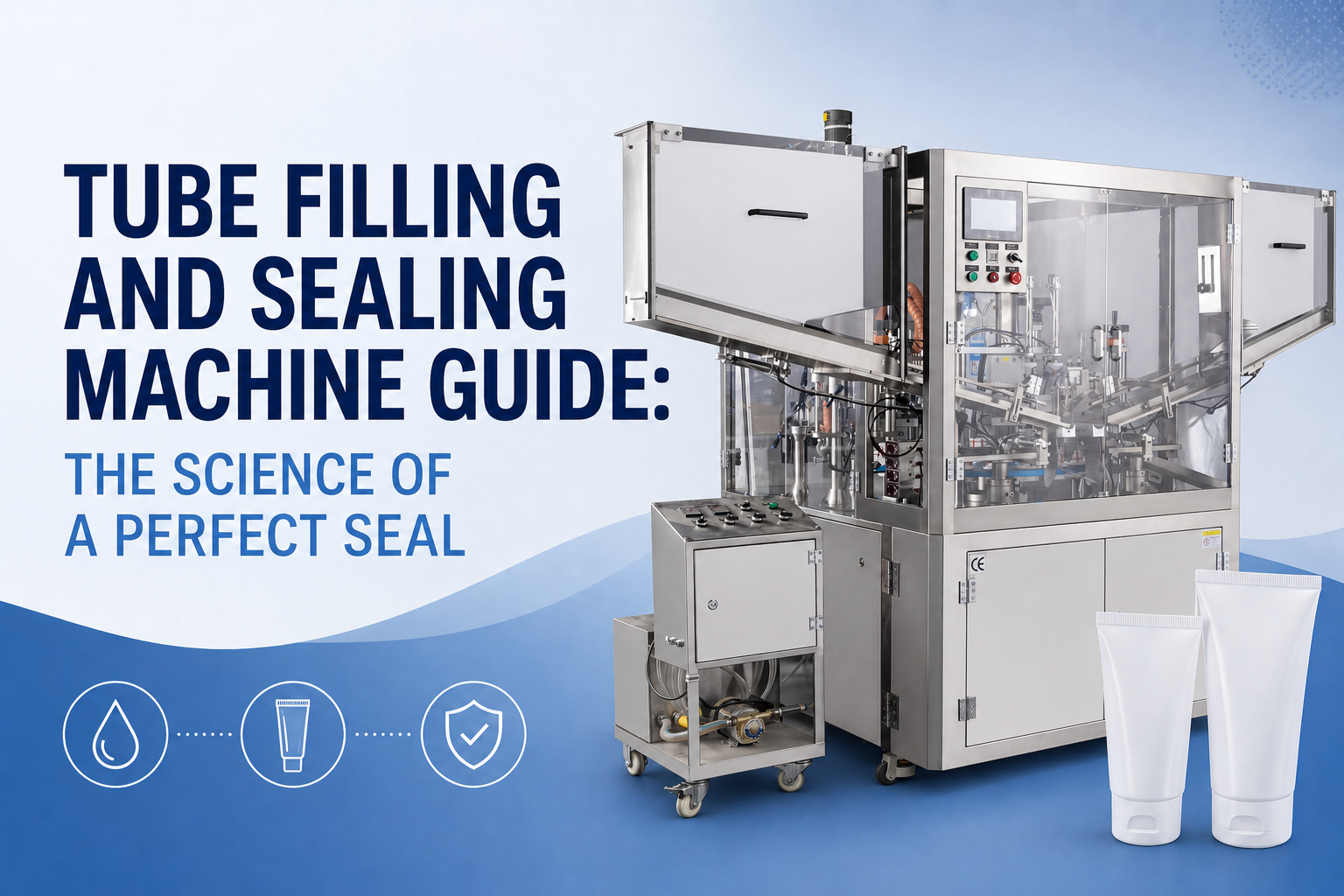
A tube filling and sealing machine doses creams, gels, ointments, pastes or liquids into preformed tubes, then closes the tube tail. Plastic and laminate tubes are commonly heat-sealed; aluminum tubes are normally folded and crimped. The correct tube sealing system depends on the tube structure, product behavior, output, batch-change schedule and required seal inspection.
For buyers, the most important question is not simply machine speed. Ask whether the supplier can prove filling repeatability, seal appearance and seal integrity with your actual tubes and product. Tube-wall construction, seal-area cleanliness, temperature, pressure, dwell time, cooling and tube positioning all affect the finished package.
Tube Filling and Sealing Methods at a Glance
| Tube or production need | Common method | What to verify |
|---|---|---|
| PE or plastic laminate tube | Internal hot-air sealing | Tube structure, seal temperature window, cooling and trimming quality |
| Aluminum barrier laminate tube | Hot-air or validated compatible sealing process | Barrier-layer construction and supplier sealing trial |
| Aluminum tube | Tail folding and crimping | Fold pattern, code position, coating damage and leak resistance |
| Frequent product or format changes | Recipe-controlled, quick-change machine | Cleaning access, change parts and proven changeover time |
| High-output automatic line | Automatic tube loading, orientation, filling, closing and discharge | Sustained accepted output with the actual tube and product |
Send tube drawings and normal production samples when requesting a proposal. Include the fill range, product viscosity and temperature, required output, coding format, cleaning method and acceptance tests. For a configured system, review our tube filling machine options or contact KING PACK.
Why Tube Filling and Sealing Quality Matters in Industrial Packaging
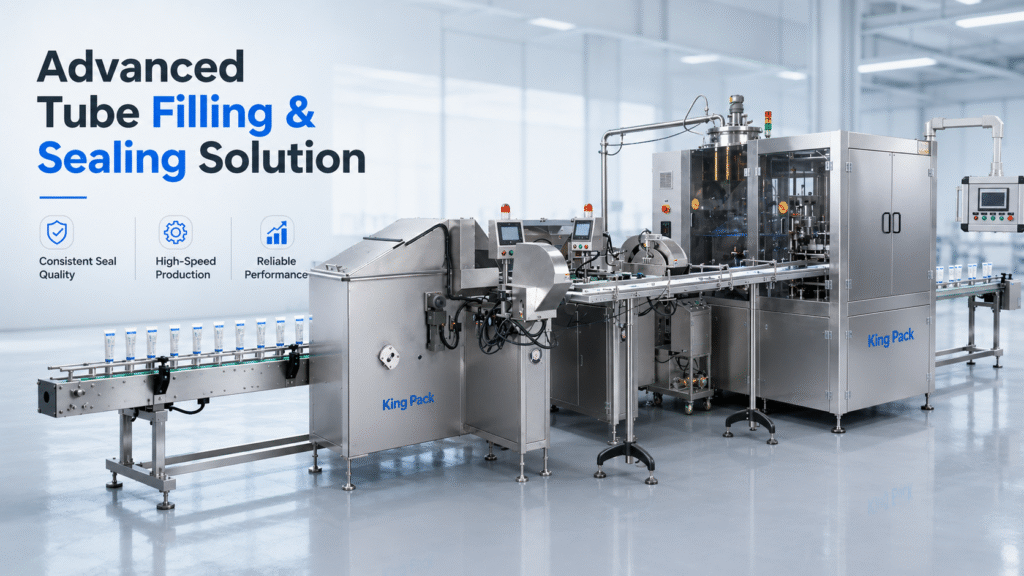
In modern manufacturing, the tube is more than a simple container. It protects the formula, controls dispensing, supports brand presentation, and influences the customer’s first impression. A cosmetic cream tube with a burned seal, a pharmaceutical ointment tube with leakage, or a food paste tube with weak closure can directly affect product safety and market trust.
For this reason, tube filling and sealing quality is a critical control point for multinational pharmaceutical companies, cosmetics factories, food producers, and chemical manufacturers. A reliable filling and sealing machine must complete accurate filling, clean sealing, stable cooling, and consistent discharge without damaging the tube body or contaminating the sealing area.
Poor sealing can cause leakage, oxidation, contamination, product waste, customer complaints, and higher production costs. In export packaging, the problem becomes even more serious because filled tubes may experience vibration, pressure changes, and temperature variation during transportation. A weak seal that looks acceptable in the factory may fail after long-distance shipping.
For procurement managers and technical directors, choosing a tube filling and sealing machine is not only a purchase decision. It is a decision about packaging reliability, operational efficiency, quality consistency, and long-term production costs. The right machine helps reduce waste, improve filling accuracy, maintain sealing quality, and support stable industrial output.
Tube Seal Acceptance Criteria
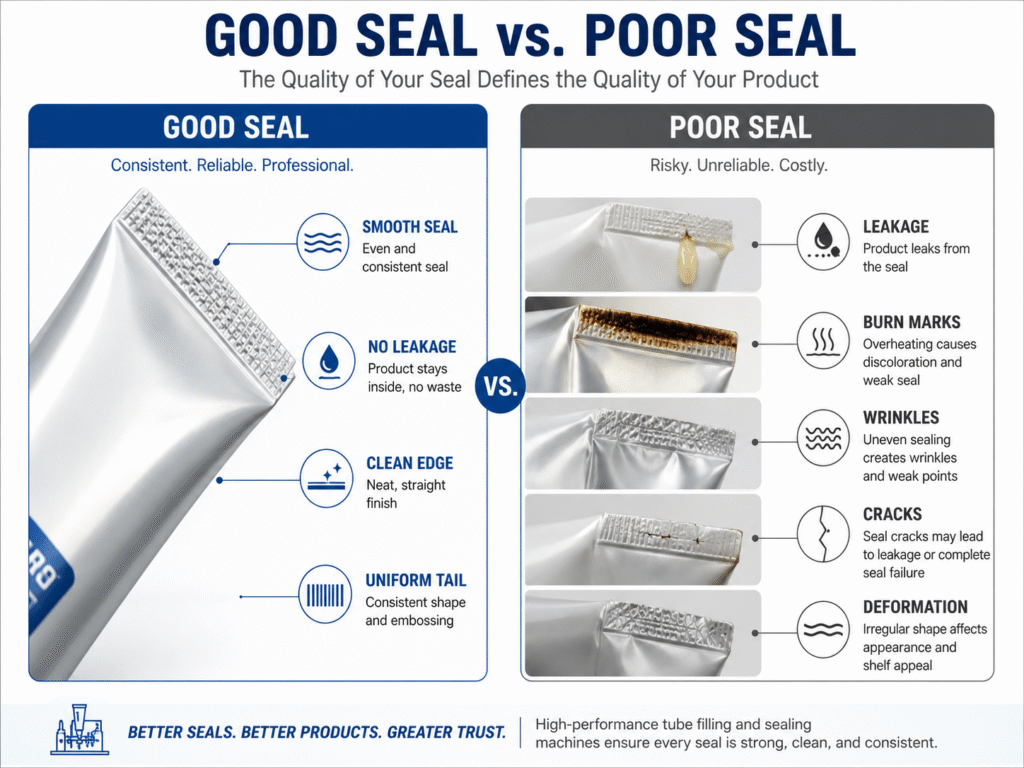
An acceptable tube seal is strong, clean and uniform, without visible burning, pinholes, wrinkles, cracks, material deformation or weak bonding. In professional tube filling production, the seal must perform well both visually and mechanically.
For skincare packaging, appearance is extremely important because the tube tail is part of the product’s premium presentation. For pharmaceutical, food, and chemical packaging, seal strength and leak resistance are even more critical. A high-quality sealing machine must therefore deliver both technical performance and clean packaging aesthetics.
The following table summarizes the main quality indicators of a perfect tube seal.
| Seal Quality Factor | What It Means | Why It Matters in Production |
|---|---|---|
| Seal strength | The sealed area can withstand handling, transport, and storage pressure. | Reduces leakage and product returns. |
| Appearance | The tube tail is smooth, flat, and visually clean. | Improves brand image, especially in skincare packaging. |
| Leak resistance | No product leaks from the sealed end. | Protects product safety and shelf life. |
| Material integrity | No burning, cracking, melting marks, or deformation. | Prevents packaging failure during transport. |
| Batch consistency | Every tube has similar sealing quality during continuous production. | Helps reduce waste and production costs. |
A professional tube filling and sealing process should achieve all five standards at the same time. If one factor fails, the final packaging result may still be unacceptable, even when filling volume and machine speed appear normal.
How a Tube Filling and Sealing Machine Works
A standard tube filling and sealing machine completes several coordinated steps in one continuous cycle. Although machine designs vary by automation level and application, the basic process usually includes tube loading, orientation, filling, sealing, cooling, coding, trimming, and discharge.
Tube Loading and Orientation
Empty tubes are loaded into a tube magazine or manually placed into holders, depending on the machine type. In automatic systems, the machine indexes each tube into position and uses an eye mark sensor to align the printed surface. Accurate orientation is important because it affects the position of coding, the appearance of the seal, and the final packaging presentation.
For branded skincare packaging or pharmaceutical tubes, poor orientation can create an unprofessional appearance even if the filling and sealing performance is technically acceptable. This is why tube positioning is one of the first factors to evaluate when selecting a tube filling machine.
Product Filling System
After the tube is positioned, the filling system dispenses the required volume of product. A tube filling machine may use piston filling, servo filling, pump filling, or customized filling technology depending on product viscosity and accuracy requirements.
Creams, gels, ointments, pastes, sauces, adhesives, and chemical products all behave differently during filling. High-viscosity products require stable pressure and suitable nozzle design. Foaming products may need slower filling or special anti-drip control. Products with particles may require wider product passages and careful pump selection.
A high-quality filling machine should not only fill accurately but also avoid splashing, dripping, air pockets, and product residue near the sealing area.
Sealing, Cooling, Coding, and Discharge
After filling, the tube moves to the sealing station. For plastic tube and laminated tube applications, the machine may use hot air sealing, internal heating, or ultrasonic sealing. For aluminum tube packaging, the closing process usually relies on folding, crimping, or rolling rather than heat sealing.
Once the seal is formed, cooling stabilizes the tube tail and helps maintain the final shape. Coding and trimming can then be applied before the finished tubes are discharged. In a well-designed filling and sealing machine, every step is synchronized to maintain stable output and reduce manual intervention.
The Core Science Behind Tube Filling and Sealing: Temperature, Pressure, and Time
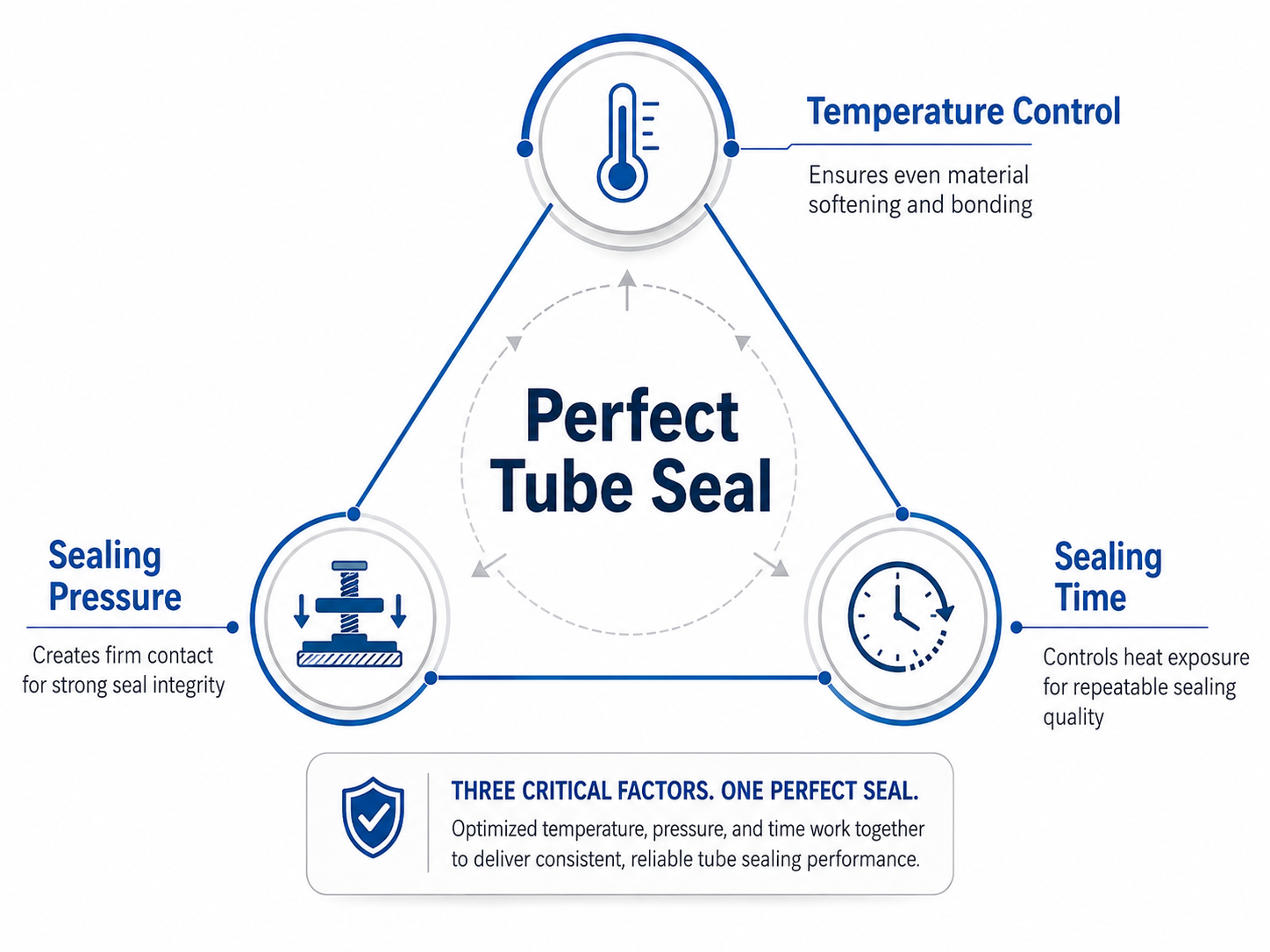
A perfect seal is not created by heat alone. It is the result of a controlled balance between temperature, pressure, and sealing time. In any professional tube filling and sealing process, these three variables must work together.
Temperature Control
Temperature determines how the tube material softens, melts, bonds, and cools. If the sealing temperature is too low, the inner layer of the tube may not bond completely, causing weak sealing or leakage. If the temperature is too high, the tube tail may burn, shrink, wrinkle, discolor, or deform.
For plastic tube and laminated tube applications, stable temperature control is one of the most important indicators of a professional sealing machine. The goal is not simply to reach a target number. The real challenge is maintaining uniform and repeatable heat during continuous production.
Sealing Pressure
Pressure ensures that the softened layers of the tube are pressed together with enough force to form a strong bond. Insufficient pressure may leave gaps inside the sealing area. Excessive pressure may damage the tube body, create poor tail appearance, or squeeze the material unevenly.
A reliable filling and sealing machine should allow operators to adjust pressure according to tube diameter, wall thickness, material structure, and required seal strength.
Sealing Time
Sealing time controls how long the material remains under heat and pressure. If the time is too short, bonding may be incomplete. If it is too long, the tube may overheat or deform. The ideal result comes from a balanced setting of temperature, pressure, and time.
This is why a professional tube filling and sealing machine must provide accurate parameter adjustment and repeatable machine movement. Without process control, even expensive tubes can produce unstable results.
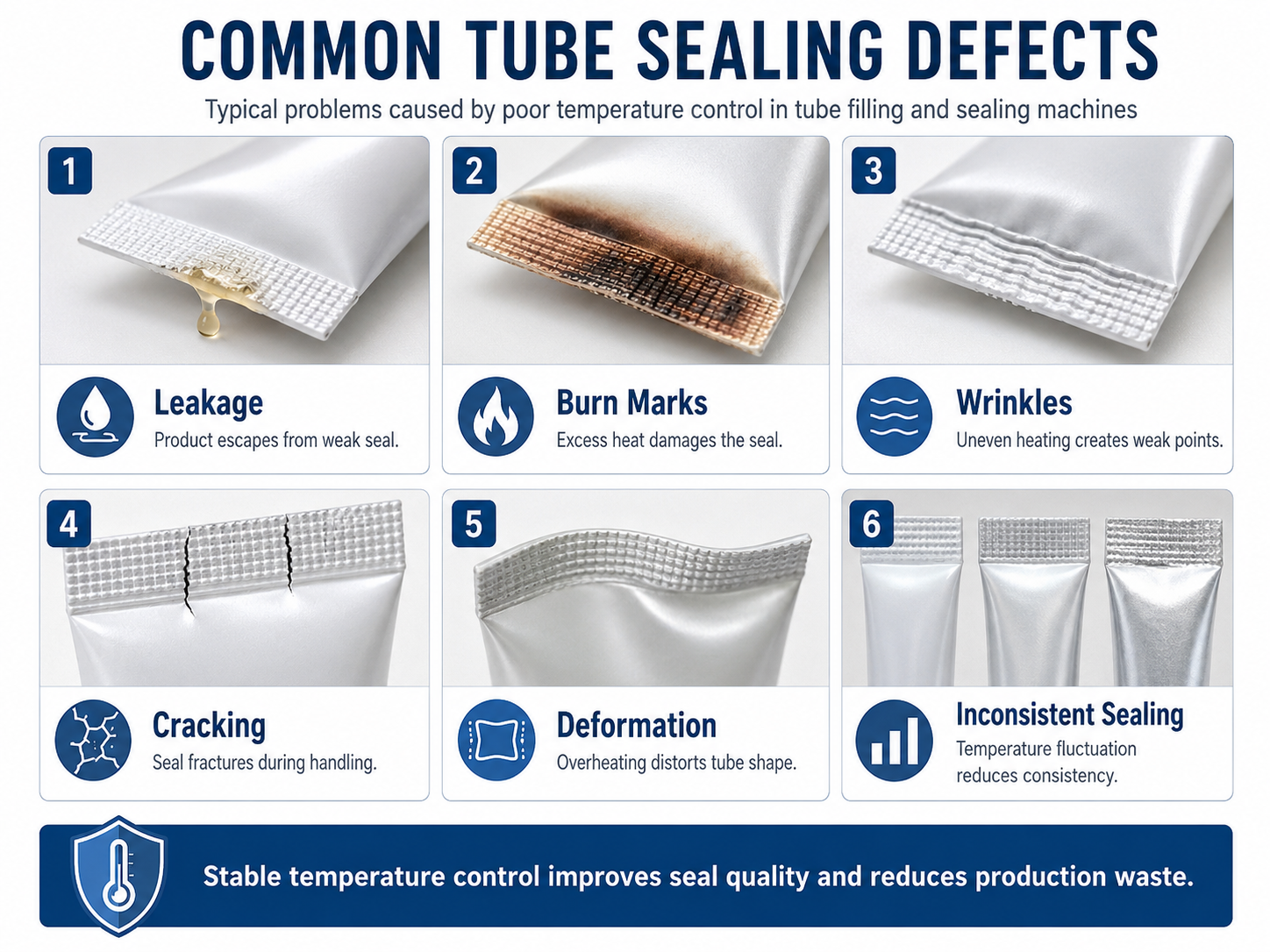
Common Sealing Problems Caused by Poor Temperature Control
Many tube sealing problems can be traced back to unstable or incorrect temperature settings. However, temperature is not the only factor. Filling accuracy, tube positioning, pressure, sealing time, cooling, and tube material must also be reviewed together.
The following table provides a practical troubleshooting framework for production teams.
| Problem | Possible Temperature Cause | Result | Recommended Adjustment |
|---|---|---|---|
| Leakage | Temperature too low or unstable | Weak bonding and poor seal strength | Increase sealing temperature gradually and check tube tail contamination. |
| Burn marks | Temperature too high | Damaged appearance and material degradation | Lower hot air temperature or reduce sealing time. |
| Wrinkles | Uneven heat distribution | Unstable sealing surface | Check heating alignment, tube positioning, and cooling efficiency. |
| Cracking | Poor temperature-time balance | Seal failure during handling | Adjust temperature, pressure, and sealing time together. |
| Deformation | Excessive heat | Tube shape distortion | Reduce temperature and improve cooling after sealing. |
| Inconsistent quality | Temperature fluctuation | Different results between tubes | Check PID control, sensor feedback, and machine stability. |
For factories, these defects are not small cosmetic issues. Every rejected tube increases material waste, labor cost, downtime, and total production costs. A stable tube filling and sealing process reduces rework and helps maintain predictable packaging quality.
Plastic Tube vs. Aluminum Tube Filling and Sealing Technology
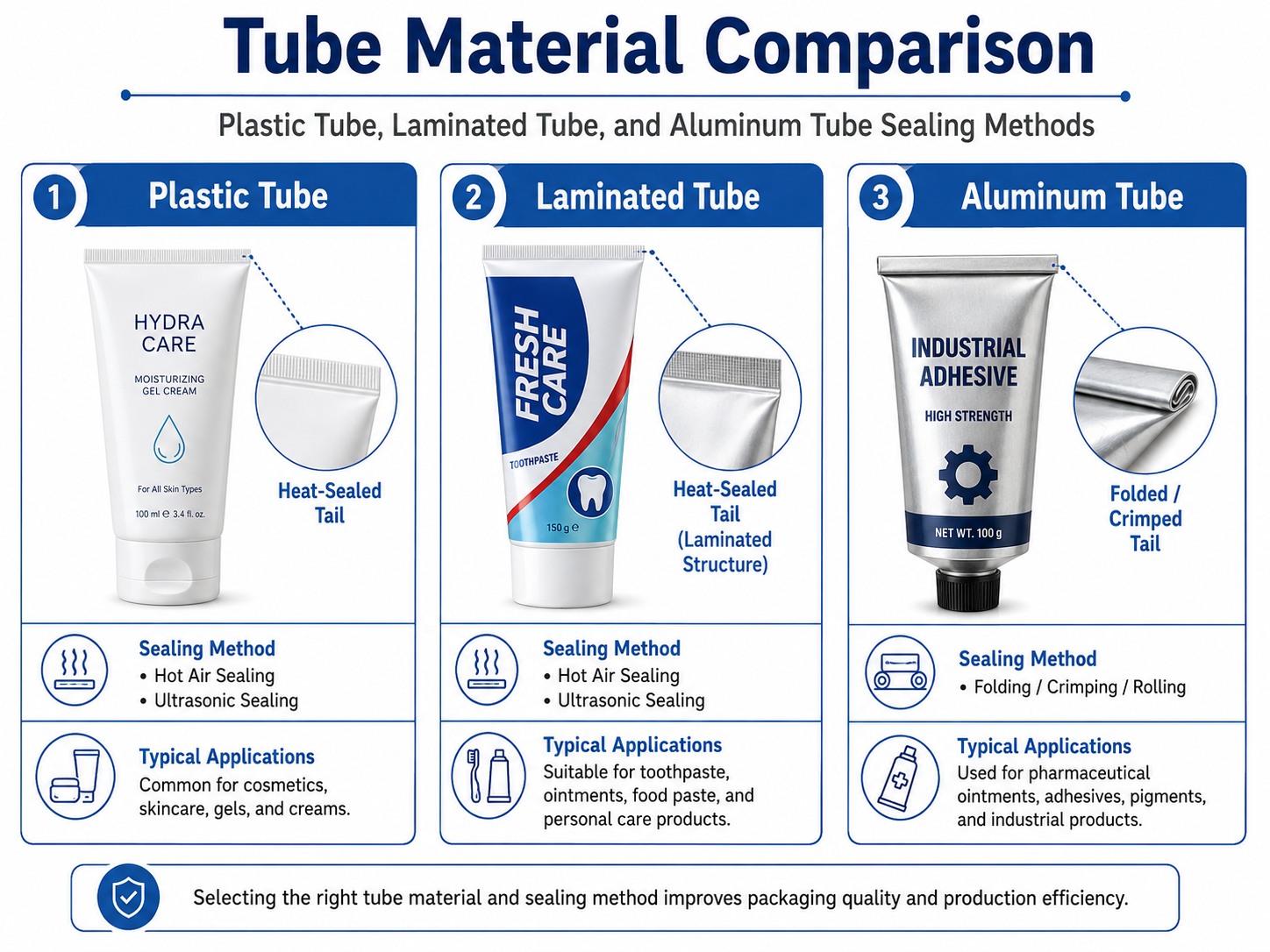
Different tube materials require different filling and sealing strategies. A plastic tube, laminated tube, and aluminum tube may look similar to end users, but their closing methods and machine requirements are very different.
Plastic Tube Filling and Sealing
Plastic tube packaging is widely used for cosmetics, skincare packaging, gels, lotions, creams, and personal care products. A plastic tube is usually sealed by hot air sealing or ultrasonic sealing. The inner layer is softened and then pressed to form a strong bond.
For plastic tube production, the tube filling and sealing machine must control temperature carefully. Uneven heat can create weak spots, wrinkles, or poor tail appearance. Stable cooling is also important because the seal must solidify quickly without deformation.
Laminated Tube Filling and Sealing
Laminated tubes are commonly used for toothpaste, ointments, food paste, personal care products, and some pharmaceutical applications. These tubes often contain multiple layers, such as plastic, barrier film, adhesive layers, and printed outer surfaces.
Because laminated tubes have a more complex structure, the sealing machine must control heat, pressure, and sealing time precisely. Too little heat may fail to bond the inner layer, while too much heat may damage the printed surface or barrier structure.
Aluminum Tube Filling and Folding
An aluminum tube is commonly used for pharmaceutical ointments, adhesives, pigments, industrial paste, and chemical products. Unlike plastic tube packaging, aluminum tube closing usually depends on mechanical folding, crimping, or rolling.
This distinction is important. A plastic tube sealing machine is not always suitable for aluminum tube production. Aluminum applications usually require a metal tube filling and folding machine with the correct tube holder, folding tool, and tail forming structure.
| Tube Material | Common Application | Sealing Method | Machine Selection Point |
|---|---|---|---|
| Plastic tube | Cosmetics, skincare packaging, gels, lotions, creams | Hot air sealing or ultrasonic sealing | Requires stable temperature control and clean tail trimming. |
| Laminated tube | Toothpaste, ointments, food paste, personal care | Hot air or ultrasonic sealing | Requires careful control of heat, pressure, and sealing time. |
| Aluminum tube | Pharmaceutical ointments, adhesives, pigments | Folding, crimping, or rolling | Requires a metal tube filling and folding machine. |
How to Choose a Tube Filling and Sealing Machine by Capacity
Production capacity is one of the first questions buyers ask, but machine speed alone should not drive the decision. A high-speed tube filling and sealing machine is valuable only when it maintains filling accuracy, sealing quality, and stable operation at the required output.
For small-batch production, a semi-automatic tube filling machine may be suitable. This type of machine is often used for laboratories, startups, pilot production, and factories with frequent product changes. It offers lower investment and flexible operation, but the output is limited.
For medium production, an automatic tube filling and sealing machine is usually more efficient. It can provide stable filling, consistent sealing, coding, trimming, and discharge in one integrated process. This type of filling and sealing machine is common in cosmetics, food, pharmaceutical, and daily chemical factories.
For large-scale production, buyers may need a high-speed tube filling and sealing line with automatic tube loading, servo filling, hot air sealing, inspection, cartoning, and downstream integration. In this case, the machine should be evaluated as part of a complete packaging system.
| Production Scale | Recommended Machine Type | Typical Buyer | Key Selection Focus |
|---|---|---|---|
| Small batch | Semi-automatic tube filling machine | Startups, labs, pilot production | Low investment, flexible changeover. |
| Medium production | Automatic tube filling and sealing machine | Cosmetics, food, pharma, daily chemical factories | Stable filling accuracy and sealing quality. |
| Large-scale production | High-speed tube filling and sealing line | Contract manufacturers and global brands | Automation, integration, lower production costs. |
Before choosing a machine, buyers should calculate daily output, tube size range, filling volume, product viscosity, cleaning frequency, operator skill, and future expansion plans.
How to Integrate a Filling and Sealing Machine into an Existing Packaging Line
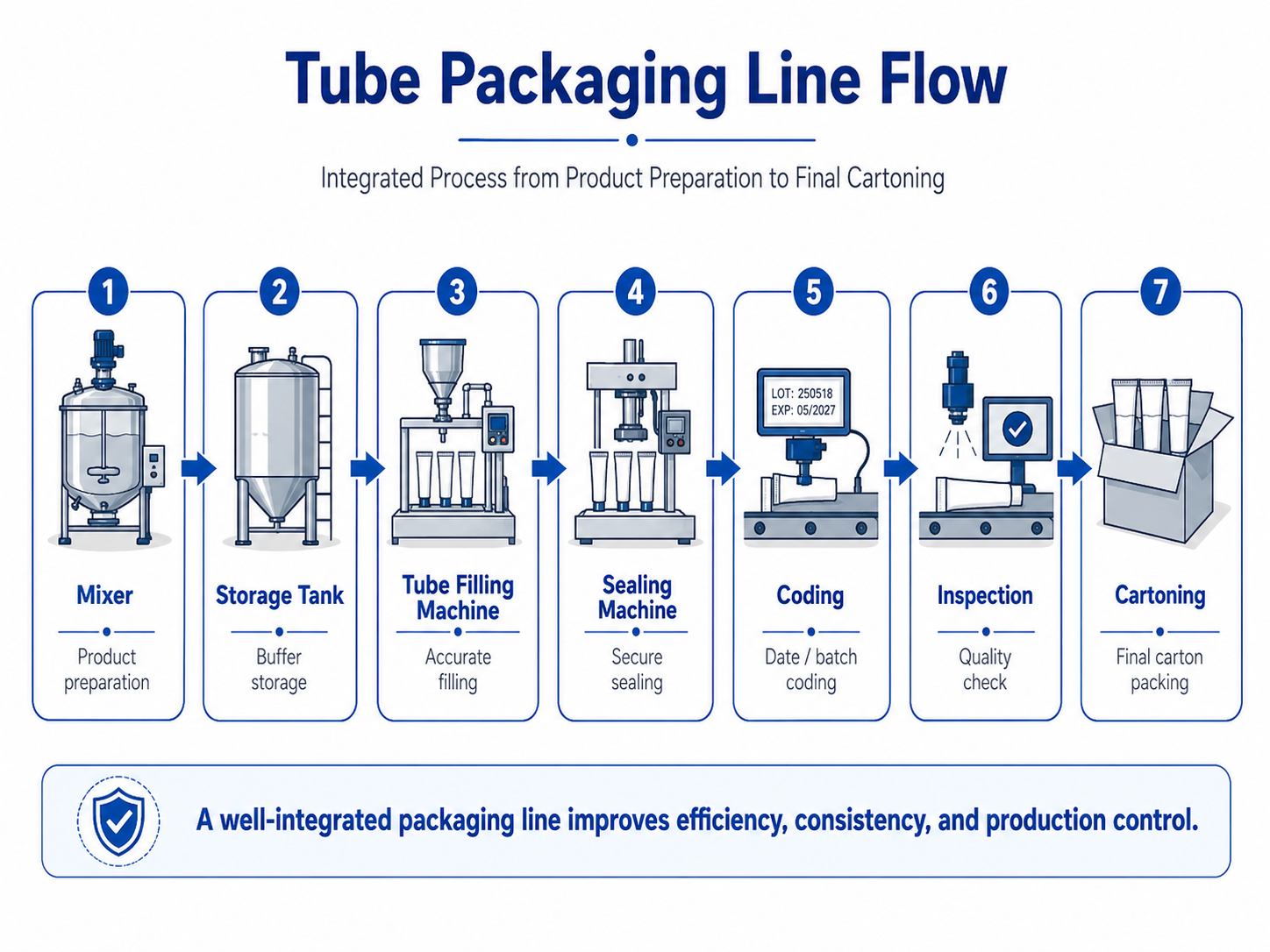
A filling and sealing machine often works as one part of a larger packaging line. In many factories, the product is first prepared in a mixer, emulsifier, or storage tank. It is then transferred to the filling system through a pump, pipeline, or hopper. After filling and sealing, finished tubes may move to coding, inspection, cartoning, case packing, or palletizing.
Although a capping machine is mainly used for bottles, jars, droppers, and other rigid containers, many manufacturers operate tube packaging and bottle packaging in the same facility. For example, a skincare factory may use a mixer to prepare cream, a tube filling machine for hand cream tubes, and a capping machine for lotion bottles.
Integration matters because poor coordination between equipment can create bottlenecks. If the mixer output is too slow, the filling machine may wait for product. If downstream cartoning is too slow, finished tubes may accumulate. If transfer pressure is unstable, filling accuracy may suffer.
A well-planned packaging line should balance mixing, filling, sealing, coding, inspection, and final packing. For B2B buyers, the best supplier is not only a machine seller but a partner that understands the complete workflow and can design a flexible system for future production needs.
Maintenance Checklist for Long-Term Tube Filling and Sealing Stability
Regular maintenance is essential for long-term tube filling and sealing stability. Even a high-quality machine can produce poor results if critical components are dirty, worn, misaligned, or incorrectly adjusted.
The filling system should be cleaned according to product type and hygiene requirements. Creams, gels, food products, and pharmaceutical ointments may require careful cleaning to prevent residue buildup. Filling nozzles, pistons, pumps, hoses, and product contact parts should be inspected regularly.
The sealing station also needs routine attention. Heating components, hot air systems, ultrasonic tools, sealing jaws, folding parts, and cooling units must remain in good condition. Worn sealing jaws or contaminated tools can cause uneven sealing, weak bonding, or poor appearance.
Sensors, tube holders, air pressure, HMI parameters, coding units, and cutting devices should be checked to maintain accurate positioning and repeatable machine action.
| Maintenance Area | What to Check | Why It Matters |
|---|---|---|
| Filling system | Nozzles, pistons, pumps, hoses | Maintains filling accuracy and hygiene. |
| Sealing station | Hot air system, sealing jaws, ultrasonic tools | Ensures strong and clean seals. |
| Tube positioning | Tube holders and eye mark sensor | Prevents misalignment and poor appearance. |
| Cooling system | Air flow and cooling efficiency | Stabilizes seal shape after heating. |
| Control system | HMI parameters, sensors, alarms | Reduces operator error and downtime. |
Preventive maintenance reduces downtime, extends machine service life, lowers production costs, and supports consistent packaging quality.
Key Questions Before Buying a Tube Filling Machine
Before purchasing a tube filling machine, procurement and engineering teams should define the real production requirements. The first question is tube material: will the project use plastic tube, laminated tube, aluminum tube, or multiple types of tubes?
The next question is product behavior. Is the product a cream, gel, paste, ointment, sauce, adhesive, or chemical formulation? What is the viscosity? Does it contain particles, alcohol, oil, or active ingredients? These factors affect filling method, nozzle design, hopper structure, pump selection, and cleaning requirements.
Buyers should also confirm filling volume, tube diameter, tube length, target output, number of SKUs, changeover frequency, available factory space, and automation level. If the machine needs to connect with a mixer, capping machine, labeling machine, or cartoning line, this should be discussed before final configuration.
Most importantly, the supplier should be able to test real tubes and product samples. Sample testing helps confirm filling accuracy, sealing strength, tail appearance, coding quality, and machine suitability before shipment. This step can prevent costly problems after installation.
King Pack’s Approach to Tube Filling and Sealing Machine Solutions
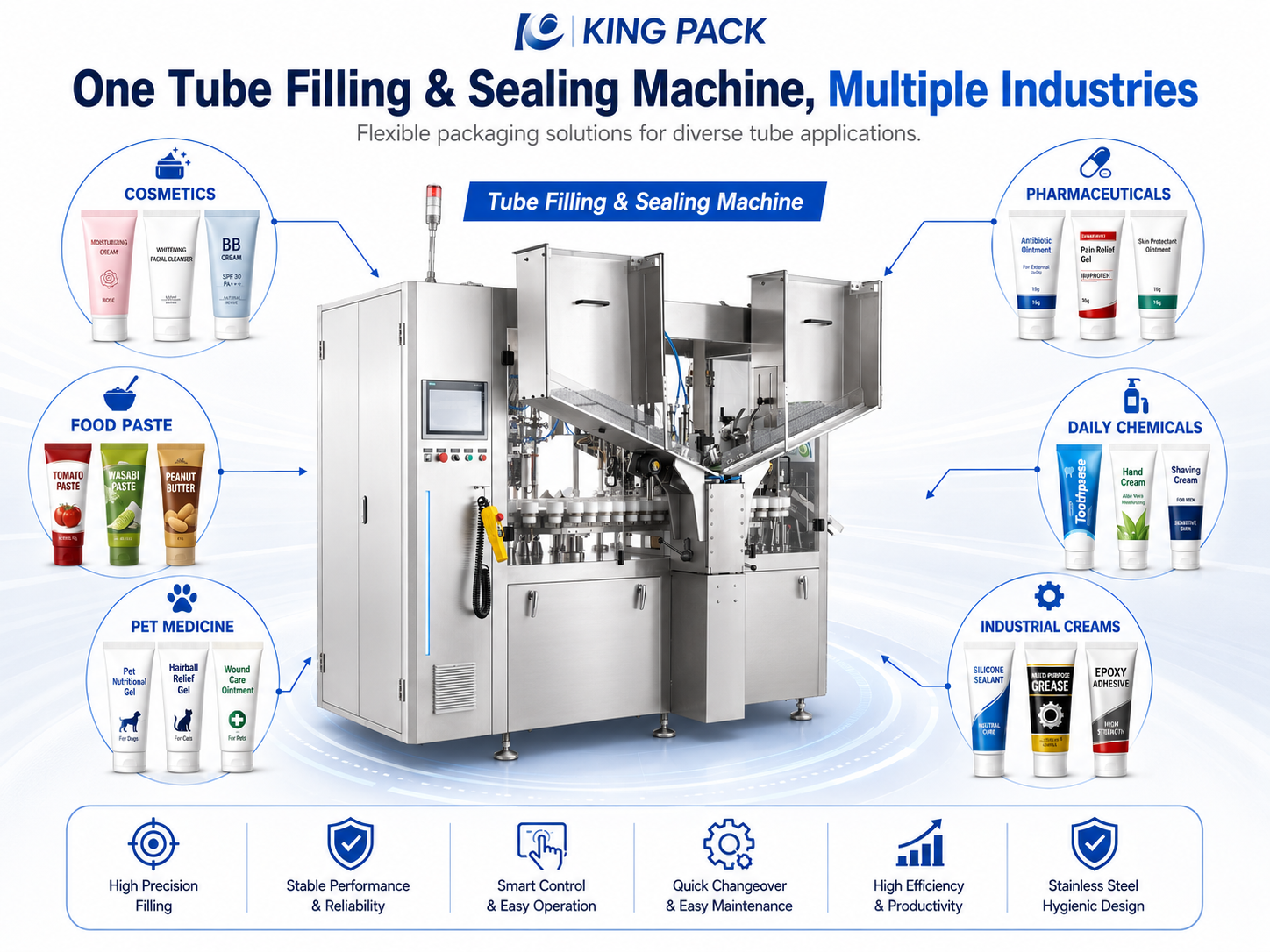
King Pack focuses on practical, stable, and customized packaging machinery solutions for manufacturers that need reliable filling, sealing, capping, and related production equipment. For tube applications, the goal is not only to provide a machine, but to match the right tube filling and sealing machine to the customer’s real product, tube material, capacity, and packaging requirements.
Different industries have different priorities. A cosmetics factory may focus on clean seal appearance, fast changeover, and premium skincare packaging presentation. A pharmaceutical producer may require accurate filling, reliable aluminum tube closing, and hygienic product contact parts. A food manufacturer may need easy cleaning and safe material design. A chemical company may require strong sealing and durable machine construction.
King Pack evaluates tube material, filling volume, product viscosity, target capacity, sealing method, and line integration needs before recommending a filling and sealing machine. This helps customers avoid underpowered equipment, unnecessary overspending, and quality problems after installation.
For buyers comparing suppliers, the most valuable machine is not the one that looks good in a short demonstration. It is the machine that can run stably in real production, reduce waste, control production costs, and deliver consistent packaging quality over time.
Conclusion: Better Tube Filling and Sealing Starts with Better Process Control
A perfect tube seal depends on more than one setting. It comes from accurate filling, stable temperature control, correct sealing pressure, suitable sealing time, efficient cooling, accurate tube positioning, and reliable machine design.
For plastic tube packaging, advanced temperature control helps create smooth, strong, and leak-proof seals. For aluminum tube applications, the correct folding or crimping structure is essential. For high-volume production, the tube filling and sealing machine must also integrate smoothly with mixers, transfer systems, inspection equipment, cartoning machines, and sometimes a capping machine used in parallel packaging lines.
When choosing a tube filling machine, B2B buyers should consider not only price, but also material compatibility, output stability, filling accuracy, sealing quality, maintenance requirements, spare parts support, and future expansion. A well-selected filling and sealing machine can reduce production costs, improve packaging quality, and support long-term manufacturing growth.
If your factory is planning a new tube packaging project, King Pack can help evaluate your tube samples, product characteristics, production capacity, and automation requirements to recommend a practical and reliable tube filling and sealing solution.
FAQ
What is a tube filling and sealing machine?
A tube filling and sealing machine fills creams, gels, pastes, liquids, ointments, or semi-solid products into tubes and then seals the tube tail. It is widely used in cosmetics, pharmaceuticals, food, personal care, and chemical packaging.
What is the difference between a tube filling machine and a sealing machine?
A tube filling machine focuses on dispensing the product into the tube, while a sealing machine closes the tube tail. In most industrial applications, both functions are combined into one filling and sealing machine.
Can one machine handle plastic tube and aluminum tube packaging?
Not always. Plastic tube packaging usually uses hot air sealing or ultrasonic sealing, while aluminum tube packaging usually uses folding, crimping, or rolling. The machine should be selected according to the actual tube material.
Why does tube sealing fail?
Tube sealing may fail because of low temperature, high temperature, insufficient pressure, short sealing time, tube misalignment, product contamination near the seal, poor cooling, or unsuitable tube material.
How do I choose the right tube filling and sealing machine?
You should evaluate tube material, filling volume, product viscosity, required capacity, sealing method, cleaning requirements, available factory space, and whether the machine needs to integrate with a mixer, capping machine, labeling machine, or cartoning line.
How can a tube filling machine reduce production costs?
A well-designed tube filling machine can reduce production costs by improving filling accuracy, reducing leakage, lowering material waste, shortening changeover time, minimizing downtime, and improving overall packaging consistency.
Related resources: Encyclopedia resources and The Importance of Tube Filling Machine and Tube Sealing.