 Skip to content


A high-viscosity syringe filling machine is suitable for paste only when the whole product path can supply, meter, cut off and place the material without unacceptable air, stringing, dose variation or package damage. A large pump alone does not prove suitability. Buyers should evaluate product rheology, bulk feed, hose and valve restriction, nozzle geometry, barrel support, filling motion, cleaning and restart behavior as one system, then verify the proposed configuration with the actual paste and syringe components.
“High viscosity” is not a complete product specification
Two products with the same viscosity value can behave differently in a filler. One may be shear-thinning and flow more easily while moving; another may retain a yield stress, trap air, form a string at cutoff or contain particles that limit the safe passage size. Temperature, measurement method, time at rest and previous mixing can change the observed behavior.
Prepare more than a single viscosity number. Where available, provide:
- viscosity or rheology data with test method, temperature and shear conditions;
- density and target fill by mass or volume;
- yield behavior, shear sensitivity and recovery after shear;
- maximum particle or filler size and abrasiveness;
- tendency to string, drip, separate, cure, dry or trap air;
- permitted product temperature, hold time and recirculation limits;
- cleaning chemistry and material-compatibility constraints;
- safety data and any limits on pressure, exposure or handling.
If the formulation is confidential, agree on how the supplier will receive, store, test and dispose of the sample. A substitute can demonstrate basic movement, but it cannot close product-specific questions about feed pressure, cutoff, air or cleanability.
Map the high viscosity syringe filling machine as a product path
Start at the bulk container and follow the paste to the barrel. Each transition can restrict flow, introduce air or create material that remains after the batch. A complete path may include a drum or pail, follower plate, transfer pump, buffer vessel, hose, dosing pump or cylinder, valve, manifold and filling nozzle.
The selected arrangement depends on the product and batch. A follower plate can help move non-self-leveling paste from a pail and reduce the open surface, while a transfer pump must still match the material, pressure and cleaning boundary. Graco's documentation for ram supply equipment describes follower-plate systems for transferring medium- to high-viscosity materials; that principle is useful, but it is not evidence that a particular paste will run on a syringe line.
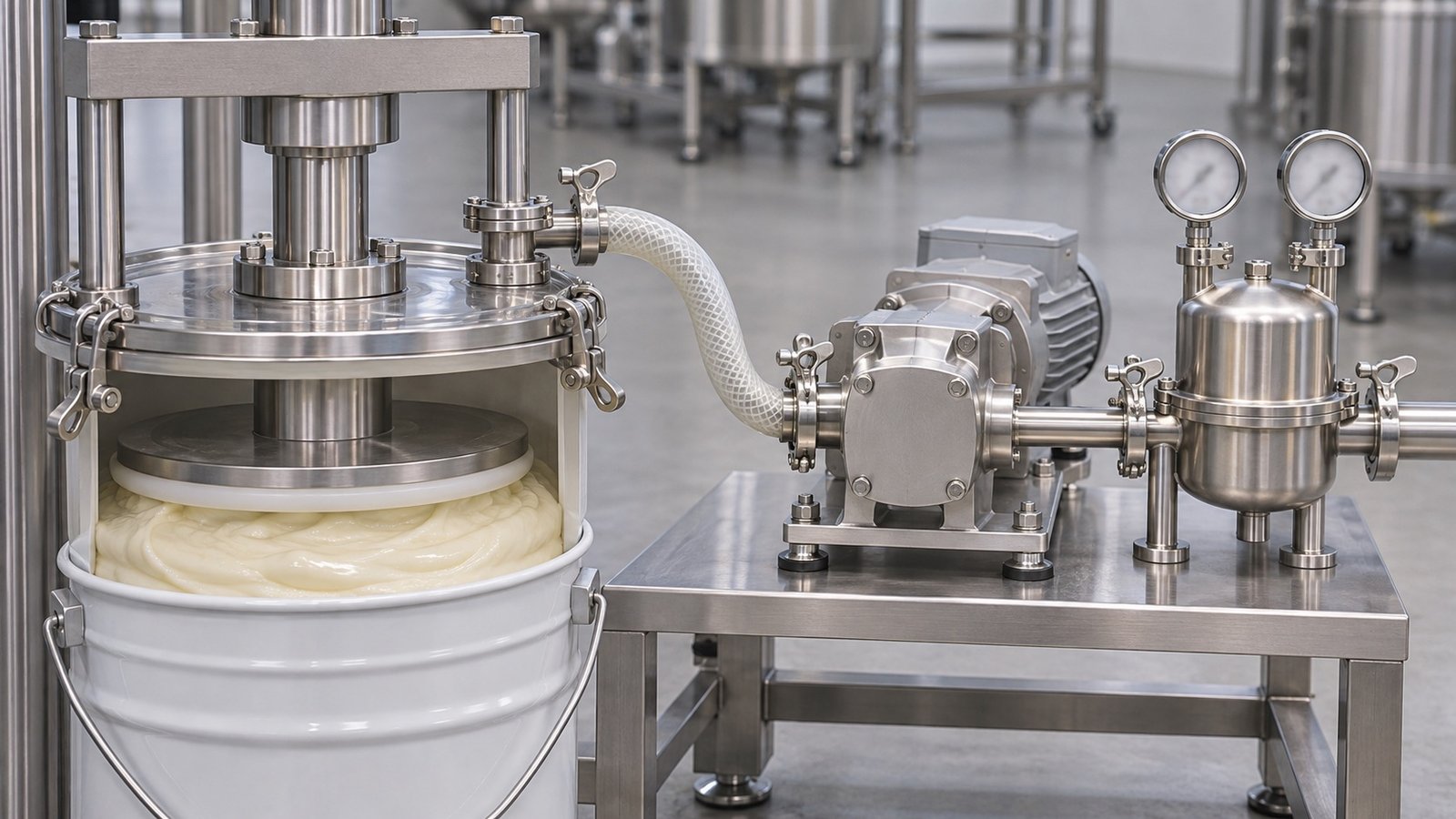
Ask for a product-contact schematic with internal diameters, hose lengths, low points, valves, seals and removable parts. Long narrow hoses can add restriction; oversized vessels can increase retained material and cleaning burden. The correct path is the smallest practical system that keeps the dosing device supplied under the agreed operating conditions.
Select the dosing principle with the complete cycle
Positive-displacement concepts are often considered for paste because they move a defined displacement, but the pump name does not establish the final dose. Inlet filling, seal condition, valve timing, trapped air, pressure recovery and nozzle cutoff all influence the unit that reaches the syringe. Nordson EFD similarly presents its high-flow piston valve as part of a system that includes a controller, fluid reservoir and dispense tip; the specific valve ratings on that page are not syringe-line performance claims and are not used here.
The comparison of volumetric and piston syringe filling explains why neither method is automatically more accurate. For a high-viscosity project, compare concepts using the same paste condition, barrel, target dose and acceptance method.
| System factor | What suitability looks like | Warning signs during a trial | What the buyer should record |
|---|---|---|---|
| Bulk feed | Dosing inlet remains supplied without uncontrolled pressure swings | Starved strokes, voids, product channeling | Supply pressure, product level and refill events |
| Dosing device | Repeatable displacement under defined product conditions | Drift after pauses or temperature change | Dose result by cycle phase and product temperature |
| Valve and manifold | Opens, closes and balances flow without excessive retention | Delayed start, pressure rebound, different heads behaving differently | Timing, pressure and head-separated samples |
| Nozzle | Fits the barrel and cuts off acceptably | Stringing, wall contact, tail or drip | Bore, insertion depth, motion and cleanup frequency |
| Barrel support | Holds centerline and insertion height under filling load | Barrel lift, tilt, whitening or deformation | Carrier reference surfaces and first-article checks |
| Cleaning | Product-contact parts can be accessed and verified | Hidden pockets, cured residue, excessive product loss | Disassembly steps, retained product and inspection points |
Check whether the product supply can meet the fill window
Required average flow is a useful screening calculation:
Required average flow = target fill volume ÷ allowed filling time
Assume, only for illustration, that a 30 mL applicator must receive its fill in 3 seconds. The average flow during dosing is 10 mL/s. This is not a King Pack machine rating and does not include acceleration, nozzle motion or cutoff. The supplier still has to show that the paste can move through the proposed hose, valve and nozzle at the required conditions without exceeding equipment or package limits.
Repeat the calculation for every dose and expected cycle. Then compare it with a representative product test. If the supply system cannot recharge the dosing chamber before the next cycle, adding filling heads or increasing motion speed will not solve the bottleneck. The gel bait syringe capacity guide provides a broader accepted-output method that includes stops, replenishment and downstream constraints.
Match the nozzle and filling motion to the paste
A broad internal passage can reduce restriction, but the nozzle must still fit the barrel opening with clearance. A narrow or long tip may place the product accurately but increase the pressure needed for the same flow. The closing method matters as well: suck-back or positive shutoff may reduce a tail for one paste while disturbing dose or drawing air for another.
Bottom-up filling is commonly evaluated because it lets the nozzle withdraw as the product level rises. The motion needs to match actual flow. Withdrawing too quickly can leave voids; moving too slowly can submerge the tip unnecessarily or contaminate the outside. The filling-nozzle selection guide for viscous products covers bore, tip profile, insertion depth and shutoff in more detail.
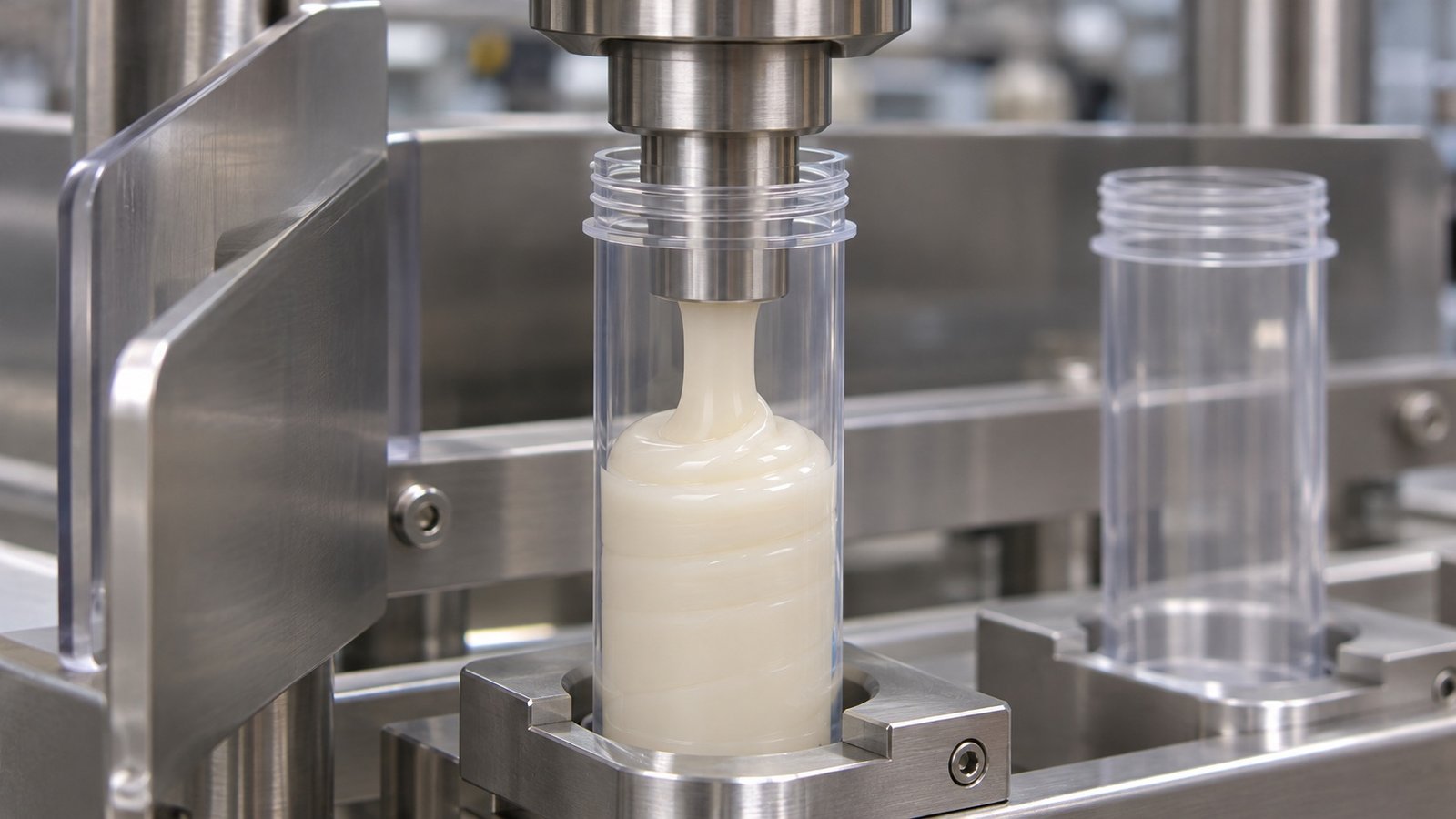
Inspect the complete cutoff sequence: end of pump displacement, valve closure, nozzle withdrawal, barrel indexing and the time before the next unit. A clean nozzle immediately after adjustment does not prove that the system remains clean after a stop and restart.
Control air from preparation through closure
Visible air can come from mixing, transfer, a partly emptied bulk container, a leaking inlet connection, poor priming or product folding over itself during filling. The remedy depends on the source. Vacuum processing may help one formulation, while another needs slower transfer, different hose routing or revised nozzle motion. Do not specify vacuum from appearance alone.
Define how air is judged. For transparent barrels, use controlled lighting, viewing angle and defect definitions. For an opaque package, another method may be required. If the fill is judged by mass, remember that an acceptable scale result does not prove the absence of a void or correct piston position.
Closure can also move or compress trapped air. Observe piston or stopper insertion and tip capping with the same fill condition used in the dosing trial. Record product movement toward the tip, closure position and any leakage or contamination. These checks connect filling suitability to the saleable package rather than to an isolated pump stroke.
Design for pauses, restart and batch end
High-viscosity paste may relax, cool, separate or build pressure while the line is stopped. The first unit after a pause can therefore differ from steady-running units. Include planned stops of agreed duration in the test protocol and define what must happen before production restarts: purge, pressure release, re-prime, sample inspection or another controlled step.
The end of the batch also matters. Ask how much product remains in the pail, follower plate, hose, pump and nozzle, how it can be recovered, and how the remaining material is reconciled. Retained volume affects product loss and cleaning, but it should be measured in the actual configuration rather than estimated from a generic pump description.
Campaign structure may change the correct automation level. A compact operator-assisted system can be practical for short batches and frequent cleaning, while long stable campaigns may justify automated component handling. Use the automatic versus semi-automatic syringe filling guide to compare this workload with the same product and package assumptions.
Make cleaning and maintenance part of suitability
Paste left in a dead leg, seal cavity or long hose can become difficult to remove. Review drainability, removable parts, clamp access, seal exposure and the order of disassembly. Product-contact materials and cleaning agents must be approved for the actual formulation and process; do not assume that stainless steel alone resolves compatibility.
Ask the supplier to identify routine operator cleaning, maintenance disassembly and parts that require replacement. Record tool requirements, lifting or handling needs, and how reassembly position is verified. The site's guide to cleaning a veterinary syringe filling machine provides a general framework, but the released procedure must come from the final product-contact design and the buyer's cleaning requirements.
Maintenance planning should include high-load seals, valve seats, hose condition and follower-plate seals where used. A spare-parts list should be tied to the selected configuration, not copied from a different product path.
Run a representative paste trial
A useful trial has a written question and acceptance method. Send actual product and the complete barrel, piston or stopper, rod and cap set. Supply enough material and components to prime the system, reach stable operation, pause and restart, and produce samples for measurement.
At minimum, record:
- Product lot, preparation, temperature and time since mixing.
- Product-path configuration, nozzle and key settings.
- Startup samples, steady samples and samples after planned pauses.
- Dose results using the buyer's instrument and method.
- Visible air, stringing, drips, barrel contact and closure condition.
- Operator interventions, cleaning frequency and rejected units.
- Open items that cannot be closed until the final machine or production components are available.
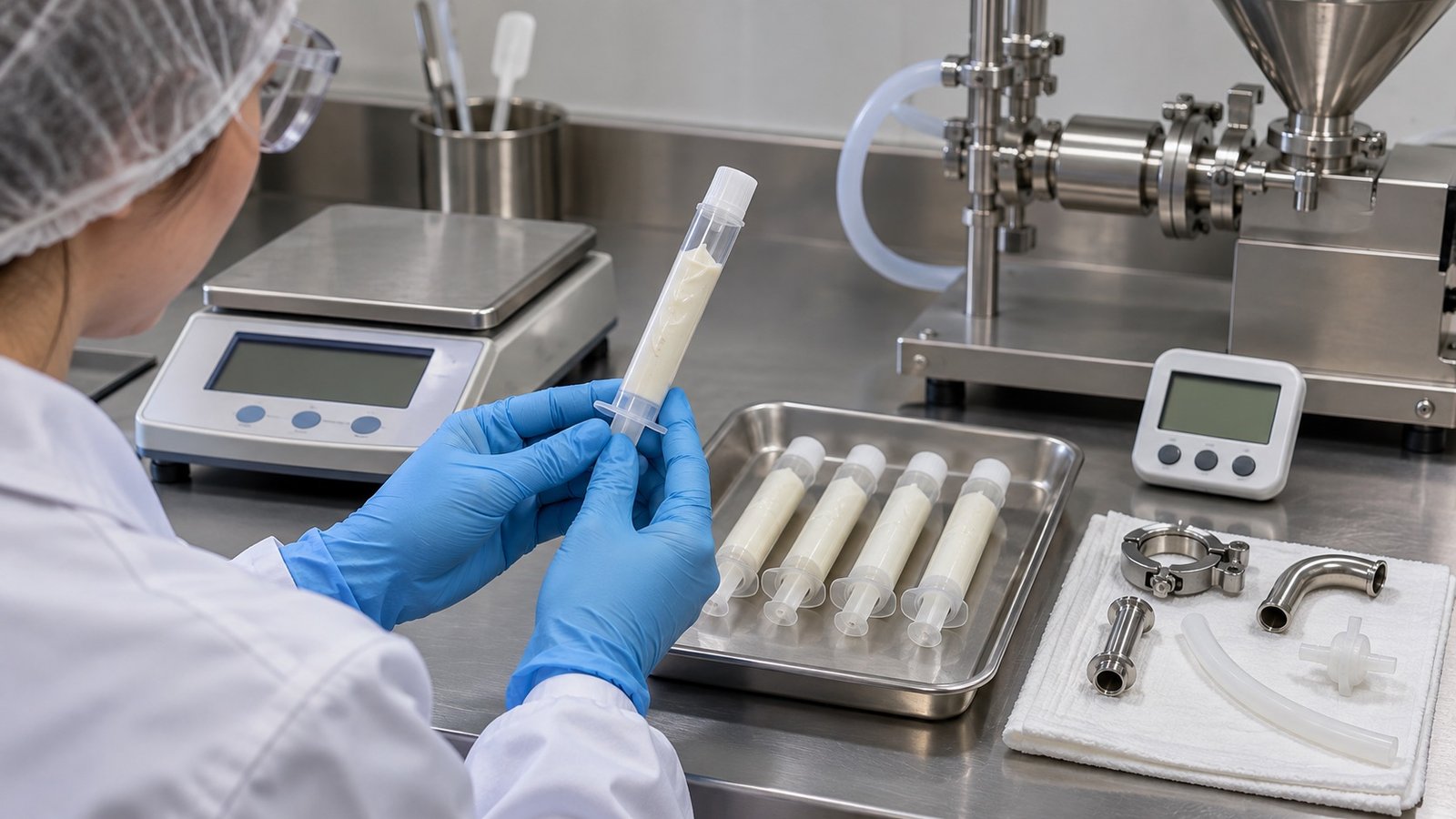
The gel bait filling trial checklist distinguishes this feasibility work from the factory acceptance test. A trial identifies a workable configuration; the FAT verifies the machine as built against the agreed protocol.
Specify the RFQ around evidence
Request a proposal that describes the complete system, not only “a machine for thick paste.” Include product data, barrel drawings, target dose, batch profile, accepted output, closure sequence, cleaning requirements, utilities, room conditions and inspection method. Ask the supplier to return:
- a product-contact flow diagram and material list;
- bulk-feed, dosing, valve and nozzle principles;
- pressure and temperature limits to be confirmed;
- barrel carrier and closure tooling scope;
- cleaning and product-recovery concept;
- sample-test plan and remaining technical risks;
- format parts, utilities, training, spares and FAT responsibilities.
King Pack can review representative paste and package samples, configure the filling and closing sequence, and agree a factory acceptance scope for the proposed line. Actual performance limits must be established in the approved technical agreement and tests. Send your paste data, target dose and syringe samples to request a technical review.
Frequently asked questions
Is a piston filler always the best choice for high-viscosity paste?
No. Positive displacement can be practical, but the inlet supply, valve, nozzle, seals and product behavior determine the final result. Compare complete configurations with the same sample and acceptance method.
Does higher pressure solve slow paste filling?
Not by itself. More pressure can increase loads on seals, hoses, valves and the package. First identify the main restriction and verify equipment and product limits through testing.
Should a high-viscosity syringe filling machine use a follower plate?
A follower plate can help feed non-self-leveling material from a pail, but it is not mandatory for every product. Batch size, container, paste behavior, cleaning and product recovery determine the choice.
How can stringing at the nozzle be reduced?
Test nozzle bore and length, shutoff method, suck-back where appropriate, product temperature, filling motion and the timing between cutoff and indexing. The best combination is product-specific.
How much product is needed for a sample trial?
Enough to fill and prime the entire proposed product path, reach steady operation, run agreed stop/restart checks and retain samples for measurement. The supplier should calculate this from the test setup before shipment.
Can water or a substitute paste prove the machine will work?
It can demonstrate basic motion or control logic, but it cannot confirm pressure, cutoff, air behavior, cleaning or dose performance for the final formulation. Keep those items open until representative product is tested.
