 Skip to content


An automatic vs. semi-automatic syringe filling machine should be selected from the work required per saleable unit, not from batch size alone. A semi-automatic setup often fits short campaigns, frequent format changes and products that still need operator judgment. Full automation becomes more useful when the same stable format runs long enough for automatic feeding, filling, closing and inspection to recover their added changeover, validation and maintenance burden. Compare both options with the same product, syringe parts, staffing plan and acceptance test.
Define automatic vs. semi-automatic syringe filling by scope
The automation label is incomplete unless the quotation states which operations are included. A powered filler that doses product while an operator loads every barrel, inserts every piston and applies every cap is semi-automatic. An integrated cell may automate filling and closing but still require manual tray loading. A fully automatic line may orient components, transfer barrels through dosing and closing, inspect selected attributes and discharge accepted units with operators mainly replenishing materials and responding to alarms.
Use a station list instead of accepting a label. The syringe filling machine process guide explains the sequence from barrel handling through filling and closure. Mark each step as automatic, operator-assisted or outside the supplier's scope. This prevents one vendor's “automatic” proposal from being compared with another vendor's dosing-only machine.
| Decision point | Semi-automatic setup | Fully automatic setup | What the buyer should verify |
|---|---|---|---|
| Barrel loading | Individual placement or tray loading by an operator | Feeder, magazine, nest or automated transfer | Which barrel formats can be oriented without damage |
| Filling cycle | Operator presents or indexes the barrel | Machine indexes barrels and triggers dosing | Product feed stability and accepted dose evidence |
| Piston and cap handling | Manual, assisted or a separate small station | Integrated feeding and insertion | Component orientation, insertion force and reject handling |
| Inspection | Manual sampling or separate checks | Selected inline checks plus sampling | What is detected, rejected and recorded |
| Changeover | Fewer parts, but more manual setup | More recipes, guides, feeders and interlocks | Parts list, tool requirements and first-article checks |
| Staffing | More direct handling per unit | Replenishment, supervision and intervention | Real operator tasks during a representative run |
Start with batch time, not monthly volume
Monthly demand can hide the operating pattern that determines the right machine. Ten thousand units produced as one stable campaign create a different workload from ten batches of one thousand units with cleaning, material changes and first-article approval between them. Record the number of campaigns, average batch size, longest batch, shortest batch and formats per week.
Calculate how long each batch occupies the proposed equipment. Use accepted output from a representative test, not a catalogue maximum. Include startup samples, planned checks, replenishment, short stops and the final quantity that cannot be recovered from the product feed system. The gel bait syringe filling capacity guide shows why good units per available hour are more useful than a nameplate rate.
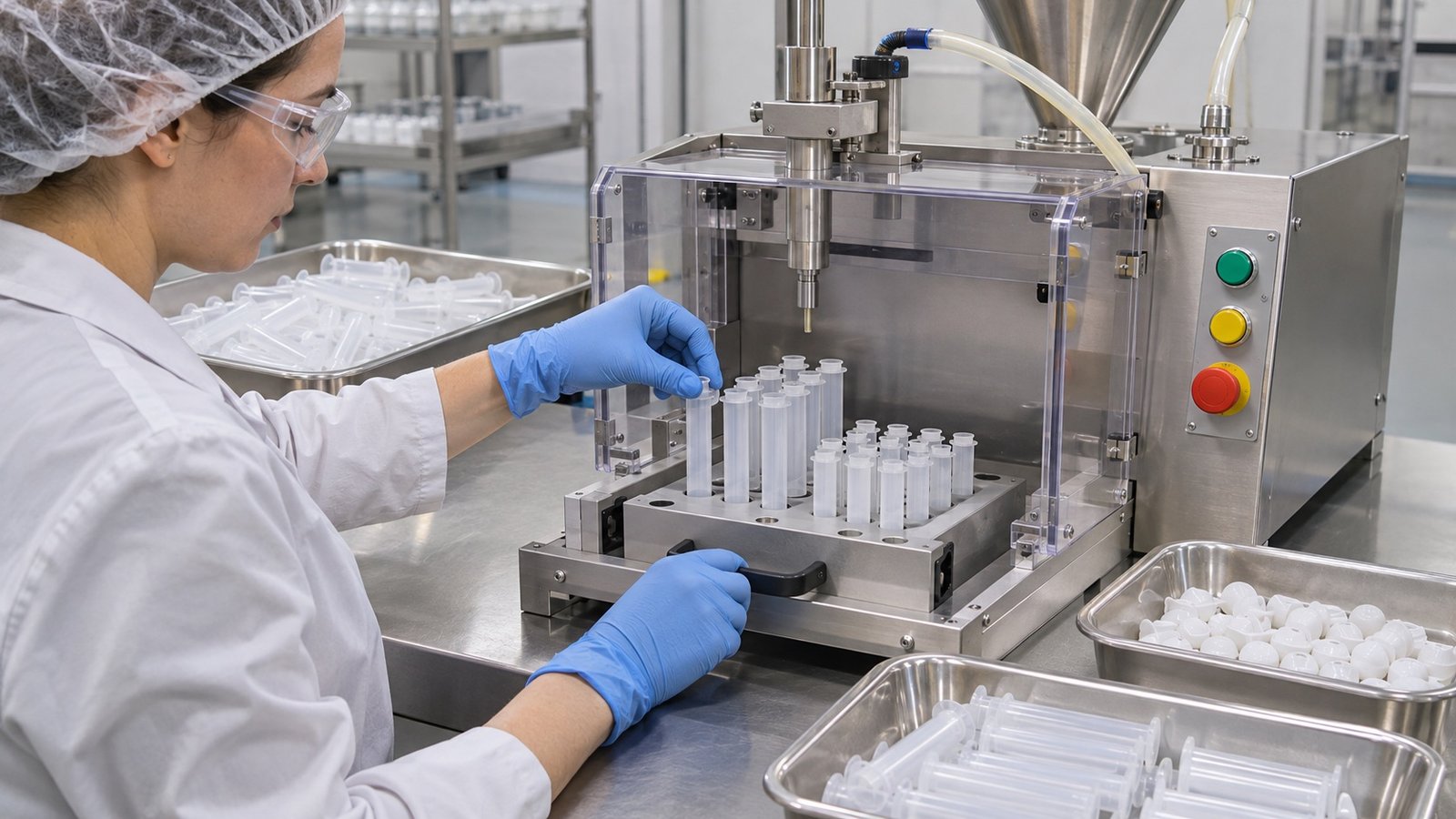
For a hypothetical comparison, assume a buyer needs 6,000 accepted applicators per campaign. Proposal A produces 20 accepted units per minute with two operators after normal startup. Proposal B produces 60 accepted units per minute with one operator, but its feeder and inspection setup add 75 minutes to every format change. These are illustrative assumptions, not King Pack machine ratings.
- Proposal A running time: 6,000 ÷ 20 = 300 minutes.
- Proposal B running time: 6,000 ÷ 60 = 100 minutes.
- If Proposal A needs 20 minutes of setup and Proposal B needs 75 minutes, the occupied times become 320 and 175 minutes.
The automatic option saves time in this example. It may not save enough to justify the project if campaigns are much smaller, if the buyer changes several feeders between batches, or if the upstream mixing and downstream packing steps cannot use the released capacity. Repeat the calculation for the actual campaign mix.
Count operator minutes at every station
Semi-automatic equipment does not simply “use more labor.” It assigns specific tasks to people: presenting barrels, starting cycles, inserting pistons, applying caps, checking fill weight, moving trays and recording results. List each task and measure hands-on minutes per batch. Note whether an operator can safely supervise another process during machine cycling or must remain at the station.
Full automation changes the work rather than eliminating it. Operators replenish barrels, pistons and caps, monitor product supply, clear faults, handle samples, reconcile rejects and perform changeovers. Maintenance and quality personnel may spend more time on sensors, feeders, recipes and inspection challenges. A realistic staffing comparison includes these activities and the skills required on each shift.
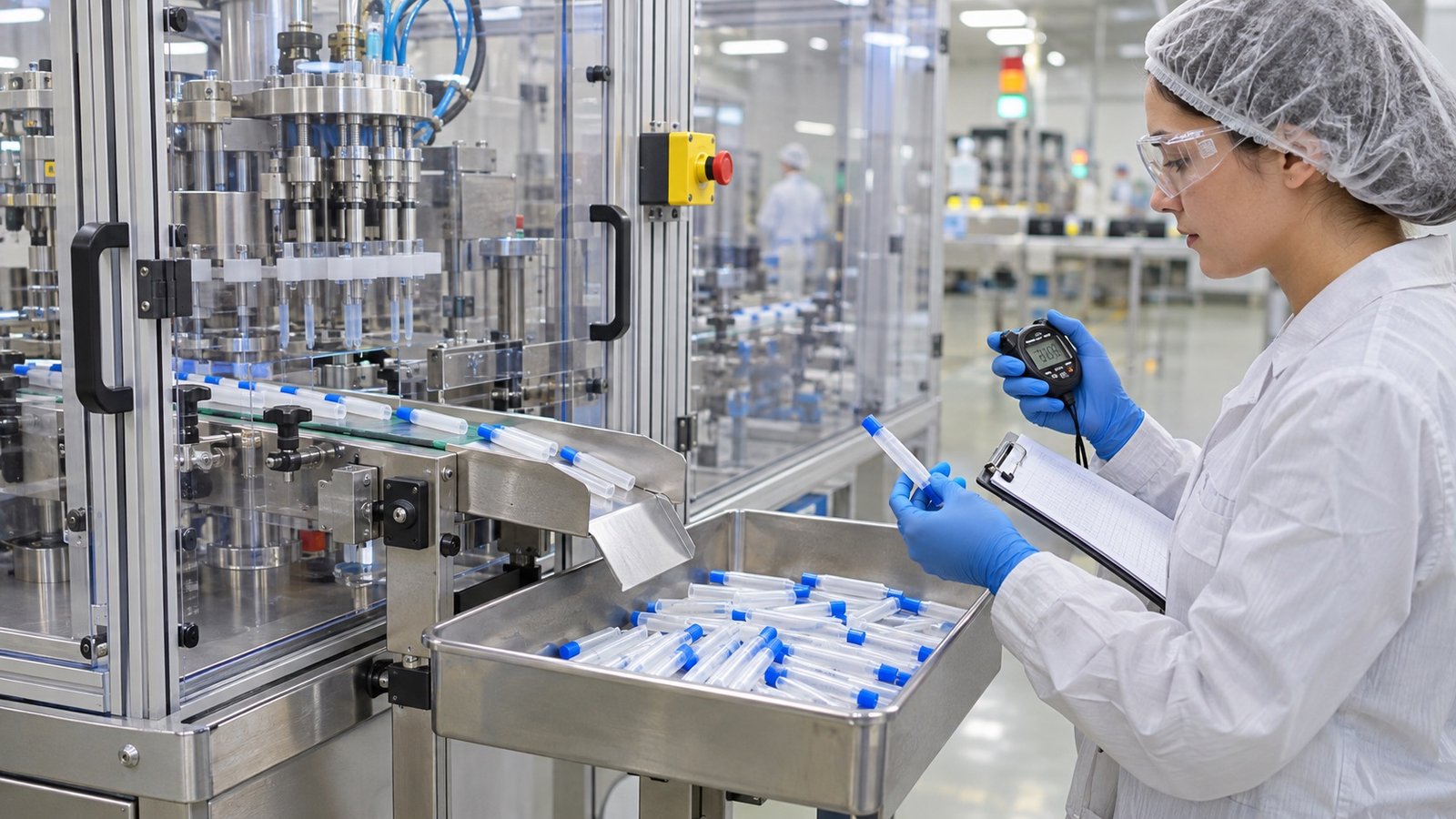
Ask both suppliers to run the same material and package set. Record how many people touch the product, how long each task takes and which interventions stop the line. This makes the comparison relevant to the buyer's labor availability without inventing a universal labor-saving percentage.
Compare format mix and changeover burden
A plant with one stable syringe barrel can use automation differently from a contract manufacturer that changes sizes, products or caps every day. Automatic feeding equipment may need format-specific bowls, guides, pockets or recipes. A semi-automatic fixture may accept a change with fewer parts, although the operator then performs more handling during the run.
Review the complete changeover sequence: drain or recover product, remove product-contact parts, clean or replace them, change barrel supports, adjust nozzles, load the correct recipe, challenge sensors and approve the first articles. The syringe format changeover guide provides a structure for identifying parts and verification steps.
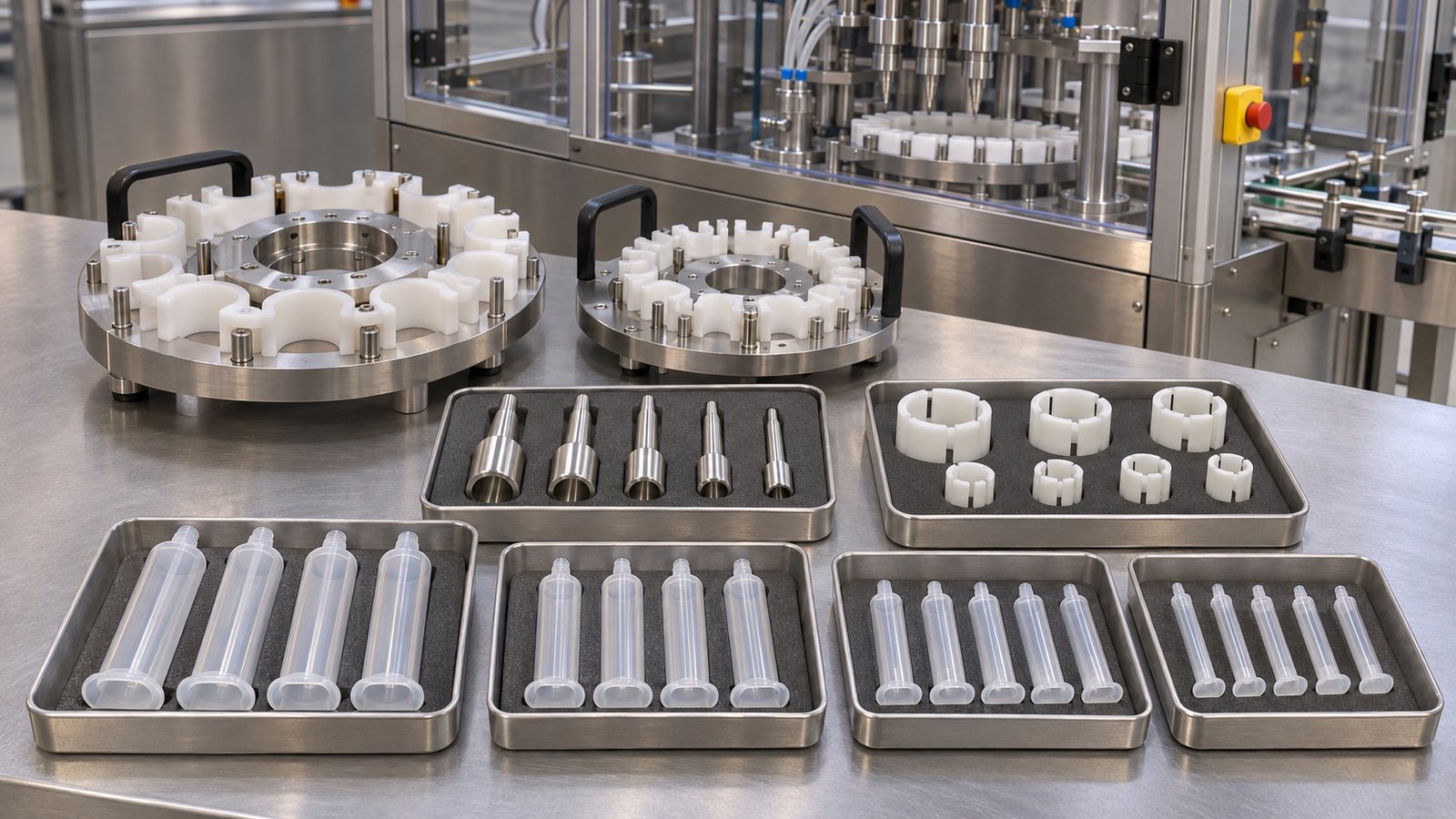
Ask for a format matrix with each barrel, piston and cap combination. The supplier should identify common parts, unique parts and the steps that require tools or trained maintenance staff. If the product family has uncertain future formats, discuss the limits of the base machine before relying on a promise that any new format can be added later.
Use product behavior to set the automation boundary
Product handling can determine whether more automation will run consistently. High-viscosity or thixotropic products may require controlled feed pressure, temperature, agitation, degassing or a follower plate. Low-viscosity liquids may require nozzle shutoff and drip control. Abrasive or filled materials can influence seals, clearances and maintenance intervals. These are application conditions to test, not performance claims that can be settled by the automation label.
A semi-automatic station may be practical while a process is still being developed because operators can observe the dose and adjust the presentation of difficult components. A stable process with known material limits is easier to integrate into automatic feeding and inspection. The existing guide on moving from manual to automatic gel bait filling covers the process-development signals for that application; this article uses a different question, namely how campaign structure and included stations change the equipment decision.
Provide representative production material, not only water or an easy substitute. Define its temperature, hold time and expected condition at the filler. If a substitute must be used during early testing, state which conclusions remain open until the final product is available.
Compare risk, control and acceptance evidence
Full automation can reduce repeated manual handling, but it adds interfaces that require definition. A barrel feeder, transfer mechanism, filling station, closure station and inspection system must exchange parts without creating a new bottleneck. A sensor may confirm presence without proving correct insertion. An automatic reject device needs a defined trigger, challenge method and reconciliation procedure.
Semi-automatic equipment has fewer interfaces, yet its results depend more directly on operator method. Work instructions should define barrel presentation, cycle initiation, closure handling, sampling and response to an abnormal dose. Training evidence and clear fixtures matter when several operators share the machine.
For the factory acceptance test, ask both suppliers to demonstrate the same:
- Representative product and each agreed package format.
- Startup, steady running, a normal replenishment and a planned stop/restart.
- Good units, rejects and the reason for every interruption.
- A routine format change and first-article approval.
- The operator and maintenance tasks included in the proposed staffing plan.
Do not compare an automatic line tested for ten uninterrupted minutes with a semi-automatic cell tested through a complete small batch. Use the same acceptance window and report accepted units at the same discharge point.
Build a total project comparison
The purchase price is only one part of the decision. Compare the equipment, format parts, feeders, guarding, inspection, installation, utilities, documentation, training and spares included in each scope. Add the buyer's site work and the cost of product and components needed for trials. Do not assign an ROI until these inputs come from a documented proposal and the buyer's own labor and production data.
Also compare schedule risk. Automatic equipment generally has more interfaces to define and more format-specific parts to approve. That does not make it the wrong choice, but the buyer should connect the automation decision to sample availability and design freeze. The custom syringe filling machine lead-time guide explains how samples, design approval and acceptance affect delivery planning.
Prepare one RFQ for both options
Send the same RFQ data to every supplier: product properties, fill range, barrel and closure drawings, sample sets, campaign quantities, format frequency, target accepted output, available operators, utilities, room drawing, cleaning expectations and required inspections. Ask each supplier to return a station-by-station scope and a timed trial plan.
King Pack can review semi-automatic and automatic configurations against the supplied product, package and line interfaces. The proposal still needs application testing and an agreed acceptance scope. Send your batch profile and syringe drawings to request a comparison based on the same production assumptions.
Frequently asked questions
Is full automation always better for large batches?
No. Long, stable campaigns make automation easier to justify, but the line must also receive product and components consistently and discharge into a capable downstream process. Compare accepted output and the complete staffing plan.
What batch size justifies an automatic syringe filling line?
There is no universal threshold. Calculate occupied machine time, operator minutes, changeover time and accepted output for the actual campaign mix. The economic threshold depends on the quoted scope and the buyer's costs.
Can a semi-automatic machine include piston insertion and capping?
Yes, depending on the proposed configuration. “Semi-automatic” only means that some handling or cycle steps still depend on an operator. List every station and responsibility in the quotation.
Which option is easier to change between syringe formats?
A compact semi-automatic fixture often has fewer feeding parts, while a fully automatic line can store recipes but may require more mechanical change parts. Compare an observed changeover for the formats you intend to buy.
What should buyers test before choosing between the two?
Test the actual product and components through startup, steady running, replenishment, a stop/restart and a routine format change. Record accepted output, rejects, interventions, staffing and cleaning or recovery steps.
