

Short answer: Selecting a filling nozzle for a viscous product requires testing the product, dose, package opening, and filling motion together. A wider bore can reduce restriction but may increase stringing or dripping; a narrow tip can improve placement but raise pressure and lengthen the fill. Start with product behavior and the syringe geometry, then compare nozzle bore, tip profile, insertion depth, shutoff method, and cleaning requirements in a controlled trial.
For creams, gels, pastes, and veterinary intramammary preparations, “viscous” is not a complete specification. A shear-thinning cream, an elastic gel, and a particulate paste can behave very differently even when they appear similarly thick at rest. The nozzle decision should therefore be part of the filling process design, not a last-minute accessory choice.
Why nozzle selection matters for viscous filling
The nozzle forms the final part of the product path. Its internal diameter, length, outlet shape, and position affect flow resistance, dose start and stop behavior, product contact with the package, and the ability to clean or inspect the wetted surface. Those effects interact with the pump or piston, hose, manifold, product temperature, and the package opening.
A nozzle that works well on a short bench test may behave differently after a long hose is installed or when the line restarts after a pause. A useful evaluation includes start-up, steady filling, stop, restart, and the final units in a batch. Record observations instead of relying on a single visual impression.
1. Define the product before choosing the nozzle
Provide a representative product sample and the product information the equipment supplier needs to plan a safe test. Where available, include viscosity across the expected temperature range, density, sensitivity to shear, particulate size, tendency to trap air, and whether the formulation changes over time. If formulation details are confidential, a qualified technical contact can agree on a suitable test protocol and sample handling approach.
Viscosity alone does not predict nozzle performance
Many creams and gels are non-Newtonian: the apparent resistance to flow changes with shear rate. Some products become easier to pump while moving and recover structure after dispensing. Others may string, retain a tail, or release trapped air. A static viscosity figure is helpful, but it does not replace observation during the actual filling cycle.
For a syringe application, also identify the smallest opening through which product must pass, the target fill volume, the container orientation, and whether the nozzle enters the syringe barrel. These details narrow the practical nozzle options before machine testing begins.
2. Match the nozzle outlet to the package opening and dose
The nozzle should deliver product into the intended area without striking the package wall or interfering with downstream closure handling. Its outside diameter must fit the package opening with an appropriate clearance. The selected tip also needs to reach the intended fill position without touching a surface that could contaminate the product path or damage the package.
A smaller outlet may provide better placement for a small opening, but it can increase pressure, fill time, and sensitivity to particles or formulation changes. A larger outlet may reduce restriction while making the stream harder to control in a narrow barrel. The best selection is the one that meets the product and package requirements across the operating range, not the one with the smallest or largest bore by default.

3. Compare common nozzle styles
| Nozzle style | Potential fit | Trade-offs to evaluate |
|---|---|---|
| Straight open tip | Simple products and accessible package openings | May leave a product tail or drip after shutoff; easy access can support inspection |
| Tapered or reduced outlet | Targeted dispensing into a smaller opening | Greater restriction; test fill time, pressure, and clogging risk with the actual product |
| Long insertion nozzle | Bottom-up filling or placement deeper in a syringe | Requires accurate height and motion control; contact and cleaning access need review |
| Shutoff or anti-drip tip | Products that continue to flow or form a tail after the dosing stroke | More components and seals may affect cleaning, maintenance, and product compatibility |
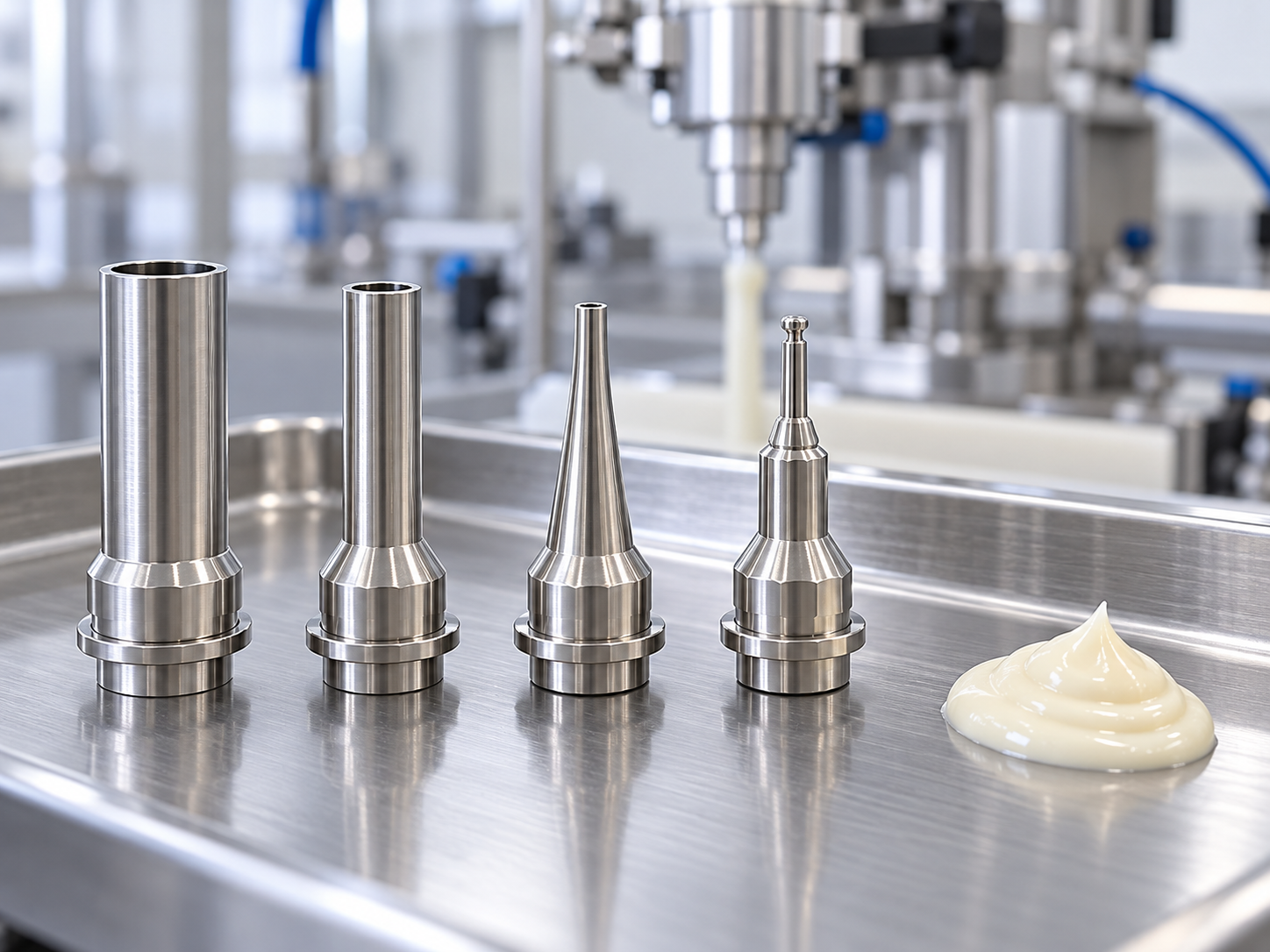
These descriptions are selection prompts, not a guarantee that a style will work for every formulation. The machine builder should confirm which tip geometries are supported by the selected filling system and what parts are product-contact components.
4. Evaluate bore size, length, and pressure as a system
Increasing the internal diameter generally reduces flow restriction, all else equal. However, nozzle dimensions cannot be selected independently from pump capacity, hose diameter and length, target cycle time, and the product’s flow curve. A longer, narrow tip may create more resistance than a short tip with the same outlet. High resistance can show up as slower filling, inconsistent starts, pressure variation, or difficulty recovering product from the path.
Do not compensate for an unsuitable nozzle only by increasing pump speed or pressure. That can change product behavior, cause splashing or air entrainment, and put more load on the product path. Instead, compare compatible nozzle and recipe combinations at controlled settings. Capture the settings with the result so the approved configuration can be repeated.
5. Control stringing, dripping, and tail formation
Stringing occurs when product stretches between the nozzle and the filled package instead of separating cleanly. Dripping can occur after the fill stroke when product continues to move or relaxes from the tip. Possible contributors include product elasticity, temperature, nozzle wetting, outlet shape, shutoff timing, withdrawal speed, and the distance between the tip and the product surface.
Use a short, controlled test matrix
Test one factor at a time where practical: nozzle bore, tip profile, insertion depth, fill speed, pause or dwell, shutoff timing, and withdrawal motion. Define a visual acceptance rule for tails and drips before starting. Use the same product condition and syringe format for each comparison. If product temperature is controlled, record it; if it is not, note the ambient and product conditions rather than assuming they are constant.
Anti-drip or suck-back functions can help in some configurations, but excessive retraction may draw air into the product path or create a variable first dose after a stop. Verify both the last dose before a pause and the first dose after restart.
6. Consider cleaning, changeover, and maintenance
A nozzle must be practical to remove, inspect, clean, and reinstall under the plant’s approved procedure. Consider whether the internal passage is visible, whether seals can be replaced, how parts are identified, and whether a tool is needed for disassembly. A complex tip can improve shutoff while adding cleaning and maintenance steps.
For campaigns with frequent product changes, compare the time and risk associated with dedicated nozzles against validated cleaning of shared components. Confirm how the nozzle connects to the hose or manifold, whether it can be installed in only one orientation, and what spare parts should be kept on site. These questions are relevant during a syringe filling machine review and commissioning plan.
7. Test the nozzle with the actual syringe and line sequence
A representative test should use the intended syringe barrel, product, target dose, and filling sequence. Include the relevant start, stop, and restart conditions. Inspect the first units, a stable section of the run, and the final units. If the production line includes a plunger or closure operation, confirm that the nozzle position and fill level leave the required downstream clearance.
Record which nozzle was used, its bore and length, the machine recipe, the product condition, observed fill appearance, drip or stringing, and any rejected units. A supplier’s factory acceptance test can be structured around agreed sample and acceptance criteria; a plant trial can then confirm performance with the site’s product handling and utilities.
For veterinary products, the veterinary medicine filling solution should account for the syringe format, nozzle entry, filling direction, and closure sequence. For other structured products, review the viscous product filling approach with the actual formulation characteristics.

Buyer checklist: information to include in an RFQ
- Product type and available flow or viscosity information, including temperature conditions.
- Whether the product contains particles, traps air, strings, or changes structure under shear.
- Syringe drawing, opening dimensions, target fill volume, and closure or plunger sequence.
- Required filling direction, nozzle insertion depth, and acceptable contact conditions.
- Expected product changeovers, cleaning method, and documentation needs.
- Requested test outputs: sample photos, dose checks, start-stop observations, and a record of tested settings.
Ask the supplier to state which dimensions and features are confirmed, which are proposed pending sample testing, and which remain the customer’s responsibility to approve. This keeps the quotation, FAT scope, and site acceptance aligned.
During a broader line review, compare the proposed nozzle with the filling machine configuration and any downstream packaging equipment. If a line integrates several stations, confirm handoff heights, available space for nozzle access, product-path routing, and whether operators can remove the tip without disturbing adjacent guards or sensors. These practical details affect inspection and cleaning just as much as the nozzle dimensions.
When the project includes multiple products, prepare a small matrix that lists each formulation against the syringe opening, target dose, candidate nozzle, and required cleaning method. Mark which combinations have been tested and which are still assumptions. This avoids treating an approved nozzle for one cream as automatically approved for every product in the portfolio. For a complete system, review the packaging machine range and align the filling step with the downstream handling sequence.
Finally, agree how test observations will be recorded. Photos can document the visible fill profile and tailing, but they do not replace quantitative checks required by the product specification. Where weight or volume checks are part of acceptance, define the sampling method and decision rule with the quality team before the trial.
FAQ
Is a larger nozzle always better for thick products?
No. A larger bore can reduce flow restriction, but it may reduce placement control or increase dripping. The product, package opening, dose, and machine motion determine the useful size.
Should the nozzle touch the product or syringe?
That depends on the filling method, hygiene requirements, package geometry, and risk of contact. Define the intended position and verify that it is repeatable without damaging the package or contaminating the nozzle.
Can one nozzle handle different syringe sizes?
Sometimes, if the openings, dose range, and product behavior are compatible. Different formats may require a different tip, height setting, or recipe. Confirm changeover steps in testing.
What sample should be sent for nozzle testing?
Ask the equipment supplier for a sample estimate based on priming, adjustment trials, repeat runs, and cleaning restrictions. Provide representative product and packaging so the test reflects the intended process.
How do I know whether anti-drip is necessary?
Observe the product after the dosing stroke and after a stop. If tails or drips breach the agreed acceptance criteria, compare shutoff and anti-drip options while checking restart behavior.
Conclusion
Choose a filling nozzle by balancing flow restriction, placement, shutoff behavior, package access, cleanability, and format changeover. For viscous products, bench appearance alone is not enough: test the actual formulation and syringe through start-up, steady filling, stop, and restart. The resulting evidence gives engineering, quality, and procurement teams a shared basis for approving the nozzle and machine configuration.
Planning a syringe filling project? Share your product characteristics, syringe drawing, target dose, and closure sequence through King Pack Machinery’s contact page or request a technical quotation. This allows the supplier to identify what can be confirmed from the specification and what should be demonstrated with a product test.