
Volumetric vs Piston Syringe Filling
AI Answer Snapshot
Volumetric and piston syringe filling should be selected from the product, syringe, air, cleaning and acceptance requirements. A volumetric system uses a defined chamber or displacement relationship; a piston system uses a positive-displacement stroke. Neither is automatically more accurate. Representative product and package testing is required.
Introduction
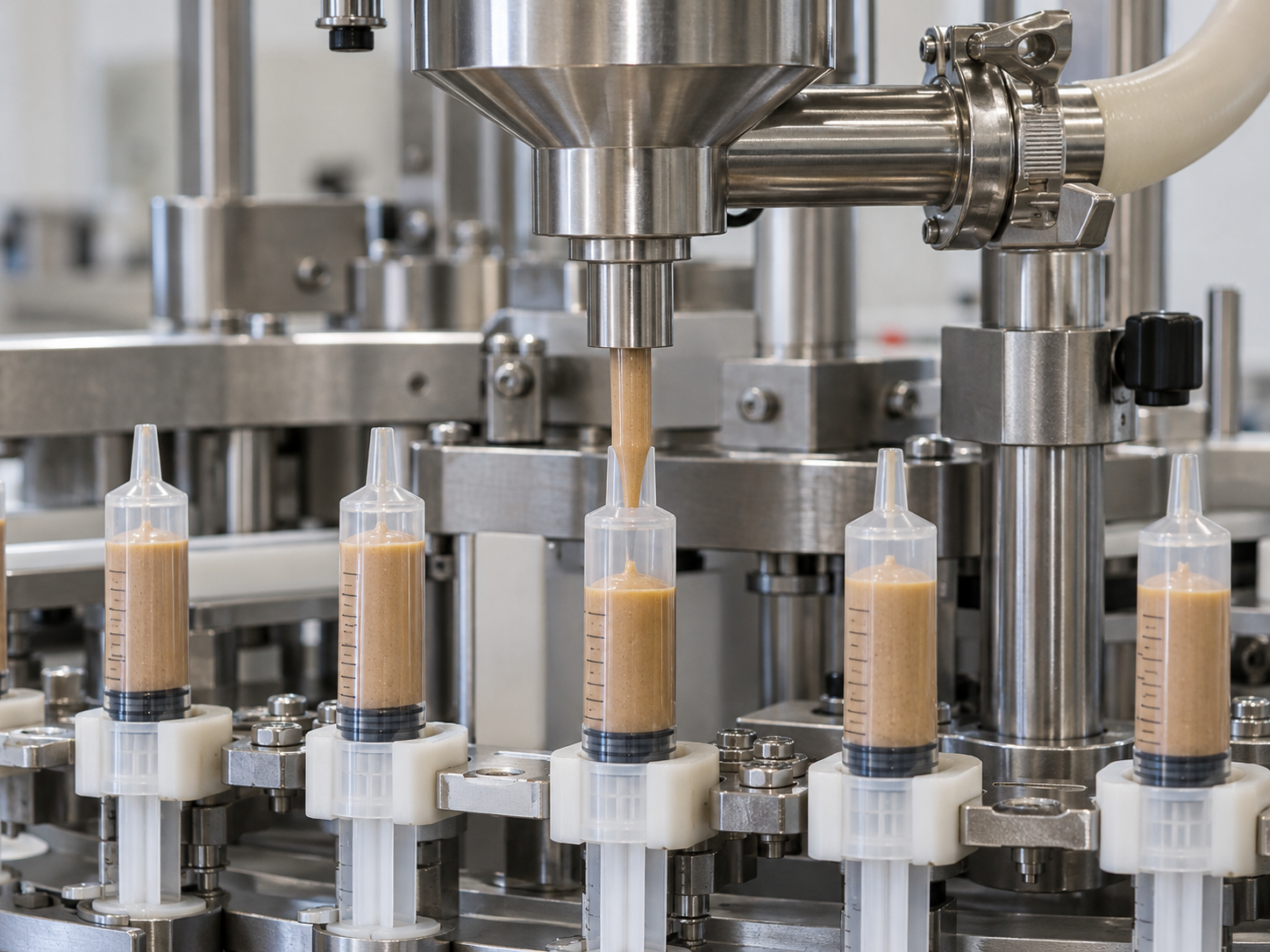
Thin liquids, gels, ointments and veterinary pastes behave differently through the same filling path. Product temperature, stringing, trapped air, valve response and syringe support can influence the finished dose. This guide compares the two methods for procurement, engineering and quality teams without making unsupported speed or accuracy claims.
Volumetric filling
A volumetric system delivers product through a defined chamber, timing relationship or calibrated displacement. Chamber geometry, product level, pressure, temperature and flow behavior all matter. If the customer checks by mass, density and temperature remain relevant even when the nominal target is volume. The valve, hose, nozzle and cutoff must be evaluated with the chamber.
Piston filling
A piston system uses a controlled stroke to move product. The piston, cylinder, valve, seal, nozzle and product preparation form one dosing chain. Positive displacement can be practical for thick products, but piston volume alone does not prove the final dose. Record stroke, temperature, product condition and inspection method during trials.
Match the product
Document viscosity, yield stress, shear sensitivity, stringing, particles and air sensitivity. A low-viscosity liquid may need a different valve and anti-drip design from a veterinary paste. Test at the intended preparation condition and include start-up, stable running and restart after a pause. A substitute product can show movement but cannot prove final product behavior.
Dose and package acceptance
Define whether the dose is checked by mass, volume, expelled dose, visual level or a combination. State the instrument, sample size, timing and response to an out-of-range result. Also inspect visible air, tip contamination, barrel damage, plunger seating and cap fit where applicable. A dose can pass a scale check and still fail a package or assembly check.
Air, cutoff, cleaning and changeover
Both methods require a priming strategy and controlled start-up. Compare dead volume, product recovery, drainability, removable parts and seal access. For multiple syringe sizes, identify the nozzle, nest, valve, support and recipe changes. Label format parts and define a first-article check after changeover. Cleaning chemistry and verification must be approved for the actual product and materials.
FAT and procurement checklist
Use the same product, syringe, target and inspection method when comparing concepts. Record temperature, preparation, component lot, recipe, intervention and rejects. Request the product-contact list, dosing principle, format parts, utility requirements, cleaning instructions, spares, training and FAT scope. Ask the supplier to separate confirmed capability, conditional recommendation and open trial items.
FAQ
Is piston filling always better for viscous paste?
No. It may be practical, but the full dosing path must be tested with the product.
Is volumetric filling only for liquids?
No. It can suit products that flow consistently through the selected chamber and nozzle.
How should the methods be compared?
Use the same product, syringe, preparation condition, sample plan and measurement method.
What belongs in an RFQ?
Provide product behavior, fill target, syringe drawings, formats, cleaning method, utilities, inspection criteria and FAT requirements.
Conclusion
Compare volumetric and piston filling as complete process solutions. Product behavior, air, cutoff, cleaning, changeover and evidence determine suitability. Send your product and syringe requirements for a technical comparison and quotation.


Review the syringe filling machine range, veterinary medicine application, intramammary syringe solution, filling and capping line, viscous nozzle guide, waste reduction guide, cleaning guide, product catalogue, packaging solutions, contact page and request-a-quote page.