 Skip to content


A disposable syringe filling machine should be specified from the complete barrel set, the product path and the closing method—not from nominal syringe volume alone. Plastic barrels with the same stated capacity can differ in flange shape, body diameter, wall stiffness, tip geometry, piston fit and dimensional tolerance. Those differences affect feeding, carrier support, nozzle alignment, plunger insertion and capping. Send drawings and samples from intended production lots, then verify the proposed tooling with the real product before freezing the machine design.
First define what “disposable syringe” means in your project
The term covers packages with very different duties. It may describe a needle-free veterinary dosing applicator, an oral or dental material dispenser, an industrial paste cartridge, or a sterile polymer syringe intended for injectable use. The equipment, room, component handling and acceptance evidence are not interchangeable.
For example, ISO 7886-1 addresses empty sterile single-use hypodermic syringes filled by the end user and explicitly excludes manufacturer-prefilled syringes. ISO 11040-6 covers polymer barrels and sterilized subassembled syringes ready for filling. A needle-free veterinary or technical applicator may fall under a different regulatory and packaging framework. The product owner must therefore identify the intended use, market and applicable requirements before a supplier proposes a machine.
This guide concentrates on the mechanical and process questions common to plastic barrels. It does not claim that one configuration is suitable for every medical, veterinary, dental or industrial application.
Build a complete component specification
Do not send only a photograph and the label “10 mL plastic syringe.” Prepare a controlled package record for every format. Include the barrel, piston or stopper, plunger rod, tip cap or closure, and any tray, nest or bulk-feeding presentation that reaches the machine.
The drawing pack should identify:
- barrel outside and inside diameters, overall length and usable fill region;
- finger-flange dimensions, shape and orientation features;
- tip position, bore and closure interface;
- permitted dimensional tolerances and molding flash limits;
- polymer and any lubricant, surface treatment or sterilization state;
- piston, stopper and rod dimensions, insertion orientation and acceptable seated position;
- cap geometry, application method and evidence used to judge correct closure;
- printed, molded or transparent areas that must not be scratched or covered.
Nominal dimensions start the tooling design, but samples reveal effects that drawings may not describe: ovality, flexible flanges, friction, static, part-to-part color variation and the way bulk parts interlock. The syringe format changeover guide explains how these features turn into a change-part matrix.
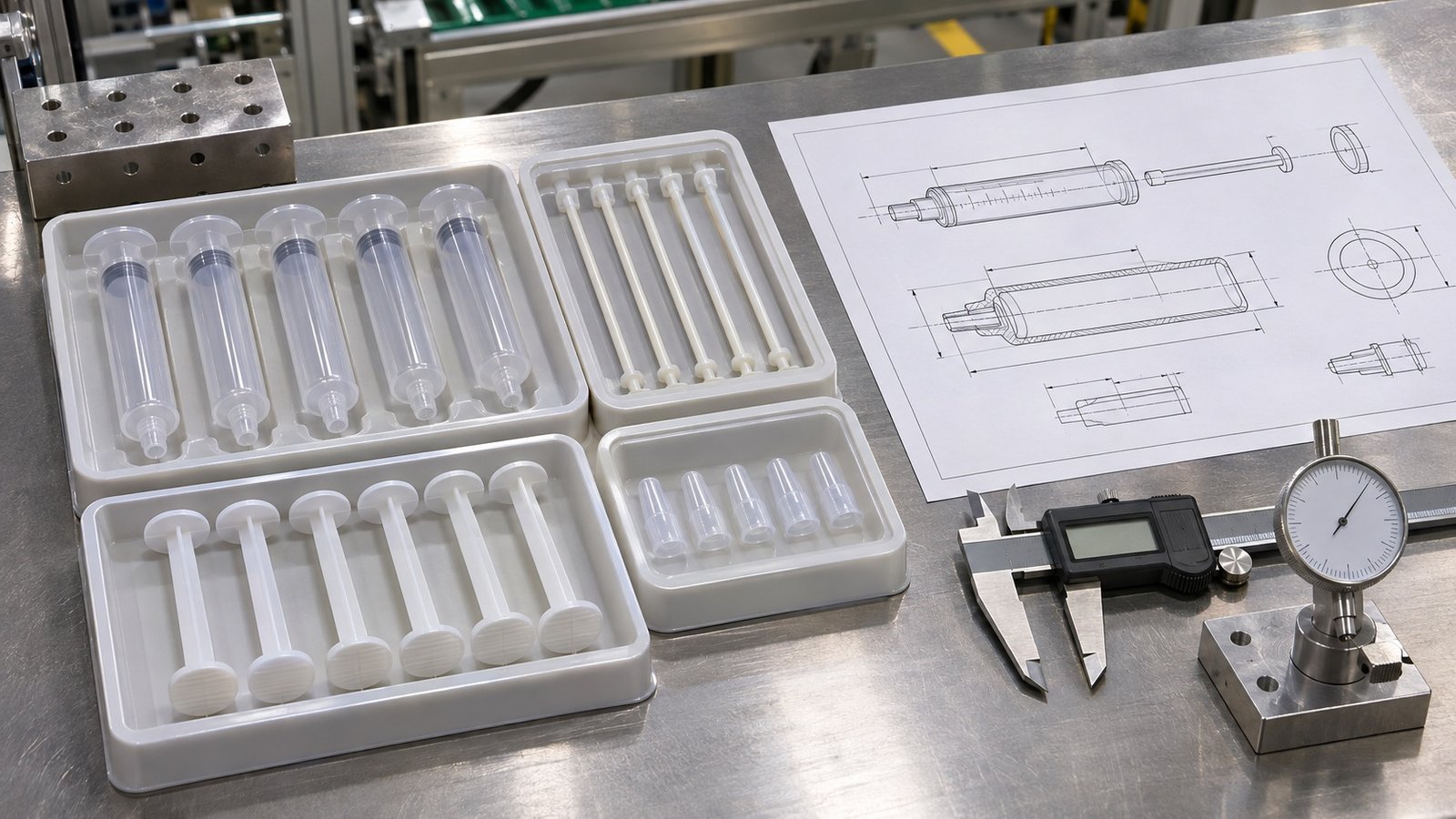
Match the disposable syringe filling machine to barrel support
A plastic barrel needs stable support while it is filled and closed. Supporting only the flange may be adequate for one rigid format but may allow another barrel to tilt, flex or sit at a different height. Supporting only the cylindrical body can interfere with molded ribs, labels or a tapered profile. The carrier concept should reference repeatable features without marking a cosmetic or functional surface.
Ask the supplier to show how the tooling controls five relationships:
- The barrel centerline relative to the filling nozzle.
- The barrel height and flange plane at the fill station.
- The body support during piston or stopper insertion.
- The closure position at capping or tip-sealing stations.
- The release path from the carrier without dragging or deformation.
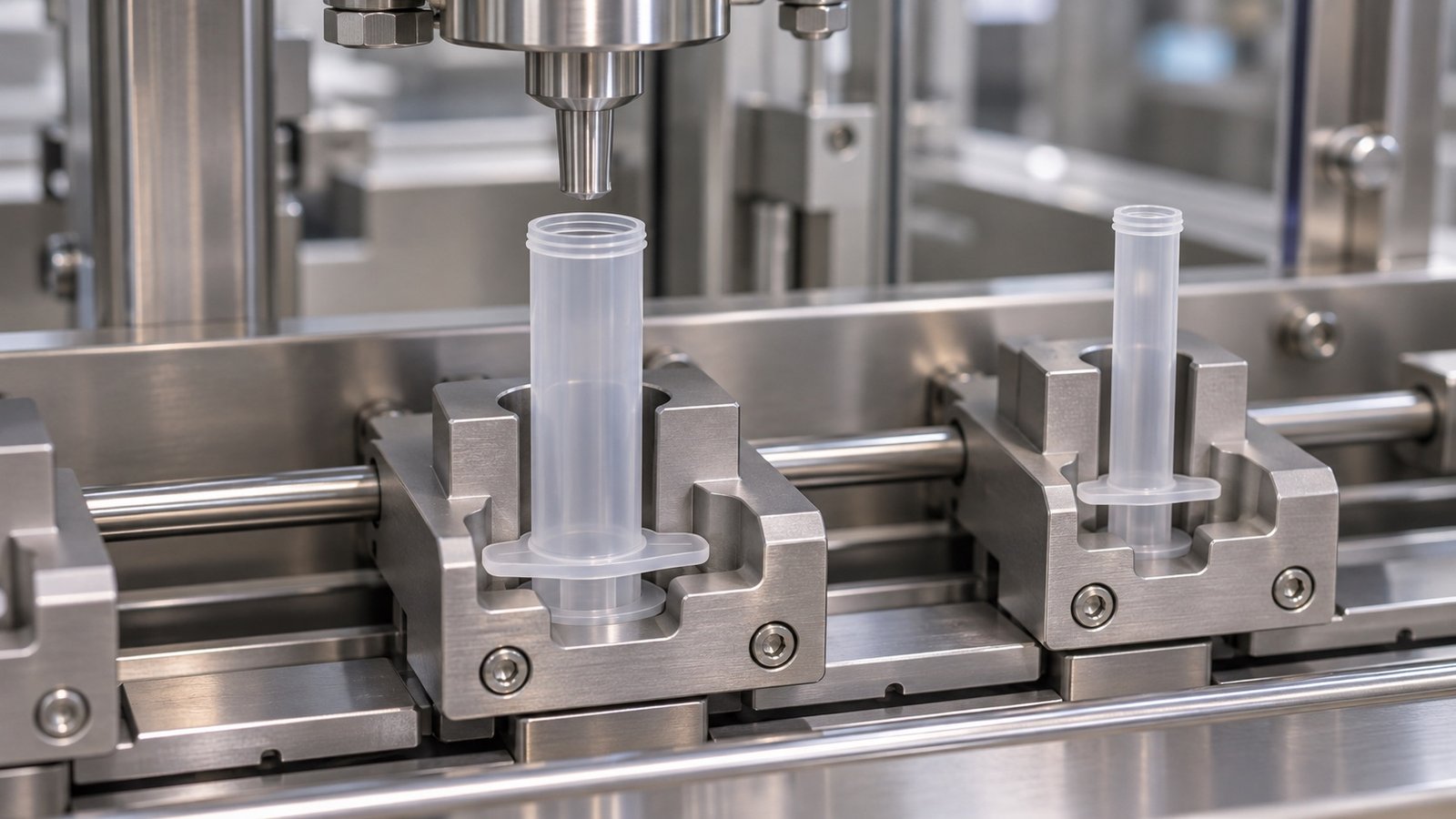
For several formats, request a table of common parts and unique parts. A recipe can store motion and timing, but it cannot correct a carrier that references the wrong flange or a guide that squeezes the barrel. If a new component needs a different nest, feeder or closing station, treat it as an engineering change rather than a simple recipe addition.
Choose component feeding from presentation and surface risk
Automatic feeding is useful only when the components can be separated, oriented and transferred consistently. Lightweight plastic barrels can nest inside one another, bridge in a hopper, carry static charge or become scratched by aggressive handling. Flexible flanges and long tips may also reduce the safe handling window.
Compare the available presentation methods instead of assuming that every part belongs in a vibratory bowl.
| Component presentation | Potential fit | Main limits to investigate | Trial evidence to request |
|---|---|---|---|
| Manual placement | Pilot work, short campaigns, unstable component supply | Direct labor, operator variation, ergonomic burden | Timed loading task and misload prevention |
| Trays or nests | Controlled orientation and protected surfaces | Tray tolerance, return logistics, changeover | Pickup reliability across full and partly empty trays |
| Magazine or stack | Parts with repeatable orientation and non-nesting geometry | Refill frequency, bridging, damage at release | Low-level and refill tests |
| Bowl or centrifugal feeder | Stable high-volume components designed for bulk handling | Static, abrasion, interlocking and format-specific tooling | Sustained feed test using several component lots |
The correct automation boundary depends on campaign size and component maturity. The comparison of automatic and semi-automatic syringe filling provides a way to count operator tasks, changeover and accepted output without assuming that more automation is always better.
Design filling around the opening, product and trapped air
The nozzle must fit through the package opening with controlled clearance and reach the intended filling position. A long narrow tip may restrict a viscous product. A wider nozzle may shorten the fill but leave too little clearance or make stringing harder to control. Bottom-up motion can help the product occupy the barrel progressively, yet the stroke, speed and cutoff still need testing.
The barrel carrier is part of this decision. If the barrel can lift, rotate or flex during nozzle entry, a theoretically suitable nozzle can contact the wall or dispense off-center. Define how nozzle position is checked after changeover and how an abnormal barrel is detected or removed.
For transparent barrels, visible air may be an acceptance attribute, but visual inspection conditions must be defined. For opaque barrels, fill mass, expelled dose or another validated method may be needed. Do not treat a smooth-looking sample as proof of dose accuracy, and do not treat a scale result as proof that the closure or barrel surface is acceptable.
Verify piston insertion, cap application and barrel loads
Closing a filled barrel can create loads that were absent during filling. A piston or stopper may compress trapped air, push product toward the tip or require a controlled insertion depth. A plunger rod can introduce torque or bending. A cap may need axial force, rotation or both. The fixture must keep the plastic barrel aligned without crushing or whitening it.
Ask how the machine distinguishes component presence from correct assembly. A sensor may show that a cap passed a station without proving that it is fully seated. Define observable acceptance criteria such as position, insertion depth, torque range where applicable, leak or closure test method, and the response to a failed unit. These criteria belong in the user requirement specification and acceptance protocol.
If the package requires a station or handling method outside the standard platform, use the framework in when a syringe project needs a custom machine to separate a format change from true custom engineering.
Test tolerance, not just one “golden” sample
A machine that runs a hand-selected sample set may not tolerate normal production variation. Build the trial set from more than one component lot when possible. Include samples near the agreed dimensional limits, and record which lot and drawing revision were used.
The test should cover at least:
- loading from the intended tray, magazine or bulk method;
- startup, steady operation, replenishment and stop/restart;
- nozzle entry, filling cutoff and barrel release;
- piston, rod and cap handling;
- visible scratching, flange damage, tip damage and deformation;
- accepted dose using the buyer's defined method;
- changeover and first-article approval for each agreed format.
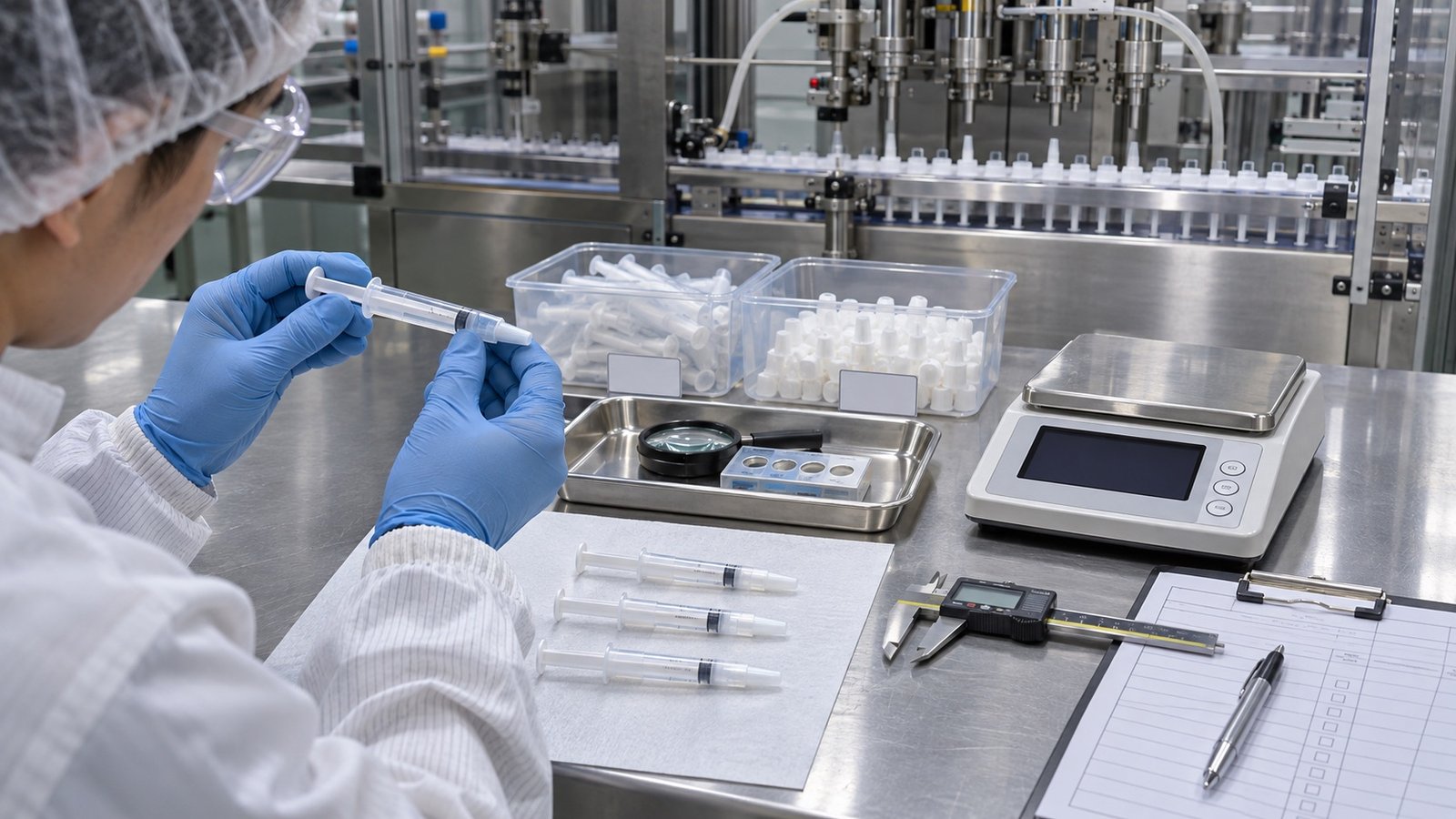
Record failures by station and component lot. “The machine ran” is not a sufficient result. The useful output is a list of tested conditions, accepted units, observed defects, interventions and open items. If only prototype components are available, state that production-lot tolerance remains to be confirmed.
Separate format flexibility from universal compatibility
Buyers often want one base machine to handle future disposable syringe sizes. This can be practical within a defined design window, but “all sizes” is not a technical specification. Ask the supplier to state the minimum and maximum barrel dimensions, supported flange and tip families, product limits, closure types and stations that can be changed without rebuilding the base machine.
For each current format, identify the required carrier, guides, nozzle, filling recipe, piston or cap tooling, feeder parts and inspection settings. For future formats, request an engineering-change process: drawings, samples, feasibility review, new tooling, testing and documentation update. The resulting scope is much more reliable than a broad compatibility promise.
Layout also matters when multiple feeders or closing stations are required. A linear versus rotary syringe filling comparison can help the project team evaluate access, format parts and downstream interfaces rather than choosing from speed labels alone.
Prepare an RFQ and acceptance package
Send one controlled information set to every supplier so proposals can be compared on the same basis:
- Intended application, destination markets and required cleanliness or regulatory boundary.
- Complete component drawings, revision numbers and representative samples.
- Product properties, target fill, temperature, hold time and safety information.
- Batch profile, target accepted output and component presentation.
- Required filling, piston, rod, cap, inspection and reject stations.
- Acceptance methods for dose, visible air, barrel condition and closure.
- Cleaning, changeover, utilities, room and downstream-line requirements.
- Documentation, training, spares and factory acceptance test scope.
Freeze the format only after drawings, samples and responsibilities are agreed. Late changes to the barrel or closure can affect carriers, feeders and acceptance work, which is why sample availability also influences the lead time for a custom syringe filling machine.
King Pack can review the supplied plastic barrel set, product and station requirements, then propose a configuration and sample-test plan. The final capability and acceptance limits must come from the approved specification and representative trials. Send your barrel drawings and sample list to discuss a technical proposal.
Frequently asked questions
Can one disposable syringe filling machine handle several plastic barrel sizes?
It can when the sizes fall within a defined design window and the required change parts are engineered and tested. Ask for a format matrix rather than a general compatibility statement.
Are barrel drawings enough to design the tooling?
No. Drawings establish dimensions and tolerances, while physical samples reveal friction, flexibility, static, nesting and molding variation. Both are needed before design freeze.
Should plastic barrels be supported by the flange or the body?
The answer depends on barrel geometry, stiffness and downstream insertion loads. A trial should show that the selected reference surfaces keep the centerline stable without marking or deforming the package.
Is automatic bowl feeding suitable for every disposable syringe barrel?
No. Lightweight or easily scratched parts may nest, bridge or carry static. Trays, magazines or controlled manual loading may be better for some formats and campaign sizes.
What samples should be sent for a machine trial?
Send the complete barrel, piston or stopper, rod and closure set from more than one intended production lot when possible, together with controlled drawings and enough actual product for startup, steady running and restart tests.
Does a successful sample trial prove production performance?
No. It is configuration evidence under recorded conditions. Long-run output, component variation, wear and site operation still require an agreed factory acceptance test and the buyer's qualification process.
