
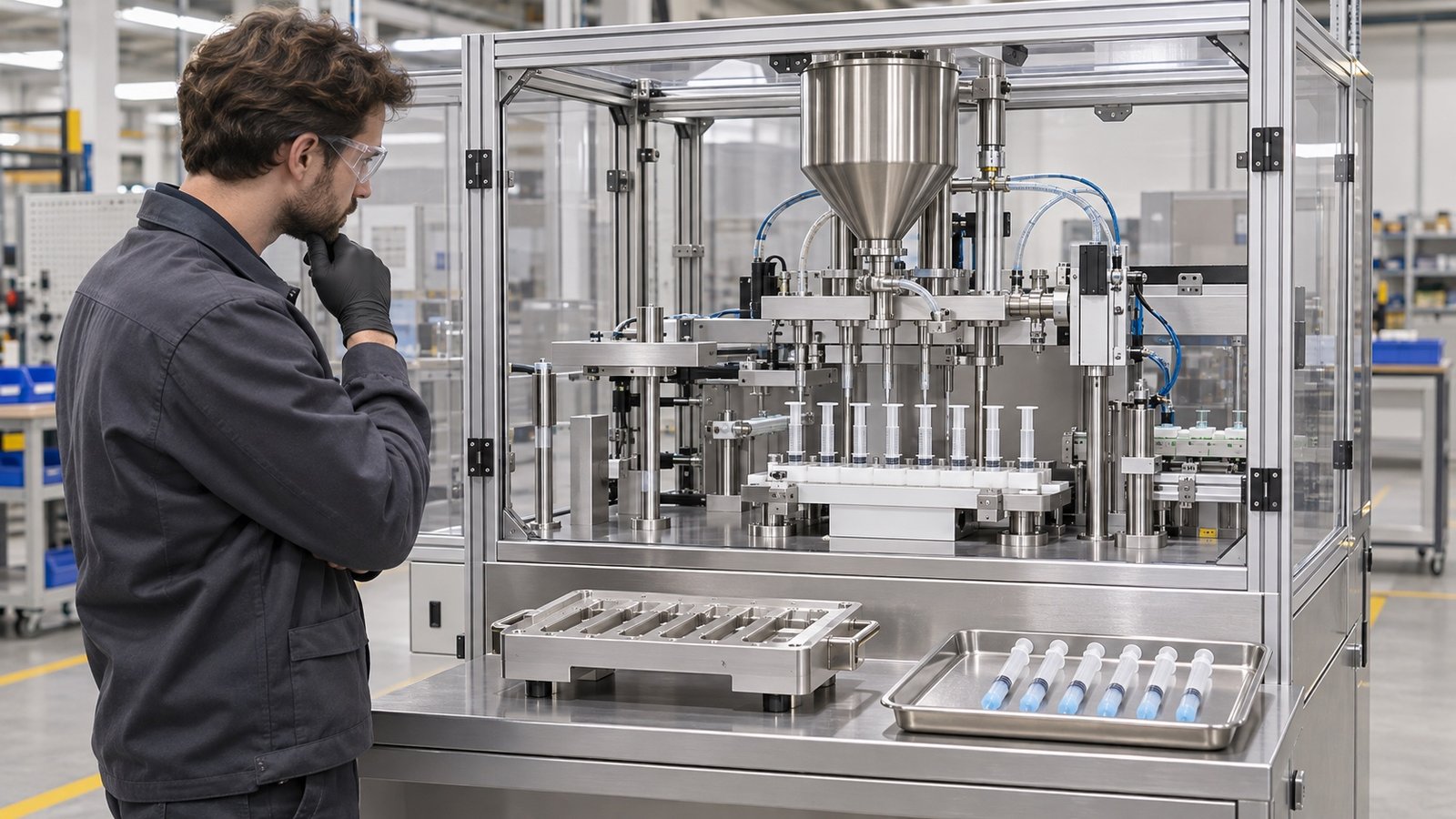
Custom syringe filling equipment is justified when a standard platform, including its approved options and format parts, cannot perform a required operation or pass a defined acceptance test. A different barrel size may only need a nest or guide. An unusual closure, material flow problem, or transfer to an existing downstream machine may need a dedicated station. Ask the supplier to identify the gap and show how it will be tested before accepting a custom or OEM quote.
Featured image: AI-generated illustration of an engineer reviewing a modular syringe filling station.
Make that decision at the process level. List how empty components enter, how product is fed and dosed, what happens after filling, and how accepted and rejected units leave. Then compare that process against the supplier’s base platform. That exercise often shows whether the project needs format tooling, a configurable module, a new station, or a coordinated line redesign.
Compare format tooling, configurable modules, and custom syringe filling stations
| Proposal scope | What changes | What the buyer should check |
|---|---|---|
| Standard machine with format parts | Fixtures, nests, guides, nozzles or similar parts for the agreed package | Which formats are included, what the operator changes, and the acceptance test per format |
| Configured machine with supported options | Supplier selects established feeding, dosing, closing, inspection or controls modules | Whether the combination has been tested for the formulation and package |
| Custom station or product-contact path | A new motion, fixture, fluid path or control sequence is engineered | What requires design review, sample trials, drawings and spare parts |
| Custom line integration | Equipment must coordinate transfers, inspection, reject handling, or data with other machines | Interface drawings, responsibility split, abnormal-state behavior, and end-to-end acceptance |
The degree of customization also affects future work. A unique module can solve a valuable problem, but it adds parts and documentation the maintenance team may need later. Request a base proposal and any required custom work as separately described items when both options can be evaluated.
If you are still validating the process in small batches, the benchtop syringe filler selection guide explains how to use a pilot trial to establish the dosing, handling, and closure requirements before fixing the production scope.
“OEM” can mean that the supplier manufactures the equipment, builds to another company’s specification, or supplies a privately labeled machine. Ask what the term means in your quote, which firm is responsible for engineering, and who owns or provides the drawings, controls backups, tooling and spare parts. The label alone does not describe the scope.
Look for an actual design gap in the package
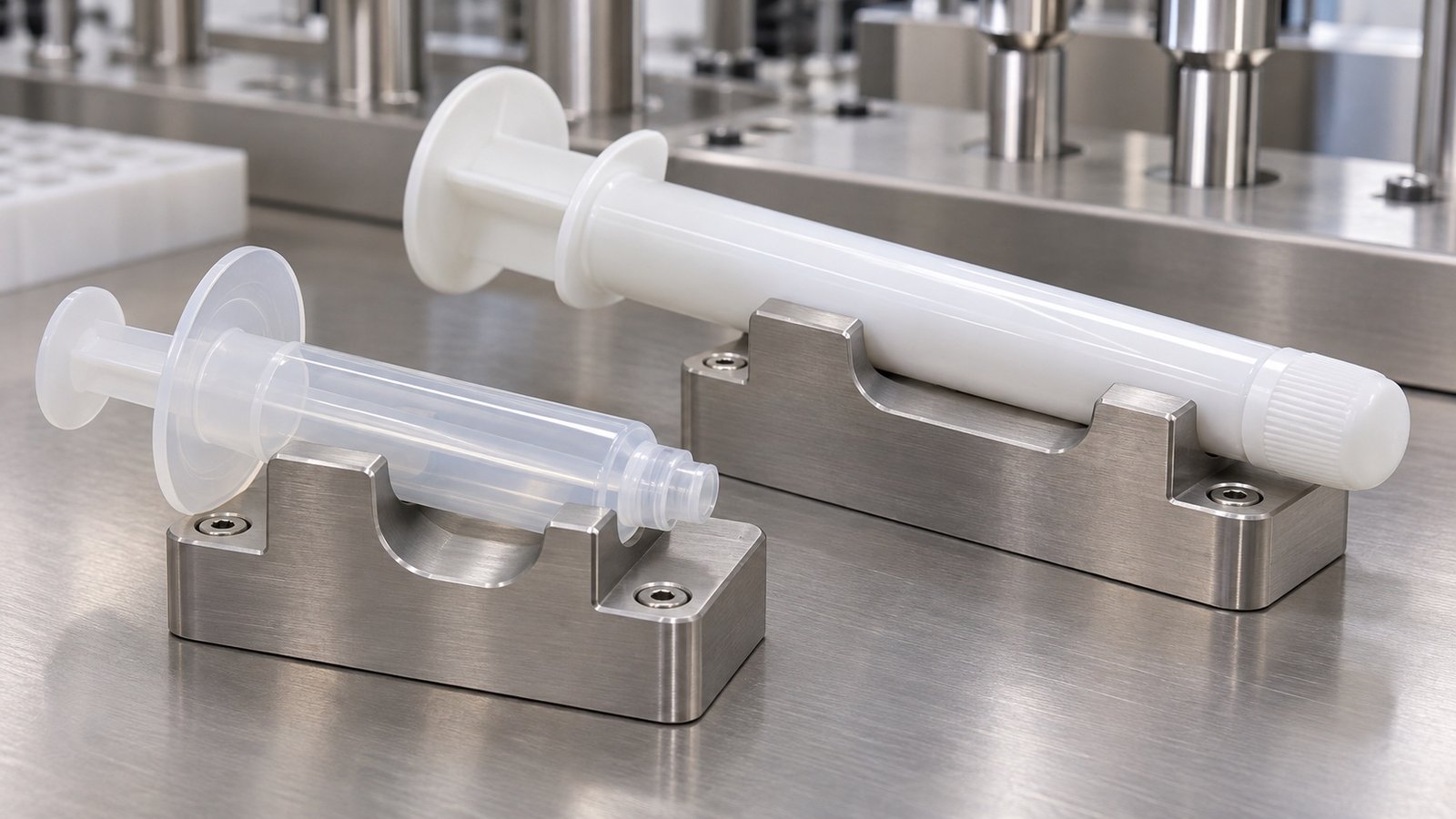
Start with the component stack. Provide the barrel, piston or plunger, tip cap and any protective parts, together with drawings, tolerance ranges and how components arrive. A filled syringe should have a defined location and orientation at each transfer. A prototype component may behave differently from production components, so tell the supplier which samples represent final tooling.
Consider two hypothetical packages with the same fill weight. One has a cylindrical barrel with a flange that fits a standard fixture. The other has a long narrow tip and arrives with a cap loosely fitted. The first might require a new nest and nozzle position. The second may require tip protection, a different orientation method, and a way to verify cap placement. The extra engineering is driven by the actions the package needs, rather than the fill weight.
Ask the supplier to map the point where standard tooling stops being enough. Can an existing fixture support the barrel without marking or distorting it? Can the system orient it consistently? Can the insertion station seat the part and confirm the result? If the answer depends on a modification, ask to see how the new operation will be challenged at the edges of the agreed tolerance range.
Decide whether the material needs a different product path
Viscous pastes, gels, creams and suspensions can place different demands on transfer, dosing and cut-off. Identify what happens at your expected operating condition. A formulation that feeds well at the start of a run may behave differently after time in the hopper. A material that fills cleanly in an open container can string or trap air at a narrow applicator opening.
Give the supplier relevant formulation and contact-material information, the target fill, the intended operating conditions, and the cleaning method the site plans to use. Ask which parts of the hopper, transfer route, pump, valve and nozzle are already supported. For a custom path, specify which improvements the trial must demonstrate, such as reduced interruptions, acceptable fill weight after restart, or access to parts that require cleaning.
Distinguish design needs from evidence needs. An unfamiliar formulation may require a trial without requiring a custom machine. Conversely, a standard pump may meet the dose while the product inlet, support, or closure station still needs engineering. Keep each conclusion tied to the observed result and the conditions under which it was obtained.
Specify integration at the transfer point
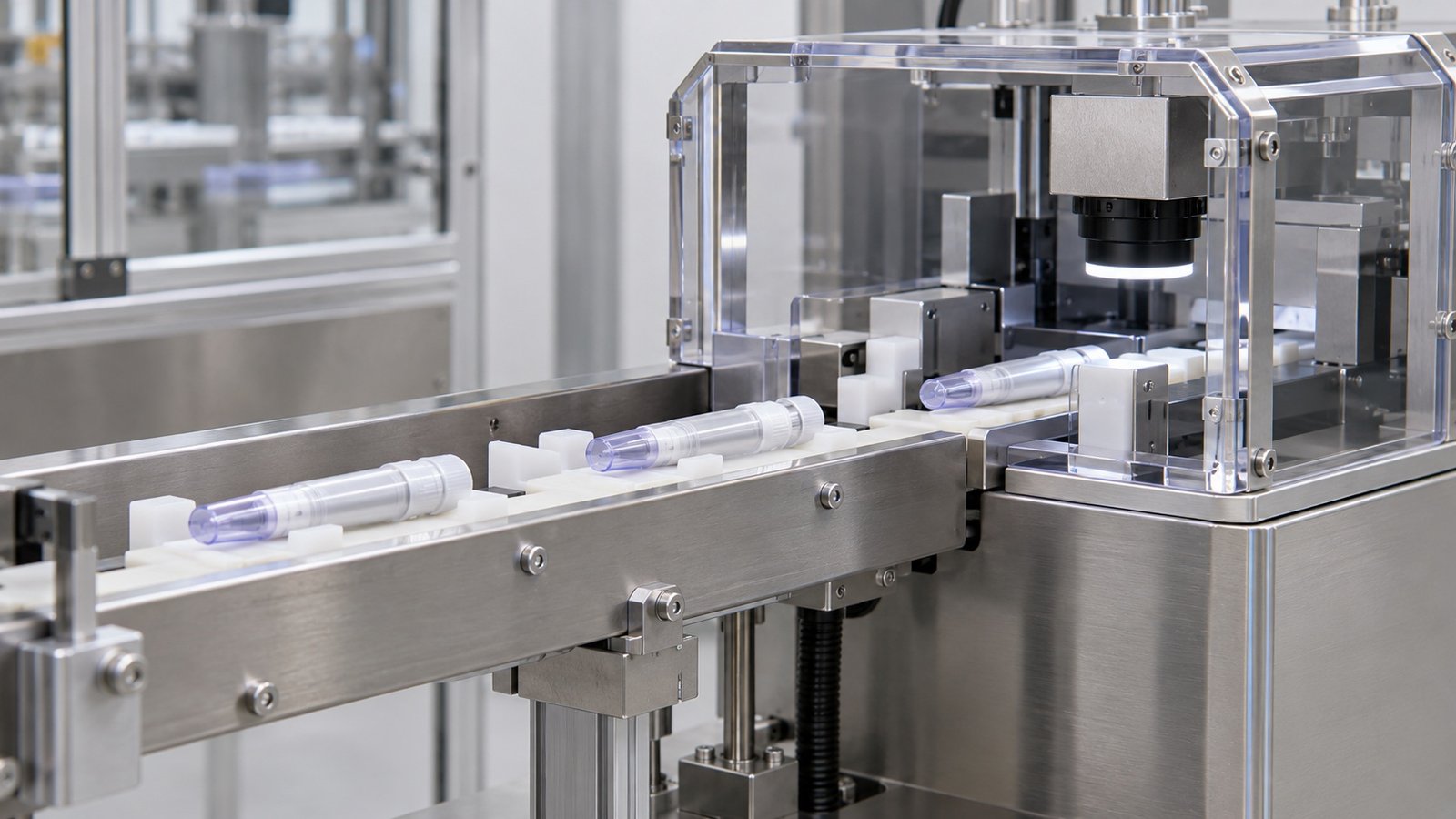
Projects often need custom work because a new filler must fit an existing line. Document where one machine hands off to the next, in what orientation, at which elevation, and with what spacing. Identify who supplies conveyors, guarding, reject handling, the electrical interface and any necessary controls integration.
Describe abnormal conditions as well as normal production. Decide how the line should behave if there is no barrel at the fill position, if a downstream machine stops, if a component is missing, or if a rejected unit cannot be confirmed. Agree where acceptable units wait and how restart is authorized. A layout drawing helps teams discuss physical fit; a responsibility matrix makes the operating decisions explicit.
For installation planning, include utility and access requirements in the project brief. The syringe filling machine site preparation guide outlines the information a site team can prepare early. Where a proposal includes commissioning, confirm who verifies interfaces and what acceptance checks must be repeated on site.
Request evidence before freezing the design
Use the user requirements specification to separate acceptance requirements from preferred design choices. “The unit remains in the correct orientation through transfer” states a result that can be tested. “The unit must use this exact handling device” is a design constraint that the buyer should explain if it is necessary. Agree on how the supplier will demonstrate the result and what the buyer must supply for the demonstration.
For each new or modified operation, ask for a chain of evidence:
- Requirement. State the package, material, intended operating condition, and acceptance criterion.
- Design response. Identify the standard module, tooling change or custom station proposed to meet it.
- Trial evidence. Record which samples and conditions were used, which unit results were measured, and what remains untested.
- Acceptance test. Agree on the factory acceptance test (FAT), the documented result, and the handling of any failure or retest.
- Handover. Request format part lists, interface drawings, cleaning access information, relevant operating records, and training scope.
For example, if the brief requires that filled applicators leave with the plunger fully seated, specify the approved position and how it is measured. Include known-good and unacceptable parts in a challenge set where appropriate. Record how the line detects or manages failed units. A run of only good samples can show routine motion, but it cannot demonstrate that the agreed defect response works.
Also agree how changes after design freeze will be managed. A revised tip length could affect several items at once, including the infeed orientation, nozzle clearance, closure and transfer. Ask the supplier to explain how the parties will review affected drawings, trial samples and retests before accepting a change. The buyer should know what can be resolved by changing a fixture and what would require new engineering.
Compare quotations on the same assumptions
Ask each syringe filling machine manufacturer to state base equipment, included format kits, custom design, trials, external integration, commissioning and spares. Record who supplies product and package samples and when the samples need to arrive. Ask whether testing a later format is included, and what changes if the final package differs from the drawings submitted for the quote.
Review the impact on future operations. Can the production team clean and maintain the custom station with its normal resources? Are dedicated parts documented and available? Can another format be added without rebuilding the whole station? A more specialized design may be justified if it resolves an acceptance-critical step, while modularity may matter more when the product range will expand.
Request an explicit statement about any claims the supplier cannot yet verify. Output, accuracy, material loss and changeover should be linked to the package, formulation, operating conditions and acceptance method used in the test. A conditional proposal can still be useful if the condition and the next trial are clear.
Leave room for a staged decision when critical evidence is missing. A handling trial can help decide between format tooling and a new station before the full equipment scope is fixed. Ask the supplier to define the trial deliverable, who reviews it, and which quote assumptions would change depending on the result. This gives the buyer a clear way to proceed without treating a preliminary demonstration as final acceptance.
Prepare a decision-ready RFQ
Send the scope and acceptance points first. Include drawings and production-equivalent samples, target dose, acceptable defects, the required output of accepted units, the intended cleaning procedure and the expected process environment. Mark which operations can remain manual, which must be automated and which existing machines must be integrated. List the format range for launch separately from formats anticipated later.
For veterinary applicators, King Pack’s syringe filling solutions illustrate how formulation and package inputs affect dosing, handling, assembly and inspection. The representative filling trial guide can help organize sample submissions for a defined application. Share your drawings, formulation details and acceptance criteria with King Pack to discuss the required equipment scope.
Frequently asked questions
Does a new syringe size always require a custom machine?
No. A new format can often be evaluated with different tooling on an existing platform. Confirm barrel support, fill and closure behavior, and the complete changeover before accepting compatibility.
Is an OEM syringe filling machine the same as a custom machine?
No. OEM describes a manufacturing or supply relationship in the quotation. Custom describes the engineering needed to deliver the required process.
What should I request before paying for a custom station?
Request a written description of the design gap, proposed solution, trial requirements, deliverables, acceptance criteria and responsibility for changes. Tie the information to the actual formulation and components.
Can a supplier use a substitute material for a preliminary trial?
A substitute may support motion or handling checks. For findings that depend on flow, aeration, residue, dose or cut-off, agree what needs to be repeated using representative material.
How can I limit the cost of future format changes?
State the expected format range early and request a change-part list. Separate requirements for launch from later options and agree how future formats can be qualified.