 Skip to content
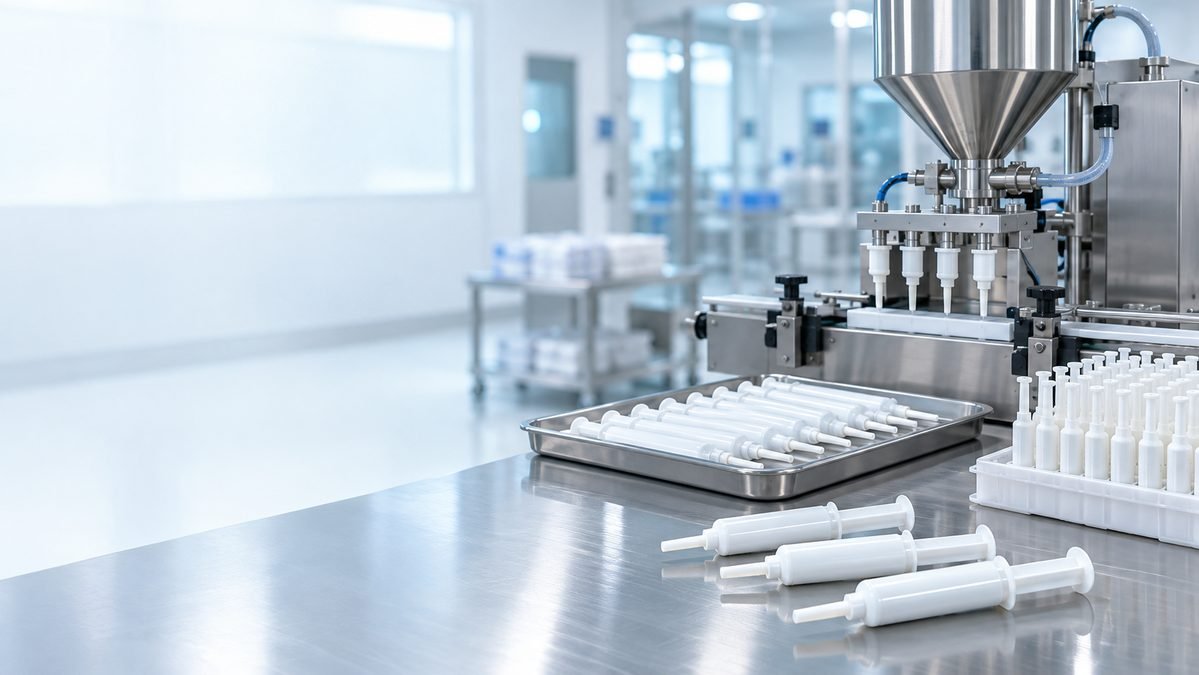
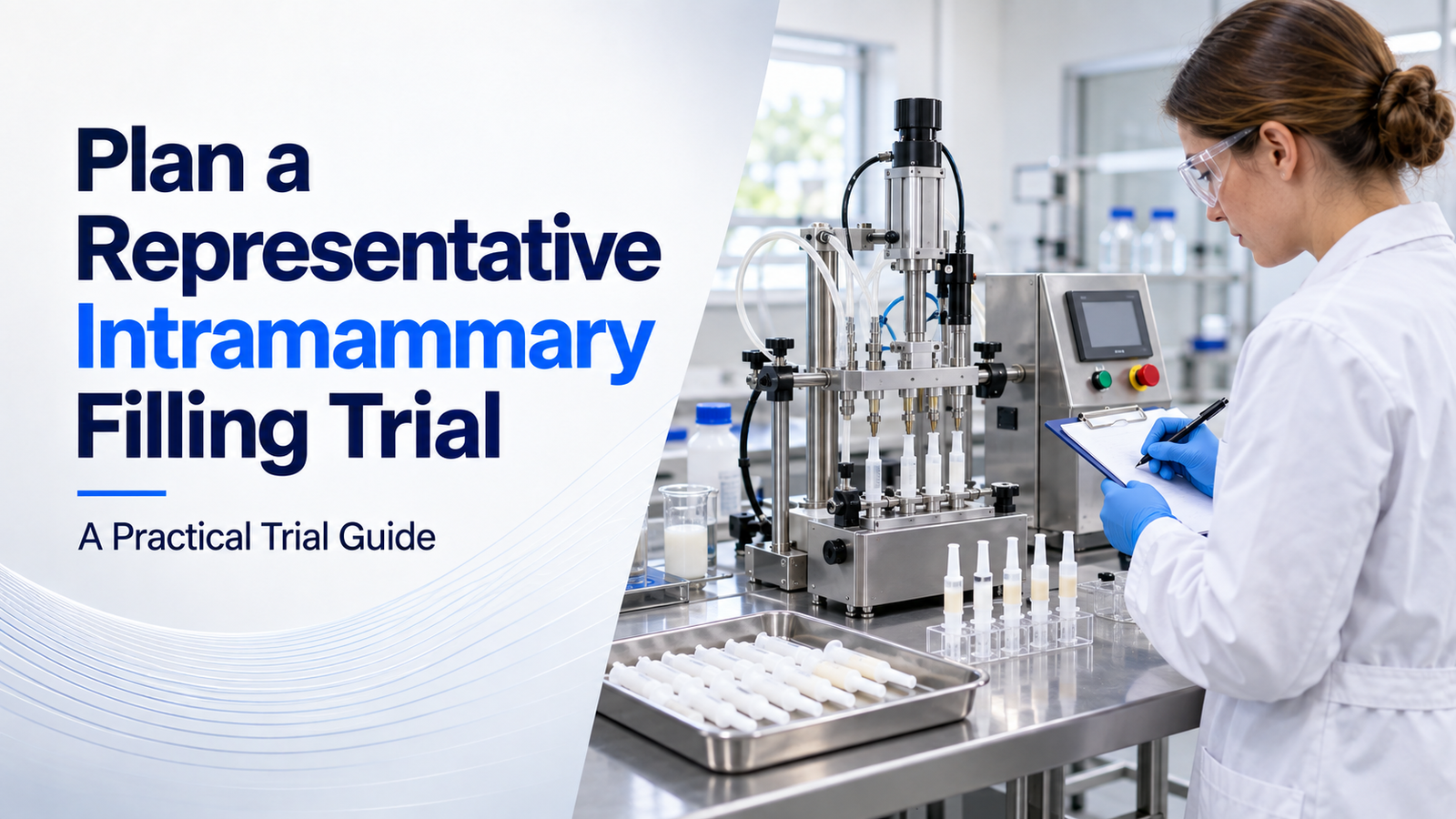
AI-generated illustration: design a representative sample trial and interpret its limits.
Introduction
An intramammary syringe filling trial should answer a practical project question: can the proposed filling route handle the intended veterinary preparation and applicator components under conditions that resemble the customer’s production reality? It is not a marketing demonstration and it is not a substitute for the manufacturer’s process validation. Its purpose is to reduce uncertainty before the equipment configuration, acceptance scope and installation plan are finalized.
This distinction is important for veterinary pastes, creams, sealants and suspensions. These products can respond differently to temperature, time at rest, transfer pressure and short production stops. Intramammary applicators also introduce a package-specific challenge: the barrel, fine cannula, plunger and cap must be presented and assembled without losing stable handling. A trial based on an empty sample barrel, a generic liquid and a few minutes of running may look successful while leaving the real project questions unanswered.
A representative trial starts with a clear product-and-package brief, uses the correct samples, agrees the observations in advance and records what was actually tested. This guide gives production, QA, engineering and procurement teams a practical way to prepare that work. It focuses on non-sterile veterinary applicator projects unless a separate, customer-defined sterile scope is agreed.
The direct answer
A representative intramammary syringe filling trial uses the intended applicator format, production-representative product or a documented simulant, an agreed component supply state, and a test sheet that records feed, filling, assembly, inspection and reject observations. It should identify what the factory trial can demonstrate and what must remain for site acceptance or the customer’s own qualification. The best output is an evidence-based configuration decision, not an unqualified promise about speed, accuracy or compliance.
Plan a factory trial
Send the product brief, applicator drawing, component samples, target campaign size and destination electrical details. KINGPACK can prepare a sample list and a trial agenda before equipment scope is confirmed.
Define the decision before sending samples
Many trials fail to create useful evidence because the customer and supplier have not agreed what decision the test is supposed to support. Write the decision in one sentence. Examples include: confirm whether a front- or rear-filling route is suitable; verify that a particular barrel and plunger lot can be handled; compare two feed concepts for a paste; or establish the acceptance observations for a proposed FAT.
This approach prevents the team from treating every variable as an open experiment. It also makes procurement discussions clearer. A quotation can then name the configuration and conditions evaluated, while items outside the test are flagged as site interfaces, optional scope or customer responsibilities.
Align the internal buying committee
The trial agenda should be reviewed by the people who will use its results. Production wants an operable route. Engineering needs dimensions, utilities and equipment interfaces. QA needs clear observations and a defensible boundary between factory evidence and site qualification. Procurement needs to compare scope, change parts, documentation and lifecycle support. A distributor may need installation and service information for the destination market.
Prepare one owner for each decision. For example, the product owner confirms the formulation and product condition; packaging confirms the component drawings and cosmetic criteria; engineering confirms utilities and layout; QA confirms the proposed observations; and procurement confirms the commercial comparison criteria. This does not create bureaucracy. It prevents a trial from being accepted by one function and questioned by another after shipment.
Prepare a product brief that describes production behavior
Do not send only an SDS, product name or single nominal viscosity. The equipment team needs to understand how the product behaves from the preparation vessel to the applicator. A short confidential brief is usually sufficient when it includes the operational information below.
- Target fill mass or volume and the way the manufacturer intends to check it.
- Product family: paste, cream, gel, sealant, suspension or another defined preparation.
- Normal product temperature at filling and any known sensitivity to heating, cooling, shear, pressure or time at rest.
- Available rheology or viscosity information, including the test temperature and method where known.
- Whether the product settles, contains particles, entrains air, changes after a production stop or requires controlled feed conditions.
- Typical batch size, expected run time, transfer route and maximum intended hold time.
- Product-contact material restrictions and cleaning requirements supplied by the product owner.
This brief does not need to disclose the formula. Its function is to ensure the factory trial represents the engineering problem. If confidentiality limits the sample that can be sent, agree on a simulant. Record its differences from the production material, because a simulant may not reproduce every flow, temperature or residue behavior.
Send representative package components—not only one ideal sample
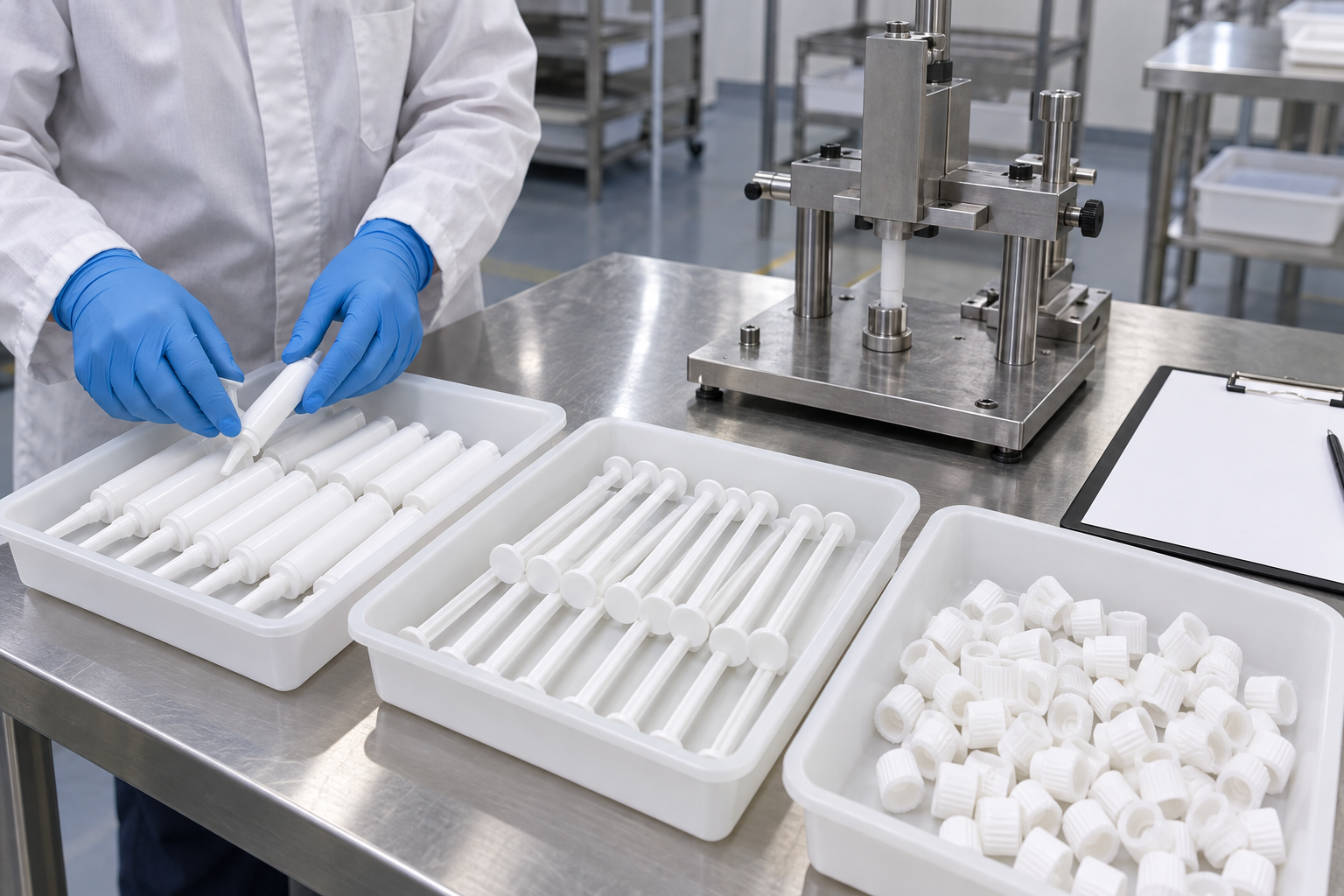
AI-generated illustration: A useful trial identifies the representative component sets used in the test.
The intramammary applicator is a multi-part package. A trial should include the barrel, cannula or tip, plunger, cap and relevant secondary component in the condition in which they will be delivered to the plant. Where practical, send components from more than one incoming lot. This can reveal whether a feed system, insertion station or inspection point is sensitive to normal variation.
Component information that changes the line design
Provide a controlled drawing or dimensional specification together with the physical parts. Mark the dimensions that matter to the line: barrel internal diameter, external gripping surface, flange, cannula length and taper, plunger geometry, cap engagement features and allowable cosmetic marks. State whether components are supplied loose, in trays, magazines or another presentation. The supply state affects infeed design as much as the nominal part size.
For a fine-tip applicator, also identify how the part can safely be supported and whether any surface must remain free from contact. Engineers should be able to trace the part through infeed, indexing, filling, assembly, inspection, reject handling and discharge. If a new component supplier is being evaluated, note that clearly. A successful trial with one supplier’s component lot does not automatically qualify another supplier’s parts.
Agree the trial route and configuration in writing
The supplier should issue a concise pre-trial configuration note. It need not be a final design package, but it should state the proposed filling route, feed concept, major stations, assumed change parts, product-contact path, proposed in-process checks and items excluded from the factory test. The customer can then identify scope gaps before samples are consumed.
For example, a rear-fill evaluation may include barrel feed, stabilization, rear filling, plunger feed and insertion, cap handling, inspection and discharge. A front-fill evaluation may include a different tip-support and nozzle-alignment approach. The point is not to force a standard layout. It is to make the actual sequence visible enough for the project team to challenge it.
Run the trial as a controlled sequence
A useful trial is more than a continuous run. It should include planned observations that mirror realistic operating transitions. The exact plan depends on the product and package, but the sequence often includes the following stages.
1. Receipt and set-up check
Confirm the product sample, component lot, drawing revision and intended trial configuration. Record the product condition at arrival and at the start of testing. Check that the correct change parts and tooling are installed. This basic evidence is valuable when trial observations are later compared with site conditions.
2. Component feed and orientation check
Observe how empty applicators, plungers and caps enter the line. Do parts separate reliably? Does the line maintain the intended orientation? Are fine cannulas protected at every transfer? Does normal static charge, surface variation or component presentation create interruptions? Record actual observations and rejected parts rather than assuming the feeder is acceptable because it ran briefly.
3. Product-feed and filling observation
Run the agreed product or simulant under the stated condition. Observe the product path, filling position, nozzle approach and departure, and the appearance of the filled barrel. Where a planned stop is relevant, include a controlled stop and restart in the test. The aim is not to create an artificial failure; it is to understand whether the product and line behave differently after the condition changes.
4. Plunger, cap and finished-package check
Observe component insertion and final package presentation. Check whether the plunger and cap are present and positioned as intended, whether the cannula remains protected and whether the finished applicator can move to the next station without damage. Any force, position or vision check should be reviewed against a defined acceptance logic rather than treated as a decorative machine feature.
5. Inspection and reject challenge
Where inspection is in scope, challenge the system with agreed conditions such as a missing component, deliberately mispresented part or visible packaging defect. The supplier and customer should agree how challenges will be introduced safely and how the reject path will be observed. A clear reject-segregation route is often as important as the detection point.
Mid-article CTA — Send Your Requirements
Before sending samples, ask for a project-specific trial sheet. It should list the product condition, component lots, test sequence, observations, acceptance scope and responsibilities for any checks that must occur at your site.
Record evidence without overclaiming it
Good trial records use simple facts: product or simulant identified, component lot identified, configuration used, observations made, test sequence completed and open actions. They do not label the equipment as compliant, qualified or suitable for every product simply because a trial ran.
Consider capturing:
- Photos or video of the relevant stations and finished-package presentation.
- The component and product sample identifiers used.
- The installed change parts and major configuration assumptions.
- Run conditions, start/stop observations and any adjustments made during the trial.
- The number and type of observed handling interruptions or reject events, with context.
- The test items completed, deferred or outside the supplier’s scope.
- Agreed next actions before design release, shipment or site acceptance.
This record is especially helpful for overseas projects. It gives the installation team a reference for the factory configuration and helps prevent the trial settings from being treated as final production settings after transport, utility connection and operator training.
Translate the trial into a focused FAT

AI-generated illustration: Factory testing records the configuration and evidence used to answer agreed questions.
The factory acceptance test should build on the successful parts of the trial. It should be tied to the final supplied configuration, agreed product or simulant condition, components, test steps and documented criteria. FAT is a supplier-customer acceptance activity; it is not automatically the customer’s process performance qualification.
For an intramammary applicator line, FAT may reasonably address component feed, package handling, filling route, assembly sequence, specified inspection points, alarms, rejects, documentation and basic operation of the supplied equipment. The scope should identify which utilities, upstream preparation systems, downstream cartoning equipment, site tests and customer quality protocols remain outside the factory test.
If the project includes a claim about output, fill verification, inspection or changeover, state the exact test conditions under which it will be evaluated. Avoid broad wording such as “works with all pastes” or “guaranteed accuracy” unless the contract defines the product, package, method and acceptance threshold. Precision in the test scope is more credible than a large unqualified promise.
Prepare installation before shipment
The time between FAT and shipment is useful for closing installation gaps. Confirm the destination voltage and frequency, compressed-air quality, product-transfer connection, floor layout, access for cleaning and maintenance, incoming component storage, operator availability and downstream handoff. If site acceptance is planned, identify the samples and personnel required in advance.
For a paste project, also consider how the product will be conditioned and transferred at the customer’s site. A factory trial cannot reproduce every plant variable. The customer should prepare the upstream equipment, materials and operating procedure that will provide the same or equivalent conditions during the first production runs.
Review the evidence before making the purchase decision
Match each result to the question it can answer. This prevents a useful but limited demonstration being interpreted as a complete production commitment.
| Trial record | Question it helps answer | Important limit |
|---|---|---|
| Component identity and incoming presentation | Were the relevant packages tested? | One sample set does not represent every future lot |
| Installed format kit | Which configuration produced the observation? | Other formats need their own review |
| Product or simulant identity | What feeding behaviour was observed? | A simulant is not automatically equivalent to production product |
| Interventions and exclusions | What remains unresolved? | A final successful run does not erase earlier observations |
| Agreed next checks | What evidence is still required? | Trial completion is not customer product release |
FAQ
How much product should be sent for an intramammary syringe filling trial?
The amount depends on the test scope, product path, planned start-stop checks and required samples after the run. Ask the supplier for a written sample list before shipment. The list should distinguish product needed for line priming, testing, retained samples and contingency.
Can a water test replace a veterinary paste test?
Water can be useful for a basic mechanical set-up, but it cannot prove behavior of a thick veterinary preparation. If the final product cannot be provided, use an agreed simulant and document the limits of the comparison.
Should QA attend the factory trial?
QA participation is valuable when the trial will inform acceptance criteria, inspection points or documentation. If travel is not possible, agree on the test sheet, live review method, photos, video and record format before the trial begins.
What is the difference between a trial, FAT and site acceptance test?
A trial explores configuration and product-package behavior. FAT checks the final supplied equipment against agreed factory criteria. Site acceptance confirms installation-related performance under the customer’s site conditions. The customer’s own validation or release activities remain separate responsibilities.
Identify the missing input and explain which decisions remain open. For example, an empty-component run can demonstrate the agreed handling sequence but cannot establish product-feed behaviour. Preserve the actual samples, configuration and exclusions in the report. Plan the remaining check when the appropriate materials become available instead of assigning a general pass to the whole project.
Conclusion
The value of an intramammary syringe filling trial is not the number of samples shown in a video. It is the quality of the evidence used to select the filling route, confirm component handling assumptions, define FAT scope and prepare installation. Use representative product and package samples, decide the questions before testing, record the real conditions and keep the boundary between supplier evidence and customer qualification explicit.
Request a representative trial plan
Contact Us: KINGPACK supports veterinary syringe and intramammary applicator projects with sample-based route reviews, filling trials and defined FAT preparation. Send your product brief, drawings, component samples and production targets to request a trial plan or discuss the intramammary syringe filling line configuration.
—
