
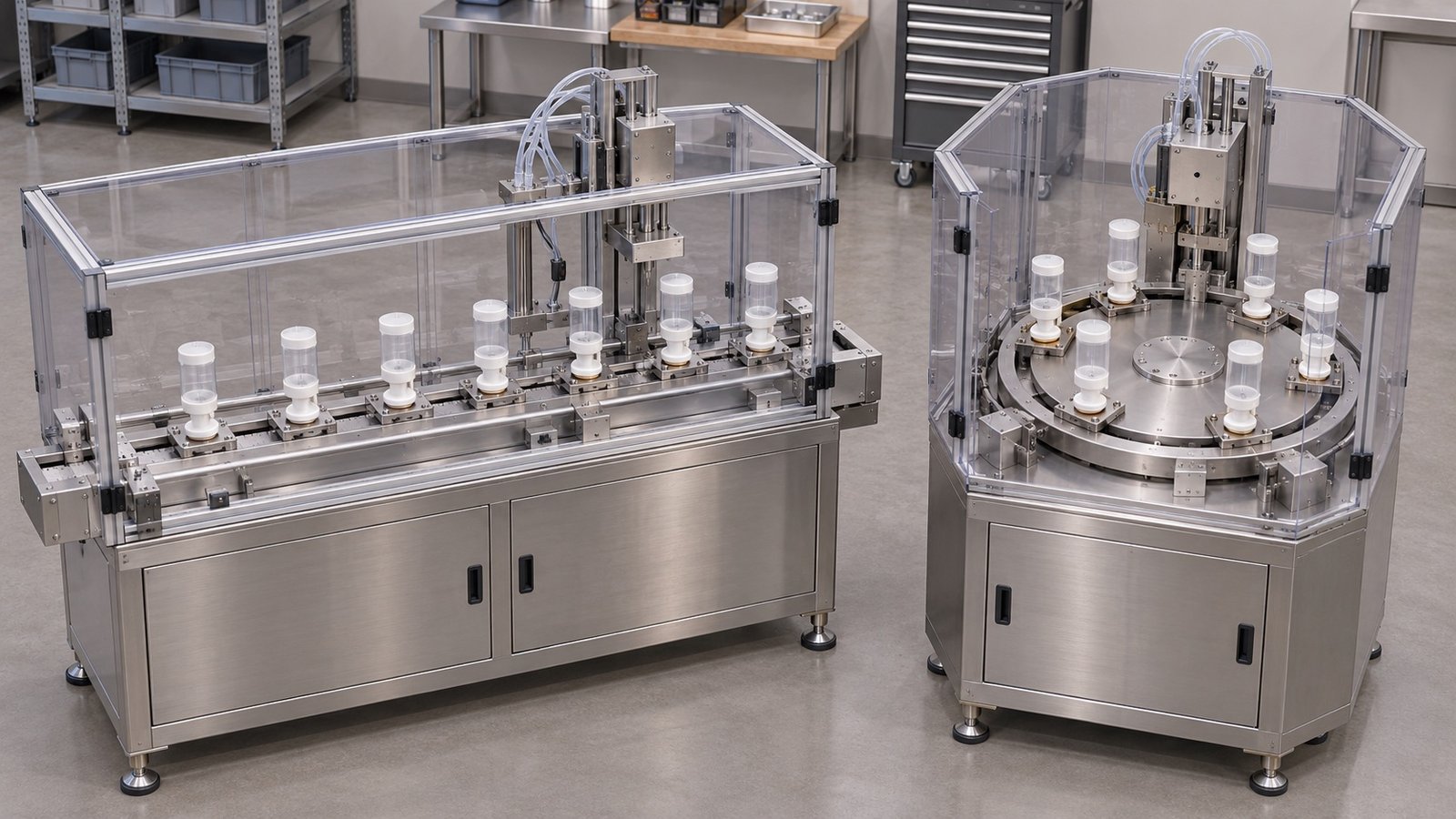
A linear syringe filling machine is a good starting point when the process needs a straight transfer through several separately accessible stations. A rotary syringe filling machine is worth evaluating when the operations can be arranged around a compact indexing dial with practical infeed and discharge. Choose between them by comparing the entire installed layout, accepted output, handling and changeover on the same syringe, formulation and test protocol.
What linear and rotary mean in syringe filling
The terms describe how the syringe moves between stations. A linear machine can move individual carriers along a straight indexed path. A rotary indexing machine moves syringes in pockets around a dial. Both can pause at stations for individual operations. A rotary piston pump describes the dosing mechanism, and either transport architecture can be evaluated with a suitable dosing system.
This comparison focuses on individually handled plastic barrels and applicators. Ready-to-use packages that remain in nests follow a different handling route. For actual equipment examples in the individual-barrel category, Dara Pharma's filling-line catalogue lists separate linear and rotary machine families for plastic syringes. Its model specifications describe those configurations. Use your own test requirements to compare proposals.
Compare layout, access and product handling
| Decision point | Linear transport | Rotary indexing | Ask both suppliers for |
|---|---|---|---|
| Installed space | A straight process path can suit a long bay and aligned downstream equipment | A central dial can concentrate several stations in a short machine envelope | Scaled plan including feeders, cabinets, doors, service aisles and downstream connections |
| Station sequence | Separate stations can give more space for handling, inspection or an independent process | Operations fit around the dial and share the pitch and available positions | Station list, part orientation, transfer drawing and any unoccupied positions |
| Format handling | Carriers and guides may need to change at multiple points | Pocket inserts, guides and transfer tooling can be format dependent | Parts list by format and a witnessed setup from first shutdown to accepted units |
| Access | Straight sections can allow access from one or both sides, depending on guarding and the room | Individual heads can be close together, so access depends on door placement and clearance around the dial | Maintenance access drawing and a demonstration of typical service tasks |
| Stoppages | Accumulation between stations can help where independently controlled sections and buffers are supplied | An indexed dial coordinates stations in the same index sequence | Test of starvation, downstream blockage, jam recovery and reject tracking |
Measure the room from real constraints: walls, columns, entry doors, operator side and the approach to adjacent equipment. Then add space for consumable replenishment, format carts and access to product-contact parts. A short frame can occupy a larger installed area once feeders and guarding are included. Use the syringe filling machine site preparation guide to turn those checks into a drawing review.
When a linear syringe filling machine fits
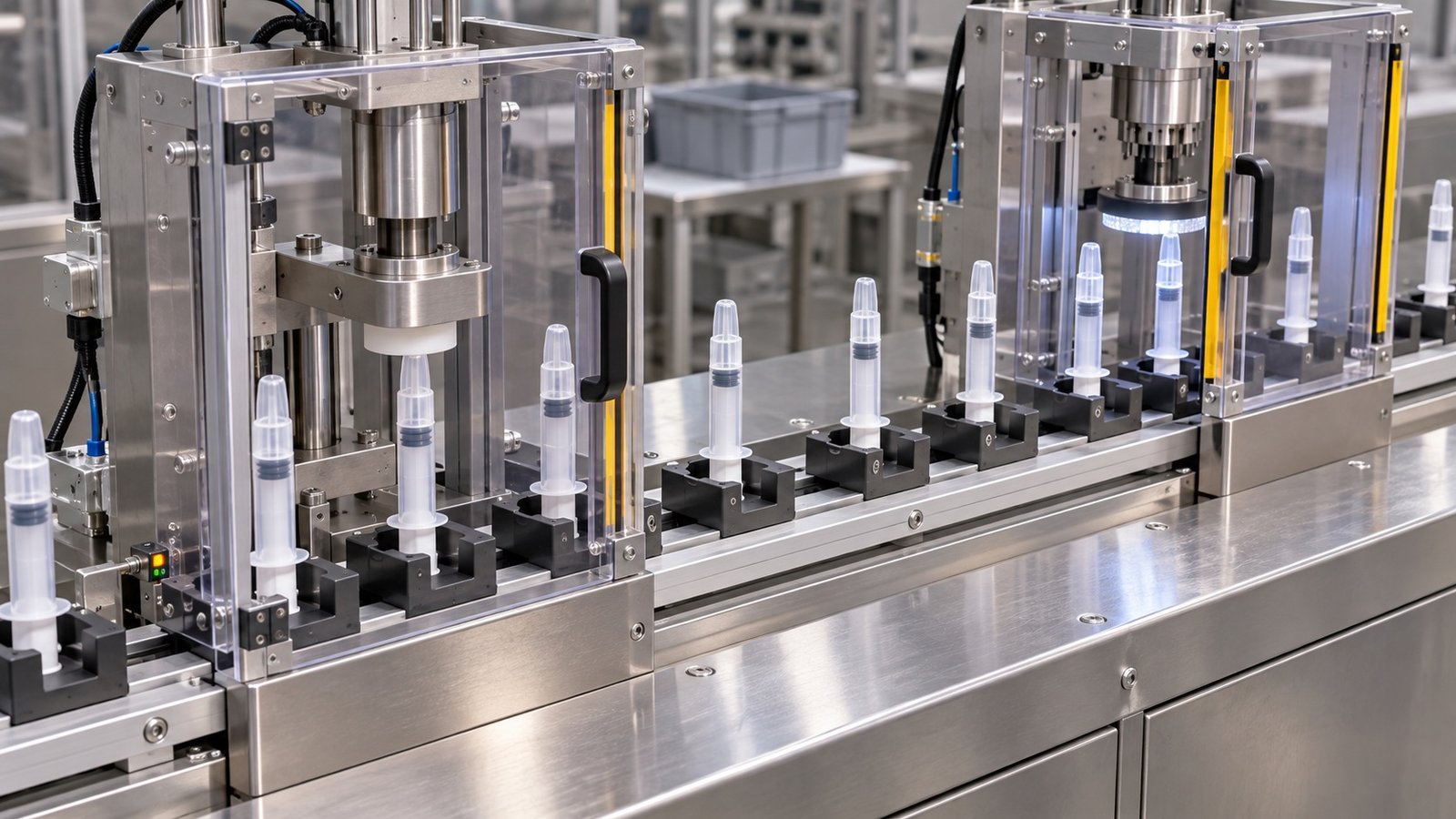
Start with a linear concept if your plant already has a straight handoff to a check, label or packaging operation, or if a specialized station needs a defined service area. Ask the supplier to mark where the syringe changes orientation or moves out of a carrier. Those handoffs are important test points for a long or flexible barrel, a narrow tip, or a closure that is sensitive to misalignment.
A straight layout can give the designer room to arrange stations and service points. Extra space on a drawing does not establish that another module can be added later. Ask for reserved floor space, control capacity, guarding and a defined mechanical interface if future expansion matters. For one format, compare a short linear proposal with a compact dial on the same drawing before assuming the linear arrangement will be too long.
When a rotary syringe filling machine fits
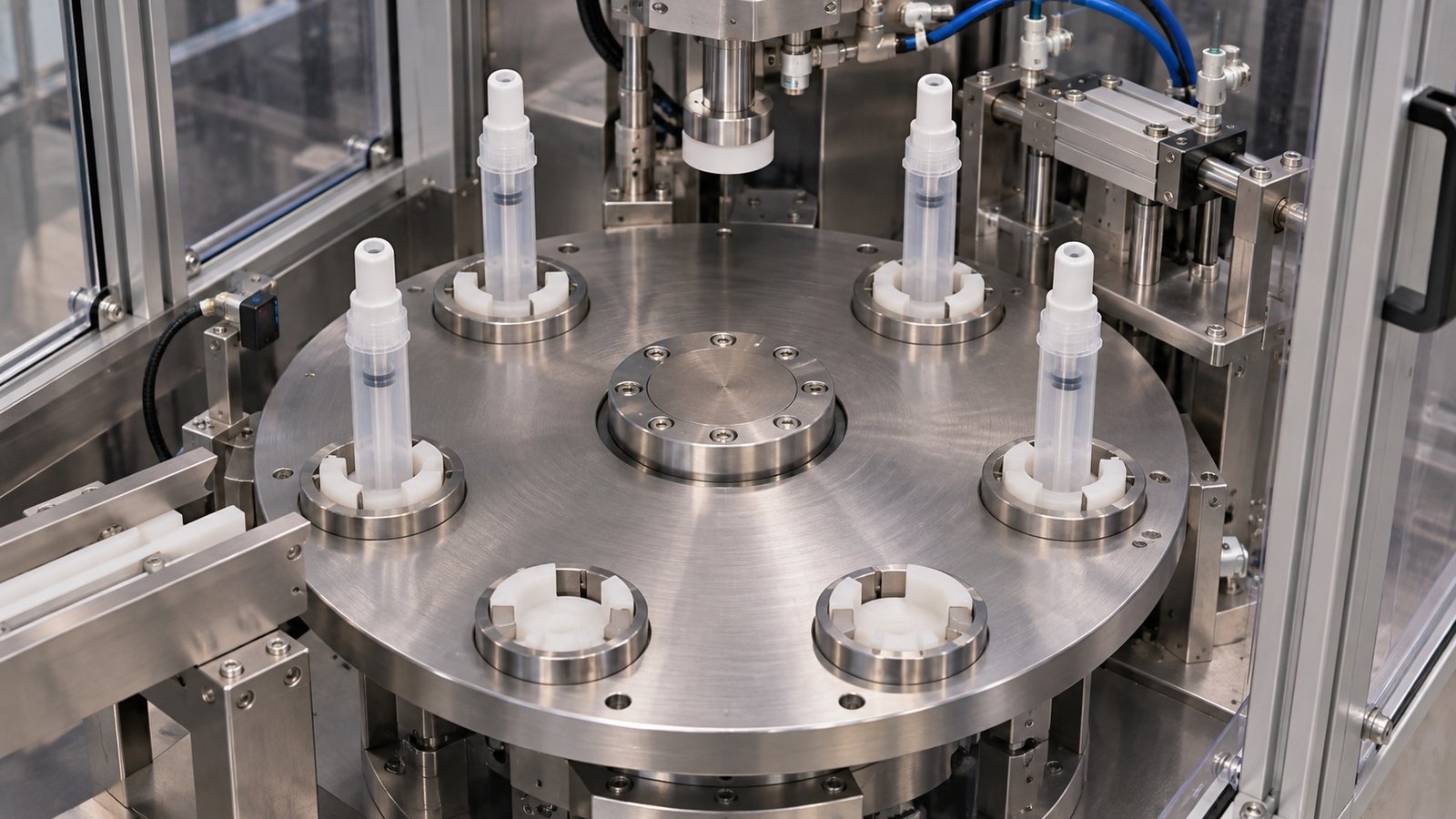
Start with a rotary concept when loading, dosing, closing, inspection and discharge can be arranged around a common dial with good access to each operation. Ask for an overhead drawing showing the pockets, the available dwell at each position, and how the syringe enters and exits. A dial may offer a short container route, while the approach from the feeder or the discharge to the next machine can still govern overall fit.
Compare the most difficult barrel in the range against the available pocket geometry. A larger flange or a tall applicator may change support, spacing or the handoff at a station. Have the vendor demonstrate both ordinary running and recovery after a missing barrel or closure, including how the controls handle affected units.
Compare accepted output on the same test
Specify the output point as accepted, filled and closed syringes at the agreed discharge, with inspection enabled if it is part of the quote. Use the same product condition, fill target, component lot or representative samples, rejection rules, and test window. Ask the supplier to report the good count, rejects and time lost to stops. A quoted number of filling heads or indexes per minute alone cannot tell you the result at the discharge.
For an illustrative comparison, suppose the test window is 30 minutes and each machine discharges 540 accepted units. Both average 18 accepted units per minute over that window. If one spent more time waiting for components and the other rejected more units during closing, the equal averages still point to different improvements. A separate changeover trial may change the purchase decision if your plant switches formats several times per week.
Agree in advance whether stops and startup are inside the test window, and apply the same definitions to both proposals. Ask where affected syringes go during a stop and restart, whether rejects are confirmed and how the operator identifies the reason for rejection. Document any feeding or downstream functions excluded from the factory test.
Compare the two layouts in the same room
Imagine a hypothetical line that fills two applicator sizes and feeds a labeler that the plant intends to retain. A short rotary concept may fit beside the existing machine, but the discharge might need to turn the applicator and deliver it at a new height. A linear concept may need more floor length and still permit a direct transfer. Ask each vendor to draw the transfer, identify the format parts it adds and show the maintenance team how to get to it.
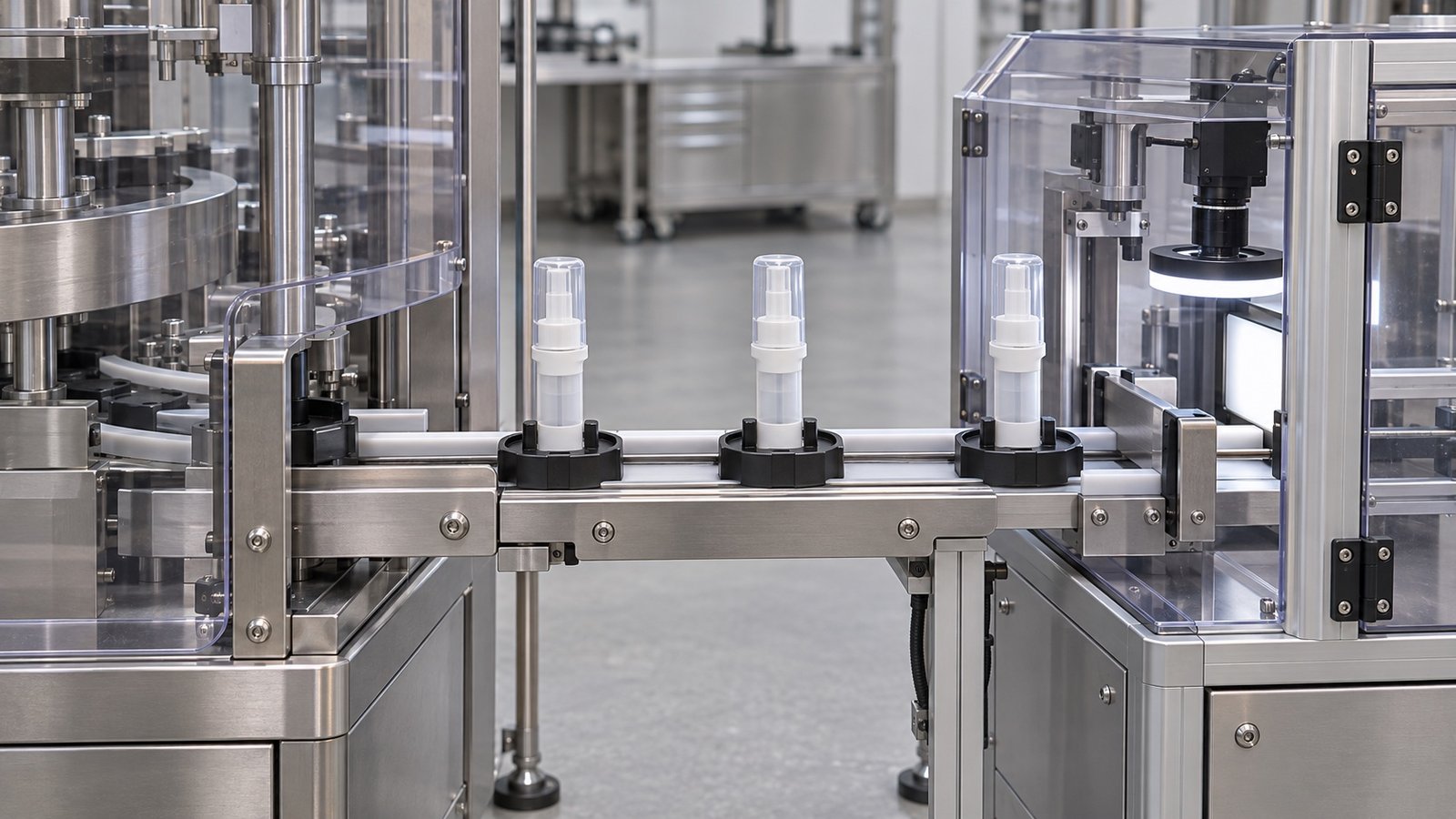
Give both vendors the same package samples and ask for a trial of the arrangement they propose. Include the larger format, a routine format change and a short downstream stop. Note the work involved in loading each type of component, changing the format and returning to accepted output. Record any manual step the quote assumes, including how many people are needed to refill component feeders or clear the line during a changeover.
Request a list of format-specific spares and the maintenance tasks the buyer is expected to perform. Compare the time and access needed to reach a pocket insert, carrier, nozzle or sensor while following the machine's approved service procedure. If a replacement needs alignment or a separate verification procedure, put it on the commissioning and training list. Those details can affect labor and downtime long after the installed footprint has been agreed.
Ask for a layout drawing and a format trial
Give the supplier a scaled room plan, component drawings and representative barrel, cap and plunger samples. Identify the discharge height and orientation that the next machine requires, then list the product conditions, formats, cleaning access and inspection needed at acceptance. Use the syringe format changeover guide to define which parts and first-article checks the format trial should include.
For veterinary paste or gel applicators, review King Pack's veterinary syringe filling applications before preparing the format list. Share your syringe drawings and installed layout to request a proposal that describes the transport path, included stations and representative sample trial.
Frequently asked questions
Is a rotary syringe filling machine always more compact?
A rotary frame may concentrate stations around a dial. Compare the installed footprint including feeders, cabinet and guarding access, downstream transfers and operator aisles.
Is a linear syringe filling machine always faster?
Output depends on the number of units handled per cycle, the time required by each operation, rejects and stops. Compare accepted discharge counts with the same format and test window.
Can a linear machine use a rotary piston pump?
Yes, where the selected pump suits the product and application. The transport layout and the dosing mechanism are separate choices.
Which layout is easier to change between syringe sizes?
Compare the number of format parts, access and adjustment points. Time a changeover through the first accepted units using the same two representative formats.
What should a factory acceptance test prove?
Agree to test the package transfer, dosing, closing and inspection included in the quote. Include the formats and stop or restart scenarios that matter to your plant, and record accepted output and reject behavior.