 Skip to content

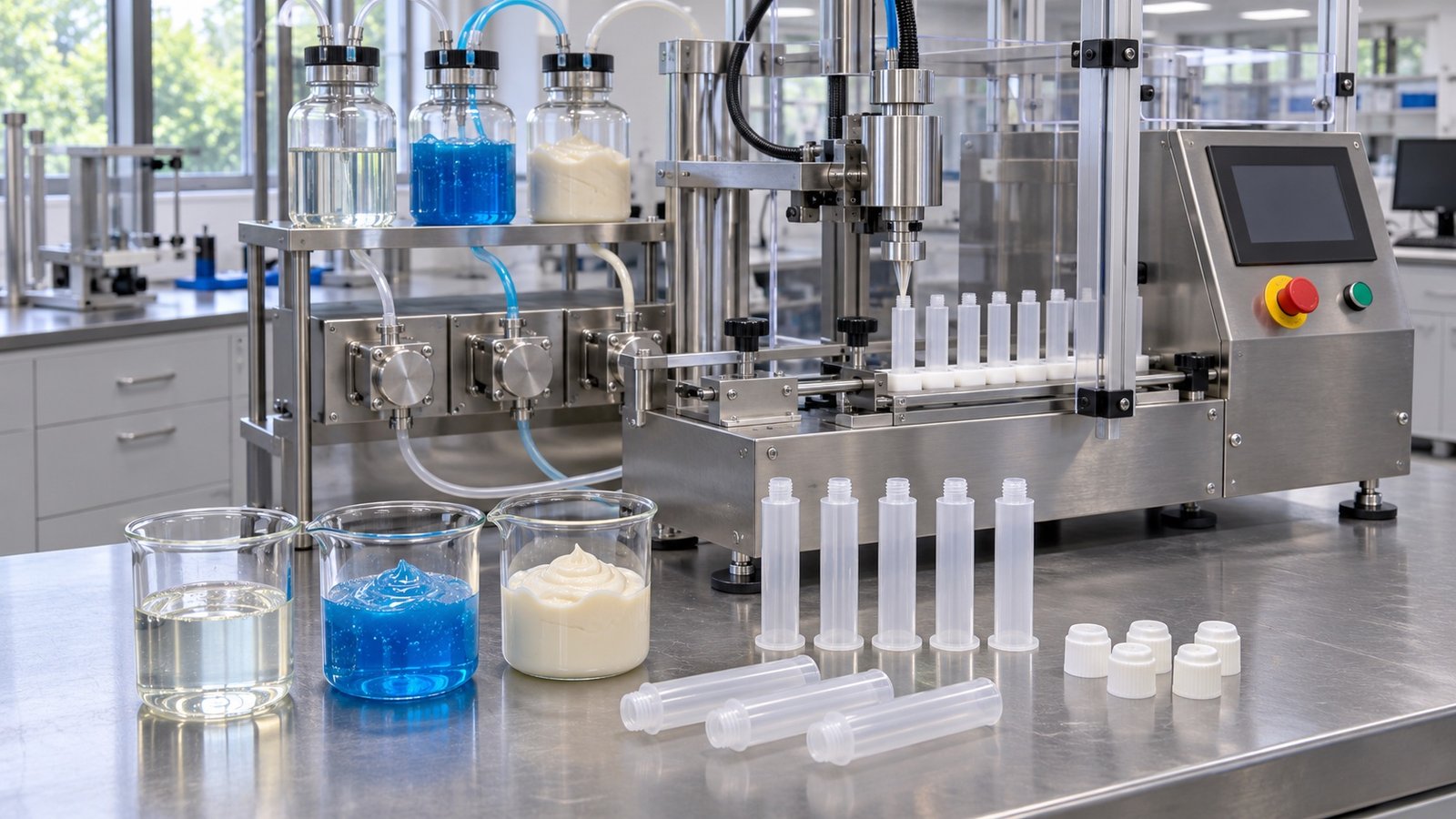
A dental material syringe filling machine should be selected from the actual formulation, applicator design and closure sequence—not from the word “dental” alone. A low-viscosity bonding liquid, an etching gel and a heavily filled restorative composite can require different product supply, metering, nozzle, air-control and cleaning arrangements. Before requesting a quotation, define the material condition, target dose, complete package set and acceptance method, then run a representative filling and closure trial.
This guide covers needle-free dental applicators and dispensing barrels. It does not assume that a machine intended for one dental formulation can process every other material, and it does not treat a dental applicator as an injectable medical syringe.
Start with the material and package, not the industry label
“Dental material” describes an application market, not a single rheology or package. Official product information illustrates the range. 3M Filtek Universal Restorative is a visible-light-activated composite offered in 4 g syringes and 0.2 g capsules, with about 76.5% inorganic filler by weight. 3M Scotchbond Universal Etchant is a 32% phosphoric-acid etching gel supplied in a syringe. By contrast, Scotchbond Universal Plus adhesive is supplied in single-dose packs or multidose bottles rather than the same type of syringe.
These examples do not prescribe a machine. They show why the buyer must identify the exact commercial package and product condition. A supplier needs the formulation data, component drawings and samples, not only a product name.
Use the broader syringe filling machine process guide to separate dispensing barrels from sterile injectable formats before defining the project boundary.
Match the dental material syringe filling machine to the application
The first selection decision is the combination of material behavior and package format.
| Dental material category | Typical behavior to verify | Package questions | Equipment questions |
|---|---|---|---|
| Restorative composite | Dense, particle-filled, may be light sensitive | Syringe or unit-dose capsule; rear or front fill; plunger geometry | How will the paste be supplied without starving the pump? What pressure and nozzle bore are acceptable? |
| Etching gel | Gel that must retain a controlled application form | Barrel, dispensing tip, cap and leak-control interface | Can the fill cut off cleanly? Will the product contact materials tolerate the formulation? |
| Bonding liquid | Lower viscosity and potentially more mobile | Bottle, unit dose or a customer-specific applicator | Is a syringe-style package actually required? How will dripping, evaporation and closure be controlled? |
| Dental cement or liner | May be one-part or multi-part; may change with temperature or time | Single chamber, separate components, cartridge or capsule | Does each component need an independent product path? What is the permissible hold time? |
| Impression or bite material | Often highly viscous; may use two components | Dual-barrel ratio, pistons, outlet cap and mixer interface | How will both chambers be dosed, closed and inspected as one package? |
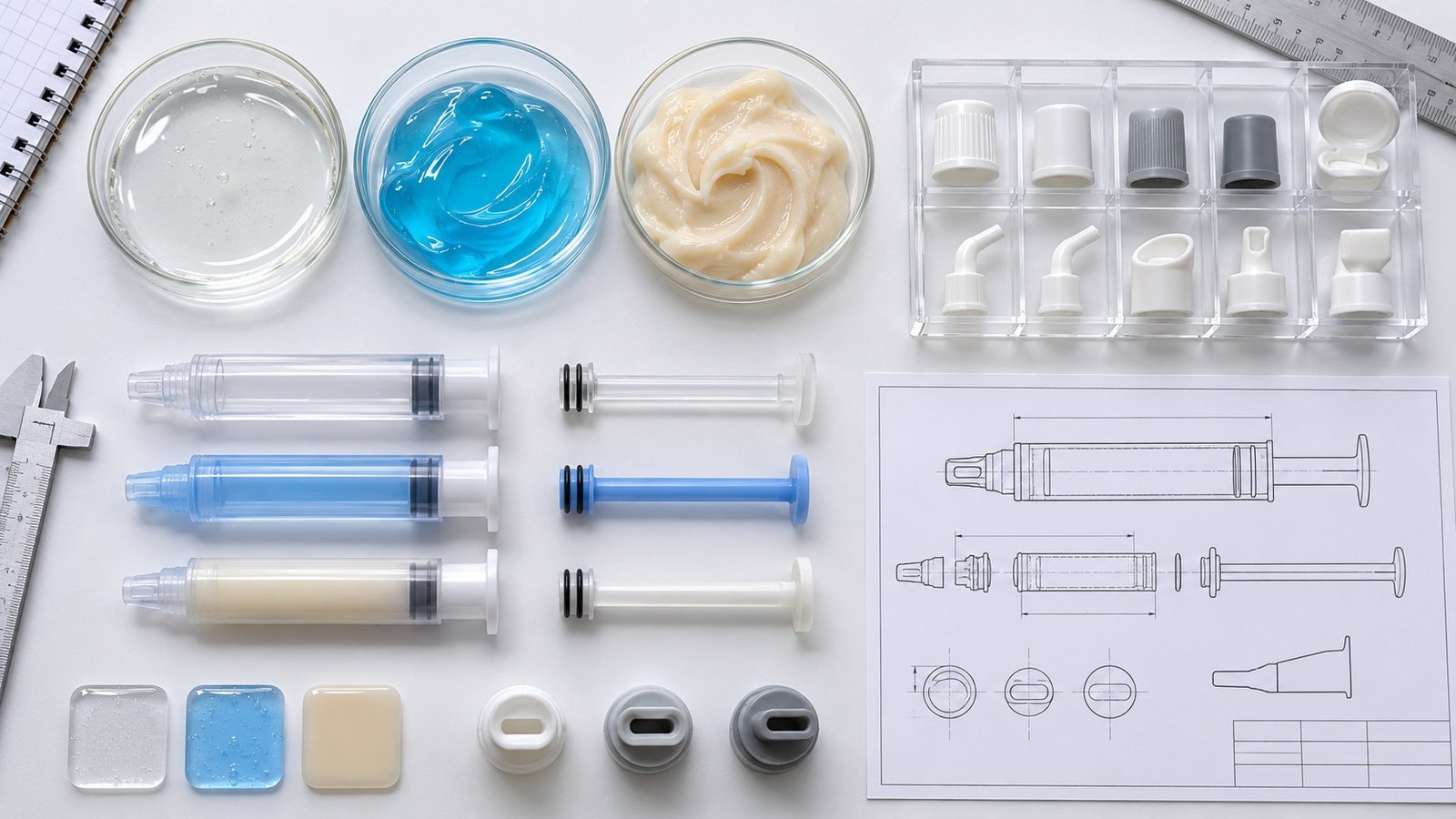
Treat this matrix as a scoping tool. The actual material may not behave like another product in the same category. Ask the formulation owner for representative production material, including the normal temperature, storage condition and preparation method.
Define the complete applicator before choosing the machine
A barrel alone is not enough for equipment design. The supplier should receive the complete component set: barrel, piston or stopper, plunger rod, dispensing tip, tip cap, outlet cap, label area and any secondary pack. Provide dimensioned drawings with tolerances as well as samples from more than one component lot.
Confirm these details:
- whether filling occurs through the rear opening or through the dispensing end;
- the internal diameter, taper and usable fill length;
- the surface that supports the barrel during filling and closure;
- the piston insertion depth and allowable position window;
- the cap thread, snap fit or press fit and the required seating condition;
- the maximum permissible residue on the barrel, flange or tip;
- whether the package must be protected from light during filling or storage;
- how a correctly closed unit will be inspected.
Package tolerances affect fixture design and closure force. The syringe format changeover guide explains why a new barrel diameter, flange or cap may require dedicated guides, nests and recipes rather than one universal adjustment.
Build the product-supply path around rheology
The dosing head cannot perform consistently if the product supply is unstable. A mobile liquid may need controlled level or pressure at the inlet. A gel may need a short path and a cutoff arrangement that prevents strings or drips. A dense composite may require pressure-assisted feed, a follower plate or another method that keeps the metering chamber full without folding air into the material.
The supply concept should cover the full path:
bulk container → conditioning or degassing → transfer → metering device → valve → nozzle → applicator
For every segment, document the contact material, internal diameter, connection, disassembly method and retained volume. Long narrow hoses, abrupt restrictions and unnecessary fittings can increase pressure demand or make cleaning harder. These are engineering risks to evaluate with the actual product; they are not reasons to assume one pump type will fit every dental formulation.
For dense pastes, the site's high-viscosity syringe filling system guide provides a more detailed product-path checklist.
Select metering and nozzle design together
Metering choice depends on dose, rheology, allowable shear, particle content, cleaning method and required operating range. A positive-displacement approach is often evaluated for viscous products because the dose is based on displaced volume, but the specific pump and valve still need a material trial. A low-viscosity product may favor a different arrangement.
Nozzle selection is part of the same decision. Check bore, length, outlet shape, insertion depth, withdrawal motion and shutoff. A bore that is too small can raise pressure and residence time. A bore that is too large may not fit the package or may leave unacceptable residue. Bottom-up filling can reduce the distance that material falls into an open barrel, but its value must be demonstrated with the intended applicator.
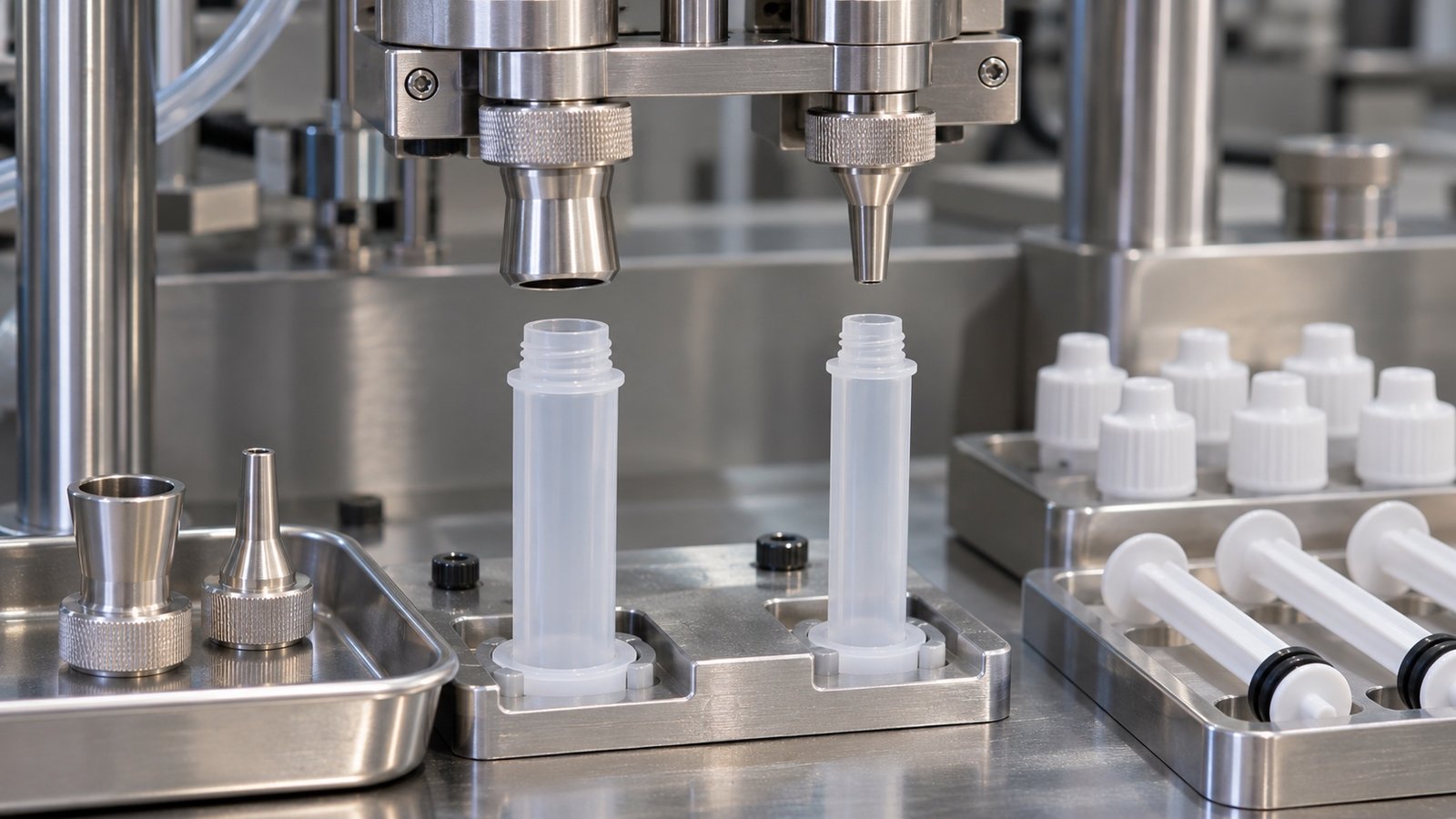
Use the viscous-product filling nozzle guide to prepare trial variables. Do not approve a nozzle from a drawing alone when the product is particle-filled, stringy or sensitive to pressure.
Treat capping, piston insertion and tip closure as different operations
The phrase “filling and capping” can hide several closure steps. One applicator may receive a rear piston after filling and a threaded tip cap before filling. Another may be filled through the rear, receive a piston and then have a plunger rod assembled. A unit-dose package may use a snap cap or foil rather than a screw cap.
Write the actual sequence in the user requirement specification. For each closure, define:
- orientation and automatic feeding method;
- presence check before assembly;
- insertion depth, torque or seating condition;
- method for detecting a skewed or missing closure;
- effect of trapped air or headspace during piston insertion;
- reject or hold procedure after a failed closure cycle;
- cleaning access if product reaches the closure tooling.
Do not use cap torque as the only acceptance criterion unless the cap and package owner has established a meaningful torque window. Visual position, leak behavior and package function may also matter.
Choose the automation level from the real bottleneck
A laboratory or pilot operation may need controlled dosing with manual component loading. A growing product may need automatic barrel loading and closure feeding but retain manual inspection. A mature high-volume project may justify a linked line with filling, closure, labeling and cartoning.
Compare options by labor content and process risk rather than headline cycle rate:
| Configuration | Suitable starting point | Main advantage | Main limitation to verify |
|---|---|---|---|
| Benchtop or semi-automatic | Development, pilot or many changeovers | Flexible trials and lower tooling complexity | Operator-to-operator loading and closure variation |
| Indexed automatic machine | Stable package and recurring batches | Repeatable station sequence and automated presence checks | More format tooling and validation effort |
| Integrated line | Stable demand and defined downstream pack | Reduced transfers between filling, labeling and packing | Higher line-balancing and changeover complexity |
The automatic versus semi-automatic syringe filling comparison gives a structured way to compare labor, changeover and acceptance needs.
Run a representative product-and-package trial
A dental application should not be released from a water trial or an empty machine demonstration. Use representative material, production-intent applicators and closures. Record the product lot, temperature, conditioning, time out of storage, bulk-container level and every machine setting.
At minimum, test:
- startup after normal priming;
- stable operation after the product path reaches its intended condition;
- replenishment or container change;
- a planned short stop and restart;
- the smallest and largest intended dose or format;
- end-of-batch operation at the lowest intended product level;
- closure insertion and package handling after filling.
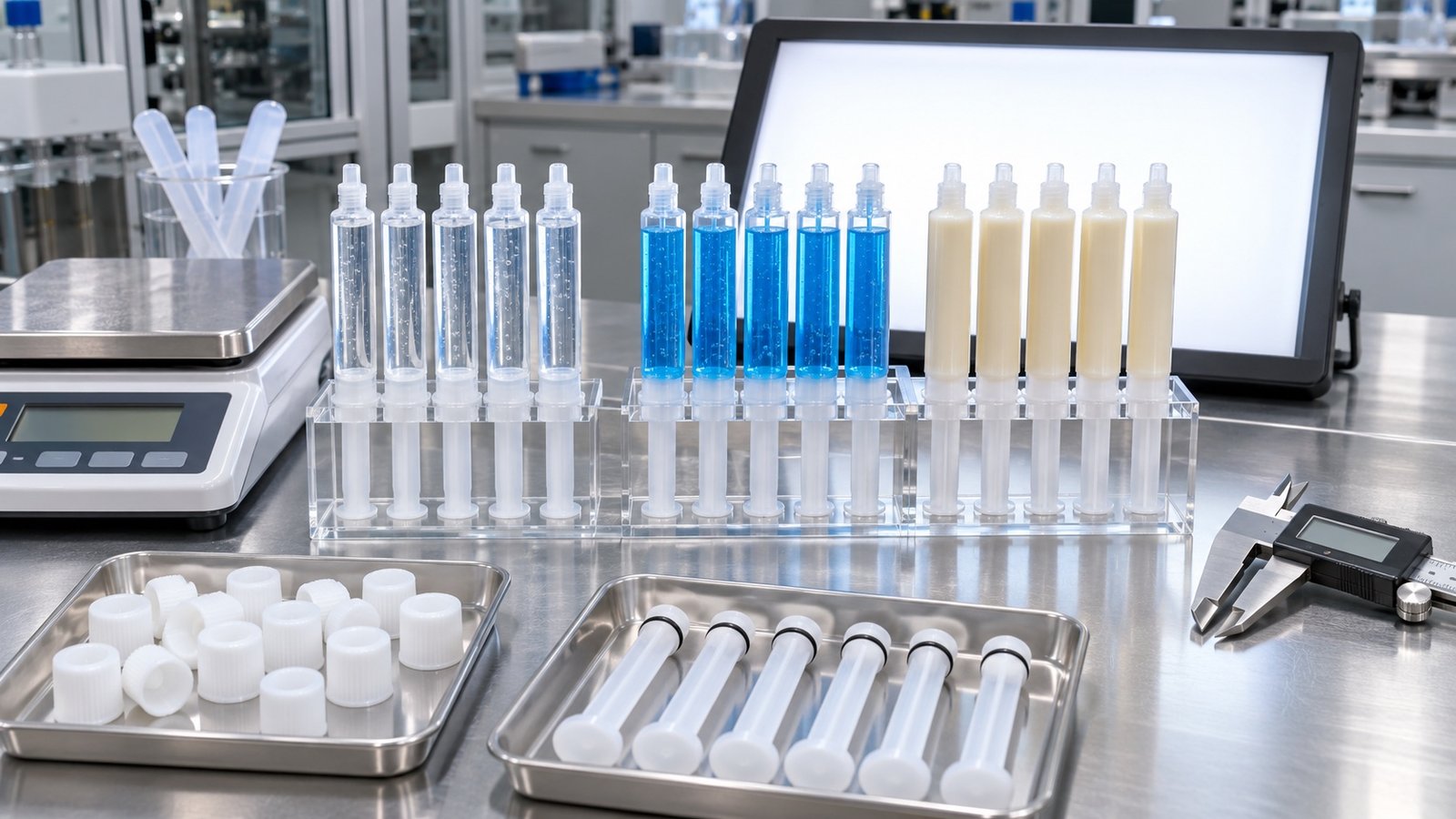
Measure net content by an agreed method. Inspect visible air, surface condition, residue, piston or cap position and package function under controlled lighting and orientation. If the product is light sensitive, establish allowable exposure with the formulation owner and include it in the protocol.
Put measurable criteria into the RFQ and FAT
The request for quotation should enable a supplier to design and test the process. Include:
- formulation category, safety data and contact-material restrictions;
- rheology information at the intended processing temperature;
- complete package drawings, tolerances and component samples;
- target dose and permitted operating range;
- batch size, daily output, changeover frequency and cleaning method;
- product preparation, transfer and maximum hold-time requirements;
- visible-air, headspace, residue, closure-position and leak definitions;
- inspection method, sample size and data-recording expectations;
- required automation, reject logic, guarding and downstream interfaces;
- FAT material quantity and responsibilities for samples, disposal and shipping.
Avoid acceptance language such as “no bubbles,” “high accuracy” or “easy cleaning” without a method and limit. A measurable FAT protocol protects both buyer and supplier.
How King Pack should be evaluated for a dental project
King Pack supplies syringe and prefilled-syringe filling equipment and supports custom configuration, FAT, documentation, training and line integration. These confirmed capabilities do not prove that a standard model can process a specific dental material.
For dental applications, feasibility should remain open until engineering has reviewed the product, applicator drawings, closure sequence and representative samples. Use the syringe filling equipment overview to understand available machine categories, then send the material data, package drawings and trial requirements for a technical assessment. Do not select a catalog model only because its nominal filling range includes the target dose.
Frequently asked questions
Can one dental syringe filling machine handle composites, gels and liquids?
Not automatically. The material supply, metering, valve, nozzle, cleaning and closure sequence may differ. A shared platform may be possible with dedicated product paths or change parts, but it must be proven with each formulation and package.
Is a dental composite syringe the same as a prefilled medical syringe?
No. A dental composite syringe is normally a needle-free dispensing package for a paste. A sterile injectable prefilled syringe has different package, cleanroom, sterility and validation requirements.
Should the buyer choose the pump before sending samples?
No. Provide rheology data and representative material, then compare suitable metering options in a trial. The complete feed path and nozzle can matter as much as the pump name.
What package parts are needed for a feasibility test?
Send the barrel, piston or stopper, plunger rod, tip, cap and any insert or label that affects handling. Include drawings with tolerances and samples from representative lots.
Does every dental material require vacuum filling?
No. First identify where air enters and test stable feed, suitable nozzle motion and closure handling. Consider vacuum only when a controlled comparison shows that it improves a defined acceptance result.
What should be accepted during FAT?
Agree on dose measurement, visible-air or headspace inspection, residue, closure position, package function, reject logic, startup and restart performance, cleaning access and documentation before the test begins.
