 Skip to content

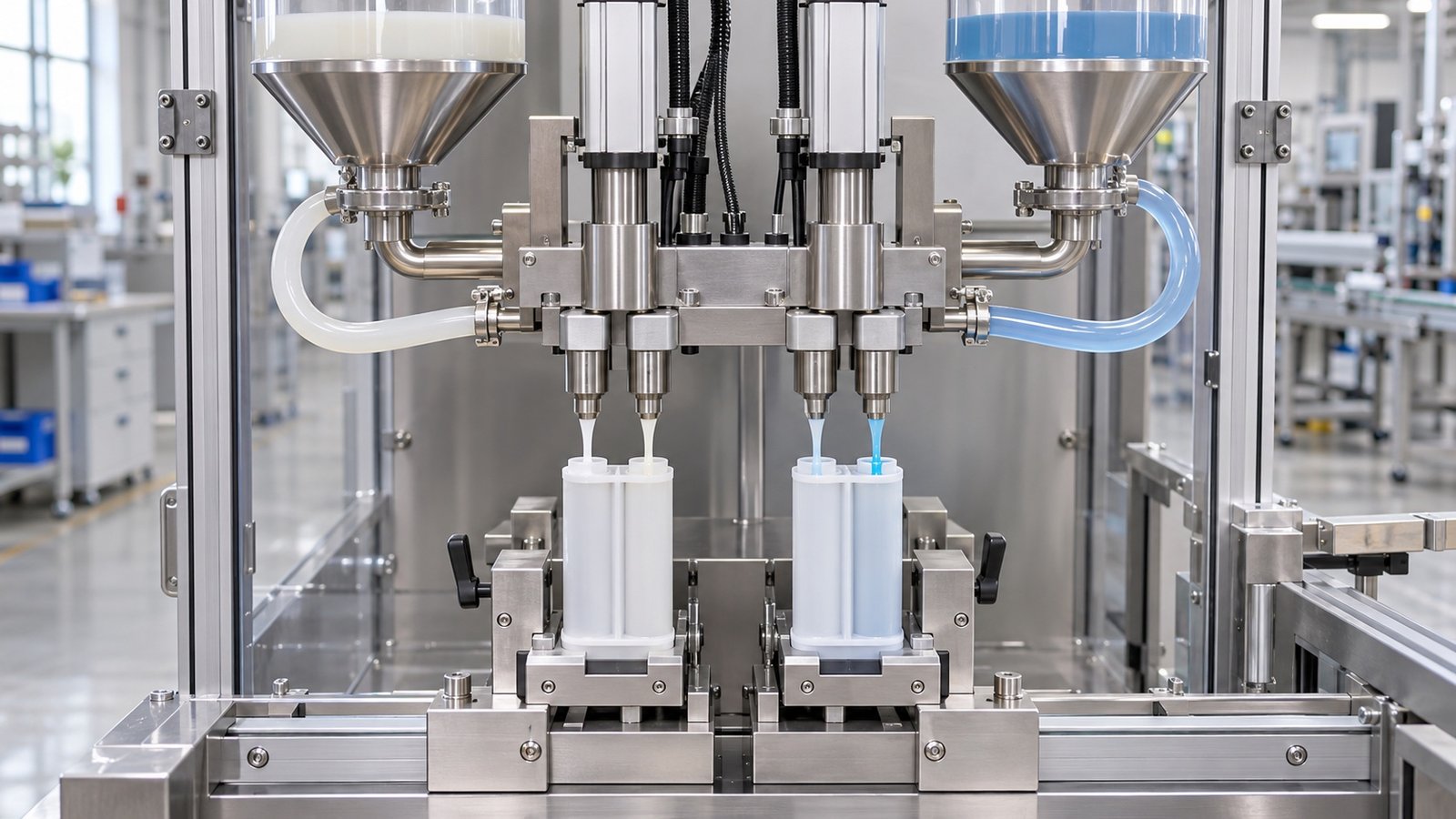
A dual barrel syringe filling machine must treat the package as two coordinated but separate product paths. The supplier needs the cartridge geometry, chamber ratio, component A and B properties, target quantity for each chamber, closure sequence and downstream dispensing method before selecting pumps, nozzles, fixtures or inspection. Do not specify the equipment as a standard single-barrel filler with an extra nozzle: the two sides must remain isolated, fill to the correct paired target and leave the outlet and plungers ready for later dispensing and mixing.
Start with the complete dual-barrel package
“Dual barrel” can describe side-by-side, coaxial or other two-chamber packages. This article concentrates on side-by-side cartridges and syringe-style applicators used for two-component products. The buyer should still send the exact package because chamber shape, outlet, flange, closure and plunger design vary by supplier and size.
Nordson EFD, for example, lists side-by-side cartridges in several nominal mixing ratios, including 1:1, 2:1, 4:1 and 10:1 for parts of its range. Those examples prove that ratio-specific packages exist; they do not establish which format King Pack can process or which ratio suits a formulation. Equipment feasibility depends on the supplied drawings and samples.
The controlled component set should include:
- the empty dual-chamber body and outlet geometry;
- separate or paired rear plungers;
- outlet cap, plug or seal;
- plunger rod or dispensing gun interface;
- static mixer or application tip used after filling;
- tray, nest, magazine or bulk presentation;
- drawings with chamber volumes, tolerances and material details;
- filled reference samples, if available.
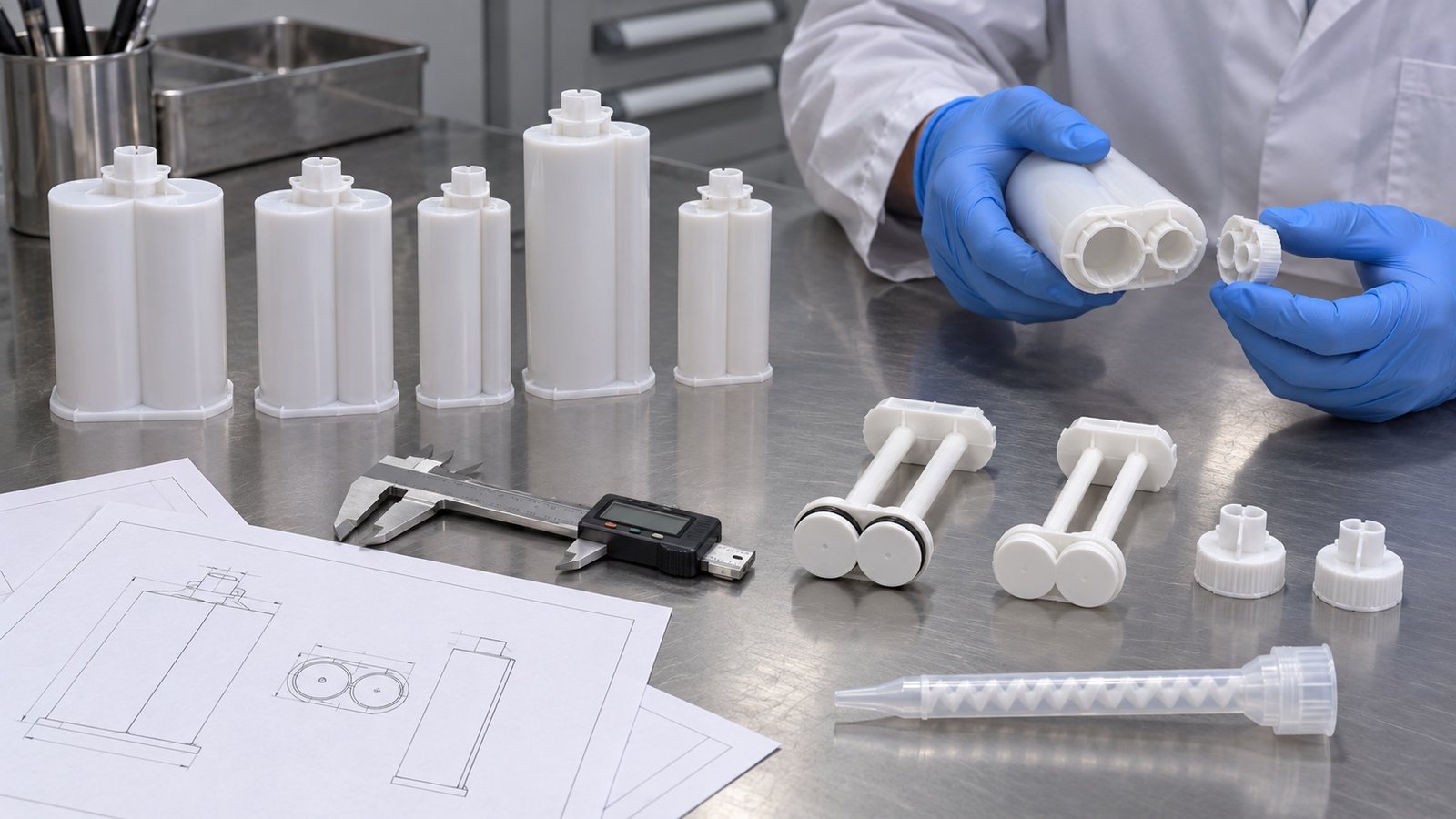
The syringe format changeover guide explains why drawings and samples both matter when carriers, guides and closing tools must be changed.
Do not confuse cartridge volume ratio with product mass ratio
The package geometry often establishes a volumetric dispensing ratio after both plungers move together. The filling machine still has to place the correct quantity into each chamber. If components A and B have different densities, their required fill masses will not follow the same numerical ratio as their chamber volumes.
Use the following relationship for each side:
Target mass = target filled volume × product density at the agreed condition
Illustrative example only: if chamber A receives 20 mL of a material with density 1.20 g/mL, its target mass is 24 g. If chamber B receives 10 mL at 0.90 g/mL, its target mass is 9 g. The package volume ratio is 2:1, but the target mass ratio is about 2.67:1. These are hypothetical values, not King Pack performance data or a product recommendation.
Define whether acceptance is based on individual chamber mass, total package mass, fill height, expelled quantity, downstream mix ratio or a combination. Weighing the complete cartridge alone may hide an overfill on one side and an underfill on the other.
A dual barrel syringe filling machine needs two controlled product paths
Component A and component B can differ in viscosity, density, abrasiveness, particle content, moisture sensitivity, temperature limit and cure behavior. They therefore need separate product-contact paths from bulk supply through dosing and nozzle cutoff. A shared hopper, manifold or cleaning return can create cross-contamination or premature reaction.
Ask the supplier for a two-path process diagram showing:
- bulk container or feed vessel for each component;
- transfer method and permitted inlet pressure;
- hose length and internal diameter;
- dosing pump or cylinder for each side;
- valve, manifold and nozzle geometry;
- seals and product-contact materials;
- drain, purge and cleaning boundaries;
- points where A and B could accidentally meet.
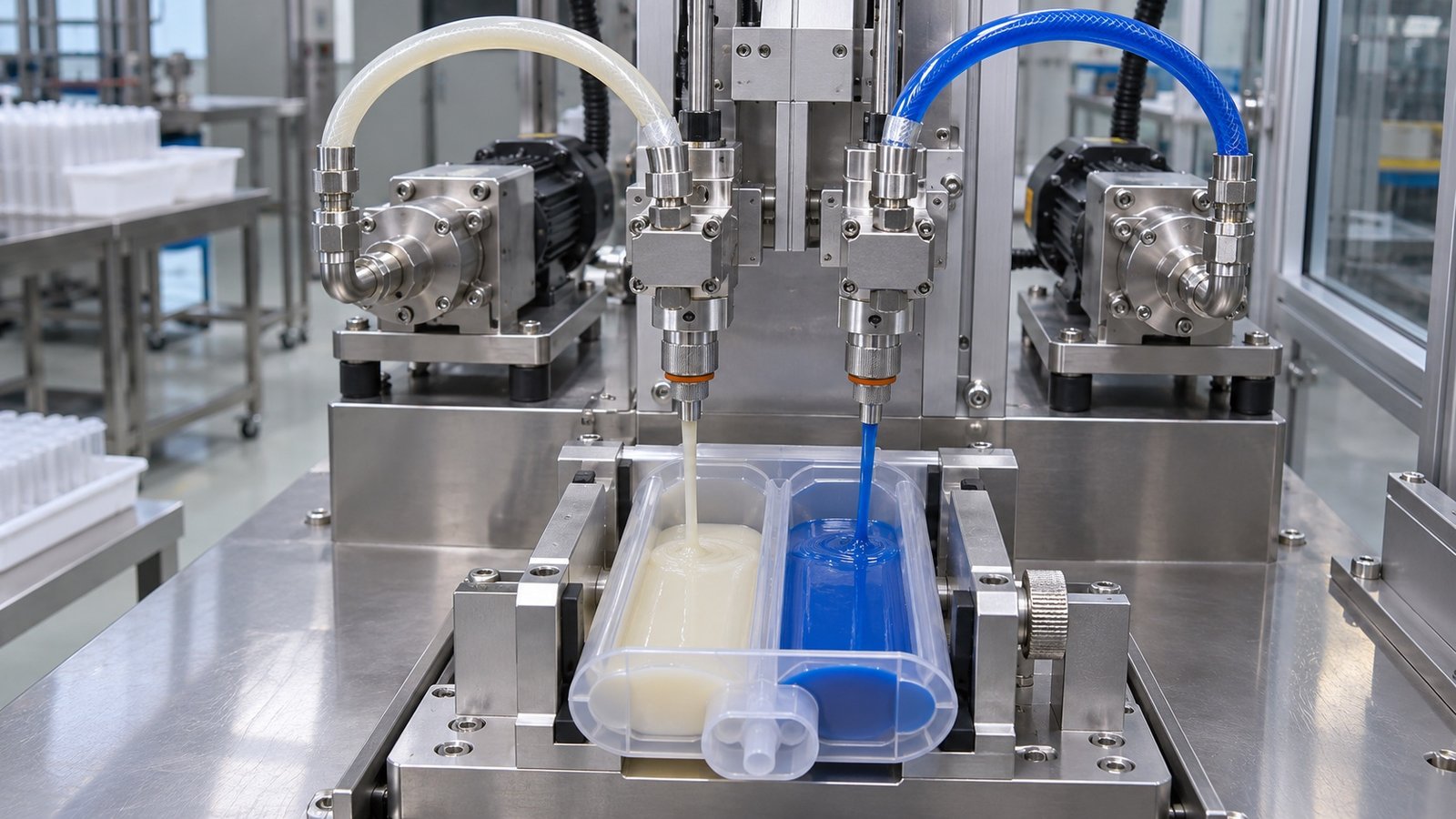
For thick formulations, apply the same whole-path thinking described in the high-viscosity syringe filling machine guide. A suitable pump cannot deliver a stable dose if its inlet is starved or its nozzle is excessively restrictive.
Match each metering device to its own component
The two sides do not always require identical pump sizes or settings. A low-viscosity hardener and a high-viscosity base may need different inlet arrangements, valve timing and nozzle geometry even when both enter the cartridge during one machine cycle. The control system should coordinate the two fills without assuming that equal stroke or equal time means the correct ratio.
Compare the proposed system using a paired matrix:
| Design question | Component A | Component B | Paired-unit check |
|---|---|---|---|
| Target quantity | Volume and mass target | Volume and mass target | Correct ratio and total package quantity |
| Product behavior | Viscosity, density, particles, cure risk | Viscosity, density, particles, cure risk | Simultaneous or staged fill feasibility |
| Bulk feed | Vessel, transfer and inlet condition | Vessel, transfer and inlet condition | Refill sequence and line balance |
| Dosing | Pump size, seals and calibration | Pump size, seals and calibration | Recipe control and interlock |
| Nozzle cutoff | Drip, string and suck-back response | Drip, string and suck-back response | Clean outlet and no cross-contact |
| Cleaning | Solvent or cleaning method | Solvent or cleaning method | Segregated tools and waste handling |
The general syringe filling machine process guide is useful for station order, but a dual-chamber project adds paired dosing, paired closure and ratio-specific inspection.
Decide whether the chambers fill simultaneously or in sequence
Simultaneous filling can reduce the time spent at the dosing station, but it requires enough space for two nozzles, stable support and coordinated product supply. Sequential filling can simplify nozzle access or reduce the risk of one side disturbing the other, yet it adds a second dosing action and may require another index position.
The decision should consider:
- center distance and opening size of the two chambers;
- whether two nozzles can enter without touching the package;
- pressure and filling-time difference between A and B;
- risk of cartridge tilt, lift or deformation;
- product stringing or drip near the common outlet;
- whether an abnormal side must stop or reject the whole package;
- required access for cleaning and changeover.
A rigid carrier should reference repeatable package surfaces and hold both chamber centerlines relative to the nozzles. The trial should include components near the agreed tolerance limits, not only selected “golden” samples.
Protect the common outlet and closing surfaces
Many dual-barrel packages bring the two chambers to a common outlet face that later accepts a cap or static mixer. Filling residue on that face can prevent correct closure or allow components to contact before use. Nozzle withdrawal, suck-back or shutoff should therefore be evaluated together with the closing step.
Define the acceptable condition for:
- outlet-face cleanliness;
- cap or plug position;
- plunger insertion depth on both sides;
- trapped air at the rear of each chamber;
- product movement during plunger insertion;
- leakage or cross-contact evidence;
- mixer attachment after storage, if relevant to the product owner.
The packaging owner must also confirm material compatibility, storage orientation, shelf-life testing and the instructions used to phase in or purge the mixer. Filling-machine testing does not replace product qualification.
Treat every cartridge as one paired quality record
A dual-barrel unit is acceptable only when both sides meet their criteria. The control logic should not allow one confirmed good side to mask a failed side. Agree how the machine reacts to an empty chamber, low product supply, incomplete dose, missing plunger, blocked nozzle or failed closure.
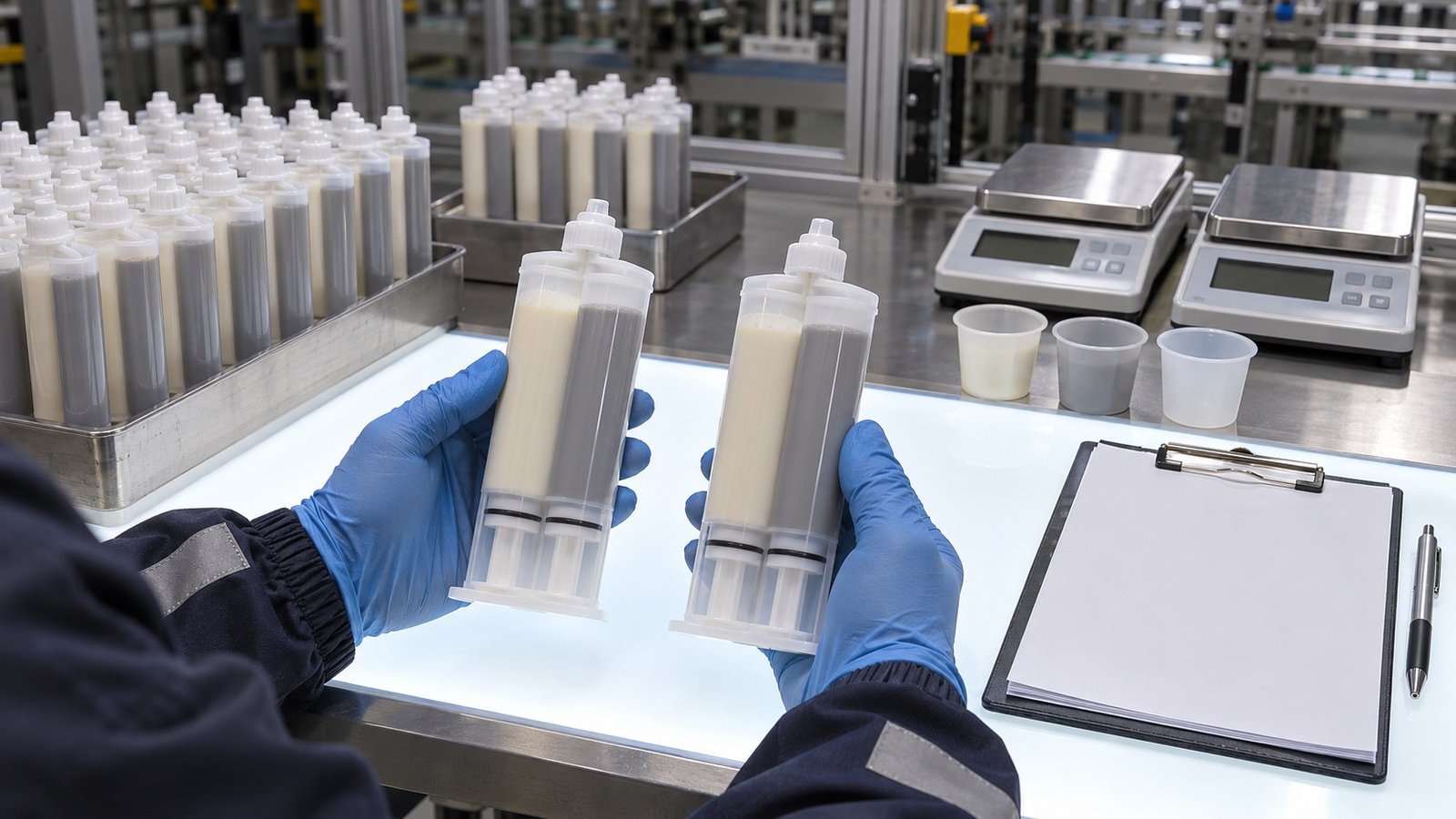
Possible inspection inputs include individual pump position, product pressure trend, in-process checkweighing, vision of fill level or plunger position, closure presence and reject confirmation. The required method depends on transparency, dose, product behavior and the buyer's quality system. Do not claim that one sensor proves the mix ratio unless the measurement principle actually distinguishes both components.
Plan changeover and cleaning as two independent circuits
Format change may involve the cartridge carrier, nozzle spacing, plungers, outlet closure and downstream transfer. Product change adds two sets of hoses, seals, valves and dosing parts. A color-coded or physically segregated parts system can reduce mix-ups, but the released procedure must match the final machine and chemicals.
Ask for:
- an A-side and B-side contact-parts list;
- disassembly sequence and tool requirements;
- cleaning-agent compatibility confirmed by the product owner;
- retained-product and drain-point review;
- reassembly checks for nozzle position and seal orientation;
- calibration or verification after changeover;
- controls that prevent the wrong recipe or wrong-side connection.
Campaign size affects the practical automation level. The comparison of automatic and semi-automatic syringe filling helps buyers count loading, replenishment, inspection and cleaning work rather than choosing automation from a headline speed.
Run a paired sample trial before design freeze
Send both actual components and enough complete cartridge sets to prime, stabilize, stop, restart and clean the proposed paths. Include more than one component lot when possible. Keep A and B in their production-representative condition and record temperature, time since preparation and any agitation or conditioning.
The test plan should include:
- Startup and priming for both paths.
- Samples from each filling head or dosing position.
- Individual A-side and B-side quantity results.
- Total package quantity and cartridge condition.
- Outlet cleanliness and closure position.
- Plunger insertion and trapped-air observations.
- A planned stop and restart.
- Low-level refill or bulk-container change for each side.
- Cleaning, product recovery and reconnection checks.
- Open items that require the final machine or production components.
If the line layout includes several component feeders or downstream stations, compare access and format handling using the linear versus rotary syringe filling guide. Layout should follow the required process rather than a generic capacity label.
Build the RFQ around evidence and responsibility
Provide the same controlled data pack to every supplier:
- intended application and destination-market requirements;
- package supplier, drawing revisions and representative samples;
- chamber volume ratio and target quantity for A and B;
- density and rheology data with test conditions;
- reactivity, temperature, safety and cleaning restrictions;
- batch size, campaign pattern and target accepted output;
- simultaneous or sequential filling preference, if justified;
- plunger, outlet-cap, inspection and reject requirements;
- downstream mixer, labeling or cartoning interfaces;
- documentation, training, spares and FAT responsibilities.
Dual-barrel processing is not presented here as a standard King Pack model capability. King Pack can review a supplied component set and product requirements to determine whether a custom filling and closing configuration is feasible. Actual performance, compatibility and acceptance limits must be agreed after sample review and testing. Review the broader syringe filling machine range and send both product data sets and the complete cartridge assembly for a feasibility assessment.
Frequently asked questions
Can a standard single-barrel filler be converted for dual-barrel cartridges?
Sometimes a base platform can be engineered for the format, but two separate product paths, paired tooling, coordinated control and paired inspection are required. Treat it as a feasibility project, not a nozzle-only change.
Does a 2:1 cartridge require a 2:1 fill mass ratio?
Not necessarily. The package ratio is commonly volumetric. If component densities differ, calculate the target mass for each side separately.
Should both chambers be filled at the same time?
Only when nozzle spacing, product supply, filling times and package support make simultaneous filling stable. Sequential filling may be more appropriate for some packages or products.
They should normally remain in separate product-contact paths until use. Any shared cleaning or recovery arrangement requires a documented cross-contamination and compatibility review.
How should fill accuracy be checked?
Use a method that distinguishes the two components, such as side-specific mass or another validated measurement. Total cartridge weight alone may not reveal opposite errors in the two chambers.
What samples are needed for a feasibility trial?
Send both products, complete dual-barrel bodies, both plungers, outlet closures, mixer or application tip, controlled drawings and enough material for priming, steady operation, stop/restart and cleaning checks.
