 Skip to content

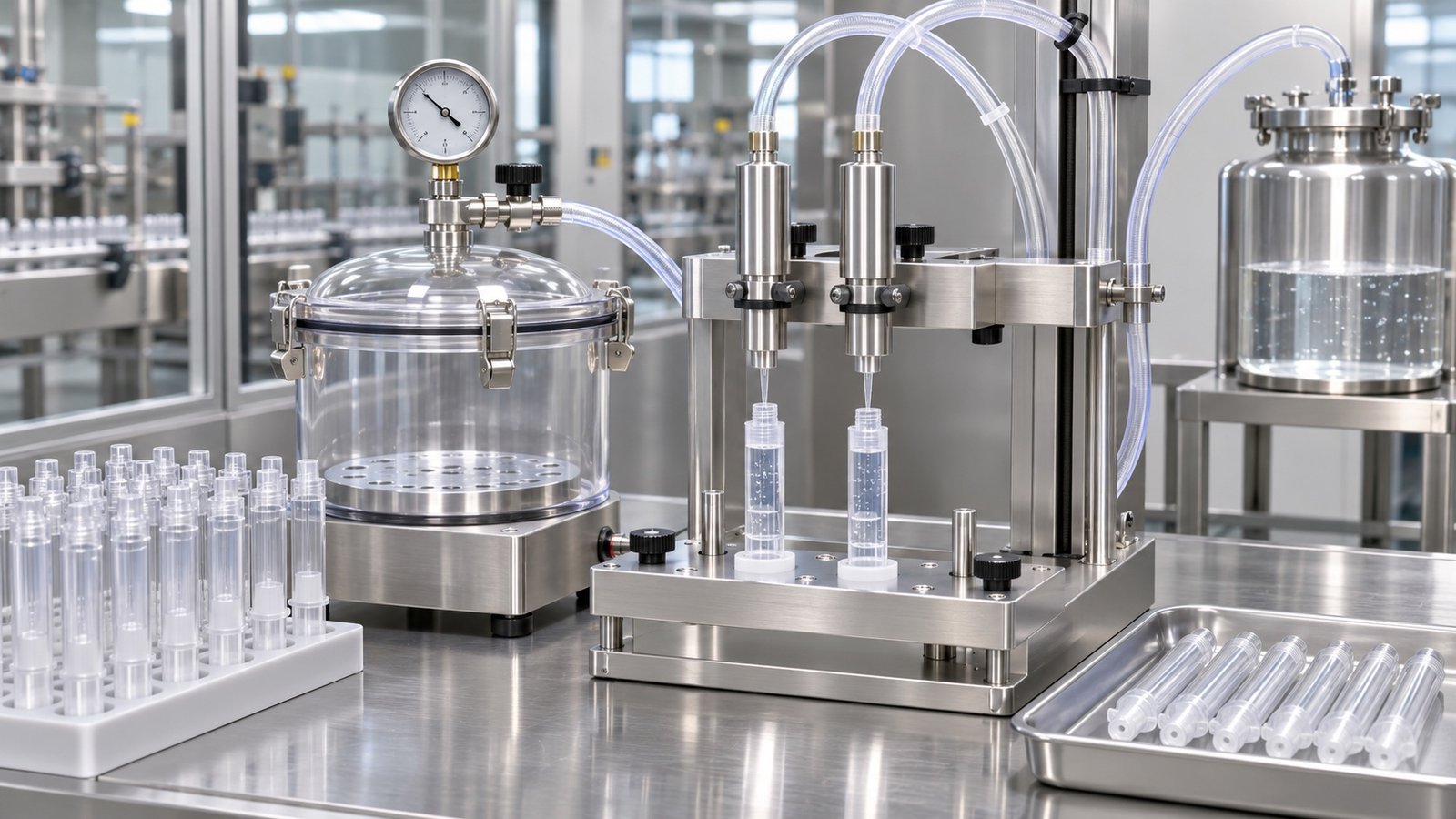
A vacuum syringe filling machine is worth specifying when representative trials show that ordinary filling cannot meet an agreed limit for trapped air, headspace or package quality. Vacuum should solve a demonstrated process problem, not appear in the specification as a generic premium feature. Buyers should first separate air already present in the product from air introduced during transfer, filling or closure, then compare a conventional process and a vacuum-assisted process using the same product, barrel, dose and inspection method.
Define vacuum-assisted filling before requesting a quotation
“Vacuum filling” can describe different operations. In one arrangement, the syringe barrel is placed under reduced pressure while product enters, so gas in the barrel or product path is less likely to remain as a pocket. In another, the product is filled conventionally and vacuum is used only while the stopper or piston is inserted. These operations address related but different risks.
The distinction belongs in the user requirement specification:
- Vacuum-assisted filling: reduced pressure is applied during all or part of product dosing.
- Vacuum stoppering: reduced pressure is applied during piston or stopper insertion to manage the headspace and closure position.
- Upstream degassing: the product is conditioned before it reaches the filler.
- Vacuum product supply: reduced pressure is part of vessel or transfer management, not necessarily the barrel-filling step.
AST notes that vacuum piston insertion can reduce bubbling associated with mechanical vent-tube insertion, while ViscoTec describes placing a syringe under vacuum during semi-solid filling to avoid air pockets. These examples show why the RFQ must name the exact step rather than use “vacuum” without a process boundary.
Find the source of air before selecting a vacuum syringe filling machine
Visible bubbles do not have one cause. Air may enter during mixing, remain in a drum after incomplete degassing, leak through a transfer connection, appear when a dosing chamber is starved, fold into the product as the nozzle withdraws, or become compressed during piston insertion. A vacuum chamber at the filling station cannot correct every one of these causes.
Nordson EFD identifies trapped air, incorrect thawing and air bypassing a piston during high-speed dispensing of thick paste as separate bubble sources. Its guidance also shows that filling technique and product preparation matter. For a production project, build a cause map with the formulation owner, equipment supplier and QA team before deciding which station to modify.
Start with five questions:
- Are bubbles present in the bulk product before it enters the filling line?
- Do bubbles first appear after transfer, dosing, nozzle withdrawal or closure?
- Is the defect random, linked to one filling head, or concentrated after replenishment and restart?
- Does the package require a defined headspace, minimum headspace or no visible pocket?
- How will the buyer inspect the result under repeatable conditions?
The site's guide to prefilled syringe filling accuracy and defect control provides a broader way to separate bubbles, drips and stopper errors. Use it to define the defect before adding equipment.
Compare the available process responses
Vacuum is one option among several. The correct comparison depends on the product, package and defect mechanism.
| Process response | Best question it answers | Main limitation | Evidence to request |
|---|---|---|---|
| Upstream degassing | Is air already dispersed in the bulk product? | May not prevent air introduced later | Bulk-product samples before and after conditioning |
| Bottom-up or controlled nozzle motion | Is product folding over itself during filling? | Motion alone cannot remove bulk-product air | Video and samples at several fill speeds |
| Shorter, fuller product path | Is the dosing inlet being starved or leaking air? | Requires product-path redesign | Pressure trend, priming record and restart samples |
| Slower filling or revised cutoff | Is the nozzle entraining air or leaving a void? | Can affect cycle time and drip behavior | Dose, bubble and cutoff results under one protocol |
| Vacuum-assisted filling | Does reduced pressure improve the filled barrel result? | Adds chamber, sealing, control and cleaning requirements | Paired trial with and without vacuum |
| Vacuum stoppering | Is air introduced or compressed during closure? | Does not correct bubbles already dispersed in product | Stopper position, headspace and closure samples |
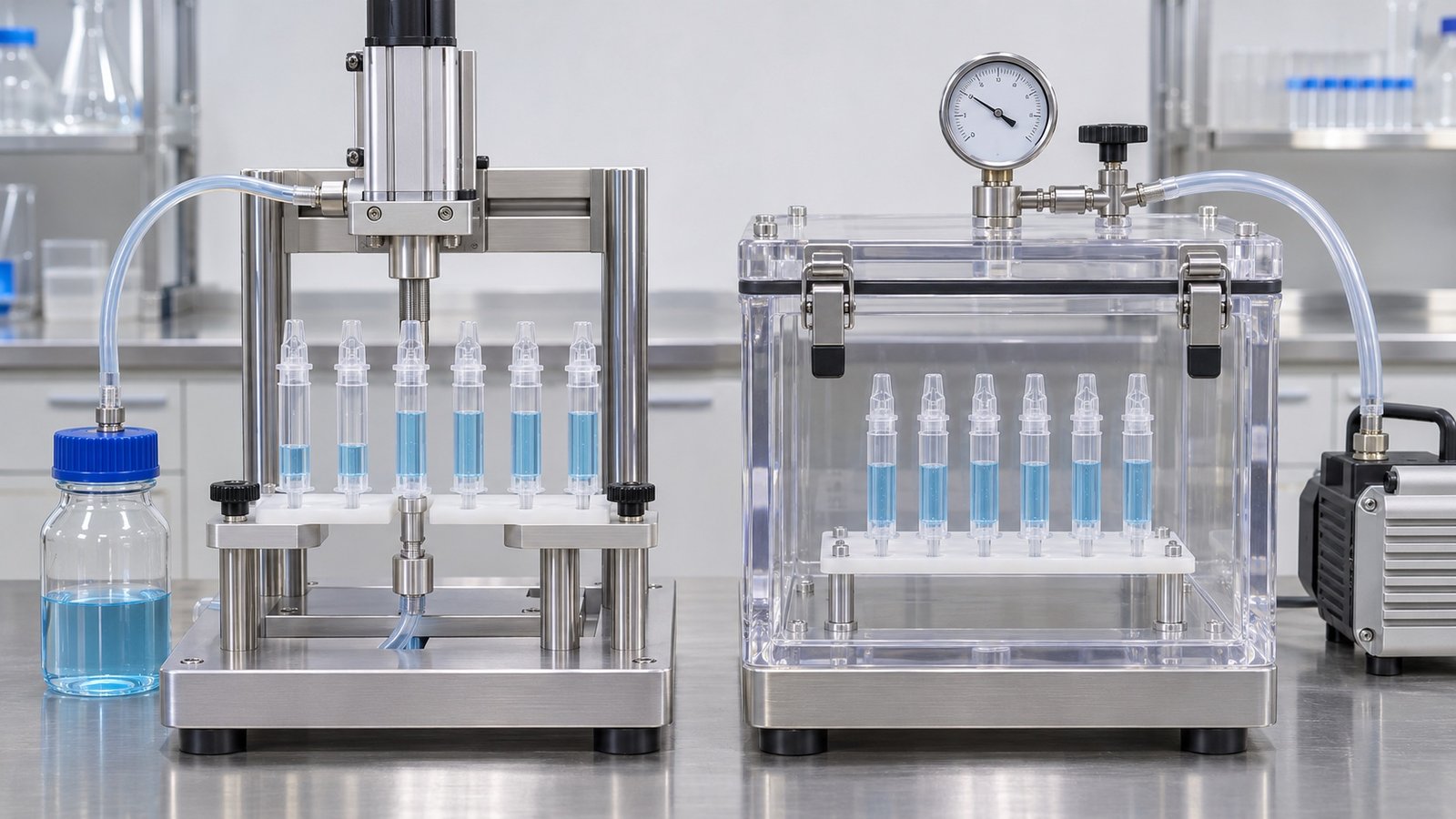
The filling-nozzle selection guide for viscous products explains how bore, insertion depth, withdrawal and cutoff affect the fill. Complete these basic checks before assuming that vacuum is the only answer.
When vacuum-assisted filling is a strong candidate
Vacuum-assisted filling deserves a controlled trial when the barrel is narrow, the product does not level easily, and conventional filling repeatedly leaves an unacceptable pocket despite a stable feed and suitable nozzle motion. It can also be relevant when the product or process owner has a justified limit on gas exposure or when the closure operation makes a remaining pocket difficult to manage.
The case is stronger when all of the following are true:
- the defect is defined and visible under a repeatable inspection method;
- the product and package are representative of production;
- upstream preparation and transfer are stable;
- ordinary nozzle and motion adjustments have been evaluated;
- reduced pressure produces a measurable improvement;
- the barrel, product and closure tolerate the proposed pressure profile;
- the added cleaning, maintenance and cycle steps are acceptable.
The case is weak when “bubble-free” has no inspection definition, only selected samples have been tested, or the product condition changes between the conventional and vacuum trials. A trial should prove the benefit under controlled conditions rather than create a visually impressive but unrepeatable sample.
Keep vacuum filling and vacuum stoppering as separate stations
The filling chamber and the stoppering station may use different pressure levels, timing and acceptance criteria. Combining them in one sentence can hide responsibility for the final result. Ask the supplier to show the sequence from barrel loading through dosing, pressure release, transfer, stopper presentation, insertion and discharge.
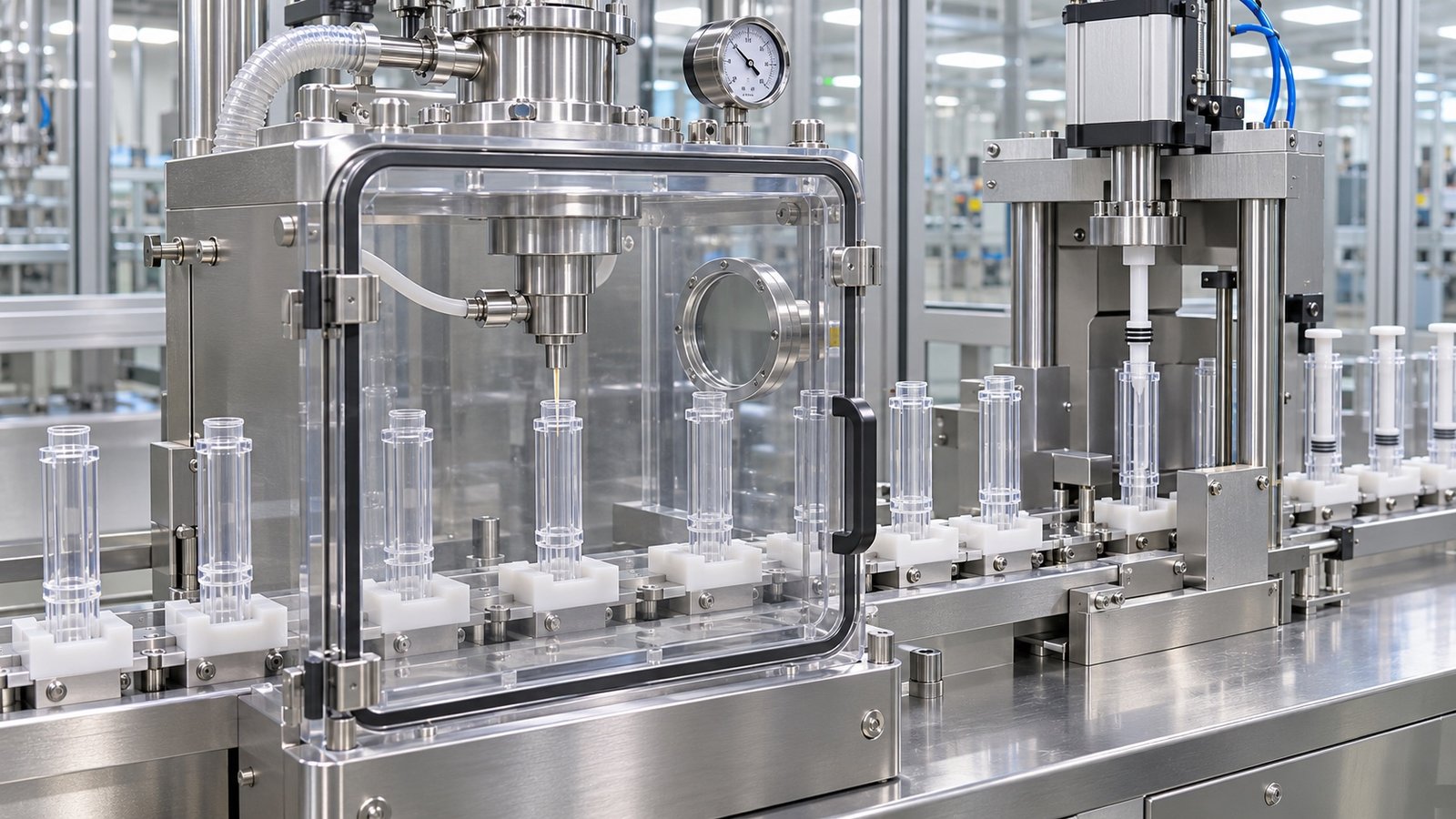
For each station, define:
- when the chamber seals and how seal condition is monitored;
- the pressure setpoint or operating window to be established by trials;
- the time allowed to reach and release pressure;
- what happens after an incomplete vacuum cycle;
- how the barrel is supported against pressure and insertion loads;
- how the system prevents a filled unit from bypassing a failed closure step;
- how cleaning and inspection access are provided.
The wider prefilled syringe filling machine guide can help the project team place these steps within the complete line without treating every syringe-style package as the same application.
Check product and package compatibility with reduced pressure
Reduced pressure changes more than the amount of air in a barrel. A volatile component may foam or evaporate more readily. Dissolved gas may come out of solution. A flexible plastic barrel or closure may deform. A viscous product may expand and then settle after pressure returns. These are engineering possibilities to evaluate, not predictions about a specific formulation.
Prepare a trial window covering the intended product temperature, hold time, fill volume and barrel lot. Observe foaming, surface rise, product movement after venting, barrel distortion, seal contact and any residue drawn toward the chamber or vacuum line. The equipment design should protect the vacuum system from product carryover and make contaminated parts accessible.
For high-viscosity applications, use the complete product-path selection guide to review bulk feed, pump inlet, hoses, valve and nozzle before evaluating the chamber. Vacuum cannot compensate for an intermittently starved dosing device.
Define a representative comparison trial
A defensible trial compares the candidate process with a baseline. Use the same product lot, preparation method, barrel and closure lot, target dose, nozzle, measurement instruments and inspection conditions. Record every setting that could affect the result.
Include these sample groups:
- Startup after normal priming.
- Stable operation after the process reaches its agreed condition.
- Replenishment or bulk-container change.
- A planned short stop and restart.
- A longer stop if it represents the production schedule.
- End-of-batch operation at the lowest intended product level.
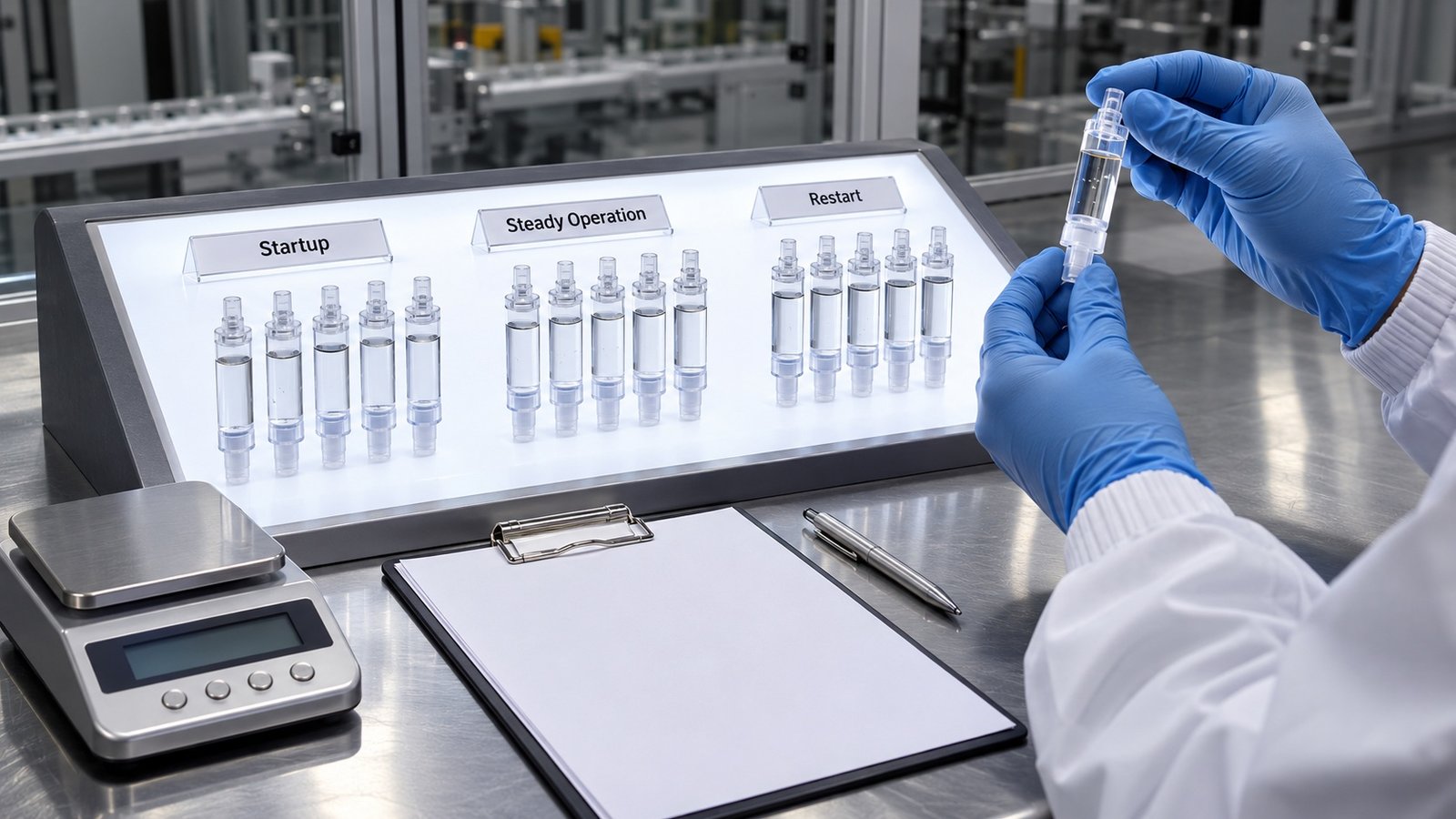
Measure dose by the buyer's agreed method and inspect visible air using controlled lighting, orientation and defect definitions. Record chamber pressure versus time, filling time, pressure-release time, product temperature, operator interventions, rejected units and cleaning events. A scale result alone does not prove that headspace, stopper position or visible air is acceptable.
Calculate the commercial effect without inventing a machine price
Vacuum adds hardware and cycle steps, but the purchasing decision should compare total process consequences rather than option price alone. Use an indexed model if supplier quotations are not yet available.
Assume the baseline installed process cost equals 100 index units. Add the confirmed cost of the vacuum chamber, pump, controls, guarding, validation work, maintenance parts and any cycle-time effect. Then subtract only losses supported by the comparison trial, such as rejected packages or repeated rework. Do not assume that every bubble becomes a reject or that vacuum removes all rejects.
The relevant decision is:
Net indexed effect = added vacuum-system cost + added operating cost − verified avoidable loss
State every assumption and run a sensitivity case for batch size, reject threshold and maintenance interval. If the defect is rare or controlled by a simpler change, the vacuum option may not be justified. If the defect is frequent, costly and demonstrably reduced, the option may be reasonable even with a longer cycle.
Put the acceptance criteria into the RFQ and FAT
Request a proposal that defines the vacuum function in measurable terms. Include:
- product description, preparation, temperature and safety data;
- barrel, piston or stopper and closure drawings plus representative samples;
- target dose and the method used to measure it;
- visible-air, headspace and closure-position definitions;
- baseline process and defect evidence;
- filling and stoppering sequence;
- pressure monitoring, alarm and reject logic;
- cleaning, product-recovery and vacuum-line protection requirements;
- planned trial matrix and sample quantity;
- responsibilities for FAT, documentation, training and site qualification.
King Pack lists vacuum filling and vacuum stoppering among configurable syringe-line functions. The final arrangement and capability still need to be established from the actual product, package and test protocol. Review the available syringe filling machine configurations and send your product data, barrel drawings and defect samples for a technical assessment.
Frequently asked questions
Does every viscous syringe product need vacuum-assisted filling?
No. Many products can be filled acceptably with stable bulk feed, suitable dosing, controlled nozzle motion and correct closure handling. Use vacuum only when a representative comparison shows a justified benefit.
Is vacuum-assisted filling the same as vacuum stoppering?
No. Vacuum-assisted filling applies reduced pressure during dosing; vacuum stoppering applies it during piston or stopper insertion. A line may use one, both or neither.
Can vacuum remove bubbles already mixed through the product?
Not reliably in every formulation or cycle. Upstream degassing or revised mixing and transfer may be required. Test the actual product rather than assuming the filling chamber will remove dispersed gas.
What should be measured during a vacuum filling trial?
Record dose, visible air or headspace, closure position, product temperature, pressure versus time, cycle time, rejected units and results after stops and restarts.
Can a flexible plastic barrel be placed under vacuum?
Possibly, but deformation depends on barrel geometry, material, support and pressure profile. Verify it with production-representative components and define acceptable cosmetic and dimensional results.
What information should be sent with an RFQ?
Send the product data, package drawings, complete component set, target dose, defect definition, batch profile, cleanliness requirements and enough representative material for baseline and vacuum-assisted trials.
