 Skip to content

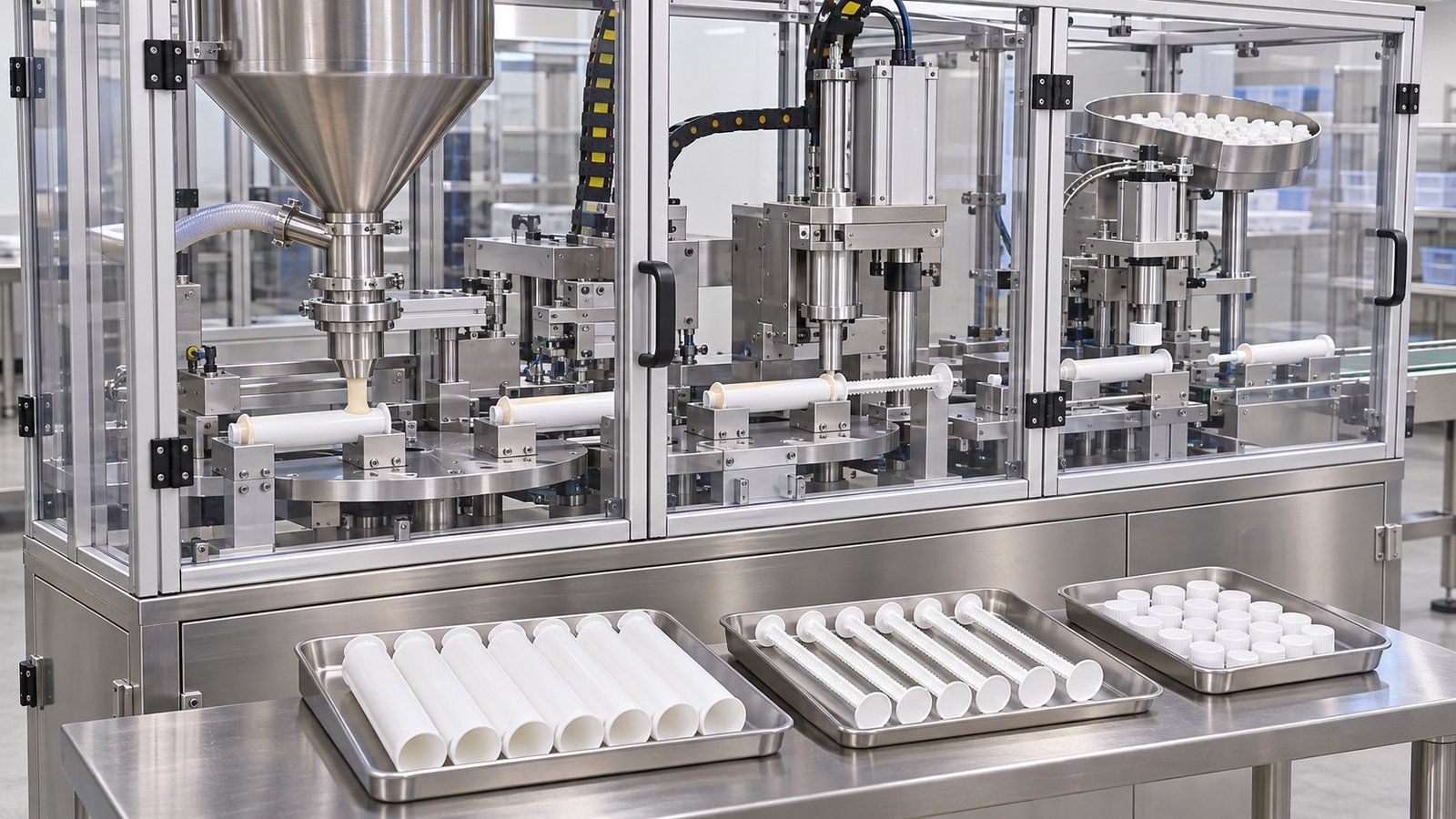
An equine oral paste syringe filling machine must be specified around the actual paste, long oral-dose barrel, calibrated plunger or dose ring, cap and label—not around a generic “veterinary syringe” description. The production process must fill a dense product consistently, keep the nozzle and closure areas clean, assemble the correct dosing components and preserve the package features used to set an animal-weight dose. Buyers should send representative paste and the complete package, then accept the line through a documented filling, closing and functional trial.
This article covers non-sterile oral paste and gel applicators for horses, including dewormer-style packages. It does not provide veterinary treatment advice and does not establish a drug dose. The product owner remains responsible for the approved formulation, label, dosage instructions and market-specific regulatory requirements.
Start with the labeled package function
Official equine product labels show why the package is part of the dosing system. Zoetis prescribing information for QUEST equine oral gel describes a ready-to-use syringe calibrated in 50-pound increments with a dial ring set to the animal’s weight. U.S. FDA labeling for EQUIOXX oral paste describes weight notches and a locking ring on the plunger. Merck’s PANACUR directions also use a dial ring and graduated body-weight setting.
These examples are not machine specifications. They demonstrate that an equine oral paste barrel, plunger and dose-setting feature can affect how the finished product is used. The filling project must therefore control the complete package and label relationship.
Provide the supplier with:
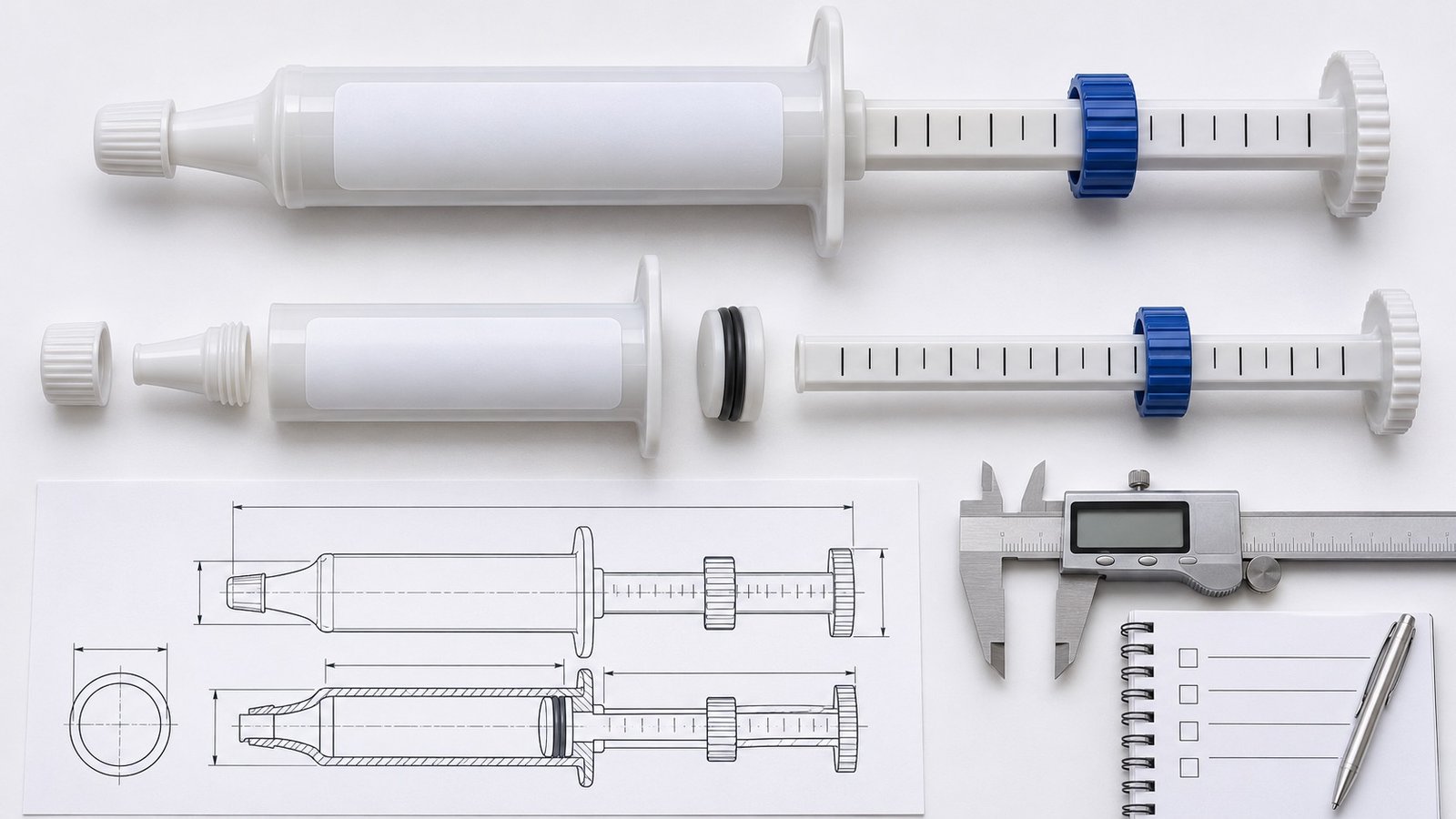
- oral-dose barrel drawing, internal geometry and usable fill length;
- outlet nozzle, cap and tamper feature if present;
- piston, plunger rod, calibrated markings and dose ring;
- label artwork zone and any lot or expiry coding area;
- assembled samples and loose components from representative lots;
- approved functional-use instructions for package testing.
The veterinary syringe filling solution overview provides a broader application context. This article concentrates on the long, multi-dose oral paste package and the checks that should be included in an equipment project.
Distinguish the package types before choosing a filler
Not every equine oral product uses the same syringe. Official FDA and manufacturer information shows packages ranging from small single-course syringes to much larger multi-day paste barrels. Weight graduations can also vary. A buyer should never assume that a fixture proven for one commercial pack will handle another.
| Package feature | Why it matters to the machine | What the buyer should provide |
|---|---|---|
| Long barrel and narrow outlet | Affects support, nozzle reach and pressure | Drawing, tolerance stack and assembled samples |
| Calibrated plunger rod | Must stay correctly oriented and legible | Rod samples, graduation scheme and assembly position |
| Sliding or locking dose ring | Adds a component and functional check | Ring drawing, locking method and use test |
| Front cap or tamper feature | Requires clean seating and presence detection | Cap samples, seating window and integrity test |
| Printed dose/weight label | Must align with the dosing mechanism | Artwork zone, print tolerance and inspection method |
| Reusable cap for multi-day use | Package must reclose after dosing | Cap-function and leakage expectations |
Characterize the paste under real processing conditions
“Oral paste” can describe different active ingredients, solids, flavors and rheological behavior. A viscosity value measured under one condition is not enough to select the product path. Ask for the actual formulation or a representative placebo with documented equivalence, plus the normal temperature and conditioning history.
Define:
- rheology or flow behavior over the intended temperature range;
- density for net-weight and volume conversion;
- solids, suspended particles or settling risk;
- air sensitivity and allowable visible-air condition;
- shear, heat or moisture sensitivity;
- product-contact material restrictions;
- maximum hold time and rework limits;
- cleaning method and residue acceptance;
- occupational and environmental handling requirements.
For a dense paste, the feed method must keep the metering chamber supplied throughout the batch. Long narrow hoses and restrictions can increase pressure demand or create unstable fill behavior. The high-viscosity syringe filling system guide explains how to review bulk container, transfer, metering, valve and nozzle as one product path.
Support the long barrel during filling and assembly
Equine applicators are often longer than dental or industrial dispensing barrels. The support tooling must prevent rocking, bowing or rotation while allowing the nozzle, piston and plunger stations to work.
Check these mechanical points with real components:
- barrel datum and support location;
- flange and outlet tolerances;
- resistance to fixture marks or deformation;
- orientation of printed or molded graduations;
- support under piston insertion force;
- plunger rod engagement and final position;
- dose-ring presence, orientation and movement;
- cap seating without product contamination;
- discharge from the nest without pulling the plunger or cap.
If more than one barrel size will run, use the syringe format changeover guide to define which guides, nests, nozzles, sensors and recipes change. Record the approved component range instead of describing the line as “universal.”
Choose feed, metering and nozzle together
The metering system must receive paste consistently and place it in the barrel without unacceptable air, smearing or residue. A positive-displacement concept may be evaluated for a dense veterinary paste, but the correct pump and feed method depend on the formulation, batch container and cleaning plan.
Nozzle variables include:
- largest practical internal bore;
- nozzle length and stiffness;
- insertion depth into the long barrel;
- bottom-up or controlled withdrawal motion;
- dispense rate and pressure trend;
- shutoff and suck-back behavior;
- clearance from the outlet and closure surfaces;
- disassembly and cleaning access.
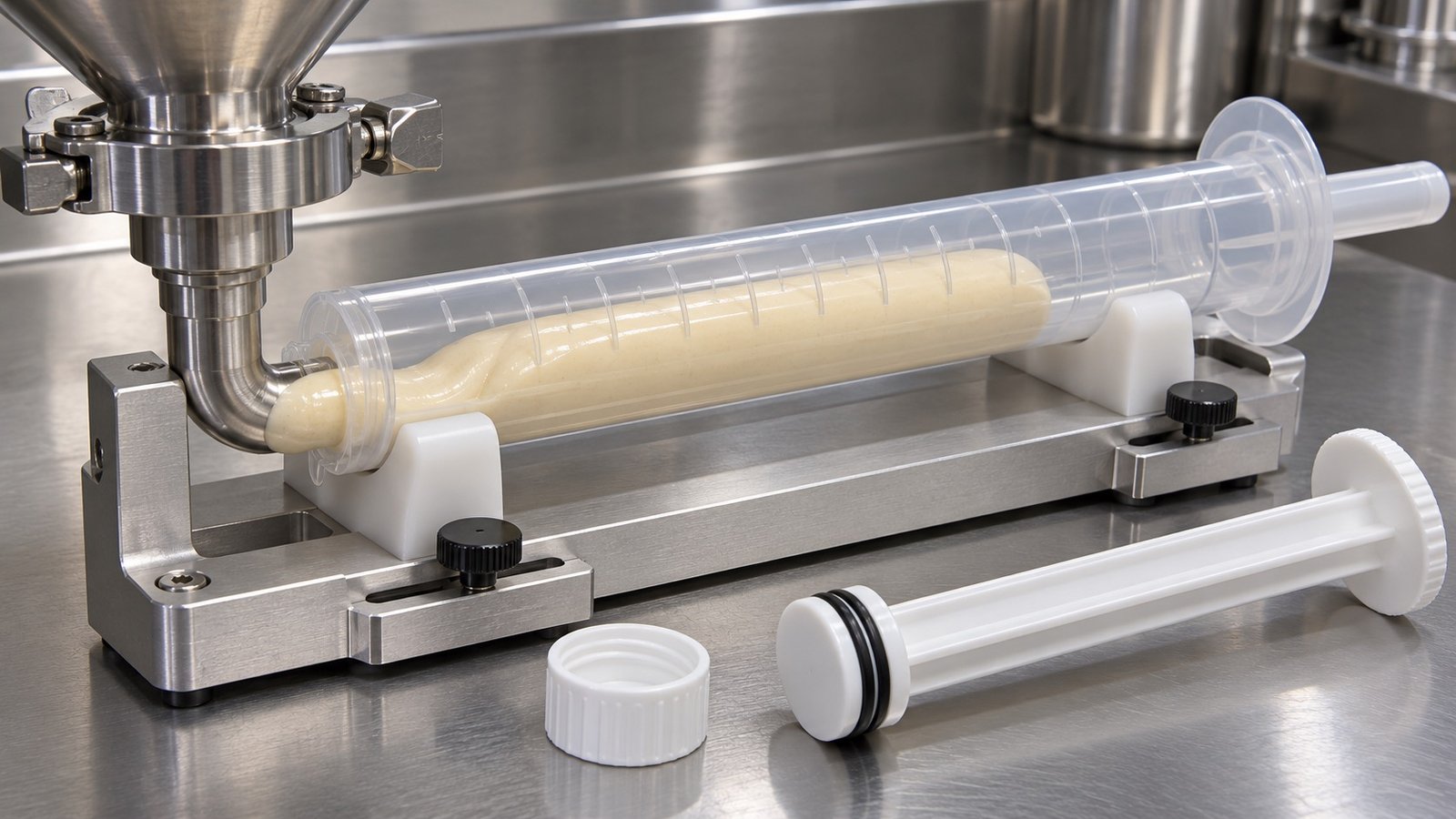
The viscous-product filling nozzle guide can structure the trial. Bottom-up filling may help place product progressively, but it does not guarantee an air-free package. Stable feed, conditioning, nozzle motion and closing all need controlled comparison.
Treat piston, plunger and dose-ring assembly as separate stations
An oral paste package may require a piston or internal plug, a long calibrated plunger rod and a movable or locking dose ring. These are different operations with different failure modes.
For each station, define:
- component presentation and orientation;
- presence and position sensing;
- insertion depth or engagement condition;
- force or displacement signal if used;
- handling of a missing, doubled or skewed part;
- reject and reconciliation procedure;
- access for cleaning and recovery.
The finished package should be function-tested against the product’s approved use instructions. FDA product labels demonstrate examples in which the ring is moved to a weight marking and locked before the plunger is depressed. A production FAT can verify that the package mechanism moves, locks and dispenses as intended without making any claim about clinical effectiveness.
Protect coding, labeling and dose readability
Lot, expiry and dose information must remain legible and correctly positioned. The equipment supplier should know whether coding occurs on the barrel, label, carton or more than one level. Define the inspection point and responsibility for each code.
If a label must align with barrel graduations, establish:
- angular alignment tolerance;
- start and end position along the barrel;
- minimum readable area after plunger assembly;
- barcode or vision-inspection requirement;
- reject logic for missing, doubled or misaligned labels;
- line-clearance process between products or strengths.
Do not place a label over a mechanical feature or dose scale without package-owner approval. The equipment layout should allow inspection before secondary packing.
Run trials by operating state, not only average output
The trial should use representative paste, production-intent barrels and closures. Record the product lot, temperature, conditioning, bulk-container level and machine settings. Separate samples from startup, stable operation and restarts.
| Trial condition | Risk exposed | Suggested checks |
|---|---|---|
| Startup after priming | Incomplete feed and trapped air | First acceptable unit, net content and visible-air condition |
| Stable operation | Normal repeatability | Net content, residue, component positions and pressure trend |
| Short stop and restart | Drying, settling or pressure recovery | Stop time, first units and nozzle cutoff |
| Bulk-container replenishment | Feed interruption | Product level, recovery and rejects |
| End of batch | Low feed head and retained product | Dose trend, scrap and cleanout |
| Format change | Wrong parts or settings | Change parts, recipe, line clearance and first-off approval |
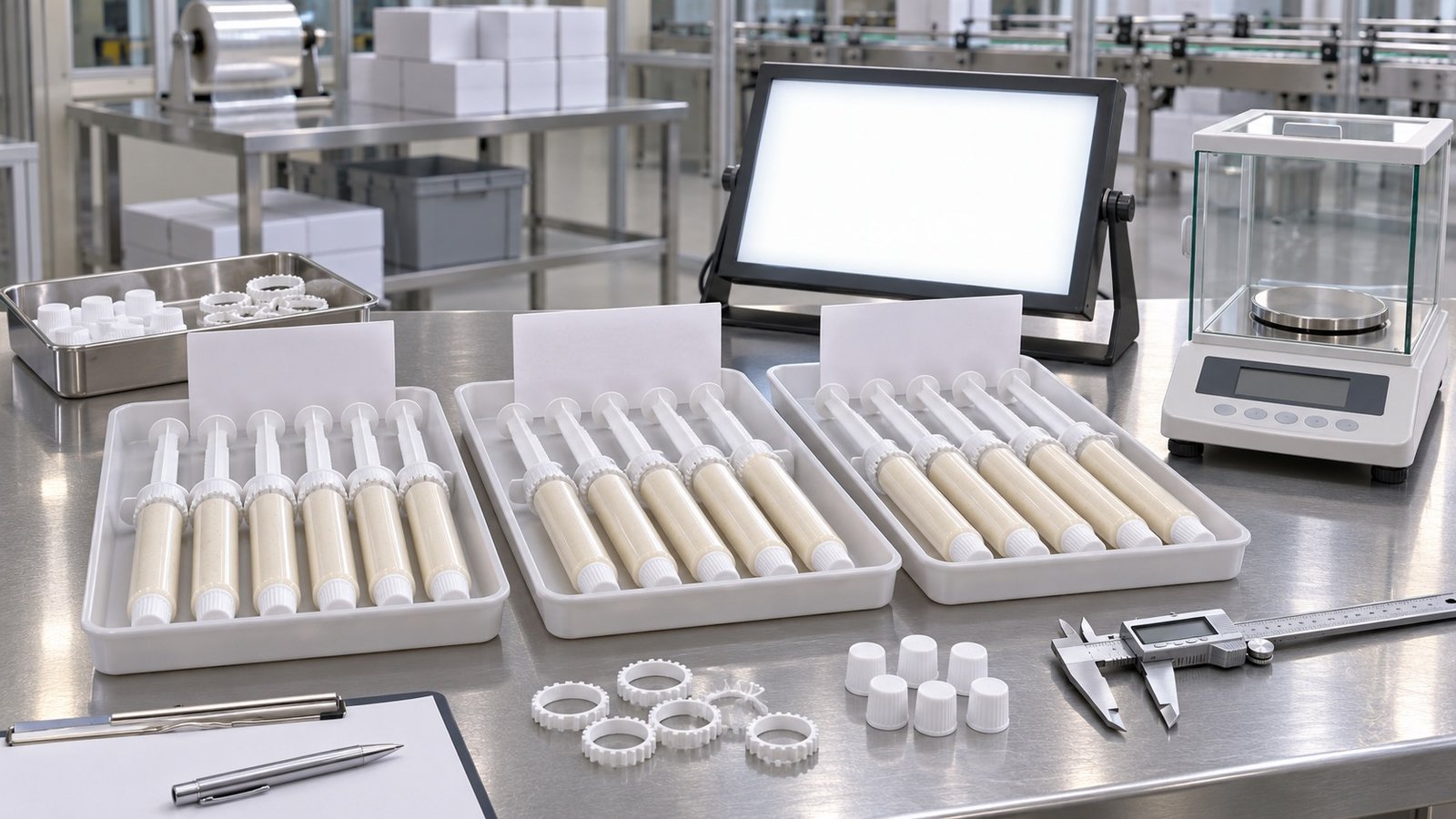
Measure net content using an agreed tare and calibrated balance. Inspect visible air under defined lighting and orientation. Check outlet cleanliness, cap seating, piston position, plunger engagement, ring movement, label alignment and package damage. A functional test should follow the approved package instructions without changing the labeled dose.
Choose the automation level from package stability and batch needs
A semi-automatic system can be appropriate for product development, smaller batches or frequent format changes. Automatic barrel and closure feeding may be justified when the package is stable and recurring production supports dedicated tooling. An integrated line may include filling, component assembly, labeling, coding, inspection and cartoning.
Compare configurations by:
- validated batch size and changeover frequency;
- number of manually handled components;
- operator exposure and ergonomic risk;
- component feeding reliability;
- inspection and reject requirements;
- cleaning time and retained product;
- downstream label and carton capacity.
The automatic versus semi-automatic syringe filling comparison helps structure this decision without assuming a headline speed.
Put measurable acceptance criteria into the RFQ and FAT
Include these inputs in the request for quotation:
- formula category, density, rheology and contact restrictions;
- complete barrel, piston, plunger, ring, cap and label drawings;
- target net content and fill range;
- batch size, annual demand and changeover plan;
- component feeding and assembly scope;
- coding, label alignment and inspection responsibilities;
- cleaning method and maximum product hold time;
- acceptance methods for dose, visible air, residue and assembly;
- package functional-use test;
- FAT sample quantities and responsibilities;
- guarding, data, documentation, training and spare-parts requirements.
The sample requirements for a syringe filling trial can be used to plan material and component quantities. Avoid vague criteria such as “no bubbles,” “high accuracy” or “easy changeover” unless the protocol defines a method and limit.
How to evaluate King Pack for an equine oral paste project
King Pack supplies veterinary filling solutions and supports custom configuration, FAT, documentation, training and line integration. These confirmed capabilities do not prove that a standard configuration is suitable for every equine paste, barrel, dose ring or label.
Use the syringe filling equipment overview to review machine categories, then send the paste data, complete package, target output and FAT criteria for an engineering assessment. The equipment proposal should identify the product path, change parts, assembly stations, inspection scope and remaining trial conditions.
Frequently asked questions
Is an equine dewormer syringe the same as a veterinary injection syringe?
No. The package discussed here is a needle-free oral-dose applicator for paste or gel. Injectable veterinary syringes have different container, sterility and regulatory requirements.
Can one filler handle 25 g and larger oral paste syringes?
Possibly, but the barrel length, outlet, piston, plunger and dose-ring geometry may require different tooling and settings. Compatibility should be demonstrated with every intended package.
Does bottom-up filling eliminate bubbles?
No. It may improve product placement, but air also depends on bulk preparation, feed stability, nozzle behavior, stops, restarts and closing. Use a controlled trial and a defined inspection method.
Should the machine assemble the calibrated plunger and dose ring?
That depends on the procurement scope and component design. If the machine performs assembly, include orientation, presence, position and functional checks in the FAT.
How should fill quantity be accepted?
Use a documented net-content method with calibrated equipment, agreed sampling and separate evaluation of startup, stable running and restart units. Do not infer dose accuracy from pump settings alone.
What should be sent to the equipment supplier?
Send representative paste, safety and process data, the complete package set, drawings and tolerances, approved use instructions, target output, cleaning method and measurable acceptance criteria.
