 Skip to content


The number of filling heads on a syringe filling machine should come from the required accepted output, the verified cycle time for the actual product and the capacity of every upstream and downstream station. More heads increase theoretical parallel dosing, but they do not correct slow product supply, unstable barrel feeding, piston insertion, cap handling or inspection. Compare one-, two- and four-head proposals with the same samples, test window and reject rules before specifying head count.
Calculate syringe filling machine head count from accepted output
Start at the point where the buyer counts saleable units. Define whether output means filled barrels, filled-and-closed applicators or units that have also passed inspection. Then calculate the required rate over the time genuinely available for production.
Use this planning relationship:
Required theoretical filling rate = target accepted units ÷ (net scheduled minutes × expected acceptance yield × expected running availability)
Yield and availability must come from the buyer's process history or a representative test. Do not use an assumed percentage as a supplier guarantee.
Consider a hypothetical planning example:
- Target accepted units: 2,400 per shift.
- Net scheduled production time after planned breaks and changeover: 420 minutes.
- Assumed acceptance yield for planning: 98%.
- Assumed running availability for planning: 85%.
Required theoretical rate = 2,400 ÷ (420 × 0.98 × 0.85) = 6.86 units per minute.
If a representative product trial shows that one head can complete four stable fill cycles per minute, two heads provide a theoretical eight fills per minute. In this illustration, two heads may cover the requirement with limited margin. Four heads would not be justified by the calculation alone. All figures are assumptions for method demonstration, not King Pack machine ratings.
The gel bait syringe filling capacity guide explains how net run time, changeovers and good units affect the output model.
Why more filling heads do not guarantee more output
Parallel heads only add output when all of them receive product, barrels and cycle permission at the required time. A four-head station needs four correctly positioned barrels for each index. If the barrel feeder delivers only three, the control system may wait, reject the incomplete set or run below the proposed pattern. The same limitation applies to pistons, caps and the discharge conveyor.
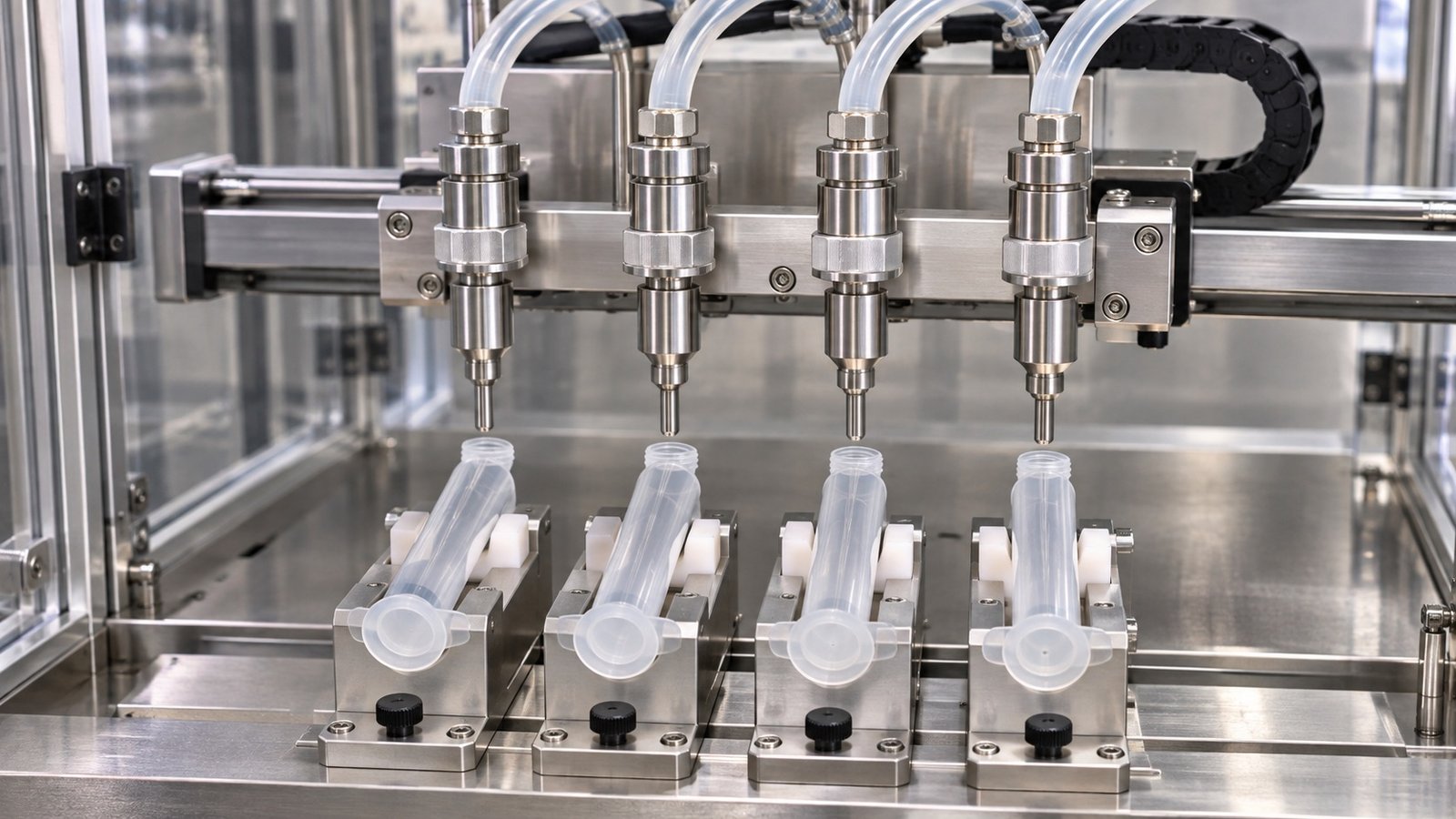
Product supply is another shared constraint. Multiple dosing cylinders or valves may draw from one hopper, pump or manifold. The supply system must recover pressure and volume before the next cycle without introducing air or changing product condition. Nordson's official valve documentation shows that multiple dispensing valves can be connected to a common material source, but the application still requires suitable supply and valve selection. For a syringe line, verify this arrangement with the actual product rather than treating the number of outlets as proof of capacity under production conditions.
Downstream operations can set a lower ceiling. If four barrels are filled together but piston insertion handles only two per index, extra dosing heads wait for the slower station. Use the syringe filling process overview to map each station and identify the slowest accepted-output step.
Match head count to product and fill window
The fill volume and product behavior determine how long one dose takes. A low-viscosity liquid may be limited by nozzle shutoff and drip control. A high-viscosity paste may be limited by flow through the feed path, nozzle and barrel opening. Thixotropic materials can change apparent flow after shear or idle time. Products containing particles or abrasive fillers may need different clearances and maintenance planning.
Head count is therefore inseparable from the dosing method and product feed design. Ask the supplier to state the tested product condition, fill target, nozzle size, feed arrangement and cycle definition. A “cycle” should include all movements that affect the next dose, not only the time that product flows.

Check the usable filling window. On an indexing line, nozzles may descend, fill, withdraw and clear the barrels before the conveyor or dial can move. Adding heads increases the number of barrels processed in that window, but it may also increase the moving mass, hose routing and time needed to confirm every position. The supplier should demonstrate the complete index with guards and inspection functions enabled.
Compare one, two and four heads by operating fit
| Head arrangement | Where it may fit | Advantages to test | Limits to price and verify |
|---|---|---|---|
| One head | Pilot work, short batches, frequent product changes or low required rate | Simple product path, fewer parts to clean, direct troubleshooting | Operator or index cycle may limit output; little redundancy |
| Two heads | Moderate output with stable paired indexing | Parallel dosing with manageable manifold, tooling and sampling | Both paths need equivalent setup; one downstream station can still bottleneck |
| Four heads | Higher required rate with reliable component feeding and downstream capacity | More units per filling index when the complete line supports them | Larger feed demand, more nozzles and seals, more format parts and head-to-head verification |
This table is a selection framework, not a universal recommendation. Some lines use more than four heads, and some high-value products remain better suited to a single carefully controlled path. The correct comparison follows the product, package, process and acceptance requirement.
Verify balance between filling heads
Every head should be treated as a separate measurement path during setup and testing. A combined average can hide one head that fills high and another that fills low. Assign samples to the head that produced them, then compare individual results to the agreed criterion.

A practical trial should include:
- Individual samples from each head after startup.
- Samples after product replenishment or a planned pause.
- A run long enough to observe feed recovery and temperature or viscosity drift.
- The largest and smallest agreed fill formats.
- Recorded adjustments, rejects and interventions by head.
If the equipment uses a common pump with a distribution manifold, verify how the system balances branches. If each head has an independent dosing unit, verify recipe control, calibration and maintenance for each path. The buyer should agree whether one out-of-tolerance head stops the complete machine, disables one lane or triggers another documented response.
Include cleaning, changeover and maintenance in the decision
Each additional head adds product-contact parts, seals, nozzles, hoses or dosing components that may require cleaning, inspection and replacement. A higher head count can reduce filling time while increasing changeover time. For short campaigns, that trade-off can reduce rather than increase daily accepted output.
Ask the supplier for a product-contact parts list by head count. Time the removal, cleaning, inspection, reassembly and first-article checks. The syringe filling machine maintenance guide helps identify routine checks for nozzles, seals, sensors and dosing components.
Format tooling also grows with parallel lanes. Four barrels must be supported in repeatable positions, and the carrier or pocket set may change with barrel diameter, flange or length. Review the proposed tooling and storage plan through the syringe format changeover guide.
Price critical spares for the full arrangement. A four-head machine may need more seals and nozzles on hand, while a common feed component can remain a single point of failure. Define the supplier's recommended spare quantity from the actual configuration and maintenance plan instead of multiplying a generic kit.
Plan for future demand without oversizing the first build
Forecast growth does not automatically justify installing the highest head count at launch. Ask the supplier whether the proposed machine can accept an additional dosing module later and which parts of the base design must be prepared now. The answer may affect frame length, guarding, controls, pump or hopper capacity, utilities, carrier pitch and the capacity of piston insertion or cap handling.
Request two documented configurations when future demand is uncertain: the equipment needed for the verified first-stage output and the defined changes needed for a higher-output stage. A credible upgrade plan should identify hardware, software, format tooling, testing and site work. It should not rely on an unspecified promise that extra nozzles can simply be bolted on.
Compare the staged plan with installing all heads at the beginning. Early installation may avoid later integration work, while staged installation can reduce unused product-contact parts, cleaning burden and spare inventory during the initial demand period. Use the buyer's approved demand scenarios and supplier quotations. Do not treat forecast volume as confirmed production or assign savings before the upgraded arrangement has an acceptance method.
Test the complete line at the required head count
A dosing bench test can confirm whether the product can be metered, but it does not prove line output. The factory acceptance test should run the agreed number of heads with representative barrels, pistons and caps. Include normal feeding, replenishment, closing, inspection and discharge.
Ask for these records:
- Start and finish time for the agreed test window.
- Gross fills and accepted units at the defined discharge point.
- Results separated by head where relevant.
- Reject count and reason.
- Stops, starved indexes and manual interventions.
- Product supply condition and any adjustments.
- Changeover or cleaning evidence if included in the acceptance scope.
Compare proposals on the same basis. A four-head supplier should not quote theoretical nozzle cycles while a two-head supplier reports accepted closed applicators. The linear versus rotary syringe filling comparison provides another layout-level check because the transport path and fixture arrangement affect how parallel heads are used.
Send the data needed to size the filling station
Prepare the daily and batch demand, net production time, product description, viscosity or flow information at the filler, fill range, barrel and closure drawings, format list, cleaning method, acceptable operator tasks and required inspection. Include the upstream product supply and the downstream stations that must match the filler.
King Pack can review the proposed head count as part of a configured syringe filling system and trial plan. Final selection depends on representative samples and agreed acceptance criteria. Send your output target, product condition and syringe drawings to request a head-count comparison tied to the complete line.
Frequently asked questions
Do two filling heads double syringe filling output?
They can approximately double theoretical fills per index when both heads run the same stable cycle, but accepted line output also depends on feeding, closing, inspection, stops and rejects. Verify the complete line.
Is a four-head syringe filler always faster than a two-head machine?
Not at the discharge if another station is slower or the product supply cannot feed four dosing paths. Compare accepted units over the same representative test window.
Can different fill volumes run on separate heads at the same time?
Only if the machine and control strategy are designed and validated for that operating mode. Do not assume independent recipes or mixed formats without a specific proposal and test.
How should fill accuracy be checked on a multi-head machine?
Separate samples by head and evaluate each path against the agreed method and acceptance criterion. An overall average should not replace individual-head results.
When is one filling head the better choice?
One head may fit pilot production, frequent product changes, short campaigns or a product that needs a simple controlled flow path. Use the required accepted output and total changeover burden to decide.
