 Skip to content


Introduction
Syringe filling machine maintenance is the routine that keeps net-content drift and cross-contamination from reaching your product. It is not a chore list for when something breaks; it is a set of checks that catch a worn seal, a clogging nozzle, or a drifting pump while the fix is still cheap.
On a gel bait filling line, most failures are slow and predictable. A thixotropic paste wears a piston seal at a steady rate, a nozzle builds residue over hundreds of doses, and fill mass drifts by a fraction of a gram per shift. Nobody notices until a checkweigher rejects a run or a customer opens a short barrel.
This syringe filling machine maintenance guide sets out the daily, weekly, monthly, and quarterly schedule we use on cockroach and ant gel bait lines. It covers cleaning, wear parts, calibration, troubleshooting, and the handover at installation. The same parts wear on a bench-top semi-automatic unit and on an integrated automatic line, so the routine crosses the range.
What the Routine Is Really Protecting
Two things go wrong when syringe filling machine maintenance slips, and both cost more than the routine itself.
The first is net-content drift. Gel bait is sold by mass in grams, not by volume, so the line exists to hit a fill target in grams and hold it. Wear in the metering pump, a stretched peristaltic tube, a nozzle closing less cleanly, or a hardened seal all push the delivered mass off target. Drift is gradual, which makes it dangerous: a line can pass every check on Monday and sit outside tolerance by Thursday.
The second is cross-contamination. If you run more than one product, or one product in more than one colour or fragrance, residue left in the pump, the nozzle, the feed path, or the insertion tool carries one batch into the next. A trace of a different fragrance is a complaint. A trace of a different active ingredient is a label and registration problem, and the rules depend on the market you sell into.
The Daily, Weekly, Monthly, and Quarterly Schedule
The table is a gel bait filling machine maintenance schedule you can adapt, so set the intervals to your paste and shift pattern. A line running two shifts on an abrasive, particle-loaded gel wears faster than one running a single shift on a smooth paste. Tighten the intervals where your own records say you should.
| Interval | Task | What to check | Why it matters |
|---|---|---|---|
| Daily | Clear residue, clean contact surfaces | Feed vessel, pump inlet, nozzle, tip cups, insertion tool | Dried residue becomes a particle source and a contamination path |
| Daily | Clean the nozzle, check the valve | Orifice, full valve closure, build-up ring at the tip | A dirty nozzle changes the cut-off and starts stringing |
| Daily | Confirm suck-back | Watch the break at the tip over a few doses | Weak suck-back leaves tails; too strong pulls air back in |
| Daily | Check air supply oil, water, pressure | Filter bowl, regulator reading, drain any water | Water or oil in the air line shortens seal life |
| Daily | Clean conveyor and sensors | Belt, guide rails, sensor faces | Paste on a sensor triggers false rejects |
| Weekly | Inspect seals and O-rings | Piston seal, pump seals, valve O-rings | Wear shows as a weep or a fill-mass shift before it leaks |
| Weekly | Gravimetric check of the metering pump | Weigh doses across the run, not just the first | Confirms the pump still delivers the target mass |
| Weekly | Check fixtures and locating parts | Barrel nests, guide blocks | A worn nest tilts the barrel and misaligns the piston or cap |
| Monthly | Full pump and valve service | Disassemble, clean, replace worn seals, re-verify by weight | Parts that pass a weekly look still need a scheduled change |
| Monthly | Electrical and cable inspection | Cabinet, sensor cables, strain relief, earth bonding | Vibration loosens terminals and chafes cables |
| Monthly | Back up parameters and recipes | Dosing volumes, suck-back settings, format recipes | A controller fault or reset can erase hours of tuning |
| Quarterly | Deep clean, wear-part audit | Strip the material path, inspect every seal and tube, review the reject log | Surfaces slow trends that weekly and monthly checks only hint at |
Clean before you inspect, and inspect before you calibrate. If you calibrate a dirty pump, you calibrate the residue, not the pump.
Wear Parts and a Spare Parts Strategy
You cannot write a fixed hour figure for a wear part and expect it to hold. The replacement window depends on three things you know: the chemistry of your paste, how abrasive it is, and how many cycles you run per shift. A smooth gel and an abrasive, particle-loaded bait consume the same seal at very different rates.
| Part | What to watch | How to set the interval |
|---|---|---|
| Seals and O-rings (pump, valve, insertion tool) | A weep, hardening, swelling, or a fill-mass shift | Replace at the first sign of wear, and on the cycle your wear record supports |
| Peristaltic pump tube | Loss of rebound, wall thinning, dose volume change | Count tube-life hours from your run log, not a generic figure |
| Nozzles | Orifice wear, residue cleaning no longer restores, changed cut-off | Replace when cleaning stops bringing the dose and the tail back |
| Fixture rubber pads and nests | A barrel that no longer sits square | Replace when the seat is compressed or the piston misaligns |
| Filters (air line, any product filter) | Weak valve action, pressure drop | Replace on the schedule your air quality needs |
The strategy is a wear record: log the install date, run hours, and reason for the change. After a few intervals you have a real replacement window for your line instead of a supplier's generic number. Keep the fast movers on site: seals, O-rings, one tube, one nozzle per format, and one set of fixture pads. That kit covers most unplanned stops; slower parts, like a spare pump head, can wait if you check the lead time first.
At handover we size the accompanying spare parts kit to the formats and shift pattern the customer told us, not a standard box. One format on one shift needs a small seal and O-ring set plus a tube; four formats across three shifts needs nozzles per format and a second set of fixture pads, because changeover wears those fastest.
Cleaning and Changeover: Colour, Fragrance, and Active Ingredient
A filling machine cleaning procedure does two jobs: remove the paste, and remove the risk of carrying one product into the next. Order matters.
- Stop and clear. Run the line empty where the design allows, and purge the feed path so no paste sits in a dead corner.
- Disassemble the material path. Remove the nozzle, the valve, the pump head or tube, and the insertion tool. Leave nothing that touched the paste in place.
- Clean rough to fine. Flush the heavy residue first, then clean the contact surfaces, then rinse and dry. Wiping a still-loaded surface only spreads the residue.
- Clean the feed vessel and its stirrer. Skinning and residue collect on the walls and the shaft first.
- Reassemble and prime. Prime with the next material and dump that prime, rather than pushing old residue forward with the new batch.
The scope changes with the changeover type.
- Colour change: the material path is enough on most lines.
- Fragrance change: fragrance clings. Extend the clean to the vessel lid, the vent, and the air path above the paste, because odour rides on residue you cannot see.
- Active ingredient change: treat it as containment. Clean every shared surface, keep separate tools and containers where you can, and confirm the cleaning before releasing the next batch.
On shared lines, run your isolation the way your own quality system and your market's rules require. We can describe the equipment and the cleaning points, but the containment standard for your product comes from your market regulator and your own registration, so set it with them. Changeover planning is a separate discipline, and the changeover planning guide counts the minutes it costs you.
Calibration and Verification
Cleaning and inspection keep the machine healthy. Calibration proves the dose is still right.
The working method is gravimetric. Weigh the delivered product, not the pump setting. Zero the scale, weigh a set of doses at the start, middle, and end of a run, and record the mass against your fill target and tolerance in grams. One weigh at the start of a shift is not a check; it is the single point most likely to be correct.
A sampling plan turns the numbers into a decision: how many units per interval, where in the run you take them, how you tare, and what makes a unit a reject. Four things move a fill mass: temperature, pump or tube wear, nozzle condition, and air in the paste. Weighing at intervals separates a slow drift from a single bad start.
The record sheet is the part people skip and later regret. Log the date, the format, the fill target and tolerance, the individual weights, the average, the reject count, the paste temperature, and any adjustment. When a customer asks why a batch was in or out of spec, the record is your answer.
When a check fails, read it before you act. If the average drifts, check the pump and nozzle before you touch the recipe. If the spread widens but the average holds, look at paste condition and suck-back. If one unit is out and the rest are in, look for a single event, not a machine trend.
Common Faults and the Order to Fix Them
In syringe filling machine maintenance, most faults that look like machine failures are paste, air, or residue. Work the order left to right.
| Fault | Likely causes | Fix order |
|---|---|---|
| Net-content drift | Pump or tube wear, nozzle residue, paste temperature, air in the paste | Recheck paste temperature, clean nozzle and valve, weigh again, then service the pump seals |
| Stringing and tailing | Weak suck-back, worn or clogged nozzle, paste temperature | Clean the nozzle, confirm valve closure, retune suck-back on the actual paste |
| Underfill and voids | Air in the paste, partial piston seat, weak suck-back drawing air, feed running low | Check feed level and priming, then piston seating, then the cut-off |
| Piston not seated | Worn insertion tool or fixture pad, wrong seating force, barrel tolerance | Check nest and tool for wear, set seating depth and force, look for paste behind the wiper |
| Cap not sealing | Paste on the tip or threads, wrong torque or press force, barrels packed on their side | Fix the cut-off first, then set closure force, keep barrels upright |
| Tank skinning | Paste drying on the surface, low agitation, long idle time | Stir gently, cover the vessel, clean the walls on schedule |
Work it in order: clean first, tune second, replace third. When a fault repeats, the air bubbles and stringing guide covers the cut-off and feed-path causes in depth. If the line is still being sized, the syringe filling machine explainer shows which stations create the maintenance load.
Why Downtime Costs More Than Spare Parts
A seal costs very little. The unplanned stop it causes costs much more. One lost shift, one rejected batch, or one late shipment can outweigh a whole year of spare parts.
Look at it through availability, performance, and quality. A line cleaned on schedule may see fewer unplanned stops and less reject risk, but the effect depends on the paste, shifts, and maintenance discipline. Compare the cost of a planned clean with the cost of an unplanned tear-down in your own records; that is the evidence for the routine's payback.
Handing Maintenance Over at Installation and Training
At first installation our job is not finished when the machine runs. We hand over the routine.
On site we brief where the wear parts sit, how to clean the material path without disturbing calibration, how to record the daily and weekly checks, and what to do when a check fails. The acceptance list in our FAT checklist carries these points into the handover, so nothing is agreed verbally and then forgotten.
Three items get ignored on site more than any others. The air filter drain, because it is quiet and nothing reminds you. The fixture pads, because they wear without looking worn, so a tilted barrel gets blamed on the syringe. And the recipe backup, because nobody takes one until a controller fault wipes the settings. None is expensive, and each causes a stop if left alone.
Then comes training. We pair our commissioning engineer with your operators and let them clean and calibrate on your own paste, not a demo sample. Write the routine into your own SOP so it survives a change of staff, because the habit belongs to the line, not one person.
FAQ
Q: How often should I check the fill weight?
A practical starting point is a full gravimetric check weekly, plus a short weigh at the start, middle, and end of each run; your quality system may require a different frequency. Gel bait is sold by mass, so the weight check is the one that protects the product. Record every result with its date and format; a bare number tells you nothing later.
Q: When should I replace seals and O-rings?
Set the interval from your own wear record, not a fixed number. Paste chemistry, abrasiveness, and cycles per shift decide how fast a seal wears. Replace on the first sign of a weep or hardening, and on the cycle your log supports. Two lines running the same part rarely reach the same count.
Q: What is the right cleaning procedure when changing colour or fragrance?
Clean the whole material path: nozzle, valve, pump head or tube, and the insertion tool. For a fragrance change, extend the clean to the vessel lid and the air path above the paste. For an active-ingredient change, follow the containment rules of your market and your own quality system.
Q: Can I calibrate a dirty machine?
No. Clean first, then calibrate, or you calibrate the residue instead of the pump. A dirty nozzle changes both the dose and the cut-off, so the weight you set is the weight of a dirty machine, not the line in normal running. Clean then calibrate is a rule.
Q: What spare parts should I keep on site?
Keep filling machine spare parts small and specific: seals, O-rings, one peristaltic tube, one nozzle per format, and one set of fixture pads. That set covers most unplanned stops and fits a shelf. Slower parts, like a spare pump head, can wait if you check the lead time while the line still runs well.
Conclusion
Syringe filling machine maintenance is a routine, not a repair. The daily clean, the weekly inspection, the monthly gravimetric check, and the quarterly deep clean each remove one class of failure before it reaches the product. Net-content drift and cross-contamination are both slow, which is why a schedule beats reacting.
Set the intervals to your paste and your shifts, keep a wear record so your replacement windows are your own, and hold a small spare kit on site. Write it down, so the routine outlives the person who learned it.
Get a Quote
If you want a maintenance schedule matched to your gel, your formats, and your shift pattern, send us your product details, your barrel sizes, and your target output. We will map the daily and weekly routine to your line and size a spare parts kit for your formats. Ask us for the maintenance and spare parts checklist, and an engineer will reply.
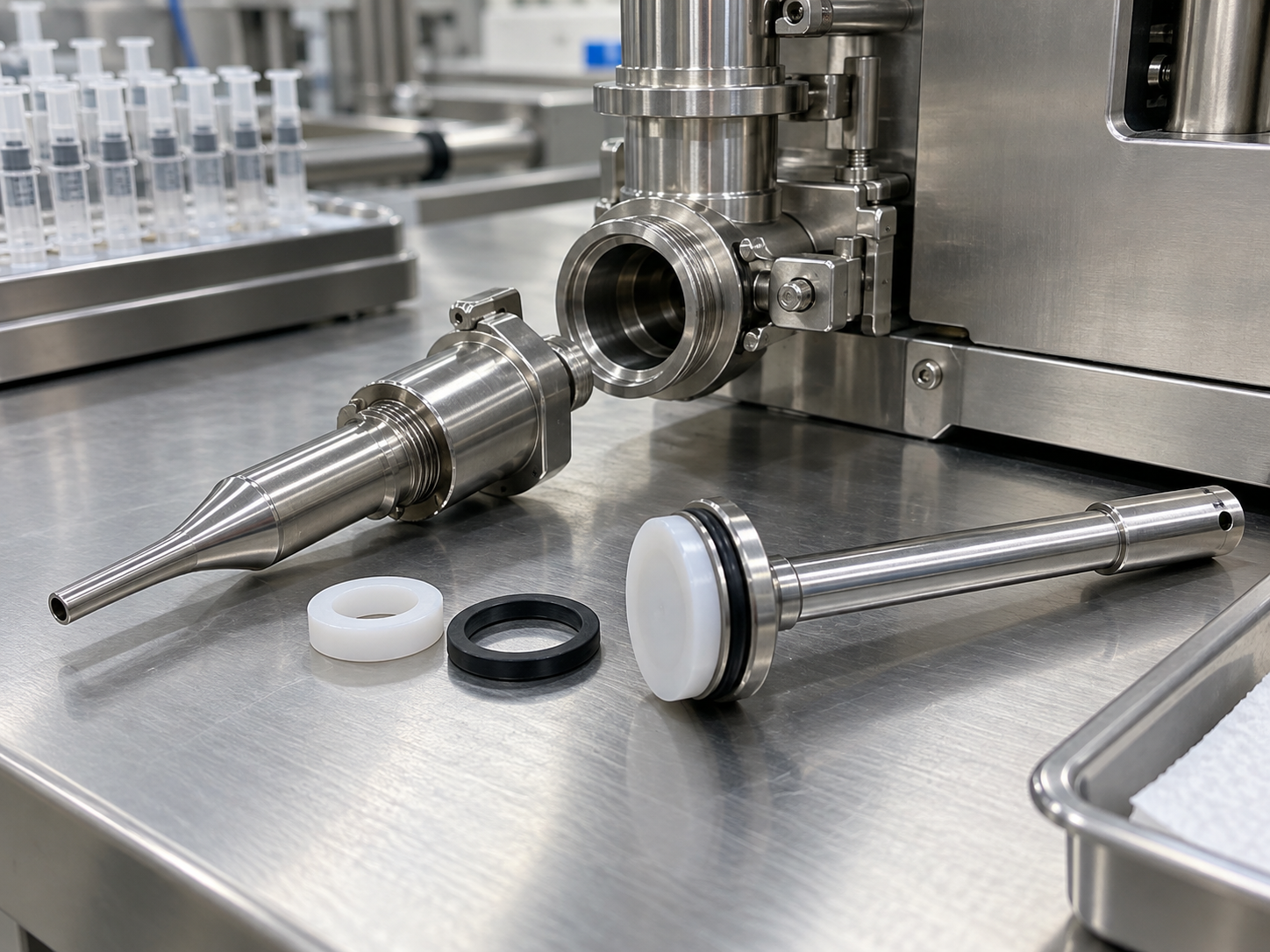
The following visuals are illustrative production and inspection references. They do not represent guaranteed output or measured validation results.


Related equipment and project resources
For equipment selection, compare the relevant filling machine product range with the packaging solution overview. Application context is available in the veterinary medicine solutions and pharmaceutical packaging guide. Where the process includes a closure step, review the filling and capping line and tube sealing equipment.
Before a trial, document product rheology, fill volume, container dimensions, contact materials, cleaning method, closure requirements and inspection points. Related planning resources include tube filling and sealing machine selection, how to choose a tube filling machine, tube sealing quality control, manual to automatic syringe filling and syringe format changeover planning.
For a project-specific review, contact the technical team, send your requirements for a quote or review the syringe filling machine range. Include samples or drawings when available so the machine scope can be assessed against real product and packaging conditions.
Need help with the next step? Request a quote with the product, package, fill volume and target checks.
