 Skip to content

Scaling mayonnaise from a kitchen recipe to industrial production is where most food manufacturers hit a wall. The recipe looks simple — oil, egg yolk, vinegar, and seasoning — but producing a stable, shelf-ready emulsion at 500–2,000 liters per batch is an entirely different engineering challenge.
Common problems surface quickly: the emulsion breaks during scaling, air incorporation causes oxidation and shortened shelf life, viscosity varies between batches, and filling machines struggle with the product’s thickness. These are not recipe problems. They are equipment and process problems.
This guide walks through the industrial mayonnaise production process, the key technical factors that determine emulsion quality, and how to evaluate mayonnaise making machines for your specific production scenario — so you can make an equipment decision that supports your product quality for the next 5–10 years.
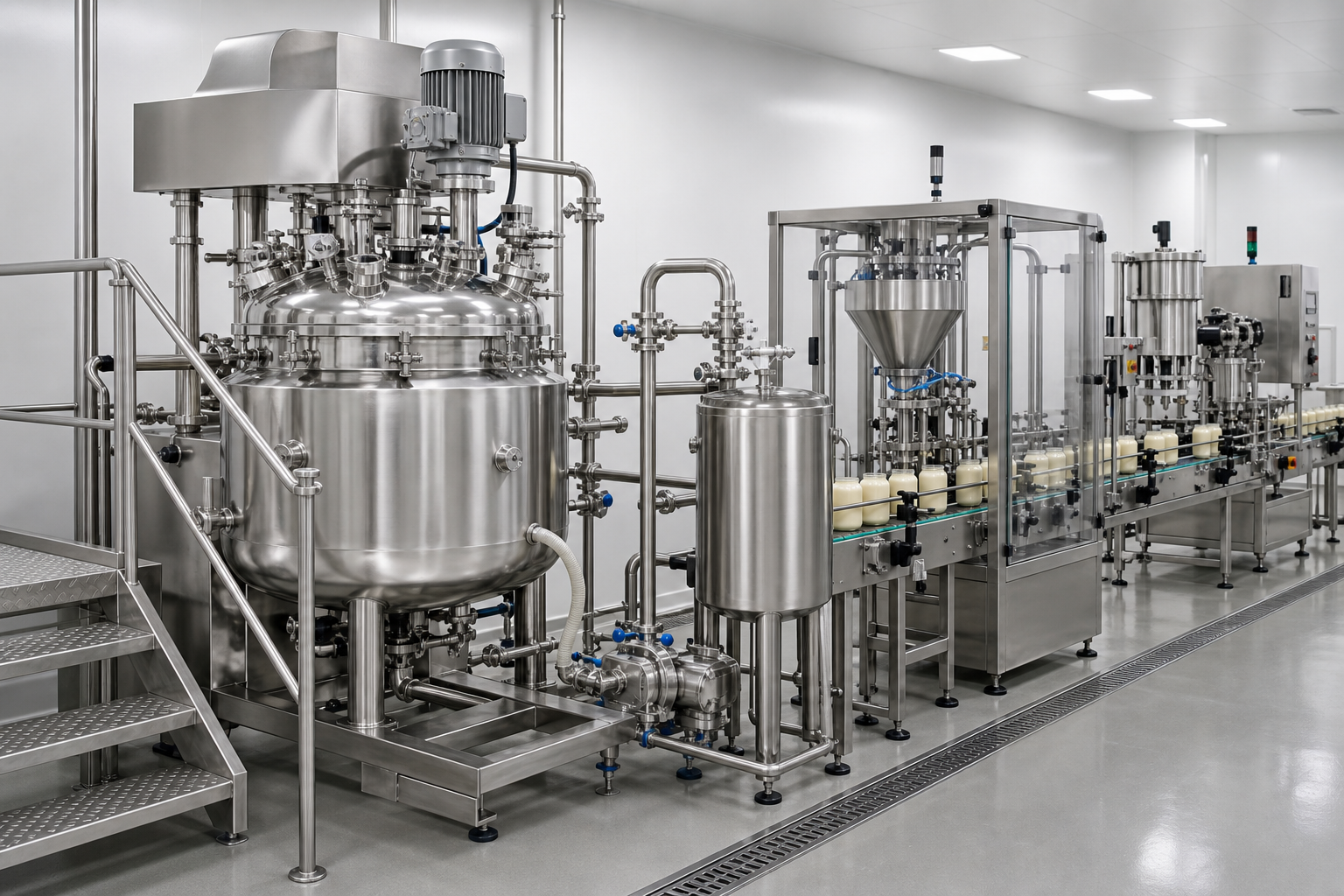
Why Emulsion Stability Matters More Than You Think
Mayonnaise is an oil-in-water (O/W) emulsion. Oil droplets are dispersed throughout a continuous water phase, stabilized by emulsifiers — primarily lecithin from egg yolk. The smaller and more uniform the oil droplets, the more stable and creamier the final product.
At industrial scale, this emulsion must remain stable through production, filling, storage, transport, and a shelf life that often exceeds 6–12 months. When the emulsion fails, the result is immediate and costly: oil separation, texture breakdown, microbial growth, and product recalls.
The equipment decision directly affects:
- Product consistency: Droplet size distribution determines texture and mouthfeel
- Shelf life: Vacuum processing reduces oxidation and microbial risk
- Production efficiency: Cycle time, changeover, and CIP design affect daily output
- Material waste: Poor emulsification leads to rejected batches and product loss
- Regulatory compliance: Hygienic design, traceability, and documentation for food safety audits
Choosing a mayonnaise making machine is not just about volume. It is about whether your equipment can reliably reproduce a complex emulsion, batch after batch, under production pressure.
How the Industrial Mayonnaise Production Process Works
Understanding the production process is essential before evaluating equipment, because each step imposes specific requirements on the machine.
Step 1: Water Phase Preparation
Water, vinegar, salt, sugar, and water-soluble ingredients are mixed in a jacketed vessel. Temperature is typically maintained at 60–70°C to dissolve powders. Starches and hydrocolloids (xanthan gum, guar gum) require sufficient hydration time — under-hydrated gums are a leading cause of batch failure during scale-up.
Step 2: Oil Phase Preparation
Refined vegetable oil (sunflower, rapeseed, or soybean) is filtered and held at 20–25°C. Oil quality is critical: acid value should not exceed 0.5%, and moisture content should be below 0.10%.
Step 3: Emulsifier Addition
Egg yolk (liquid or powder) is added to the water phase. Lecithin in egg yolk reduces interfacial tension, allowing oil to be dispersed into fine droplets. Vegan mayonnaise replaces egg with modified starches, proteins, or plant-based emulsifiers — which requires tighter process control.
Step 4: Controlled Oil Incorporation
This is the most critical stage. Oil is gradually added to the water phase while a high-shear mixing head creates the emulsion. If oil is added too quickly, the emulsion breaks. If shear is insufficient, droplet size remains too large and the texture becomes loose. Industrial systems use mass flow meters to control oil dosing rate precisely.
Step 5: High-Shear Emulsification
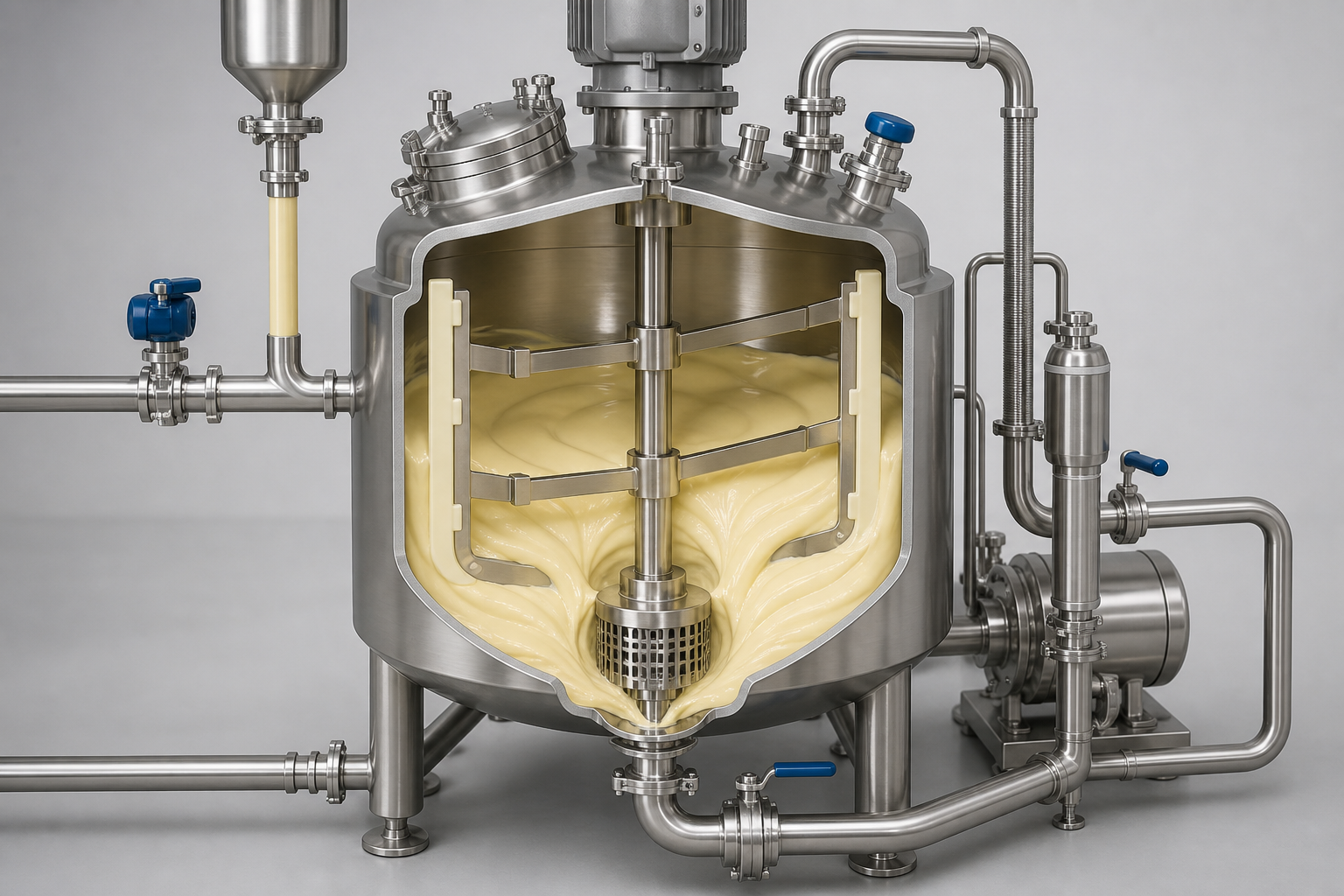
A rotor-stator homogenizer reduces oil droplets to 2–10 microns, creating a smooth, stable emulsion. Tip speeds of 15–24 m/s generate shear rates exceeding 100,000 s⁻¹. Processing time is typically 10–20 minutes.
Step 6: Vacuum Deaeration
Vacuum processing at approximately -0.08 MPa removes trapped air introduced during mixing. This step is essential: air bubbles cause oxidation, off-flavors, color degradation, and inaccurate filling volumes.
Step 7: Cooling and Transfer
Mayonnaise is cooled to 25–28°C and transferred to a storage tank or directly to the filling line via a sanitary lobe pump. The pump must handle viscosities of 10,000–100,000 centipoise without damaging the emulsion structure.
Key Factors That Affect Mayonnaise Machine Performance
1. Emulsification Technology
The core of any mayonnaise making machine is the emulsification system. Two main approaches exist:
- Inline high-shear mixer: Oil and water phases are pre-emulsified in an external circulation loop before entering the main tank. This improves efficiency and allows continuous processing.
- In-tank rotor-stator: The homogenizer is mounted inside the mixing vessel. Simpler design, but mixing uniformity depends heavily on vessel geometry and batch size.
For mayonnaise, the inline approach generally produces more consistent droplet size distribution because all material passes through the same shear zone.
2. Vacuum System
Vacuum processing is not optional for commercial mayonnaise — it is a quality requirement. Without vacuum, air entrained during mixing causes:
- Oxidation of oil, leading to rancidity
- Color and flavor degradation
- Reduced shelf life
- Inaccurate filling volumes (trapped air displaces product)
- Poor visual appearance (visible air pockets)
A vacuum system rated for -0.06 to -0.08 MPa with extended deaeration time (10+ minutes) produces a denser, more stable product.
3. Temperature Control
Mayonnaise processing requires precise temperature management at multiple stages: heating to dissolve powders (60–70°C), maintaining emulsification temperature (20–25°C for cold process), and cooling the finished product (25–28°C). Jacketed vessels with steam, hot water, or chilled water circulation are standard. For low-fat formulations using starches, a pasteurization step at 80–90°C may be required — typically using a scraped surface heat exchanger (SSHE).
4. Oil Dosing Precision
The rate at which oil is introduced determines whether the emulsion forms or breaks. Industrial mayonnaise machines use mass flow meters or positive displacement pumps with variable frequency drives to control oil addition rate. Systems capable of dosing oil at up to 3 kg/s without breaking the emulsion offer significant productivity advantages for high-volume producers.
5. Agitator Design
For high-viscosity mayonnaise, a center anchor agitator with wall-scraping Teflon blades ensures uniform heat transfer and prevents material from sticking to vessel walls. Variable-frequency drive allows independent control of the anchor agitator and the high-shear head, which is essential for products with different viscosity profiles.
6. Material Construction
All product-contact parts must be food-grade stainless steel. SUS304 is acceptable for standard food applications; SUS316L is preferred for products with higher acidity (mayonnaise pH is typically 3.5–4.2) or when CIP/SIP is required. Sanitary fittings, polished internal surfaces (Ra ≤ 0.4 μm), and hygienic design principles are non-negotiable for food safety compliance.
7. CIP (Clean-in-Place) System
Integrated CIP spray balls, sanitary valves, and cleanable piping are essential for production efficiency. Without CIP, cleaning between batches can take 2–4 hours, dramatically reducing daily output. A well-designed CIP system reduces changeover time to under 30 minutes and ensures consistent hygiene standards.
Comparison: Batch vs Continuous Mayonnaise Processing
| Factor | Batch Processing | Continuous Processing |
|---|---|---|
| Production method | One batch at a time, 100–2,000 L | Continuous material flow, 1,000–5,000 L/h |
| Flexibility | High — easy recipe changeover | Best for standardized, single-SKU products |
| Formula changeover | CIP between batches | Requires pigging and flush systems |
| Suitable scale | Small to medium (startups to mid-size brands) | Medium to large (high-volume producers) |
| Initial investment | Generally lower | Generally higher |
| Process control | Batch-based recipe management | Inline sensors, continuous monitoring |
| Emulsion consistency | Depends on operator and batch cycle | More consistent with proper calibration |
| Typical application | Multiple products, contract manufacturing | High-volume single product, export |
Most mayonnaise manufacturers start with batch processing. Continuous systems become justified when production exceeds 3,000–5,000 L/h and product variety is limited.
Different Production Scenarios
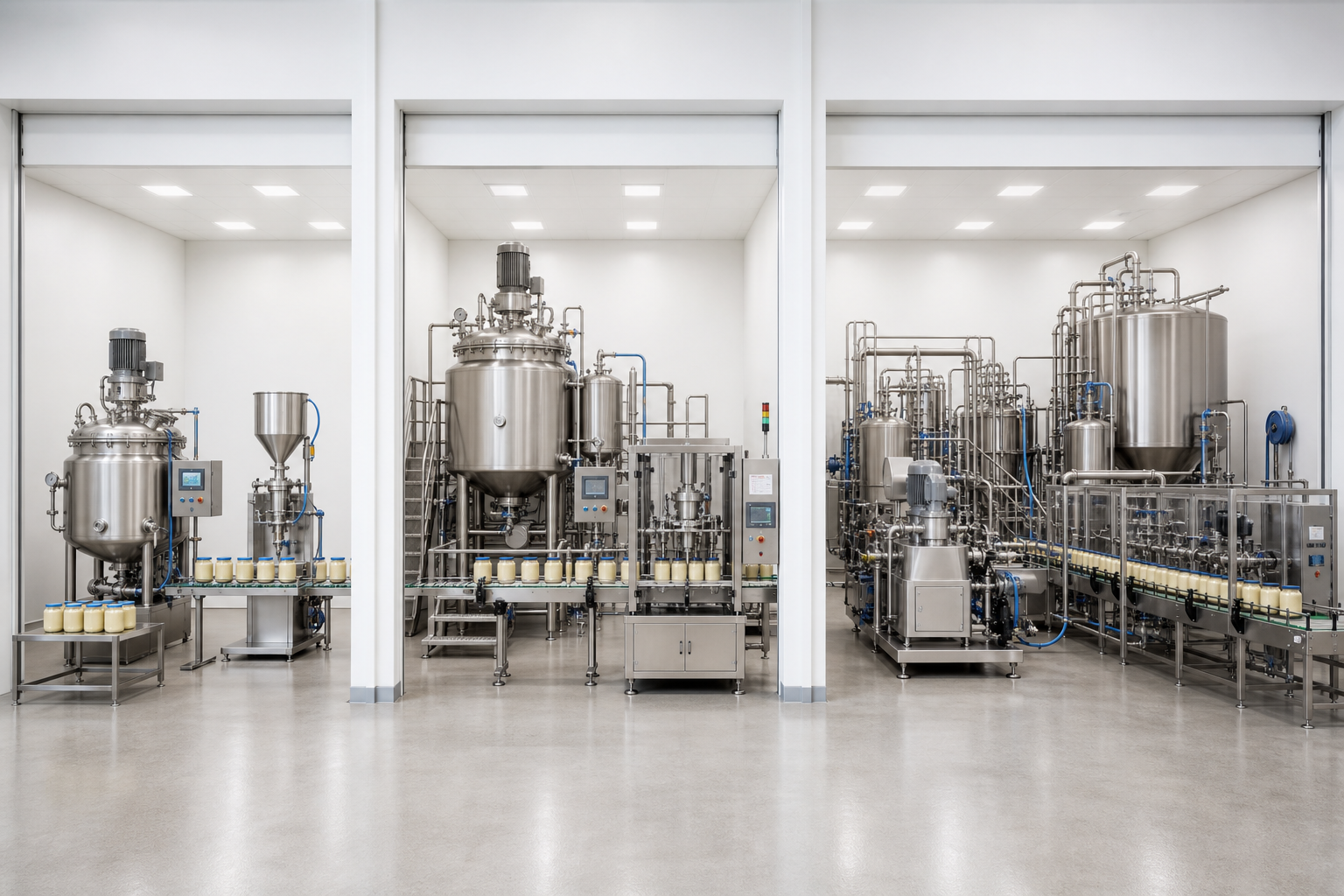
Scenario 1: Small Condiment Startup
Profile: New food brand, producing mayonnaise and sauces for local distribution.
- Output: 150–500 L per batch, 1–2 batches per day
- Product range: 3–5 recipes, frequent changeover
- Budget: Limited, ROI-focused
- Staffing: 2–3 operators
Recommendation: A 150–500L vacuum emulsifying mixer with manual feeding, PLC control, and integrated CIP. Batch processing is ideal — flexibility matters more than throughput. Budget for a piston filling machine rated at 20–40 containers per minute.
Key risk: Underestimating the importance of vacuum. Some entry-level machines lack proper vacuum capability, which will limit shelf life and product quality from day one.
Scenario 2: Mid-Size Food Brand
Profile: Established regional brand scaling mayonnaise production for retail and foodservice.
- Output: 500–1,000 L per batch, 3–5 batches per day
- Product range: 5–10 recipes, including low-fat and vegan options
- Compliance: HACCP, ISO 22000, or equivalent
- Staffing: Dedicated production team
Recommendation: A 500–1,000L vacuum emulsifying system with automated oil dosing (mass flow meter), dual agitator (anchor + high-shear), full CIP, and PLC with recipe management. Integrate with a servo piston filling line (40–60 containers/min) and automatic capping/labeling.
Key risk: Choosing a machine without proper documentation. Food safety audits require equipment validation, material certificates, and traceability records.
Scenario 3: Large Contract Manufacturer
Profile: Contract manufacturer producing mayonnaise for multiple brands, with frequent changeovers.
- Output: 1,000–2,000 L per batch, 6+ batches per day
- Product range: 10+ recipes, custom formulations, private label
- Compliance: Full GMP, audit-ready documentation
- Staffing: Multiple shifts, engineering team
Recommendation: A 1,000L+ vacuum emulsifying system with inline homogenization, automated weighing, fully integrated CIP/SIP, and SCADA-level process control. Recipe management with audit trail is essential for multi-brand production. Consider a continuous processing line if product variety is limited.
Key risk: CIP time between brands. Without proper system design, cleaning between different brands’ products can consume 3+ hours of production time per changeover.
Common Mistakes When Choosing Mayonnaise Equipment
1. Selecting equipment only by maximum capacity
A machine rated at 1,000 L does not mean it produces 1,000 L of stable mayonnaise in every cycle. Actual output depends on product viscosity, oil dosing rate, emulsification time, and CIP duration. Always ask for the stable production cycle — total time from loading to discharge — not just the vessel volume.
2. Ignoring vacuum capability
Some mayonnaise machines are marketed as “emulsifying mixers” but lack a proper vacuum system. Without vacuum, your product will have trapped air, shorter shelf life, and inferior appearance. Always verify the vacuum pump specification — target -0.06 MPa or better, with deaeration time of at least 10 minutes.
3. Underestimating viscosity at the filling stage
Mayonnaise at 10,000–100,000 cP does not behave like water. Gravity fillers will not work. If your filling machine is not designed for high-viscosity, thixotropic products, you will face inaccurate fills, product waste, and sealing failures. Piston or servo-driven fillers with dive-in nozzles are the standard.
4. Skipping the Factory Acceptance Test (FAT)
An FAT with your actual product formula is the single most important quality assurance step. Running a test batch with real ingredients reveals whether the machine can achieve the required droplet size, viscosity, and stability. Never accept a machine based on water testing alone.
5. Ignoring CIP design
Cleaning between batches is not a minor detail — it is a production bottleneck. A machine without integrated CIP spray balls, sanitary valves, and properly designed piping will require manual cleaning that can take hours. For any production above one batch per day, CIP is essential.
6. Choosing the cheapest option without calculating TCO
A machine that costs 30% less upfront may have higher maintenance costs, lower production efficiency, more product waste, and shorter service life. Over 5 years, the cheaper machine can cost significantly more. (See the TCO section below.)
Buyer Checklist: What to Confirm Before Purchasing
Before requesting a quotation or committing to a mayonnaise making machine, confirm the following:
- Product details: Mayonnaise type (full-fat, low-fat, vegan), viscosity range, pH range, oil content
- Production volume: Batch size needed, batches per day, target daily/weekly output
- Recipe variety: Number of different formulations, frequency of changeover
- Container details: Jar/bottle/sachet sizes, filling volumes, material (glass, PET, PP)
- Required filling speed: Containers per minute for each format
- Filling accuracy: Acceptable tolerance (typically ±1% for piston fillers)
- Emulsion specification: Target droplet size, viscosity range, shelf life requirement
- Vacuum requirement: Target vacuum level and deaeration time
- Temperature requirements: Cold process or pasteurization needed?
- CIP/SIP requirement: Cleaning between batches, sterilization for low-acid products
- Compliance standards: HACCP, ISO 22000, FDA, CE, or local food safety regulations
- Material certificates: 3.1 material certificates for product-contact parts
- Factory utilities: Available voltage, compressed air, steam, chilled water, floor load capacity
- Factory layout: Available floor space, ceiling height, material flow
- Validation documents: FAT, SAT, IQ/OQ/PQ requirements
- Spare parts and service: Local stock, remote support, response time guarantees
How to Evaluate a Mayonnaise Equipment Supplier
Before committing to any supplier — regardless of brand or origin — evaluate them against these criteria:
Manufacturing Capability
Does the supplier manufacture the core equipment (emulsifying vessel, homogenizer, control system) in-house, or do they assemble components from third parties? In-house manufacturing generally means better quality control, faster technical support, and more customization flexibility.
Engineering Capability
Can the supplier design a complete production line — from emulsification through filling, capping, labeling, and packaging — or only individual machines? A supplier who understands the full line can optimize material flow, reduce transfer distances, and prevent integration problems.
Component Quality
What brands are used for critical components? Reputable suppliers use internationally recognized brands:
- PLC and HMI: Siemens, Schneider
- Servo drives: Yaskawa, Siemens
- Pneumatics: Festo, SMC
- Vacuum pumps: Busch, Leybold, or equivalent
- Material-contact parts: SUS304 or SUS316L with surface finish Ra ≤ 0.4 μm
Factory Acceptance Testing (FAT)
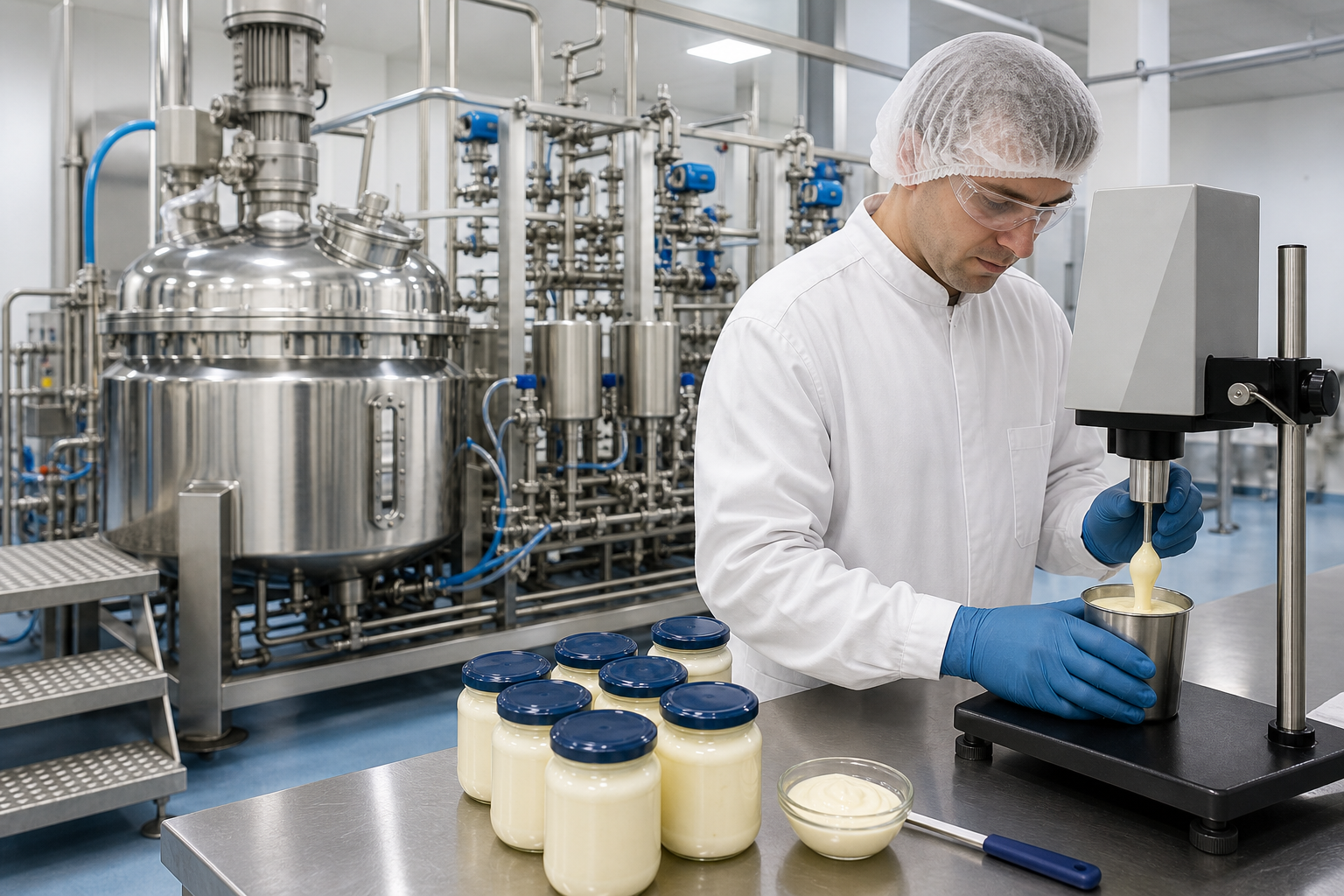
Does the supplier allow FAT with your actual product formula? This is non-negotiable for mayonnaise equipment. Water testing does not validate emulsion performance. A proper FAT should produce a full batch with your recipe and test viscosity, droplet size, and stability.
After-Sales Support
What support is available after delivery?
- Remote diagnostic capability (PLC remote access)
- On-site installation and commissioning
- Operator training programs
- Spare parts inventory (locally stocked or shipped within 48 hours)
- Response time guarantee for technical issues
Customization and Line Integration
Can the supplier customize the machine for your specific product, container, and factory layout? Mayonnaise production lines require integration between the emulsifying system, transfer pumps, storage tanks, and filling machines. A supplier who only sells standalone machines may leave you to handle integration challenges yourself.
Total Cost of Ownership
The purchase price of a mayonnaise making machine is only 30–40% of its total cost over a 5-year period. The remaining 60–70% comes from operational factors that are easy to overlook during procurement.
| Cost Category | Low-Cost Machine | Professional Machine |
|---|---|---|
| Initial purchase | Lower (baseline) | +30–50% premium |
| Production efficiency | Lower cycle efficiency, more rejected batches | Higher throughput, consistent quality |
| Product waste | 3–5% batch rejection rate | <1% rejection rate |
| CIP time per changeover | 2–4 hours (manual cleaning) | 20–30 minutes (automated CIP) |
| Maintenance frequency | Quarterly or more | Semi-annual or annual |
| Spare parts availability | Long lead times, limited stock | Local stock, 48-hour delivery |
| Operator dependency | High — quality varies by operator | Low — recipe-driven, consistent |
| 5-year estimated TCO | Baseline + 25–40% hidden costs | Baseline + 10–15% maintenance |
The math is straightforward: a machine that costs 30% less but rejects 5% of batches, requires 3 hours of cleaning per changeover, and needs quarterly maintenance will cost more over 5 years than a professional system purchased at full price.
When Does Automation Make Sense?
If your mayonnaise production is experiencing any of the following, automation investment is likely justified:
- Production volume is increasing and manual processes cannot keep up
- Batch-to-batch inconsistency is affecting product quality or customer complaints
- Labor costs are rising and operators are difficult to recruit or retain
- Food safety requirements demand documented, repeatable processes
- Product waste from manual handling is exceeding 2–3% of production
- Cleaning time between batches is consuming more than 15% of production hours
- Multiple recipes require quick, error-free changeover
Automation does not mean replacing every manual step at once. A phased approach — starting with the emulsification system (the most quality-critical stage), then adding automated filling, then CIP — allows you to validate ROI at each step.
Where King Pack Fits
For food manufacturers evaluating mayonnaise production equipment, King Pack Machinery provides vacuum emulsifying systems and complete mayonnaise production lines designed for industrial-scale emulsion processing.
Key capabilities relevant to mayonnaise production:
- Vacuum emulsifying mixer with inline high-shear homogenization, capable of producing oil droplet sizes in the 2–10 micron range
- Dual agitator design — center anchor with wall-scraping Teflon blades + high-shear rotor-stator head, with independent variable-frequency drive control
- Automated oil dosing with mass flow meter integration for controlled emulsion building
- Vacuum system rated for -0.06 to -0.08 MPa with extended deaeration cycle
- Full CIP integration with sanitary spray balls, hygienic valves, and cleanable piping design
- SUS316L product-contact parts with surface finish Ra ≤ 0.4 μm
- PLC control system (Siemens) with recipe management, audit trail, and data recording
- Complete line integration — emulsifying system, transfer pumps, storage tanks, piston filling machines, capping, and labeling
- FAT with real product — King Pack conducts factory acceptance testing with the customer’s actual formula before shipment
- Customized configurations for full-fat, low-fat, and vegan mayonnaise formulations
Founded in 2009, King Pack operates a 5,000 m² manufacturing facility with 40+ utility patents, ISO9001 certification, and equipment supplied to 40+ countries. The company’s engineering team can review your product formula, container specifications, required capacity, and factory layout before recommending a machine configuration — ensuring the equipment matches your production reality rather than a generic catalog spec.
If you are evaluating a new mayonnaise production line or upgrading existing equipment, King Pack can help review your product, container, required capacity, and production process before recommending an equipment configuration.
Vacuum Emulsifying Mixer — King Pack’s vacuum emulsifying mixer is the core equipment for mayonnaise production, also applicable to creams, lotions, and sauces.
Filling & Capping Machine — Mayonnaise requires high-viscosity filling solutions. King Pack’s piston filling machines handle viscosities up to 100,000 cP with ±1% accuracy.
Frequently Asked Questions
What size mayonnaise making machine do I need?
Machine size depends on your target daily output and batch cycle time. As a reference: a 150L machine produces approximately 600–900 L per day (4–6 batches); a 500L machine produces 2,000–3,000 L per day; a 1,000L machine produces 4,000–6,000 L per day. Factor in CIP time between batches (20–30 minutes with automated CIP, 2–4 hours without).
Can one mayonnaise machine produce different recipes?
Yes, if the machine has recipe management and automated CIP. PLC-controlled systems store multiple recipes with different ingredient ratios, mixing speeds, temperatures, and cycle times. Changeover between recipes requires a CIP cycle between batches. For frequent changeovers (more than 2 per day), invest in a well-designed CIP system — it is the bottleneck, not the mixing capacity.
How much does a mayonnaise making machine cost?
Cost varies significantly based on capacity, automation level, and configuration. Entry-level batch systems (150L, manual operation) are at the lower end; fully automated 1,000L+ systems with mass flow metering, full CIP, and integrated filling lines represent a substantially higher investment. Rather than focusing on purchase price alone, calculate the 5-year total cost of ownership, including production efficiency, waste, maintenance, and spare parts.
Do I need pasteurization for mayonnaise production?
Traditional full-fat mayonnaise (pH 3.5–4.2, 79–80% oil) is naturally hostile to pathogens and does not typically require product pasteurization — provided you use pre-pasteurized liquid egg or egg powder. Low-fat and starch-based formulations, however, require a pasteurization step (80–90°C for 3–5 minutes) to activate starches and ensure food safety. Consult your food safety consultant and local regulations.
What information should I provide before requesting a quotation?
Provide: mayonnaise type and formulation (full-fat/low-fat/vegan), target batch size, daily production volume, number of recipes, container types and sizes, required filling speed, compliance standards (HACCP, ISO, FDA), available factory utilities (voltage, steam, chilled water), and available floor space. The more specific the information, the more accurate the equipment recommendation.
How do I test a mayonnaise machine before shipment?
Request a Factory Acceptance Test (FAT) with your actual product formula. The FAT should produce a full batch, then test: emulsion stability (visual inspection, viscosity measurement), droplet size (if equipment is available), vacuum performance (air removal), and CIP cycle time. If the supplier cannot accommodate a real-product FAT, that is a significant red flag.
Can a mayonnaise making machine also produce sauces and dressings?
Yes. A vacuum emulsifying mixer designed for mayonnaise can also produce salad dressings, ketchup, mustard, cream sauces, and similar oil-in-water or water-in-oil emulsions. The key is whether the machine’s shear range, temperature control, and recipe management can accommodate different viscosity profiles and ingredient systems.
What is the difference between a vacuum emulsifying mixer and a regular mixer?
A regular mixer blends ingredients but does not control air incorporation or achieve fine droplet size distribution. A vacuum emulsifying mixer combines high-shear homogenization (rotor-stator), vacuum processing (air removal), and temperature control in a single system. For commercial mayonnaise, this combination is essential — a regular mixer cannot produce a stable, shelf-ready emulsion at industrial scale.
Conclusion
Choosing a mayonnaise making machine comes down to understanding your product, your production volume, and the technical factors that determine emulsion quality. The most important considerations are not capacity numbers on a spec sheet — they are the emulsification technology, vacuum capability, temperature control, CIP design, and the supplier’s ability to support you over the equipment’s lifetime.
Before making a decision, confirm your product specifications, calculate the total cost of ownership over 5 years, and insist on a factory acceptance test with your actual formula. These steps will prevent the most common — and most expensive — procurement mistakes in mayonnaise equipment selection.
If you are evaluating a new mayonnaise production line or upgrading existing equipment, King Pack can help review your product, container, required capacity, and production process before recommending an equipment configuration tailored to your manufacturing needs.
