 Skip to content

Quick answer: A volumetric filling machine dispenses a defined volume of product into each container. It can measure that volume with a piston chamber, a positive-displacement pump, a flowmeter or a controlled flow time. It works best when the product can be supplied consistently and the metering technology matches its viscosity, particles, foaming behavior and required dose.
The practical selection rule is simple: use a piston or positive-displacement system for viscous products and larger doses, a compatible pump for repeatable liquid dosing, and timed flow only when product conditions are stable and the required tolerance is not unusually tight. Then confirm the choice with a product trial instead of selecting by viscosity alone.
For a production manager, “volumetric” describes the measuring principle—not one universal machine. The filler still has to be engineered around the product, container, output, cleaning method and downstream closing process. This guide explains the main types, the variables that influence filling accuracy and the checks that should appear in a serious request for quotation and factory acceptance test.
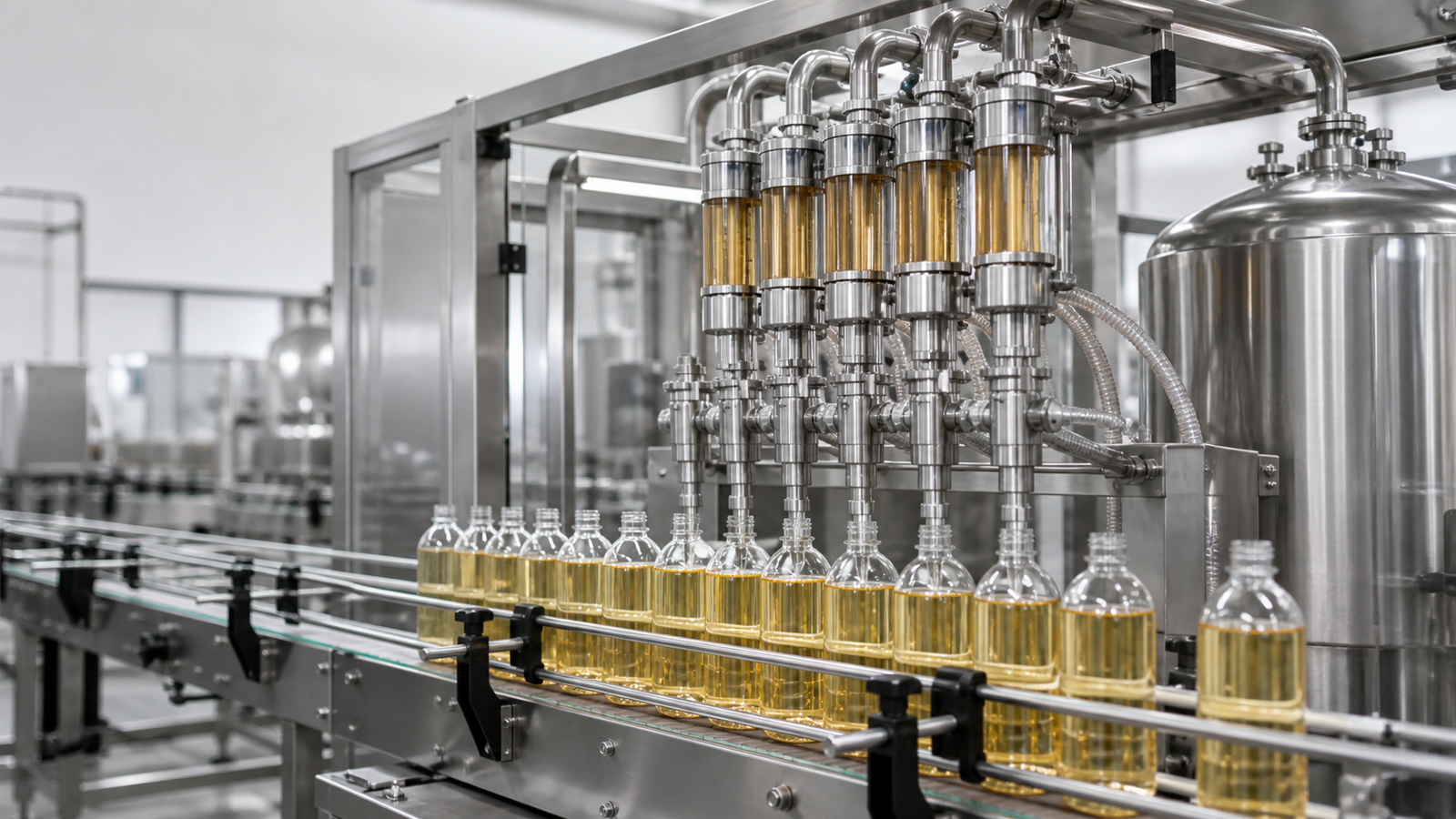
How a Volumetric Filling Machine Works
Most volumetric liquid filling systems repeat five operations:
- Product is supplied from a hopper, balance tank, pipeline or pressure vessel.
- A container is detected and positioned under the nozzle.
- The metering device measures a preset volume by displacement, pump revolutions, flowmeter signal or valve-open time.
- The nozzle delivers the dose, often using slow–fast–slow speed control, a diving motion or a shut-off feature to manage foam, splashing and stringing.
- The valve closes, the filled container exits and the next cycle begins.
The controller stores recipes for fill volume, speed, acceleration, nozzle height and suck-back. Servo-driven systems can change the piston stroke or pump revolutions from the touchscreen, while mechanical systems may require handwheel or component adjustments. A multi-head machine repeats the same metering cycle at several nozzles to increase output.
In a flowmeter-based system, the meter continuously measures the quantity passing to the bottle. Krones describes a volumetric water filler in which a flowmeter monitors the fed liquid and signals the valve to close when the set volume is reached. That is one industrial example of closed-loop volumetric control; its published application limits should not be copied to a different product without testing.
Four Main Types of Volumetric Fillers
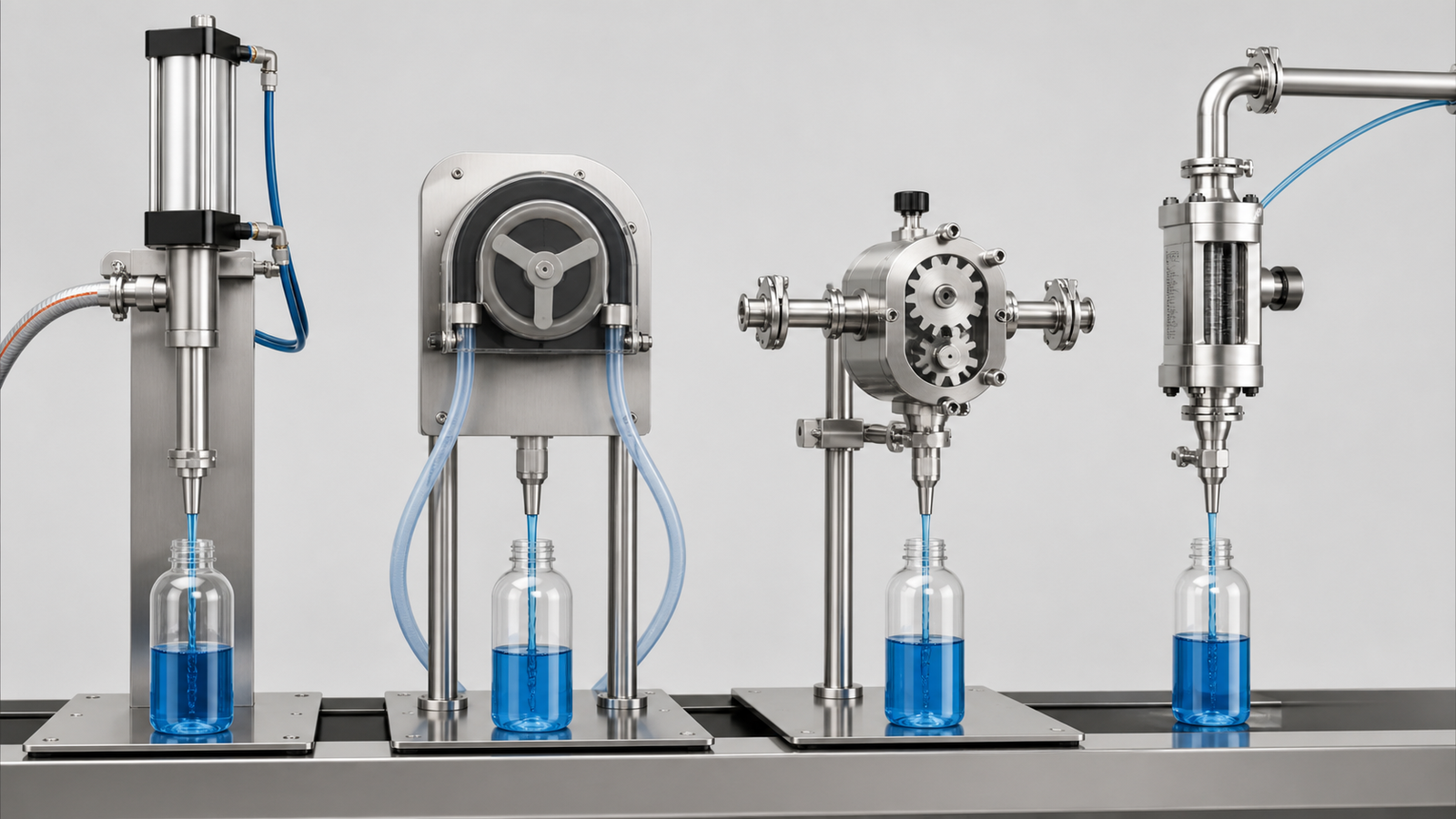
| Filler type | How volume is created | Best starting point | Main watch-outs |
|---|---|---|---|
| Piston filler | A cylinder and piston displace a set chamber volume | Creams, sauces, gels, lotions and other viscous products; products with manageable soft particles | Cylinder size, valve passage, seals, air pockets, cleaning access and product shear |
| Positive-displacement pump filler | A defined pump displacement is multiplied by controlled revolutions | Oils, detergents, chemicals, cosmetics and products requiring recipe-driven changeover | Pump material, slip, back pressure, seal compatibility, solids and wear |
| Flowmeter filler | A meter measures product passing through the line and closes the valve at the target | Free-flowing and moderately viscous liquids compatible with the selected meter | Conductivity or mass-flow requirements, entrained air, bubbles, temperature and flow profile |
| Timed-flow or gravity filler | A valve stays open for a controlled time under stable head pressure | Water-like liquids, economical projects and applications with a wider acceptable tolerance | Tank level, pressure, viscosity and temperature changes directly affect delivered volume |
Piston fillers
A piston filler draws product into a cylinder and then pushes it through the nozzle. Because the chamber displacement is mechanically defined, this design is a strong candidate for products that do not flow reliably by gravity. The valve and nozzle can be sized for ketchup, shampoo, cream, gel or paste, and a larger flow path may accommodate soft inclusions.
The real engineering work is in the details: the piston diameter and stroke must cover the fill range without operating at an impractical extreme; the valve must switch cleanly; the hopper must keep the inlet flooded; and the seals must tolerate both the product and the cleaning chemistry. A piston filler can be accurate, but trapped air, worn seals or an inconsistent product feed will still create variation.
Positive-displacement pump fillers
Gear, lobe, progressive-cavity and other positive-displacement pumps move a known amount per revolution or cycle. A servo motor can therefore turn a target number of revolutions for each fill. This makes recipe changes convenient and supports electronic adjustment across a useful fill range.
Pump choice matters more than the label “pump filler.” A gear pump may suit a clean, lubricating, low-to-medium viscosity liquid but can be a poor fit for large particles or products damaged by shear. A progressive-cavity pump can handle higher viscosity and some solids more gently. ViscoTec, for example, describes hygienic filling pumps that can be cleaned and sterilized in place and highlights an endless-piston principle for viscous, abrasive, solid-containing or shear-sensitive products. These are useful design signals, not universal guarantees.
Flowmeter fillers
Electromagnetic flowmeters are typically considered for conductive liquids, while Coriolis mass flowmeters can measure mass flow and density without relying on conductivity. The controller integrates the meter signal and closes the product valve at the target. Flowmeter systems remove the need for a physical measuring cylinder and can support clean product paths and fast recipe changes.
However, meter selection, straight-run conditions, bubbles, pulsation and valve response all affect results. A liquid containing air can make the measured flow differ from the actual liquid delivered. Fast valve closure may also create pressure transients or dripping. The complete valve–meter–nozzle system must therefore be tuned as one process.
Timed-flow and gravity fillers
Timed systems estimate volume from flow rate multiplied by valve-open time. They can be simple and cost-effective for stable, water-like products. They become less repeatable when the hopper level falls, supply pressure changes, temperature shifts or viscosity varies between batches. A constant-level tank, regulated pressure and regular checkweighing can improve control, but timed flow remains dependent on stable conditions.
What Determines Filling Accuracy?
“Accuracy” should never appear in a quotation without a test method. Ask whether the number refers to repeatability, deviation from target, a percentage of set volume or a percentage of full scale. Also ask for the dose, product, container, speed and sample size used to calculate it.
The following variables usually have the greatest influence:
- Product temperature and viscosity. Many liquids thin as temperature rises. Flow, valve cut-off and pump slip can change even when the recipe is unchanged.
- Entrained air. Bubbles occupy volume, compress under pressure and can produce low net product after settling.
- Supply conditions. Hopper level, inlet pressure, suction restriction and product starvation affect chamber filling and pump performance.
- Metering range. A very small dose on an oversized piston, pump or meter may reduce controllability. Select the measuring element around the real production range, not only the maximum bottle.
- Valve and nozzle response. Closing delay, dripping, suck-back and product stringing change the amount that reaches the container.
- Machine speed. Shorter fill time increases acceleration, pressure and cut-off demands. A filler that performs well at laboratory speed must also be tested at the contracted production rate.
- Wear and maintenance. Seals, check valves, tubing and pump clearances change over time. Preventive replacement and calibration protect repeatability.
- Container handling. A tilted, unstable or poorly centered bottle can splash product or interrupt a bottom-up filling profile.
The most useful verification method is gravimetric: tare each container, record the filled weight and convert weight to volume using a documented product density at the test temperature. For density-variable products, weight may be the better production control variable even when the filler itself meters volume.
Application Matrix: Match Product Behavior to the Metering Method
| Product example | Key behavior | Recommended starting technology | Test focus |
|---|---|---|---|
| Water, toner, thin solvent | Low viscosity; may splash or foam | Flowmeter, magnetic/gear pump or timed flow | Conductivity, chemical compatibility, nozzle control and vapor safety |
| Edible oil, fragrance, light detergent | Free-flowing but product value may make giveaway important | Flowmeter or positive-displacement pump | Drip-free cut-off, density/temperature and seal compatibility |
| Shampoo, lotion, hand cream | Medium to high viscosity; may trap air or string | Servo piston or progressive-cavity pump | Air removal, diving nozzle, suck-back and cleaning |
| Sauce with soft particles | Viscous with inclusions | Large-port piston or suitable low-shear pump | Particle size, valve passage, product damage and weight variation |
| Pharmaceutical solution | Low viscosity with hygiene and validation requirements | Peristaltic or sanitary pump/flowmeter system, depending on process | Product-contact path, sterilization strategy, batch records and in-process checks |
| Corrosive chemical | Compatibility and operator protection dominate | Chemically compatible pump or meter path | Wetted materials, seals, ventilation, guarding and containment |
This matrix is a starting point. A product described as “shampoo” can range from nearly water-like to a thick, aerated gel. Provide a technical data sheet and a representative production sample before finalizing the design.
Volumetric vs Gravimetric vs Level Filling
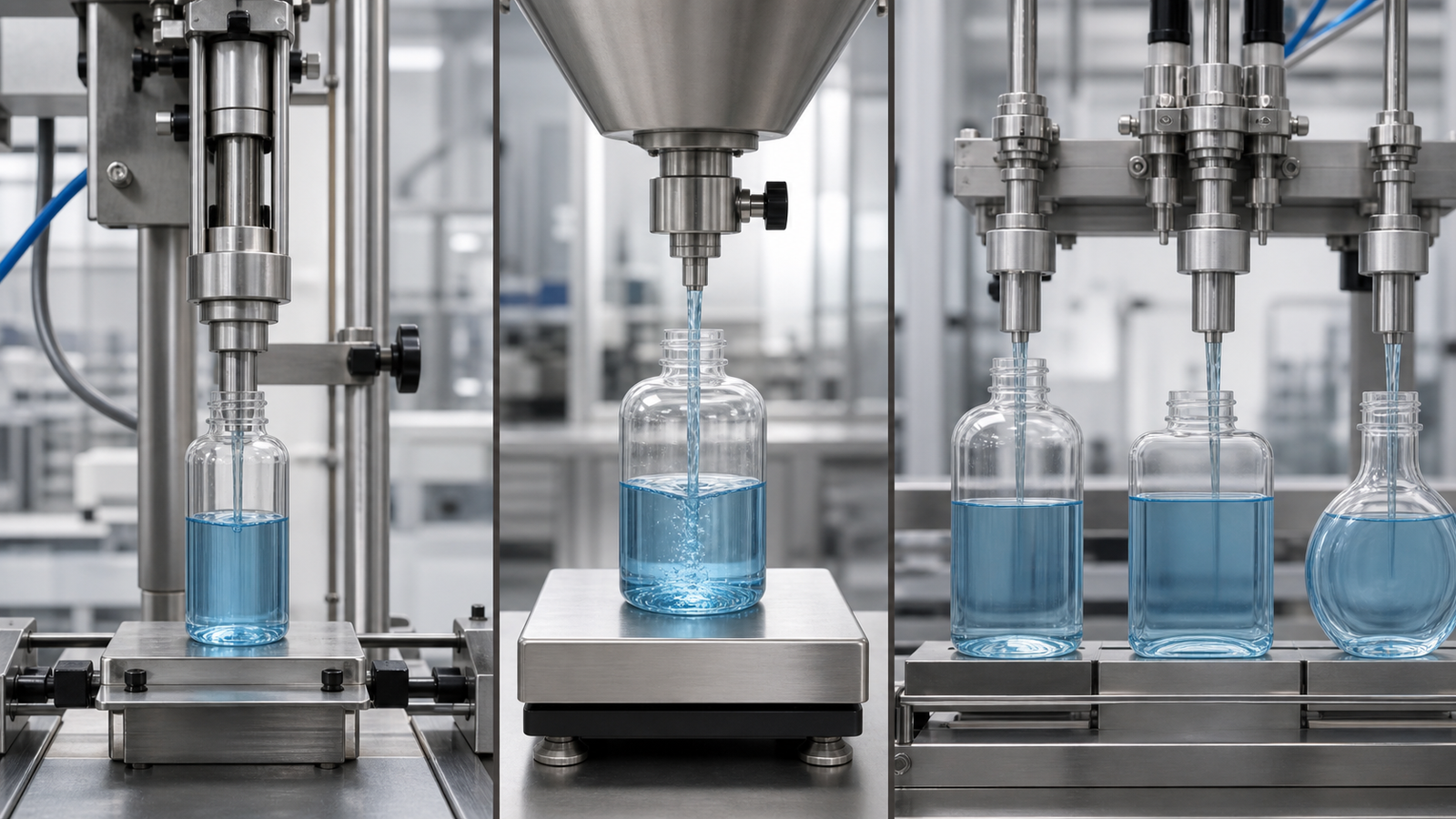
Volumetric filling targets a quantity of product. Gravimetric filling targets mass using a load cell. Level filling stops when product reaches a defined height in the container.
Choose volumetric filling when the selling quantity is expressed as volume, product density is stable and high throughput or compact multi-head dosing is important. Choose gravimetric filling when density varies, product value makes overfill expensive, or the package is large enough that load-cell control is practical. Choose level filling when identical visual fill height is the priority, especially with transparent containers whose internal volume varies.
None of the three is automatically “most accurate.” The best method is the one that controls the quantity customers buy under actual product and production conditions.
How to Size a Volumetric Filling Machine
Prepare these eight inputs before requesting a proposal:
- Product data: name, viscosity range and test temperature, density, foaming, stringing, particles, abrasiveness, flammability and chemical compatibility.
- Fill range: minimum, normal and maximum dose—not a single nominal value.
- Containers: drawings and samples covering every bottle or jar, including neck finish, stability and dimensional tolerance.
- Closures: cap, plug, dropper, pump or seal details if the filler will be integrated into a capping line.
- Required output: good containers per minute at each fill size, plus expected line efficiency.
- Acceptance tolerance: target, upper/lower limits, statistical method, sample size and test duration.
- Cleaning strategy: manual strip-down, clean-in-place (CIP), sterilize-in-place (SIP), product recovery and changeover time.
- Utilities and layout: power, compressed air, ventilation, floor space, line direction and upstream/downstream interfaces.
King Pack’s automatic filling and capping line can integrate bottle feeding, filling, plug insertion, capping, labeling and inspection. The metering technology should be selected before the number of heads is fixed, because fill time and product behavior determine how many nozzles are required to reach the target output.
For regulated or hygiene-sensitive projects, review the pharmaceutical filling solution early in the specification. For lotions, creams and appearance-critical packs, use the cosmetic filling solution to frame product handling and format-change requirements.
Common Selection Mistakes
- Selecting from a brochure using viscosity alone and ignoring particles, air, shear and temperature.
- Quoting one broad fill range with one measuring element when the smallest and largest doses need different cylinders, pumps or nozzles.
- Calculating speed from filling time only and omitting container indexing, nozzle movement, settling and capping constraints.
- Accepting an accuracy statement that does not define product, dose, speed, sample size or calculation method.
- Treating 316L stainless steel as proof of complete chemical compatibility while ignoring elastomers, tubing, gear materials and cleaning agents.
- Assuming CIP is effective because liquid can circulate. Cleaning validation also depends on flow, temperature, chemistry, time, drainability and coverage.
- Testing with water when the production product is viscous, foaming, aerated or particulate.
FAT Acceptance Checks for a Volumetric Filler
Your factory acceptance test should use agreed samples and settings. Run the minimum, normal and maximum fill sizes; test the contracted speed; and include start-up, normal running, stop/restart and low-product-level conditions. Weigh individual containers rather than reporting only an average. Record standard deviation, minimum, maximum and any rejected fills.
Also challenge operational risks: remove a bottle to confirm “no bottle, no fill,” create a product-low alarm, change recipes, perform a format change, inspect the drip tray and nozzle cut-off, and demonstrate cleaning or contact-part removal. Verify material certificates, electrical drawings, spare-parts list, manuals and calibration records before shipment.
FDA’s aseptic processing guidance emphasizes qualification, written procedures and process simulation for sterile drug production. A volumetric filler does not become suitable for aseptic service simply because it uses a sanitary pump; the facility, sterile boundary, interventions, cleaning/sterilization and validation strategy must work together.
Frequently Asked Questions
Is a volumetric filling machine accurate?
It can be highly repeatable when properly sized and calibrated, but accuracy depends on product, dose, temperature, supply, speed, valves and maintenance. Request a defined test using your product and production conditions.
Can one volumetric filler handle both water and thick cream?
Sometimes, but a single metering device rarely performs optimally across extreme viscosity ranges. A modular machine with changeable pumps or cylinders may be more practical. Confirm cleaning, nozzle and speed implications for each product.
What is the difference between a piston filler and a volumetric filler?
A piston filler is one type of volumetric filler. “Volumetric” is the measuring principle; “piston” identifies the mechanism that creates the measured volume.
How many filling heads are required?
Divide the required containers per minute by the proven cycles per minute per head, then include indexing time, fill time, nozzle motion and realistic efficiency. Product testing is needed because a foaming or viscous liquid may require a slower fill profile.
Should filling accuracy be checked by volume or weight?
Weight is usually easier to measure consistently during a trial. Convert it to volume using density at the documented temperature when the commercial target is volumetric. Use net weight directly when mass is the controlled quantity.
Can a volumetric filler be cleaned in place?
Yes, if its product path, valves, pump, piping and controls are designed for validated CIP. Ask for a cleaning sequence, flow and temperature requirements, drainability review and evidence for the exact configuration.
What information does King Pack need to recommend a machine?
Send the product safety or technical data, viscosity and density range, fill volumes, container and closure samples, target bottles per minute, required tolerance, cleaning method and factory layout. A representative product sample allows the engineering team to confirm the filling method and nozzle behavior before the configuration is frozen.
Build the Specification Around Your Product
A good volumetric filling machine is not selected by nameplate speed. It is selected by proving that the metering principle, wetted path, nozzle control, cleaning method and container handling work together at the required output.
Send King Pack your product viscosity, fill-volume range, bottle and closure samples, required accuracy and target bottles per minute. The engineering team can recommend a suitable piston, pump, flowmeter or timed-flow configuration and define a product test before you commit to the final line.
Technical Sources
- Krones, “Modulfill VFS” — https://www.krones.com/en/products/machines/modulfill-vfs-water.php
- ViscoTec, “Filling Pumps” — https://www.viscotec.de/en/products/filling-pumps/
- U.S. FDA, “Sterile Drug Products Produced by Aseptic Processing—Current Good Manufacturing Practice” — https://www.fda.gov/regulatory-information/search-fda-guidance-documents/sterile-drug-products-produced-aseptic-processing-current-good-manufacturing-practice
