 Skip to content
FAT of High-Speed Tube Filling, Checkweighing, Rejecting and Cartoning System for Pharmaceutical Ointment Production
For pharmaceutical equipment projects, Factory Acceptance Testing (FAT) is an important step before shipment. It gives the customer an opportunity to verify machine performance, production functions, safety features and line integration under controlled factory conditions.
Recently, we completed the FAT for an Australian pharmaceutical customer for a complete ointment tube filling and secondary packaging line. The project includes a high-speed plastic tube filling and sealing machine, checkweigher with automatic rejection, cartoning machine and coding system.
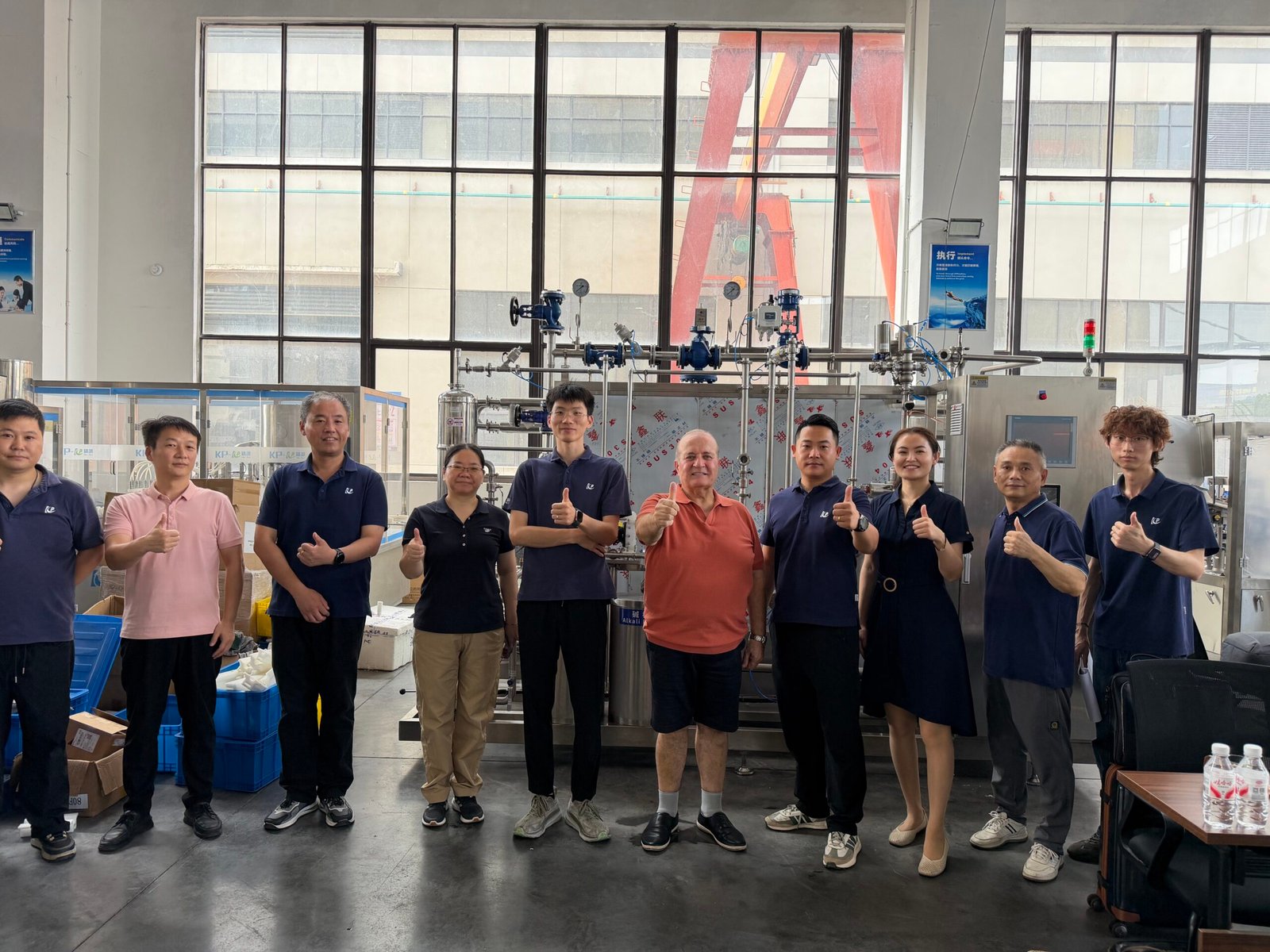
The FAT was carried out at the KINGPACK factory in Wuxi, China, with the customer participating directly in the testing and technical review.
Complete Ointment Tube Packaging Line

The line was designed for pharmaceutical ointment production and packaging, covering the main processes from tube feeding to final carton packaging.
The complete system includes:
- Automatic plastic tube loading and feeding
- High-speed tube filling
- Tube sealing
- Filling weight verification
- Automatic rejection of out-of-specification products
- Carton forming and product insertion
- Leaflet insertion
- Carton closing
- Batch number and expiry date coding
- Integrated line control
The objective was not simply to test each individual machine, but to verify that the equipment could operate as an integrated production system.
FAT Preparation Before Customer Arrival
A successful FAT starts well before the customer arrives at the factory.
For this project, the FAT preparation included mechanical inspection, electrical and control system checks, production testing, filling accuracy verification, sealing tests, checkweigher challenge tests, carton compatibility testing and integrated line operation.
Customer packaging materials were also considered during the testing process, including plastic tubes and cartons.
For projects involving multiple tube sizes, it is not always necessary to use large quantities of customized packaging materials for every FAT test. In this project, the largest Ø40 mm plastic tube was selected as the main FAT format, while the other tube sizes were used for additional functional and changeover verification.
This approach helps reduce unnecessary packaging costs while still allowing the key machine functions to be evaluated.
High-Speed Tube Filling and Sealing
The tube filling and sealing machine is the core equipment of the line.
During FAT, the machine was tested at different operating conditions to verify filling stability, tube positioning, filling performance and sealing quality.
The main inspection points included:
- Tube feeding stability
- Tube detection
- Tube positioning
- No-tube/no-fill function
- Filling volume or weight
- Filling consistency
- Filling nozzle performance
- Product dripping or stringing
- Tube sealing appearance
- Sealing position
- High-speed operating stability
For pharmaceutical ointment applications, filling performance can be affected by product viscosity, temperature, air content and other product characteristics. Therefore, the final filling parameters need to be confirmed through actual product testing rather than relying only on theoretical machine specifications.
The FAT therefore focused not only on the nominal production speed, but also on the stability of the machine during continuous operation.
Filling Accuracy Verification
Filling accuracy is one of the most important FAT items for an ointment filling machine.
Instead of checking only a few individual tubes, a representative number of samples were tested and recorded.
The final acceptance criteria are based on the agreed technical specification and product characteristics.
This type of documented testing provides the customer with a clearer understanding of actual machine performance and creates a reference for future SAT and production commissioning.
Checkweigher and Automatic Reject System
After filling and sealing, the products pass through an online checkweighing system.
The purpose of the checkweigher is to identify products outside the defined weight range and automatically remove them from the production flow.
During FAT, the checkweigher should be tested using different product conditions, including:
- Qualified product
- Underweight product
- Overweight product
- Consecutive rejected products
- Reject confirmation
- Reject counting
This challenge testing is particularly important because the checkweigher is not only a weighing device. Its integration with the filling line and automatic reject mechanism is also part of the overall quality control process.
The FAT therefore verified both the weighing function and the rejection logic.
Cartoning Machine and Carton Compatibility

The cartoning machine was tested for automatic carton opening, product insertion and carton closing.
One important lesson from this FAT was the influence of carton design on machine performance.
A carton can meet the required external dimensions while still not being fully suitable for automatic cartoning. Flap dimensions, folding angles, insertion structure and carton stiffness can all affect the forming and closing process.
For future carton development, KINGPACK recommends reviewing the carton drawing together with the customer before mass production.
The external dimensions and overall appearance of the carton do not necessarily need to change. Instead, the flap dimensions, folding structure and folding angles can be optimized to improve compatibility with the cartoning machine.
This is particularly important for high-speed automatic cartoning applications.
Coding and Product Identification
The coding system was also included in the FAT verification.
Typical pharmaceutical coding requirements may include:
- Batch number
- Manufacturing date
- Expiry date
- Product code
- Other customer-defined information
The FAT checks the coding content, position, legibility and communication with the packaging line.
For pharmaceutical applications, coding information should be confirmed by the customer before final machine setup to avoid unnecessary changes during commissioning.
Complete Line Integration Test

Testing individual machines is only part of the FAT.
The complete line must also be tested as an integrated system.
The production sequence for this project was:
Tube Feeding → Filling → Sealing → Checkweighing → Rejecting → Cartoning → Coding → Final Product
During integrated testing, the team checked the communication and synchronization between the machines.
Particular attention was given to:
- Start/stop synchronization
- Product transfer
- Machine speed matching
- Product accumulation
- Alarm signals
- Interlocks
- Reject signals
- Production counting
- Emergency stop response
A machine may perform well as an individual unit but still require adjustment when connected to other machines. Integrated FAT testing helps identify these issues before shipment.
GMP-Oriented Equipment Inspection

For pharmaceutical equipment, FAT is also an opportunity to review GMP-related design details.
The inspection can cover:
- Product contact materials
- Stainless steel construction
- Surface finish
- Accessibility for cleaning
- Product contact components
- Machine guards
- Safety switches
- Emergency stop systems
- Pneumatic and electrical identification
- Maintenance accessibility
The exact requirements depend on the customer’s URS, manufacturing process and applicable regulations.
For an Australian pharmaceutical customer, the FAT documentation and acceptance criteria should be aligned with the agreed project requirements rather than relying on a generic checklist.
FAT Punch List and Corrective Actions

During FAT, customers may identify items that require adjustment or improvement.
This does not necessarily mean that the entire FAT has failed.
A professional FAT process should distinguish between different types of findings and clearly define:
- Issue description
- Machine involved
- Corrective action
- Responsible person
- Target completion date
- Verification method
- Final status
The resulting FAT Punch List provides a controlled record of outstanding actions.
Items that can be corrected immediately are addressed during the FAT whenever possible. Remaining items are assigned to the responsible team and tracked until verification and closure.
This creates a clear transition from FAT to shipment and SAT.
From FAT to SAT
The completion of FAT is not the end of the project.
After FAT, the project moves into the preparation stage for shipment, installation and Site Acceptance Testing.
Before engineers travel to the customer’s site, both parties need to confirm the SAT preparation requirements, including:
- Machine installation area
- Electrical power supply
- Compressed air
- Product availability
- Tubes and packaging materials
- Cartons and leaflets
- Coding information
- Required operators
- Maintenance personnel
- QA or validation personnel
- Installation tools and lifting equipment
Proper site preparation can significantly reduce commissioning time.
The SAT plan should also define the expected number of engineers, commissioning duration and training requirements in advance.
A Collaborative FAT Process
One of the most valuable aspects of FAT is the direct communication between the equipment manufacturer and the end user.
During this project, the customer provided detailed feedback on machine operation, packaging materials and practical production requirements.
For a customized pharmaceutical packaging line, this communication is extremely valuable because some improvements can only be identified when the customer interacts with the actual equipment.
FAT is therefore more than a final inspection. It is also an opportunity to optimize the equipment before shipment and reduce potential issues during installation and commissioning.
Conclusion
The successful FAT of the Australian ointment tube filling and cartoning line provided an important verification point before shipment.
The project covered the complete production and packaging process, including:
High-Speed Tube Filling → Tube Sealing → Checkweighing → Automatic Rejecting → Cartoning → Coding
Through mechanical inspection, performance testing, filling accuracy verification, challenge testing and complete line integration, the equipment was reviewed against the agreed project requirements.
For pharmaceutical manufacturers, a well-structured FAT can help identify potential issues before shipment, improve commissioning efficiency and establish a clear technical baseline for SAT.
At KINGPACK, we believe that a successful project is not only about supplying individual machines. It is about developing a complete processing and filling solution that can be tested, documented and successfully transferred to the customer’s production site.
KINGPACK Machinery provides GMP-oriented mixing, filling and packaging solutions for pharmaceutical, healthcare, cosmetic and related industries, with a focus on customized equipment integration and complete project delivery.
