 Skip to content



The practical question is: can the team explain the identity, status and disposition of each component family for this batch, including exceptions? The answer must be built into receiving, staging, line clearance, in-process handling, packaging and record review. The details depend on the customer’s quality system, product requirements and local procedures, but the operating logic is transferable.
Why three component families need one reconciliation plan
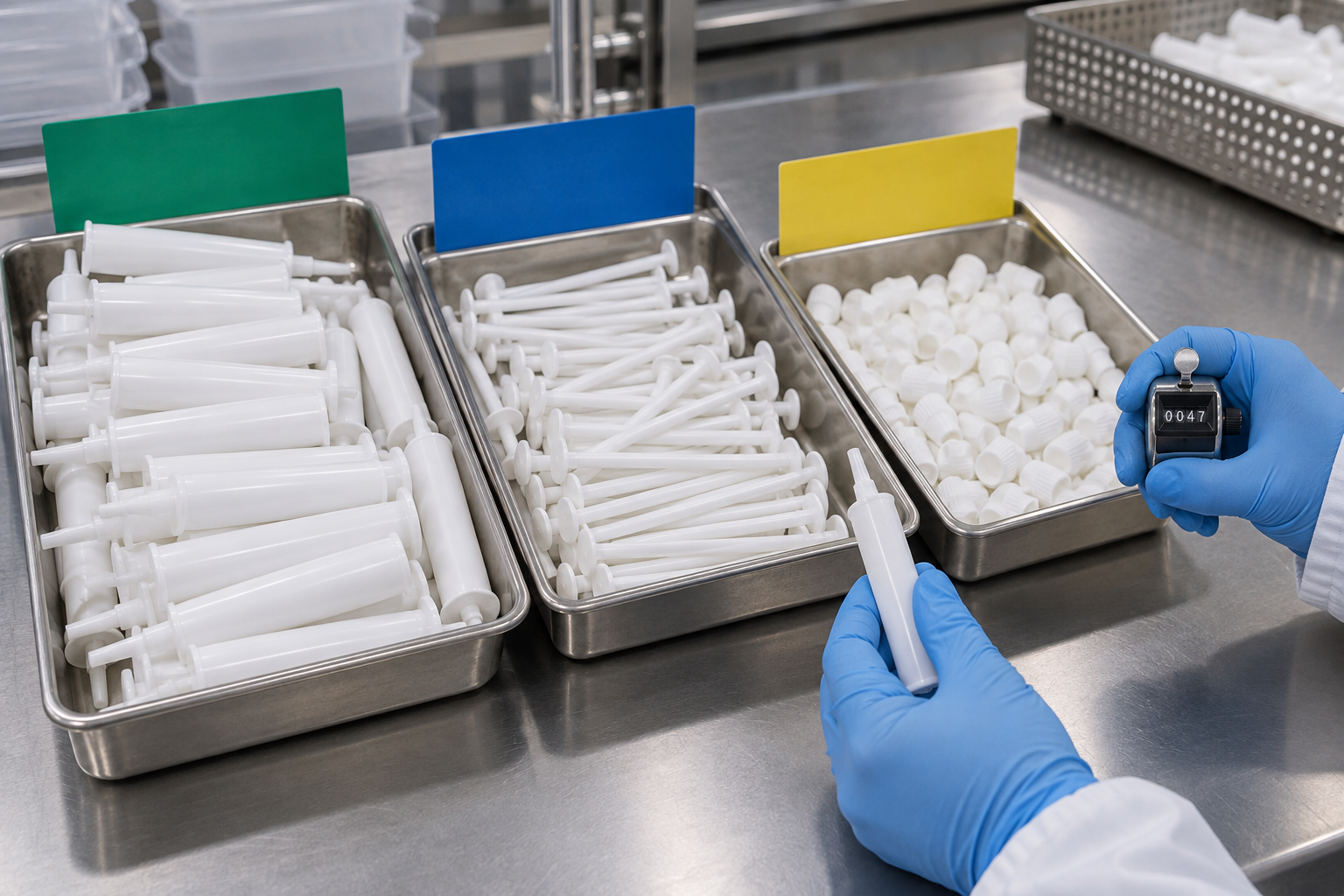
An intramammary applicator becomes a finished package only when the correct barrel, plunger and cap are assembled in the intended sequence. Each component can arrive in a different container, have its own inspection status and be consumed at a different point in the process. If a line has stops, setup samples, rejected units or a component change during a batch, a simple “pieces in versus pieces out” figure becomes hard to interpret.
Reconciliation does not replace formal quality release or regulatory controls. It provides operational evidence that helps a qualified team investigate a discrepancy. The plan should be appropriate to the customer’s procedures and should not claim traceability beyond the records and controls actually used.
Start with an identity and status model
Separate identity from quantity
Identity answers “which barrel, plunger or cap is this?” Quantity answers “how many are here?” Both are necessary. A precise count of an unidentified container is weak evidence. An identified container with an unverified count is also incomplete. Keep the two questions visible on the batch record or controlled electronic workflow.
Define permitted status clearly
Components typically need a practical status such as released for use, pending review, rejected, returned, sampled or held. Physical segregation and record status should agree. A plainly marked location, a defined container type or a controlled rack can help prevent a rejected or unreviewed component from returning to the line by mistake. The actual labels and procedures remain site-specific; the goal is unmistakable separation.
Confirm line clearance before issue
At batch start and after a format change, remove or account for components and documents from the previous activity according to the site’s line-clearance procedure. Check feeders, chutes, nests, reject bins, accumulation zones and worktables—not only unopened cartons. A component can remain in a low-visibility transfer area after a stop. The reconciliation plan should name those locations because they are where unexplained differences often start.
Build a component flow that matches the real line
Map the route from receiving to finished product. For each component family, note the issue point, staging container, feed point, inspection or reject point, return route and final disposition. This is more reliable than trying to impose one universal count point on parts that enter the line differently.
Barrels
Barrels are often introduced early and may travel through orientation, locating and filling before later assembly. The plan should state how containers are introduced, whether an operator records opening a container, where damaged or improperly oriented barrels are placed, and how setup pieces are separated from batch material. If an automatic feeder provides a counter, record what that counter represents. A feeder count may represent presentations, not necessarily accepted production units.
Plungers
Plungers may be handled at a distinct station and can generate exceptions that are not visible at filling. Missing, misoriented or incompletely inserted plungers should have a defined rejection or hold route. If rework is allowed by the site procedure, its identification and count must not disappear from the record. If rework is not allowed, make that equally clear and physically practical.
Caps
Caps may be fed in bulk, a tray or another controlled presentation. Because they are small and may be replenished during a run, operators need a disciplined method for recording issue, remaining quantity and unused returns. Avoid combining an uncertain remainder with a new lot unless the site’s approved procedure specifically permits it and preserves identity.
Reconcile the batch with a transparent equation
The exact calculation should be approved by the site, but its logic should be understandable. For each component family, begin with the verified issued quantity. Account for accepted units, documented rejects, approved samples, authorized setup use, returns and physically verified remainder. Investigate any unexplained difference rather than forcing the numbers to balance.
The same finished-unit count should not be blindly applied to all three component families. A barrel may be rejected before filling; a plunger may be rejected after a barrel has already been filled; a cap may be rejected at a later station. The record should allow the team to see where the loss occurred. Separate counters and reject categories can make that easier, but the equipment configuration must be matched to the approved batch logic.
Count points and their limits
Machine counters can be valuable operational aids. A barrel-present sensor, plunger-present sensor, cap-present sensor, reject counter or finished-pack counter each observes a different event. Before relying on a counter, state what event increments it and what events it cannot see. A sensor may detect a part at a station without proving it was finally accepted. A finished-unit count may not explain why a component was removed earlier.
Manual counts also have limits. Use a controlled method for partial containers and a second-person check where required by the site’s procedure. Avoid inventing precision where bulk components cannot be counted practically without an agreed sampling or weighing method.
Control exceptions while they are still understandable
The best time to investigate a discrepancy is close to the event. If a reject bin fills, a feeder jam occurs, or a component container is changed, record the event promptly. A later end-of-batch difference is harder to explain once multiple shifts, containers and adjustments have occurred.
Rejects and segregated material
Define the physical route for rejected barrels, plungers, caps and assembled units. A reject bin should not become an unofficial source of spare parts. The team needs to know whether material in the bin is counted, inspected, destroyed, returned or held. If a part cannot be identified to its component family or batch status, keep it separated and escalate according to the site procedure.
Stops, interventions and restarts
During a stop, parts may remain in nests, under a nozzle, in a capper or between sensors. Before restart, the operator should have a defined check for those locations. The purpose is not to slow production unnecessarily; it is to ensure that the recorded component state matches what is physically on the line. This is especially important after maintenance work, a rejected sample investigation or a format adjustment.
Component changes during a batch
If a new container or lot is introduced, record the handover point and confirm that the old material has been cleared or held according to procedure. Do not assume a similar-looking component is interchangeable. A drawing revision, mould change or material change can affect tooling, handling and package performance even where visual differences are small.
CTA — Send Your Requirements: Share your component flow, batch-record fields and intended exception handling. We can review where a filling line needs counters, segregation points and operator checks to support your process.
Make the record useful at shift handover
Component reconciliation is easiest when the current state is visible before the next operator begins. A shift handover should identify the component family currently at each feed point, the last confirmed issued container, any open reject or hold containers, equipment counts where used, and any discrepancy awaiting review. This is not a substitute for the formal batch record; it is a practical bridge between the physical line and the formal record.
Where electronic records are used, verify that the information an operator can see matches the material physically staged at the line. Where paper records are used, protect them from being updated retrospectively from memory. Timely entries, clear corrections under the site’s procedures, and named ownership of open exceptions make the final reconciliation less dependent on oral explanations.
Plan sampling without losing the count
Quality, engineering and customer sampling can consume components at several points: incoming inspection, setup, factory testing, in-process checks and retained samples. Define their route before the batch begins. A sample should have a clear identity, reason for removal and disposition. If it is returned to the line, only do so through the approved procedure. If it is retained or destroyed, record it as such. This keeps normal quality activity from appearing as an unexplained shortage at closeout.
Link change parts to component status
Format parts and component identity meet at changeover. Before a barrel, plunger or cap set is introduced, verify that the installed guide, nest and sensor arrangement corresponds to the approved package format. A simple changeover checklist can include the component code or drawing revision, without turning the machine into the master quality record. If the wrong format part is discovered, hold affected material and follow the site procedure rather than trying to reconstruct the sequence after production has continued.
Review trends without manufacturing false certainty
Over multiple batches, recurring differences may reveal a feeder presentation issue, a sensor timing limitation, an operator step that needs clarification or a component condition worth reviewing. Trend review should lead to investigation and controlled improvement—not to a blanket assumption that a certain loss is “normal.” Record the evidence, decide the corrective action and confirm whether the change affects equipment settings, work instructions, supplier communication or future acceptance tests.
Use factory testing to verify the operational design

At shipment inspection, confirm the supplied change parts, counter-related documentation and any agreed containers or accessories are present. During installation preparation, agree the physical locations for issued, in-process, rejected and returned components. This makes the first site trial more orderly and helps avoid using temporary benches or unmarked bins as a permanent control method.
Common reconciliation failures
Treating an equipment count as the batch record
Equipment data can support a record, but it must be interpreted against the event it measures and the site procedure. It does not automatically cover components removed during setup, manual rejects or remaining material.
Mixing returns without preserving status
Combining remainders may make staging convenient but can destroy the ability to explain identity or condition later. Use the approved return and hold process.
Forgetting parts already inside the machine
Line clearance must include feeders, guides, nests, reject paths and discharge zones. “No cartons left at the line” is not enough.
Using unexplained differences as a normal loss factor
A repeated unexplained difference is a process signal. Investigate the likely location, counter behaviour, operator step or component presentation instead of normalising it away.
Carry reconciliation into the shift handover
A shift handover should identify issued components, material still held in the equipment, segregated exceptions and any unresolved difference. State which records are current and who owns the next decision. An oral estimate is not a substitute for the customer’s controlled reconciliation method.
Where maintenance or a trial interrupts the batch, account for components removed for inspection or adjustment. Keep those units identifiable until their disposition is determined. This prevents a sample taken for engineering review from becoming an unexplained difference or being returned to production without authorisation.
Use the agreed material boundaries rather than creating a new count method whenever the operator changes. Consistent definitions make exceptions easier to investigate and keep the equipment record distinct from the customer’s product-release decision.
Compare the record categories before closing the batch
Definitions should remain consistent from issue to handover. This table helps the customer develop its own record structure without prescribing a universal reconciliation formula.
| Material category | Record question | Disposition question |
|---|---|---|
| Issued components | Which identified lots entered the defined boundary? | Who confirms issue records? |
| Assemblies in equipment | Where is material retained at the stop or handover? | Can its status be established? |
| Removed samples | Why were units taken and where are they now? | Can they return under an authorised procedure? |
| Segregated exceptions | Which observation led to the hold? | Who owns the next decision? |
| Accepted discharge | What destination and count basis apply? | Which release decisions remain customer-owned? |
FAQ
Does reconciliation mean every individual component must be serialised?
No. The appropriate method depends on the site’s quality system, product risk and component flow. Reconciliation can use controlled lots, container records, machine counts and physical verification without individual serialisation.
Should barrel, plunger and cap counts always be identical?
Not necessarily at every intermediate point. They may be rejected at different stations. The important requirement is that documented use, rejects, samples, returns and remainder explain the difference according to the approved procedure.
Can a line counter be used as the only evidence?
Usually no. First define what event the counter detects and compare it with physical material status, documented exceptions and the batch record.
What happens to a component found after line clearance?
Segregate it and follow the site’s deviation or material-status procedure. Do not simply return it to the feeder because it appears similar to the current component.
What should a buyer ask an equipment supplier about?
Ask where components are counted, where rejects are separated, how operators can inspect residual parts during a stop, what the counter signals mean, and which parts of the workflow remain the site’s procedural responsibility.
Conclusion
Reliable reconciliation is created by a visible flow: identified issue, controlled staging, meaningful count points, clear segregation and prompt documentation of exceptions. For an intramammary filling batch, barrels, plungers and caps should be reconciled as related but distinct component streams. That gives the site a more defensible record and gives equipment design a clearer operational purpose.
CTA — Contact Us: Send your batch-flow sketch and component-handling requirements. We can help identify practical count points, segregation locations and factory-test observations for an intramammary applicator line.
—
Related King Pack resources
For equipment selection, compare our syringe filling machine solutions, veterinary medicine filling equipment, and veterinary and animal-health packaging solutions. For intramammary production, review the intramammary syringe filling line, dosing paste syringe filling, and veterinary filling and capping applications. Related process guides include tooling contact-zone definition, site-acceptance preparation, and batch component reconciliation. You can also review filling and capping line solutions, packaging equipment solutions, and tube filling machine options. For project coordination, use the Contact Us page or request a quote form.
