 Skip to content



Introduction
A factory acceptance test confirms an agreed equipment scope under stated conditions. It does not automatically reproduce the customer’s site utilities, operators, incoming component lots or secondary-packaging route. An intramammary filling line site-acceptance start-up pack closes this handover gap by making the evidence, materials and responsibilities visible before commissioning begins.
This framework applies to non-sterile veterinary intramammary applicator filling projects. It does not set a universal validation protocol or replace the customer’s quality-system requirements.
The direct answer
A useful start-up pack connects the factory-tested configuration to site reality: component identity, product and packaging samples, utilities, tooling, drawings, training roles, inspection references and open actions. It should state what FAT demonstrated, what will be rechecked at site and what remains customer-owned qualification work.
Request a site-start-up checklist
Send your installation layout, component list and intended site-acceptance scope. We can help identify the line-specific documents and samples to prepare before shipment arrives.
Separate FAT evidence from site acceptance
FAT may show the handling route with the samples available at the factory. Site acceptance checks whether the delivered machine, local utilities, actual components and trained operators can reproduce the agreed route. Neither stage should be represented as a blanket product or package qualification.
The pack should include a short evidence statement: samples used, configuration tested, observations made, agreed adjustments and known exclusions. This lets the site team focus on genuine open items rather than rerunning every factory activity without a reason.
Prepare the physical inputs
Confirm the delivery condition of barrels, plungers, caps and any secondary packaging. Identify lot references and drawing revisions. Bring enough representative components for setup and the customer-defined checks. If product will be used, prepare it under the customer’s approved handling and safety procedures.
| Start-up input | Why it matters | Owner to confirm |
|---|---|---|
| component samples and lot IDs | proves the actual package route | customer / component supplier |
| utilities and connections | affects installed machine operation | site engineering |
| layout and access route | supports positioning and service access | site engineering |
| change-part kits | connects format to tested tooling | supplier and customer |
| visual inspection references | supports first-piece judgement | customer quality |
Make roles and decisions explicit
Name the people responsible for installation coordination, utility readiness, machine setup, component release, quality observation, operator training and final acceptance. A site visit can slow down when everyone is present but nobody is authorised to decide whether a component variation is acceptable or whether a process observation requires escalation.
Record open actions with an owner and due date. The record should distinguish equipment-scope work from product, cleaning, validation and release activities that remain customer-owned.
Use staged start-up checks
Begin with installation, levelling, guarding and utilities according to the supplied documents. Then confirm empty-component feeding, transfer and location before introducing product. Observe plunger and cap handling, defined rejects and the customer’s first-piece inspection. The exact checks and acceptance criteria should be agreed in advance, not created during the visit.
Keep factory-test photos, tooling labels and the defect-library reference available. They provide an efficient comparison if an applicator appears differently at site. Before adjusting a guide or nest, check component lot, setup kit and utility condition.
Preserve records for routine operation
After site acceptance, store the final setup records, component references, operators trained, outstanding actions and current inspection materials under the customer’s document-control process. They become the starting point for maintenance, changeovers and future component changes.
Make installation readiness a decision, not a calendar date
A delivery date does not establish that a site is ready to receive or run the equipment. Before booking commissioning, review the route from vehicle unloading to the final machine position. Confirm doorways, turning space, floor condition, lifting arrangements and the access needed to open guards and service the installed machine. Use the equipment’s actual packing and layout documents. Do not infer these requirements from a photograph of a similar line.
Document the status of each prerequisite as confirmed, awaiting evidence or unavailable. An unresolved item needs an owner and a consequence: postpone the affected activity, arrange an approved alternative or revise the visit scope. This makes a readiness meeting useful to both purchasing and operations. It also prevents a technician’s time being consumed by work that belongs to building services or material supply.
Confirm utilities at the connection point
Site engineering should compare the documented utility requirements with the connections actually available where the machine will stand. Depending on the confirmed equipment scope, this may include electrical supply, protective earthing, compressed air and product-service connections. Record the agreed interface, responsibility for connecting it and the checks required before energising the machine. No generic utility value should be substituted for the supplied specification.
A connection available somewhere in the building is not necessarily available at the machine under operating conditions. Follow the supplier’s installation instructions and the customer’s authorised engineering procedures. If an unexpected utility condition appears during commissioning, record it before changing machine settings. Otherwise a temporary site problem can become an unexplained difference from the factory-tested setup.
Agree the surrounding work area
The line’s working area includes component replenishment, product preparation, inspection, rejected-material storage and discharge. Discuss where each task occurs and how material moves between them. A layout that accommodates the machine but not these tasks can create awkward reaches, blocked access or mix-up risks.
This planning is especially important for intramammary formats supplied as separate barrels, plungers and caps. Their containers should remain identifiable throughout start-up. Confirm where opened packs are placed and how the team distinguishes trial stock from material intended for later production. A start-up pack should describe those boundaries without claiming to replace the site’s approved segregation procedure.
Receive the machine and accessories systematically
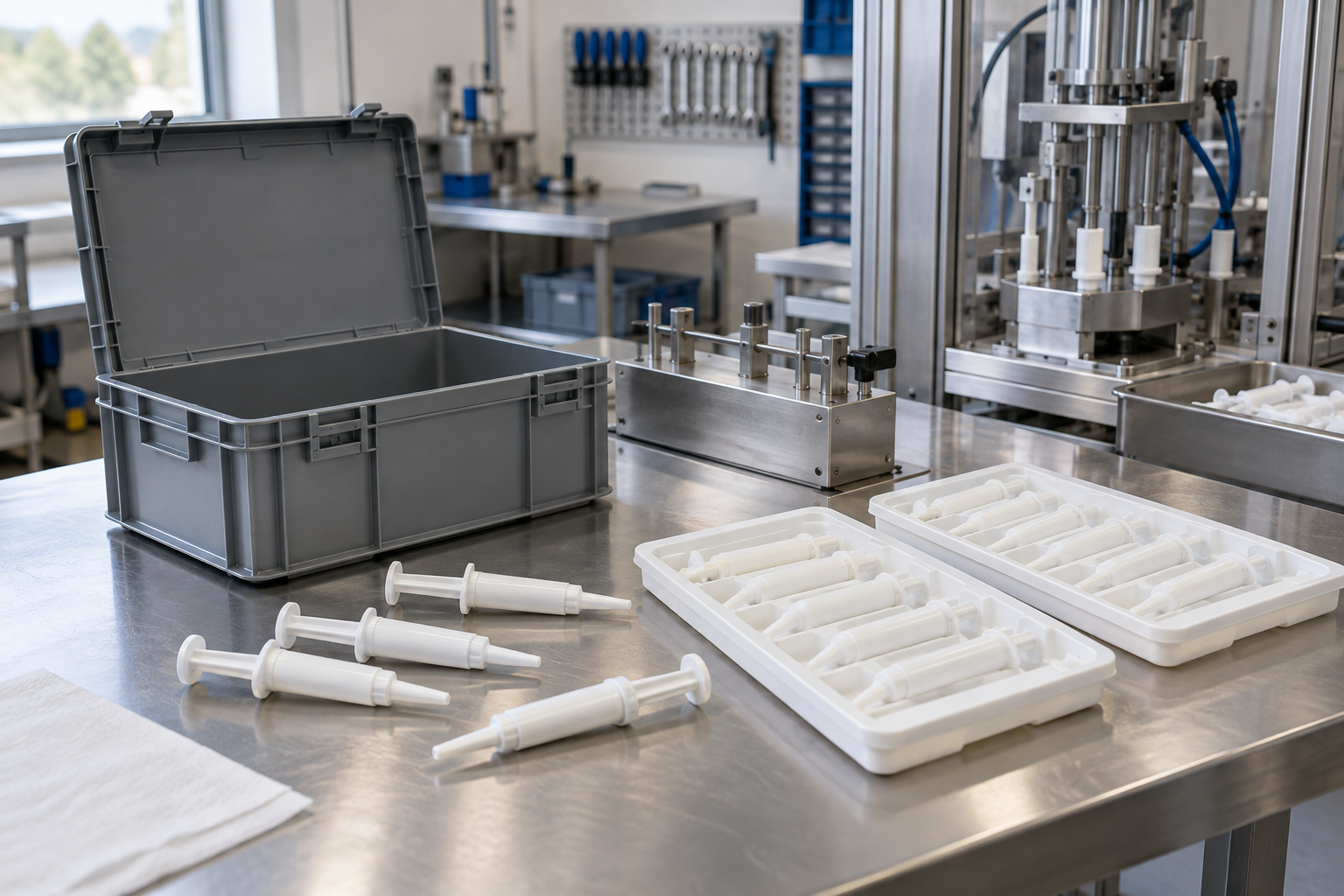
Shipment inspection and site receiving answer related but different questions. Before dispatch, the supplier can check the agreed equipment, format parts, documents and protective packing. At receipt, the customer checks the condition and completeness of the delivered items against the applicable packing records. Neither activity establishes that the finished applicator is qualified for its distribution route.
Keep the accessory list accessible before the crate is opened. Identify format parts, installation items, supplied spare parts and documents separately. Photograph relevant receiving conditions and record discrepancies through the agreed channel. Use safe unpacking and lifting arrangements; the presence of a crate does not authorise an untrained person to move the machine.
Resolve a missing part before improvising
If a guide, nest or spacer cannot be found, compare the packing record, labelled storage and tooling list. Ask whether it belongs to a different assembly or was shipped separately. Do not replace a missing format item with an apparently similar piece from another machine. The contact geometry can change how a fine-tip barrel is supported or how a cap approaches the assembly.
Where a discrepancy affects the planned test, record the revised scope. A component-feeding demonstration may still be possible while another activity waits, but its results should not be presented as acceptance of the unavailable configuration. Specific exclusions protect both parties from an ambiguous handover.
Mid-article CTA — Plan your commissioning inputs
Share your target site, applicator samples, planned utilities and acceptance questions. We can prepare a practical input list for intramammary line commissioning.
Build an acceptance matrix around observable evidence
An acceptance matrix should connect each agreed requirement to a check, its inputs, an acceptance reference and the person authorised to judge the result. For a barrel-handling check, the input might be an identified component lot and format kit. The evidence might be observations of seating and transfer under the stated conditions. For a documentation check, it could be receipt of the specified drawings and operating instructions.
Keep equipment observations separate from customer product assessments. A machine can locate a package consistently while the formulation still requires customer-owned evaluation. Similarly, a visible cap-seating observation does not establish leakage, shelf life or transport performance. State those limits beside the record rather than adding an unqualified “passed” to a long list.
Specify the test boundary
Record which stations and transfers are included. If a downstream cartoner or inspection system is outside the supplied scope, identify the hand-off point and who will check the connection. Explain any temporary arrangement used during commissioning. The final operating route may require a further review when the permanent downstream equipment becomes available.
Agree how departures from the plan are handled. A changed sample lot, unavailable product or unfinished utility connection can alter what the visit demonstrates. Record the reason, the checks completed and the remaining action. The objective is a reliable decision about the delivered scope, not the appearance of completing every box.
Keep open actions visible after acceptance
An action record should describe the observation, responsible party, required evidence and intended closure decision. Distinguish a document correction from an equipment adjustment and from a customer process qualification. Their owners and completion evidence may be different.
Avoid allowing informal conversations to replace the record. If a setting is changed during the visit, update the relevant configuration reference. If an issue is accepted for later follow-up, preserve its conditions and limits. The people working the next shift should be able to understand the remaining scope without contacting everyone who attended commissioning.
Train people on the actual package route
Training should follow the applicator from incoming presentation to discharge. Show operators how component identity, tooling, settings and inspection references fit together. Then walk through replenishment, a controlled stop, authorised recovery and the route for uncertain assemblies. Use the delivered controls and instructions, not a generic explanation from a different machine.
A trainee may observe a check without being authorised to perform maintenance or decide product release. Record the roles covered by training and the tasks that need separate site authorisation. Identify the person who can answer questions about components, equipment operation and quality decisions after the supplier leaves.
Demonstrate where the current instructions are stored and how an operator reports an unfamiliar condition. A useful training outcome is that the team knows when not to continue. For example, a barrel presenting differently from the approved reference should trigger the defined review rather than an improvised guide adjustment.

Prepare the first routine production handover
Before the line moves from commissioning to routine operation, transfer the current setup references, material status and open actions to the responsible team. Account for components used during checks and distinguish accepted trial observations from production-release decisions. Product application requirements remain subject to the customer’s quality and safety procedures.
The handover should include a practical route for future assistance: equipment identification, format kit, component lot, warning information and photographs that show the observation. This makes a later technical discussion more specific. It is more useful than reporting only that the machine “worked at FAT” or “stopped after installation.”
Finally, preserve the start-up pack as a controlled baseline. Update it when the package, utilities, tooling or surrounding transfer changes. A document that no longer describes the installed route can mislead a later team even if it was accurate on the acceptance date.
Send Your Requirements: Share your component supply state, installation layout and planned acceptance responsibilities. Ask for a line-specific review of the inputs needed before commissioning.
Organise evidence for a remote follow-up
A later service discussion is easier when the start-up pack identifies the machine, component combination, installed kit and current instructions. Before sending a general request for assistance, assemble the relevant observation, warning information and safe photographs. State whether the issue occurs with empty components, during product application or after downstream transfer.
Keep confidential formulation information and personal details out of unnecessary photographs. Follow the customer’s information-sharing procedure. The equipment supplier needs enough context to understand the handling route, but that does not mean every internal quality record should be sent without review.
If remote guidance leads to an adjustment, document the authorisation and resulting checks. Preserve the distinction between a proposed action and a completed, verified action. Closing an email conversation is not the same as closing an acceptance item.
Check that the final record describes the installed route
Before closing the start-up pack, compare its layout, component references and open actions with the equipment as installed. Identify temporary collection arrangements or downstream connections that still differ from the intended route. These details can matter during the next production handover even when the principal equipment checks are complete.
Assign responsibility for updating the records after a later change. The useful baseline is the current installed condition, not simply the first version issued before shipment. Preserve earlier evidence with its original conditions so that a document update does not imply an unperformed test.
FAQ
Does SAT replace the customer’s validation work?
No. SAT checks the installed equipment and agreed scope. Validation, product release and compliance decisions remain with the customer.
What if the site component lot differs from FAT?
Record the difference and follow the customer’s change-control process. Review any line-contact features before assuming the prior setup is unchanged.
Should shipment inspection be included?
Yes, as a handover record for tooling, documents and protective packing. It does not prove transport or final package performance.
What should happen if a commissioning input is not ready?
Record the missing input and the checks it prevents. Agree whether to postpone the affected activity or complete a narrower scope with explicit exclusions. A visit can produce useful equipment observations without establishing acceptance of a configuration that could not be tested.
Who owns the first production-release decision after commissioning?
The customer owns that decision through its authorised quality and operating procedures. The supplier’s installation, training and equipment-check records support the handover but do not establish product release. Keep outstanding component or process questions visible until the responsible team resolves them.
Conclusion
Site acceptance is most effective when it starts with a defined evidence pack rather than an improvised commissioning list. Clear samples, roles, utility checks and open-action control make the factory-to-site transition safer and easier to document.
Plan your intramammary line start-up
Contact Us: KINGPACK supports installation preparation, commissioning and training within the confirmed project scope. Contact us to discuss your site conditions, component samples and start-up plan.
—
