 Skip to content

Introduction
Two buyers bring us the same gel and ask the same question, and they need different answers. One fills a high-viscosity cockroach bait that a pest control technician applies in measured dots. The other fills a paste that a homeowner squeezes from a retail tube. The machine that fills a syringe barrel is not the machine that fills a squeeze tube, and the choice between them starts with the package, not with the pump.
This article compares syringe filling and tube filling as two production routes for gels, pastes, and thick liquids. We look at the container itself, how each line is laid out, how net content is controlled, which materials suit which package, output and labor, tooling and changeover, and the end use that should drive the decision. At the end there is a short decision path you can run against your own product.
What Each Container Actually Is
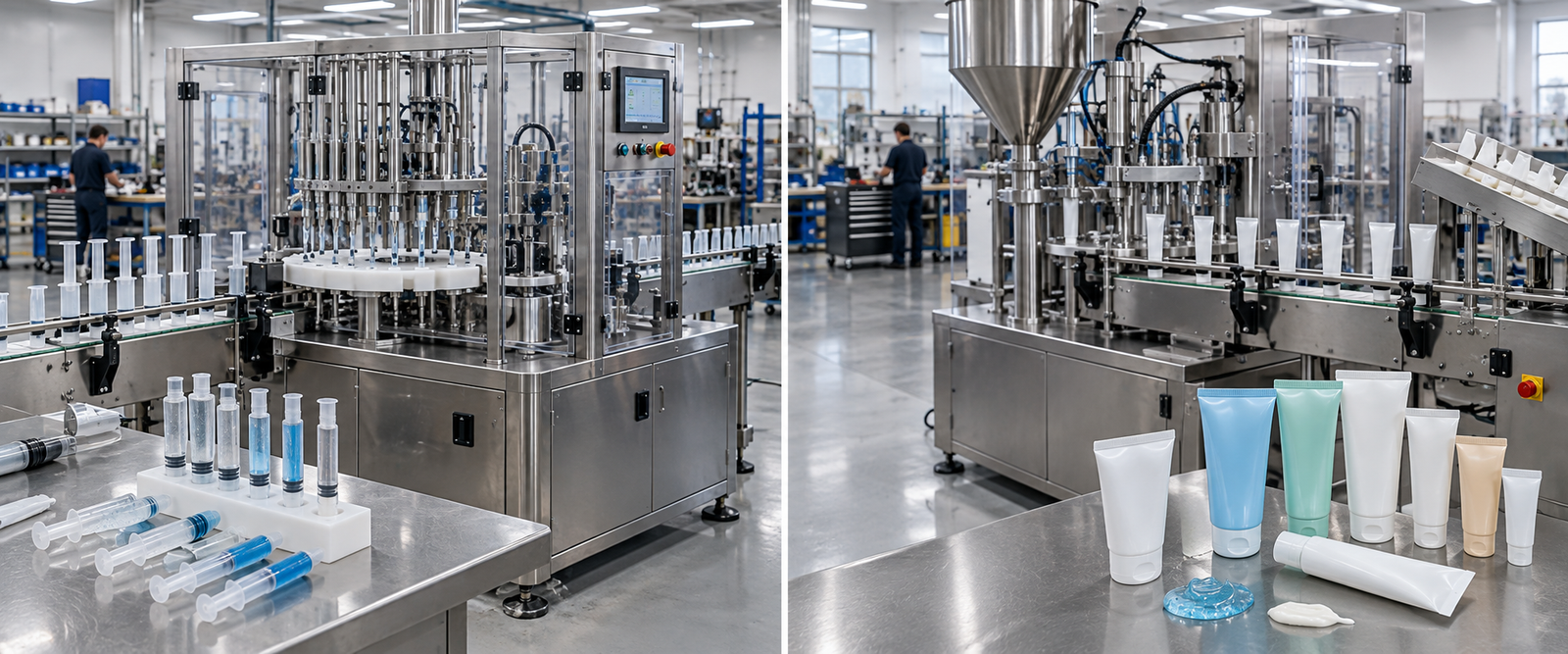
A syringe container is a barrel with an elastomer piston and a plunger rod, closed by a tip or cap, that becomes a hand-held dosing device once filled: each advance of the plunger extrudes a measured bead.
A tube container is a soft or laminated body with a shoulder and nozzle, sealed at the open tail by folding and crimping, that a user squeezes by hand to push product out.
Those two sentences carry most of the decision. One package repeats a dose at the push. The other lets the user decide how much to squeeze. Everything downstream, from the line layout to the changeover parts and the labor, follows from that difference.
One boundary note before we go further. This article is about filling syringe-style and tube-style containers for pastes and gels. It is not about sterile medical syringes, and it is not a re-run of the gel bait syringe manufacturing guide, which we cover separately.
How the Two Filling Lines Differ
Both lines feed a container, dose product into it, close it, and check it. The middle is where they split.
A tube filling line usually runs: feed and orient the tube, fill from the open tail, then fold and crimp the tail shut, then trim and inspect. The crimp can carry the batch code and the date in the same stroke.
A syringe filling line usually runs: feed and orient the barrel, fill the barrel, insert the piston, place the tip or cap, then check-weigh and reject. On a gel bait syringe line the piston and the cap are separate operations, and either one can become the bottleneck.
The table below sets the two routes side by side.
| Line stage | Tube filling line | Syringe filling line |
|---|---|---|
| Container feeding | Tubes fed and oriented from a magazine or hopper | Barrels fed and oriented; piston and cap fed as separate parts |
| Filling | From the open tail, often bottom-up to keep the shoulder clean | Front filling through the tip, or rear filling through the open tail |
| Closing | Fold and crimp the tail; batch code often in the crimp | Insert the piston, then place the tip or cap |
| Inspection | Fill level, crimp quality, leak | Fill weight, piston depth, cap fit |
| Cadence | One tube per cycle at a steady high rate | Multi-station, paced by the slowest station |
Dosing Behavior and Net Content Control
On a syringe line, the piston and plunger do the dosing for the user. You set one fill, and every squeeze of that barrel should deliver the same amount. That makes fill accuracy and piston seating the two numbers that matter. If the barrel holds air or the piston sits shallow, the applied dose changes even when the net weight is right.
On a tube line, the user does the dosing with their hand. Nobody promises a fixed dot from a squeeze tube, because the squeeze is not repeatable. What matters instead is net content by mass and a tail seal that holds. A short fill understates what the label claims, and a weak crimp leaks in the carton.
Both products are sold by mass, in grams, not by volume. A barrel's rated volume is not its net mass, and a tube's printed size is not its net mass either. The control item on both lines is grams and the tolerance around them, measured the same way at the same point in the line.
In practice, a syringe line carries a tight requirement on fill and piston position, while a tube line carries a tight requirement on fill and crimp integrity. When a customer sends both a filled syringe and a filled tube to our test bench, that is the first difference we point out, before we even talk about speed.
Material Fit: Viscosity, Particles, and Thixotropy
Not every gel behaves the same way in both packages. Three properties decide most of it.
High viscosity. A paste like thick toothpaste pushes back on the pump. Both routes handle it, but a tube line fills from the open tail, so the nozzle sees less back pressure and the shoulder stays cleaner. A syringe barrel filled from the tip needs a narrow nozzle and higher pressure, and rear filling through the open tail is often simpler for very thick material.
Particles and fibers. If the formulation carries particles or fibers, the smallest passage in the machine sets the limit. On a tube line that passage is often the tube nozzle orifice, which is fixed by the package you already chose. On a syringe line it is the nozzle and the pump, which you can size around the material. Particle-loaded gels tend to favor the route with the more open, controllable path.
Thixotropy. Many gel baits are shear-thinning: they move when you push and thicken when you stop. That behavior is useful at the point of application and risky at the pump. High-shear pumps can damage the structure, so both routes should dose with a positive-displacement system and both need a clean cut-off, so a string of gel does not follow the nozzle. Suck-back, a nozzle valve, or a lift-and-dispense sequence all help.
Low-viscosity liquids are a different story. Neither a syringe barrel nor a squeeze tube is the natural package for a thin liquid, and a machine chosen for a paste will not run it well. If your product is thin, the container decision comes before the machine decision.
Output and Labor Structure
The two lines fail in different places when you push them.
A tube line tends to run one tube per cycle at a high, steady rate. Feeding is automated from a magazine, filling and crimping sit close together, and one operator can watch a long run. That structure rewards long runs of a single tube size.
A syringe line is a set of stations: fill, piston, cap, check. The cadence is set by the slowest station, not the fastest, so adding speed to the pump does not add output if the cap station is behind it. In our experience, the hands that matter on a gel bait syringe line are at barrel feeding and at capping and packing, not at the pump.
This is a common surprise. Buyers look at the metering pump first, because it is the part they can name. In a manual or semi-automatic gel bait line, metering is rarely the bottleneck. The bottleneck sits upstream in paste handling and barrel feeding, or downstream in capping, inspection, and labeling. Plan the line by its shortest link, not by the pump's rated speed.
Labor per shift also differs. A tube line front-loads its labor into setup and feeding, then runs mostly unattended. A syringe line spreads labor across more stations, which means more people on the floor but more flexibility when you add a format.
Tooling, Mould Cost, and Changeover
This is where the two packages diverge on money.
A tube is usually one purchased part. You source the tube body from a tube supplier, and the filling line adds format-specific parts: the fill nozzle, the crimp jaws, and the feeding rails. Tube moulds and tube supply form a mature, competitive chain in most markets, which keeps the per-unit package cost low at volume.
A syringe container is a set of parts: barrel, piston, plunger rod, and tip or cap. That means more suppliers, more minimum order quantities, and more inventory lines to manage. The trade is that a syringe is a dosing device, not just a container, and the parts can be combined into several finished formats from a smaller base.
Changeover touches different parts on each line. On a tube line you change the fill nozzle and the crimp jaws, and you adjust the feeding rails to the new tube diameter. On a syringe line you change the barrel fixture, the piston insertion tool, and the cap gripper, and you re-teach the check-weigher for the new target weight.
We ask every customer to photograph their current changeover and list the parts swapped, in order. That list, not the catalogue, is what tells you how long a format change really takes and how many spares you should hold.
End-Use Scenarios: Professional Point Dosing vs Retail
The final tiebreaker is the person who uses the product.
A syringe container is built for point dosing. A pest control technician applies measured dots along a crack, a hinge, or a harbourage, and the dose has to repeat from barrel to barrel so the treatment is both effective and legal. A tube cannot promise that dose, because the hand controls it.
A tube container is built for retail and home use, where the buyer squeezes a bead or a dab and judges the amount by feel. The package is familiar, cheap to make at volume, and easy to print on.
So the question is not which package is better. It is who applies your product and how much control over the dose they need. If the dose must repeat and the user is a professional, the syringe format is the one that carries the promise. If the user is a consumer and the dose is approximate, a tube may cost less and sell just as well. The gel bait syringe selection guide goes deeper on choosing the syringe itself once that route fits.
A Decision Path for Your Product
Run these questions in order and stop at the first one that is decisive.
- Who applies it? Professional point dosing points to a syringe. Consumer squeeze use points to a tube.
- How viscous is the material? Very thick or paste-like gels work in either package; rear filling is often simpler on a syringe, and tail filling keeps the tube shoulder clean.
- Does it carry particles or fibers? A more open, controllable path helps; check the tube nozzle orifice against your largest particle.
- Does the dose have to repeat? If yes, a syringe is the package that delivers it.
- What is your annual volume and how many formats? Long runs of one format suit the steady cadence of a tube line; many formats suit a line you can change over cleanly.
- Which packaging supply chain is mature where you buy? Tube supply is widely available; syringe parts come from a broader set of suppliers.
- Which market and channel? Professional channels accept a syringe format; retail often expects a tube.
If the package is still undecided, compare the annual volume and labour assumptions with the syringe filling cost-per-unit guide before you request a machine quotation.
Here is the same logic as a tree, if you prefer to follow it visually.
flowchart TD
    A[Product is a gel or paste] --> B{Who applies it?}
    B -->|Professional point dosing| C{Dose must repeat?}
    B -->|Consumer squeeze| D[Tube filling line]
    C -->|Yes| E[Syringe filling line]
    C -->|Not critical| F{Particle or fiber load?}
    F -->|High| E
    F -->|Low| D
    E --> G{Volume and format count}
    D --> G
    G -->|Many formats, short runs| H[List changeover parts and spares]
    G -->|One format, long runs| I[Match the line to its slowest station]
Whatever the tree says, do not sign for a machine on the strength of a data sheet. Send us, or any supplier, a filled sample of each format and a sample of the actual paste. Run both on a test bench, time the changeover, and check the tail crimp and the piston seat for yourself. The dosing system selection article explains how the pump choice follows from the material once the package is set.
FAQ
Q: Can one machine fill both syringes and tubes?
Not well. The closing stations are different: a tube line crimps a tail, a syringe line inserts a piston and applies a cap. Some semi-automatic bases share a frame and swap the tooling, but you should treat the two routes as separate lines and budget for each.
Q: Which package is cheaper to produce?
At high volume, a tube is usually cheaper per unit, because the package is a single purchased part and the supply chain is mature. A syringe costs more in parts but carries a dosing function. Compare on cost per good filled unit, not on package price alone.
Q: My gel is very thick. Can a tube line fill it?
Yes. Thick pastes fill from the open tail and the nozzle sees low pressure. Watch the tube shoulder and the nozzle orifice: a narrow orifice can limit a particle-loaded gel.
Q: Why does net content matter more than volume?
Because gel baits and rodenticide pastes are sold by mass, in grams. A barrel's rated volume, or a tube's printed size, is not its net mass. Write your fill target and tolerance in grams, and measure the same way on both routes.
Q: Do I need a sample trial before choosing?
Yes. A trial on your real gel, your barrel or tube, and your closure shows how the material doses, how clean the cut-off is, and how long a changeover takes. A trial on a supplier's favorite material tells you very little about your product.
Conclusion
Syringe filling and tube filling are two answers to one question, and the question is not which machine is faster. It is which package your product needs. A syringe is a dosing device that repeats a measured bead; a tube is a squeeze container that hands the dose to the user. That single difference runs through the line layout, the net content control, the material fit, the labor, the changeover, and the shelf.
Choose the package by the person who applies the product and the control they need over the dose. Then choose the machine by your material, your volume, and your formats, and prove it on a sample trial before you commit.
Send Us Your Samples
If you are still deciding between a syringe and a tube, send us a filled sample of each and a sample of your actual gel. We will run both on the test bench, time the changeover, and check the tail crimp and the piston seat with you. Send your target net content in grams, your annual volume, and your format list, and an engineer will compare the two routes and recommend the one that fits. No obligation, and no cost to look at the numbers.
