 Skip to content

Introduction
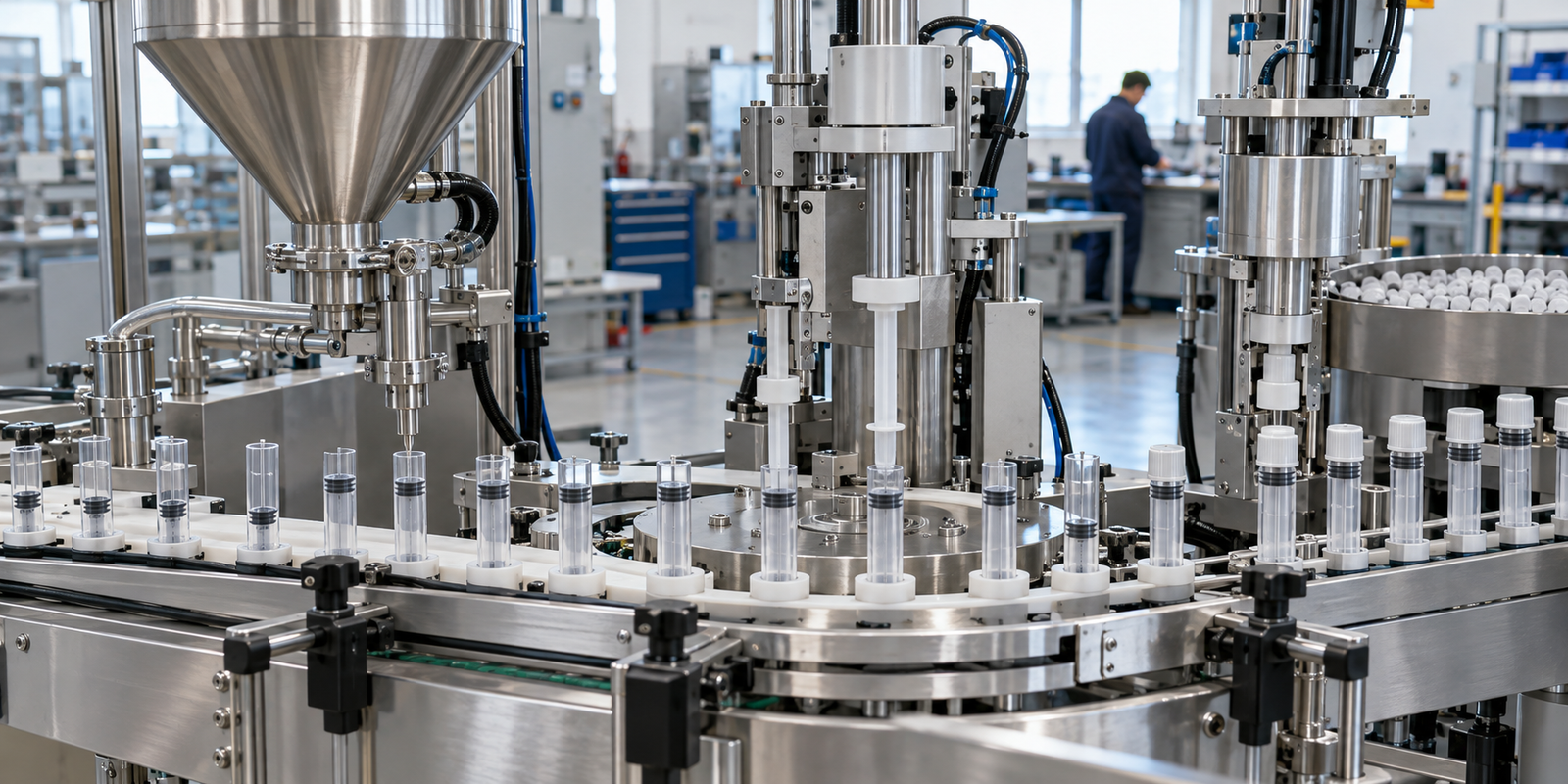
What is a syringe filling machine? It is a packaging machine that doses a measured amount of paste or gel into a syringe-style container, seats the piston, and closes the tip or cap. In our factory it fills viscous insecticide gel bait, so the container is a dispenser, not a sterile medical syringe.
This page covers the parts inside the machine, the stations in order, and the reason thick gel needs volumetric metering rather than gravity.
Where the Boundary Sits: Dispensers, Not Injections
In this product family, syringe means a syringe-style dispenser with four parts: a barrel, an elastomer piston, a plunger rod, and a tip or cap. The machine fills a pest-control product sold by weight, in grams, and the user presses the plunger rod to lay a small bead of gel. There is no needle, no sterile fluid path, and no patient.
Medical syringe filling is a separate discipline: cleanrooms, sterility assurance, and validation against pharmaceutical rules. Gel bait filling is not that. It still calls for repeatable dosing and clean contact surfaces, but the compliance frame is set by the market where the product is sold. When we say syringe filling machine here, we mean the pest-control packaging machine.
What Is Inside a Syringe Filling Machine?
The machine is a set of stations along one product path. A bench-top unit may carry two or three; a full automatic line carries all of them and links them with a conveyor.
- Product tank or hopper with agitation. Holds the gel and keeps it moving so it does not settle or skin over mid-shift.
- Feed pump. Pulls paste from the tank and pushes it to the metering system at steady pressure.
- Metering system. The dosing heart, a positive-displacement pump sized to your dose and paste.
- Filling head and nozzle. Delivers the dose into the barrel, through the tip or the open tail.
- Barrel locating fixture. Holds each barrel square and at a fixed height, so the dose lands in the same spot every cycle.
- Conveyor or indexing table. Moves barrels between stations at a set pitch and pace.
- Piston insertion station. Presses the elastomer piston to a consistent depth without folding it or trapping air.
- Tip and cap closure station. Fits a separate cap, an attached tip, or a tip-and-cap pair, and controls how tightly it seals.
- Inspection and reject station. Checks net content or fill weight and pushes out-of-tolerance barrels off the line.
- Control cabinet and recipes. Stores dose, speed, and timing per format, so changeover follows a saved setup, not memory.

In our experience, the parts that touch the gel decide how the machine holds up. Seals, stator material, nozzle finish, and tank surface matter more than the frame, because the paste is what wears and reacts.
How Syringe Filling Works, Step by Step
The sequence depends on the filling route. In a rear-fill line the barrel is dosed first and the piston goes in afterwards. In a front-fill line the piston is already seated and paste is pushed in through the tip. The steps below follow a rear-fill order.
- Load and orient. Barrels arrive in trays or a hopper. The machine turns each one so the open tail faces up and the barrel sits square in its fixture.
- Feed the paste. The feed pump moves gel from the agitated tank to the metering system. Gentle handling matters, because rough pumping can fold air into a thixotropic gel.
- Meter the dose. The metering system draws a set volume and holds it ready. A piston pump sweeps a fixed volume each stroke; a progressive cavity pump advances a precise volume with a rotor.
- Dispense into the barrel. The filling head releases the dose and lifts as the barrel fills. A short suck-back at the end of the stroke pulls the paste tail clean so it does not string across the rim.
- Insert the piston. The piston station presses the wiper in to a set depth. If it tilts or traps air, net content can drift, so depth and squareness are checked.
- Close the tip or cap. The closure station fits the tip, the cap, or both. Cap torque or press force is set so the cap seals without cracking the barrel.
- Check net content. A checkweigher or inline scale compares each barrel against the target in grams and flags anything outside tolerance.
- Reject and accumulate. Flagged barrels drop into a reject tray; good barrels accumulate for labelling or cartoning.
- Reset for the next format. At changeover the operator swaps the fixture and nozzle parts, then loads the saved recipe for the new barrel size.
Front filling changes steps three to five. The piston is already seated, so there is no insertion after dosing; the nozzle is narrow and the pump runs at higher pressure. Rear filling avoids that back pressure, which is why many producers find it simpler for very thick gel. Our note on selecting gel bait syringes for automated filling covers how barrel and closure design affects the choice.
The Working Principle: Why Viscous Gel Needs Positive Displacement
Ask how a syringe filling machine holds its dose with a thick product, and the answer starts at the pump. The syringe filling machine working principle for viscous gel bait is positive displacement. A positive-displacement pump traps a fixed volume in a chamber and pushes it out, so the dose follows pump geometry, not how thick the paste happens to be that morning.
Time-pressure and gravity dosing do not fit here. Time-pressure dosing lets material flow for a set time under a set pressure; gravity dosing lets it fall under its own weight. Both assume the material moves at a predictable rate. A thixotropic gel breaks that assumption: it thins under shear, thickens at rest, and can trap air, so the volume delivered over a fixed time drifts. Thin liquids can be dosed this way. Thick, shear-sensitive paste cannot.
| Principle | How it moves the paste | Good fit | Watch for |
|---|---|---|---|
| Piston / plunger | A chamber sweeps a set volume each stroke | Most gel baits; tolerates particles and fibers | Seal wear on abrasive paste |
| Progressive cavity | A rotor turns inside a stator | High-viscosity, low-shear products | Cost; careful cleaning of the stator |
| Peristaltic | Rollers squeeze a flexible tube | Thinner gels; fast changeover by swapping the tube | Tube life; lower pressure |
| Gear / rotary | Meshing gears move a fixed volume | Uniform paste without large solids | Not suited to big particles or fibers |

Accuracy figures from pump makers describe the technology family, not your line. As public references, ViscoTec cites about ±1% for its endless-piston principle, and Nordson EFD cites ±1% for progressive cavity pumps. Both are the vendor's own figures, published under the vendor's own test conditions. Read them as what the principle can reach, not as a guarantee on your gel, your barrel, and your cut-off; we confirm the real figure on your product at a sample trial. If your paste carries particles or shifts viscosity between batches, settle the dosing family first, as our guide on how to select a dosing system for gel bait syringe filling explains.
Types of Syringe Filling Machines
Syringe filling machine types fall into three stages of automation, plus a choice of head count. The stage you need follows the bottleneck you already have, not the longest feature list.
| Stage | What it does | What people still do | Typical use |
|---|---|---|---|
| Bench-top semi-automatic | Powered dosing only | Load barrels, insert pistons, cap, weigh | Low to medium volume; the dose is the problem |
| Integrated semi-automatic | Fill, piston insertion, and capping in one cell | Load barrels, take trays away, inspect | Labor tied up in the closing steps |
| Full automatic | Adds orientation, inline inspection, labelling, cartoning | Supervise, replenish paste and parts, maintain | Steady, repeat volume with a stable format mix |
Bench-Top Semi-Automatic
The simplest powered version. A single head doses into a barrel the operator positions by hand, and the rest of the chain stays manual. It is a sound first step when dosing repeatability, not labor cost, is your pain. On a bench-top unit we set the pump stroke and the suck-back first, because those two settings decide whether fill weight repeats.
Integrated Semi-Automatic
An integrated machine combines filling, piston insertion, and cap placement in one unit. The operator loads barrels and moves trays out, but the three critical steps are machine-controlled. This stage earns its cost when your labor sits in closing and checking. Our commissioning order on this frame is fill, then piston, then cap, then checkweighing last, so each upstream setting is stable before we tune the next.
Full Automatic
A full automatic line adds orientation, inline inspection, labelling, and cartoning. Barrels feed in and finished syringes come out. It makes sense once your format mix is stable and your volume is steady enough to keep the line fed. Buyers who step up often find the filling station is the calmest part of the line.
Single-Head, Multi-Head, and In-Line
Head count is separate from automation stage. A single-head machine doses one barrel at a time. A multi-head machine doses several in parallel, which raises output without raising the cycle speed of any one head, but also means a bigger footprint and more air and power draw. In-line machines carry barrels past fixed stations on a conveyor, which suits higher volume and fewer format changes.
Choosing the Automation Level by Your Bottleneck
A common mistake is buying automation from a feature list. Find the step that limits your daily output, automate that step, and stop. In most manual gel bait operations, dosing is not the bottleneck: a skilled operator doses a barrel in seconds. The lost minutes sit upstream in paste handling and barrel loading, or downstream in piston insertion, closure, and weighing.
Watch one full batch and time each task, not just the dose. If the dose is the slow or drifting step, a bench-top filler fixes it for the least money. If piston insertion and capping eat your labor, the integrated stage is where the next real gain appears. A full line pays back once inspection, labelling, and cartoning also consume people.
When a Syringe Filling Machine Fits, and When It Does Not
A syringe filling machine suits high-viscosity paste and gel that holds its shape, products sold by weight, and syringe-style packaging with a piston and cap. Gel bait, paste bait, and similar thick pest-control formulations fit, as do many cosmetic and industrial pastes in the same packaging style.
It does not suit thin liquids that pour freely. Watery liquids, oils, and low-viscosity solutions move too easily for a paste filler's metering and nozzle, and they belong on a machine family built around liquid filling, capping, and level control.
Particle content splits the two further. A gel with soft particles or fibers can often still run on a piston or progressive cavity pump with the right clearances. A liquid with large solids that must not be crushed belongs in a different design. We ask for a sample with the real particle content before recommending anything, since one base formula behaves differently once fillers are added.
How to Read Syringe Filling Machine Specifications
Listings use several numbers that sound alike and are not. Read them in this order.
Rated or nameplate cycle rate. The theoretical maximum under ideal conditions, with no stops. A "3,000 per hour" figure can fall far short once loading, changeover, and rejects are counted. Ask for sustained good output per shift instead.
Metering accuracy. The repeatability of the pump, usually quoted as a percentage at the pump outlet. Treat vendor figures as family-level references and confirm the number on your own paste.
Net-content tolerance. The range allowed on the filled, closed barrel, in grams against your target. It is wider than pump accuracy, because closure, cut-off, and trapped air all add variation.
Changeover time. How long it takes to move between barrel sizes or closures, with or without tools. If you run several formats, this number can decide your real output more than the cycle rate does.
Air and electrical requirements. The compressed-air pressure and flow, and the voltage and phase the cabinet needs. Check these against your plant before the machine ships, and ask whether the air needs drying.
Wetted materials. The parts that touch the gel: pump seals, stator, nozzle, tank, and tubing. Match them to your formulation, since an active ingredient or solvent can attack the wrong seal. Your SDS and a compatibility check settle this.
We size the metering system and stations to the product first and the cycle rate second. Buyers at a trial often misread one number: they see the rated speed and assume it is achievable with their gel and format mix. The trial shows the sustained rate, and we write that figure into the acceptance plan. Cost follows the same logic, which is why our gel bait syringe filling machine cost guide starts from configuration rather than a price list.
Glossary of Syringe Filling Terms
- Barrel. The tube that holds the paste, commonly 5 mL, 8 mL, 10 mL, or 20 mL in this market.
- Piston. The elastomer wiper inside the barrel that pushes the paste forward.
- Plunger rod. The separate part the end user presses; it may arrive pre-assembled or be added by hand or on the line.
- Tip / cap. The closure: a separate cap, an attached tip, or a tip-and-cap combination.
- Front filling. Dosing through the tip with a narrow nozzle and higher pressure; suits barrels with the piston already seated.
- Rear filling. Dosing through the open tail and inserting the piston afterwards; often simpler for viscous gel.
- Suck-back. A short reverse pump movement at the end of the dose that pulls the paste tail clean and prevents stringing.
- Checkweighing. Weighing each filled barrel against the target in grams to confirm net content and catch drift.

FAQ
What does a syringe filling machine do?
It doses a measured amount of paste or gel into a syringe-style container, then seats the piston and closes the tip or cap. In this market it fills insecticide gel bait into small barrels. It is not a machine for sterile medical syringes.
What is the difference between front filling and rear filling?
Front filling pushes paste through the tip into a barrel that already holds its piston, so it needs a narrow nozzle and higher pressure. Rear filling doses through the open tail and inserts the piston after dosing, which is easier on thick gel but adds a step and a venting check.
Why can't a syringe filling machine use gravity dosing?
Gravity and time-pressure dosing assume the material flows at a predictable rate. A thixotropic gel thins under shear, thickens at rest, and traps air, so the volume delivered over a fixed time drifts. Positive displacement traps a fixed volume instead, which keeps net content steady.
How accurate is a syringe filling machine?
Pump makers reference figures such as about ±1% under their own test conditions, for example ViscoTec with an endless-piston principle and Nordson EFD with progressive cavity pumps. Those describe the pump family, not your line. The real figure depends on your paste, barrel, and cut-off, so we measure it on your product.
When should I choose an automatic line over a bench-top machine?
Start from your bottleneck, not the cycle rate. If the dose is the drifting step, a bench-top semi-automatic is enough. If your labor sits in piston insertion, closure, and inspection, or your volume is steady, an integrated or full automatic line is the better fit.
Conclusion
What is a syringe filling machine, in the end, is a simple idea: it doses a measured amount of paste or gel into a syringe-style container and closes it. It suits thick, weight-sold products such as insecticide gel bait, and it depends on positive-displacement metering rather than gravity. The station list is much the same across the family, but the automation stage you choose should follow the step that limits your own line. Read the specs in order, treat vendor figures as family references, and confirm the numbers on your own gel.
Get a Quote
Send us your gel sample, an empty and a filled barrel, the component drawings, your SDS, and your net-content target in grams. We will review your product, recommend the filling route, dosing principle, and stations that fit, and run a sample trial on your actual gel. You get a line proposal with a clear acceptance-test plan, written before anything ships.
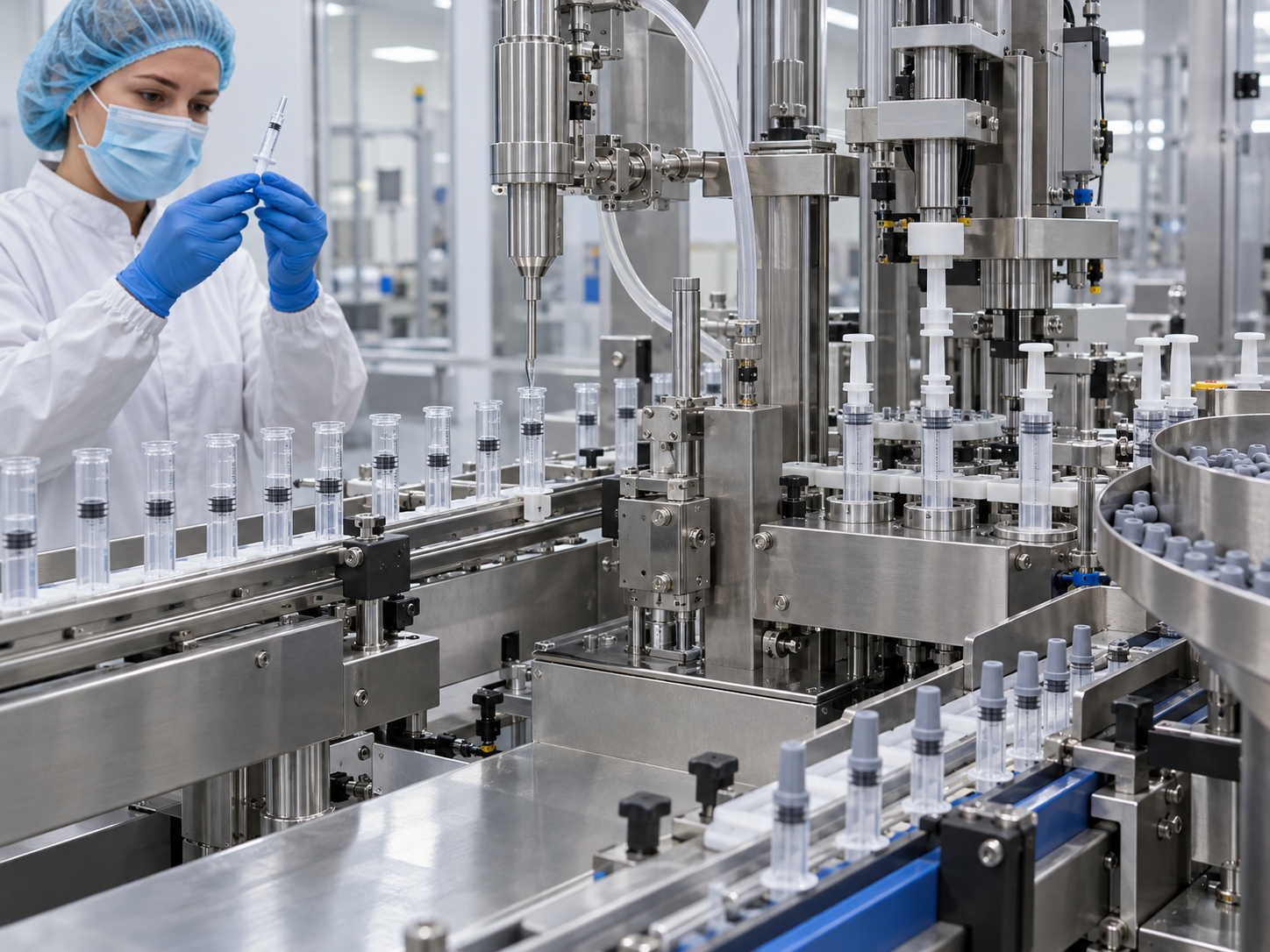
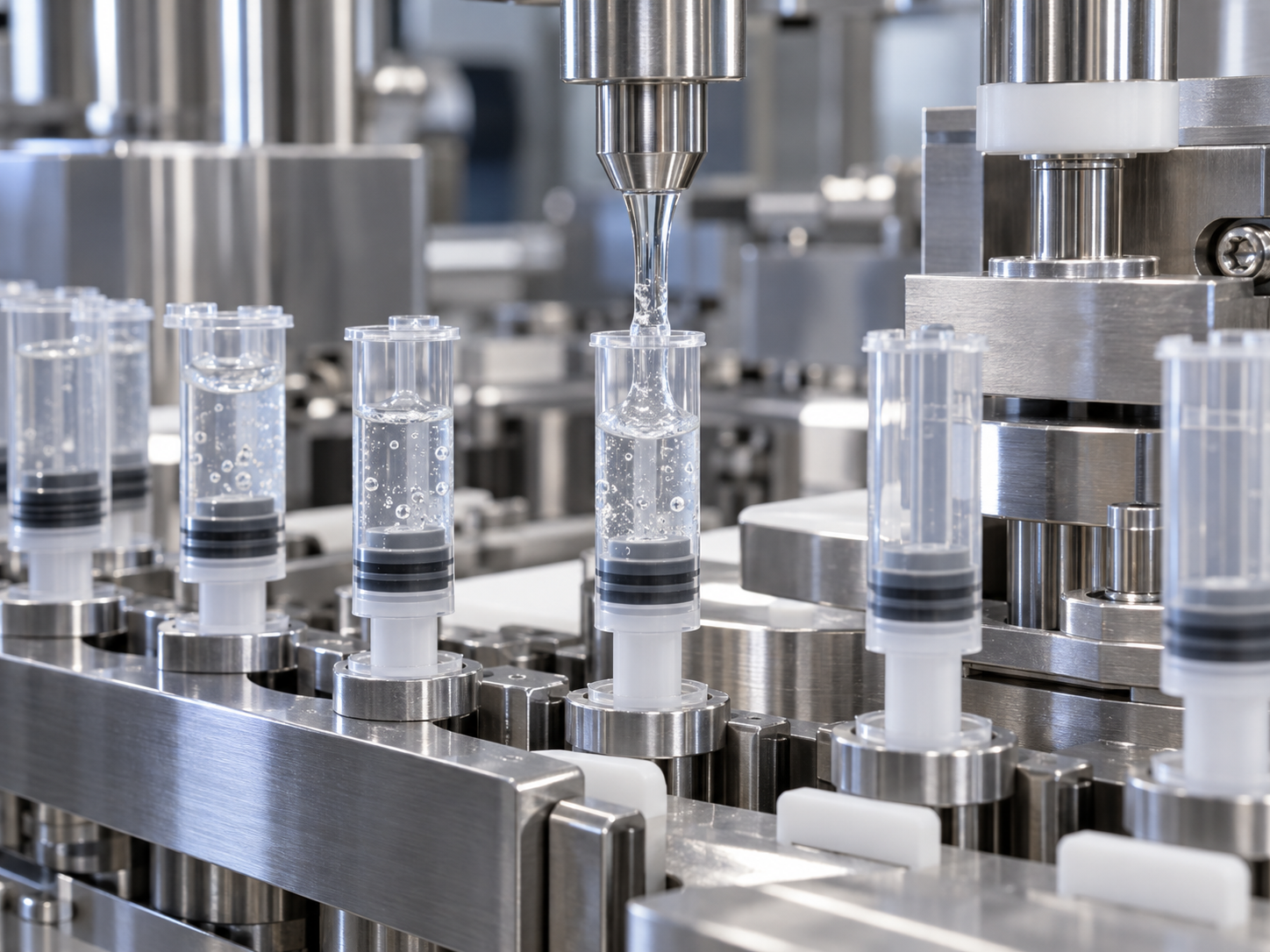
What a syringe filling line looks like in practice
The images below are illustrative engineering visuals for evaluating line stages. They are not measured output data and should be used together with a product sample, filling trial and documented acceptance criteria.

Related equipment and RFQ resources
For a complete equipment comparison, review our syringe filling machines and the veterinary medicine application guide. Product-specific use cases include paste syringe filling, cockroach bait syringe filling, pet drops filling and intramammary syringe filling.
When the line includes multiple operations, compare a filling and capping line with the wider packaging solution range. Related planning articles cover grams versus millilitres in gel-bait syringe filling, the move from manual to automatic syringe filling and changeover planning for syringe formats.
For a project discussion, use our filling equipment product range, contact page or request-a-quote page and include the product, fill volume, syringe format, closure, target inspection checks and any washdown or cleanroom constraints.
