

Selecting a dosing system for gel bait syringe filling is a decision about the paste, not about a brochure. Two suppliers can quote the same fill volume, the same cycle rate and the same stainless-steel frame, and still deliver very different results on a real cockroach or ant gel bait, because the dosing principle underneath the machine decides how the material behaves at the nozzle: whether it holds a clean thread, whether it leaves residue on the syringe tip, whether a filled barrel contains a hidden air pocket, and whether the first shots after a refill match the rest of the batch.
This article explains how to separate the dosing principle from the drive and control system, how to read vendor claims about accuracy honestly, what to check on the material and the package before comparing offers, and how to run a like-for-like comparison that produces a decision rather than a shortlist.
Match the Decision to the Buyer’s Question
The buyer’s real question is rarely “which pump is best.” It is: *which dosing-system characteristics matter for this specific gel bait product, in this specific syringe, at this output target?* That question has four parts, and each one eliminates or admits options:
- Material behaviour. Viscosity, yield behaviour, filler content, entrapped air, temperature sensitivity.
- Package interface. Syringe barrel geometry, tip or tail filling route, nozzle length and cut-off distance.
- Dose and repeatability. Target net content, allowable spread, and what “repeatable” means for the labelled unit.
- Operating envelope. Output target, cleaning and changeover between products, and who maintains the wetted parts.
A supplier who answers only the third part has answered one-quarter of the question.
Separate the Metering Principle from the Drive and Control

The most common source of confusion in gel bait dosing specifications is that “servo” is treated as if it were a pump type. It is not. Servo, pneumatic and mechanical drives are how a metering element is moved; the metering element itself is what creates the volume. A servo-driven piston, a servo-driven progressive cavity pump and a servo-driven peristaltic head are three different metering principles sharing one control technology.
This distinction matters commercially. Two proposals can both say “servo-controlled dosing with PLC recipe management” and still contain entirely different wetted paths, pressure profiles and maintenance obligations. Buyers should require the supplier to name the metering principle explicitly, separately from the drive, and to state what the drive actually adds: stroke profile control, suck-back programming, speed ramps, or closed-loop correction.
| Metering principle | How the volume is created | Typical material fit | Practical limits to verify |
| Piston / plunger positive displacement | A piston sweeps a fixed cylinder volume; volume set by stroke | Medium to high viscosity pastes, gels and creams | Valve and seal wear; shear and aeration at high cycle rates; recovery stroke between fills |
| Progressive cavity (endless piston / eccentric screw) | Rotor rotates in an elastomer stator; a defined cavity moves continuously | Viscous, filled, shear-sensitive pastes over a wide viscosity range | Stator is a wear part with abrasive fillers; sizing must match the dose range |
| Peristaltic (tube) | Rollers compress a flexible tube; volume set by bore and rotation | Low to medium viscosity; shear-sensitive or sterile-sensitive duty | Tubing is a consumable and calibration drifts as the tube ages; limited pressure generation |
| Gear / rotary displacement | Rotating elements carry a fixed volume between teeth or lobes | Free-flowing to medium viscosity, continuous flow | Shear on sensitive products; poor fit for highly viscous, non-flowing pastes |
| Time / pressure (flow-meter corrected) | Flow for a set time, or valve timing with a flow-meter correction loop | Low viscosity liquids | Generally unsuitable as the primary strategy for a firm paste |
Vendor-published figures illustrate the range of claims a buyer will meet: ViscoTec states a theoretical dosing accuracy of ±1% at the pump outlet for the endless piston principle, dependent on the fluid, and notes that in more than 95% of applications no closing valve is needed because the pump uses a short reverse movement (suck-back) at the end of dosing; Nordson EFD publishes ±1% volume accuracy and repeatability for its 797PCP progressive cavity pumps across four sizes from 0.01 mL to 0.30 mL per revolution. These are vendor statements about their own products under their own conditions. They are useful as an indication of what the technology family can do. They are not a prediction of what your gel bait will do in your syringe, and they are not King Pack performance data.
Material and Pressure Compatibility
Gel bait is not one material. A cockroach gel bait and an ant gel bait can differ in filler loading, in yield stress, in how they behave when the temperature in the filling room drifts, and in how much air they carry when transferred from a bulk container. The dosing system has to move the specific material that will be in the syringe, at the condition it will actually be filled at.
Points a buyer should resolve before comparing systems:
- Viscosity at the filling condition, with the method named. “High viscosity” is not a specification. A measured value with its temperature and instrument method is.
- Whether the material is shear-thinning. A thixotropic paste can be thinned by the act of pumping it, so the flow rate at the start of a stroke and at the end may not be the same.
- Filler content and particle size. Abrasive or particulate-bearing products change the wear picture on seals, stators and valves.
- Pressure the system can generate and the pressure the syringe can take. A dosing method that needs high pressure to move a firm paste will apply that pressure to the barrel, the flange and the seal. The pressure is a system property, not only a pump property.
- Suction behaviour. If the material resists being drawn into the metering chamber, the fill will be short regardless of how accurate the pump is.
A note on the tip interface. Where a syringe is filled through a narrow tip or a Luer-type connection, the restriction at that connection is part of the pressure budget. Vendor technical notes describe how filling through a Luer Lock connection relates to high-viscosity material and narrow passages; the same principle applies to any narrow tip route. What matters for selection is that the buyer treats the syringe tip as part of the dosing system, not as something downstream of it.
Cut-Off, Drip Control and Repeatability
The interesting part of a gel bait fill is the last few millimetres. How the dose is cut off determines whether the syringe tip arrives clean or with a bead of product that will later contaminate the cap seat, the carton, or the operator’s glove.
Three mechanisms are commonly used, and each is a different trade:
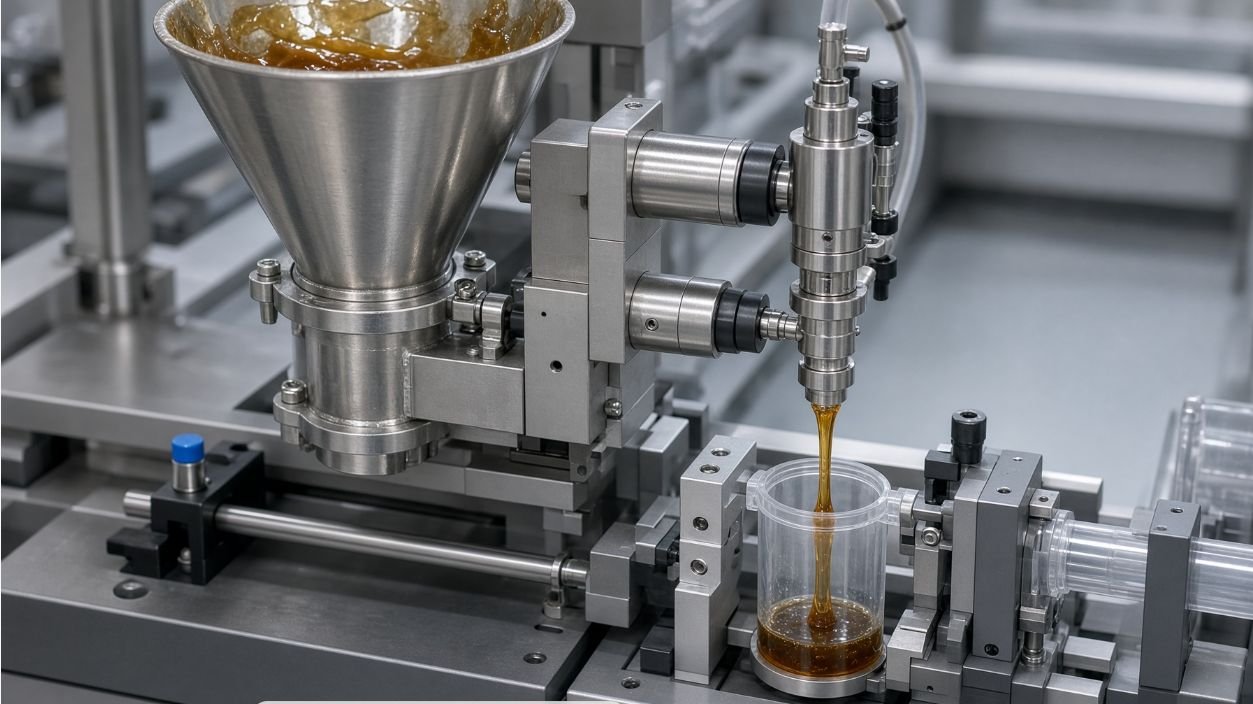
- Suck-back (reverse movement). After the dose, the metering element briefly reverses, drawing the material back from the nozzle. ViscoTec describes this as its standard means of achieving clean cut-off without a closing valve in the large majority of applications. The limit: if the nozzle is too long, the reverse movement may not reach the material at the tip, and an additional closing element may be needed.
- Nozzle closure (valve or plunger). A mechanical closure seals the tip between cycles. Effective, but it adds a moving part in the product path and therefore a cleaning and wear item.
- Lift-and-dispense timing. The nozzle rises as or after the dose is delivered, using the material’s own cohesion to break the thread. Simple and low-cost; sensitive to material rheology and to the timing being right for each product.
Repeatability should be discussed in the buyer’s units. Nordson EFD describes a correction-factor setting on its controllers to hold deposit volumes within a stated tolerance over time; the equivalent question for a gel bait line is which value is being corrected, measured how often, and by whom. A dosing system described as repeatable without a stated measurement method and sampling plan is a claim, not a specification.
| Question to the supplier | Why it changes the buying decision |
| Which metering principle, stated separately from the drive? | Determines wetted path, wear parts and pressure profile |
| What reversal or closure method provides cut-off, and can it be programmed per recipe? | Determines tip cleanliness, cap-seat contamination and changeover flexibility |
| What is the smallest and largest dose the selected pump size can deliver reliably? | Determines whether one unit covers the full format range or needs multiple sizes |
| How is dose verified — weight, volume reference, or in-line check — and at what frequency? | Determines whether the repeatability claim is auditable |
| Which parts are product-contact, and what is the replacement interval basis? | Determines consumable cost and the spare-parts plan |
Cleaning and the Scope of Wetted Parts
Gel bait is a pesticide product. Cleaning is therefore not only a changeover convenience; it is a product-safety boundary that the buyer’s own quality system may need to defend. The dosing system determines how much of that boundary is dismantlable and how much is not.
Ask for the wetted-part list as a drawing or a bill of materials, not as a sentence. Then check:
- Reachability. Can every product-contact surface be reached, inspected and cleaned without special tools?
- Retention points. Dead ends, sharp internal corners, threaded joints, long nozzle bores and crevices between the stator and its housing are the places product stays.
- Compatibility. Seal, stator and tubing materials must be checked against the actual product and against the cleaning agents the buyer intends to use. ViscoTec’s own literature notes that the stator in a progressive cavity pump is an elastomer and that abrasive products increase wear; elastomer compatibility is a buyer-side material question, not something a catalogue answers.
- Dedicated versus shared parts. Where a line runs more than one product type, the number of parts that must be dedicated or replaced between products is a recurring cost and a scheduling constraint.
The cleaning chemistry, the frequency and the acceptance criteria should come from the buyer’s product SDS and the buyer’s quality requirements. A machine supplier can describe accessibility and materials; it cannot define the buyer’s cleaning validation.
Compare Dosing Options Like for Like
Proposals become comparable only when the same inputs are given to every supplier. The most reliable approach is to write the comparison inputs first and send the identical package to each candidate.
| Comparison input | What “identical” means |
| Product | Same gel bait, same batch or lot identity, with SDS and viscosity data |
| Condition | Same fill temperature, same ambient assumption, same allowed time in the bulk container |
| Package | Same syringe barrel, piston, tip, cap — physical samples plus drawings |
| Dose | Same target net content and the same stated tolerance on that target |
| Output | Same good-units-per-hour target, stated as a requirement rather than a tick-box |
| Verification | Same sampling plan and the same measurement method for every trial |
| Cleaning | Same product-switch scenario and the same cleaning requirement |
| Scope | Same supply boundary — what is included, what is excluded, who supplies the upstream feed |
Without this, a comparison compares sales margins, not technology. Two quotes for “a gel bait syringe filling line” can differ by an entire station and still look similar on a summary page.
Common Risks and Mistakes
- Treating “servo” as a metering principle. It is a drive technology. The pump or piston underneath is the thing that determines dose behaviour.
- Accepting a vendor accuracy figure as the project’s acceptance criterion. A published ±1% describes the vendor’s pump under the vendor’s conditions. The gel bait line’s criterion must be agreed against the actual syringe and product.
- Copying a specification from another industry. A veterinary gel or prefilled-syringe specification carries assumptions (filling route, sterility requirements, tolerance basis) that do not transfer to a pest-control gel bait syringe. Do not carry those numbers across.
- Ignoring the syringe as a system component. Tip bore, tip length, barrel stiffness and flange geometry all interact with the dosing pressure.
- Under-specifying the dose range. One pump size rarely covers a very small and a very large format equally well. Buyers should compare the required range against the offered size range explicitly.
- Leaving cleaning to be settled later. Cleaning is a selection criterion. If it is deferred to installation, it becomes a change order.
- No sampling plan for the trial. A trial without a defined sampling plan produces photographs, not data.
What to Send So the Comparison Can Actually Be Run
The comparison inputs above become a submission list. In practice, a buyer should prepare:
- Product documentation — SDS, technical data sheet, measured viscosity with method and temperature, filler or particle description, and the storage/handling conditions the product expects.
- Complete syringe package references — barrel, piston, plunger rod (if the finished unit carries one), tip and cap, supplied as both physical samples and dimensional drawings.
- Dose and output requirements — target net content and its unit, the tolerance the buyer intends to apply, and the good-output target rather than the nominal machine speed.
- Interface and upstream description — how the material arrives (bulk container, pail, drum), and whether an upstream feed or transfer system is in scope.
- Defects the trial must investigate — for example tip residue, air voids at the tail, deformation, or dose drift after a refill.
- Cleaning and changeover scenario — the products that will share the line and the sequence they run in.
The quantity of samples required to run a meaningful trial is a project-specific decision. It depends on the number of test conditions, the sampling plan and whether destructive checks are needed, so it should be confirmed with the engineering team rather than assumed.
How King Pack Supports This Application

King Pack Machinery (Wuxi King-Pack / Wuxi Jingpai Machinery Co., Ltd., founded 2009, with a core technical and management team carrying more than 20 years of industry experience) configures filling equipment for pharmaceutical, veterinary, cosmetic, personal-care and high-value functional products, including syringe and applicator filling applications. In a gel bait syringe dosing decision, the relevant support is:
- Selection driven by the material, not by a preferred pump. The starting point is the buyer’s product data, dose and package, and the configuration follows from there. We do not assert that one metering principle is universally the best choice for all gel baits, and we do not treat a pump family listed by another vendor as automatically available in our own configuration.
- Sample-based configuration. The proposed dosing arrangement is developed against the buyer’s actual paste and actual syringe components, so the trial tests the product rather than a substitute.
- Stable production over a headline speed figure. The design intent is repeatable production at the agreed output with defined verification, not the highest instantaneous cycle rate that can be demonstrated once.
- Complete-line integration. Where the project spans feed, dosing, piston insertion, closure, inspection and end-of-line packaging, the stations are planned as one interface set with defined responsibility boundaries.
- International component availability, documentation and training. Electrical and pneumatic components are selected with international availability in mind, and the project is delivered with technical documentation, training and after-sales support including spare-parts planning.
- FAT and acceptance on agreed criteria. Fill-related acceptance criteria are agreed with the buyer before the test, so that the result is evidence rather than an opinion.
If your project involves a veterinary or applicator-based syringe format, the existing application page describes how King Pack approaches syringe and applicator filling more broadly.
FAQ
Q1: Which dosing principle is best for gel bait syringe filling?
There is no single answer. Piston positive displacement suits medium-to-high viscosity pastes with straightforward flow; progressive cavity handles a wide viscosity range and filled, shear-sensitive pastes with continuous volumetric delivery; peristaltic suits low-to-medium viscosity and cleaning-driven duty. The right choice depends on the specific product’s rheology, the syringe interface and the dose range.
Q2: Does “servo controlled” tell me anything about accuracy?
It tells you about the drive. Servo control can improve stroke profile and allow programmed suck-back, but the metering principle creates the volume. Ask for the principle separately.
Q3: Can I use a vendor’s published accuracy figure as my acceptance criterion?
No. Vendor figures are self-published statements about their own pump under their own conditions. Your acceptance criterion should be agreed for your product, your syringe and your measurement method, and verified in a trial.
Q4: How do I control stringing and tip residue at the cut-off?
Three common approaches are programmed suck-back (reverse movement), a mechanical nozzle closure, and lift-and-dispense timing. Each has different implications for cleaning and for how the timing must be tuned per product.
Q5: Do I need a closing valve?
Not always. ViscoTec states that with the endless piston principle no closing valve is required in more than 95% of applications, provided the nozzle length allows the suck-back to work. If the nozzle is long, an additional closing element may be necessary.
Q6: How many syringe samples should I send for a dosing comparison?
This is project-specific and should be confirmed with the engineering team. It depends on how many conditions you want to test, the sampling plan, and whether destructive or extended-run checks are included.
Q7: What is the single most useful document to send first?
The product’s measured viscosity at the filling temperature, with the method named, together with the syringe drawings. Those two items remove most of the guesswork from the initial selection.
Q8: How do I compare two proposals fairly?
Give both suppliers identical inputs: same product lot, same temperature, same syringe samples, same dose and tolerance, same output target and the same verification method. Then compare scope, not headline price.
Q9: Are the accuracy claims from veterinary or prefilled-syringe equipment relevant here?
Only as technology background. Precision, sterility and vacuum claims made for veterinary or prefilled-syringe systems are not gel bait performance data and should not be transferred as a specification. *(For any claim relating to a regulated product or market, confirm with a qualified regulatory professional for your target market.)*
Conclusion
Choosing a gel bait syringe filling dosing system is a process of elimination, not a search for the best pump. The metering principle, the drive and control layer, the cut-off method, the wetted-part scope and the cleaning path each answer a different part of the buyer’s question. When the same inputs are given to every candidate and the trial has a sampling plan, the comparison produces a defensible decision — and the numbers that matter are the ones measured on your product, in your syringe, on your measurement method.
Ready to compare dosing options on your own product? Send your gel bait specification, viscosity data, syringe drawings and samples, target net content and good-output requirement, and request a dosing system comparison for your application.