 Skip to content


Food tube packaging can support portion control and convenient dispensing, but shelf life and safety depend on formulation, process, tube construction, seal integrity, storage and the applicable food-safety system. Equipment selection should follow the customer’s product and validation plan.
In this complete guide, we will break down food tube filling equipment for 2026, with a focus on aseptic technology, sealing performance, and food safety compliance. The goal is to help manufacturers understand what’s required to run safe, efficient, and scalable food tube operations.
Defining Food-Grade Filling: The Critical Difference Between Standard and Aseptic Processing
Food-contact materials, cleanability and process controls should be specified from the product, hygiene program and target market. Stainless-steel grade, cleaning method and documentation are application-specific; do not assume one grade or checklist applies to every food line.
King Pack can discuss food-grade filling and sealing configurations for products such as sauces, purees and nut butters. Compliance with FDA, USDA, HACCP or other requirements must be confirmed for the selected machine, facility and customer’s quality system.
The Principles of Aseptic Filling vs. Hot Filling
Food manufacturers choose between aseptic filling and hot filling based on product characteristics, desired shelf life, and production economics. Each approach offers distinct advantages for different applications.
Aseptic Filling Process

Aseptic filling uses separately controlled product and package sterilization with a defined sterile zone. The actual temperatures, sterilization method, cooling, air handling and sealing sequence depend on the validated process and product.
The sequence follows these steps:
- Illustrative process parameters only. HTST temperature and hold time must be established from the product, validated thermal process and applicable regulations.
- Rapid Cooling: Products cool to filling temperature (20-30°C) immediately after sterilization
- Tube sterilization method depends on the package, process and validated equipment; confirm whether peroxide, UV, electron beam or another method is appropriate.
- Sterile Filling: Products fill tubes within enclosed sterile chambers protected by HEPA-filtered positive air pressure
- Hermetic Sealing: Tubes seal immediately after filling in the sterile zone
Recommended Reading: Types of Food Packaging Machines: Applications, Benefits, and Industry Uses – King Pack Machinery
Hot Filling Process
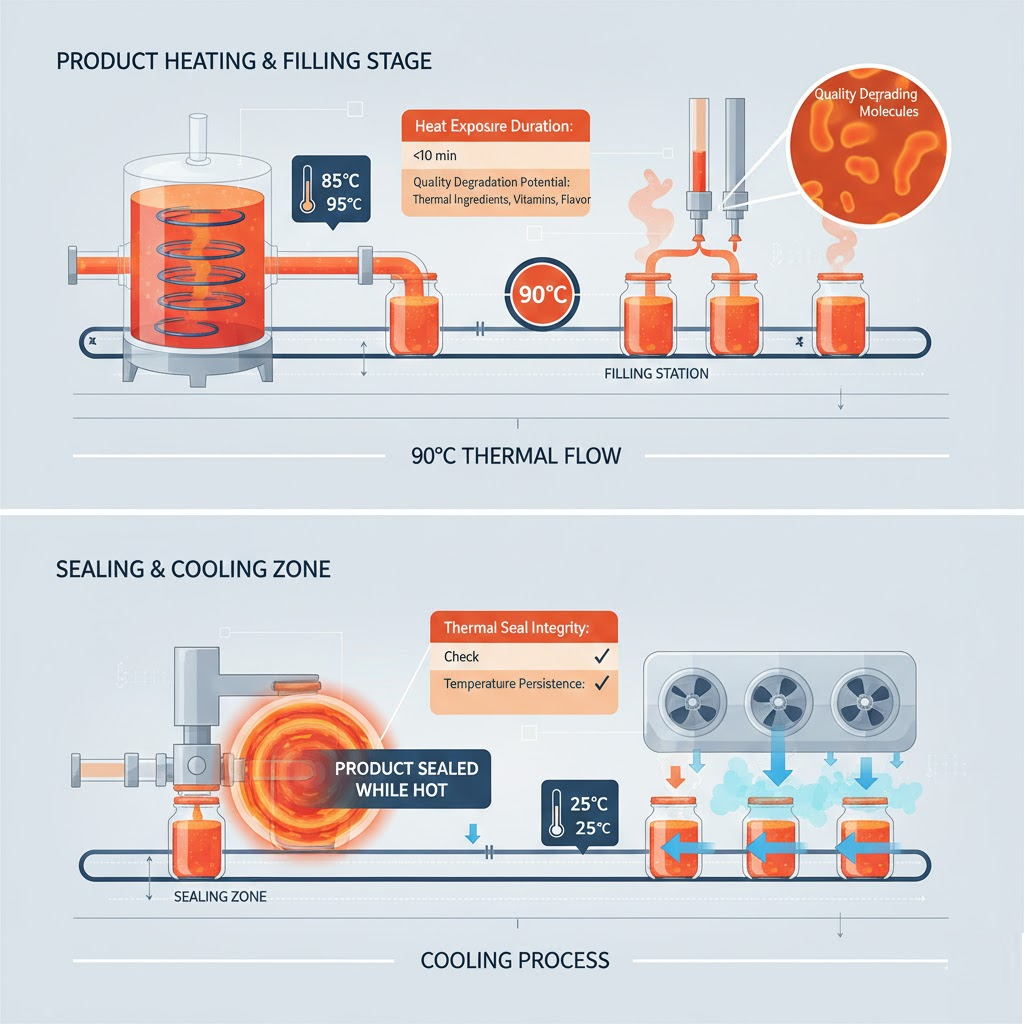
Hot filling uses an elevated product temperature and immediate sealing when suitable for the product. The exact temperature and hold conditions must be established from formulation, packaging and validated food-safety requirements.
| Processing Method | Product Temperature | Shelf Life (Ambient) | Nutrient Retention | Equipment Cost | Best Applications |
| Aseptic Filling | 20-30°C | 12-24 months | 85-95% | $$$$ | Baby food, specialty sauces, organic products |
| Hot Filling | 85-95°C | 6-12 months | 70-80% | $$ | Ketchup, mustard, standard condiments |
| Cold Filling + Preservatives | 4-15°C | 3-6 months | 90-98% | $ | Fresh sauces, refrigerated products |
Aseptic processing may provide an extended ambient-life option for suitable products, but shelf life, nutrient retention and refrigeration requirements must be demonstrated through formulation, process and package studies.
Technical Challenge: Handling High-Viscosity and Particulate Foods (Sauces, Purees, Gels)
Viscosity, particulates and non-Newtonian flow can affect pump selection, nozzle design and filling stability. Measure the customer’s product across its operating temperature range instead of relying on a generic cP limit.
The selected dosing system should be validated on the representative food product. Fill tolerance depends on product, temperature, tube, nozzle, calibration and machine configuration; do not assume ±0.5% or a 500,000 cP capability universally.
Viscosity Management Strategies
Filling liquid and paste products with high viscosity requires careful equipment selection and process control:
- Temperature Control: Heated hoppers and product reservoirs maintain consistent viscosity throughout production runs. Medium speed filling helps avoid product separation or flow issues.
- Pump Selection: Ceramic pumps, piston fillers, or volumetric filling systems deliver precise fill volumes regardless of thickness. Level Fillers and Paste Fillers are ideal for thick cosmetic products or CBD products.
- Nozzle Design: Capillary nozzles, outward opening nozzles, and large-bore filling tips prevent clogging while ensuring smooth flow. Check valves and recirculation tanks support continuous product movement.
- Anti-Drip and Tube Protection: Closure stations with heat seal, fold and crimp, or heated tool sealing maintain hygiene and prevent waste. Fixing molds and crimping machines ensure uniform tube sealing.
- Handling Particulates: Products with solids, like herbal extracts in cosmetic or CBD products, require gentle pumping to preserve particle integrity and product appearance.
Particulate products require a pump, valve, nozzle and clearance matched to the largest particle and desired product appearance. Confirm gentle handling, cleanability and seal performance with product trials.
Recommended Reading: How Food-Grade Tube Sealing Improves the Shelf Life of Mayonnaise – King Pack Machinery
Material Science: Selecting High-Barrier Tubes to Maximize Shelf Life
Tube material selection directly impacts product shelf life, production costs, and environmental sustainability. Food applications demand materials that provide excellent barrier properties against oxygen, moisture, and light while maintaining food-safe certifications.
Comparison Table: Laminate vs. Aluminum Tubes for Food Preservation
| Property | Laminate (Plastic) Tubes | Aluminum Tubes |
| Oxygen Barrier | Barrier values vary by structure, supplier, thickness and test method. Use the selected film/tube supplier’s oxygen transmission data rather than generic numbers. | Aluminum can provide a strong barrier when the tube and coating are suitable; verify the actual transmission specification. |
| Moisture Barrier | Moisture-barrier performance depends on the full laminate or aluminum construction and test method. | Verify the selected tube’s moisture transmission and coating compatibility. |
| Light Protection | Fair to Good (metallized layers improve) | Light protection depends on the material structure, thickness and print/foil construction. |
| Material Cost | Material cost varies by supplier, volume, region and specification; use a project quotation. | Material cost varies by supplier, volume, region and specification; use a project quotation. |
| Shelf Life Achievement | Shelf life must be established by formulation and package stability studies. | Shelf life must be established by formulation and package stability studies. |
| Product Compatibility | Product compatibility depends on pH, formulation, coating and supplier data; validate the selected package. | Product compatibility depends on pH, formulation, coating and supplier data; validate the selected package. |
| Consumer Dispensing | Easy to squeeze, complete evacuation | Requires more force, iconic appearance |
| Sustainability | Recyclability depends on the full tube structure and local recycling system. | Recyclability depends on the full tube structure and local recycling system. |
| Print Quality | Excellent full-color graphics, complex designs | Limited printing area, traditional appearance |
| Sealing Method | Hot air or ultrasonic sealing | Mechanical folding and crimping |
Laminate Tube Construction for Food
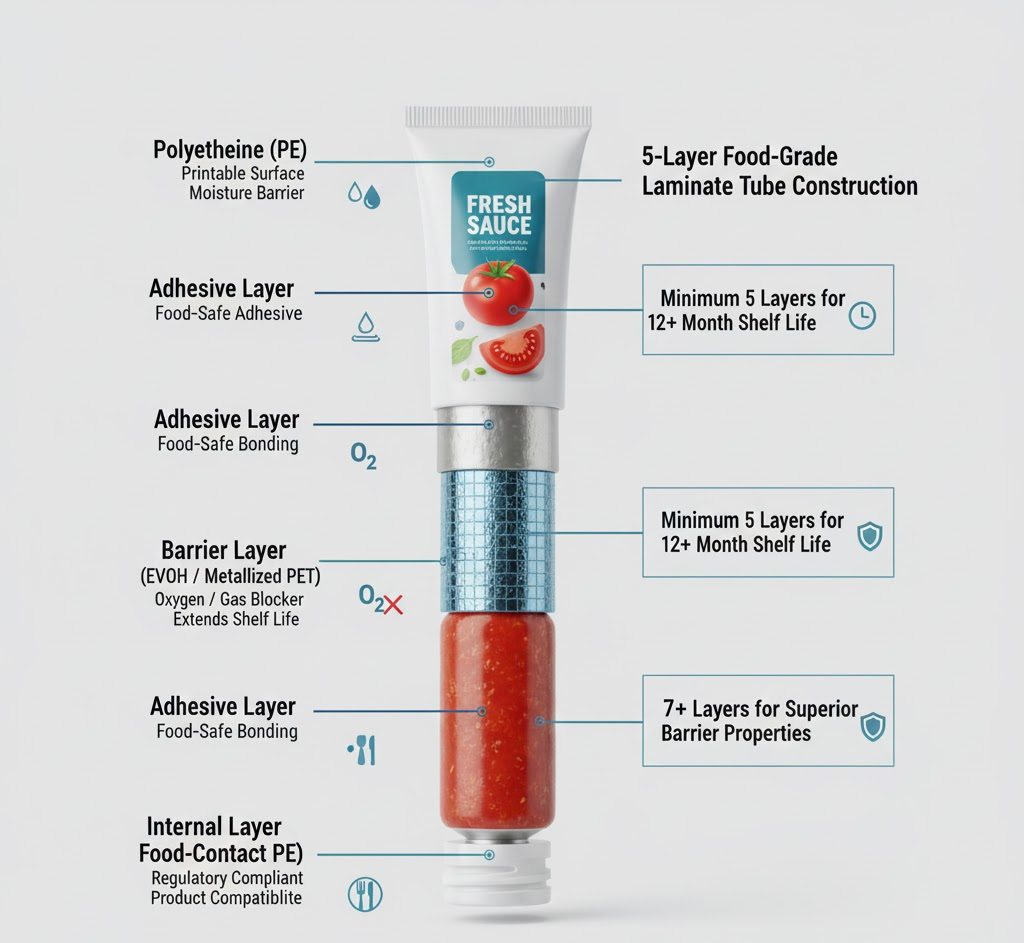
Laminate barrier performance depends on polymer layers, adhesive, thickness and supplier controls. Confirm oxygen/moisture transmission and food-contact compliance for the selected tube.
Layer count and shelf-life suitability should be established from package studies; do not treat a five- or seven-layer structure as a universal baseline.
Aluminum Tubes for Premium Food Products
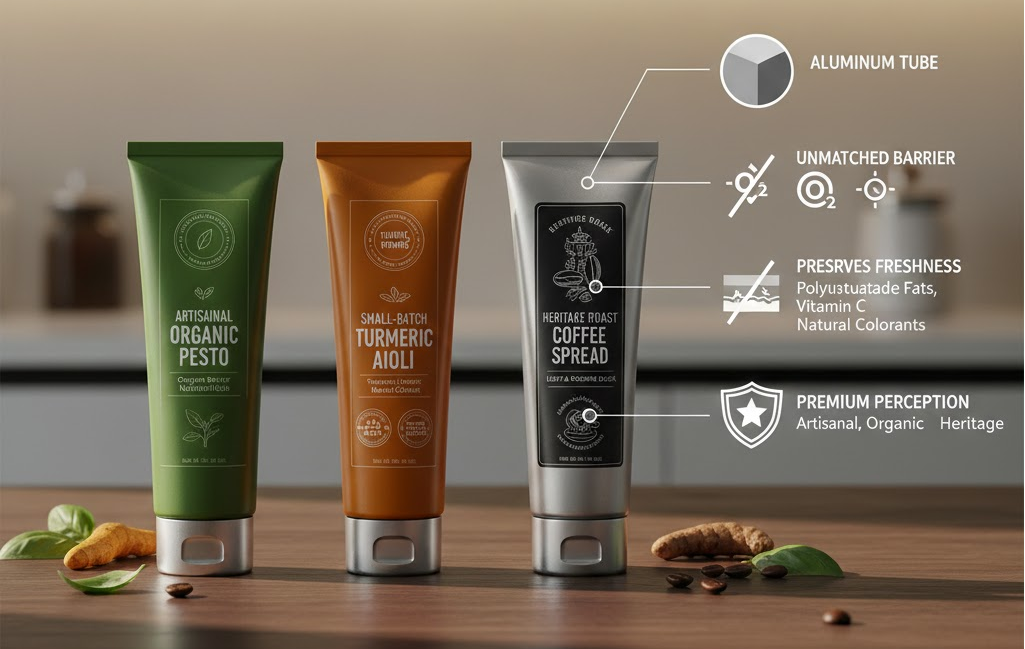
Aluminum can provide high light and oxygen barrier for suitable products, but the coating, closure, formulation and stability data must be evaluated together.
Premium food brands increasingly specify aluminum tubes despite higher costs. The traditional appearance communicates quality and heritage, particularly valuable for artisanal products, organic foods, and specialty condiments targeting discerning consumers.
Recommended Reading: A Beginner’s Guide to Tube Filling Machines – King Pack Machinery
The Role of Hermetic Sealing and Inert Gas Flushing (Nitrogen) in Extending Freshness
A hermetic seal can reduce ingress when the seal is correctly formed and verified. Food safety and shelf life still depend on the product, package, process and storage conditions.
Seal Quality Verification Methods
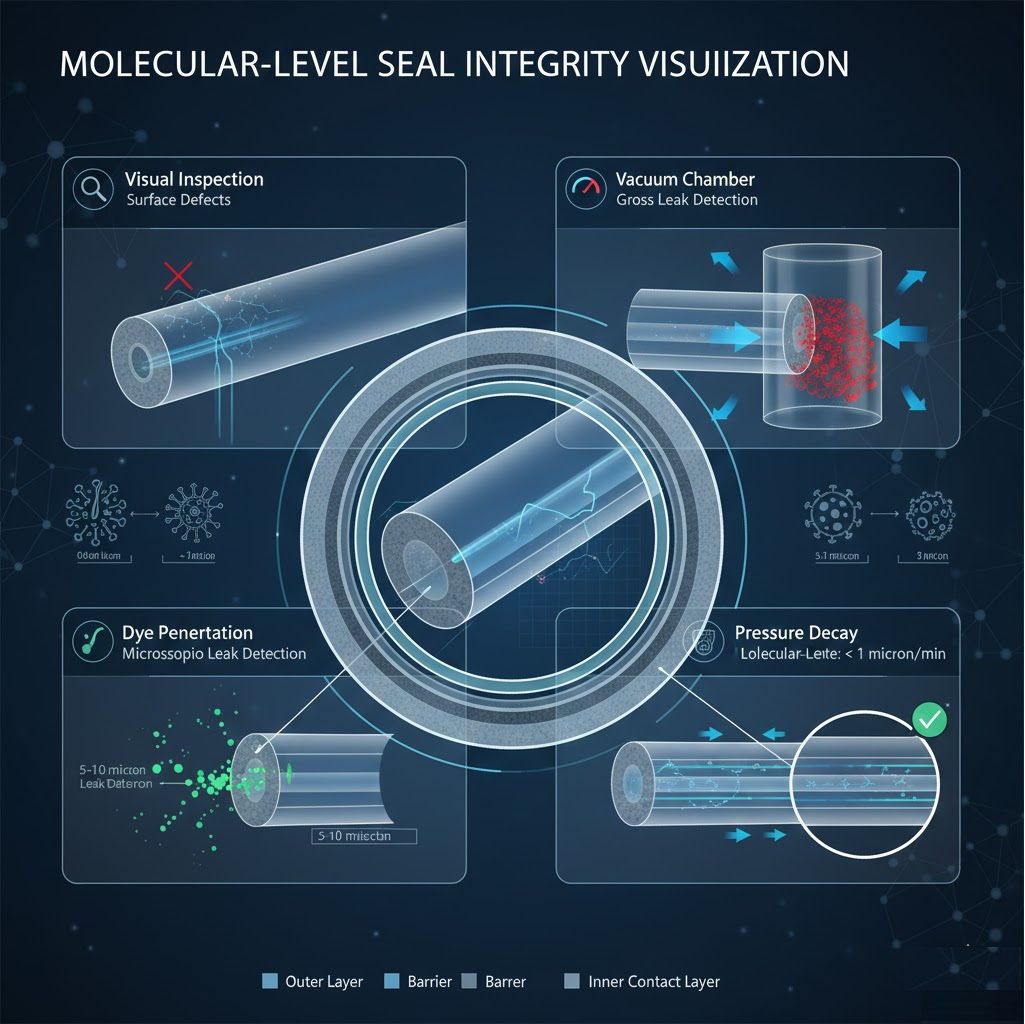
Manufacturers employ multiple testing approaches to validate seal integrity:
| Test Method | Detection Capability | Testing Speed | Destructive/Non-Destructive |
| Visual Inspection | Gross seal defects only | Instant | Non-destructive |
| Vacuum Chamber Testing | Leak-detection sensitivity varies by equipment, method, package and test setup. Confirm detection capability and sampling plan with the quality team. | 30-60 seconds per sample | Non-destructive |
| Dye Penetration | Dye-penetration sensitivity varies with method and laboratory setup; validate the selected test method. | 5-10 minutes per sample | Destructive |
| Pressure Decay | Pressure-decay capability varies by instrument and package. Use the agreed test method and acceptance criteria. | 2-3 minutes per sample | Non-destructive |
Inline vision or leak testing may inspect defined attributes, but 100% coverage and microscopic-leak detection are configuration-dependent. Confirm false-reject, sensitivity and sampling requirements.
Nitrogen Flushing Technology
Nitrogen flushing can reduce headspace oxygen for suitable packages, but the effect depends on flow, product, fill level, seal timing and equipment. Confirm residual oxygen with the customer’s test method.
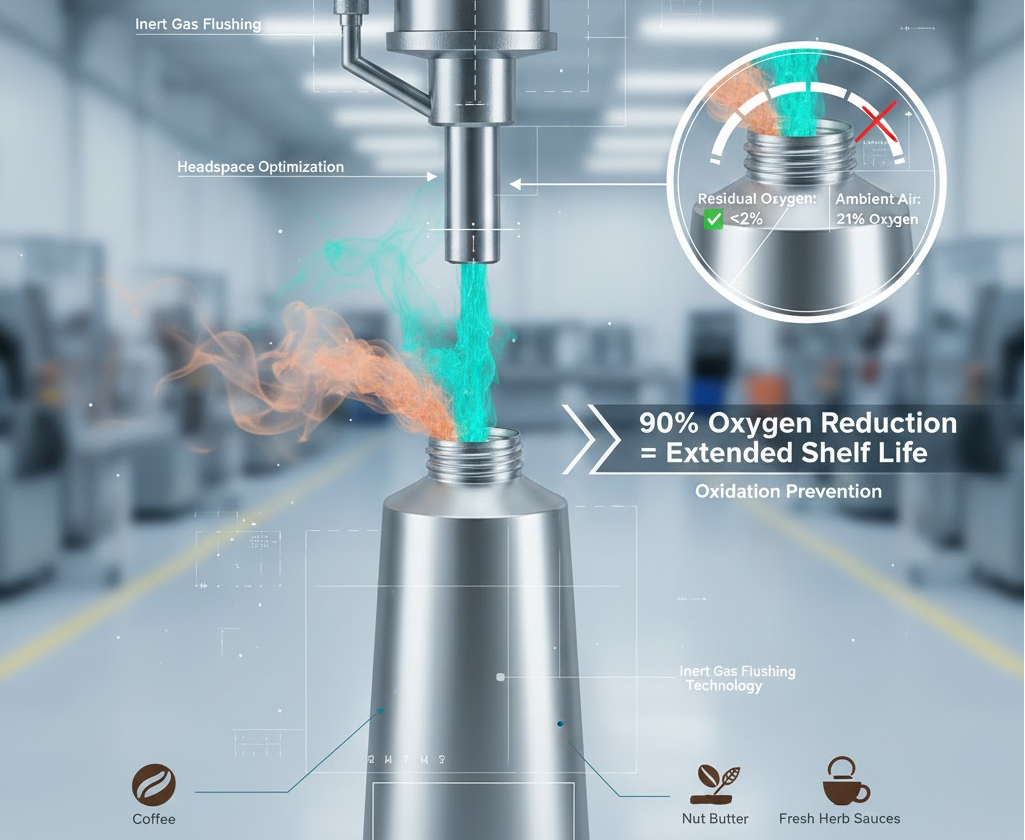
A residual-oxygen target must be established and measured for the selected package and product; do not assume a universal less-than-2% result.
Any shelf-life benefit from gas flushing must be demonstrated through product and package studies rather than inferred from a percentage reduction in headspace oxygen.
Recommended Reading: The Differences Between Homogenization and Emulsification – King Pack Machinery
Food Safety & Compliance: A Critical Checklist for Equipment Selection
Food equipment should be designed around the applicable food-contact, hygiene and quality requirements. FDA, USDA, HACCP, GMP and other frameworks apply differently by product, market and facility.
Key Requirements for GMP/HACCP Compliance in Tube Fillers
When selecting tube filling machinery for plastic tubes, laminated tubes, or pharmaceutical products, manufacturers should check the following:
- Contact-material grade should be specified from the product and cleaning program. 316L may be appropriate in some applications, but it is not a universal requirement for every food tube filler.
- CIP may be included when justified by the process. Cleaning cycles, access, chemicals, residual limits and validation remain customer-specific.
- Sanitary Design: Equipment should avoid horizontal surfaces, dead legs, and crevices. Tri-clamp connections are preferred over threaded fittings to prevent residue buildup.
- HEPA-filtered air may be required for a defined aseptic or high-hygiene zone, but not every food filling application needs it. Confirm the process classification and air-handling design.
- Sterilization protocols and validation are required only where the process calls for them. Confirm the method, monitoring and records in the approved quality plan.
- Batch data and coding records can be integrated when specified. Define the data fields, retention, access control and validation responsibilities.
- Personnel Barriers: Physical or automated barriers should limit operator contact. Safety interlocks should prevent operation during manual access.
King Pack can configure hygienic filling equipment around the product and process. Any claim about speed, cleanliness or compliance must be verified for the selected configuration.
Conclusion: Technology and Safety — The Future of Food in Tubes
Food tube filling technology can support safe, stable packaging when the formulation, process, package and quality system are validated together.
Material sustainability, traceability and connected controls are evolving areas. Evaluate them from the customer’s market, package and data requirements rather than assuming a universal benefit.
Request a Technical Consultation on Food Tube Filling Solutions
Food tube filling requires specialized expertise combining food science, process engineering, and regulatory knowledge. Generic packaging equipment rarely delivers acceptable results for the unique demands of food applications.
Working with experienced suppliers helps food manufacturers avoid costly mistakes, accelerate time to market, and achieve regulatory compliance.
Technical consultations should evaluate:
- Product characteristics including viscosity, pH, particle size, and stability
- Desired shelf life and distribution conditions (ambient, refrigerated, frozen)
- Production volume requirements and future growth projections
- Existing facility capabilities including utilities, clean room classification, and floor space
- Regulatory requirements based on product category and target markets
- Budget constraints and ROI expectations
King Pack offers comprehensive consultation services backed by extensive experience in food-grade tube filling equipment. Our technical team can assess your specific requirements and recommend optimal solutions that balance performance, compliance, and cost considerations. Contact us today for more details!
Frequently Asked Questions (FAQs) on Food Tube Filling
What is the cost difference between aseptic and non-aseptic tube filling machines?
Aseptic and hot-filling costs vary widely with capacity, sterilization, utilities, validation and site requirements. Obtain a project-specific quotation; the example price multiples are not universal.
How is tube contamination prevented during high-speed filling?
Contamination-control measures depend on the process classification and equipment. HEPA, automated handling, CIP, anti-drip and inspection features should be specified and validated for the selected line.
What tube materials work best for acidic foods like ketchup or mustard?
Highly acidic products require aluminum tubes or special laminates with acid-resistant inner layers. EVOH barrier layers and food-safe coatings prevent material breakdown and flavor transfer.
What viscosity can a standard food tube filler handle?
Viscosity capability is model- and product-specific. Test the representative food at operating temperature and confirm the pump, nozzle and heating requirements before specifying a range.
Related Industry and Solution Pages
For related equipment context, see our food industry solutions and tube filling and sealing machine solutions for the relevant industry and packaging workflow.
