 Skip to content

Food-grade tube sealing for mayonnaise must protect an already defined food process and package specification. A clean, repeatable tail seal is important, but it cannot establish shelf life by itself. Evaluate the formulation, hygienic filling conditions, tube barrier, cap, seal integrity, storage and distribution as one system. The food producer should approve the process and shelf-life evidence before making a market claim.
This guide focuses on packaging decisions for mayonnaise and similar emulsified sauces in collapsible tubes. It explains which requirements belong to the food owner, which equipment conditions should be tested, and how to collect useful evidence during factory testing and site commissioning.
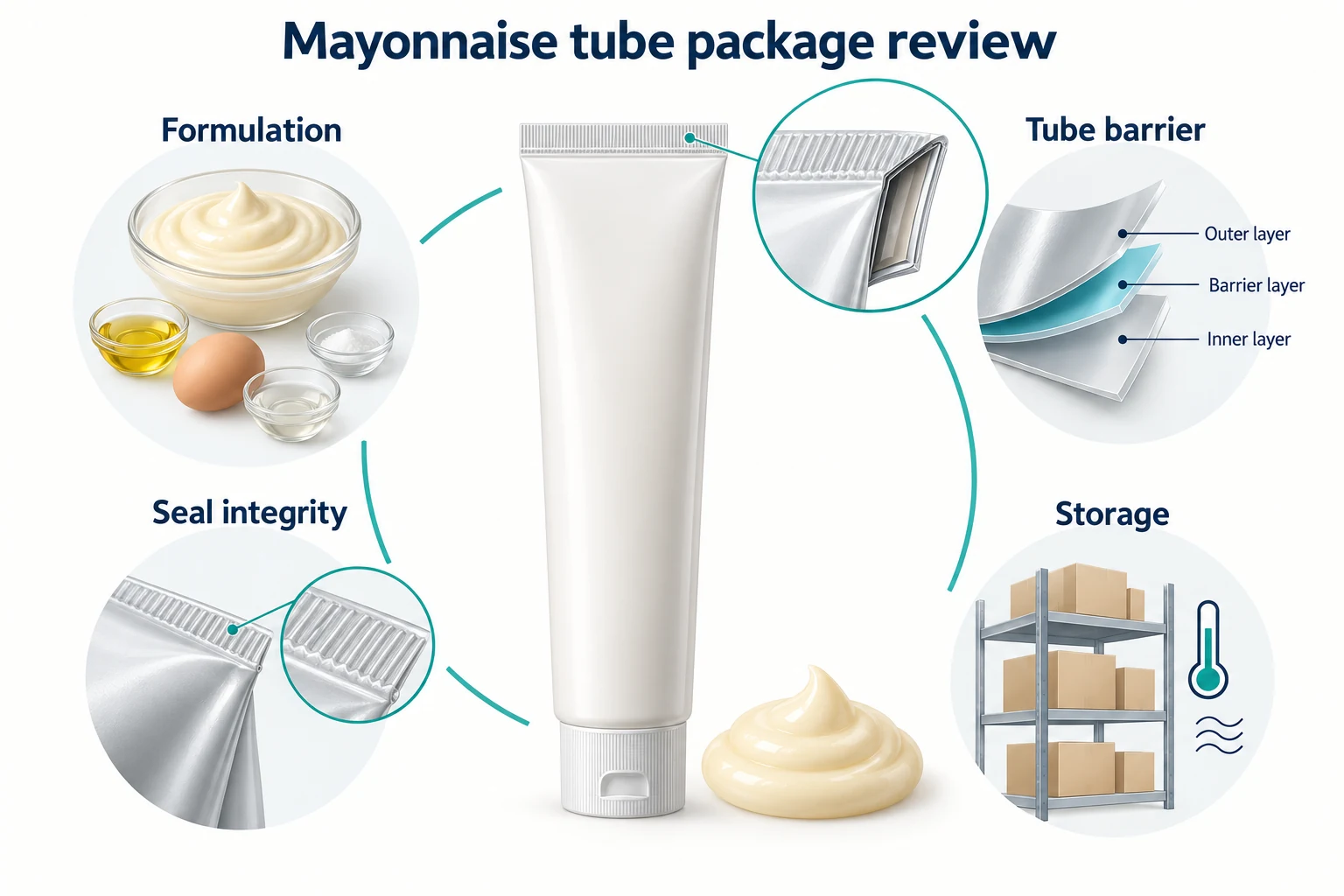
Start with the food process, not the sealing temperature
Identify the intended product, storage condition and distribution market before selecting the tube. Share whether the product is refrigerated or intended for ambient distribution, how the bulk is prepared and which process conditions have been established by the food team. A product name alone does not tell the machine supplier whether a sauce has the required safety controls.
Separate safety from appearance
A stable-looking emulsion can still need microbiological assessment, while a product can separate without a seal leak. Keep observations about texture, oxidation, microbial quality and package integrity distinct. This helps the team assign the right test and prevents a filling adjustment from being presented as proof of food safety.
For the US market, FDA provides acidified and low-acid food regulatory information. Applicability depends on the actual product and process classification. Do not assume that every mayonnaise formulation falls into the same category or that changing from a bottle to a tube leaves the process assessment unchanged.
Specify the entire tube package
The packaging specification should include wall construction, food-contact suitability, product compatibility, cap and shoulder, tail dimensions, decoration and intended dispensing. Obtain the relevant information from the tube and closure suppliers. The filling-machine supplier can assess handling and closure tooling, but it does not replace the package supplier’s material evidence.
Barrier performance and seal integrity are different
Barrier properties concern transmission through the packaging material under defined conditions. Integrity concerns unwanted pathways through a seal, closure or damaged body. A tube with an appropriate barrier can still leak at the tail, while an intact seal does not prove that the wall protects the sauce for the intended period.
Discuss oxygen, moisture, light and aroma requirements with the product and package specialists. Do not select a laminate solely because it has a foil layer or because a similar sauce uses it. The final combination needs product-specific compatibility and storage evidence.
Protect the mayonnaise during transfer and dosing
Describe how the emulsion reaches the filler: from a holding vessel, a mobile tank or another approved transfer arrangement. Identify the expected temperature, residence condition and permitted agitation. Review air entry, product recovery and access for cleaning along the route.
Do not use the filler to finish the formulation
The packaging hopper should receive product in its agreed condition. Extra mixing, heat or recirculation may affect the emulsion and must be assessed by the food team. A machine trial should record whether the observed texture was already present in the bulk or appeared after transfer and dosing.
Keep the open tail clean
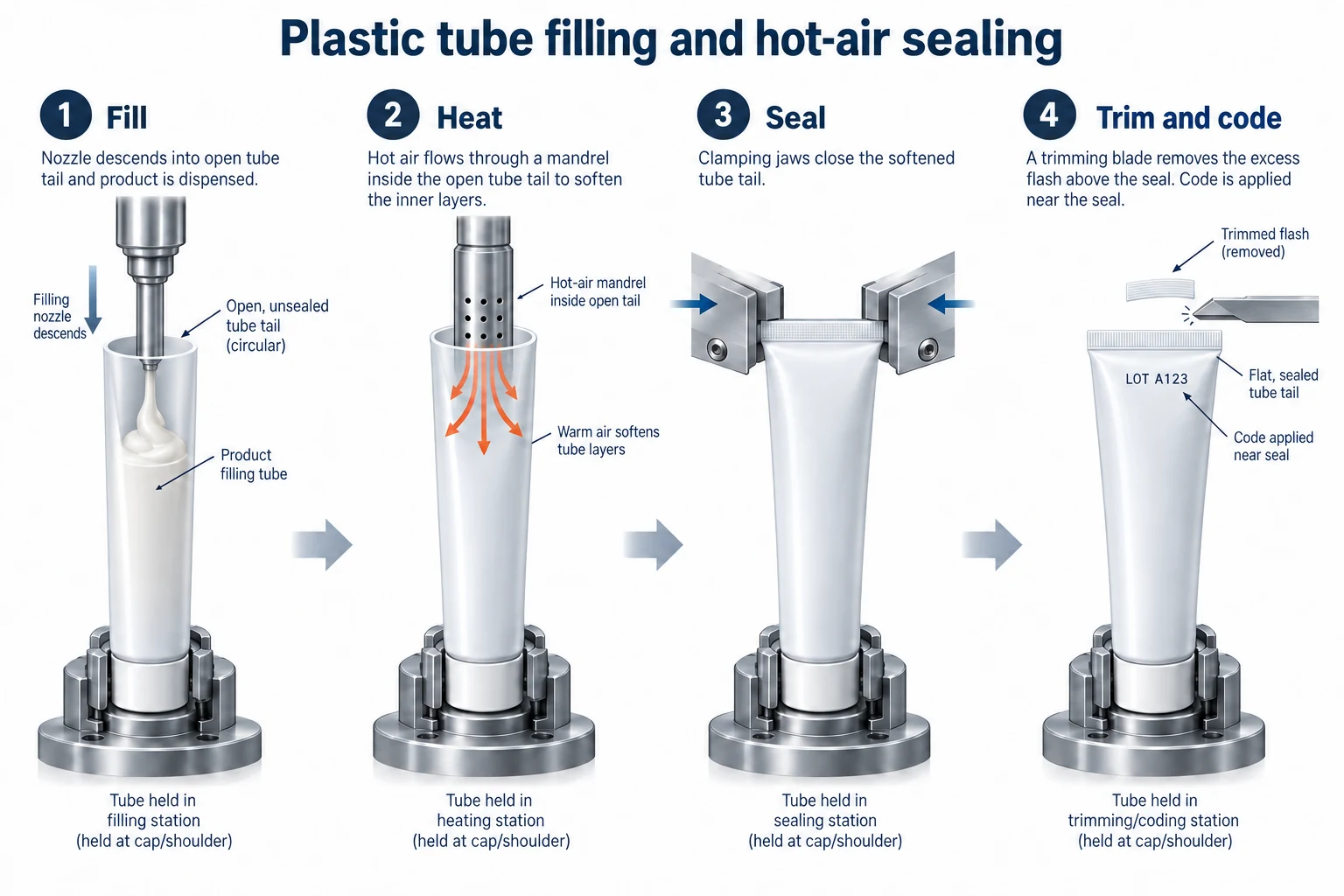
The tube’s cap or shoulder is supported below while its unsealed tail faces upward. A nozzle doses through that opening and withdraws before closure. Control the discharge and shut-off so mayonnaise does not coat the sealing area. Oil-rich residue or product strings can interfere with a closure even when the fill mass is correct.
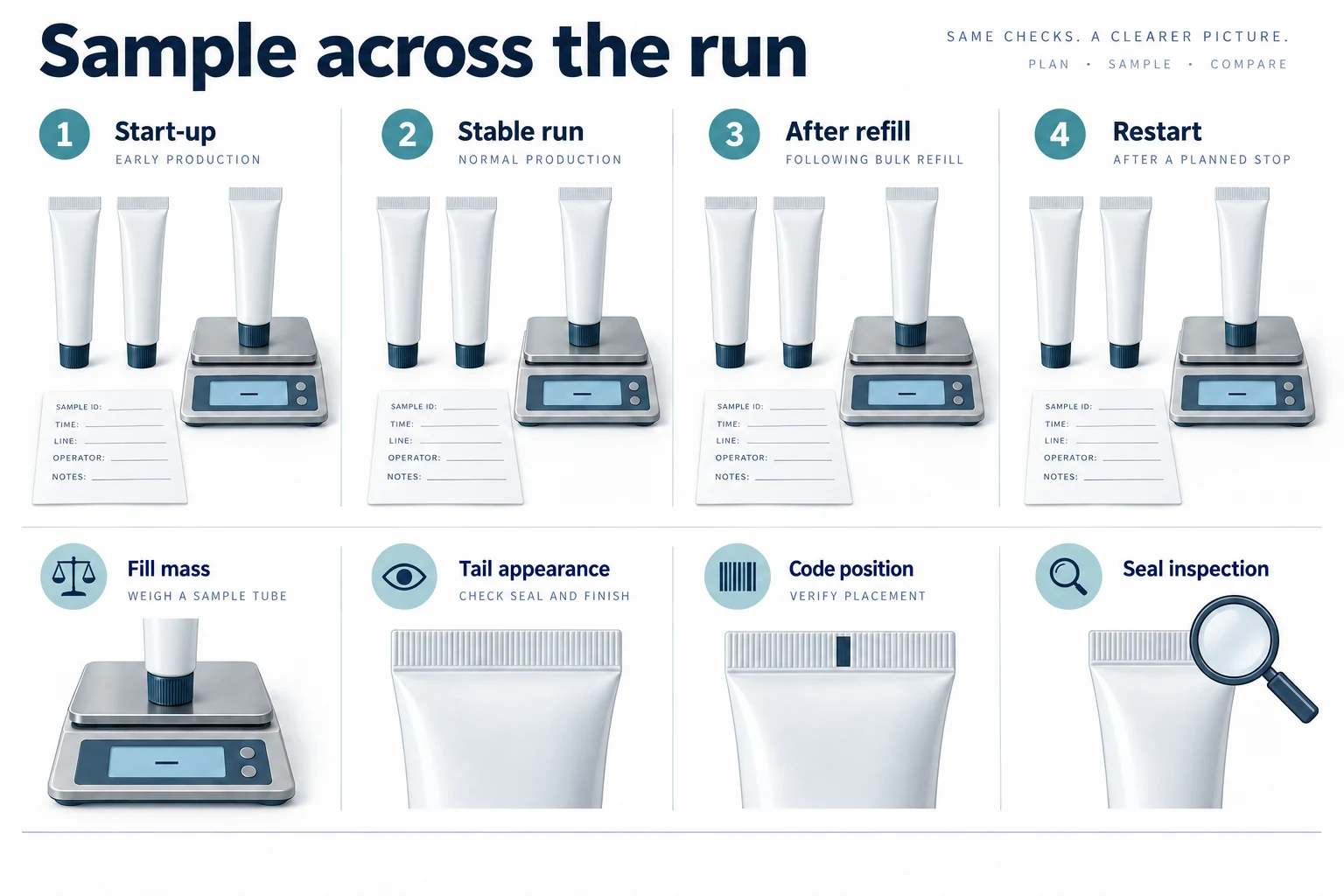
Compare start-up, normal running, refill and restart samples. If tail contamination appears only after a pause, investigate product condition and nozzle behavior at that point. Changing heat alone may mask one symptom while increasing deformation or damage elsewhere.
Choose a closure process for the actual tube construction
Plastic and laminate tubes may be sealed with hot air or a compatible ultrasonic arrangement. Collapsible aluminum tubes use their specified mechanical fold. Confirm the intended closure with production samples and record the tools used. An aluminum-barrier laminate should not be confused with a metal-body tube.
Hot-air sealing checks
Review heating-air delivery, dwell, tail alignment, clamping and release. Inspect the complete width of the seal and the area near the tube’s longitudinal seam. Material thickness and printed decoration can influence the usable settings. A displayed temperature is only one input; inspect finished packs using the agreed method.
Ultrasonic sealing checks
Verify the inner sealing layer, horn and anvil contact, energy control and pressure. A general statement that ultrasonics tolerates contamination should not replace testing with the actual mayonnaise and tube. The acceptance test must establish the relevant package outcome under the planned conditions.
Build an inspection plan that distinguishes defects
Agree a defect vocabulary with production and quality. Identify channels, wrinkles, incomplete bonding, trapped product, cracking, body damage, cap leakage and code problems separately. Record the location and time of each defect. Different failure types may require different corrective actions.
| Packaging concern | Useful investigation | Evidence boundary |
|---|---|---|
| Visible tail contamination | Observe nozzle cut-off and empty seal zone | Does not assess microbiological quality |
| Leak at one tail edge | Check alignment, material and contact | Use the approved integrity method |
| Flavor or color changes in storage | Review formulation, barrier and storage study | Not established by a short FAT |
| Cap leakage after handling | Review closure and distribution simulation | Tail-seal results are insufficient |
Choose the test method before the trial
The package owner should select the integrity method, sample condition and acceptance criteria. Possible approaches depend on the container and product; they are not interchangeable. Define whether the method is destructive, how test units are segregated and how failures are documented.
A manual squeeze can reveal an obvious defect, but an informal squeeze alone is a weak basis for a controlled release decision. Use a repeatable procedure where it is part of the approved plan. Keep operator observations alongside the defined test result rather than replacing it.
Evaluate the package through storage and distribution
Shelf-life work should represent the intended formulation, package and storage conditions. The food owner determines the study design and the necessary analytical, microbiological and sensory checks. A filler supplier should provide the packaging-run conditions needed to interpret the samples, without claiming that its machine grants a particular shelf life.
Include real handling risks
Discuss transport, temperature exposure, compression, vibration and normal dispensing with the package team. Select justified simulations and retain the identity of the filled samples. Inspect tail, body, shoulder and cap after handling. This prevents a seal from being approved only in an undisturbed factory sample.
Separate unopened storage from instructions after opening. A package study for the sealed tube does not automatically support claims about repeated use by a consumer. Label and storage requirements should follow the producer’s approved product assessment.
Hygiene and cleaning between sauces
Review product-contact parts, seals, hose connections and nozzle cavities. Oil films can remain after visible product is removed. If recipes contain different ingredients or cross-contact concerns, define the customer’s clearance method and sequence restrictions before equipment is selected.
Cleanability is a demonstrated procedure
Ask operators to dismantle and inspect the planned path during a trial. Record inaccessible areas, retained product and reassembly risks. The supplier can explain machine access and materials; the food producer validates or verifies its sanitation programme as appropriate to the process.
For equipment architecture and material-flow scope, start with the food filling and packaging applications. Define any special sanitation, allergen, temperature or package requirements in the RFQ rather than assuming they are included in a general food-industry label.
Make FAT useful without overstating it
A mayonnaise FAT can examine product transfer, dosing, tail cleanliness, material-specific closure, coding, rejection, changeover and cleaning access. State which product and tube were used and record settings. If the actual food cannot be sent, identify the surrogate and its limitations.
FAT is not a shelf-life study. It should supply a repeatable equipment baseline and identify work that remains at the site. Preserve raw fill measurements and package observations. Retain samples only under conditions that make their later interpretation meaningful.
Shipment and site confirmation
Before dispatch, inspect nozzles, closure tooling, guards, electrical labels, spare parts and documentation. Protect contact surfaces and identify all format parts. Installation preparation should include utilities, bulk-food connections, cleaning arrangements, drainage, floor access and the trained people needed for acceptance.
Compare the installed equipment with the agreed tube filling and sealing configuration. Repeat checks affected by transport, site utilities or the use of final product. Do not transfer factory observations to the site without assessing those differences.
A hypothetical packaging-study workflow
Consider a producer comparing two laminate tubes for one mayonnaise formula. Both have the same nominal size, but their barrier structure and tail thickness differ. The team should treat the package designs as separate candidates until evidence supports grouping them. This example is a planning exercise, not a report of a King Pack delivery or a tested shelf-life result.
Stage one: define responsibilities
The food team supplies the approved formulation and handling conditions. The packaging supplier identifies the tube and cap materials. Engineering records the filling and closure configuration. Quality establishes sample handling, defect criteria and any storage-study requirements. Purchasing confirms that the quoted machine includes the tools and documentation needed for both candidates.
Give each trial candidate a unique identifier. Do not rely on two visually similar white tubes to remain distinguishable throughout filling, transport and storage. Use controlled labels on sample cartons and retain tube-lot information in the test record.
Stage two: establish a clean, repeatable tail closure
Begin with controlled filling and inspect the tail before sealing. If product enters the seal zone, resolve the dosing and withdrawal condition first. Then explore the appropriate closure settings for each material. Change one condition at a time and record both successful and defective samples.
Inspect the finished tubes after the complete downstream sequence. Trimming, coding, discharge and cartoning can introduce a different defect from the one seen at the sealing station. The package should be evaluated in the form in which it will leave the line.
Stage three: send identified samples for the wider study
The producer selects samples representing approved conditions for its laboratory and storage programme. Engineering supplies the filling record, tube lot, closure settings and any deviation information. The food and packaging specialists then interpret the relevant changes in product and pack over time.
If one candidate develops a defect, investigate the failure mechanism before rejecting all tubes from that material family. A cap issue, wall-barrier issue and tail-seal issue have different implications. Equally, do not attribute a product change automatically to the machine when formulation or storage conditions also changed.
Use operating records to keep the approved condition
After acceptance, define first-piece checks and routine observations that detect meaningful drift. Useful records may include tube supplier and lot, active recipe, product condition, code confirmation, seal inspection and rejected quantities. The exact record should fit the customer’s quality system and food-process controls.
Changes that deserve a review
Review a new laminate layer, different cap, altered formula, changed filling temperature, replacement sealing tool or revised cleaning method. Even when the nominal tube size remains unchanged, these changes may affect the pack. Record whether a repeat machine trial, packaging assessment or storage study is needed before routine use.
Keep approved examples of tail appearance and clear photographs of common defects near the training file. These visual references can improve consistency between shifts, but they should support the formal inspection method. A photograph does not reveal every integrity weakness and should not become the only release criterion.
Respond to a leak without losing traceability
When a repeated leak is found, identify the affected production interval, tube lot and machine condition. Segregate suspect stock under the site’s procedure. Retain leaking examples and the relevant operating record. Avoid unrecorded adjustments that make it impossible to understand which condition produced which packs.
After a correction, repeat the checks that demonstrate the intended outcome and document the disposition of earlier material. This closes the loop between an equipment change and the customer’s packaging decision. It also provides better evidence for future troubleshooting than a note that the heater was simply turned up.
During handover, agree how operators contact maintenance, quality and the supplier when the same defect returns. A concise escalation record should identify the observed failure, product and tube condition, recipe and recent changes. It helps the right team investigate while preserving the approved food-process boundaries.
RFQ questions for a mayonnaise tube project
Ask what production conditions the proposal assumes, which tube materials were evaluated, how the tail is protected from product and what evidence supports the closure method. Define the scope of cleaning parts, format kits, code equipment, training and technical documents. Keep food-process and shelf-life responsibilities visible alongside machine responsibilities.
Plan your tube trial: Send your product handling notes, package construction and required inspection method through the King Pack enquiry form. Request a technical review based on the actual mayonnaise and tube samples.
Assess optional features against a stated need
If a proposal includes agitation, warming, gas flushing or additional inspection, ask which requirement each feature addresses and how it will be assessed. An optional feature is not evidence of longer shelf life. It may introduce additional cleaning, utility or maintenance needs. The food owner should decide whether it fits the established process, and the acceptance protocol should state what the equipment trial can actually demonstrate. Keep unsupported claims out of the purchase specification and preserve any remaining question for the appropriate food or packaging specialist before the final production release decision is made.
FAQ
Does a stronger tail seal increase shelf life?
It can address a closure weakness, but shelf life also depends on formulation, process, material barrier, cap and storage. A seal result alone does not establish an extension.
Can I use hot air for any mayonnaise tube?
No. Confirm the tube’s inner sealing layers, geometry and material compatibility, then test the selected settings with representative samples.
Will ultrasonics seal through mayonnaise residue?
Do not assume so. Control tail cleanliness and assess the actual package with its approved integrity test. Any tolerance claim needs relevant evidence.
Can a factory run prove ambient storage suitability?
No. A short equipment trial does not replace the food producer’s process and shelf-life assessment.
Who determines US acidified-food requirements?
The producer should establish classification and obligations with qualified food-process and regulatory support. The machine supplier cannot infer them from the product name.
Does a food-grade description establish certification?
No. Confirm the specific material, equipment and process evidence required for the application. Do not infer an unverified certification or shelf-life claim from a general description.
Conclusion
Mayonnaise tube sealing belongs within a complete food and package control plan. Keep the tail clean, validate the closure method for the actual material, inspect the whole pack and preserve the distinction between equipment testing and shelf-life evidence.
Request a food tube filling proposal: Share the formulation-handling limits, tube drawings and quality requirements with King Pack to define a practical sample-test and installation plan.
Last reviewed: October 14, 2026. US regulatory references are contextual; product classification and site obligations require an assessment for the destination market.
The following visuals are illustrative production and inspection references. They do not represent guaranteed output or measured validation results.
Related equipment and project resources
For equipment selection, compare the relevant filling machine product range with the packaging solution overview. Application context is available in the veterinary medicine solutions and pharmaceutical packaging guide. Where the process includes a closure step, review the filling and capping line and tube sealing equipment.
Before a trial, document product rheology, fill volume, container dimensions, contact materials, cleaning method, closure requirements and inspection points. Related planning resources include tube filling and sealing machine selection, how to choose a tube filling machine, tube sealing quality control, manual to automatic syringe filling and syringe format changeover planning.
For a project-specific review, contact the technical team, send your requirements for a quote or review the syringe filling machine range. Include samples or drawings when available so the machine scope can be assessed against real product and packaging conditions.
Need help with the next step? Request a quote with the product, package, fill volume and target checks.
