 Skip to content

Introduction
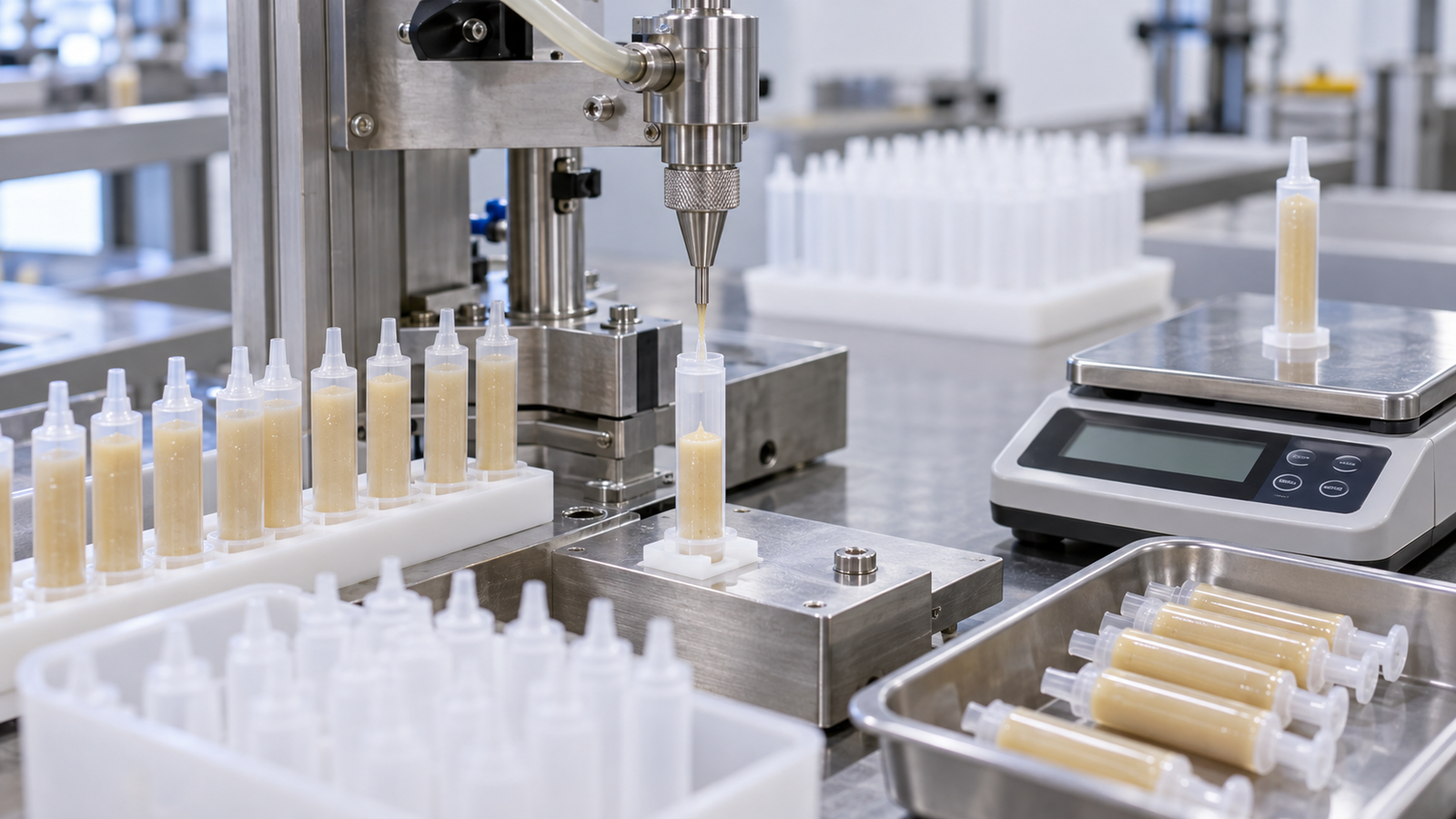
An ant gel bait filling machine doses ant bait gel into syringe-style tubes, bait-box cavities, or small squeeze tubes, and closes each container to a target net weight in grams. Positive-displacement metering is often a practical starting point for viscous or shear-sensitive formulas, but the correct principle still depends on the product's flow behaviour, particle load, dose size, and required cut-off. The metering element must also be sized for the actual shot, which may be smaller than the dose used on a cockroach-bait line.
That small shot can separate an ant line from a cockroach line. Some ant formulas are thinner or use more sugar or moisture-retention ingredients, while others behave much like a conventional gel; the recipe, dose, and packaging must be checked rather than assumed. Settings therefore should not be copied from one product to the other without a trial. This article covers what the equipment has to do, how the setup and cleaning are planned, and which items we check when a customer sends an ant gel sample to our factory for a trial.
What Is an Ant Gel Bait Filling Machine?
It is a filling system built around a positive-displacement meter, a feed vessel that keeps the paste moving toward the pump, and the closing stations that finish the container. On a syringe-format product, the station list usually runs from tube orientation and feeding, through metering, piston insertion, and tip closure or cap placement, to a net-content checkweigh and a reject station. A bait-box format replaces the piston and tip stations with cavity positioning and film or lid sealing.
The same machine family covers a benchtop semi-automatic unit and an integrated automatic line. Moving up that ladder changes labor and output, not the dosing principle, and the metering head is sized the same way at every step. One point we repeat a lot: on a manual or semi-automatic gel bait line, metering is rarely the bottleneck. Shift time tends to disappear upstream, into paste handling and tube feeding, or downstream, into closure and checkweighing. Teams that size the dosing head first and the material flow second often end up with a line that idles at the dosing station.
If you want the wider picture of the syringe format and how it is produced, see the cockroach gel bait syringe manufacturing guide. For the machine definition and station logic, the syringe filling machine explainer is the useful next read.
Ant Gel Bait vs Cockroach Gel Bait: What Changes on the Line
Both products are insecticide gels, and on paper the filling task looks identical. In practice the two pull the machine in different directions. The table below lists the differences we look at first when a customer moves from one to the other, or runs both on one line.
| Aspect | Cockroach gel bait (typical) | Ant gel bait (typical) | What it changes on the line |
|---|---|---|---|
| Dose per placement | Often larger, but the actual target varies by product | Often smaller, but the actual target varies by product | Metering element size, cut-off timing, weighing resolution |
| Body and viscosity | Frequently thick and paste-like | May be thinner or may remain highly viscous | Suck-back setting, nozzle seats, drip control |
| Base system | May use oil, fat, protein, or another carrier | May use sugar, syrup, moisture-retention, or another carrier | Cleaning scope and residue behaviour |
| Solids | Frequently smooth, but not always | Some formulas carry particles or fibres | Pump principle, nozzle bore, valve clearance |
| Surface behaviour | Drying time depends on the formula | Some formulas dry or crystallise quickly at an open tip | Nozzle parking, idle handling, wipe routine |
| Package | A 30 g syringe with a plunger rod is a familiar format | Small syringes, bait-box cavities, and small squeeze tubes | Piston seating versus cavity dosing and sealing |
The pattern in that table points one way. Ant bait moves toward smaller doses, thinner and stickier pastes, and faster surface drying, and each of those shifts tightens the tolerances on the dosing side. A cockroach line with a larger shot can absorb a small physical error and still pass its net-content check. The same error on a 0.5 g ant dose is a much larger share of the target. That arithmetic drives most of the setup decisions in the next section.
What Those Differences Demand From the Machine
The differences above translate into four concrete requirements. None of them is exotic, and all four are easier to specify before the line is built than to add afterwards.
A metering element sized for the small end
A pump that is comfortable at 20 g is not automatically comfortable at 0.6 g. Positive displacement is still the right family for this paste, but the size of the metering element decides how much of the stroke is used. When the shot is a small fraction of the pump's natural volume, the same mechanical clearance and the same valve travel produce a larger relative error, and the cut-off becomes a bigger share of the shot. We size for the smallest dose you plan to sell, not the largest, and check that the pump still holds repeatability at that end. Within positive displacement, piston or plunger, progressive cavity, peristaltic, and gear principles each suit different pastes, and the solids content is often what decides between them.
Higher relative accuracy, not just lower absolute error
Absolute and relative error are two different numbers. A 0.1 g deviation is 0.4 percent of a 25 g dose, and roughly 3.3 percent of a 3 g dose. Ant bait pushes the same physical error into a much larger relative share, so a tolerance that passes on a cockroach line can fail on an ant line without anything changing on the machine. This is why a small-dose ant project has to define its tolerance in percentage terms as well as grams, and why the weighing step deserves the same attention as the dosing head.
A finer nozzle and a shorter cut-off tail
A small dose through a large orifice is hard to stop cleanly. Ant bait usually calls for a finer nozzle bore and a shorter, more repeatable cut-off, because the tail left at the tip is a larger share of a small shot. Suck-back, a brief reverse movement into the nozzle, shortens that tail. A nozzle valve closes the stream at the orifice. Lift-and-dispense timing breaks the stream as the nozzle pulls away. Which one fits depends on how your paste behaves when flow stops, and on some ant gels the answer is a short suck-back combined with a slight lift. Drying and crystallization at the tip are the second reason to keep that cut-off tight: a residue that sets on the nozzle face becomes a hard particle the next dose has to push past.
A low-shear pump where the structure matters
Some ant gels are thixotropic, and some carry suspended solids. A pump that shears the paste hard, or a valve that squeezes it through a tight clearance, can change the body of the product or break up the dispersed phase. A gentler pumping principle protects the structure, though it is usually slower per cycle. Where the formula tolerates shear, a faster principle costs less. Where it does not, the gentler route is the one that keeps the gel behaving the same in the tube as it did in the lab sample.
Net Content Control at Small Doses
Net content is the control point on any gel bait line, and small doses make it harder for a reason that has nothing to do with machine quality: the tolerance is measured in grams against a smaller target.
Why small doses amplify relative error
A 0.2 g deviation is 1 percent of a 20 g dose, and about 6.7 percent of a 3 g dose. Nothing about the machine changed, and no variation grew. The target shrank. That means the whole chain has to be looked at in the same units: the metering element, the cut-off, the piston seat, the fill temperature, and the scale resolution all contribute a piece of a smaller number. When we review a small-dose project, we ask for the net-content target in grams with a tolerance, and we check whether the tolerance was written against the smallest SKU or the largest one.
Calibrate by weight, not by screen
A dosing screen shows a number the controller believes. The number a customer buys is grams on a scale. Those two agree only if the density and the pump condition are what they were at calibration. Ant baits with a high sugar or moisture content can shift in density with temperature, so we calibrate on a verified scale, at the filling temperature, and we re-check at the start of each run rather than trusting the value entered last month. Vendor accuracy figures are worth quoting only as what a pump family can reach under the vendor's own conditions. In our experience, ViscoTec cites roughly plus or minus 1 percent at the pump outlet with an endless-piston principle, and Nordson EFD cites roughly plus or minus 1 percent with progressive-cavity pumps. Treat those as the ceiling of a technology family, not as a promise for your paste and your tube.
Write the sampling plan in grams and method
The sampling plan is what turns a net-content target into something a line can be judged against. It fixes the scale, the tare procedure, the sample size, and the interval, and it states whether checkweighing is done in-line or off-line. The plan should span a whole shift, because a line that starts short and corrects by the third tube has a priming issue, and a line that drifts down over four hours has a temperature or paste-condition issue. Those are different faults with different fixes. Get the sampling plan and the defect definitions in writing before the acceptance test, so nobody is arguing about a number after the fact. If you are preparing for that stage, our sample checklist at /blog/gel-bait-syringe-filling-trials-a-buyers-sample-checklist/ lists what to send and what to agree in advance.
Changeover and Cross-Contamination Control
An ant line often runs several recipes on one machine: different bait actives, different colors, different scent systems. Cleaning is where those recipes meet each other.
Sugar residue and scent carryover
Sugar-based and scented bait leaves a film that is easy to miss. It dries tacky, holds dust, and can carry color or scent into the next product. On an ant line the risk is higher than on a cockroach line because more of the formula is water-soluble and because a small residue in a small dose is a bigger proportion of the fill. A pale bait run after a dark one shows the problem immediately; two similar colors hide it.
Scope the cleaning, order the dismantling
We ask customers to write down which parts the paste touches, not which parts are inconvenient to remove. In practice that means the feed vessel and its stirrer, the feed line, the pump head or metering chamber, the nozzle and valve, the drip tray, and any surface the paste can splash onto. On a syringe format, add the piston feeder and the tip or cap chute. Dismantling order matters as much as the list: pulling the nozzle before the feed line is drained spreads paste instead of removing it. In our experience the cleaning step, not the mechanical change of parts, is where changeover time actually goes. Teams that post a dismantling order at the station and keep the right brushes and spanners there cut that time more than teams that buy a faster machine. Recipe memory on the controller helps too, because it removes the changeover's second biggest cost, re-entering parameters and re-tuning the cut-off.
A purge run is not a cleaning step
Running one tube of the next recipe through the line moves the plug of old paste out of the nozzle, and nothing else. The material still in the pump head, in the valve clearance, and behind the piston stays there. Treat the purge as a check that the visible path is clear, and keep the actual cleaning on the dismantling list.
Paste Feeding, Temperature, and Skinning
Everything downstream of the feed vessel inherits whatever the feed vessel does, so this is the section we spend the most time on during a trial.
Holding the paste at a steady condition
Ant bait can be thinner than a cockroach gel, and a thinner paste separates and settles faster. Gentle, continuous stirring keeps a thixotropic paste from firming between runs and keeps dispersed ingredients from dropping out, as long as the stirring does not whip air into the surface. The feed vessel should keep the paste moving without folding air in, which usually means a slow sweep rather than a fast agitator.
Temperature is the other half. Most of these gels thin as they warm and firm as they cool, and the filling temperature shifts the dose weight because it shifts density. A jacketed or temperature-controlled vessel lets you hold a window through the shift, and the window should be the one you can actually hold in your plant, not a laboratory number. We would rather see a range the customer can maintain than a single set point the workshop cannot keep.
Skinning and drying at the open surfaces
Skinning is the open-surface problem. A sugar-based paste forms a film on the surface of the vessel and on the nozzle face during any pause. Once that film is drawn into the pump, it appears later as a soft lump in the barrel or a blocked nozzle. A lid on the vessel, a nozzle that parks in a wipe or a capped rest, and short, controlled idles all reduce it. Where a line stops often, we look at whether the paste can be kept inside the closed part of the feed path during the pause.
Packaging Formats and the Stations They Change
Ant bait ships in more than one container, and the container decides the stations behind the dosing head. The dosing principle usually stays the same across formats; the handling changes.
Syringe-style point-application tubes
This is the format most readers picture, and it is the one with the most stations. A typical sequence is tube orientation and feeding, metering, piston insertion, tip closure or cap placement, net-content checkweighing, and reject handling. Front filling through the tip needs a narrow nozzle and higher pressure and suits tubes that arrive with the piston already inserted. Rear filling through the open tail is often simpler for a viscous paste, but it adds the insertion step and needs venting so air behind the paste can leave instead of being trapped under the piston. The piston has to seat square and to a consistent depth: too much force distorts the elastomer, too little leaves it proud or tilted, and paste behind the wiper is the tell-tale sign of a seating problem.
Bait-box cavities
A bait-box reservoir has no piston and no tip station. The line doses gel into a plastic cavity that is closed or film-sealed later, so the nozzle has to be centred and the dose directed onto the cavity floor. Overflow and splash control take the place of piston seating, and the checkweighing plan usually moves to off-line sampling because the cavity cannot go over a scale the way a syringe can.
Small squeeze tubes
Small tubes usually want a clean bead at the shoulder and a consistent tail-off at the open end. The fill is often larger than a point dose, so net content is easier, but the open end stays exposed until it is sealed, which brings the drying problem back. The order of sealing and the time between fill and seal are worth fixing in the specification.
Trial and Acceptance: What to Check Before You Commit
A sample trial on your own paste and packaging is the cheapest place to find a problem. When a customer ships us an ant gel sample, we run the paste on the proposed dosing principle and watch a short list of items. These are also the items to write into the factory acceptance test.
- Net content and drift. We weigh samples across the whole run, not just the first ten tubes, and report the spread against the target in grams and as a percentage. A first-tube shortfall and an afternoon-long downward drift are recorded separately, because they are different faults.
- Cut-off form. We look at the tail at the nozzle, the weight of the tail if it can be caught, and whether the tip stays clean enough for the cap to seat. We photograph the tip on the good and the bad cycles.
- Void rate at the tip and under the piston. Cutting a few finished tubes open shows where the air sits. Voids at the tip usually come from the cut-off; voids behind the paste usually come from the feed or from insertion.
- Changeover time. We time a full change from one recipe to the next with a real cleaning scope, and note which parts drove the time.
- Continuous-run stability. We let the line run long enough that the feed vessel empties and refills and the paste temperature moves, because that is when the numbers change.
Agree the acceptance criteria before the line ships: the measurement method, the sampling plan, and the definition of a defect. The line is then judged against numbers both sides signed, rather than against an impression on the day. Before you send a sample, it also helps to know which parts customers most often forget when they change specification. In our experience it is the piston and the tip or cap rather than the machine: a new tube diameter can need a new piston profile and a new cap geometry, and the nozzle bore often has to change with them. Bringing those parts to the trial is the difference between testing your real package and testing an approximation.
FAQ
Q: What is an ant gel bait filling machine?
It is a filling system that doses viscous ant bait gel into syringe-style tubes, bait-box cavities, or small squeeze tubes, then closes each container to a target net weight in grams. The metering is positive displacement, because these pastes are too thick for time-pressure or gravity dosing, and the pump is sized for doses of a few grams rather than the larger shots a cockroach line runs.
Q: How is filling ant gel bait different from filling cockroach gel bait?
The dose is usually smaller, the paste is often thinner, and sugar or moisture-retention systems make up more of the formula. That means holding relative accuracy at a small shot, a finer nozzle, a shorter cut-off tail, a gentler pump where the gel is shear-sensitive, and tighter attention to drying and crystallization at the tip. A line set up for one bait rarely carries figures across to the other without a fresh trial.
Q: Why is net content harder to control on small ant bait doses?
Because net content is measured in grams and the target is small. A 0.2 g deviation is one percent of a 20 g dose and roughly 6.7 percent of a 3 g dose. The variation did not grow; the target shrank, so the percentage tolerance tightens and the sampling plan has to cover the whole shift instead of the first few tubes.
Q: Which pump suits ant gel bait?
Positive displacement, for this viscosity. Within that family, piston or plunger, progressive cavity, peristaltic, and gear principles suit different pastes, and solids content usually decides between them. As vendor-published references, ViscoTec cites about plus or minus one percent at the pump outlet with an endless-piston principle, and Nordson EFD cites about the same with progressive-cavity pumps. Treat those as what the family can do under vendor conditions, not as a figure your paste will reach on its own.
Q: How do I stop ant gel bait from drying at the nozzle?
Tune a short, repeatable cut-off, keep the time the paste spends exposed to air to a minimum, and keep the feed vessel covered. Suck-back, nozzle closure, and lift-and-dispense timing all shorten the tail that dries. A nozzle that parks in a wipe or a capped rest, plus a lid on the vessel, cuts skinning during the pauses that a normal shift contains.
Q: What should I bring to a sample trial?
Your actual ant gel, your syringe or container samples, piston and cap samples in the sizes you plan to run, component drawings, an SDS, viscosity and density data, your net-content target in grams with tolerance, and your defect list. We run the paste on the proposed dosing principle and report net content, cut-off form, void rate, changeover time, and stability across a longer run.
Conclusion
An ant gel bait filling setup follows the material. Small doses raise the relative cost of every gram of error, thinner and sweeter pastes dry and crystallize faster at an open tip, and shear-sensitive gels punish a rough pump. None of that is fixed by buying a faster line. It is fixed by matching the metering size, the nozzle, the cut-off, and the cleaning scope to the paste you actually run.
Measure the paste first, size the metering for the smallest dose you sell, calibrate by weight rather than by a screen value, keep the feed clean and at a temperature you can hold, and agree the acceptance test before the line ships. Those steps decide whether the line holds net content on the second shift as well as the first.
Get a Quote
Send us your ant gel sample, your container or syringe specification, and your net-content target. We will run the paste on the proposed dosing principle, report the net-content, cut-off, and void results, and recommend the station list that fits your product, whether that is a syringe tube, a bait-box cavity, or a small squeeze tube. An engineer will reply with the next step.
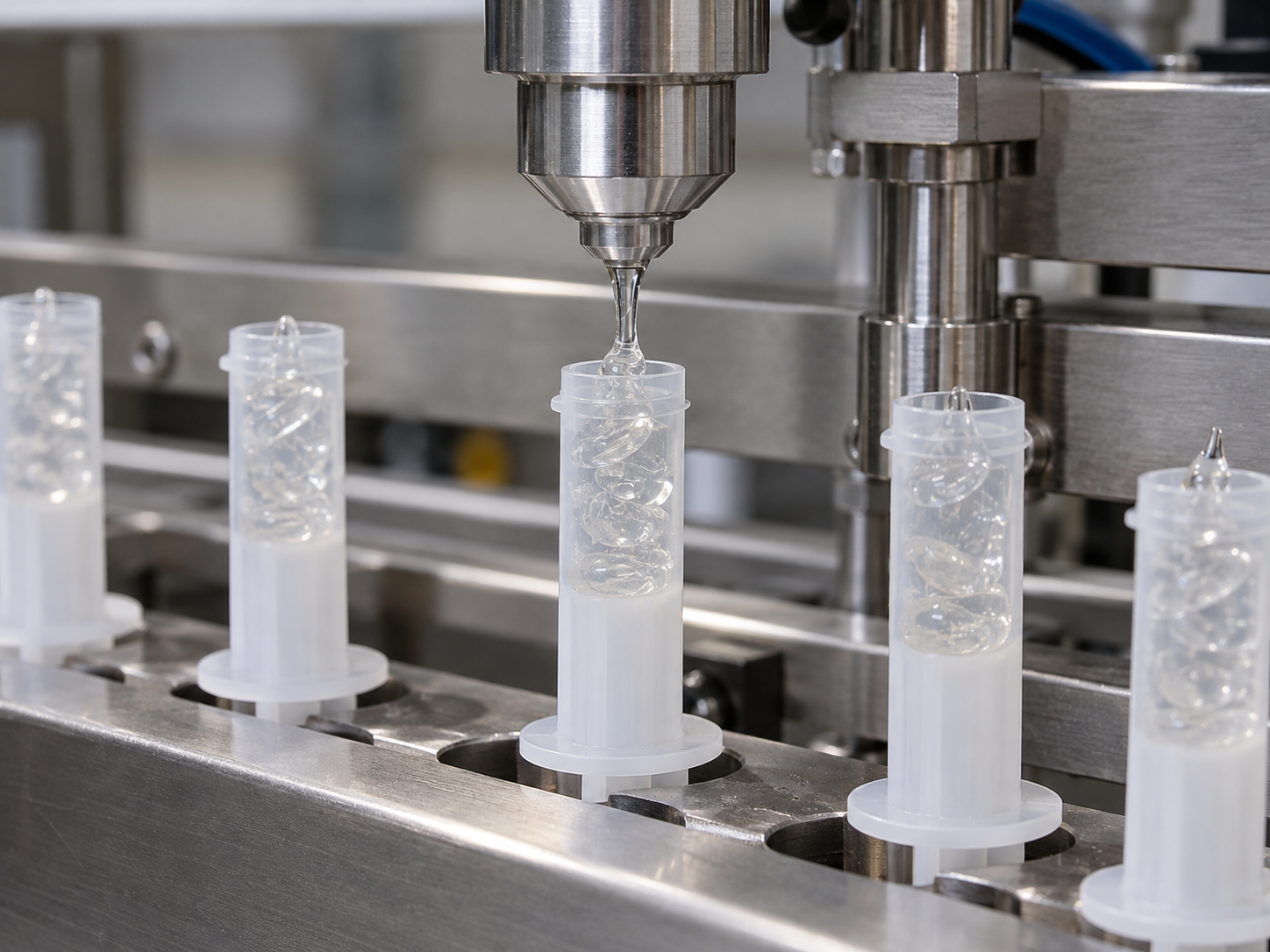
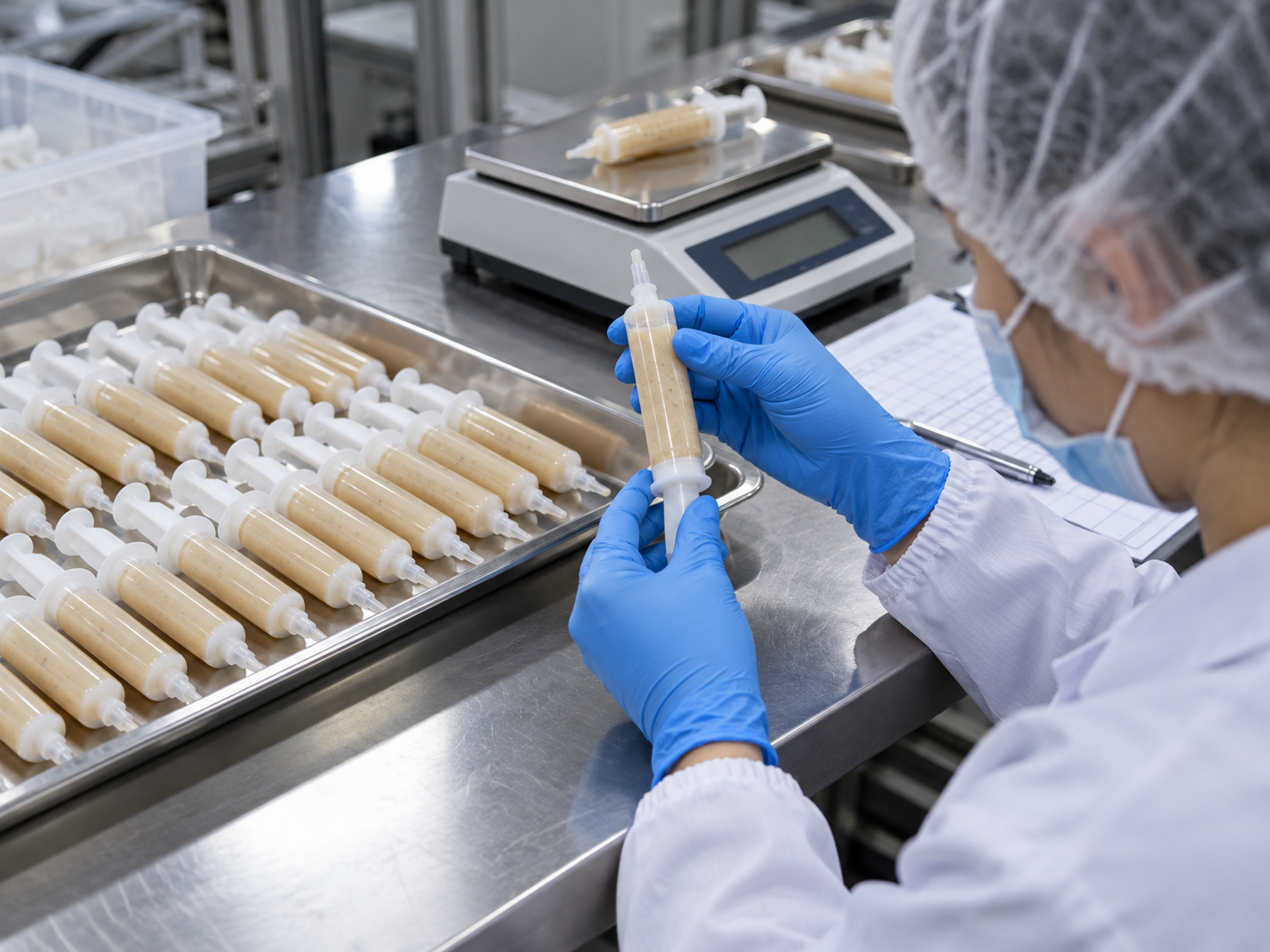
The following visuals are illustrative production and inspection references. They do not represent guaranteed output or measured validation results.

Related equipment and project resources
For equipment selection, compare the relevant filling machine product range with the packaging solution overview. Application context is available in the veterinary medicine solutions and pharmaceutical packaging guide. Where the process includes a closure step, review the filling and capping line and tube sealing equipment.
Before a trial, document product rheology, fill volume, container dimensions, contact materials, cleaning method, closure requirements and inspection points. Related planning resources include tube filling and sealing machine selection, how to choose a tube filling machine, tube sealing quality control, manual to automatic syringe filling and syringe format changeover planning.
For a project-specific review, contact the technical team, send your requirements for a quote or review the syringe filling machine range. Include samples or drawings when available so the machine scope can be assessed against real product and packaging conditions.
Need help with the next step? Request a quote with the product, package, fill volume and target checks.
