
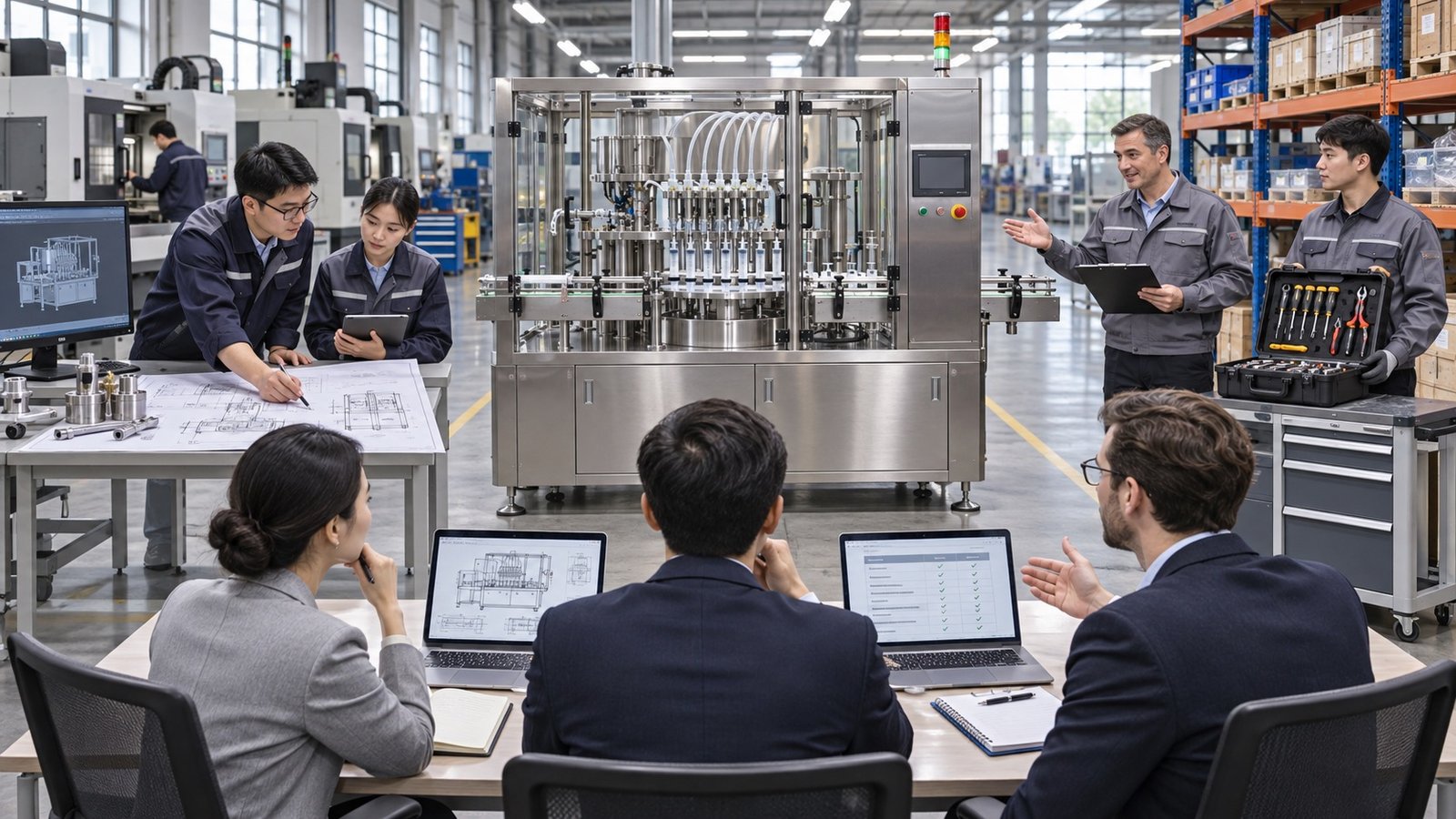
Buy a syringe filling machine factory-direct when direct access to the design team, custom engineering and one technical owner matter more than local commercial convenience. Use a qualified distributor when local language, time-zone coverage, import coordination and verified onsite service add real value. The best choice is not the shortest sales channel; it is the channel that puts contract scope, technical authority, FAT, commissioning, spare parts and warranty responsibility in writing without gaps.
Compare both routes against the same user requirement specification and acceptance test. A distributor is not automatically a reseller with limited expertise, and a factory-direct sale does not automatically provide faster service. Verify the people, legal entities, competencies and obligations behind each offer.
Start by identifying who is actually selling and supporting the machine
“Factory-direct” and “local distributor” are commercial labels, not complete operating models. Before comparing price, map the parties.
Ask these questions:
- Which legal entity issues the quotation and invoice?
- Which entity signs the sales contract and receives payment?
- Who owns the machine design and approved bill of materials?
- Who confirms that the product, package and process are feasible?
- Who controls engineering changes and software revisions?
- Who performs FAT and signs the test record?
- Who handles export packing, freight documents and import support?
- Who installs, commissions and trains the buyer’s team?
- Who approves warranty claims and supplies replacement parts?
- Who provides first-line and escalated technical support?
A direct contract can still involve a local technician or logistics agent. A distributor contract can still give the buyer direct access to the OEM’s engineers. Draw the actual responsibility chain instead of assuming it from the channel name.
The supplier comparison guide for veterinary syringe filling machines evaluates a supplier’s broader project capability. This article focuses on a different buyer decision: which sales and support channel should carry each responsibility for the same machine.
Compare channel models with one responsibility matrix
Use the following table as a starting point, then replace general tendencies with evidence from each bidder.
| Procurement factor | Factory-direct route may offer | Distributor route may offer | What the buyer must verify |
|---|---|---|---|
| Technical access | Direct communication with design and controls engineers | Local team translates and structures requirements | Names, response route and access to OEM experts |
| Customization | Fewer handoffs for nonstandard fixtures or stations | Local application knowledge if technically trained | Who approves feasibility and engineering changes |
| Contract | One contract with the machine builder | Local contract, currency or commercial terms | Legal seller, governing terms and back-to-back obligations |
| FAT | Test at the OEM facility with design team present | Distributor may attend or witness on buyer’s behalf | Protocol, samples, signatories and authority to close deviations |
| Logistics | OEM prepares export packing and documents | Distributor may coordinate import and local delivery | Incoterm, named place, customs roles and damage process |
| Commissioning | OEM engineers know the machine deeply | Local team may mobilize faster and speak the site language | Competence, tools, travel scope and escalation path |
| Spare parts | Direct access to as-built part numbers and custom tooling | Local stock may shorten supply for selected items | Actual stock, ownership, pricing and OEM authorization |
| Warranty | Direct technical and commercial decision by OEM | Local first response may be convenient | Who authorizes claims and pays parts, freight and labor |
Do not award points for “local presence” unless the bidder provides an address, named service personnel, relevant machine experience and a clear escalation agreement with the manufacturer. Do not award points for “direct factory price” unless the scope and post-delivery support are equivalent.

Use the same technical specification for both quotations
Channel comparison is meaningless when the offers describe different machines. Issue one controlled request for quotation containing:
- product type, rheology, temperature and handling restrictions;
- barrel, plunger, cap or stopper drawings and tolerance ranges;
- target fill range and agreed accuracy method;
- batch sizes, production window and required output;
- component presentation and feeding responsibility;
- dosing, filling, closure, inspection and reject scope;
- changeover formats and planned future packages;
- utilities, footprint, guarding and site standards;
- cleaning method and product-contact materials;
- data, recipe, language and user-access requirements;
- FAT material, sample size, test states and acceptance criteria;
- installation, commissioning, training and handover scope;
- documentation, spares, warranty and remote-support requirements.
If the project needs custom fixtures, product supply or a new station, use the custom or OEM syringe filling project guide to distinguish configurable options from real engineering work. Both channels must quote from the same frozen assumptions.
Require each bidder to publish deviations in a separate list. A distributor should not quietly replace the OEM specification with a locally sourced peripheral, and a factory should not omit local electrical, language or site obligations because they were not discussed during an early video call.
Decide who owns application engineering
The application owner converts the buyer’s product and package into machine requirements. That role is critical for a syringe filler because dose behavior, nozzle motion, barrel support, closure sequence and inspection depend on representative inputs.
For a standard format with demonstrated samples, a trained distributor may collect data and coordinate the trial effectively. For a new package, very viscous product, dual-component format or integrated line, direct contact with the OEM engineering team may reduce interpretation risk. The distributor can still remain the commercial seller, but the technical approval chain should be explicit.
Ask for a named person or team responsible for:
- sample and drawing review;
- process assumptions;
- trial method and settings;
- format-tool design approval;
- peripheral interfaces;
- software and recipe ownership;
- deviation approval;
- final as-built documentation.
The buyer should participate in decisions that affect acceptance. A distributor’s verbal reassurance cannot override an OEM engineering limitation, and an OEM’s generic feasibility statement cannot replace local site verification.
FAT is where a channel problem becomes visible. The machine may be at the manufacturer’s facility, the contract may be with a distributor and the buyer may attend remotely. Who can approve a test change, accept a deviation or commit to rework?
Define before FAT:
- the approved protocol and controlled revision;
- who provides product, barrels and closure components;
- which lots and operating states will be tested;
- which instruments and measurement methods will be used;
- who may change settings or acceptance criteria;
- who signs the test record;
- who owns the punch list;
- who pays for retest material, travel or delay caused by a failed item;
- which open items block shipment;
- how distributor and OEM commitments become contractually binding.

A video demonstration can support communication but should not substitute for agreed evidence. Keep raw measurements, sample identification, alarm records, settings, photographs and signed conclusions. If the distributor witnesses on the buyer’s behalf, define the limits of that authority.
Separate delivery terms from service obligations
Cross-border buyers often treat the Incoterm as if it defined the entire deal. It does not. The ICC explanation of Incoterms and the contract of sale states that Incoterms rules allocate delivery obligations, costs and risk but do not determine ownership, payment, pricing or broader contractual remedies. The sales contract must address those matters.
For a machine purchase, record separately:
- selected Incoterms 2020 rule and precise named place;
- export packing and preservation standard;
- freight booking and cargo insurance responsibility;
- export and import clearance roles;
- unloading, rigging and movement to the installation point;
- inspection for transit damage and claim procedure;
- installation readiness and utilities;
- commissioning start condition;
- acceptance milestone and warranty start;
- service travel, spares freight and return-parts process.
A local distributor may simplify customs and final delivery, but only if those tasks are in scope. Factory-direct buyers may appoint their own forwarder and broker successfully, but the interfaces must be planned. Neither channel should hide installation or after-sales responsibility inside a delivery abbreviation.
The custom syringe filling machine lead-time guide helps separate engineering, sample confirmation, FAT, dispatch and transport milestones. Channel comparison should use the same milestone logic.
Compare contracts, not only quotations
International machinery sales can be affected by the governing contract and applicable law. The UNCITRAL CISG overview explains that the Convention may govern certain international sales and addresses formation, party obligations and remedies, while some matters remain outside its scope. Whether it applies to a particular transaction is a legal question.
This article is not legal advice. Have qualified counsel review the final agreement, especially when the seller, OEM, distributor and buyer are in different jurisdictions.
The contract should make these channel-specific points clear:
- identity and authority of every party;
- order of precedence among contract, specification, drawings and quotation;
- OEM obligations that are enforceable by the buyer;
- distributor obligations that are not delegated away after payment;
- change-order authority and price approval;
- payment milestones tied to evidence;
- ownership and permitted use of documentation and software backups;
- confidentiality and remote-access rules;
- FAT, shipment, SAT and final-acceptance milestones;
- warranty decision, remedy and cost responsibilities;
- dispute, governing-law and termination provisions reviewed by counsel.
If a distributor promises an OEM service level, require evidence that the OEM accepts the same obligation. If the factory promises local service, require the local provider’s identity and authority. Back-to-back language reduces the risk that each party points to the other after a problem.
Test commissioning and training capacity
Commissioning is not simply switching on the machine. The service team may need to inspect transit condition, confirm utilities, level and connect the equipment, verify safety functions, load the approved program, run product and components, tune process settings, train operators and close site deviations.
Compare the actual team proposed by each channel:
- relevant machine and process experience;
- language and time-zone coverage;
- travel eligibility and site-access readiness;
- diagnostic tools, test instruments and software access;
- authority to change parameters or software;
- ability to obtain OEM engineering support;
- safety, maintenance and operator-training competence;
- deliverables at the end of the visit.
The automatic versus semi-automatic syringe filling guide can help define operator loading, intervention and changeover tasks. Training must reflect the purchased automation level and the buyer’s actual staffing plan.
Verify spare-parts and warranty ownership
Ask whether parts are supplied by the OEM, distributor or both. A local stock claim should list actual part numbers, quantities, ownership and replenishment rules. Custom fixtures, software-dependent controls and configured drives may still need factory input even if common sensors or seals are sourced locally.
For warranty, define one front door for the buyer and one escalation route behind it. Record:
- where claims are submitted;
- who performs first diagnosis;
- who can authorize a replacement;
- who ships the part and from which country;
- who pays freight, duties, travel and labor;
- who restores software or configuration;
- when onsite intervention is required;
- who closes the report.
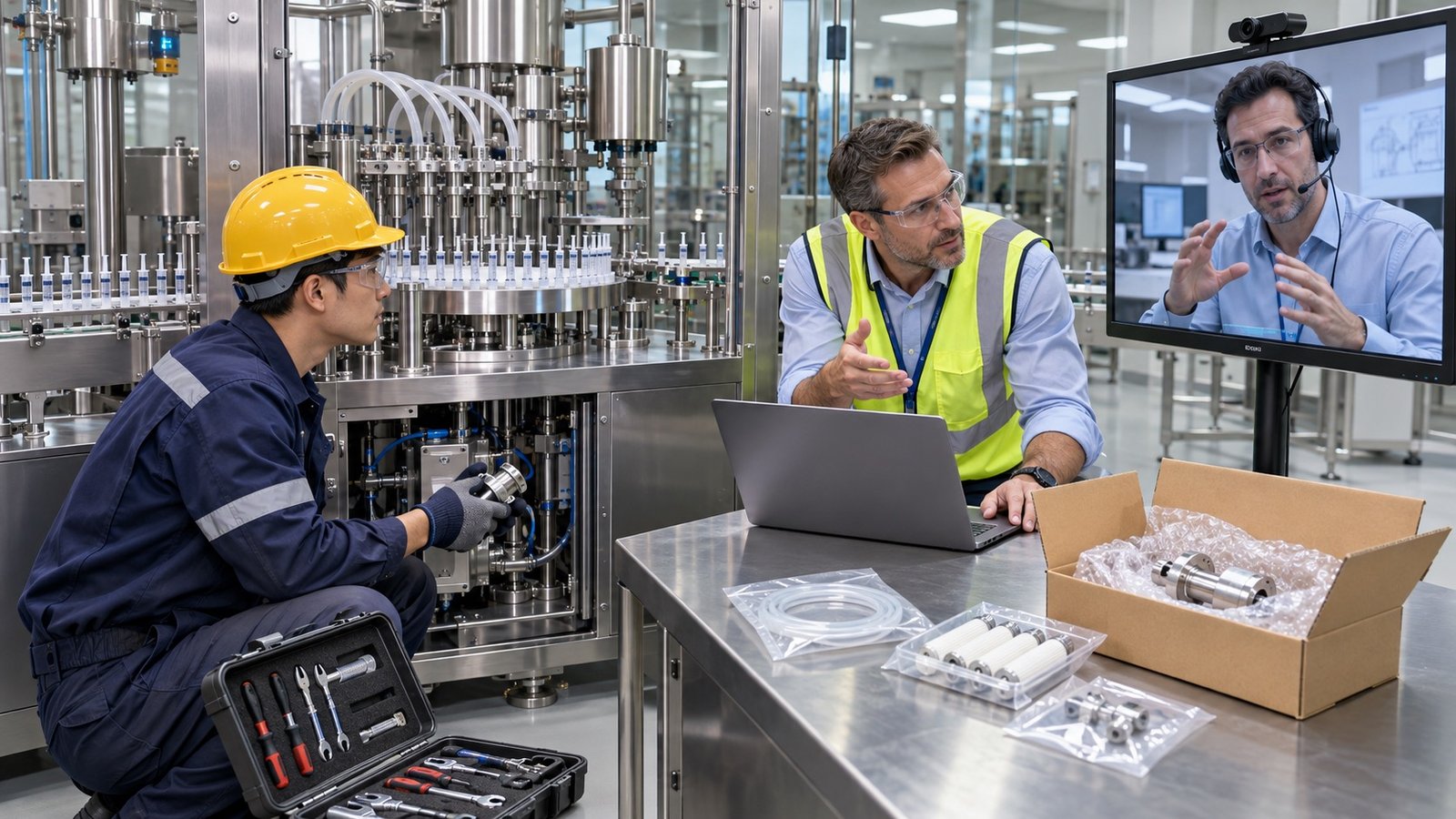
A hybrid arrangement can be effective: local first response and common spares, backed by OEM engineering, program control and custom parts. The contract should state the boundaries so the buyer is not forced to coordinate two unaccountable parties during downtime.
When factory-direct is usually the stronger route
Factory-direct procurement often deserves preference when:
- the package or process requires custom engineering;
- the buyer needs frequent access to design and controls engineers;
- several machines or future formats will share a technical platform;
- the buyer has its own import, installation and maintenance resources;
- local distributor capability is unproven;
- the OEM will own integration, FAT and lifecycle documentation.
These are decision factors, not guarantees. Confirm support capacity, response rules and destination experience with evidence.
When a distributor can add more value
A distributor can be the stronger route when:
- the team has documented experience with the exact OEM and machine type;
- local language and time-zone support materially reduce risk;
- import, delivery, rigging or compliance coordination is genuinely in scope;
- trained technicians and relevant spare parts are verifiably local;
- the distributor has authority to resolve warranty issues;
- the OEM-distributor escalation agreement is visible to the buyer.
The distributor’s margin should be evaluated against the work and risk it actually removes, not treated automatically as either waste or value.
How to compare a King Pack direct offer
King Pack supports custom configuration, FAT, documentation, training and line integration for filling projects. The exact contract, delivery, commissioning, warranty and local-support arrangement depends on the confirmed destination and project scope.
Use the syringe filling machine platform overview to identify a starting configuration, then send King Pack your product data, package drawings, output, destination and channel requirements. Ask for a responsibility matrix covering technical approval, FAT, logistics, commissioning, training, spares and support. Compare that matrix against any distributor offer on the same specification.
Frequently asked questions
Is a factory-direct syringe filling machine always cheaper?
Not necessarily. Compare equivalent scope, freight, import work, commissioning, training, spares, travel and support. A lower equipment price can exclude work included in another offer.
Does buying through a distributor cancel the OEM warranty?
It should not be assumed either way. Ask who issues the warranty, who authorizes claims and whether the distributor is formally approved for the quoted work. Put the answer in the contract.
Can the buyer sign with a distributor but communicate directly with the factory?
Yes, if all parties agree. Define the communication and approval path so technical discussions do not create unauthorized scope or conflicting commitments.
Who should conduct the FAT?
The machine builder normally performs the test, while the buyer or authorized representative witnesses it. The protocol must identify signatories, authority and deviation closure for the chosen contract model.
Are Incoterms enough to define installation and warranty?
No. Incoterms allocate defined delivery obligations, costs and risk. Installation, acceptance, ownership, payment, warranty and remedies need appropriate contract provisions.
What is the safest hybrid model?
There is no universal model. A common structure is local first-line service and logistics backed by direct OEM application engineering, program control and custom parts. It is safe only when responsibility and escalation are documented.