 Skip to content

Last reviewed: October 14, 2026.
Direct answer: Cream, sunscreen and body lotion tube filling should be configured from the product rheology, target dose, tube material, closure method and cleaning routine. These products may look similar to consumers but can behave differently during pumping, nozzle withdrawal, changeover and sealing. Use representative samples and final tubes to verify dosing, tail cleanliness, air control, closure appearance and cleanability before selecting a line.
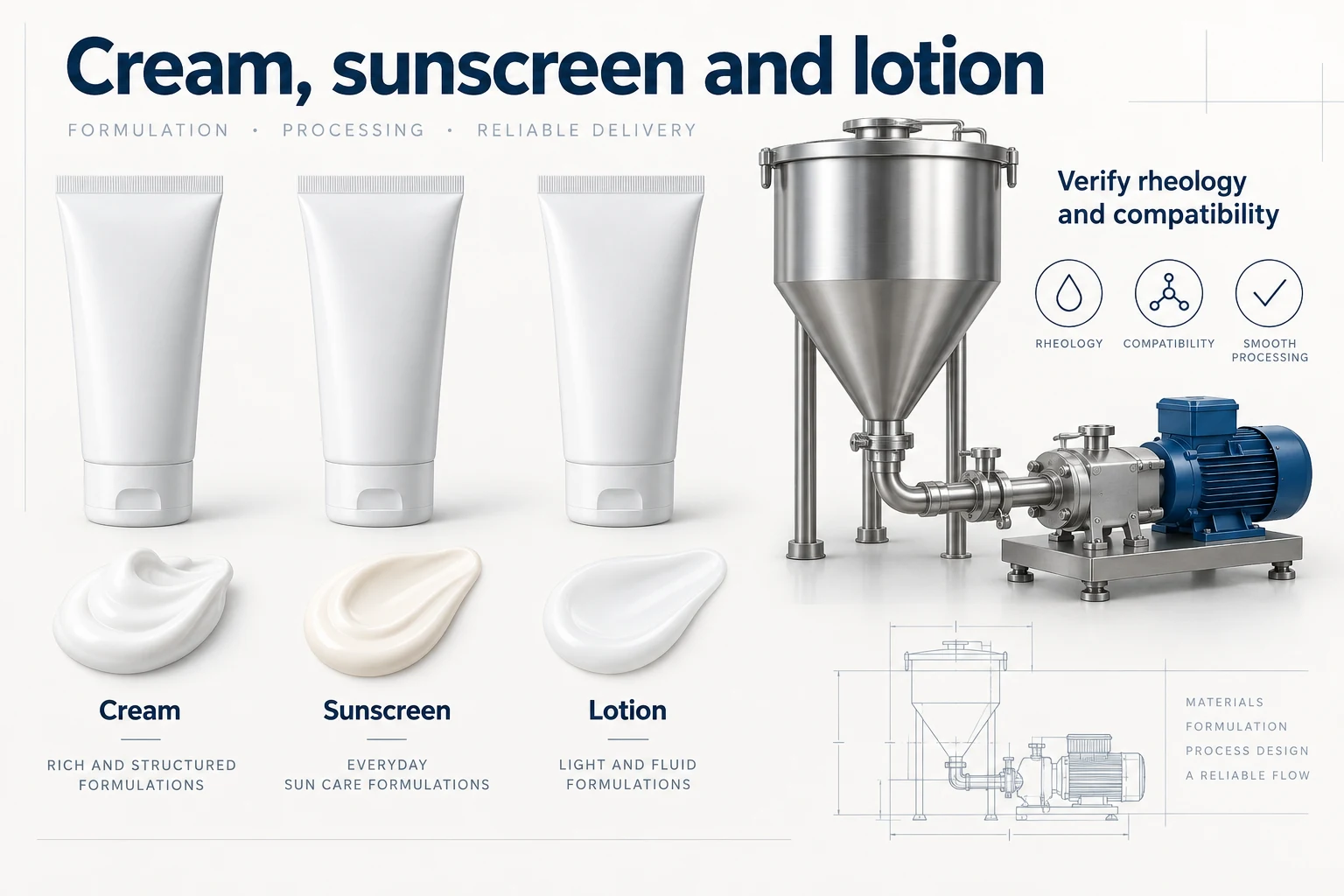
Cosmetic and personal-care manufacturers often need one line to support several formulas. A light lotion may run differently from a structured face cream, while a sunscreen can contain pigments, powders or high-solid ingredients that influence residue. This guide explains how to plan the filling and sealing process, compare tube materials and prepare a useful FAT and installation package.
Start with product behavior
Collect viscosity behavior, temperature range, density if known, solids, pigments, fragrance, shear sensitivity and settling risk. Record the time between mixing and filling. If the product is warmed, identify the approved range from the formula owner. Do not assume that a warmer product will always fill better; temperature can change viscosity and package compatibility.
For each formula, specify target fill volume or mass and the check method. Note whether the product is prone to stringing, air entrainment, skin formation or recovery after shear. These observations guide pump, valve, nozzle and cut-off evaluation. They are process inputs, not performance guarantees.
| Product type | Questions to investigate | Test focus |
|---|---|---|
| Body lotion | Flow, foaming and temperature sensitivity | Start-up, steady fill and nozzle cut-off |
| Face cream | Structure recovery and residue | Fill profile, withdrawal and cleaning |
| Sunscreen | Pigment, powder or high-solid behavior | Homogeneity, air, residue and changeover |
Choose the tube material with the closure
Plastic, laminate and aluminum tubes each require a compatible tail treatment. Plastic and laminate tubes may use hot-air or ultrasonic sealing; aluminum tubes may use folding. Tube drawings should show diameter, length, shoulder, tail, barrier structure and cap. Samples are important because wall variation, printed seams and stiffness can influence loading and sealing.
When switching materials, confirm whether the line uses exchangeable sealing tooling, a dedicated module or a separate machine. Verify that tube orientation, coding and downstream transfer remain compatible. A universal claim should be replaced by a documented format list and sample-test plan.
Filling from the open tube tail
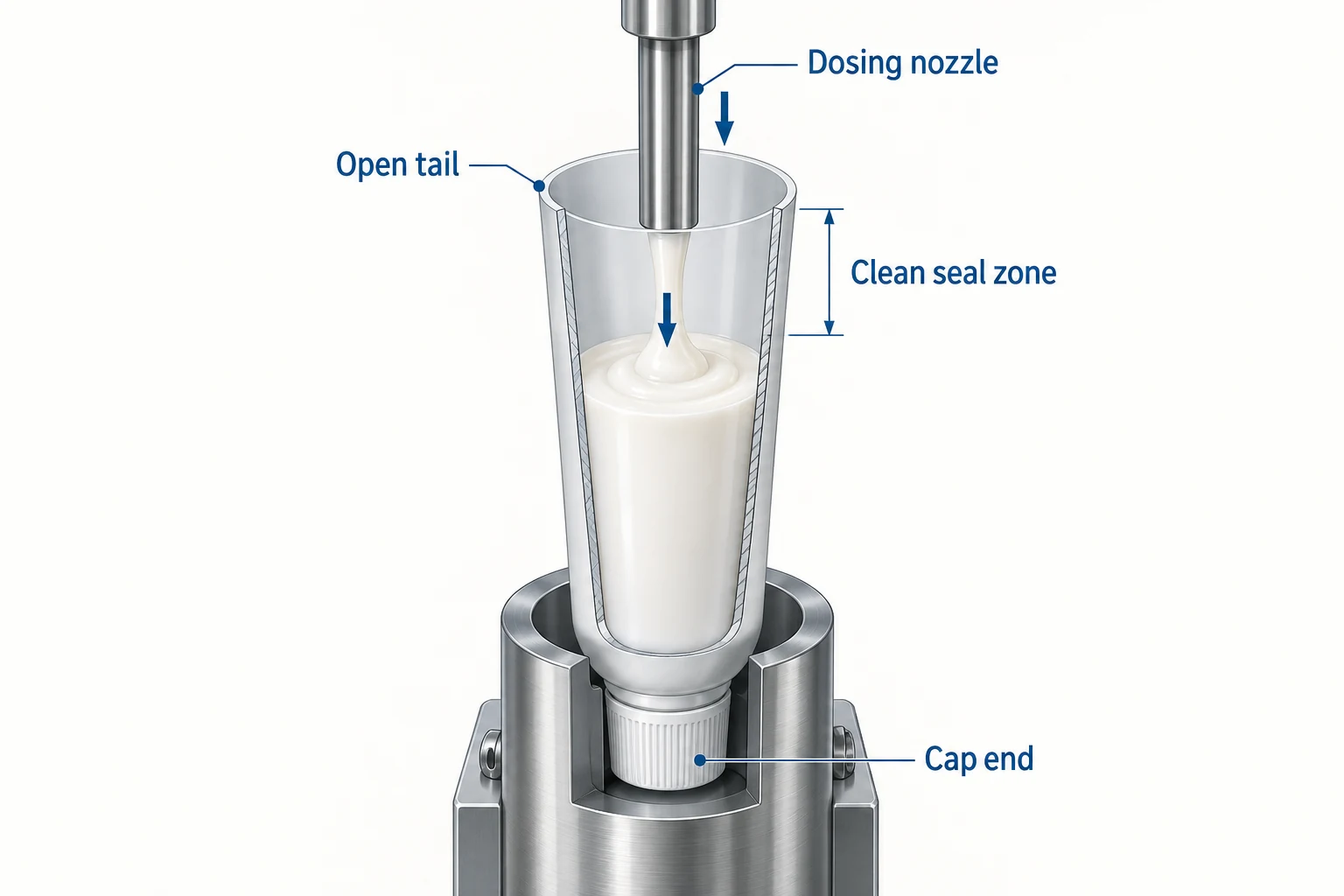
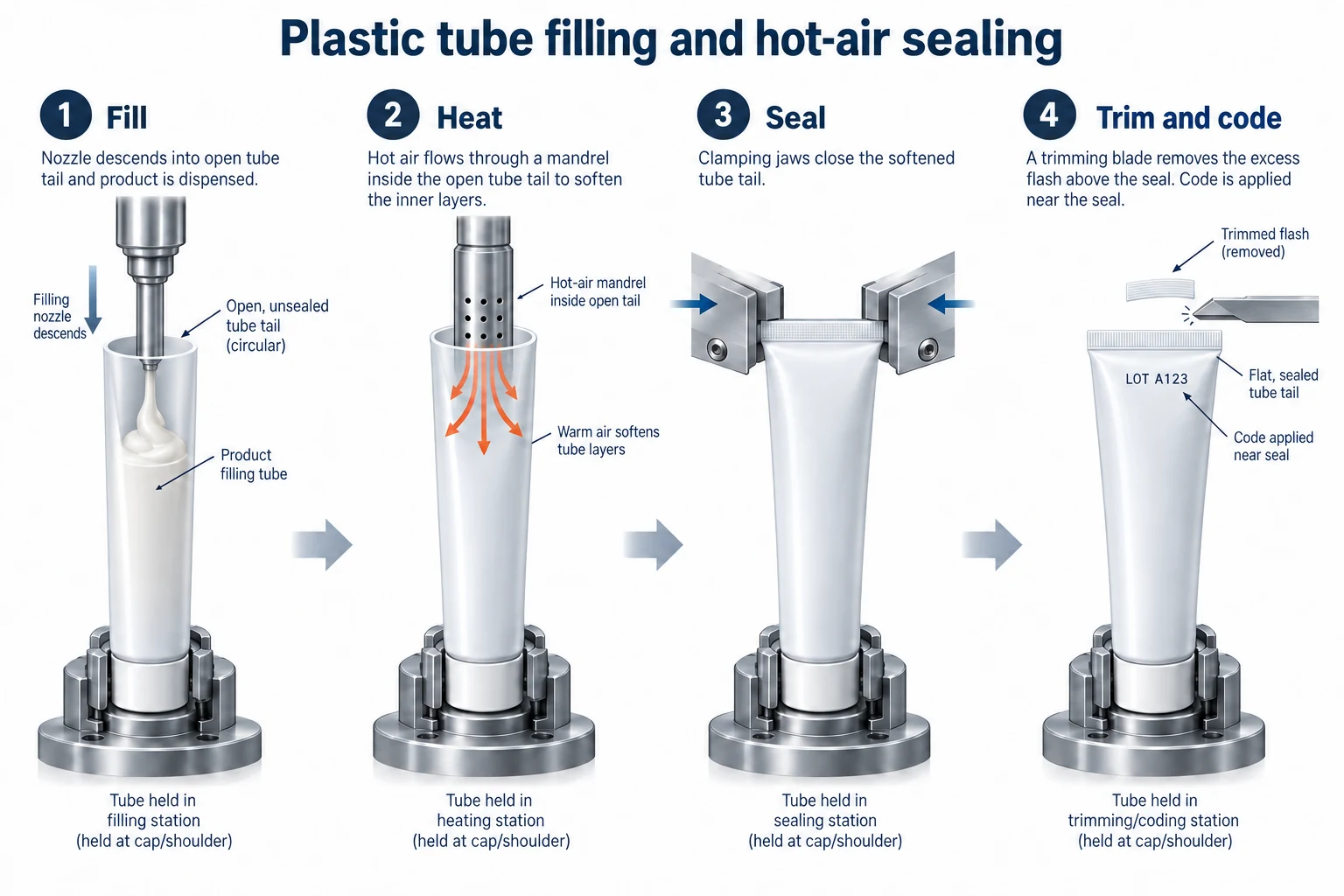
For common plastic and laminate tube processes, the tube is presented with the capped head supported below and the tail open above. The nozzle enters the unsealed tail, doses the product, withdraws without contaminating the seal area, and the tube then moves to heating or ultrasonic sealing. The tail is not filled through the already closed head. This sequence should be reflected in process diagrams and training material.
Bottom-up or controlled insertion may be evaluated for products where air control matters. The choice depends on tube geometry, nozzle reach and product behavior. Test nozzle position, withdrawal, cut-off and tube support with real product. A clean tail is necessary for a reliable seal, but it must be demonstrated rather than assumed.
Dosing and nozzle selection
The dosing system should be selected for the product range and target fill. Piston, servo and other dosing arrangements may be appropriate under different conditions. Ask how the machine handles product recovery after a stop, hopper refill, restart and changeover. If the product strings, evaluate cut-off timing and nozzle movement as conditional engineering options.
Record product temperature and conditioning at the nozzle. A sample that has been sitting in a room or hopper may not represent the intended production condition. The test record should note whether an operator primed, wiped or adjusted the machine during the run.
Air, splash and appearance control
Cosmetic products can show air bubbles, splashing or shoulder contamination when the fill profile and nozzle movement are not matched to the formula. Define the visual standard, lighting, sample size and permitted condition before FAT. A “smooth appearance” statement is too vague to support acceptance.
If the formula is shear-sensitive, the team should review pump speed, pressure, residence time and any agitation. If it contains solids, confirm that the product remains homogeneous over the planned run. These conditions belong in product preparation and operator instructions.
Tail sealing and inspection
Hot-air sealing requires an agreed temperature, air flow, dwell and clamping method for the tube construction. Ultrasonic sealing requires compatible tooling and a defined inspection method. Aluminum folding requires the correct folding sequence and tooling. Parameters must be set through sample testing; do not copy a value from an unrelated tube.
Inspect the tail for wrinkles, channels, incomplete closure, product on the sealing zone, coding damage and distortion. If the line includes trimming or embossing, include the operation in the acceptance plan. Record representative acceptable and unacceptable samples for production training.
Cleaning and changeover
Map the product-contact path from hopper to nozzle. Creams and sunscreens can leave oil, pigment or wax residue around seals, valves and guides. Define removable parts, cleaning agents, inspection points and line-clearance steps. If formulas vary in color or fragrance, select a difficult changeover for the trial.
Cleaning duration depends on equipment design, formula and operator method. Measure it during a representative test instead of claiming a fixed time. The formula owner must approve cleaning chemistry and carryover criteria.
FAT and shipment inspection
FAT should use the intended formula and final tubes whenever possible. Verify fill, tail condition, seal, coding, change parts, cleaning access, safety functions and documents. Include start-up and restart samples. If a substitute is used, list the limitations and open actions.
Shipment inspection should check machine configuration, guards, electrical and pneumatic interfaces, tooling, manuals, spare parts and packing photographs. Installation preparation should cover floor space, utilities, access, compressed air, electrical supply and downstream equipment.
Supplier evaluation
- Which cream, sunscreen or lotion samples were reviewed?
- Which tube materials and sealing methods are included?
- How is the open tail protected from product contamination?
- Which contact parts can be removed for cleaning?
- What will FAT measure and what remains conditional?
- Which format parts, documents and training are included?
King Pack’s confirmed scope includes plastic, laminate and aluminum tube filling, hot-air and ultrasonic sealing, aluminum-tube folding, custom configuration, FAT, documentation, training and line integration within the agreed project scope.
Account for formulation changes
Cosmetic formulas can change after a line has been installed. A new thickener, pigment, fragrance, preservative or oil phase can alter viscosity, residue and cleaning. Treat each significant change as a process review. Confirm whether the existing recipe, nozzle, product-contact material and cleaning procedure remain appropriate.
The formula owner should identify changes that require a sample test. The equipment team can then review the product path and adjust the test plan. This avoids carrying a setting from an earlier cream into a new sunscreen without evidence.
Control tube orientation and artwork
Printed tubes may need the seam, mark or artwork to face a defined direction. Confirm how the operator loads the tube and how the machine detects orientation. If a mark sensor is used, test different print contrast and tube lots. The reject route must be visible to operators and included in the line-clearance record.
Review the complete line
When the filler connects to a cartoner, check discharge orientation, buffer capacity and transfer height. Finished tubes should not be damaged by a downstream guide or accumulate in a way that affects seal inspection. Include cartoning and end-of-line interfaces in FAT if they are part of the purchase scope.
Discuss your requirements: Send your cream, sunscreen or lotion samples and tube drawings to King Pack for a technical review covering dosing, sealing, cleaning and line integration.
Compare the proposed station and tooling scope with the tube filling and sealing equipment overview; suitability still depends on the actual product and tube samples.
Compare dosing options with evidence
A dosing method should be judged by product behavior, required dose, cleanability and recipe range. Piston dosing can be useful when a defined chamber and stroke suit the formula. Servo-controlled motion can help create repeatable profiles across recipes. Other arrangements may be appropriate when pressure, air or product recovery is the main concern. The supplier should explain the selection and identify what will be checked with samples.
Do not transfer a setting from one cosmetic formula to another without testing. A body lotion with a light texture may drip after nozzle withdrawal, while a structured cream may string or hold air. A sunscreen with solids may require different agitation or residence control. Record the condition under which each setting was approved.
Tube loading, orientation and cap handling
Tube loading must match the package. If the shoulder or artwork is asymmetric, define the orientation method and the response to a misoriented tube. Cap feeding may be manual or automatic depending on the line scope. Check cap presence, seating, thread engagement or snap fit. The filler should not be accepted only because product enters the tube; the complete package sequence must be reviewed.
Tail sealing validation
For plastic and laminate tubes, heat or ultrasonic sealing should be evaluated with the final barrier structure. Check seal appearance, tail width, wrinkles, channels, product contamination, coding and any trimming or embossing. A seal that looks acceptable immediately after the operation may require a defined hold or inspection condition, depending on the packaging specification.
For aluminum tubes, verify the folding sequence, tool profile, number of folds and final appearance. The aluminum process should not be described as interchangeable with a plastic tube heat seal. Use separate tooling and acceptance examples when the material changes.
Cleaning risk by product family
Cleaning priorities differ by formula. A white lotion may leave an oily film, a colored cream may stain, and a sunscreen may leave particles or solids in a valve or nozzle. Define the hardest changeover and run it during the trial. Map all product-contact parts and the surrounding guides where product may splash.
Record cleaning agent, concentration, temperature, contact time, rinse method and inspection points according to the customer’s approved procedure. The equipment supplier can explain access and removable parts, while the product owner approves the cleaning acceptance criteria.
Handover documents
The final handover should include product and tube assumptions, approved recipes, change-part list, utility requirements, cleaning access, FAT records, open actions, manuals, drawings, spare-parts recommendations and training records. Keep acceptable and unacceptable seal examples with the quality documentation. This gives operators a practical reference when a new formula or tube lot is introduced.
Discuss your requirements: Send your cream, sunscreen and body-lotion samples with tube drawings to King Pack for a product, filling and sealing review.
Sample approval before routine production
Approve representative filled and sealed tubes before routine production. The approval should cover dose, appearance, tail seal, coding, cap fit and the defined cleaning or line-clearance condition. Keep the sample and record available for operators so that later batches can be compared with an agreed reference.
If the formula, tube supplier or closure component changes, identify whether a repeat test is required. Treat a change in package construction as a process change even when the nominal tube size remains the same. This discipline protects the seal and makes future troubleshooting faster.
Prepare a technical proposal request
Include formula samples, tube drawings, target fills, cap details, sealing method, cleaning restrictions, utilities and downstream equipment in the proposal request. Ask the supplier to separate confirmed capability, conditional engineering guidance and items that require a sample test. This makes the quotation useful for both procurement and quality review.
Record boundaries for future formulas
Every formula test has a boundary. Record the product temperature, conditioning time, tube lot, target fill, nozzle setting, sealing method and cleaning condition that produced the result. If a future formula changes the pigment, wax, oil phase or thickener, review the record instead of assuming that the old recipe applies.
Separate observations from assumptions. “The tube tail remained clean during the agreed run” is an observation. “The same setting will work for all sunscreens” is an assumption that requires further testing. This distinction keeps the technical file useful for quality, production and customer communication.
Practical procurement decision
Choose the configuration that matches the product range, tube formats, closure method, cleaning plan and evidence required by the plant. A larger or more automated line is not automatically better if it adds unnecessary changeover and cleaning points. A smaller line is not automatically cheaper if it cannot support the approved formats or inspection method. Compare the complete process and documentation scope.
Discuss your requirements: Send your actual cream, sunscreen or body-lotion samples and tube drawings to King Pack for a controlled sample-test plan and technical proposal.
Before release, compare the approved sample with the production specification and retain the result with the batch documentation. The sample should show the expected fill appearance, tail condition, coding and cap fit. If the plant changes the formula, tube supplier or closure, use the same review method to decide whether the process remains valid.
Include training, spares and commissioning requirements in the equipment service and handover scope so the plant can prepare its own personnel and utilities.
Compare the three products using different trial priorities
| Product family | Potential concern | Useful trial observation |
|---|---|---|
| Structured cream | Stringing and retained air | Nozzle withdrawal and texture after filling |
| Sunscreen | Suspended solids and formulation sensitivity | Residence condition and product-path residue |
| Body lotion | Dripping and splash | Valve closure and clean tube tail |
These are conditional trial priorities, not claims about every formula. Two sunscreens can need different handling, and a lotion may be more viscous than a product sold as a cream. Ask the formula owner which appearance and stability attributes must be preserved. The equipment trial should use those requirements rather than the product label as its acceptance basis.
Assess the pack after normal dispensing
Check how the filled product dispenses from its intended cap after an agreed conditioning period. Inspect visible air pockets, separation or an unexpected change in texture. Those observations help the product team decide whether further formulation or stability evaluation is necessary. They should not be converted into a shelf-life promise from a short filling trial.
Send your specifications: Use the King Pack technical enquiry form to share the product profile, tube drawings and the conditions you need verified.
FAQ
Can one tube filler handle cream, sunscreen and lotion?
It may be possible when product behavior, tube formats, dosing hardware, cleaning and closure tooling are reviewed together. Verify representative formulas.
Which tube material is best?
There is no universal answer. Compare compatibility, barrier needs, decoration, dispensing, closure and sample-test results.
How can tail contamination be reduced?
Control nozzle insertion, dose profile, withdrawal, cut-off and tube support. Fill from the open tail and verify a clean seal area before heating or ultrasonic sealing.
What should be tested before purchase?
Test dose, appearance, air, tail cleanliness, sealing, coding, cleaning access, changeover and restart conditions using final product and tubes.
What is the next step?
Send Your Product and Tube Specifications: Request a technical proposal and sample-test plan based on your formulas and packaging.
Conclusion
Cream, sunscreen and body lotion filling projects succeed when product rheology, tube material, open-tail filling, sealing and cleaning are considered as one process. A representative sample test and clear FAT record create a defensible basis for equipment selection and installation. Get a Technical Proposal: Send your product and tube matrix to King Pack for review.
Related King Pack resources
For cream, sunscreen and body lotion projects, compare our tube filling machine solutions, filling and capping line solutions, and complete packaging equipment solutions. Review cosmetic filling solutions, veterinary medicine filling equipment, and syringe filling machines when the product format changes. Related technical guidance includes ultrasonic tube filling, aluminum tube filling, tooling contact zones, and multi-SKU tube-filler selection. For project preparation, see the FAT guidance, use the Contact Us page, and send a technical quote request.
