

A syringe filling machine warranty is useful only when the buyer can tell what is covered, who must diagnose the fault, how quickly critical parts can be supplied and what happens when remote support is not enough. Compare suppliers with a written service matrix rather than a headline warranty period. The matrix should name covered modules, exclusions, evidence required for a claim, response and escalation targets, spare-parts responsibilities, remote-access controls and the boundary between factory support and onsite work.
This is a procurement framework, not a statement of King Pack warranty duration, inventory level or guaranteed response time. Those commercial terms depend on the confirmed machine configuration, destination and contract. Ask each bidder to place its measurable commitments in the quotation or signed agreement.
Why the longest warranty is not automatically the best offer
Two suppliers can both advertise a twelve-month warranty and deliver very different operational protection. One period may start at shipment while another starts after acceptance. One may include replacement parts but not freight, labor or travel. Another may exclude product-contact seals, misuse, unapproved modifications and normal wear without defining how a failure will be classified.
The real comparison is the complete support system:
- when the warranty clock starts and pauses;
- which mechanical, electrical, control and format parts are covered;
- which items are treated as consumables or wear parts;
- who performs diagnosis and what evidence the buyer must provide;
- who pays for parts, international freight, duties, onsite labor and travel;
- whether software, PLC and HMI backups are included;
- how emergency remote support is requested and secured;
- what triggers onsite service and who can provide it;
- what support remains available after the warranty expires.
The existing veterinary syringe filler supplier comparison covers broader supplier capability. This guide asks a narrower question: whether the after-sales terms can keep one specified machine supportable after acceptance.
Build a warranty scope matrix before comparing prices
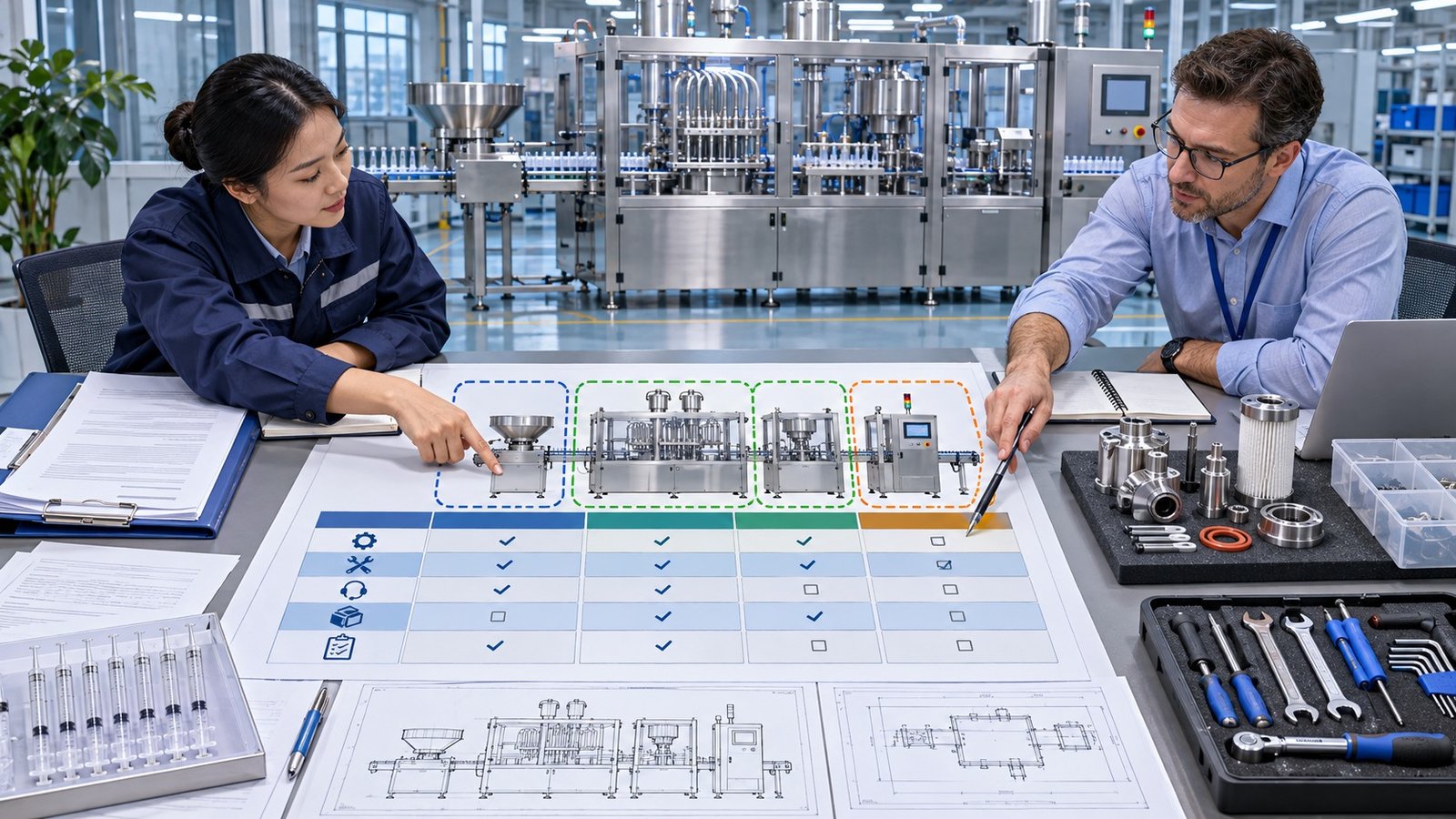
Do not accept “standard warranty applies” as the final description. Ask the supplier to complete a line-by-line matrix for the actual configuration and every supplied peripheral.
| Item to define | Question for the supplier | Evidence to retain |
|---|---|---|
| Start point | Does coverage start at shipment, arrival, installation, SAT or another milestone? | Contract clause and dated acceptance record |
| Covered equipment | Are feeder, pump, filling station, closure station, inspection, conveyor and guarding all included? | Final scope list and approved layout |
| Covered costs | Are parts, freight, duties, remote labor, onsite labor and travel treated separately? | Cost-responsibility table |
| Wear parts | Which seals, belts, bearings, nozzles or other items are excluded? | Model-specific parts list |
| Claim evidence | Are alarm logs, photographs, video, electrical measurements or returned parts required? | Claim procedure and contact route |
| Unauthorized work | Which repairs, parameter changes or third-party parts can affect coverage? | Written change-control rule |
| Software | Who holds program backups and how is a validated version restored? | Backup register and recovery test |
| End of warranty | What paid support, parts supply and upgrade options remain? | Post-warranty service terms |
The buyer should connect this matrix to the final equipment scope. A warranty for the “main machine” may leave the dosing pump, feeder, coding unit or downstream transfer outside the covered boundary. This is especially important for a custom or OEM syringe filling project where several engineered modules may be integrated into one line.
Separate warranty response from repair completion
“Twenty-four-hour support” can mean only that an email is acknowledged. It does not prove that a qualified engineer will begin diagnosis, that a needed component is available or that production will restart within a day.
Request separate, measurable targets for:
- acknowledgement of the support request;
- first technical response by a qualified person;
- remote diagnostic session, when appropriate;
- written diagnosis or next-action plan;
- parts quotation or warranty decision;
- dispatch after the required part is identified;
- escalation to onsite service;
- closure report after the machine is returned to service.
Define business hours, time zone, languages and holiday coverage. Also define severity. A cosmetic issue, a single disabled optional station and a complete line stop should not share one response target. Ask who has authority to classify severity and escalate a ticket.
Avoid a supplier promise that depends on incomplete buyer inputs. The buyer should identify an authorized contact, maintain network and electrical records, preserve alarms, provide safe machine access and send a concise fault package. A useful first report includes machine serial number, operating recipe, recent changes, alarm history, photographs or video, affected samples and the last known good condition.
Specify critical spares from failure consequence, not a generic kit
A “free spare-parts box” is not necessarily a critical-spares plan. The correct list depends on the installed bill of materials, expected use, changeover frequency, local sourcing, component lifecycle and the operational consequence of failure.
Classify parts in three groups:
- Consumables and planned-wear items: seals, gaskets, tubing, filters, belts and other items replaced by condition or schedule.
- Critical downtime items: a sensor, valve, drive, controller, power supply or custom format part whose failure can stop production and cannot be sourced quickly.
- Insurance spares: high-value or low-failure components held because lead time or obsolescence risk is unacceptable.
For every proposed spare, record the manufacturer, exact part number, machine location, quantity installed, recommended stock quantity, shelf-life or storage condition, interchangeability and replacement instructions. Where a third-party component can be bought locally, confirm that the supplier allows equivalent sourcing and state any configuration or firmware requirement.
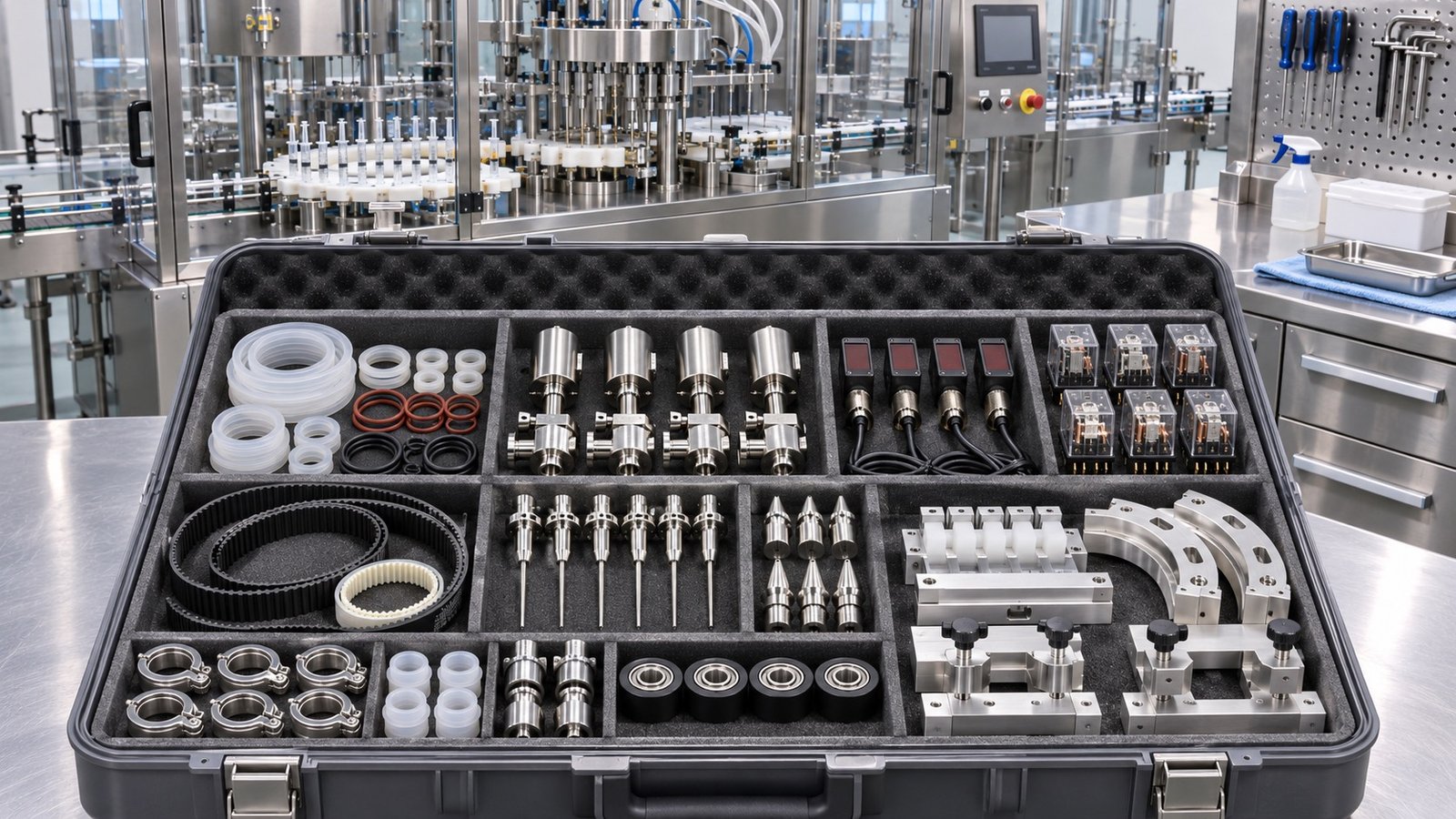
Ask the supplier to distinguish stock status from an estimate. “Normally available” is not the same as reserved inventory. For custom-machined tooling, define whether drawings are controlled by the OEM, whether a damaged part must be returned and whether a verified replacement can be produced from the approved revision.
Include spares in the project schedule. The custom syringe filling machine lead-time guide explains why design freeze, sample confirmation, testing and dispatch are separate milestones. The critical-spares list should be frozen against the as-built machine before shipment, not copied from an early quotation.
Make remote support useful and secure
Remote access can shorten diagnosis when the supplier needs alarm history, PLC status or a live view of the machine. It also creates an OT security decision for the buyer. A permanently open vendor connection should not be treated as a default convenience.
NIST SP 800-82 Rev. 3 recommends that OT remote access be justified, limited to the business need, monitored and removed when no longer required; it also discusses multi-factor authentication and temporary access for vendor maintenance. CISA’s industrial remote-access guidance emphasizes defined roles, defense in depth, least privilege, segmentation and centralized logging. The buyer’s IT/OT policy and applicable regulation control the final architecture.
Put these requirements into the support plan:
- the buyer initiates or explicitly approves each session;
- access is time-limited and disabled after the task;
- named accounts are used instead of shared default credentials;
- multi-factor authentication and an approved secure path are used where the buyer requires them;
- the permitted machine, service and privilege level are defined;
- operator and IT/OT contacts know when the session begins;
- activity and configuration changes are logged;
- current PLC, HMI, drive and recipe backups exist before changes;
- the supplier records the diagnosis, change and rollback method;
- remote access does not bypass guards, interlocks or the buyer’s safety procedures.
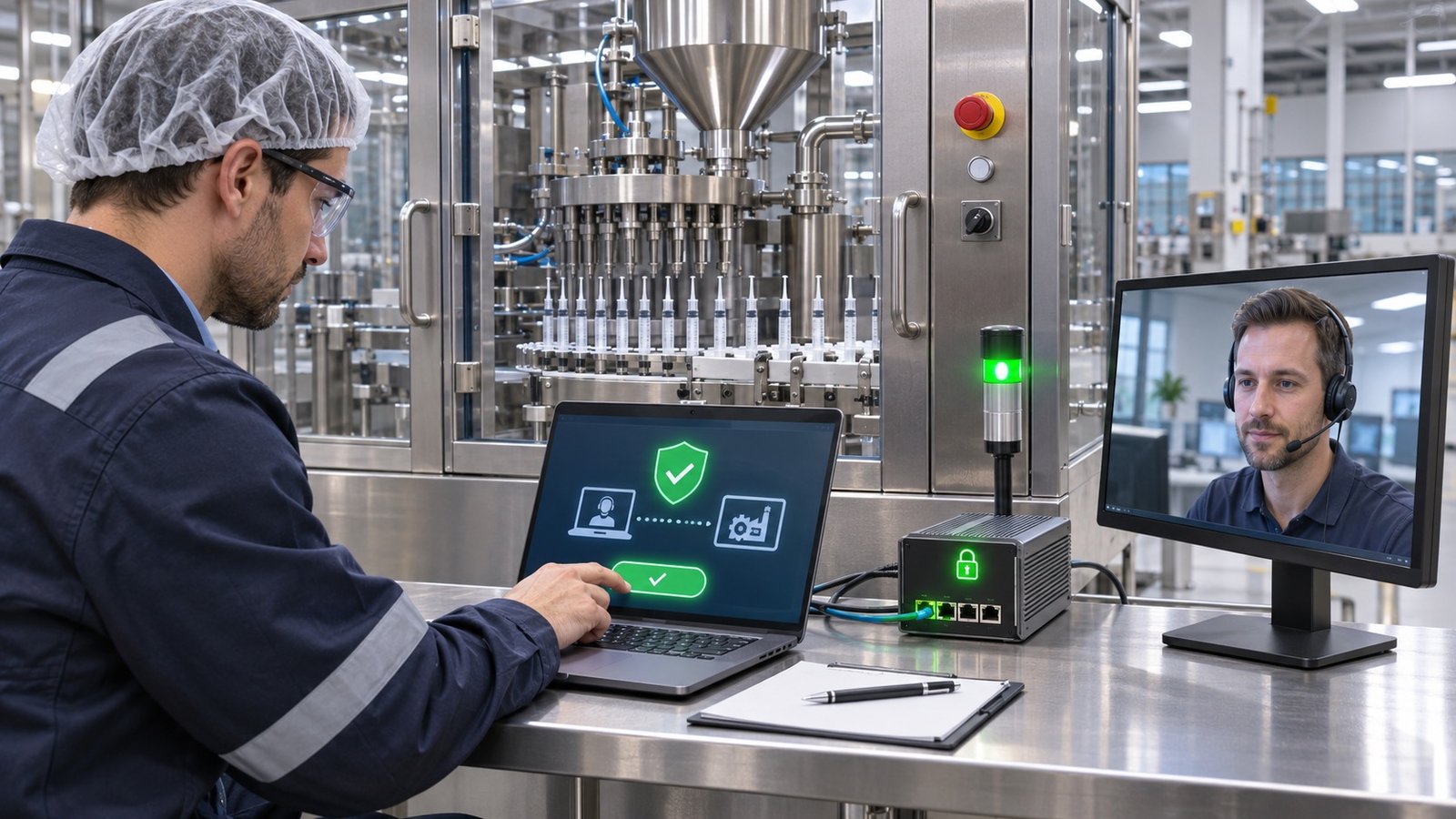
Test the support connection before acceptance, but do not confuse connectivity with problem resolution. A practical test verifies who authorizes access, whether the support engineer can retrieve the agreed diagnostic information, how changes are approved, whether logs are retained and how the session is terminated.
Define the boundary between remote and onsite service
Some failures can be resolved through instructions, a backup restore or a locally replaceable part. Others require mechanical alignment, safety verification, specialist instruments or work that the buyer will not authorize its own team to perform.
Agree in advance when onsite service is required. Define:
- symptoms or tasks that are remote-support only;
- tasks the buyer’s trained maintenance team may perform;
- work reserved for the OEM or an authorized local technician;
- who decides that an onsite visit is necessary;
- target mobilization process, visa or site-access requirements;
- travel, labor, accommodation and local transport responsibility;
- tools, lifting equipment and replacement parts required onsite;
- safety induction, permits and lockout responsibilities;
- service report, training and restart evidence required before closure.
If a distributor or local service partner is involved, name the legal and technical responsibility of each party. “Local support available” should identify the organization, location, competence, stocked parts, escalation route and authority to approve warranty work. The buyer should verify the arrangement rather than infer it from a logo on a quotation.
Use FAT and handover to prove support readiness
FAT should prove more than output from a clean machine. It is also the point to establish the as-built service baseline. Include the following support deliverables in the acceptance list:
- final mechanical and electrical drawings;
- approved parts list with manufacturers and part numbers;
- PLC, HMI, drive and recipe backup procedure;
- alarm list and first-response troubleshooting guide;
- preventive-maintenance schedule;
- lubrication and cleaning instructions;
- format-part register and setup values;
- critical-spares recommendation;
- remote-support connection test;
- named escalation contacts and ticket process;
- operator and maintenance training records;
- list of open items with owners and due dates.
The machine should be tested under agreed conditions with representative product and package components. A support promise cannot compensate for an unclear process specification. Use the automatic versus semi-automatic syringe filling guide to define the actual operator tasks, because staffing and maintenance responsibilities change with automation level.
A practical supplier comparison scorecard
Score evidence, not sales language. Weight each category according to the cost of downtime at your site.
| Category | Example evidence | Warning sign |
|---|---|---|
| Warranty clarity | Signed scope, start point, exclusions and cost matrix | “Standard warranty” with no attachment |
| Diagnostic process | Severity levels, named channel and required fault package | Only a salesperson’s messaging account |
| Critical spares | As-built list with part numbers and lead-time basis | Generic kit unrelated to installed components |
| Remote support | Approved architecture, authorization and session record | Permanent uncontrolled access |
| Onsite service | Named provider, mobilization process and cost rule | Unverified claim of global local support |
| Documentation | Backups, drawings, manuals and revision control | Files promised after shipment with no acceptance item |
| Lifecycle support | Obsolescence notice and post-warranty route | No owner for discontinued controls |
Do not combine the score into one number until mandatory conditions are passed. A low price should not offset an unacceptable remote-access design or the absence of a recoverable control backup.
How to discuss support with King Pack
King Pack supports custom configuration, FAT, documentation, training and after-sales work for filling projects. Those general capabilities are not a substitute for project-specific warranty, spares or response commitments.
Review the syringe filling machine platform and then send King Pack your package drawings, product information, operating plan, destination and required service matrix. Ask the quotation to identify the installed modules, warranty boundary, critical spares, remote-support method, training scope and onsite responsibility. Confirm every commercial promise in the final contract.
Frequently asked questions
What is a normal syringe filling machine warranty period?
There is no safe universal period to assume. Compare the start point, covered modules, exclusions, costs and claim process as well as the duration. Obtain the project-specific term in writing.
Should a buyer purchase every recommended spare part?
Not automatically. Rank parts by failure consequence, local availability, shelf life, component lifecycle and lead time. Hold what the site’s downtime risk justifies.
Is remote technical support enough for an overseas machine?
It can resolve some control, setup and diagnostic issues, but it cannot replace every mechanical, safety or process task. Define the escalation boundary and onsite route before ordering.
Who should pay international freight for a warranty replacement?
The contract should say. Warranty coverage of the part does not automatically determine freight, customs, duties, return shipment or labor responsibility.
Can the machine supplier connect directly to the factory network?
Only under the buyer’s approved IT/OT policy. Prefer justified, limited, monitored and time-controlled access with named authorization and a recorded change process.
What support evidence should be completed at FAT?
Confirm the as-built parts list, backups, manuals, alarm guide, spares plan, training, escalation contacts and a controlled remote-support test, in addition to machine-performance acceptance.