
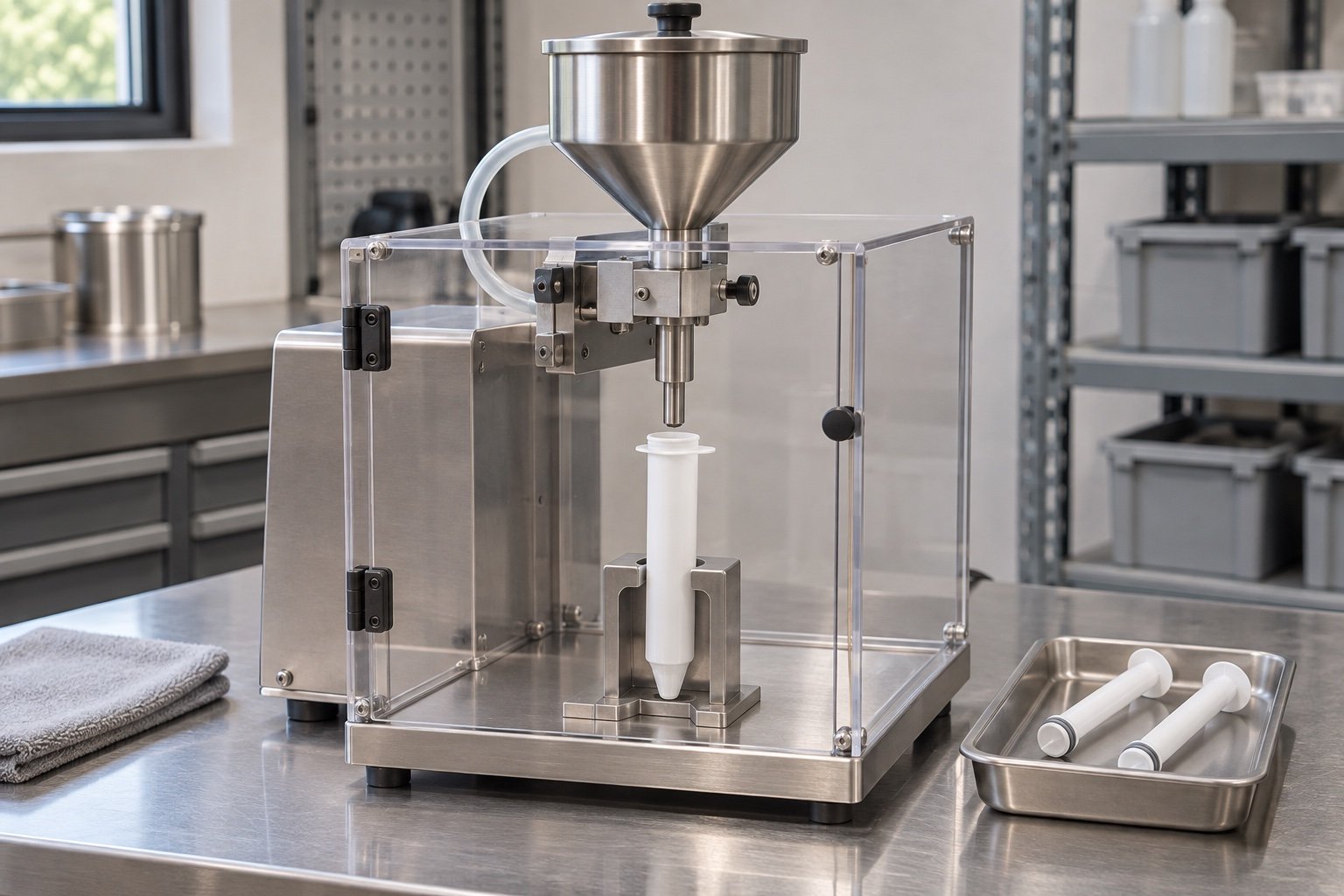
A benchtop syringe filling machine can be a practical choice when you need to test a formulation, qualify a new applicator, or make short runs with frequent changeovers. Specify the machine around your smallest usable batch, the actual syringe and closure, and the number of acceptable units an operator can finish. A demonstration that only shows the dosing stroke leaves the buyer without evidence about product recovery, closure quality, or usable output.
Featured image: AI-generated illustration of a generic benchtop syringe filling station.
Before requesting a quote, decide where the pilot process ends. Some projects only require a repeatable fill into a supported barrel. Others need a correctly seated piston or plunger, a closed tip, and an inspected applicator. Those two briefs can lead to very different equipment even when the fill weight is identical.
Start with what the pilot batch needs to prove
An R&D run might compare two formulations or check whether a sample package can be filled without obvious trapped air. A packaging qualification run might need enough finished units to check weight, closure, and handling after filling. Small commercial batches may add operator training, batch records, cleanability, and a repeatable process for switching products. State which of those outcomes matters and who will judge it.
Also state whether the first production machine must reproduce the pilot process. For example, if the pilot is intended to inform a future automatic line, record the material temperature, how the barrel is supported, the direction of filling, and the closure sequence. Those details provide a useful baseline when a supplier proposes a different dosing system or moves component handling to automatic stations.
Write the scope in one line. A useful example is “Pilot fill and close the supplied oral-paste applicator, verify net weight and piston seating, and log saleable units and waste through one complete batch.” The project team can then agree whether inspection, labeling, or packing is included.
Compare a benchtop syringe filler with compact automatic equipment
“Benchtop” describes the footprint. Ask which operations are manual, powered, or integrated. A tabletop dose head may depend on the operator for barrel presentation, unloading, piston insertion, and tip closure. A compact automatic machine may perform several of these operations in sequence and still be designed for small batches.
| Equipment arrangement | A reasonable fit when | Ask the supplier to demonstrate |
|---|---|---|
| Bench fixture with manual or assisted filling | Material is limited and operators need to change formats frequently | Repeatable barrel position, clean cut-off, product recovery and handling with gloves |
| Semi-automatic dosing with operator loading | A controlled dose is needed but short runs do not justify automatic feeding | The complete operator cycle, including handling, closure and inspection |
| Compact line with integrated stations | Closure, presentation or inspection has become the main source of variability | A continuous run with actual components, agreed defect checks and a realistic changeover |
Examples in the market illustrate the range. Nordson EFD lists manually operated syringe barrel filling systems for non-pourable industrial fluids. Syntegon describes small-output ready-to-use syringe equipment in its pharmaceutical portfolio. These examples concern different processes and cannot be used to infer suitability for a buyer’s formulation or for sterile fill-finish.
Work out the minimum useful batch before comparing speed
Separate three quantities: product introduced into the system, product recovered in accepted units, and product consumed during setup or lost at the end of the run. Ask suppliers to include product remaining in the hopper, tubing, pump and nozzle. Also record first-piece adjustments and any units rejected during the run.
An illustrative material balance makes the comparison tangible. Suppose a team has 2.0 kg of trial material and needs 300 accepted applicators at 5 g each. Accepted units consume 1.5 kg, leaving 0.5 kg for setup, residual material, samples and rejects. If the demonstration consumes 0.35 kg before an acceptable unit is produced, only 0.15 kg is left for everything else. Change the inputs for your product and include any material that must be kept for retention testing. These figures are planning assumptions, not machine performance.
Ask the supplier to measure remaining material after a realistic run. A small machine may still use a long transfer path that holds significant product. A shorter path or smaller reservoir may reduce hold-up, but must still provide reliable feeding and the required cleaning access. The trial is the place to check both.
If a compact machine cannot complete an acceptance-critical operation, use the guide to specifying custom syringe filling equipment to decide whether the job needs format tooling, an added module, or a dedicated station.
Check the entire operator cycle
Watch one operator load the barrel, initiate the dose, remove the filled unit, fit the closure, and place it for inspection. If the trial uses two operators, record which task each person performs. Count accepted units and divide by the time spent across the agreed cycle. Keep set-up and changeover time visible when estimating output for a working shift.
For example, 80 accepted units over 30 minutes would be an observed rate of 160 accepted units per hour for that segment. A shift estimate would still have to account for breaks, cleaning, replenishment, samples, rejects and changeovers not included in that segment. A machine cycle shown on video cannot establish those assumptions.
Use the same operator count and task boundary when comparing suppliers. A quote may show filled barrels per hour while another shows fully assembled and inspected units. To make those results comparable, log the count at fill, the count at closure, and the count accepted after inspection. If the quantities diverge, ask what happens to units waiting between operations and whether those units can be held without affecting the trial’s quality criteria.
Look for interruptions: an awkward barrel grip, frequent nozzle wiping, a piston that must be started by hand, or a closure that requires a second station. Ask which interruptions are design issues and which depend on the package or product. If one operation dominates the cycle, automation there may matter more than a faster dosing stroke.
Bring the actual syringe set and formulation to the trial
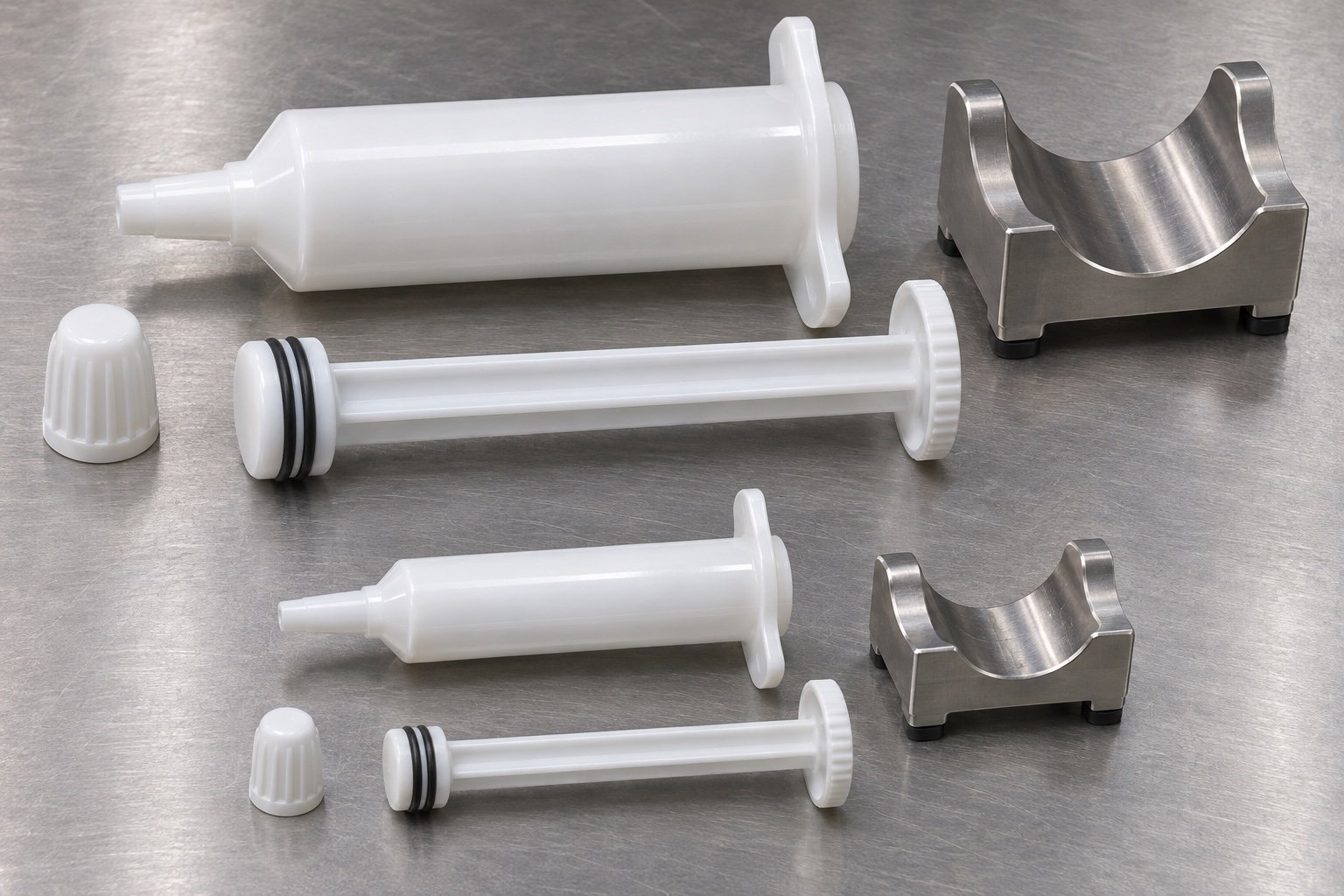
Provide barrel drawings and samples, including the piston or plunger, tip cap and any part that changes how the barrel can be held. Identify the smallest and largest formats. A sample barrel with the correct nominal capacity can still have a different flange, tip or interference fit. Record any tolerance ranges you want the fixture to accommodate.
Send the target dose and acceptance method. Specify whether results will be assessed by net fill mass, volume, or another agreed measure. For a gravimetric check, agree how tare is determined, how many units to record, and how to identify units across start-up, steady operation and restart. If volume will be inferred from mass, confirm the appropriate density and test conditions with your quality team.
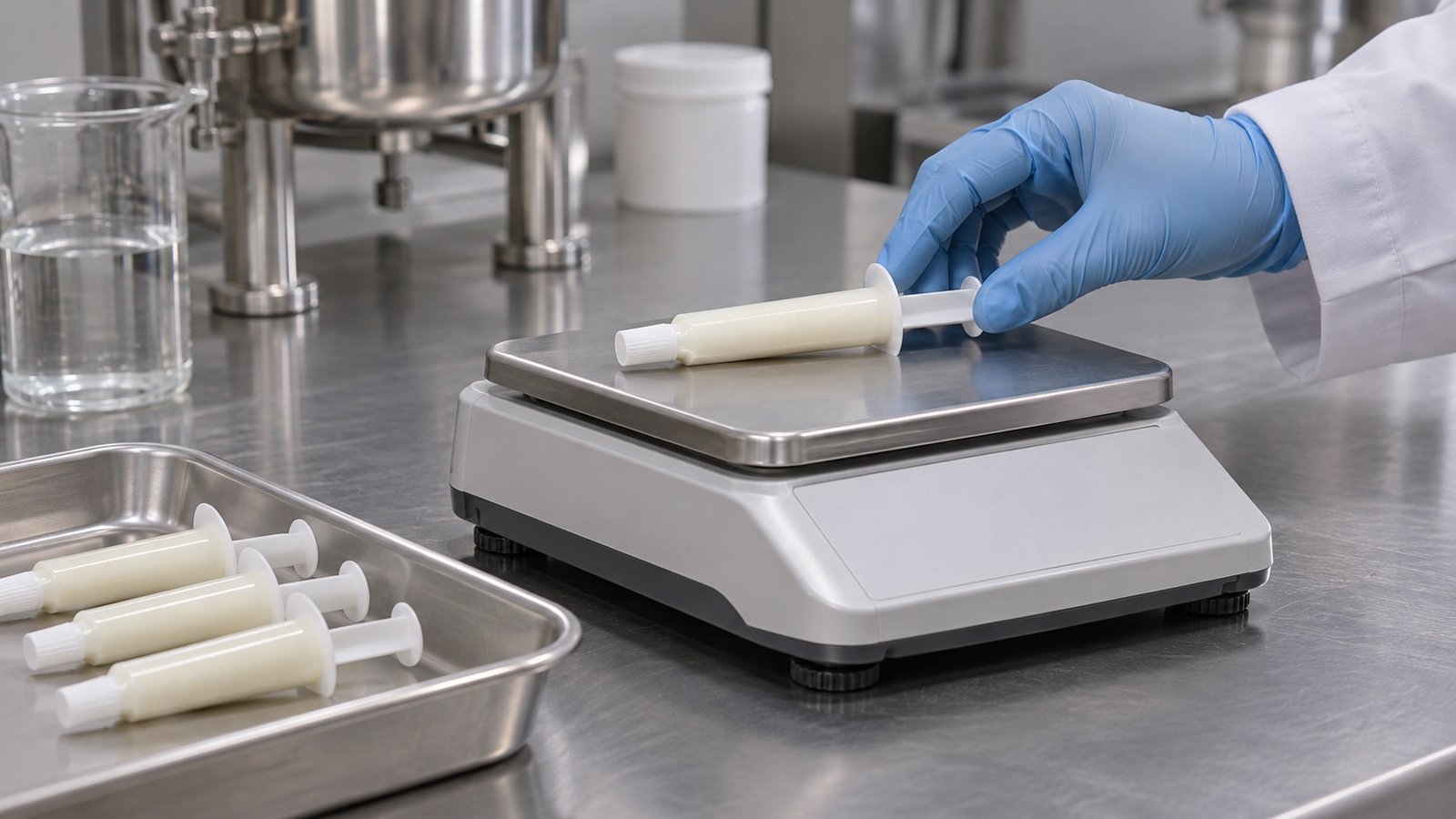
Describe how the formulation behaves at the operating condition expected in production. Useful inputs include viscosity data when available, observations of settling or aeration, temperature sensitivity, and whether the paste strings or drips at cut-off. A substitute may help check motion and access, but specify which conclusions still require your representative formulation.
King Pack’s guide to planning a representative syringe filling trial gives an application-specific example of pairing the formulation and the real package. The same procurement principle applies to a pilot fixture: test the conditions that determine whether the finished unit passes.
Define cleaning and changeover before equipment selection
Ask for a drawing of the wetted path and identify the parts the operator will remove between products. Evaluate access around the nozzle, hopper, transfer tubing and seals. Confirm which parts will be reused, which are consumables, and what documentation the buyer needs for its own cleaning procedure.
Run a format change during the demonstration if frequent switching is part of the business case. Time the interval from the last accepted unit of the first format to the first accepted unit of the next. Include part removal, fixture exchange, setting changes, inspection and any product lost while restarting. Record whether tools are required and how the team verifies that the correct fixture and recipe are installed.
Include a brief stop and restart in the test when planned production involves pauses. Observe whether the first unit after the pause remains within the agreed acceptance criteria. Note how the team handles product already in the wetted path and whether any restart purge is required. Record a failed restart separately from an out-of-tolerance unit during continuous operation. The two events may have different causes and require different changes to the proposed equipment or procedure.
Where the intended operation is aseptic or otherwise subject to regulated production controls, define the applicable process and environment with the quality team before selecting equipment. A benchtop arrangement can serve a particular development role, but its use in a regulated production process depends on the documented equipment, facility and process requirements for that application.
What to send in a pilot filler RFQ
- Product: intended application, representative sample, operating conditions and smallest useful batch.
- Package: drawing and actual barrel, tip, closure, piston or plunger for each priority format.
- Output: batch size, accepted units per shift, operator count and how often you change format.
- Quality: target fill and tolerance, measurement method, closure criteria, and defect samples if available.
- Scope: operations performed by the equipment and by the operator, wetted parts, utilities, cleaning and training.
- Trial: sample quantities, start-up and end-of-run waste, changeover checks and the records required for acceptance.
If the pilot line will move into an existing room, use the syringe filling machine utilities guide to prepare questions about power, compressed air, product supply and service space. For a veterinary applicator project, explore King Pack’s syringe filling solutions to identify relevant sample and process inputs. Send your package drawing and pilot batch requirements to discuss a representative equipment trial.
Frequently asked questions
Is a benchtop syringe filler always manual?
No. Some bench units use a powered dosing system while the operator loads and unloads each barrel. Ask which functions are integrated and which depend on the operator.
What is the minimum batch size for a tabletop syringe filling machine?
It depends on the wetted path, priming requirements and acceptable product loss. Compare proposals using a measured material balance at the smallest planned batch.
Can one pilot filler run different syringe sizes?
Possibly. Confirm fill range, barrel geometry, fixture support and closure compatibility. Trial the formats most likely to expose a limitation.
What should count as a successful pilot batch?
Define acceptance for finished units before the trial. Depending on your brief, records may include net fill weight, acceptable closure, visible defects, accepted unit count, material loss and restart behavior.
When should I move from a benchtop filler to automatic equipment?
Consider upgrading when manual handling, closure, inspection, or a recurring capacity shortfall limits the process. Verify the bottleneck with full-cycle measurements before changing the equipment scope.