
Food tube filling equipment should be evaluated by how the actual food moves through the machine and how every relevant surface can be cleaned, inspected and maintained. A stainless-steel exterior is not sufficient evidence of hygienic design. For mustard, sauces and food pastes, review product-contact materials, joints, valves, drainage, nozzle access, tube handling and the customer’s sanitation method before selecting a configuration.
This guide gives procurement, engineering and food-quality teams a practical design-review framework. It concerns equipment suitability and cleanability. The food producer remains responsible for its process controls, sanitation programme, cross-contact assessment, package compatibility and product release.
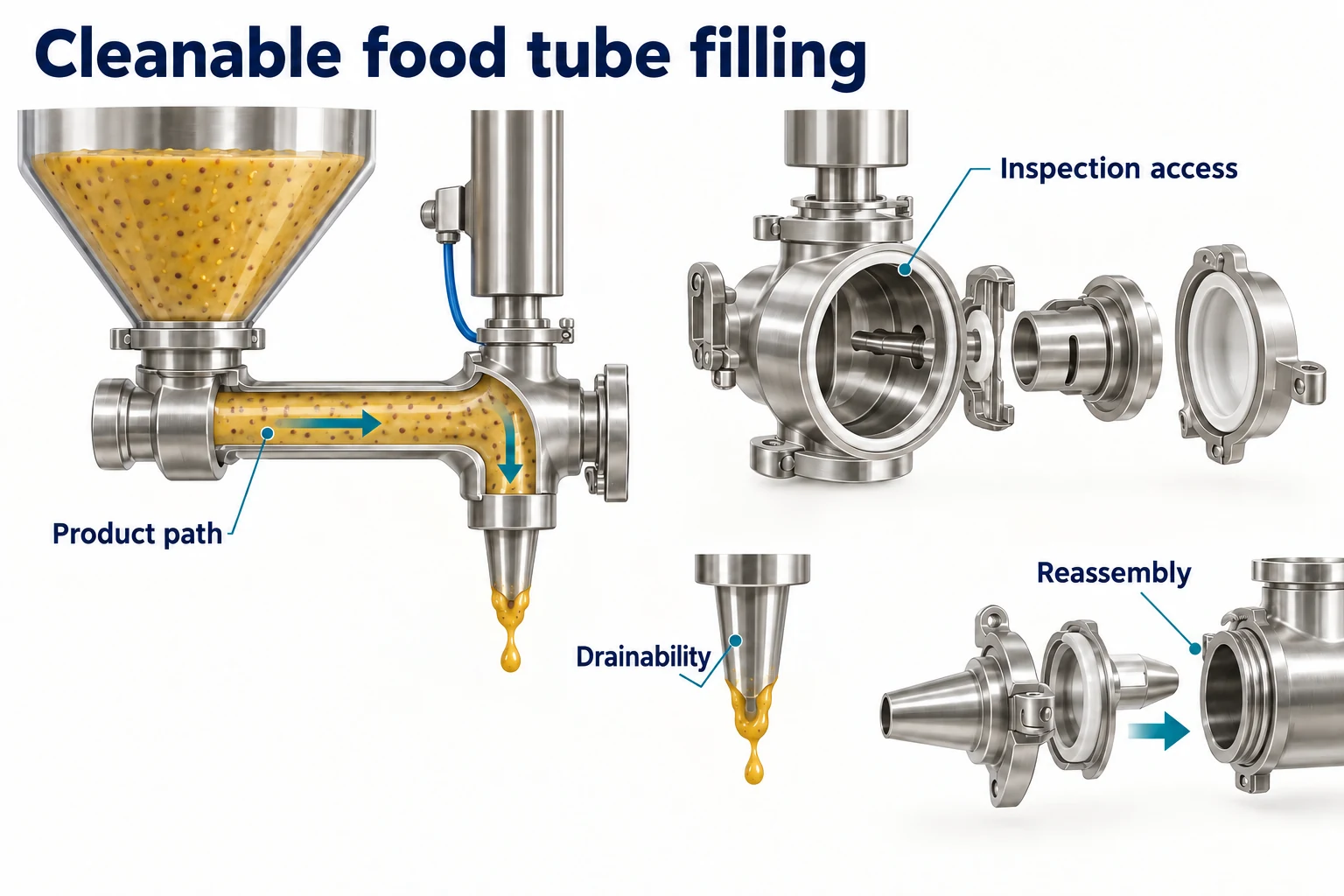
Describe the food and the cleaning method together
Provide viscosity, particles, fibers, acidity, oil content, filling temperature and sensitivity to shear. Describe whether the product dries, sticks, settles or separates during a planned hold. Include the cleaning agents and operating conditions approved by the customer. Materials must suit both production and the cleaning environment.
Mustard is not a single handling condition
A smooth mustard, a coarse seed-containing formulation and a thicker blended sauce can need different passages, valves and cut-off behavior. A mustard tube filling machine should therefore be reviewed against representative recipes. The product name does not establish pump suitability or predict the hardest cleaning task.
Identify cross-contact concerns in the customer’s product portfolio and destination markets. Do not assume that a general list of food products defines the site’s cleaning obligations. The quality team should state which changeovers require additional controls and what evidence is needed to release the equipment for the next recipe.
Map the full product-contact path
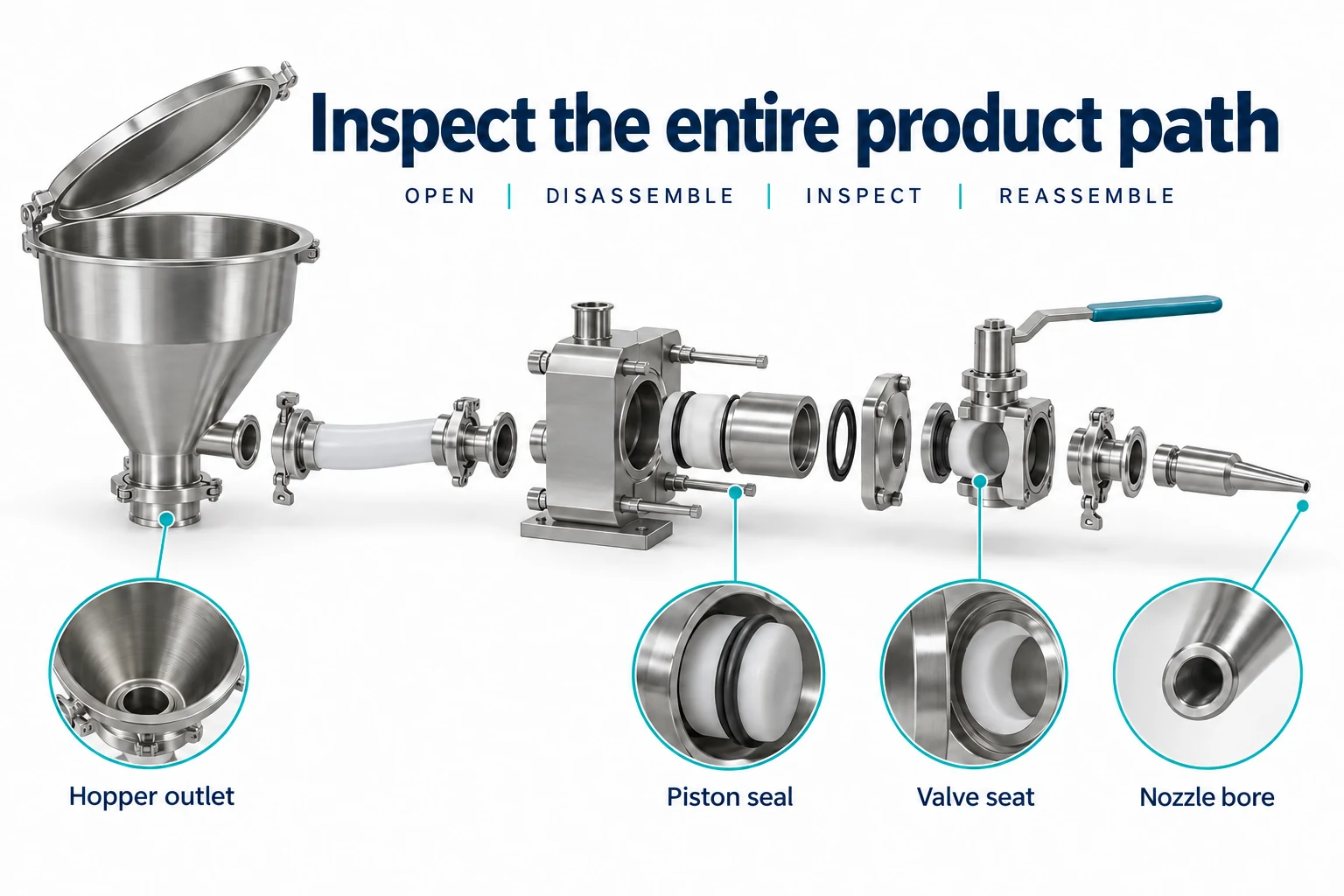
Trace the route from the customer’s vessel connection to the hopper, pump, valve, hose and dosing nozzle. Mark low points, cavities, removable parts and instrument connections. Include any return or recirculation path. A cleanable hopper cannot compensate for residue retained in a valve or long transfer hose.
Look beyond the primary contact surfaces
Review areas that can splash or drip onto tubes, tooling or exposed product. Inspect the supports around the hopper outlet, guards near the nozzle and guides beneath the filling station. Define how these areas are accessed and cleaned without creating a new contamination route during reassembly.
For US manufacturing context, 21 CFR 117.40 addresses cleanable equipment, suitable food-contact surfaces, maintenance and installation that permits cleaning. Convert the applicable requirements into a site-specific review rather than treating a supplier’s “food-grade” label as blanket compliance.
Review materials and contact components
Ask for the specified metals, elastomers, hoses, seals and other contact components. Confirm suitability with the food, temperature and cleaning agents involved. A metal grade alone does not describe surface condition, joint design, gasket behavior or the suitability of a replacement component.
Seals, joints and wear parts
Inspect how a gasket sits in its groove, whether a joint creates a retained pocket and how parts are identified after dismantling. Confirm replacement part numbers and the instructions needed to preserve the approved assembly. A nominally similar seal can change product compatibility or leave a different crevice.
Request construction and material documentation within the purchase scope. If a specific equipment certification is required, verify the exact model and scope with the issuing body. Do not imply that King Pack holds an unverified certificate or that a component certificate applies automatically to an entire line.
Drainability and product recovery
Inspect how the hopper, pump and hoses empty after production. Identify material that remains in low points or cavities and decide how it is removed. The practical objective is a controlled transition from production to cleaning, with retained food visible to the sanitation procedure.
Do not confuse recovery with sanitation
Recovering product from a line can reduce retained material, but it does not establish that surfaces are clean. Define the site’s disposition for recovered product and keep it separate from cleaning fluids. Product recovery must remain within the customer’s approved food process and traceability arrangements.
If a proposal includes a recirculation loop, ask why it is needed and how it is drained and cleaned. Additional pipework may solve one handling issue while adding sanitation and residence-time questions. Evaluate the full path rather than approving features individually.
Select dosing for the actual mustard or sauce
A piston or other metering arrangement should be chosen from the product’s flow, particles, target fill and cleaning method. Review inlet conditions, valve passages and shut-off parts. A pump that handles a smooth paste may behave differently with seeds or fibers.
Nozzle access and clean cut-off
The nozzle must provide the required flow while controlling dripping or stringing. Confirm how it is removed and inspected. Product retained in a shut-off tip can affect the next start-up as well as cleaning. Trial the proposed nozzle with representative food rather than assuming that a larger bore resolves every issue.
At the filling station, support the tube at the head or capped end and keep the unsealed tail upward. Fill through the open tail, then transfer to the material-specific closure. Keep food away from the seal zone and inspect how the tube moves during nozzle withdrawal.
Choose a realistic cleaning architecture
Decide whether the system is intended for manual disassembly, clean-out-of-place, clean-in-place or a combination. Define the boundaries. A rinse connection does not demonstrate that every internal surface receives an effective cleaning treatment. Ask which parts still need removal and how they are inspected.
Manual cleaning and reassembly
Check that operators can dismantle the required parts safely, identify their orientation and protect clean components before reuse. Review the tools, handling space and storage needed. A procedure is less reliable if it depends on reaching an inaccessible seal or remembering an undocumented assembly detail.
In-place cleaning claims
For a proposed in-place method, request an explanation of coverage, drainage, instrument points and remaining manual tasks. The customer establishes the application-specific cleaning procedure and verification. Do not infer effective cleaning from pump circulation alone.
EHEDG’s public explanation of test methods distinguishes equipment suitability assessment from performance in a particular application. That distinction is useful when reviewing evidence: the producer still needs a cleaning regime appropriate to its own food and process.
Tube feeding and closure also need hygienic review
Review the storage and loading of empty tubes, their exposure before filling and the condition of holders and guides. Define which compressed-air or gas functions contact food or contact surfaces. Any treatment or monitoring should follow the site’s assessment and relevant equipment requirements.
Protect the tail and finished pack
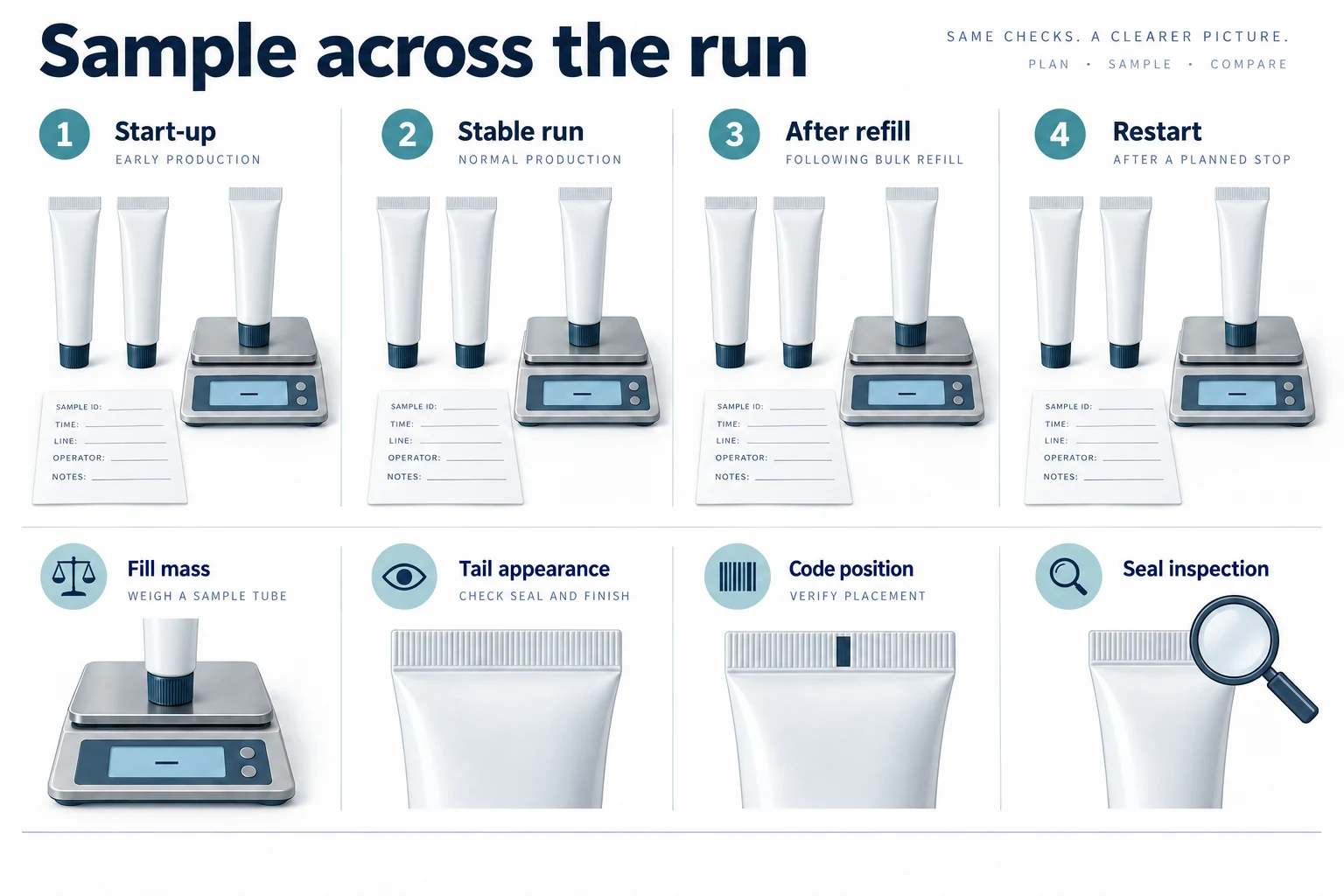
Closure selection depends on tube construction: compatible thermoplastic sealing for plastic or laminate, and the specified mechanical fold for a metal-body tube. Inspect tail contamination, seal or fold appearance, code position and damage after discharge. Cleanability of the filler does not replace package-integrity evidence.
| Area | Question at design review | Practical demonstration |
|---|---|---|
| Hopper outlet | Can retained food be removed? | Drain and inspect after a representative run |
| Pump and valves | Are cavities and seals accessible? | Dismantle and identify contact parts |
| Nozzle | Can the tip be cleaned and reassembled? | Inspect shut-off and first-dose behavior |
| Tube tooling | Can splashed residue reach the next tube? | Review guides, pockets and clearance |
| Discharge | Is the finished pack protected? | Inspect after normal handling |
Use FAT to examine the proposed cleaning method
A useful factory acceptance test includes the actual food or a justified substitute, production tubes, dose, closure, coding, rejection and access for cleaning. Ask the intended operators to perform the relevant dismantling steps where practical. Retain observations about residue and reassembly, not only a video of the line cycling.
State the limits of factory evidence
A factory demonstration of access is not proof that the customer’s sanitation process has been established. Record cleaning agents, utilities, personnel and tests that were unavailable. Assign the remaining verification to site commissioning or the customer’s sanitation programme as appropriate.
Review the proposed scope against the food filling and packaging application range. Ask for the particular contact materials, cleaning features and tools needed for the mustard or sauce project, rather than relying on an industry category.
Prepare shipment and installation for clean operation
Shipment inspection should identify and protect contact parts, nozzles, tooling, instruments and spares. Confirm manuals, drawings and the parts list. At the destination, review the delivered condition before the site begins its approved cleaning and commissioning activities.
Leave enough room to clean
Mark operating, dismantling and maintenance space on the layout. Include the route for bulk food, removed parts and waste, and the access needed around adjacent equipment. A machine can fit its floor footprint yet be difficult to clean if a wall or conveyor blocks an important panel.
The installation and commissioning plan should assign utilities, drainage, cleaning connections, operator training and acceptance responsibilities. Resolve these interfaces before dispatch so the site does not improvise them around a delivered machine.
A practical cleanability review during a mustard trial
Consider a hypothetical project that will alternate a smooth sauce and a seed-containing mustard. The trial should examine whether the product path handles both foods and whether the planned changeover reaches the locations where either can remain. This is a proposed review method, not a reported King Pack test or sanitation result.
Observe before dismantling
After the product run, record where food remains during the approved drain-down. Check the hopper outlet, inlet hose, pump chamber and nozzle. Distinguish intentional product-hold volume from inaccessible residue. Photographs can help engineering explain the path, but the customer’s inspection and cleaning acceptance methods determine the decision.
Do not apply a different cleaning procedure simply to make the demonstration look easier. If the factory method differs from the planned site method, record that difference and its consequences. A change in water supply, cleaning tools or disassembly practice can alter what the demonstration represents.
Follow the actual dismantling sequence
Ask how operators release clamps, remove seals, protect components and identify their orientation. Check whether parts can be dropped, mixed or damaged during handling. If a gasket is difficult to inspect without stretching it, raise the issue during design review. The machine should support a repeatable procedure, not depend on unusual operator skill.
Review the non-contact surfaces around the product route as well. Residue on a guard or support can transfer during reassembly even if the internal parts are clean. Identify where the clean components will be placed and how the sanitation area is separated from dirty parts and waste.
Inspect and reassemble
The customer’s sanitation team should select inspection points and appropriate tests. Visual access helps locate remaining food, while any additional analytical or microbiological methods answer their defined questions. Keep the difference between an access demonstration and a sanitation result clear.
During reassembly, use the documented parts and orientation. Check the product path before the next recipe enters. Follow the site’s procedure for cleaning-fluid residue and the first product through the machine. A successful changeover includes controlled restart, not only removal of the previous sauce.
Protect hygienic design during maintenance
Maintenance can unintentionally change a cleanable assembly. A different seal, improvised hose, damaged contact surface or altered support can introduce a retained pocket or a difficult-to-clean location. Keep a controlled parts list and assess replacements against the intended product and cleaning conditions.
Identify early signs of deterioration
Inspect wear parts for the symptoms relevant to their function. A nozzle that begins to drip may contaminate the tube tail; a worn pump seal may affect dose or allow product to collect. Record the observation, repair and return-to-service check. Do not treat repeated cleaning difficulty as normal if the original assembly was easier to inspect.
Define who reviews repairs that affect food-contact surfaces. The site should decide whether cleaning verification, a product trial or another assessment is needed before release. Keep the updated configuration and instructions with the equipment file so later staff do not rely on obsolete drawings.
Compare suppliers on demonstrated access
During proposal review, ask each supplier to show the same product path and describe the same cleaning sequence. Compare the number and type of removable parts, access to seals and valves, drainage and the method for protecting clean components. Avoid reducing the decision to a polished exterior or a generic hygiene claim.
Clarify which documentation is included: material specifications, component identification, drawings, dismantling instructions, maintenance intervals and operator training. If a special certification or surface requirement is essential to the customer, state it before quotation and verify the offered evidence. Unsupported assumptions are harder to resolve after fabrication begins.
Finally, identify the customer’s own responsibilities. Suitable utilities, cleaning equipment, trained personnel, approved chemicals and a defined sanitation procedure are part of the operating system. A clear division of responsibilities lets a supplier propose the correct equipment while the food producer retains control of its food-safety and release decisions.
RFQ checklist for hygienic food tube filling
Provide food recipes and handling conditions, tube drawings, fill range, cleaning method, cross-contact concerns, layout and destination-market requirements. Request material information, a product-path drawing, change-part identification, a trial plan and explicit exclusions. Keep the distinction between equipment design, sanitation evidence and food-process approval visible in the proposal.
Review your food product path: Send the mustard or sauce profile and cleaning requirements through the King Pack technical enquiry form for a configuration and sample-test discussion.
Keep the evidence tied to the application
Retain the food description, cleaning method, tube lot, installed parts and trial observations in one indexed handover record. If the product changes from smooth sauce to a particulate mustard, review the passages and cleaning points again. If a new cleaning agent is introduced, review contact-material compatibility and the approved procedure. The original equipment trial remains useful only while its assumptions are visible.
Use the same discipline for a new destination market or customer specification. Identify any additional evidence before accepting the production commitment, rather than converting a general hygienic-design statement into a promise about an untested application.
FAQ
Does stainless steel make a filler food-grade?
No. Suitability also depends on contact components, surface condition, joints, drainage, cleaning access, maintenance and the intended application.
Can one machine fill smooth and coarse mustard?
Possibly, if the passages, valves, nozzle and cleaning method suit both. Test representative particle and viscosity conditions before approval.
Does a CIP connection prove the machine is cleanable in place?
No. Review coverage, drainage, manual tasks and the customer’s application-specific cleaning evidence.
Who approves the sanitation procedure?
The food producer’s designated quality and sanitation owners establish and approve the procedure. The supplier provides equipment information and support within the agreed scope.
Can a hygienic design guarantee shelf life?
No. Product formulation, processing, package integrity and storage also determine the required food-quality and shelf-life evidence.
Can coarse mustard change the cleaning review?
Yes. Seeds and particles can affect passage selection and retained-product locations. Review representative recipes and the intended sanitation procedure rather than assuming equivalence with a smooth sauce.
Conclusion
Food tube filling equipment should make the complete product path accessible, maintainable and compatible with the customer’s cleaning method. Evaluate the actual mustard, sauce or paste, then demonstrate dismantling, drainage, dosing and closure before purchase.
Request a hygienic design review: Share your food formulation, packaging and sanitation requirements with King Pack to define the equipment scope and factory acceptance plan.
Last reviewed: October 14, 2026. US equipment-rule and EHEDG references are contextual; the producer should establish applicable destination-market requirements.
The following visuals are illustrative production and inspection references. They do not represent guaranteed output or measured validation results.
Related equipment and project resources
For equipment selection, compare the relevant filling machine product range with the packaging solution overview. Application context is available in the veterinary medicine solutions and pharmaceutical packaging guide. Where the process includes a closure step, review the filling and capping line and tube sealing equipment.
Before a trial, document product rheology, fill volume, container dimensions, contact materials, cleaning method, closure requirements and inspection points. Related planning resources include tube filling and sealing machine selection, how to choose a tube filling machine, tube sealing quality control, manual to automatic syringe filling and syringe format changeover planning.
For a project-specific review, contact the technical team, send your requirements for a quote or review the syringe filling machine range. Include samples or drawings when available so the machine scope can be assessed against real product and packaging conditions.
Need help with the next step? Request a quote with the product, package, fill volume and target checks.