
A hand cream tube filling and sealing trial should demonstrate the complete pack under defined conditions: representative cream, production tubes, controlled dosing, a clean tail, an acceptable closure and readable identification. Agree those conditions and acceptance criteria before the test. A short run with convenient paste and unprinted tubes may reveal mechanical operation, but it does not establish readiness for the intended hand cream.
This checklist is intended for cosmetic manufacturers, private-label producers and contract packers preparing a factory trial or first production run. It describes recommended engineering observations rather than a report of measured King Pack results. Use the product owner’s requirements to decide which checks and sample quantities are appropriate.
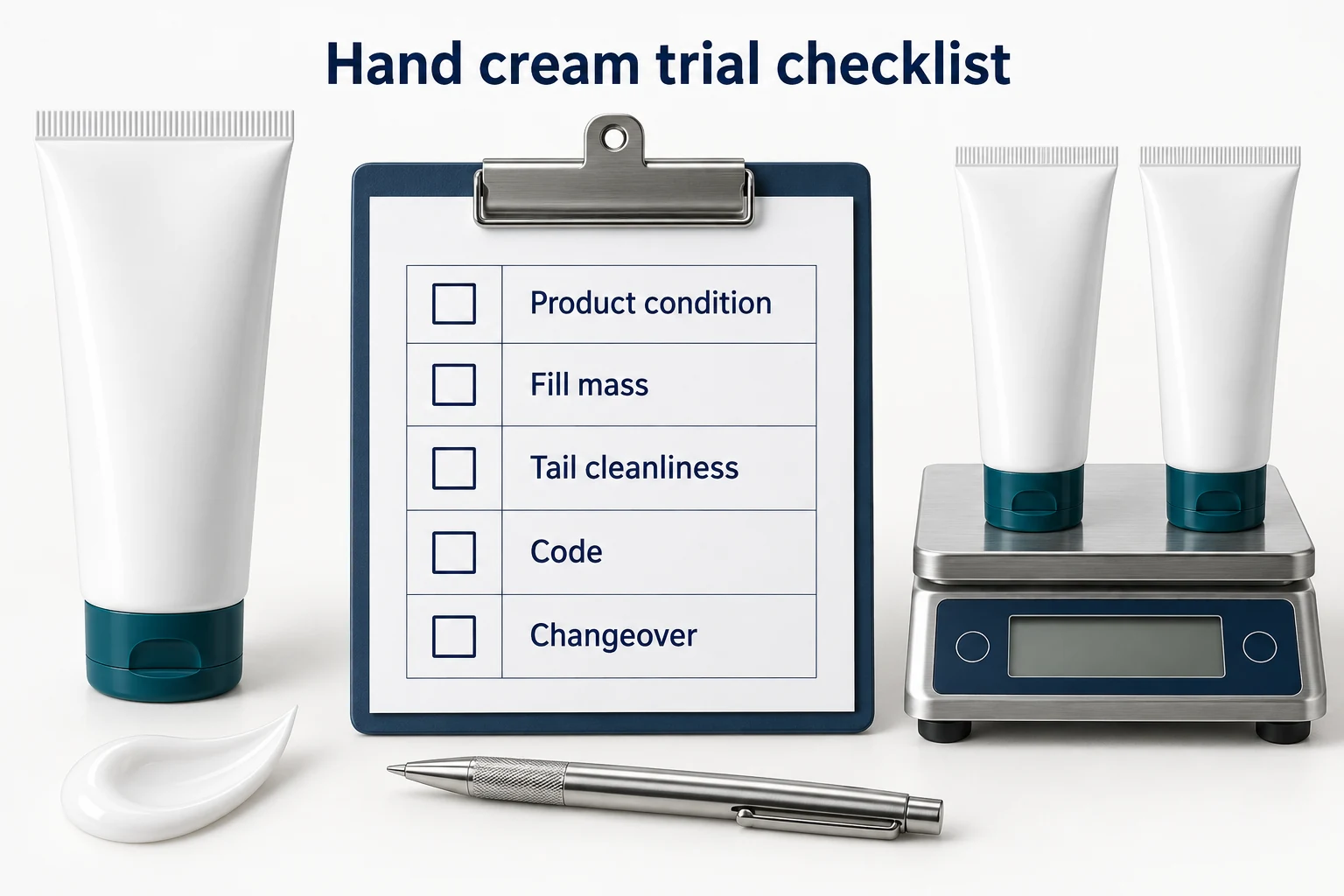
Prepare a trial brief that everyone can use
List the cream, tube format, target fill, planned batch pattern and closure method. Identify the people who approve product condition, packaging appearance, dose and cleaning. Give the trial a version and date so late changes are visible. If several formats are included, specify which result belongs to each format rather than combining them into one pass statement.
Record what is confirmed and what is assumed
Confirm tube dimensions from drawings and actual samples. State the product temperature and preparation method supplied by the formulation team. Record any assumptions about bulk transfer, agitation or available utilities. If the final hand cream cannot be tested, describe the substitute and identify which conclusions remain open for commissioning.
Check the incoming hand cream
Document how the cream was made available to the test, how long it has been stored and how it should be conditioned. Examine whether it contains visible air, separated liquid, particles or a texture different from the approved reference. These observations help prevent an upstream product condition from being misdiagnosed as a filling fault.
Define permissible handling
Ask whether warming or agitation is permitted and what limits apply. Do not warm the cream simply because it makes pumping easier. A formula may change as it cools or recovers after shear. The trial should preserve the product conditions that the customer intends to use in production.
If the test includes transfer from a vessel, record the pump, hose route and connection. If it uses a small hopper directly, note that the factory has not reproduced the entire production transfer path. Installation preparation should include confirmation of that interface.
Inspect the tube and tooling before loading
Use production-representative tubes, including the intended printing, finish and orientation mark. Check diameter, length, tail width, body stiffness and cap condition against the drawing. Identify the tube lot and supplier. Nominally similar tubes can behave differently in a holder or at the closure station.
Confirm the installed format kit
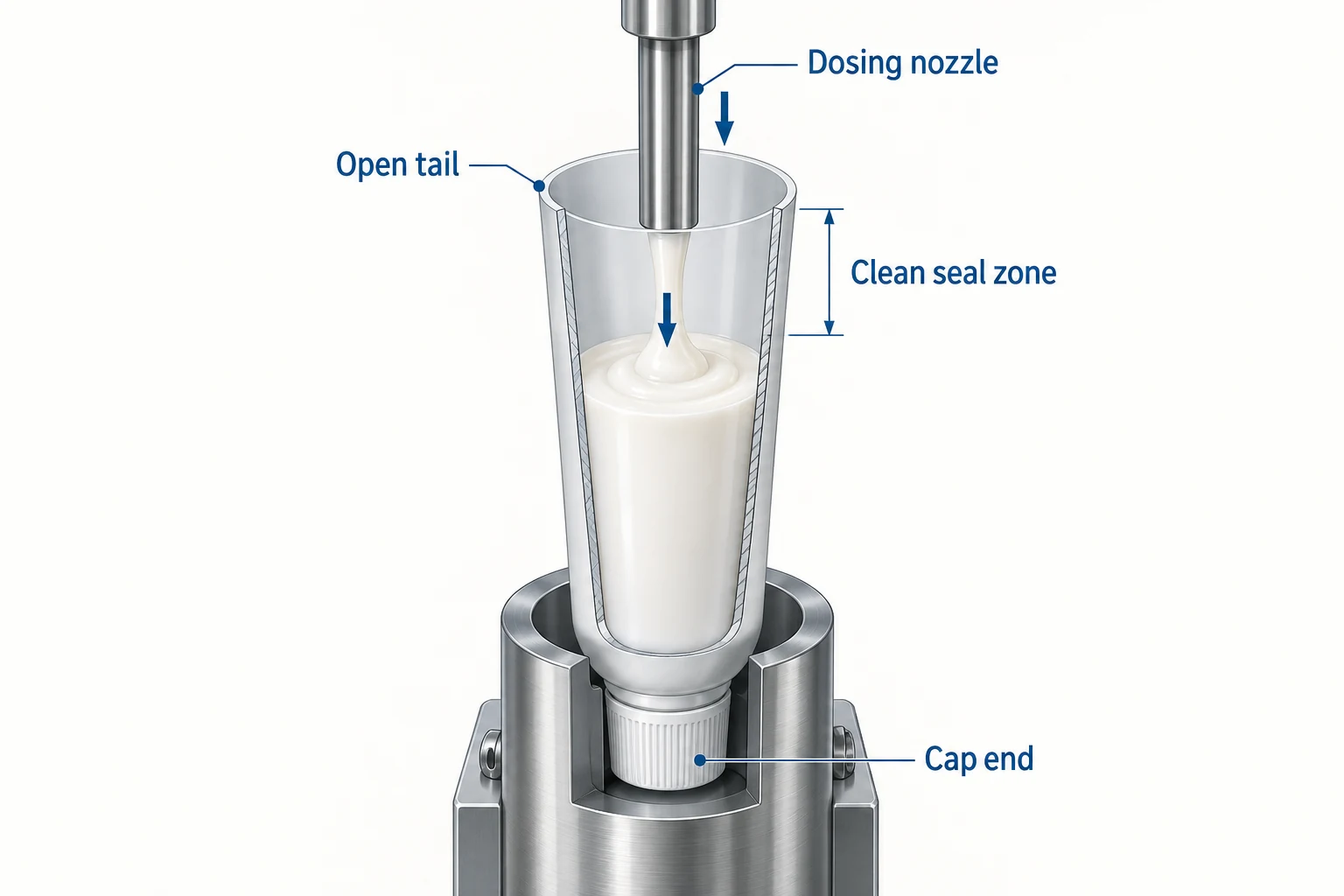
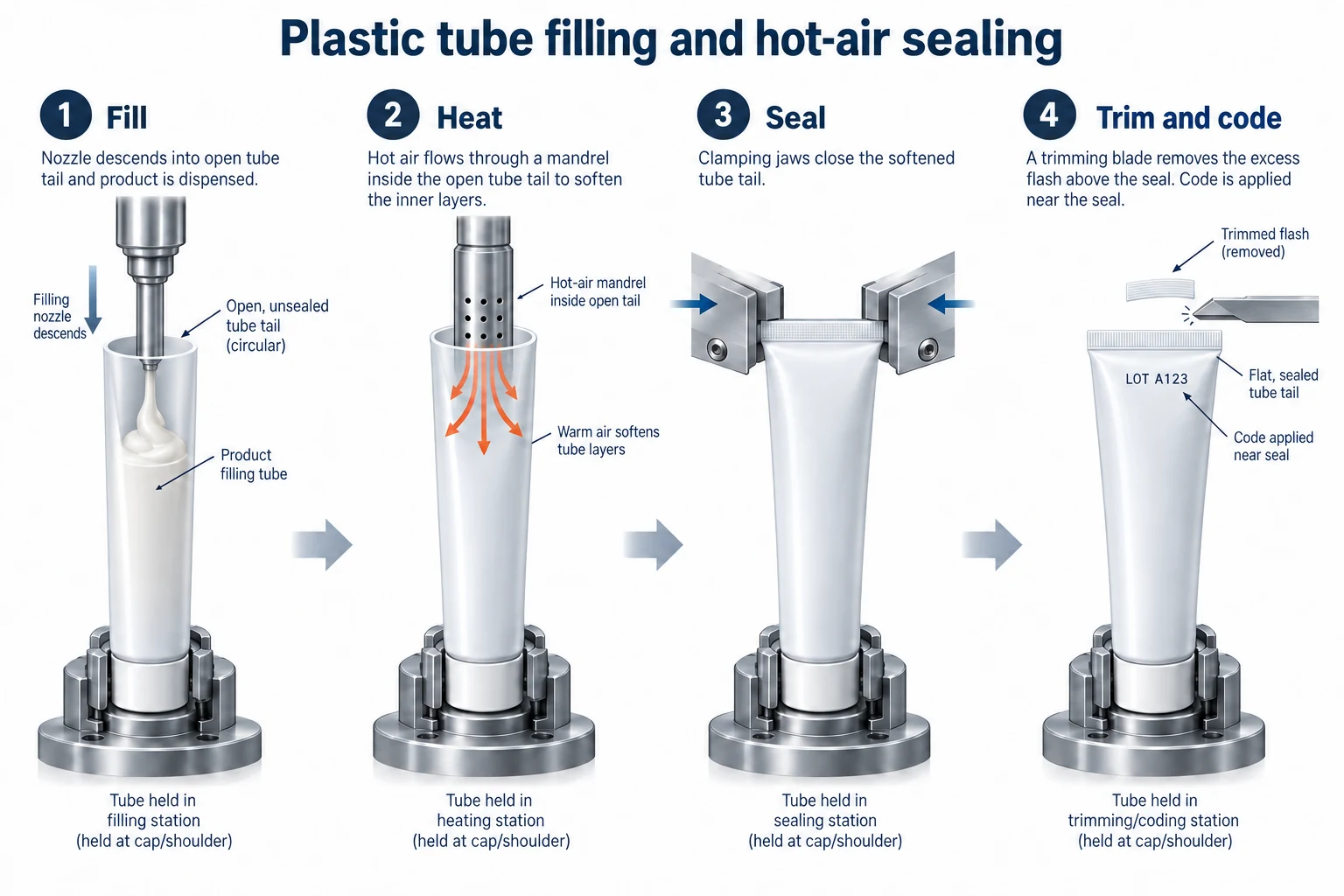
Identify holders, guides, nozzles, closure tools and coding parts. Check that the tube is supported without body damage or distortion. Its head or capped end should sit below the open tail during filling. The dosing nozzle enters through the unsealed upper opening; the flat closed tail should appear only after the closure step.
For an artwork-sensitive pack, verify the final seal orientation against the printed panel. An orientation sensor should be tested with the actual finish and contrast. Define the response to a missing mark or incorrectly presented tube before product is released to the run.
Establish the filling recipe
Record pump settings, fill profile, nozzle height, insertion, withdrawal and shut-off. Start within the supplier’s appropriate setup range and adjust one condition at a time. Retain first-piece samples and observations rather than overwriting the history every time a better setting is found.
Assess more than fill mass
Weigh samples using the agreed tare method and identified measuring equipment. Also inspect visible voids, splash, stringing and residual cream at the nozzle. A tube can meet its mass requirement while still carrying product into the seal area. Those defects need a different corrective action from a simple dose adjustment.
If there are two filling heads, label the samples by head. Compare individual results and the behavior at each nozzle. A combined average can conceal one head’s offset or a shut-off problem on only one side.
Use a sampling sequence that represents production
Select sampling points from the expected operating pattern. Start-up, stable running, hopper refill, planned pause, restart and batch end are useful conditions to consider. The approved plan should explain why each point matters and how samples will be identified.
| Trial condition | Observation | Decision supported |
|---|---|---|
| First pieces | Mass, air, tail cleanliness and code | Readiness to begin the run |
| Stable operation | Consistency across heads and holders | Proposed running setup |
| Refill | Air entry, supply and cut-off | Bulk handling method |
| Restart | Texture, first doses and tail condition | Recovery procedure |
| After discharge | Body, cap, tail and code damage | Finished-pack handling |
Keep the record interpretable
Record time, recipe, product condition, tube lot and sample identity beside the observation. Photograph a stringing event or a defective seal where it helps explain the cause. Photographs should supplement the measurement and acceptance decision, not replace them. Keep trial samples separate from saleable stock.
Review the actual closure method
For plastic or laminate tubes, confirm the compatible hot-air or ultrasonic arrangement. For aluminum tubes, identify the specified folding tools. Do not transfer a closure recipe from a different material simply because the tube has the same nominal dimensions.
Inspect the complete tail
Look for wrinkles, contamination, incomplete bonding, excessive marking and trimming damage. Define any additional package-integrity test with the customer. Agree sample conditioning and acceptance before the trial so a disagreement about the method does not obscure a real closure defect.
When a tail fails, preserve the sample and inspect what happened before sealing. Product in the seal zone can come from nozzle behavior or overfill. One-sided damage can come from tube presentation or uneven tool contact. Repeatedly increasing heat without an investigation may introduce another defect.
Check coding, discharge and downstream interfaces
Inspect the code after embossing, trimming and handling. Verify that the planned code area remains on the finished tube and does not become distorted. If automatic code inspection is included, challenge the agreed fault conditions and confirm the reject route.
Handle finished tubes as the site will
Check transfer height, guide contact, discharge orientation and accumulation. For a cartoned product, include the handover to the next machine if it belongs to the project. For manual collection, review operator access and the method for preventing rejected pieces from returning to acceptable stock.
The tube filling and sealing configuration should be reviewed as a sequence, rather than as an isolated dosing station. This is especially useful when a trial result changes after the tube leaves its holder.
Demonstrate cleaning and format change
If the line will run several hand creams, use a demanding but representative changeover in the test. Review pigments, oils and fragrances that may leave residue. List dismantling, washing, drying, inspection, reassembly, setup and first-piece approval separately. The customer establishes its cleaning acceptance requirements.
Review valve seats, gasket grooves, piston seals, nozzle shut-off components, hopper outlets and hose low points. Include nearby surfaces where cream may splash. Confirm that removed parts are identifiable and can be stored without damage. A clean-looking hopper does not prove that the pump and nozzle are equally clean.
After reassembly, verify parts and recipe before restarting. Check whether the first product contains water or residue from cleaning, and follow the customer’s approved segregation procedure. The purpose of the exercise is a repeatable changeover method that production staff can actually perform.
Turn observations into controlled decisions
For each defect, record the condition, suspected cause, change made and retest result. Avoid changing product temperature, nozzle height and seal settings simultaneously. If several changes are necessary, preserve the sequence so another engineer can understand which evidence supports the final setup.
Example: stringing appears after a pause
In a hypothetical trial, the cream fills cleanly during normal running but strings on the first dose after a planned stop. Compare product condition, nozzle temperature and shut-off response before changing the fill target. Repeat the agreed restart sequence and inspect both mass and tail cleanliness. This is an investigation example, not a claimed customer result.
Complete the FAT and shipment handover
Summarize the tested configuration, approved samples, raw results, deviations and open items. Identify which requirements were not represented at the factory. Obtain the relevant customer approvals before describing the trial as accepted. A video of the machine running is useful context but cannot replace that record.
Shipment inspection should confirm the machine identity, nozzles, holders, closure kits, spares, guards, electrical labels and documentation. Protect contact and tooling surfaces during packing. Keep the packing list aligned with the final tested scope.
Prepare the destination before delivery
Confirm electrical and air connections, access dimensions, bulk supply, cleaning arrangements and safe maintenance space. Schedule the operators and quality personnel who will participate in commissioning. Agree the installation and commissioning scope before the machine arrives.
A run sheet for the first production campaign
The trial record should be useful to the shift team after the project engineers leave. Turn the approved observations into a short run sheet with the product and tube identity, format parts, recipe, pre-start conditions, sampling points and fault-response instructions. Keep detailed evidence in the technical file, while making the routine setup information accessible to operators.
Before product enters the line
Confirm that the previous product and packaging have been cleared. Check cleaned-part status and verify the installed holders, nozzle and closure tools. Confirm the correct printed tubes and code data. Inspect guards and required utility connections using the approved start-up procedure. Assign responsibility for each check rather than leaving the team to assume that someone else completed it.
During initial filling
Collect identified first pieces and compare them with the approved requirements. If an adjustment is necessary, record the original and revised condition. Inspect the tail before heating or ultrasonic closure, then inspect the finished pack after the full line. Keep any questionable material segregated until the designated person decides its disposition.
Observe whether the operator can replenish tubes and product without interrupting the agreed handling sequence. A trial that runs smoothly only while extra staff are assisting may not represent normal production. Record staffing assumptions if labour planning is part of the purchasing decision.
During a planned interruption
Use the approved stop sequence and identify tubes that remain at intermediate stations. Confirm which pieces may be partially filled, heated or awaiting a code. The restart instruction should explain how these units are handled. Do not return an uncertain pack to the acceptable stream merely because the machine has resumed cycling.
After restart, sample the condition that caused concern in the original study. If temperature, trapped air or nozzle stringing was sensitive to pauses, record that observation again. A useful recovery test demonstrates the approved procedure; it does not require an unsafe or artificial interruption.
Evaluate cosmetic appearance separately from mechanical acceptance
Hand cream buyers often have visual expectations for tube finish, printing, cap cleanliness and the appearance of the dispensed product. Define these expectations with approved samples or written limits. Keep them distinct from dose and seal-integrity criteria so a disagreement about one attribute does not obscure another.
Compare after an agreed conditioning period
The formulation team may want to examine texture after the cream has rested. Identify how samples are stored and dispensed, and who assesses any separation or voids. The equipment test can supply samples and process conditions, but it should not claim product stability from a brief observation. If the dispensed texture differs, compare bulk, post-transfer and filled samples to locate the change.
Packaging appearance should also be checked after handling. Look for rubbing, cap scuffing, guide marks and a tail damaged by collection. If several tube finishes are planned, include the one expected to be most sensitive. This gives engineering a practical basis for guide design and discharge adjustments.
Close the trial with a decision log
End the session by listing accepted requirements, unresolved issues and required follow-up. A decision log should identify the evidence behind the conclusion, its owner and the point at which an open item must be closed. It may be appropriate to accept a demonstrated machine function while keeping a final-product or site-interface confirmation open; the authorized reviewers should state that distinction clearly.
Do not write “all passed” if the final tube, intended cream or cleaning procedure was unavailable. State the limits and agree the next verification step. A transparent report is more useful for procurement and commissioning than an apparently complete approval that the site cannot reproduce.
What to send King Pack before the trial
Prepare the cream-handling profile, production tubes, drawings, target fills, code requirements, changeover pattern and acceptance method. Add any layout or utility constraints and the documentation expected at handover. King Pack can review configuration, FAT, training and integration requirements within the agreed equipment scope.
Arrange a hand cream trial: Share the product and package information through the King Pack technical enquiry form and request an evidence-based sample-test plan.
Keep a reference pack for future formats
Retain the approved drawing revision, tool identification, recipe and representative finished tubes according to the customer’s document and sample procedures. If a later promotional tube changes body length, tail width, finish or cap, compare it with that reference before approving production. An unchanged product name does not mean that the packaging change is mechanically irrelevant.
Ask the supplier to identify which changes can be handled by existing tooling and which require a new review. Include the sampling and first-piece method in that review so the new format has a controlled release path. This creates a practical connection between the first hand cream trial and later production development, while keeping untested future formats outside the original acceptance claim.
FAQ
Can another cream be used for the factory test?
It may support selected mechanical observations, but document the differences and repeat relevant product-specific checks with the final hand cream.
Is fill weight enough to approve the trial?
No. Review product condition, air, tail cleanliness, closure, code and finished-pack handling against the customer’s requirements.
Should hand cream always be warmed?
No. Warming requires the formulation owner’s approval. Record the permitted conditions and measure the actual product at relevant points.
How should a restart be tested?
Use a planned pause representative of production and collect identified first pieces after restart. Check both the dose and the tail before closure.
What remains after FAT?
Site installation, utilities, final-product conditions and other unrepresented requirements still need confirmation according to the customer’s acceptance plan.
Should the trial use the intended printed finish?
Yes, where finish or artwork affects handling, orientation or appearance. Identify any substitute and confirm the final material before routine production release.
Conclusion
A useful hand cream trial connects product condition, tube presentation, dosing, sealing and handling to clear acceptance decisions. Preserve the observations, investigate defects and test the actual changeover. This produces a practical basis for purchase and first production.
Request a trial checklist: Send King Pack your hand cream samples, tube matrix and planned operating conditions to define the configuration and factory acceptance scope.
The following visuals are illustrative production and inspection references. They do not represent guaranteed output or measured validation results.
Related equipment and project resources
For equipment selection, compare the relevant filling machine product range with the packaging solution overview. Application context is available in the veterinary medicine solutions and pharmaceutical packaging guide. Where the process includes a closure step, review the filling and capping line and tube sealing equipment.
Before a trial, document product rheology, fill volume, container dimensions, contact materials, cleaning method, closure requirements and inspection points. Related planning resources include tube filling and sealing machine selection, how to choose a tube filling machine, tube sealing quality control, manual to automatic syringe filling and syringe format changeover planning.
For a project-specific review, contact the technical team, send your requirements for a quote or review the syringe filling machine range. Include samples or drawings when available so the machine scope can be assessed against real product and packaging conditions.
Need help with the next step? Request a quote with the product, package, fill volume and target checks.