 Skip to content

A tube filling machine IQ, OQ and PQ programme should demonstrate that the installed equipment, its operating controls and the intended production process meet site-approved requirements. Start with the product and tube risks, link them to measurable acceptance criteria, and preserve the evidence behind every release decision. A supplier’s factory test can contribute useful information, but it does not automatically establish that a pharmaceutical filling process is validated at the customer’s site.
This guide is for engineering, quality and procurement teams planning non-sterile pharmaceutical or veterinary tube filling. Sterile manufacturing requires a separate contamination-control assessment. The examples below are suggested engineering checks, not a universal protocol or a claim that any particular machine has completed qualification.
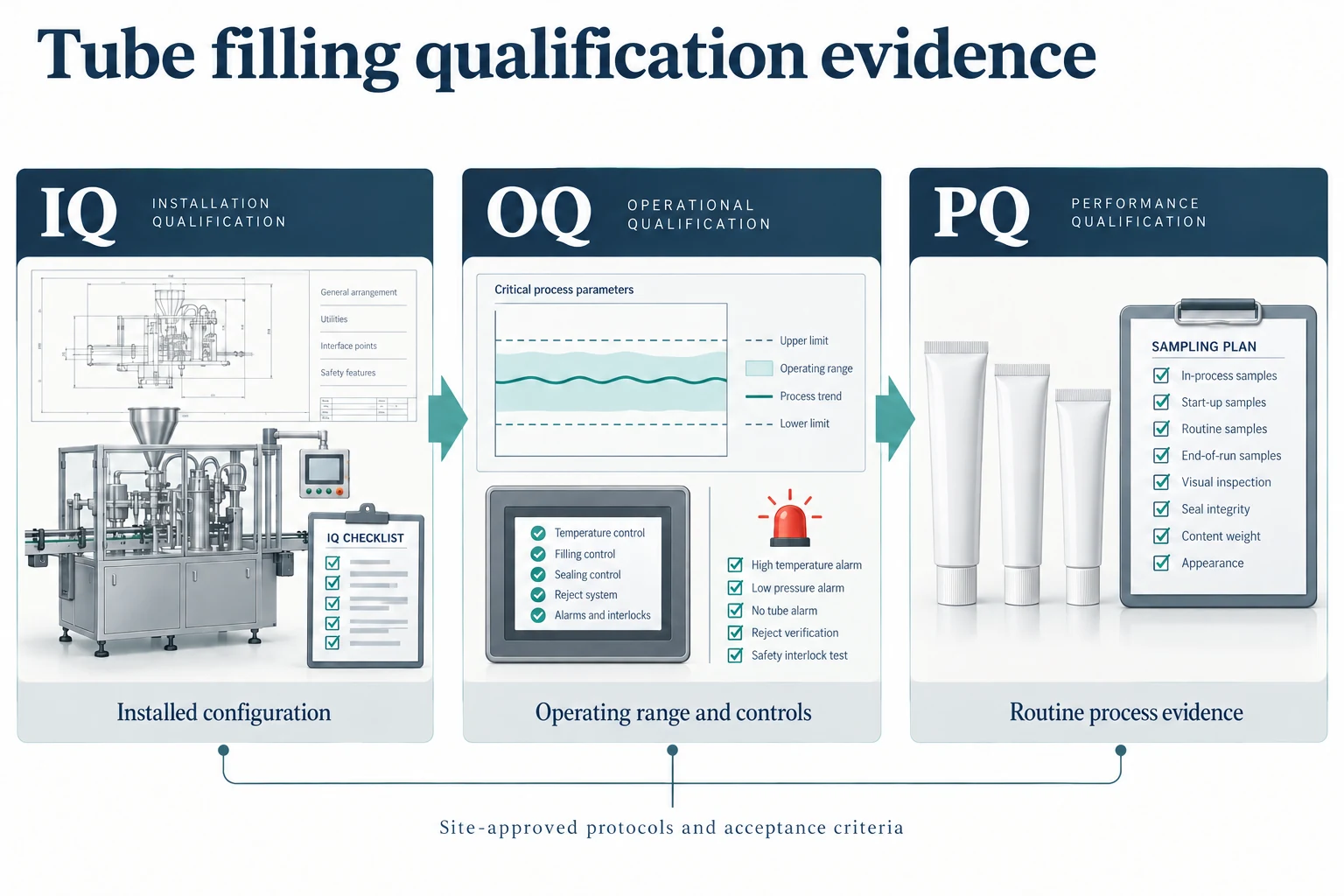
Separate equipment qualification from process validation
Equipment qualification asks whether the machine is installed correctly, operates as intended and performs suitably for its defined application. Process validation addresses the wider manufacturing process, including materials, methods, personnel and continued control. These activities overlap, but a completed equipment checklist does not replace evidence about the finished product.
For US projects, FDA’s Process Validation: General Principles and Practices describes a lifecycle approach spanning process design, process qualification and continued process verification. The site’s quality unit should determine how equipment IQ/OQ/PQ documents support that lifecycle for the intended dosage form. Avoid using IQ/OQ/PQ and the three FDA lifecycle stages as interchangeable labels.
Define the scope before requesting protocols
State whether the project covers only a filler, an integrated filling and sealing machine, or a line including feeding, coding, inspection and cartoning. Identify product-contact boundaries, utilities, control interfaces and downstream transfer points. A qualification plan that omits the code reader or reject station can leave a significant packaging risk outside the test programme.
Build a URS that produces testable requirements
The user requirements specification, or URS, should explain what the line must do and how the customer will decide whether it is acceptable. Replace broad statements such as “high accuracy” with the target fill, acceptance limits, sampling method and operating conditions approved by the product owner. Do the same for seal integrity, coding, recipe control and cleaning access.
Useful inputs include tube drawings, material construction, product rheology, fill range, permitted temperature, batch pattern, utility conditions and the planned cleaning procedure. Record format-specific tooling and the responsibility for supplying final product and tubes for trials. An assumption about a substitute paste should remain visibly separate from a confirmed requirement.
| Risk or requirement | Proposed evidence | Release owner |
|---|---|---|
| Product-contact compatibility | Approved material and elastomer review | Engineering and quality |
| Correct installed configuration | Drawings, component identification and utility checks | Site engineering |
| Reliable dose and tail closure | Operating-range studies and product samples | Quality and production |
| Controlled rejected units | Challenge tests and reconciliation | Quality |
| Repeatable routine operation | Site-approved production study | Process owner and quality |
Use risk assessment to choose the important tests
Map the process from bulk-product connection to finished-tube discharge. Consider underfill, overfill, air, temperature drift, contamination, incorrect tube material, weak seals, wrong codes and failed rejection. Describe the consequence, likely causes, existing controls and additional evidence needed. The assessment should determine test depth rather than simply generate a long document.
Distinguish parameters from product attributes
Pump stroke, nozzle motion and sealing settings are process inputs. Fill mass, seal integrity and code legibility are outputs. Not every adjustable setting is automatically a critical process parameter, and not every observation is a critical quality attribute. The site team should justify classifications from product and process knowledge.
For example, a nozzle-withdrawal setting may matter because product strings into the seal area. A meaningful study therefore observes both tail cleanliness and closure performance. Recording the setting without inspecting the tube would miss the reason the setting matters.
Plan FAT and shipment inspection as supporting evidence
Factory acceptance testing, or FAT, is an opportunity to resolve design and functional problems before shipment. Include representative formats, available product, recipe identification, missing-tube response, dosing, sealing, coding, rejection and access for cleaning. Use an agreed protocol so that the factory and customer assess the same requirements.
Retain raw measurements, photographs, sample identification and deviations. A video can clarify the mechanical sequence, but it does not replace measurements or approved acceptance criteria. If a substitute product is used, describe which properties it represents and which product-specific conclusions remain open.
Shipment inspection should confirm that the tested configuration, tooling, spare parts and documentation are the items packed for delivery. Photograph sensitive assemblies, secure instruments and identify transport restraints. These records help the site investigate a changed condition after arrival.
IQ: verify the machine that was actually installed
Installation qualification, or IQ, should establish the identity and condition of the equipment at the site. Compare serial numbers, installed parts and drawings with the approved configuration. Check product-contact material records, utility connections, instrument identification, calibration status, software versions and required manuals.
Installation preparation and utility boundaries
Before execution, confirm electrical supply, compressed air, floor access, cleaning provisions and the route used to connect bulk product. Identify the point at which the customer’s utility becomes the supplier’s machine connection. A suitable plant supply does not prove that a regulator, hose or connection at the machine is correct.
Record gaps as deviations rather than completing a checklist from expectation. If an installed gasket differs from the parts list, resolve its suitability and documentation before treating the configuration as approved. Keep the final drawing revision with the executed IQ file.
OQ: challenge controls and operating ranges
Operational qualification, or OQ, examines the intended functions and relevant operating boundaries. Develop tests from the URS and risk assessment. Challenge alarms, interlocks, recipe selection, setpoint limits and fault recovery in a controlled manner. Equipment safety tests should follow the approved method and be performed by competent personnel.
Dosing and restart challenges
Consider low and high approved fills, difficult product conditions, hopper-level changes, pauses and restart. If the line has two filling heads, retain the head identity for each result. Combining both heads into one average can conceal an offset between them.
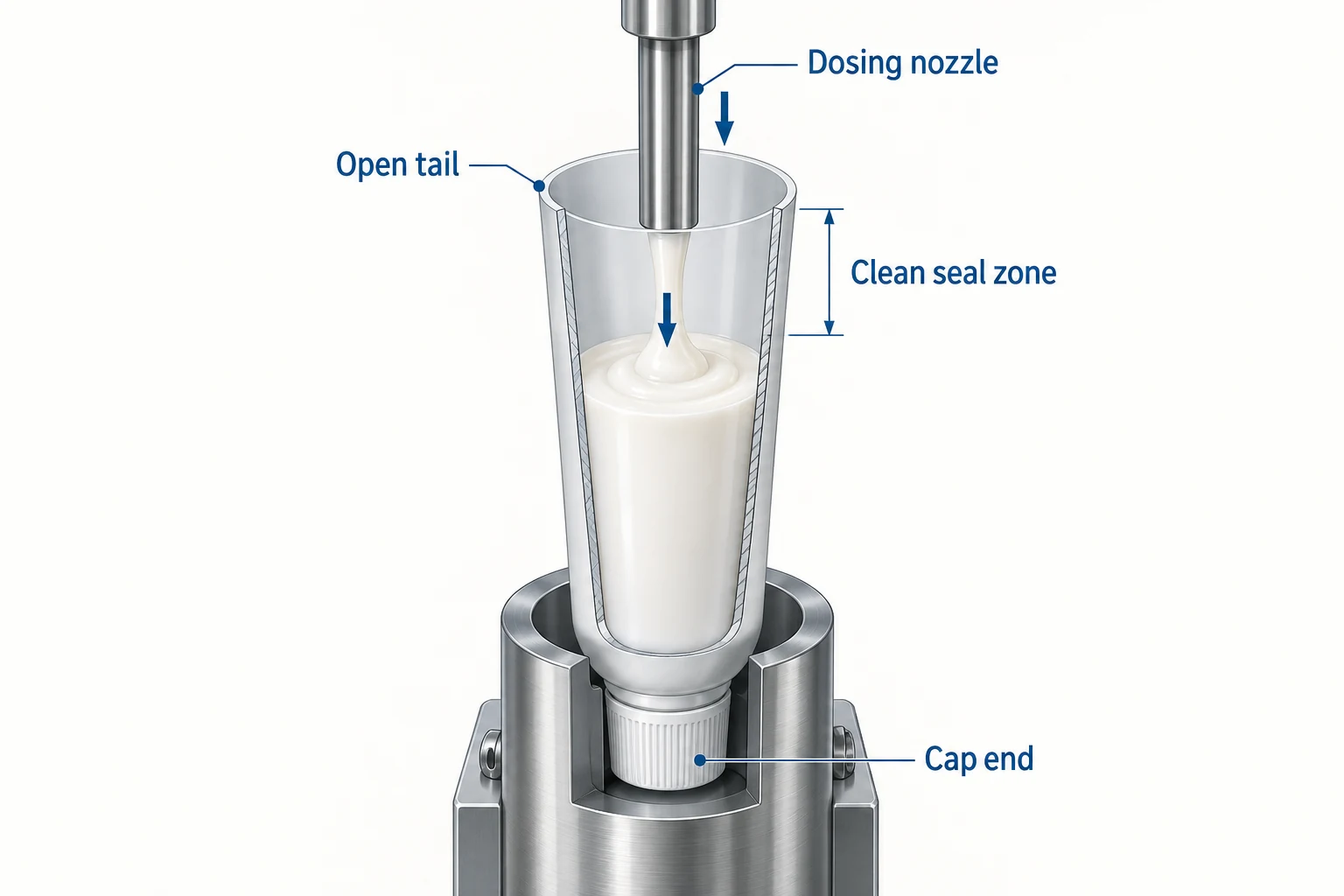
Inspect the open tube tail after nozzle withdrawal. The tube head or capped end is supported below; the unsealed tail faces upward during filling. For plastic or compatible laminate formats, the tail subsequently enters heating and sealing or ultrasonic closure. Aluminum formats need their specified folding tooling. Tests should reflect the actual closure method.
Seal, code and reject challenges
Define the seal test and acceptance method before changing heat, energy, pressure or timing. Verify code position and legibility on finished tubes after trimming. Challenge a missing tube, a detected coding error and the relevant reject response without letting test units enter released product.
EU projects can use EudraLex Volume 4, Annex 15 as a qualification reference. It discusses URS, FAT/SAT and IQ/OQ/PQ, including justified operating-range testing. The exact protocol, use of supplier evidence and progression decisions remain subject to the site’s approved qualification strategy.
PQ: demonstrate the intended production use
Performance qualification, or PQ, should connect equipment operation to the customer’s normal production arrangement. Define product, tube lots, operators, batch sizes, run conditions and sampling in an approved protocol. The study should represent the intended application rather than a convenient demonstration with unusually easy material.
Choose samples for a reason
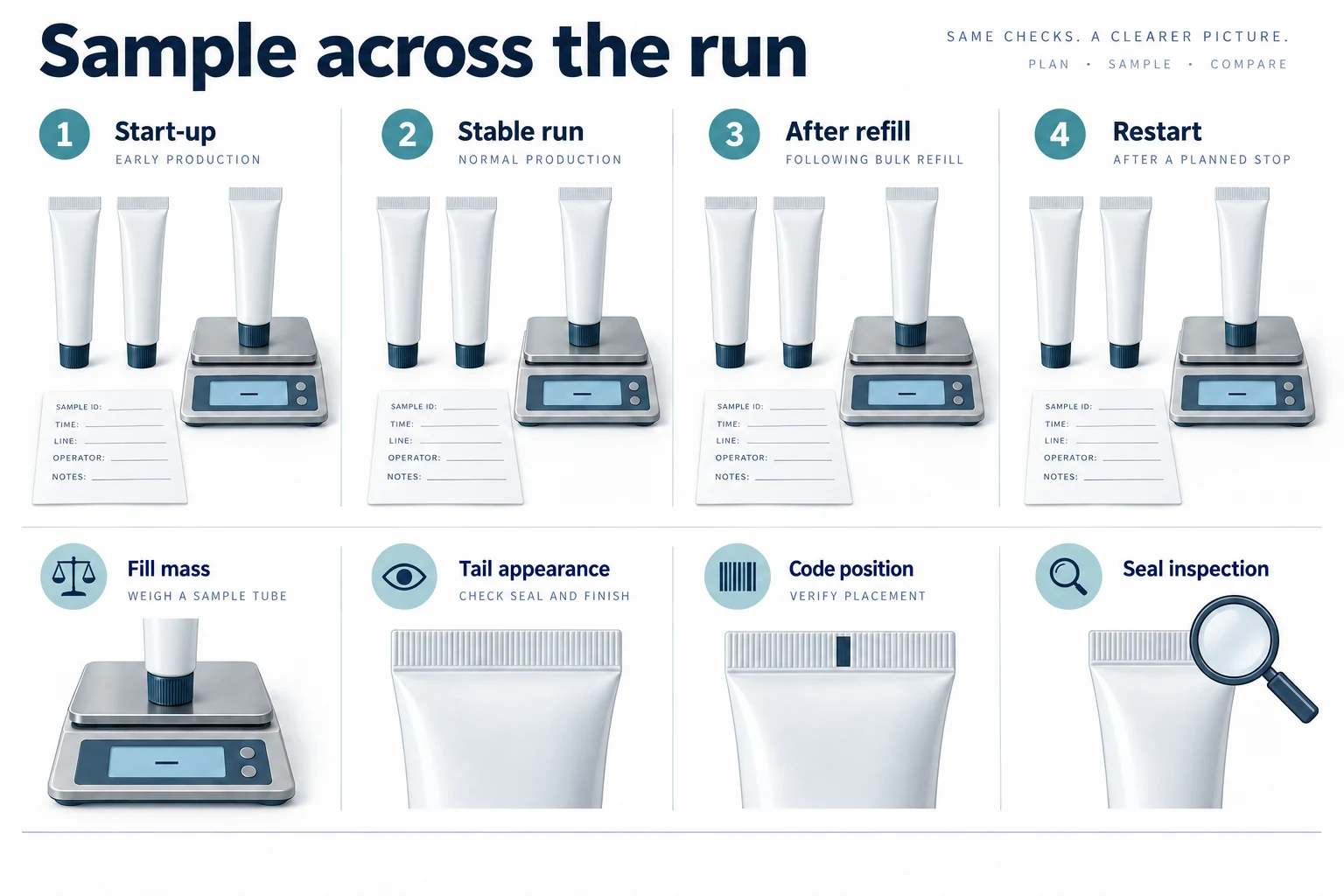
Sample locations may include start-up, stable operation, refill, planned interruption and the end of the run, depending on risk. Consider each head, lane or closure station. Explain what the selection demonstrates and how the sample size supports the decision. There is no universal sample count suitable for every tube product.
Results should connect to finished-pack requirements, including fill, closure, code and relevant product attributes. The site’s quality team should decide which laboratory or stability activities belong in the wider validation programme. Machine settings alone do not demonstrate that an ointment remains suitable throughout its claimed shelf life.
Cleaning evidence and data integrity
Keep equipment cleaning instructions separate from proof that a product-specific cleaning process is adequate. Engineering can identify drain points, dismantling steps and access limitations; quality and the product owner establish residue and microbiological acceptance where applicable. Review the hardest-to-clean path, not only the visible hopper.
FDA’s CGMP equipment questions and answers emphasizes suitable equipment design, cleaning and product-contact materials. Use this as context for the site’s equipment review, without presenting a supplier’s material list as regulatory approval.
Preserve original observations
Identify instruments, analysts, dates, recipe versions and raw data. Corrections should remain traceable under the site’s procedures. When electronic recipes or records are included, define access roles, backup, change history and recovery requirements according to the intended use. Do not assume that a touch screen automatically supplies every data-integrity feature needed by the plant.
Responsibilities and deviations
The machine supplier can explain design, provide drawings and support agreed tests. The customer supplies product knowledge, approves acceptance criteria and controls site release. Assign responsibility for protocol approval, execution, calibration, laboratory testing, deviation assessment and final reports before the project reaches FAT.
When a test fails, retain the result, investigate the cause and assess affected requirements. Document any repair or setting change and justify retesting. Repeating a test until it passes without explaining the earlier failure weakens the evidence. Open actions need an owner and an approved disposition.
A practical traceability example
Consider a hypothetical project involving two plastic tube diameters and a non-sterile ointment. The URS requires a defined fill range, an approved seal-integrity test and legible batch identification. This example describes a planning method; it does not represent a King Pack customer project or measured machine result.
Assign each requirement an identifier. Link the fill requirement to the selected pump and nozzle drawings, the OQ operating-range study and the PQ sampling table. Link the seal requirement to the tube specification, heater and jaw configuration, inspection method and relevant challenge tests. Link coding to the printer setup, operator recipe and rejection logic. One requirement may need several kinds of evidence.
What a completed test record should show
For a fill check, record the balance identifier and status, tube tare method, target, raw observations and acceptance decision. Note the product condition, hopper level, head identity and any interruption. A conclusion such as “weight satisfactory” gives a reviewer too little information to reproduce or assess the test.
For a seal check, record tube supplier, lot, construction, tooling, settings, sampling position and test outcome. Keep acceptable and defective examples identifiable. If the tube supplier changes after FAT, explain whether the existing material evidence still represents production. This is a packaging change question as well as an equipment question.
Document handover and readiness review
Before commissioning, assemble a controlled handover index. Include the approved URS, design reviews, final drawings, parts list, calibration records, executed FAT, shipment inspection, open-action list and installation instructions. Add draft operating, cleaning, changeover and maintenance procedures for site review. Documents should describe the supplied configuration, not a similar machine from an earlier order.
Hold a readiness review with engineering, production, quality, maintenance and the supplier. Confirm that product, tubes, utilities, test instruments and trained personnel will be available. Identify which tests require laboratory support and how samples will be labelled and stored. Scheduling those resources prevents a machine delivery from being mistaken for production readiness.
Maintain the qualified condition after release
After qualification, define routine checks that show the equipment remains suitable. Examples include approved recipe verification, first-piece inspection, calibration review, wear-part checks and trends in rejects or seal defects. Select the checks from risk and operating experience rather than copying every qualification test into every batch record.
Define triggers for investigation and reassessment. A recurrent leak at one jaw position, increasing dose correction or an unexplained code rejection may signal deterioration even when individual samples remain acceptable. Review changes with the site’s quality system and keep the approved configuration current. Qualification documents lose value if later repairs and software changes are invisible to the evidence file.
Finally, distinguish an outstanding documentation item from an unresolved product-quality risk. Both need management, but they may affect the next activity differently. The designated site approvers should document whether progression is justified, what restrictions apply and which evidence must be completed before routine release. The supplier should never make that release decision on the customer’s behalf.
How to scope King Pack support
King Pack supplies tube filling and sealing equipment with configuration, FAT, documentation, training and integration support. For a qualification project, ask which drawings, material records, instrument information and test services are included in the proposed scope. Site qualification and product release should stay with the designated customer owners.
Prepare a qualification matrix alongside the tube filling FAT checklist. If an existing plant is upgrading one module, state which interfaces and earlier evidence remain applicable. This helps avoid buying documentation that does not match the installed system.
Plan your qualification package: Use the technical enquiry form to send your tube matrix, validation scope and required document list for review.
Commercial scope questions
Before purchase, distinguish document preparation from execution support. Ask whether the quotation includes protocol templates, customized protocols, factory measurements, site attendance or only machine manuals. State who supplies calibrated instruments, test materials and laboratory analysis. Clarify how design changes will update drawings and whether outstanding actions are closed before shipment. These details make competing offers comparable and reduce the chance of discovering a documentation gap during commissioning. Keep the agreed scope with the purchase specification so procurement, quality and engineering share the same expectation.
FAQ
Does passing FAT mean the line is validated?
No. FAT provides supplier-site evidence. Installation, utilities, operating conditions and product-specific requirements still need the assessments defined by the customer’s quality system.
Can FAT results be used in IQ or OQ?
Potentially, where the site’s strategy justifies their relevance and integrity. Identify what transport, installation or site conditions could change and which checks therefore need repetition.
Are three PQ batches always sufficient?
A fixed count should not substitute for a justified study design. The process owner and quality unit should establish the approach from product knowledge, risk and applicable requirements.
Who approves supplier qualification protocols?
The customer’s designated reviewers should assess suitability for the installed equipment and site procedures. A supplier template can be a starting point, but approval is a site responsibility.
Must every tube size receive a separate full study?
Grouping may be possible when the rationale and representative boundary conditions are documented. Do not assume that similar nominal dimensions prove equivalent dosing or sealing behavior.
What changes can require reassessment?
Examples include product formulation, laminate construction, nozzle design, sealing tooling, control software or utility changes. Evaluate their impact through the site’s change-control process.
Conclusion
A useful tube filling machine IQ/OQ/PQ package connects approved requirements to installed configuration, operating challenges and production evidence. Preserve raw results, resolve deviations and keep responsibilities clear. Qualification becomes more reliable when product, tube and sealing risks shape the protocol before testing begins.
Request a technical and documentation review: Share the intended dosage form, tube samples, product conditions and site qualification requirements with King Pack before finalizing the equipment scope.
Last reviewed: October 14, 2026. Regulatory references: US FDA guidance and EU GMP Annex 15; applicability and current site obligations require jurisdiction-specific review.
The following visuals are illustrative production and inspection references. They do not represent guaranteed output or measured validation results.
Related equipment and project resources
For equipment selection, compare the relevant filling machine product range with the packaging solution overview. Application context is available in the veterinary medicine solutions and pharmaceutical packaging guide. Where the process includes a closure step, review the filling and capping line and tube sealing equipment.
Before a trial, document product rheology, fill volume, container dimensions, contact materials, cleaning method, closure requirements and inspection points. Related planning resources include tube filling and sealing machine selection, how to choose a tube filling machine, tube sealing quality control, manual to automatic syringe filling and syringe format changeover planning.
For a project-specific review, contact the technical team, send your requirements for a quote or review the syringe filling machine range. Include samples or drawings when available so the machine scope can be assessed against real product and packaging conditions.
Need help with the next step? Request a quote with the product, package, fill volume and target checks.
