
Tube Filling Machine FAT: A Practical Factory Acceptance Test Checklist
A factory acceptance test (FAT) gives a buyer and a tube filler manufacturer a structured opportunity to verify the agreed machine scope before shipment. It is more useful than a general demonstration because the product, tube format, process sequence, inspection points and records are defined in advance.
This practical checklist is intended for pharmaceutical, cosmetic, personal-care, food and industrial tube filling projects. It explains how to prepare a FAT, what to inspect on the machine, how to record results and which items may need site commissioning. The final protocol should be adapted to the selected configuration, product samples, tube drawings and the buyer’s quality system.
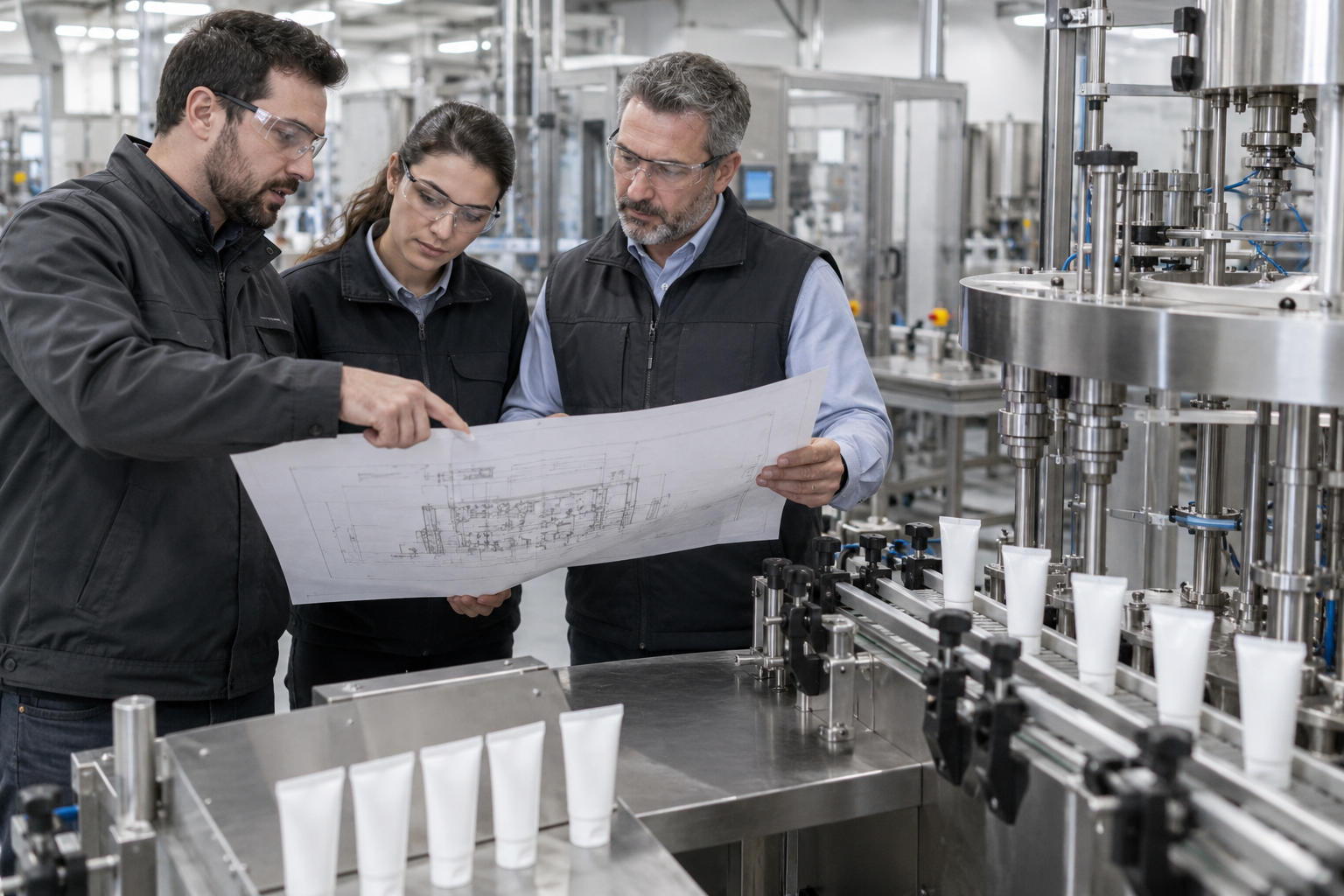
What a tube filling machine FAT should prove
A FAT should answer whether the configured machine performs the agreed process under agreed conditions. It should verify the station sequence, operator controls, safety functions, product-contact parts, tube handling, filling, tail treatment, coding and discharge. It should also confirm the documents and training required for handover.
FAT is not a substitute for site acceptance. Room utilities, upstream product transfer, downstream cartoning, local safety integration and production conditions may only be verified after installation. Mark each requirement as factory-testable, site-testable or document-based so the protocol does not create unrealistic expectations.
| FAT area | What to define | Typical evidence |
|---|---|---|
| Machine scope | Stations, options, tooling and interfaces | Approved quotation, drawings and scope list |
| Samples | Product condition, tube material, size and quantity | Sample log and batch information |
| Process | Loading, dosing, sealing, coding and discharge sequence | Observed run and signed checklist |
| Quality | Fill checks, appearance, seal and reject handling | Measured samples and inspection records |
| Handover | Manuals, drawings, training and spares | Document index and punch list |
Prepare the protocol before the test
Start from the approved technical specification and convert each important requirement into a check. Avoid vague wording such as “good performance.” State what will be observed, what sample will be used, who records the result and what happens if the result is incomplete.
Include the product name or code, tube material and dimensions, target fill volume or range, sealing method, coding requirement, number of change parts, planned run sequence and measurement method. If the formulation is sensitive to temperature, shear, air or hold time, record the condition used for the test.
Define the responsibilities of the buyer and supplier. The supplier normally prepares the machine, operators, drawings and test records. The buyer provides approved samples, acceptance criteria and the people who can approve deviations. A short responsibility matrix avoids delays on the test day.
Check the machine and station sequence
Walk through the machine before running product. Confirm identification, guards, access panels, emergency stops, sensors, control-panel functions and the condition of product-contact parts. Verify that the equipment matches the latest approved general arrangement and that optional items are present where included in the scope.
Run empty tubes through the intended sequence. Observe tube loading, orientation, presence detection, indexing, filling position, sealing position, coding and discharge. Check how the machine responds to an empty pocket, a missing tube, a stop command and a restart. Record alarms and operator actions rather than relying only on a successful continuous run.
For plastic or laminate tubes, confirm that the open tail is presented for dosing and that the tail-sealing sequence matches the selected method. The correct process depends on the tube construction and machine configuration. Aluminum tubes may use a different folding or crimping arrangement and should be tested with the actual format.

Verify filling and product-contact behavior
Use the agreed product sample and record its batch condition, temperature and preparation. Confirm that the dosing system, hopper or product transfer arrangement is the configuration specified for the project. Inspect hoses, valves, seals and nozzles for correct identification and installation.
Run the defined samples and measure them using the agreed method. Depending on the project, this may include net weight, volume, appearance, air inclusion, residue, nozzle cutoff and product on the tube shoulder or tail. Do not introduce a new accuracy promise during FAT. Compare the observed result with the written acceptance criterion and the conditions under which it was measured.
Observe startup and restart behavior. The first pieces after filling begins, after a stop and after a product replenishment may need a separate inspection. Record the procedure used to decide when the line is ready for normal production. If a requirement depends on the buyer’s upstream product supply, mark it for site commissioning.
Verify sealing, coding and finished-tube quality
Inspect the tail seal using the actual tube material and closure method. Check seal position, appearance, contamination, deformation and any required embossing, trimming or coding. For hot-air sealing, document the setup and the visual criteria used by the buyer. For other materials or sealing methods, use the method defined in the technical scope.
Check coding or marking for position, legibility and the required variable information. Confirm how a missing or unreadable code is detected and how the tube is rejected when that function is included. Keep representative samples and record the code settings used during the test.
Use a finished-tube inspection table that links each defect to an observation and action. The purpose is to make the test repeatable for operators at the buyer’s site, not to create a photographic demonstration with no records.
Test change parts and cleaning access
If the project includes more than one tube size or product, run the agreed changeover. Verify that guides, holders, sensors, nozzles and sealing tools are identified and fit the intended format. Record which adjustments are made, which tools are needed and how the correct recipe is selected.
Ask the supplier to demonstrate removal of routine product-contact parts. Confirm that parts can be identified, cleaned and reinstalled, and record any special cautions. Review the tube filling cleaning and changeover guide when building the buyer’s own checklist.
Changeover time can be recorded as an observation, but it should be interpreted with the actual number of parts, cleaning steps and inspection requirements. A short demonstration with pre-staged parts may not represent the buyer’s normal operating conditions.

Review documents, training and punch-list items
Document review is part of acceptance. Check the operating manual, maintenance notes, electrical and pneumatic drawings, parts list, recommended spares, change-part list, cleaning guidance and any software or recipe backup agreed in the scope. The buyer should know which documents are final and which will be updated after commissioning.
Include operator and maintenance training in the FAT or in a linked handover plan. Training should cover startup, normal operation, alarms, safe stops, changeovers, cleaning and routine checks. It should also explain which adjustments require authorization and how deviations are recorded.
Use a punch list for incomplete items. Each item should have an owner, due date or release condition, evidence required and a clear effect on shipment. Separate cosmetic corrections, document updates and functional deviations so the buyer can make an informed release decision.
For project planning, review the tube filling machine overview and the King Pack contact page when preparing a technical request. Include your product data, tube drawings and proposed FAT criteria.
FAT questions for the buyer’s team
- Are the product and tube samples representative of the intended production scope?
- Which requirements are measured at FAT and which remain for site commissioning?
- Are fill, seal, code and reject criteria written before the test starts?
- Can operators explain the startup, stop, restart and changeover sequence?
- Are all included change parts, documents and recommended spares identified?
- Does every punch-list item have an owner and release condition?
Separate FAT release from site commissioning
A clear FAT protocol distinguishes what the supplier can prove in the factory from what depends on the buyer’s site. Machine sequence, controls, alarms, sample dosing, tube handling and the agreed sealing method may be observed at FAT. Room utilities, upstream product transfer, downstream cartoning, local safety integration and the final production procedure normally require site checks.
Write this boundary into the release record. A result can be accepted, accepted with an open punch-list item, or deferred to commissioning with an identified owner and evidence requirement. This avoids both overclaiming what the FAT proved and delaying shipment for an item that cannot be reproduced until installation.
Use representative samples and record their identity. Product batch, tube material, dimensions, fill range, code information and any preparation or temperature condition should be traceable to the test record. If a substitute product or tube is used, label it clearly and state what still needs to be repeated with the commercial material.
Preparing a FAT protocol? Send the acceptance criteria, product details and tube drawings to King Pack for a pre-FAT review.
Close the FAT with a useful handover
The final FAT package should contain the signed checklist, measured sample records, photographs where useful, alarm or reject observations, approved drawings, document index and punch list. Mark each item with a revision so the buyer can tell which information was available at release.
Training should use the same sequence that appears in the protocol. Operators need to understand loading, startup, normal operation, safe stopping, alarms, changeover, cleaning and first-piece approval. Maintenance staff need access to product-contact parts, wear items, lubrication or inspection points and the recommended spare list. Quality staff need the agreed sampling and defect criteria.
Before shipment, confirm the installation preparation list: access route, lifting plan, utility connections, product and tube availability, receiving inspection and the people responsible for commissioning. This turns the FAT from a one-day demonstration into a controlled handover between the supplier and the site team.
Use FAT evidence to prepare the site team
Invite the people who will operate, maintain and release the machine to the relevant FAT sessions where practical. Their questions can reveal whether a control label is understandable, whether a change part can be handled safely, or whether a cleaning step is missing from the draft procedure.
Capture representative samples and records for training. A photo of the accepted tube, the approved code position, the inspection point and the change-part identification can be useful during installation preparation, provided the image is treated as a reference and not as proof of site performance.
After shipment, carry the open punch-list items into the commissioning plan. Repeat only the checks that depend on site conditions, such as utilities, upstream product transfer, downstream accumulation or local safety integration. This keeps the site test focused while preserving the traceability established at FAT.
For a regulated product, coordinate the FAT package with the site quality unit. The supplier can provide technical records and training, while the product owner defines the approved process, sampling rationale and release decision.
Use the protocol as a repeatable record
Store the approved FAT protocol and completed record with the project documents. Future format additions can then be compared with the original scope, samples and acceptance logic. This is more reliable than relying on memory from a demonstration.
When an item is deferred to site, reference the relevant drawing, sample or punch-list number. The commissioning team should be able to identify exactly what must be repeated and what evidence closes the item.
A disciplined FAT does not need exaggerated claims. It provides a clear record of what was tested, under which conditions, and what remains for the buyer’s site and quality system.
FAQ
Is FAT mandatory for every tube filling machine?
The level of FAT should match project risk. A simple machine may need a focused inspection, while a multi-format or integrated line benefits from a detailed protocol and sample run.
Can a FAT guarantee site output?
No. FAT verifies agreed conditions at the supplier’s facility. Site utilities, upstream product transfer, downstream equipment, room conditions and local procedures still need commissioning checks.
Who supplies the product and tubes?
The responsibility should be written in the protocol. The buyer normally supplies representative, approved samples or agrees the supplier’s sample basis before testing.
What happens if a FAT result is incomplete?
Record the deviation, evidence and owner in the punch list. Decide whether it blocks shipment, requires a repeat test or can be closed during installation and commissioning.
Conclusion
A useful tube filling machine FAT turns a purchase specification into observable evidence. Define the samples and measurements, inspect the complete process sequence, verify filling and sealing with the actual tube format, test change parts and document the handover package. Clear acceptance records reduce ambiguity before shipment and give the site team a practical starting point for commissioning.
Preparing a FAT protocol? Send Your Requirements with product data, tube drawings, target checks and integration details so the technical scope can be reviewed before the test.