 Skip to content

An ointment tube filling and sealing machine should preserve the bulk product’s approved condition while delivering the required fill and package closure. Select the product path, temperature controls, nozzle and sealing tools from the formulation and tube specification. A nominal fill range or a demonstration with a different cream is insufficient evidence for a pharmaceutical ointment project.
Not every ointment is an emulsion. An anhydrous base, a suspension of active particles and an emulsified cream can have different handling requirements. This guide explains the equipment questions for non-sterile semisolid products. The formula owner and quality team remain responsible for product specifications, microbial controls, stability and release.
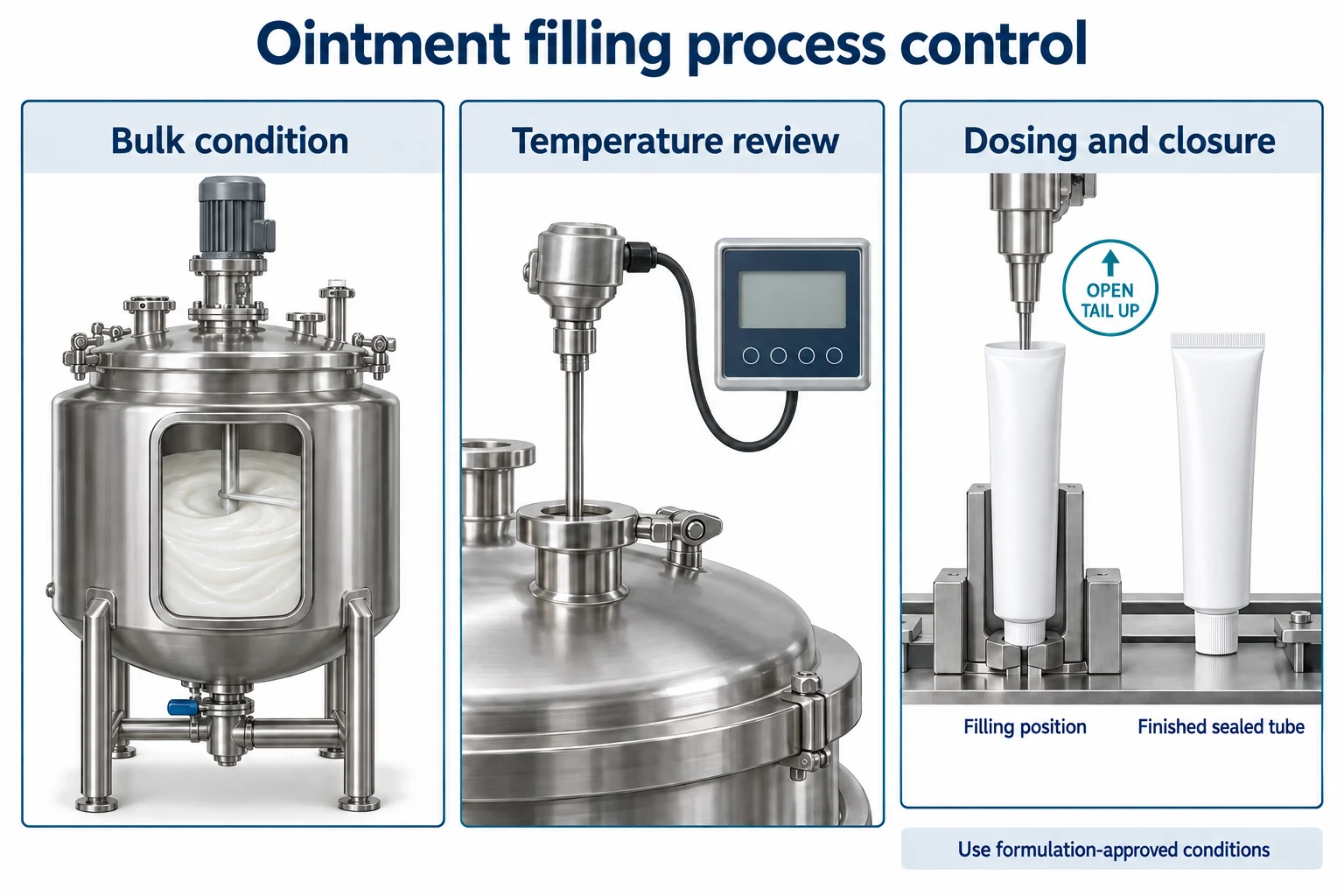
Define the formulation before selecting the filler
Describe whether the active ingredient is dissolved or dispersed, whether particles or crystals are present, and how the product responds to shear, temperature and time. Include density, fill mass, bulk-storage conditions and the expected handover from manufacturing to packaging. A single viscosity value without temperature or measurement conditions can mislead equipment selection.
Emulsions and suspended ingredients
For an emulsion, discuss the conditions needed to preserve its structure through transfer and filling. For a suspension, ask how uniformity is maintained as the hopper level falls. For an anhydrous base, consider changes in flow or texture as it cools. These questions guide trials; they should not be answered by assuming that all ointments need the same agitator or heated hopper.
FDA’s historical Topical Drug Products inspection guide highlights uniformity and temperature control as concerns in topical manufacturing. It is inspection reference material rather than a machine certification standard. Use it to frame product questions alongside the site’s current requirements.
Map the route from bulk vessel to tube
Draw the actual product route: bulk vessel outlet, transfer pump, hose, hopper or buffer, dosing chamber, valve and nozzle. Mark where product can remain after draining, where air can enter and where temperature is measured. This exercise often reveals a more important problem than the choice between two pump brands.
Define the handover condition
The bulk-product team should specify when material is ready to fill, how it is conditioned and how long it may wait. The packaging team should know whether a pause requires mixing, temperature confirmation or new samples. Avoid treating the filler hopper as a substitute for unfinished upstream manufacturing.
If transfer equipment is customer-supplied, identify its scope explicitly. A supplier trial fed directly from a small hopper may not represent the pressure and temperature of a long production transfer line. Record that limitation and plan the relevant site confirmation.
Control temperature without assuming warmer is better
Warming may make an ointment easier to pump, but it can also affect the formulation. Obtain the permitted range and residence conditions from the product owner before proposing a jacketed hopper or heated hose. A heater setpoint is not the same measurement as the product temperature at the dosing nozzle.
Measurement locations and gradients
Choose measurement points that reveal the risks identified in the product-path review. The hopper wall, bulk center and nozzle can experience different conditions. A long stop may allow material in a small outlet or hose to change before the main vessel does. Specify how the team decides that the product is ready to restart.
For a temperature-sensitive product, record how it reaches the filler and what happens during the longest planned pause. Test the approved production arrangement instead of selecting an arbitrary heating setting from another project. Do not use heating as an unverified remedy for dose variation.
Select dosing and nozzle motion together
A piston-based system may suit a semisolid when its chamber, seals and valve passages match the formulation. Controlled motion can help adjust suction and discharge profiles. Other pump arrangements may be considered where transfer conditions or product sensitivity justify them. Ask the supplier to explain the choice in terms of the actual formulation.
| Observed behavior | Engineering question | Trial focus |
|---|---|---|
| Product strings after discharge | Is shut-off and withdrawal suitable? | Nozzle tip and clean tail area |
| Air appears after refill | Does the inlet draw air or lose prime? | Refill and low-level samples |
| Flow changes as product cools | Is temperature controlled at the product path? | Start, pause and restart conditions |
| Particles collect in valves | Are passages and cleaning access suitable? | Residue, wear and product condition |
Protect the tube and the seal zone
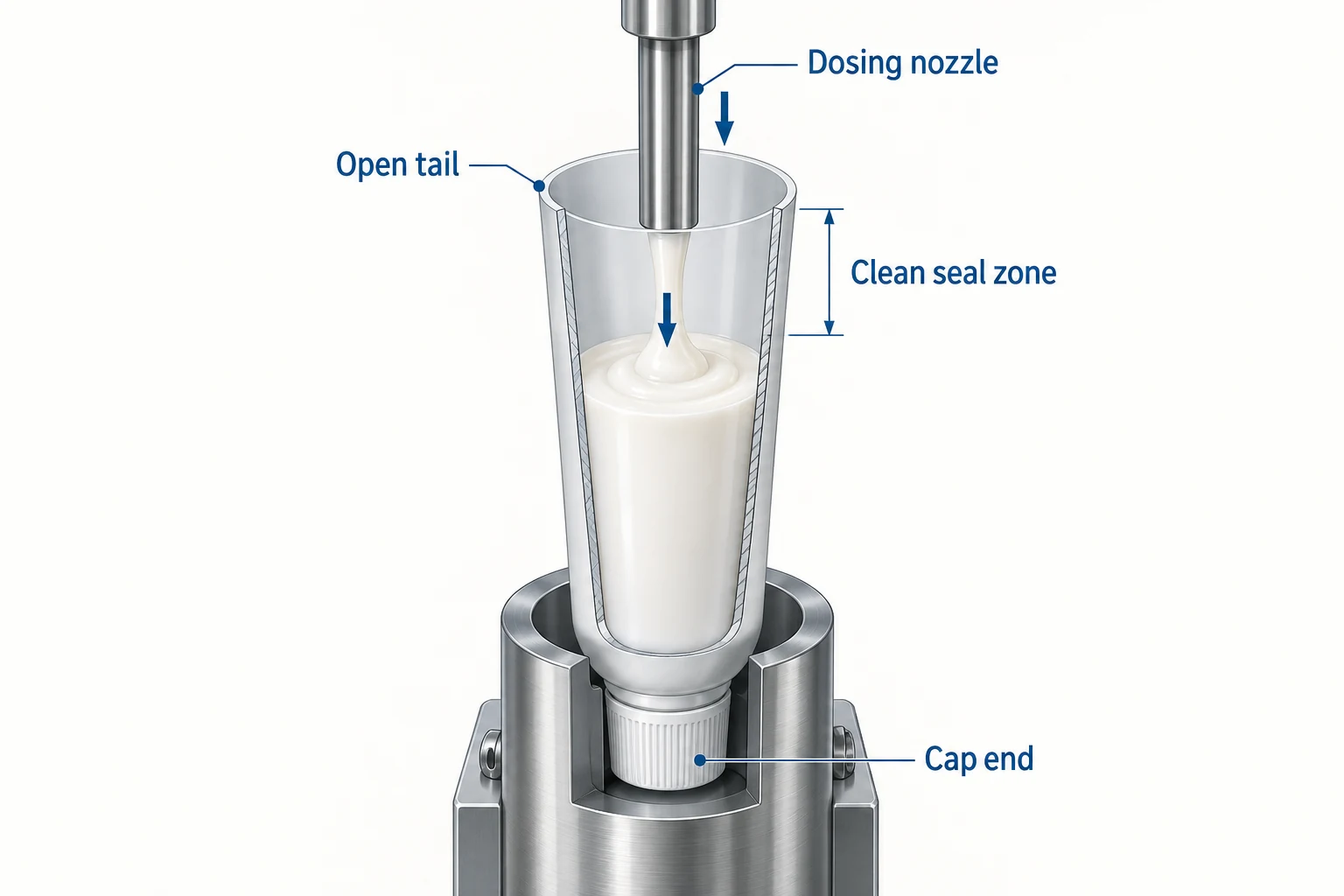
Define nozzle diameter, insertion depth, discharge profile and withdrawal. The tube is supported at its head or capped end with its unsealed tail upward. Product enters through that opening. The nozzle must leave sufficient clean tail for the intended closure; a correct fill mass does not compensate for product on the sealing surface.
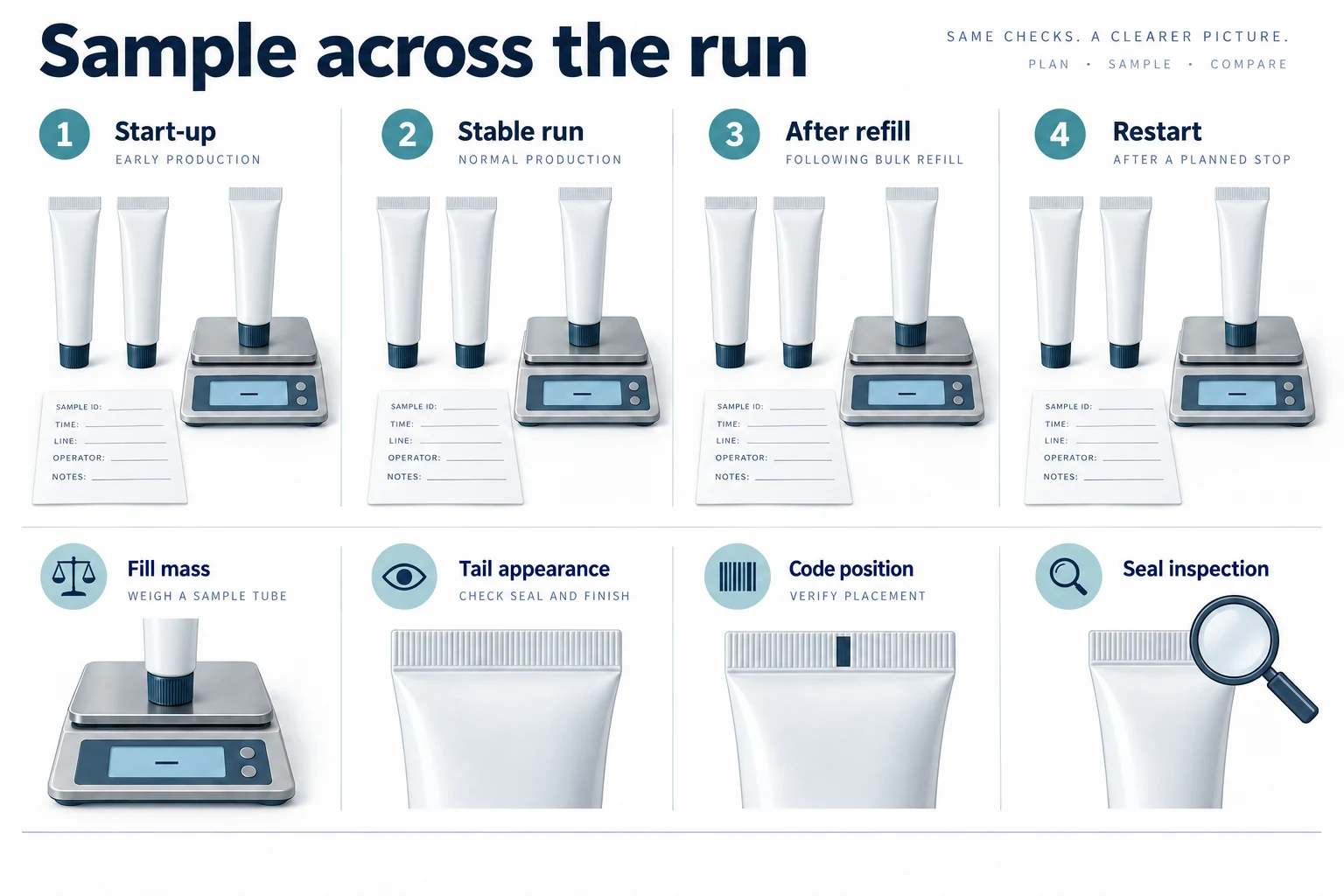
Trial several representative conditions rather than one attractive sample. Inspect first pieces, stable running, low hopper level, refill and pause recovery as justified. If the machine has two heads, identify results separately so a common average does not hide a head-specific issue.
Match tube construction to the closure
Plastic or laminate tubes use compatible thermoplastic closure processes, commonly hot air or a validated ultrasonic arrangement. Collapsible aluminum tubes require the specified folding tools. An aluminum-barrier laminate is not the same package as a metal-body tube, so obtain the construction drawing before selecting tooling.
Hot-air and ultrasonic considerations
For hot air, review the heating profile, air delivery, tube alignment, jaw contact and release timing. For ultrasonics, review horn and anvil contact, energy control and the actual sealing layer. Neither method removes the need to control product contamination and inspect the finished closure.
Aluminum folding considerations
For aluminum, inspect body protection, tail presentation, fold profile and any coding operation. Agree how the closure will be assessed and identify the production tube lot. A plastic-tail appearance standard cannot simply be reused for a mechanically folded tube.
The King Pack tube filling equipment overview provides the starting machine category. The final configuration should still be tied to the specific ointment, tube samples and required acceptance evidence.
Separate filling evidence from product-quality conclusions
A factory test can demonstrate handling, dose and closure under its recorded conditions. It does not independently demonstrate potency uniformity, preservative effectiveness or the finished product’s shelf life. The customer’s approved analytical and stability programme determines the wider product conclusions.
Sampling that supports investigation
Identify the sample’s time, head, tube lot, recipe and product condition. Keep the raw weight and inspection result, not only a pass mark. When laboratory samples are needed, agree the collection and handling method so they can be related to the packaging run.
If the trial uses a surrogate, explain what it represents: flow, particle behavior or another particular characteristic. Record what remains unrepresented. A convenient white paste cannot establish compatibility with every active ingredient or cleaning requirement.
Cleanability and product changeover
Inspect the pump inlet, valve seat, gasket grooves, piston seals, hoses and nozzle shut-off parts. Consider the surfaces around the product path where splashes can remain. Define how parts are removed, inspected, protected after cleaning and reassembled without mixing format kits.
Instructions and validation are different deliverables
The supplier can provide dismantling and cleaning-access instructions. The site establishes whether its product-specific cleaning process is adequate. Ask which residue, carryover or microbiological concerns the site’s quality assessment identifies, then review whether the equipment provides access to the relevant locations.
FDA’s CGMP equipment guidance questions discusses suitability of equipment design and product-contact surfaces. For procurement, translate that context into specific material records, cleaning access and maintenance responsibilities. Avoid presenting a generic stainless-steel claim as complete evidence of suitability.
Factory testing, shipment inspection and site readiness
Agree FAT objectives before samples are sent. Include tube loading, product transfer where available, dosing, tail treatment, seal or fold inspection, coding, rejection and restart. Record configuration and recipe versions. Identify any tests that need production utilities or final product at the destination.
During shipment inspection, compare the packed machine and tooling with the tested scope. Protect nozzles, instruments, guides and closure tools. Confirm the spare-parts kit, drawings, manuals and outstanding-action list before dispatch. A missing format kit can delay commissioning even when the main machine arrives undamaged.
Installation preparation
Review power, compressed air, access dimensions, product connections, cleaning arrangements and operator workspace. Schedule the people who will perform first-piece approval and any laboratory work. The installation, documentation and training scope should identify customer and supplier responsibilities before travel or delivery is booked.
Three practical investigations to include in a trial
The following scenarios illustrate how a team can investigate packaging behavior. They are hypothetical and contain no measured King Pack results. Use the logic to design a study appropriate to the actual product; do not treat the scenarios as automatic acceptance protocols.
Scenario one: correct mass but visible air pockets
Suppose filled tubes meet the approved mass requirement but some dispense with visible voids. First compare bulk condition before transfer with samples after dosing. Check whether the transfer hose draws air, the hopper runs too low or the nozzle profile introduces air during discharge. Preserve samples from each point so the team can identify where the change occurs.
Change one suspected condition at a time. A slower discharge might change tube appearance, but the result should be reviewed against fill mass, production feasibility and product quality together. If the bulk already contains voids, increasing filler automation will not resolve the upstream preparation issue. Record the responsibility for any required bulk-product correction.
Scenario two: clean tail at start-up, residue after a pause
Suppose the tail remains clean during continuous running but the first tubes after a pause show strings of ointment. Compare nozzle temperature, product residence and shut-off response before and after the stop. Check whether the site uses the same pause duration and restart sequence as the factory trial.
Agree how questionable first pieces are segregated. A change to nozzle retract or product conditioning may need another seal test because the practical objective is an uncontaminated, acceptable closure. Do not hide the behavior by simply increasing the nominal empty-tail allowance without reviewing the complete package specification.
Scenario three: variation appears near the end of the vessel
Suppose the final portion of a batch behaves differently from the earlier bulk. Review hopper level, transfer pressure, mixing effectiveness and temperature before assuming the piston needs recalibration. If the product contains suspended material, the formula team should evaluate whether the remaining bulk is representative.
The equipment study can record operating conditions and collect identified samples, while the appropriate product tests address composition or uniformity. Keep those responsibilities clear. A repeatable mechanical dose does not demonstrate that every dose has the required concentration when the incoming material is not uniform.
Design the inspection record around decisions
Use a record that a second engineer can understand without attending the trial. Identify the approved requirements, machine configuration, sample materials and measuring equipment. For every observation, state the condition and the acceptance decision. Attach photographs where they explain a nozzle string, fold profile or seal defect, but keep the raw data that supports the conclusion.
| Observation | Information to retain | Possible follow-up |
|---|---|---|
| Mass variation | Individual values, tare method, head and sample time | Review supply and metering conditions |
| Texture or voids | Product condition before and after filling | Product-team investigation |
| Tail contamination | Nozzle settings and stop/restart history | Cut-off and closure trial |
| Closure defect | Tube lot, tool identity and test method | Material and sealing assessment |
Include a deliberate changeover
If the purchase is intended to support multiple ointments, trial the planned cleaning and format change. Time individual steps only if the customer needs the information for planning, and label the conditions behind any observation. Separate dismantling, cleaning, drying, reassembly, recipe setup and first-piece approval. One total duration can conceal the step that will be hardest at the customer’s site.
Review whether dismantled parts can be handled without damage or misidentification. Include seal orientation and torque instructions where the design requires them. The operator should not have to infer the correct assembly from a photograph of the machine exterior. Clear parts documentation helps maintain the tested condition after the supplier leaves.
Define what remains open after the trial
A transparent trial report may identify an unresolved temperature condition, final packaging sample or cleaning check. Assign an owner and a closure method. Procurement can then decide whether the equipment scope needs revision or whether the remaining work belongs to site acceptance. This makes the technical proposal reviewable without claiming that every pharmaceutical requirement has already been proved.
Write an RFQ that distinguishes the difficult conditions
List the lowest and highest planned fills, tube dimensions, product temperature conditions, required closure and hardest changeover. Identify what can be grouped and what remains untested. Request a proposed trial method, acceptance documents and explicit exclusions. A broad statement that a machine fills ointment is insufficient for comparing engineering offers.
Discuss your ointment project: Send the formulation handling notes and tube drawings through the King Pack technical enquiry form. Request a configuration and sample-test plan before confirming the purchase scope.
Check downstream handling before acceptance
Inspect tubes after discharge and any transfer to cartoning, rather than approving the pack only while it remains in the filling holder. A guide can mark the body, a drop can soil the cap, and poorly supported transfer can stress a warm tail. Record the intended orientation, transfer height and accumulation behavior when downstream equipment is part of the order.
Coordinate the coder with the final trim and fold profile. A clearly printed code placed on material that is later removed does not meet the packaging requirement. Similarly, a rejected tube must remain distinguishable from acceptable stock after the conveyor stops. These practical checks connect machine operation to the finished package the customer actually releases.
FAQ
Does every ointment need a heated hopper?
No. Heating should follow the formulation’s approved requirements. Some products need temperature control, while others can be damaged or unnecessarily changed by warming.
Can an emulsion and an anhydrous ointment use one machine?
Possibly, with suitable product-contact parts, dosing settings, cleaning and tooling. A shared product label does not prove equivalent behavior, so test representative boundary conditions.
Why does the fill change after a pause?
Possible causes include temperature change, trapped air, altered inlet conditions or product structure recovery. Compare product and machine observations before changing the dose setting.
Does a good-looking seal prove integrity?
No. Appearance is one check. The package owner should define any additional integrity test and the conditions under which samples are evaluated.
Can FAT replace site qualification?
FAT supplies useful evidence, but installation, utilities and product-specific activities still need the site’s approved review and testing strategy.
What if a tube supplier changes?
Review construction, dimensions and product compatibility, then repeat the affected handling and closure checks. Nominal size alone does not show that the previous trial still represents production.
Conclusion
Pharmaceutical ointment filling requires control of formulation condition, temperature, transfer, dosing and material-specific closure. Select equipment using representative samples and clear evidence boundaries. A documented handover from bulk preparation through FAT and site acceptance is more valuable than unsupported performance claims.
Request an ointment filling proposal: Share the dosage form, tube matrix, cleaning restrictions and required documentation with King Pack to define the next engineering review.
Last reviewed: October 14, 2026. Regulatory context: US topical and CGMP equipment references; the customer’s quality system determines applicability and release requirements.
The following visuals are illustrative production and inspection references. They do not represent guaranteed output or measured validation results.
Related equipment and project resources
For equipment selection, compare the relevant filling machine product range with the packaging solution overview. Application context is available in the veterinary medicine solutions and pharmaceutical packaging guide. Where the process includes a closure step, review the filling and capping line and tube sealing equipment.
Before a trial, document product rheology, fill volume, container dimensions, contact materials, cleaning method, closure requirements and inspection points. Related planning resources include tube filling and sealing machine selection, how to choose a tube filling machine, tube sealing quality control, manual to automatic syringe filling and syringe format changeover planning.
For a project-specific review, contact the technical team, send your requirements for a quote or review the syringe filling machine range. Include samples or drawings when available so the machine scope can be assessed against real product and packaging conditions.
Need help with the next step? Request a quote with the product, package, fill volume and target checks.
