 Skip to content

Multicolor toothpaste requires coordinated product paths, stable rheology and controlled dosing so the visual pattern remains consistent from start-up through the batch. The filling line must preserve the intended color arrangement while filling through the open tube tail, then seal the tail without contaminating the closure area.
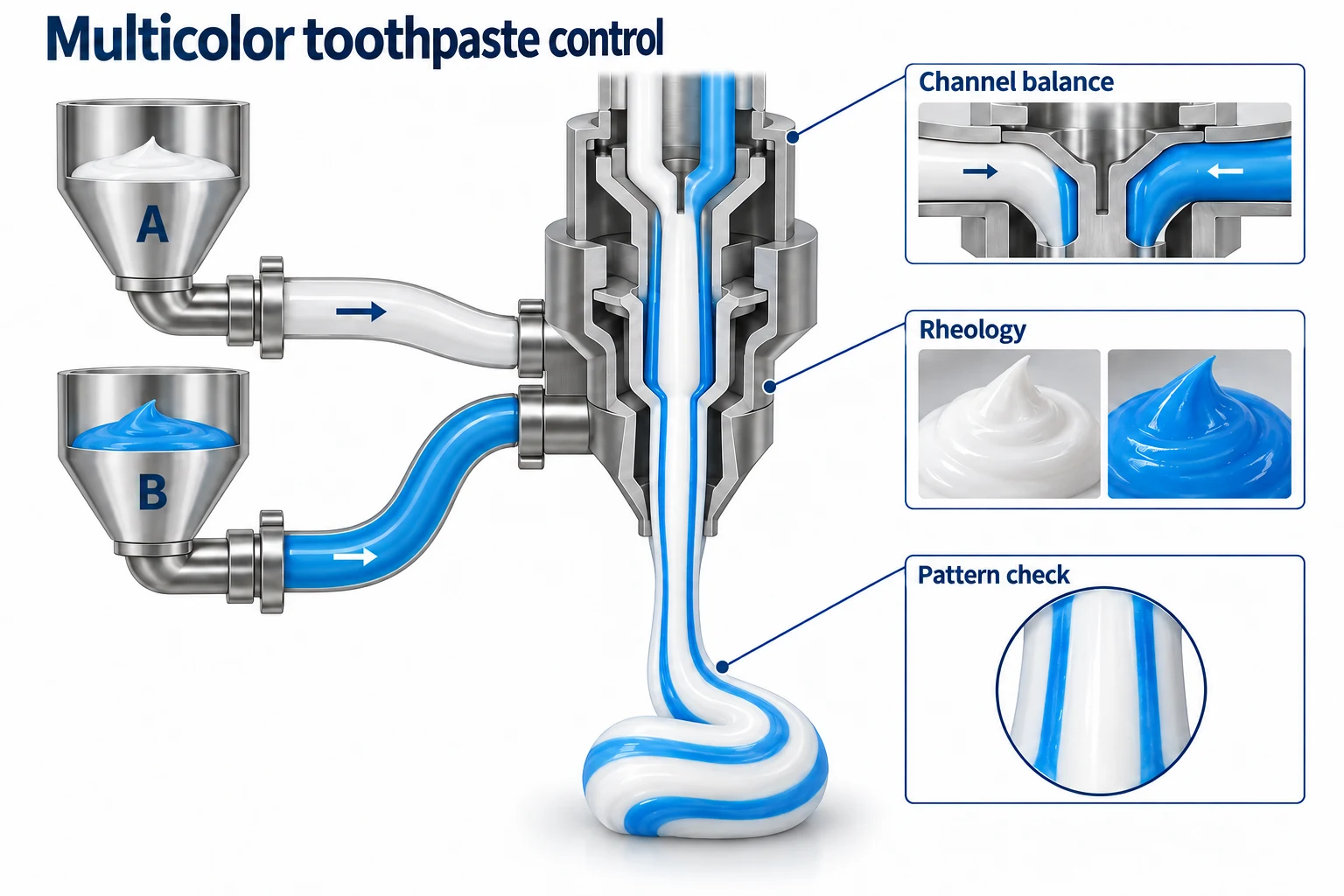
Product and color-system review
Share the number of colors, viscosity range, pigment or abrasive content, density and sensitivity to shear. Some formulas use separate colored phases, while others use a base paste with stripe inserts. The equipment must match the actual design. Do not assume that a standard single-color piston filler can create a controlled multicolor pattern.
Rheology differences
If one color flows more easily than another, the pattern can move during transfer or filling. Measure each component under the expected temperature and mixing condition. Confirm whether the product should be gently agitated and how long it may remain in the hopper.
Multi-channel dosing
A multicolor filler may use multiple product channels, a central core path, or a stripe-forming nozzle. Review pump type, valve timing, nozzle geometry and clean-out procedure. Each channel should be identified and adjustable. The factory trial should record the recipe and the color arrangement.
Pattern stability
Inspect the first tubes after start-up, stable operation, pause recovery and refill. Check stripe width, color boundary, fill weight and tail cleanliness. Keep samples from each condition. If the pattern changes after a stop, review pressure balance, air and product temperature before increasing speed.
Tube filling and sealing
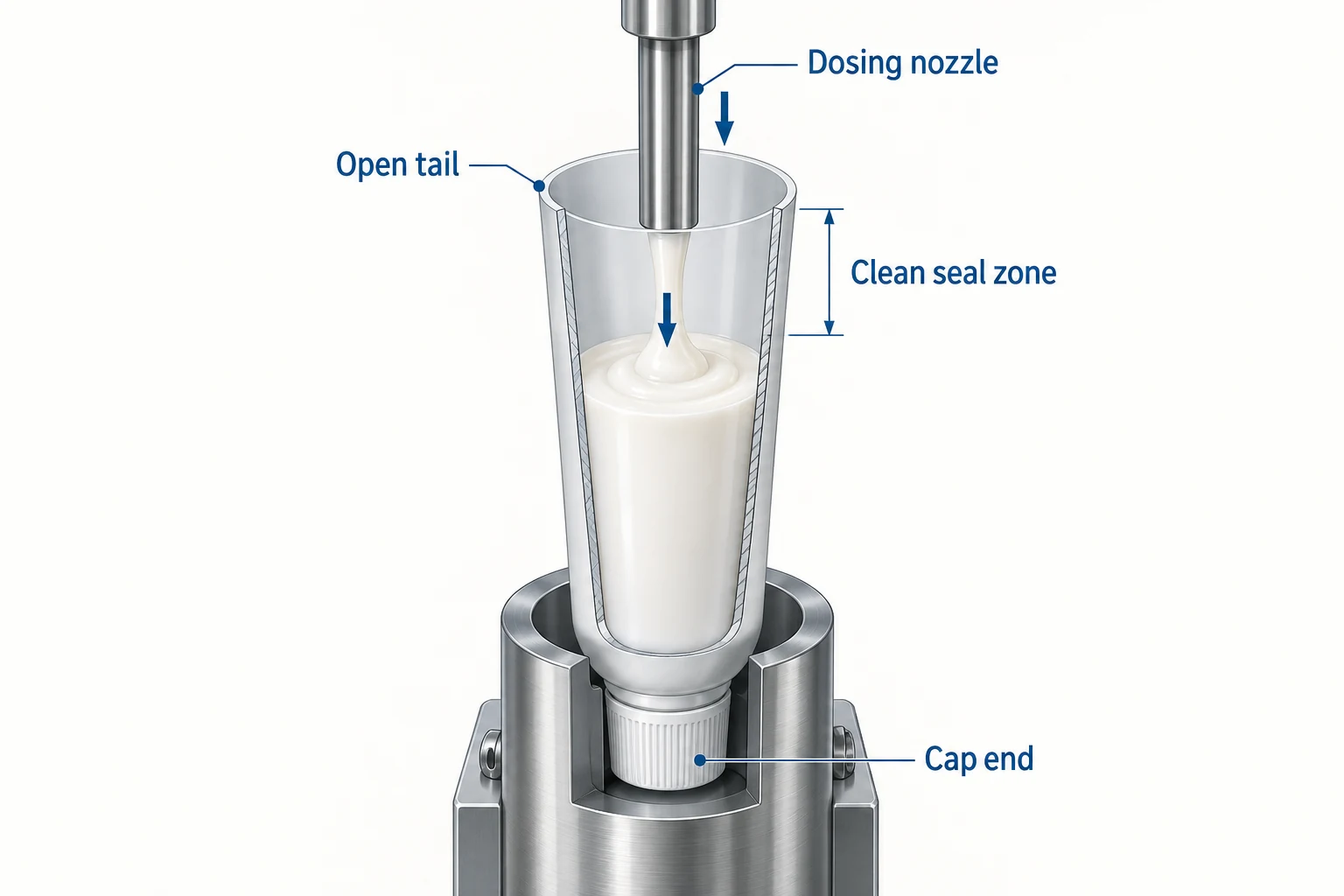
The tube is held with the open tail facing upward. The dosing assembly fills the product pattern through the unsealed tail. The tube then moves to hot-air or compatible ultrasonic sealing. The tail must remain clean because color residue can affect seal integrity and appearance.
Cleaning and changeover
Cleaning is more complex because residual color from one formula can contaminate the next. Define channel drain points, hose flushing, valve cleaning, nozzle disassembly and visual clearance. Label each color path and store parts in a controlled kit.
FAT and installation
FAT should verify color arrangement, dose, pattern stability, sealing, coding, reject handling and cleaning access. Use the real tube and representative product where possible. Shipment inspection should include color-channel tools, spares, manuals and recipe backups. Installation preparation should cover product handling, power, air and operator training.
Buyer checklist
- Number of colors and pattern design
- Rheology and temperature of each phase
- Channel, pump and nozzle configuration
- Color-change and cleaning procedure
- Tube and seal requirements
- FAT samples and acceptance criteria
Discuss your requirements: Send your multicolor pattern, tube drawing and product data to King Pack for a channel and dosing review.
Define the stripe concept before specifying the machine
Different toothpaste packages create a colored dispensing pattern in different ways. A product may use separately metered phases, a particular nozzle geometry or a package-assisted striping arrangement. Define the intended cross-section and dispensing appearance with the formulation and packaging teams. A photograph of striped toothpaste does not reveal the complete filling architecture.
Specify the acceptance view
Agree whether the customer will inspect paste immediately after filling, the first dispensed portion, repeated portions or the pattern through an agreed part of the tube. These observations answer different questions. A neat pattern visible at the nozzle does not establish how the product will dispense after storage in the intended package.
Norden’s toothpaste application overview describes equipment concepts for different numbers of colors. It demonstrates that multicolor is a distinct configuration discussion. It does not establish that a standard single-product filler, or any untested King Pack configuration, can create the required pattern.
Review each phase as a separate product
Identify base and stripe phases with their density, temperature, flow behavior, particles, air condition and permitted residence time. Provide the preparation and conditioning method for each. Two colored phases that look similar in a cup may respond differently inside a pump, valve or narrow passage.
Rheology is more than a viscosity number
State how a measurement was taken and describe practical behavior at rest, under pumping and after a pause. A structured paste may need a particular pressure to begin moving and may recover structure differently after shear. The formulation team should define the conditions that preserve the intended product, while equipment trials explore a suitable operating method.
Do not try to correct every color-pattern problem mechanically. A significant mismatch between phase behavior may need formulation review. Keep that conclusion separate from adjustment of pump timing or nozzle position so the approved product and process remain traceable.
Control bulk supply to every channel
Review hopper level, refill, transfer distance and any agitation independently for each phase. A small stripe reservoir may reach a different condition from the base reservoir during the same run. The trial should show how the system responds when one channel is refilled and how questionable first pieces are handled.
Examine the complete channel and nozzle design
Ask for a functional explanation of how the phases remain separate and where they meet. Identify the pump, valve, hose and nozzle passage for each channel. The drawing should clarify whether flow is metered independently, how the recipe is adjusted and how residual product is removed.
Nozzle geometry and physical support
The nozzle must suit the intended stripe arrangement and tube opening. Review alignment, insertion clearance, motion and the route by which product leaves the tool. A change in tube diameter or tail width may require a different nozzle or profile rather than a simple recipe adjustment.
At the filling station, the tube’s open tail faces upward and its cap or shoulder is supported below. Product enters through the unsealed tail. The drawing should not depict a filler dosing through the threaded cap end. This distinction is especially useful when comparing a conceptual channel diagram with the actual packaging sequence.
Balance channels through a recorded setup
Define which settings control each phase and how adjustments affect the combined dose. Record the recipe version and the relevant physical tools. If the base mass changes, confirm whether stripe delivery and final appearance need review as well. A total fill measurement alone cannot identify every color-ratio or pattern issue.
Separate three kinds of quality observation
| Observation | What it can reveal | What it does not prove alone |
|---|---|---|
| Total fill mass | Combined quantity in the tube | Correct distribution of every phase |
| Pattern inspection | Stripe shape and visible boundaries | Complete formulation-quality compliance |
| Closure inspection | Tail appearance and integrity outcome | Long-term dispensing or stability |
Establish the acceptance method for each observation before the trial. Identify who evaluates the pattern and what reference is used. Avoid an instruction such as “same as photograph” without stating sample condition, dispensing method and the region to inspect. Retain accepted and defective examples with their process identity.
Run a trial across the expected production conditions
Use representative phases and production tubes. Record temperature, preparation, conditioning and material lots. The factory should know the planned output requirement, but the trial must also address the customer’s normal pauses, refills and format changes. A short continuous run may miss the condition that produces the pattern defect.
Start-up and stable operation
Inspect the first portions from the channels and define when product is ready for acceptance sampling. Check total dose, visible pattern and tail cleanliness. Continue sampling under the agreed plan, preserving head and channel identity where relevant. Keep the observations that support the decision, not only a video of a successful section of the run.
Refill and restart
Consider a refill of the base phase and a refill of a stripe phase separately. After a planned stop, inspect the first pieces and subsequent stabilized samples. If one color arrives earlier or later, review inlet conditions, valve timing and phase behavior. Do not conceal the observation by discarding unrecorded samples.
Dispensing from the finished pack
Use the intended cap and outlet when assessing the discharged toothpaste. Define the conditioning and dispensing method with the product team. A cut-open tube can show an internal arrangement, but it may not represent how the user sees the pattern. Record both methods distinctly if both are used.
Troubleshoot by the observed pattern
If stripe width changes, compare phase delivery and bulk conditions. If a boundary becomes diffuse, review product behavior and the nozzle. If the first dispensed portion differs from later portions, examine the package, fill sequence and conditioning. These are investigation directions, not automatic diagnoses.
Change one condition at a time
Keep a baseline sample and record each adjustment. Changing phase temperature, ratio and nozzle motion together makes the result hard to interpret. Ask the relevant formulation, packaging and equipment specialists to assess their own boundaries before accepting the correction.
For an overview of the mechanical platform, refer to the tube filling and sealing equipment category. A multicolor project needs its own feasibility review; do not assume the standard machine scope includes every product channel or pattern tool.
Cleaning and cross-color clearance
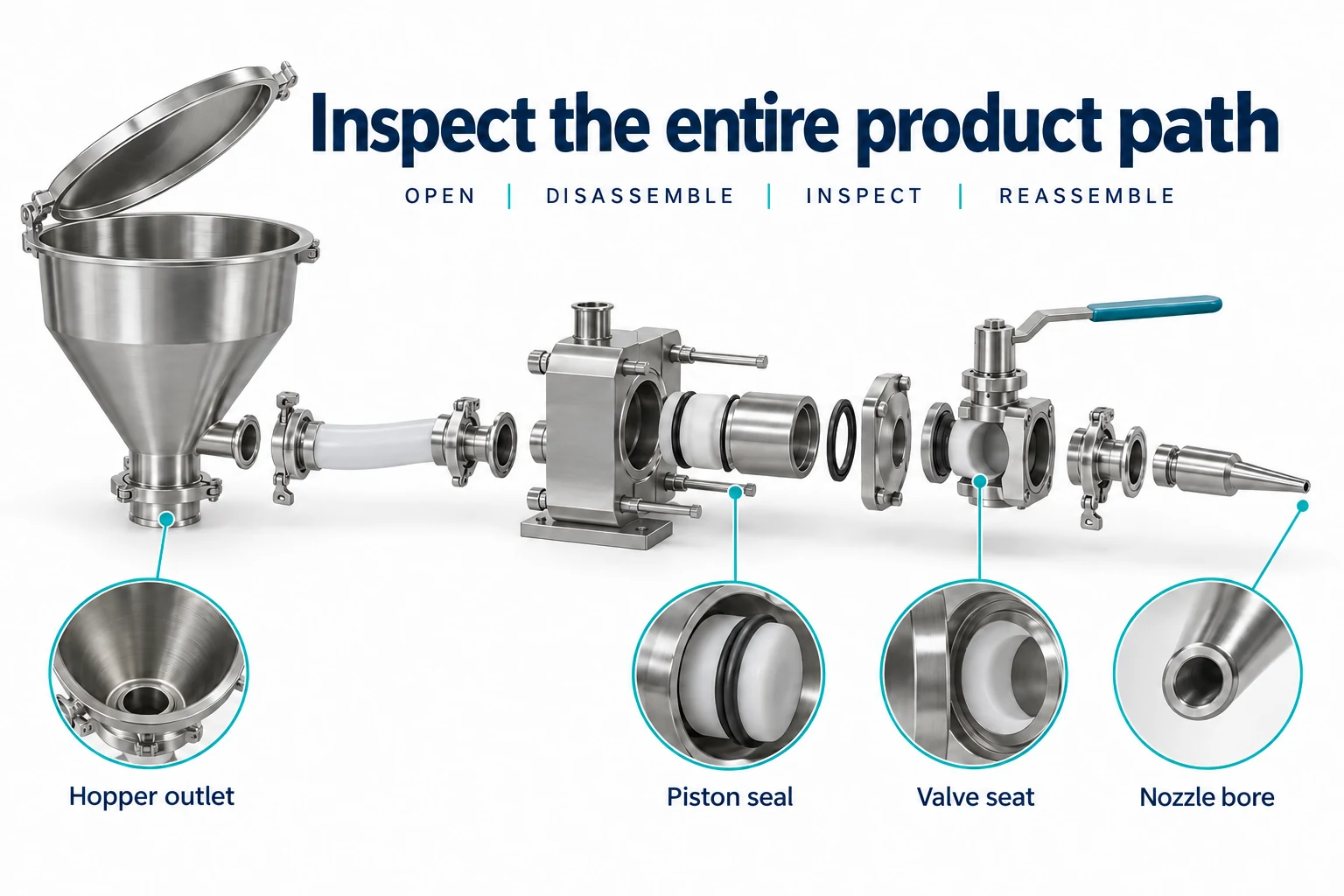
Map all product-contact paths and identify low points, valves, seals and narrow nozzle passages. A colored residue can be easier to see than a clear residue, but visible clearance alone should not be treated as proof of every product-specific cleaning requirement. The customer establishes the appropriate procedure and acceptance.
Keep channel parts identifiable
Label nozzles, hoses and valve components so they return to the intended position. Review how dismantled clean parts are protected and stored. An undocumented swap can change flow or introduce residual color even when the touch-screen recipe is correct.
Demonstrate the planned changeover during FAT where practical. Record removal, cleaning, inspection, reassembly and first-piece approval separately. Ask how a new color or product changes the required parts and cleaning method. This is particularly important for a contract manufacturer promising several patterns on one platform.
Handover, spares and site preparation
Shipment inspection should identify the complete channel kits, nozzle drawings, approved recipes, closure tooling, spare parts and manuals. Protect precision surfaces and retain the tested configuration. Installation preparation should confirm separate product supplies, utilities, cleaning space and trained personnel for acceptance sampling.
Define documentation, training and after-sales support for the supplied configuration. Ask who owns recipe changes and how the site identifies a replacement nozzle or channel component. These details help preserve the approved pattern after maintenance or a format change.
RFQ inputs for a multicolor toothpaste project
Send the desired pattern, phase information, tube construction, cap drawing, target fill, operating pattern and cleaning requirements. Include accepted dispensing examples where available and explain how they were prepared. Request confirmation of technical feasibility, a trial scope and any conditions that remain unverified.
Discuss multicolor feasibility: Use the King Pack technical enquiry form to share the phase and package data. Ask for a scoped engineering review rather than an unsupported promise that a general toothpaste filler can reproduce any stripe design.
A hypothetical two-phase pattern study
Consider a buyer comparing a white base with a blue stripe phase in one laminate tube. The desired pattern is already approved by the product team, but the production filling arrangement is not selected. This example shows how to organize evidence without inventing a trial result, ratio or machine output.
Prepare references before the run
Identify the intended appearance, tube and cap, phase preparation and sample conditioning. Agree which part of the dispensing sequence will be inspected. Keep a reference that describes the customer’s acceptable pattern rather than asking the supplier to infer it from a marketing image.
Label base and stripe materials separately. Record their lots, storage and temperature conditions. Confirm which channel and tool receives each phase, then preserve that identity in the recipe. The test should make it possible to trace a later pattern observation to the supplied material and setup.
Observe the first and later portions
Collect the agreed first pieces and stabilized samples. Inspect total fill, tail cleanliness and the defined dispensing pattern separately. If the pattern looks different, compare the phase supply and nozzle conditions before adjusting several settings. A change that improves appearance should also be checked against the total dose and closure.
Repeat a normal pause and a representative refill. The buyer should know whether the approved result depends on continuous running or whether the normal recovery method maintains the required pattern. Record any rejected first pieces and the instruction used to prevent their release.
Preserve the decision and its limits
Keep the configuration, recipe, material lots, observations and accepted references together. State which formats were not tested. If the customer later requests a second stripe color, different cap or transparent tube, review the added channel, tooling and pattern requirements rather than treating them as a cosmetic artwork change.
Distinguish stripe methods from swirl and layers
A stripe pattern, a swirl and separately filled layers can require different nozzle and motion concepts. IWK’s multicolor technology presentation illustrates several approaches rather than one universal method. Use the intended final product design to choose the trial architecture; do not assume that a change in nozzle color produces every pattern.
Do all patterns use the same nozzle?
No. The channel arrangement, package and desired appearance can require dedicated tools. Ask for a functional explanation and a representative demonstration before approving the scope.
Does a clear stripe prove correct formulation quality?
No. Visual pattern is one packaging observation. The product owner determines the analytical and other requirements needed to release the toothpaste.
Can the supplier promise every future pattern?
Future designs should remain subject to product, package and configuration review. Define the tested boundary and the sample information needed for an additional feasibility assessment.
Release each channel after maintenance
When a pump, valve or nozzle component is replaced, verify its identification and installed position. Check for air, residual cleaning material and a changed cut-off condition before approving the next tube. A repair to one channel can affect the combined pattern even if the other channels remain unchanged.
Preserve a short record of the maintenance work, recipe, first-piece observations and approval. If the pattern later changes, that history helps the team distinguish material variation from a configuration change. Train operators to escalate a recurring correction rather than continually adjusting phase delivery to compensate for an unidentified fault.
Keep critical replacement parts and their drawings in the handover list. The buyer should know which parts are standard and which are specific to the selected pattern. This supports realistic spare-part planning without claiming that a stock nozzle will reproduce every design.
FAQ
Can one nozzle fill multicolor toothpaste?
Some designs use a specialized multi-channel nozzle, while others use separate dosing paths. The product pattern determines the correct configuration.
What causes color mixing?
Common causes include pressure imbalance, unsuitable nozzle geometry, excessive shear, temperature variation and poor cleaning.
How is sealing affected?
Product on the tail can contaminate the seal. Cut-off and tail inspection must be included in the trial.
Can one total weight verify every phase ratio?
No. A correct combined mass can conceal a changed contribution from one channel. Define the additional product and pattern evidence with the formulation and quality teams.
Conclusion
Multicolor toothpaste filling requires control of rheology, channel balance, nozzle design, cleaning and sealing. Validate the pattern with representative trials and document the recipe before production.
Request a technical review: Contact King Pack for a multicolor toothpaste filling trial plan and equipment review.
The following visuals are illustrative production and inspection references. They do not represent guaranteed output or measured validation results.
Related equipment and project resources
For equipment selection, compare the relevant filling machine product range with the packaging solution overview. Application context is available in the veterinary medicine solutions and pharmaceutical packaging guide. Where the process includes a closure step, review the filling and capping line and tube sealing equipment.
Before a trial, document product rheology, fill volume, container dimensions, contact materials, cleaning method, closure requirements and inspection points. Related planning resources include tube filling and sealing machine selection, how to choose a tube filling machine, tube sealing quality control, manual to automatic syringe filling and syringe format changeover planning.
For a project-specific review, contact the technical team, send your requirements for a quote or review the syringe filling machine range. Include samples or drawings when available so the machine scope can be assessed against real product and packaging conditions.
Need help with the next step? Request a quote with the product, package, fill volume and target checks.
