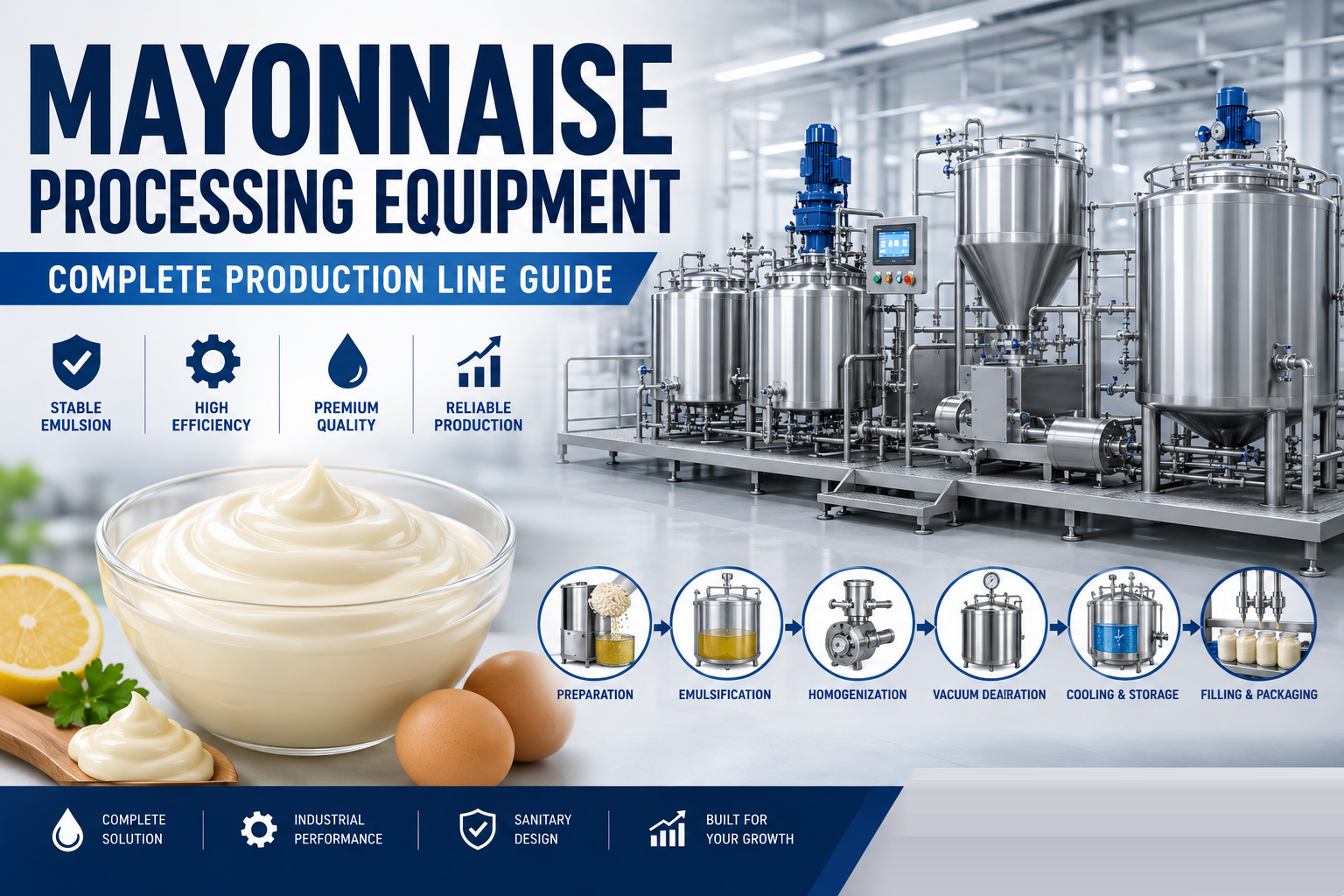
Commercial mayonnaise production requires more than one mixing machine. A stable oil-in-water emulsion at 150,000–250,000 cP cannot be made in a single bucket with a simple agitator. It needs a system that prepares phases separately, adds oil at a controlled rate, applies high shear, removes air, controls temperature, and then transfers without damaging the emulsion.
A complete line includes raw material preparation, emulsification, storage, transfer, filling and packaging. Equipment selection affects texture, emulsion stability, efficiency and filling accuracy. Production lines can be configured for laboratory, startup, medium-scale and industrial production, from 50 L pilot mixers to 5,000 L/h continuous systems.
This guide explains what mayonnaise processing equipment is required to make mayo, how each machine works, and how to select a mayonnaise production line based on product and capacity. It also shows how processing connects to a mayonnaise filling machine and downstream packaging.
What Is Mayonnaise Processing Equipment?
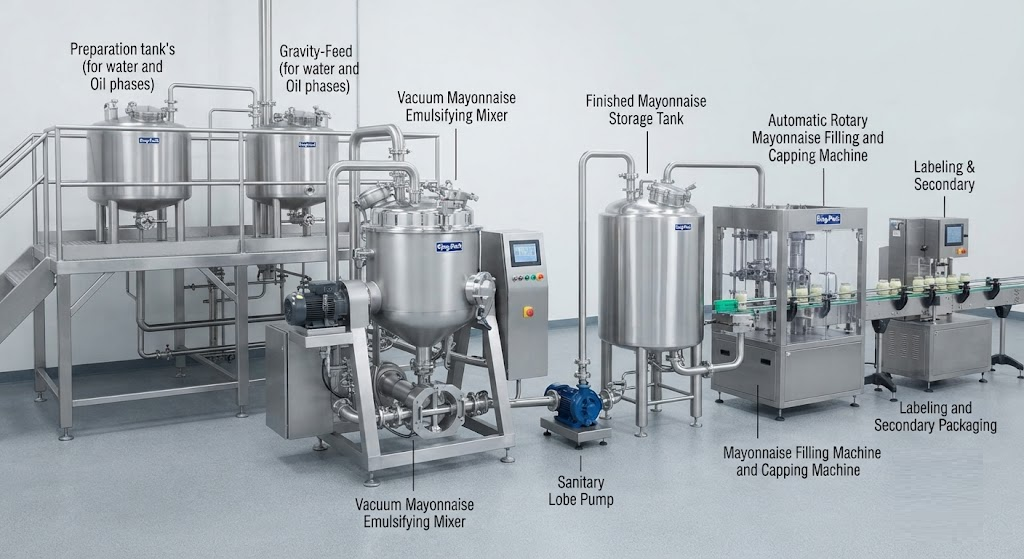
Mayonnaise processing equipment refers to the machines used to prepare oil-phase and water-phase ingredients, mix and dissolve raw materials, create a stable oil-in-water emulsion, remove trapped air, control product temperature, store finished mayonnaise, transfer it to the filling line, and fill, seal and package the final product.
It is important to clarify that a mayonnaise processing line normally combines several machines rather than relying on one standalone mixer. A mayonnaise mixing machine alone can blend, but it cannot reduce oil droplets to the 2–10 micron range needed for long-term stability. For that you need a mayonnaise emulsifying machine with rotor-stator homogenizer and vacuum.
For B2B buyers, the term mayonnaise processing equipment covers the whole chain from ingredient tanks to palletizer. King-Pack builds this chain as an integrated system so viscosity and air content stay controlled from emulsification to pack.
Complete Mayonnaise Production Process
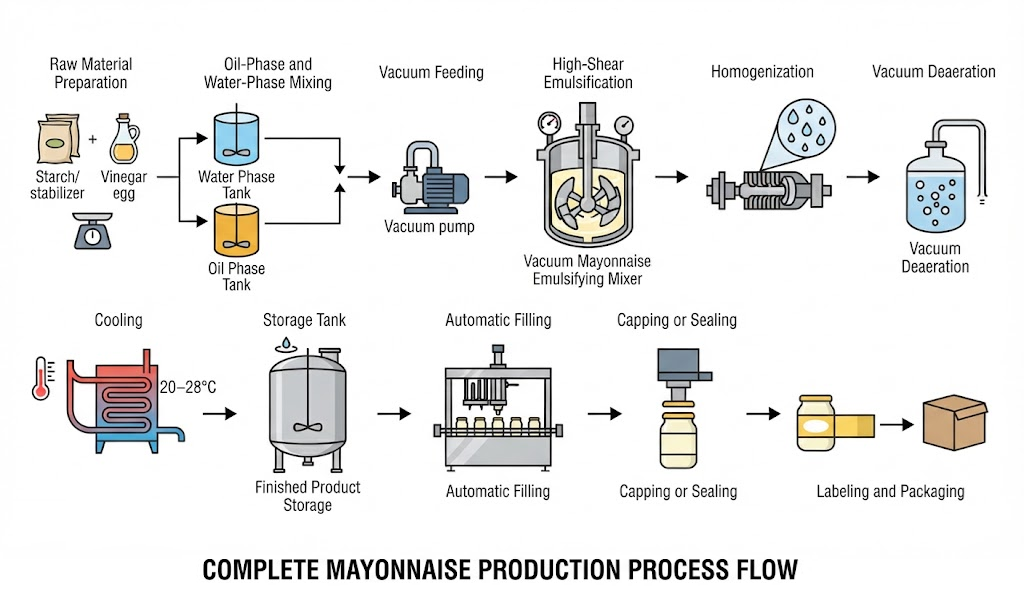
Commercial mayonnaise production follows a fixed sequence. Each stage has a clear purpose and is logged by PLC for traceability.
Raw material preparation ensures accurate dosing and pre-hydration of powders. Oil-phase and water-phase mixing dissolves salt, sugar, and stabilizers separately. Vacuum feeding prevents aeration when transferring phases. High-shear emulsification disperses oil into the water phase.
Homogenization narrows droplet size distribution. Vacuum deaeration removes air introduced during mixing. Cooling brings product to 20–28°C for optimal filling viscosity. Storage buffers production and filling. Filling and packaging must preserve the emulsion without stringing or dripping.
Main Mayonnaise Processing Equipment
The mayonnaise production process involves several processing stages, from raw material preparation to emulsification and storage. Each piece of mayonnaise processing equipment plays an important role in achieving a stable emulsion, consistent quality, and efficient production.
Water-Phase Preparation Tank
The water-phase preparation tank is used to dissolve water, vinegar, salt, sugar, egg ingredients, stabilizers, and other water-soluble raw materials. This stage helps prepare the aqueous phase before emulsification.
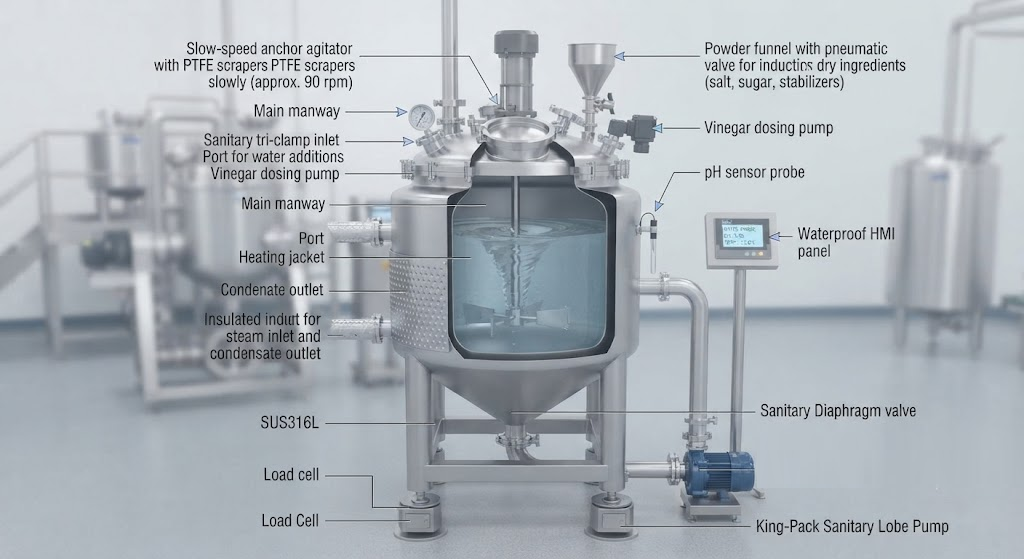
Typical features include agitators, heating jackets, temperature control, sanitary discharge systems, and ingredient feeding controls. Temperature control helps dissolve stabilizers such as xanthan gum and maintain consistency. The process begins by preparing the water phase and adjusting the acid component to achieve the required pH range.
Oil-Phase Preparation Tank
The oil-phase preparation tank stores and prepares vegetable oil before it enters the emulsification system. It is used to blend oil-soluble ingredients such as flavors and colors while maintaining proper oil temperature.
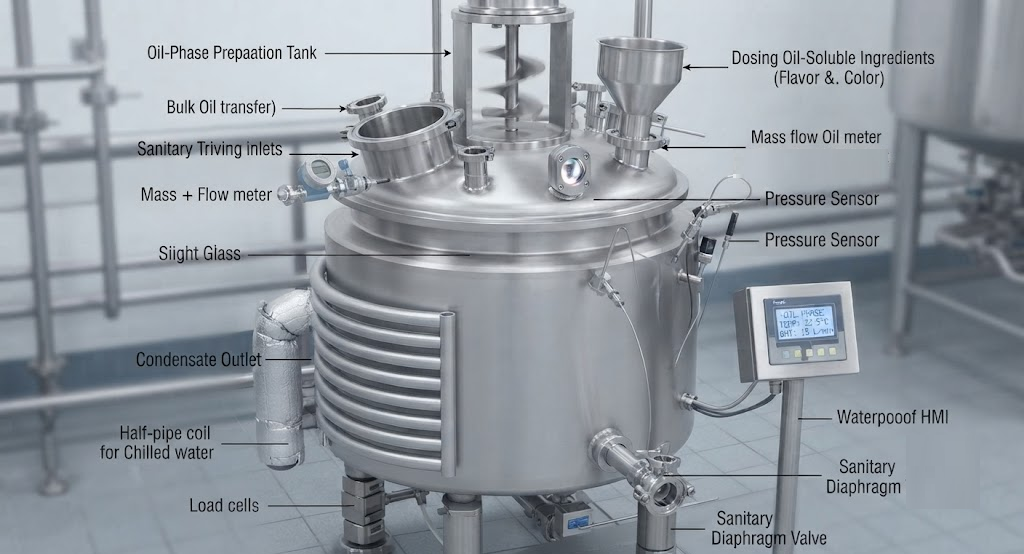
Controlled oil addition is essential for producing a stable and uniform emulsion. Adding oil too quickly can increase oil droplet size and affect the final product’s texture, shelf life, and stability.
Ingredient Mixing Tank
An ingredient mixing tank supports pre-mixing, powder dispersion, and raw material blending before the main emulsification stage. It helps create a uniform feed for the emulsifying system.
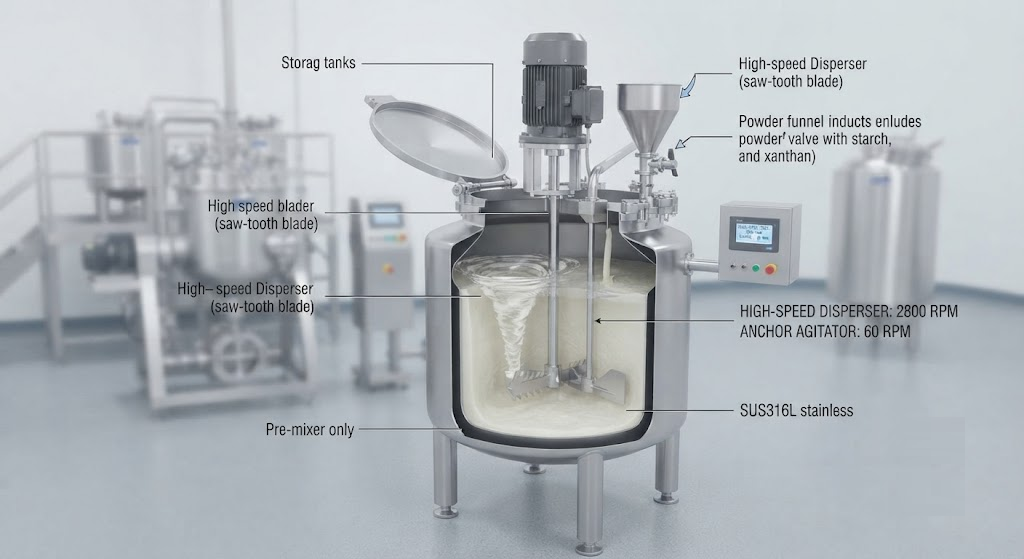
A high-speed disperser can help wet out ingredients such as starch or xanthan gum. However, a standard mixing tank cannot replace a high shear mixer because it only creates a coarse pre-mix rather than fine emulsions.
Vacuum Emulsifying Mixer
The vacuum emulsifying mixer is the core equipment in a mayonnaise production line. It combines high shear mixing, homogenization, vacuum processing, and temperature control to create a stable and uniform emulsion.
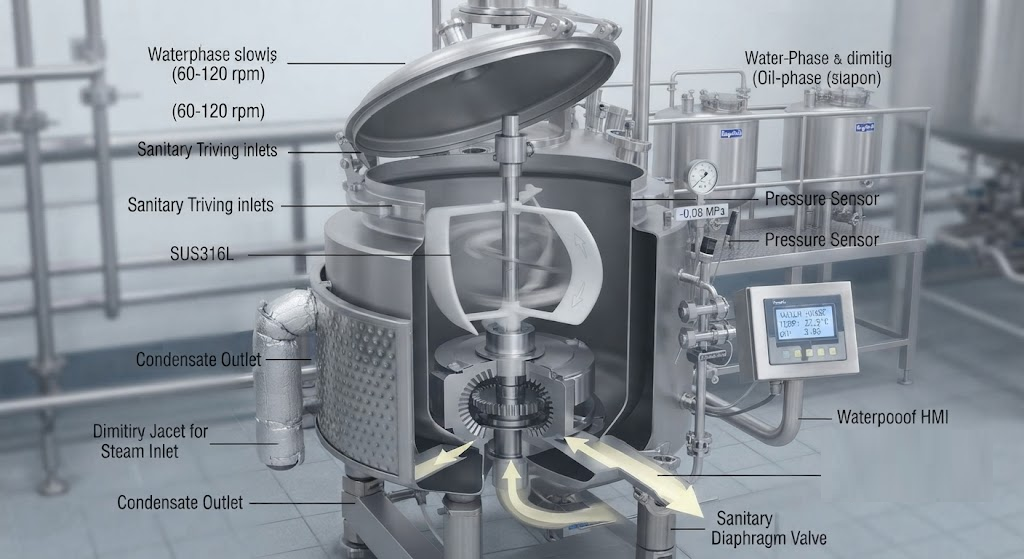
The machine reduces oil droplets to a fine size, improves smooth texture, and supports the production of high quality mayonnaise, salad dressings, creamy sauces, and tartar sauce.
Main functions include:
- High shear mixing for breaking down oil droplets
- Vacuum processing to remove air bubbles
- Heating and cooling control
- Wall scraping for high-viscosity products
- Mixing of materials with viscosities up to 500,000 cP
A modern mayonnaise making machine integrates the main vessel, oil and water tanks, rotor-stator homogenizer, anchor agitator, vacuum system, and PLC control system. King-Pack’s equipment uses SUS316L stainless steel contact parts and CIP systems to support food safety and easy cleaning.
Modern mayonnaise production equipment can support large-scale production, with some systems reaching up to 10,000 liters per hour depending on the production setup and formulation.
Inline or External-Circulation Homogenizer
An inline homogenizer circulates mayonnaise through an external rotor-stator system to provide additional high shear. It improves texture, supports uniform emulsion formation, and helps maintain consistent product quality in larger production lines.
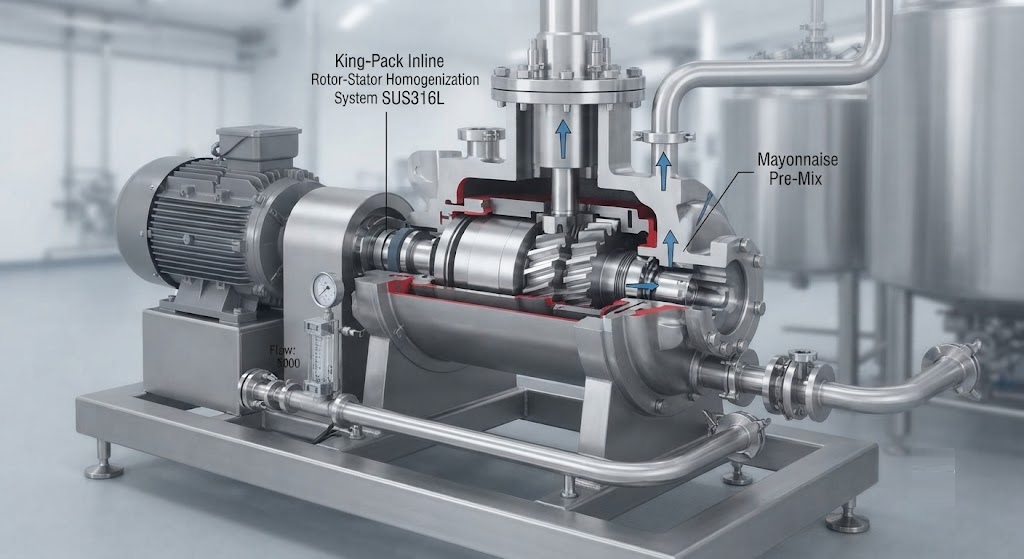
This equipment is useful when manufacturers need finer emulsions, higher production capacity, or improved efficiency. The need for inline homogenization depends on the formula, production volumes, and desired final texture.
Heating and Cooling System
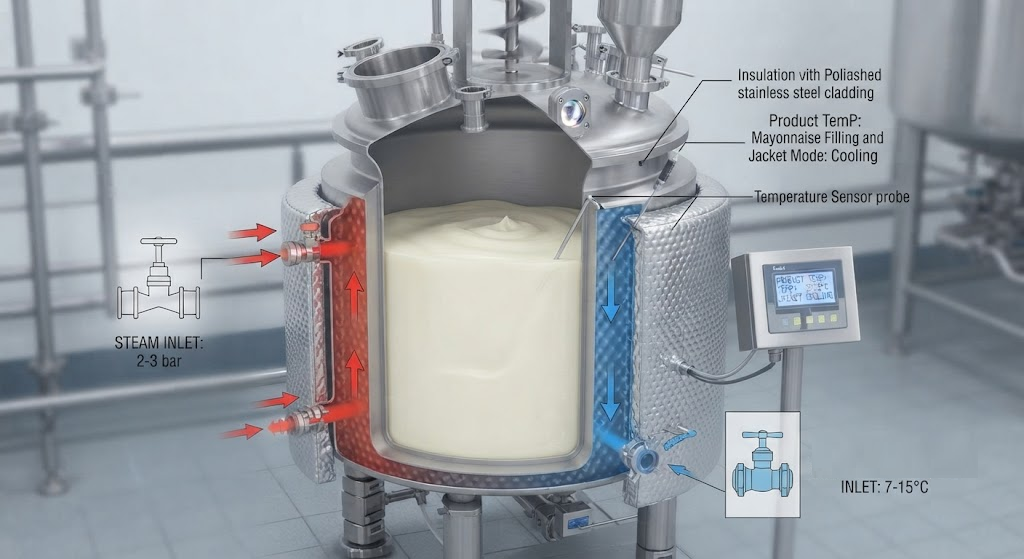
Temperature control is an important part of the mayonnaise manufacturing process. Heating helps dissolve ingredients and prepare raw materials, while cooling helps achieve the required final viscosity.
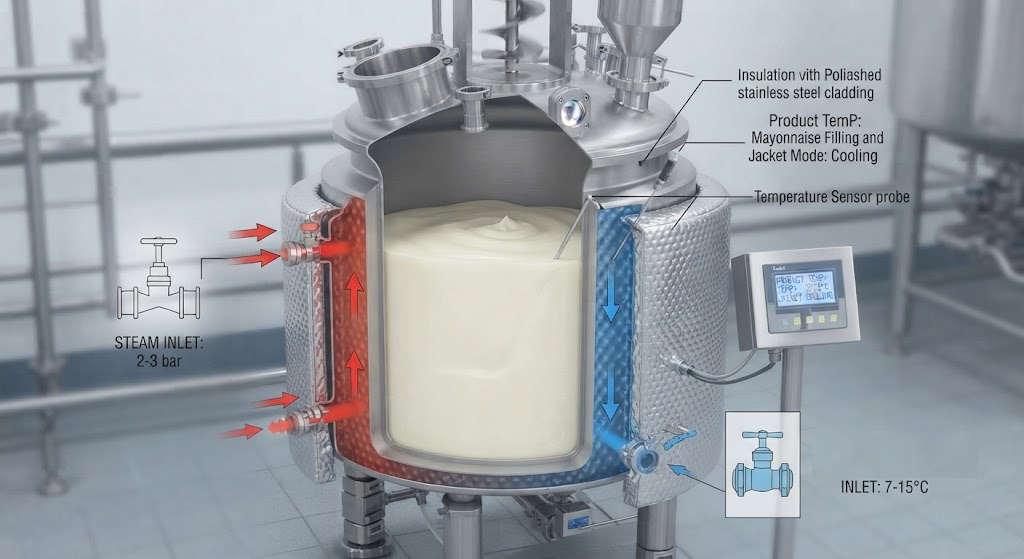
Jacketed tanks may use steam, hot water, or electric heating systems. Pasteurization systems may also be included to heat mayonnaise and reduce harmful bacteria while maintaining product safety.
Vacuum System
The vacuum system removes trapped air during mayonnaise production. It reduces bubbles, improves smooth mayonnaise texture, and supports better filling performance.
Vacuum processing helps reduce oxidation and improve appearance, but product shelf life also depends on factors such as pH control, preservatives, and storage conditions.
Finished Mayonnaise Storage Tank
A finished product storage tank holds mayonnaise between processing and filling. It provides a continuous supply to bottling equipment and helps prevent production interruptions.
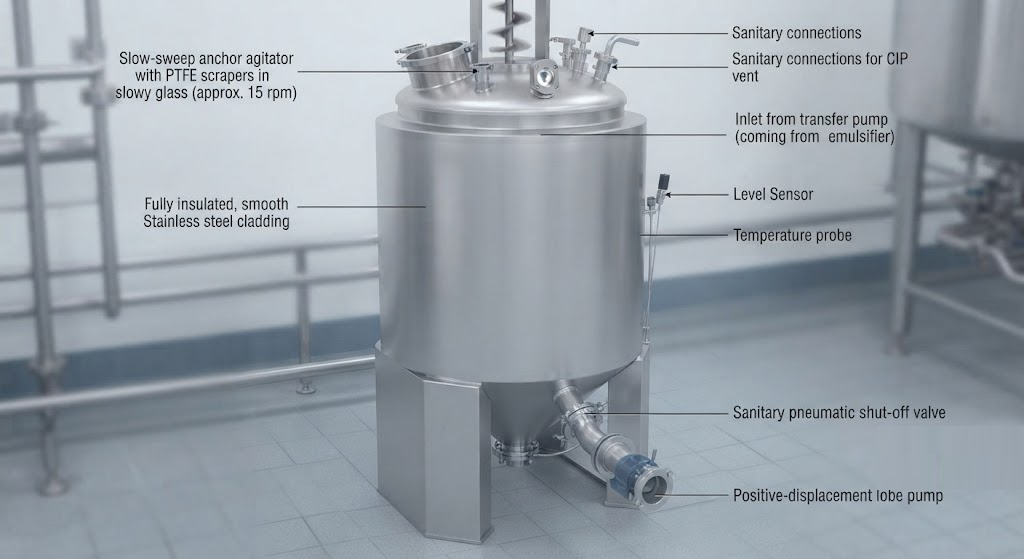
Common features include slow-speed agitators, insulation, level sensors, sanitary outlets, and CIP spray balls. These systems help maintain uniform consistency before packaging.
Sanitary Transfer Pump
High-viscosity mayonnaise requires a suitable sanitary transfer pump to move the product without damaging its structure. Rotary lobe pumps, screw pumps, and progressive cavity pumps are commonly used.
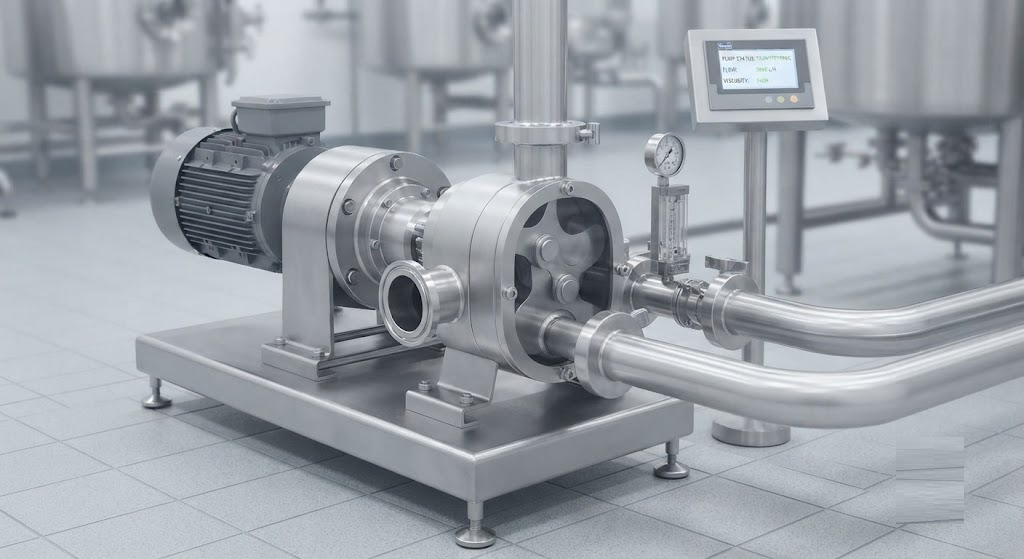
Pump selection depends on viscosity, pipeline length, flow rate, and production capacity. Centrifugal pumps are usually avoided because they can introduce air and affect the emulsion.
Short, hygienic pipelines with proper cleaning systems help reduce waste, minimize downtime, and maintain food safety during the production process.
Mayonnaise Quality Control During Production
Quality control is essential throughout the mayonnaise production process. Each batch is tested for pH, viscosity, texture, and microbial safety to ensure consistent product quality.
Classic mayonnaise typically contains around 8–10% egg yolk and 79–80% oil, with lecithin from egg yolk acting as a natural emulsifier. Vegan mayonnaise replaces egg yolk with plant-based ingredients, while low-fat varieties often use starches or gums to improve stability.
Manufacturers use precise dosing, temperature control, and advanced technologies to produce stable emulsions while meeting food safety standards. Proper quality control prevents defective mayonnaise products from reaching consumers.
How Does a Mayonnaise Emulsifying Machine Work?
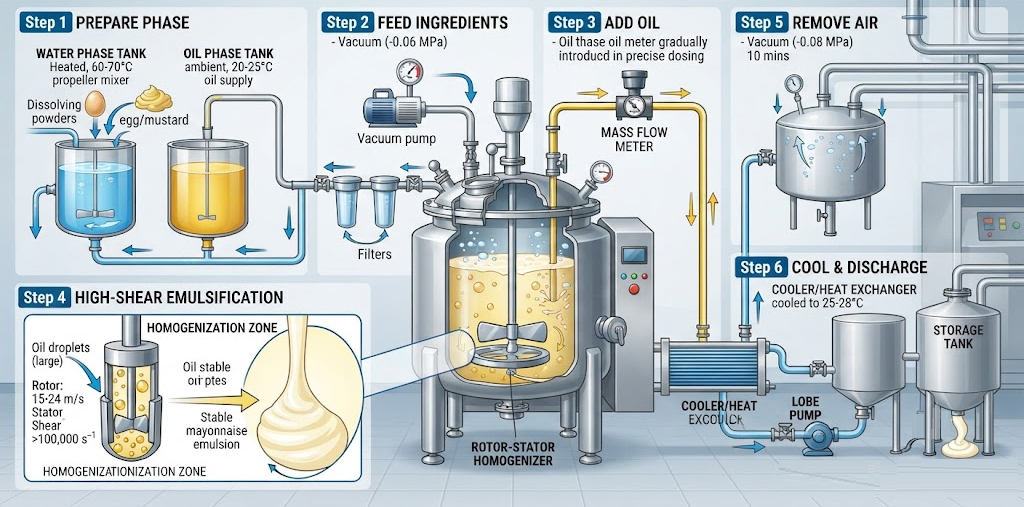
Step 1 — Prepare the Oil and Water Phases
Ingredients are mixed separately according to production formula. Water-phase at 60–70°C dissolves powders; oil-phase at 20–25°C holds oil. Both are filtered to 50–100 μm.
Step 2 — Feed Ingredients into the Main Vessel
Ingredients are added manually, automatically or under vacuum. Vacuum feeding at -0.06 MPa pulls water-phase without pumps, reducing air.
Step 3 — Add Oil at a Controlled Rate
Oil is gradually dispersed into water phase under agitation. Controlled dosing via mass flow meter ensures oil fraction increases slowly, allowing lecithin from egg to stabilize new interface.
Step 4 — Apply High-Shear Emulsification
The rotor-stator homogenizer reduces oil droplets and distributes them through water phase. Tip speed 15–24 m/s generates shear rates >100,000 s⁻¹. Processing time 10–20 minutes.
Step 5 — Remove Trapped Air
Vacuum processing reduces bubbles introduced during mixing. Extended deaeration for 10 minutes at -0.08 MPa gives denser product and more accurate filling.
Step 6 — Cool and Discharge
Mayonnaise is cooled to required condition, typically 25–28°C, and transferred to storage tank or filling machine via lobe pump. Discharge via bottom valve prevents air pickup.
For regulatory background on mayonnaise identity and composition standards, manufacturers can refer to official food regulations and standards that define requirements for commercial mayonnaise production. These guidelines help ensure proper formulation, labeling, and quality control throughout the manufacturing process.
Batch vs Continuous Mayonnaise Processing Equipment
Choosing between batch and continuous affects flexibility, investment, and staffing.
| Comparison | Batch Processing | Continuous Processing |
| Production method | One batch at a time, 100–2,000 L | Continuous material flow, 1,000–5,000 L/h |
| Production flexibility | High, easy recipe change | Best for standardized products |
| Formula changeover | Easier, CIP between batches | More complex, pigging and flush |
| Suitable scale | Small to medium | Medium to large |
| Initial investment | Generally lower | Generally higher |
| Process control | Batch-based recipe | Continuous monitoring with inline sensors |
| Typical application | Multiple products and recipes, contract manufacturing | High-volume production, single SKU |
Best system depends on production volume, formula variety and factory operation. Most mayonnaise manufacturing equipment for startups is batch; large national brands move to semi-continuous with inline homogenization.
Mayonnaise Processing Equipment by Production Scale
Laboratory and Product Development
Suitable for formula testing, product development, sample production, and small pilot batches of 5–50 L. Typical equipment: small emulsifying mixer, laboratory homogenizer, and small filling machine.
Startup and Small-Batch Production
Suitable for local brands, new sauce factories, and limited product ranges up to 500 kg/day. Typical equipment: water-phase tank, oil-phase tank, batch vacuum emulsifier 100–300 L, semi-automatic filling machine, and manual or semi-automatic capping.
Medium-Scale Production
Suitable for regional brands, contract manufacturers, and multiple daily batches of 2–5 tons/day. Typical equipment: automated ingredient preparation, vacuum emulsifying mixer 500–1,000 L, finished-product holding tank, automatic filling and capping line, and labeling machine.
Large Industrial Production
Suitable for national brands, export factories, and high-output production >10 tons/day. Typical equipment: automated raw material feeding, large-capacity emulsification system 1,000–2,000 L, inline homogenization, multiple storage tanks, automatic filling lines, secondary packaging equipment, CIP system, and PLC production control with SCADA. This full mayonnaise production line is designed for OEE >85%.
How Is Mayonnaise Transferred After Processing?
Main challenges are high viscosity 150k–250k cP, trapped air that causes short fills, product pressure drop over long pipelines, temperature changes that shift viscosity, product residue in pipelines, and emulsion damage caused by unsuitable pumps.
Recommended considerations: use short, sanitary pipelines where possible, select pump suitable for viscous products, avoid unnecessary turbulence and sharp elbows, match pump flow rate to filling machine at 1.1x filler demand, maintain stable product temperature ±1°C, and design system for cleaning and drainage with 2–3% slope.
What Equipment Is Used to Fill Mayonnaise?
Mayonnaise is normally thick, non-free-flowing product, so gravity fillers do not work. You need positive displacement.
Servo Piston Filling Machine
Suitable for jars, bottles, food-service containers, and thick and smooth mayonnaise. Advantages include controlled volumetric filling, adjustable filling volume via touchscreen, suitable for high-viscosity products, and anti-drip nozzle options. This is the core mayonnaise filling machine in most lines. A Mayonnaise Filling Machine with servo control holds ±0.5% accuracy.
Recommended Reading: ROI Analysis: The Hidden Costs of Choosing Low-Price Servo Driven Filling System – King Pack Machinery
Positive-Displacement Filling Machine
Suitable for consistent high-viscosity dosing, continuous production lines, and different container sizes. Uses lobe or gear pump with encoder feedback.
Jar Filling and Capping Machine
Suitable for glass jars, plastic jars, wide-mouth containers. Typical line: Container Feeding → Mayonnaise Filling → Cap Placement → Capping → Foil or Induction Sealing → Labeling. This configuration is sold as a Jar Filling and Capping Machine.
Squeeze-Bottle Filling Machine
Suitable for plastic squeeze bottles, upside-down sauce bottles, and retail mayonnaise packaging. Equipment should control nozzle dripping, product stringing, container contamination, and filling pressure. Dive-fill nozzles prevent tailing.
Sachet Packaging Machine
Suitable for single-serve mayonnaise, restaurant portions, takeaway food, and airline and catering packages. A Sachet Packaging Machine with piston dosing handles 10–50 ml at 40–80 sachets/min per lane.
Pouch Filling Machine
Suitable for spout pouches, premade pouches, food-service packs, and refill packaging. A Spout Pouch Filling Machine uses nitrogen flushing and large-bore valves for thick product.
Mayonnaise Packaging Formats
Common formats: glass jars, plastic jars, squeeze bottles, upside-down bottles, sachets, stick packs, premade pouches, spout pouches, portion cups, buckets, and food-service containers.
Packaging format determines filling machine type, nozzle design, capping or sealing method, required production speed, and secondary packaging equipment. For example, sachets need heat seal control at 130–160°C, while jars need torque control at 1.5–3 Nm.
Complete Mayonnaise Processing and Packaging Line
Suggested configuration for a complete mayonnaise production line:
Raw Material Storage → Water-Phase Preparation Tank → Oil-Phase Preparation Tank → Vacuum Emulsifying Mixer → Finished Product Holding Tank → Sanitary Transfer Pump → Mayonnaise Filling Machine → Capping or Heat Sealing → Labeling and Coding → Cartoning or Case Packing
This integrated system connects processing to packaging without manual handling. King-Pack provides this as a turnkey mayonnaise processing line including ingredient tanks, Mayonnaise Making Machine emulsifiers, storage tanks, transfer pumps, filling machines and food Packaging Machinery.
Essential Features of Mayonnaise Processing Equipment
List of features to specify when comparing mayonnaise production equipment:
- Food-contact stainless steel SUS304/316L, Ra<0.8 μm interior
- High-shear rotor-stator system with variable speed
- Vacuum processing to -0.095 MPa
- Heating and cooling jacket with PID control
- Wall-scraping agitator with PTFE scrapers
- Temperature monitoring and level monitoring
- Sanitary pipelines, easy product discharge via bottom valve
- CIP cleaning with spray balls
- PLC touchscreen, recipe control, and filling line integration
EHEDG hygienic design guidelines are a useful benchmark when evaluating food processing equipment, especially for systems that require strict sanitation and easy cleaning. Manufacturers can use these standards to compare equipment design, material selection, and cleaning performance.
Benefits of an Automatic Mayonnaise Production Line
An automatic line delivers more consistent emulsification, stable texture between batches, reduced manual handling, better ingredient control via load cells and flowmeters, improved filling accuracy, higher production output, reduced product waste via pigging, easier cleaning with CIP, better production traceability with batch logs, and easier capacity expansion by adding storage tanks or filler heads.
Common Problems in Mayonnaise Processing
| Problem | Possible Cause | Equipment or Process Direction |
|---|---|---|
| Oil separation | Insufficient emulsification, oil added too fast | Review oil addition rate and homogenization speed, check rotor-stator gap |
| Uneven texture | Inconsistent mixing time or temperature | Standardize processing parameters via PLC recipe |
| Excessive air bubbles | Air introduced during mixing or transfer | Use vacuum deaeration, check pump seals |
| Powder lumps | Poor powder dispersion, no disperser | Improve premixing and feeding with high-speed disperser |
| Unstable viscosity | Temperature or formula variation | Improve temperature control and recipe control |
| Slow transfer | Pump or pipeline unsuitable for viscosity | Select high-viscosity lobe pump, increase pipe diameter |
| Inaccurate filling | Air pockets or unstable feed from storage | Improve holding agitation and vacuum level |
| Product dripping | Unsuitable filling nozzle | Use anti-drip shut-off nozzles with back-suck |
How to Choose Mayonnaise Processing Equipment
Product Formula
Consider oil content, egg ingredients, stabilizers, powder content, acidity, and desired texture. High oil formulas require stronger homogenization and higher shear force to maintain stable emulsifying properties.
The mayonnaise production process typically begins by mixing the aqueous phase with egg yolk before adding oil. Stabilizers such as xanthan gum help improve separation resistance and extend shelf life.
Required Capacity
Select equipment based on batch size, daily output, production shifts, filling speed, and future expansion plans. For industrial scale production, a high capacity system with precise control helps achieve uniform quality and minimal downtime.
Product Viscosity
Viscosity affects mixer design, motor power, homogenizer selection, transfer pumps, and filling equipment. High-viscosity mayonnaise requires precise ingredient dosing to prevent the emulsion from breaking.
Viscosity testing confirms that mayonnaise reaches the required thickness and texture. Industrial mixers should be selected according to product thickness and production goals.
Packaging Format
Choose equipment based on whether mayonnaise will be packed in jars, bottles, sachets, pouches, cups, or buckets. A specially designed filling and capping system helps maintain accurate filling, reduce waste, and support reliable performance.
Automation Level
Automation options include manual ingredient feeding, automatic weighing, PLC recipe control, temperature management, automatic filling and capping, and CIP cleaning.
Advanced automation provides precise control, improves production efficiency, and helps manufacturers meet quality standards while maintaining consistent output at industrial scale.
Recommended Reading: How Food-Grade Tube Sealing Improves the Shelf Life of Mayonnaise – King Pack Machinery
How to Choose a Mayonnaise Processing Equipment Manufacturer
Choosing the right mayonnaise processing equipment manufacturer requires evaluating experience, machine quality, customization options, and technical support. A reliable supplier should understand the complete mayonnaise production process, including emulsification, storage, transfer, filling, and packaging.
The manufacturer should provide equipment made from food-grade stainless steel, offer solutions based on production capacity and product viscosity, and support line integration with filling machines, capping machines, and CIP systems. Proper testing and quality control help ensure stable emulsions, consistent texture, and reliable production.
King-Pack provides customized mayonnaise processing solutions, including emulsifying mixers, storage tanks, transfer systems, filling machines, and complete production lines. With experience in food processing equipment, King-Pack helps manufacturers build efficient systems for different production scales and packaging requirements.
Frequently Asked Questions about Industrial Mayonnaise
Q1: What equipment is needed to manufacture mayonnaise?
Water-phase tank, oil-phase tank, vacuum emulsifying mixer, storage tank, transfer pump, mayonnaise filling machine, and capping/labeling equipment.
Q2: What is the main machine used to make mayonnaise?
The mayonnaise emulsifying machine, specifically a vacuum emulsifying mixer with high-shear rotor-stator.
Q3: Can mayonnaise be made in a standard mixing tank?
No. A standard tank cannot reduce oil droplets enough. It can only pre-mix. You need high shear and vacuum.
Q4: Why is vacuum used in mayonnaise production?
To remove trapped air, reduce bubbles, improve density, and increase filling accuracy.
Q5: What is the difference between a mixer and an emulsifier?
Mixer blends with low shear; emulsifier uses rotor-stator to create fine, stable emulsion.
Q6: What pump is suitable for transferring mayonnaise?
Sanitary positive-displacement pumps: rotary lobe, screw, or progressive cavity.
Q7: What filling machine is suitable for mayonnaise?
Servo piston filling machine or positive-displacement filler with anti-drip nozzles.
Q8: Can the same production line make salad dressing?
Yes, with adjustable shear, larger nozzles for herbs, and agitators to keep particles suspended. Formula changeover via CIP.
Q9: What production capacity should a factory choose?
Base it on daily output, shifts, and growth. Size emulsifier 20% above filler demand.
Q10: Can mayonnaise processing equipment be connected directly to packaging machines?
Yes. Via storage tank and lobe pump to an automatic filler, with PLC handshake and level control.
Looking for Complete Mayonnaise Processing Equipment?
King-Pack provides customized mayonnaise processing and packaging systems, including ingredient preparation tanks, vacuum emulsifying mixers, storage tanks, transfer pumps, filling machines and packaging equipment.
Solutions can be configured according to product formulation, batch capacity, required output, product viscosity, packaging format, automation requirements, and factory layout.
As a professional manufacturer of mayonnaise processing, filling and customized food packaging equipment, King-Pack supplies mayonnaise production equipment, mayonnaise making equipment, and complete lines for commercial mayonnaise production. Contact us today for a customized mayonnaise production line.
Content ScoreSEOAI SearchAuto-Optimize
#1Research & Create Outline
#2Write & Optimize
#3Internal Links
#4Pre-Publish Review
#5Publish or Export
words33761.5K-1.8K
headings5824-57
paragraphs9134+
Mayonnaise Processing Equipment: Complete Production Line Guide
Commercial mayonnaise production requires more than one mixing machine. A stable oil-in-water emulsion at 150,000–250,000 cP cannot be made in a single bucket with a simple agitator. It needs a system that prepares phases separately, adds oil at a controlled rate, applies high shear, removes air, controls temperature, and then transfers without damaging the emulsion.
A complete line includes raw material preparation, emulsification, storage, transfer, filling and packaging. Equipment selection affects texture, emulsion stability, efficiency and filling accuracy. Production lines can be configured for laboratory, startup, medium-scale and industrial production, from 50 L pilot mixers to 5,000 L/h continuous systems.
This guide explains what mayonnaise processing equipment is required to make mayo, how each machine works, and how to select a mayonnaise production line based on product and capacity. It also shows how processing connects to a mayonnaise filling machine and downstream packaging.
What Is Mayonnaise Processing Equipment?
Mayonnaise processing equipment refers to the machines used to prepare oil-phase and water-phase ingredients, mix and dissolve raw materials, create a stable oil-in-water emulsion, remove trapped air, control product temperature, store finished mayonnaise, transfer it to the filling line, and fill, seal and package the final product.
It is important to clarify that a mayonnaise processing line normally combines several machines rather than relying on one standalone mixer. A mayonnaise mixing machine alone can blend, but it cannot reduce oil droplets to the 2–10 micron range needed for long-term stability. For that you need a mayonnaise emulsifying machine with rotor-stator homogenizer and vacuum.
For B2B buyers, the term mayonnaise processing equipment covers the whole chain from ingredient tanks to palletizer. King-Pack builds this chain as an integrated system so viscosity and air content stay controlled from emulsification to pack.
Complete Mayonnaise Production Process
Commercial mayonnaise production follows a fixed sequence. Each stage has a clear purpose and is logged by PLC for traceability.
Raw material preparation ensures accurate dosing and pre-hydration of powders. Oil-phase and water-phase mixing dissolves salt, sugar, and stabilizers separately. Vacuum feeding prevents aeration when transferring phases. High-shear emulsification disperses oil into the water phase.
Homogenization narrows droplet size distribution. Vacuum deaeration removes air introduced during mixing. Cooling brings product to 20–28°C for optimal filling viscosity. Storage buffers production and filling. Filling and packaging must preserve the emulsion without stringing or dripping.
Main Mayonnaise Processing Equipment
The mayonnaise production process involves several processing stages, from raw material preparation to emulsification and storage. Each piece of mayonnaise processing equipment plays an important role in achieving a stable emulsion, consistent quality, and efficient production.
Water-Phase Preparation Tank
The water-phase preparation tank is used to dissolve water, vinegar, salt, sugar, egg ingredients, stabilizers, and other water-soluble raw materials. This stage helps prepare the aqueous phase before emulsification.
Typical features include agitators, heating jackets, temperature control, sanitary discharge systems, and ingredient feeding controls. Temperature control helps dissolve stabilizers such as xanthan gum and maintain consistency. The process begins by preparing the water phase and adjusting the acid component to achieve the required pH range.
Oil-Phase Preparation Tank
The oil-phase preparation tank stores and prepares vegetable oil before it enters the emulsification system. It is used to blend oil-soluble ingredients such as flavors and colors while maintaining proper oil temperature.
Controlled oil addition is essential for producing a stable and uniform emulsion. Adding oil too quickly can increase oil droplet size and affect the final product’s texture, shelf life, and stability.
Ingredient Mixing Tank
An ingredient mixing tank supports pre-mixing, powder dispersion, and raw material blending before the main emulsification stage. It helps create a uniform feed for the emulsifying system.
A high-speed disperser can help wet out ingredients such as starch or xanthan gum. However, a standard mixing tank cannot replace a high shear mixer because it only creates a coarse pre-mix rather than fine emulsions.
Vacuum Emulsifying Mixer
The vacuum emulsifying mixer is the core equipment in a mayonnaise production line. It combines high shear mixing, homogenization, vacuum processing, and temperature control to create a stable and uniform emulsion.
The machine reduces oil droplets to a fine size, improves smooth texture, and supports the production of high quality mayonnaise, salad dressings, creamy sauces, and tartar sauce.
Main functions include:
- High shear mixing for breaking down oil droplets
- Vacuum processing to remove air bubbles
- Heating and cooling control
- Wall scraping for high-viscosity products
- Mixing of materials with viscosities up to 500,000 cP
A modern mayonnaise making machine integrates the main vessel, oil and water tanks, rotor-stator homogenizer, anchor agitator, vacuum system, and PLC control system. King-Pack’s equipment uses SUS316L stainless steel contact parts and CIP systems to support food safety and easy cleaning.
Modern mayonnaise production equipment can support large-scale production, with some systems reaching up to 10,000 liters per hour depending on the production setup and formulation.
Inline or External-Circulation Homogenizer
An inline homogenizer circulates mayonnaise through an external rotor-stator system to provide additional high shear. It improves texture, supports uniform emulsion formation, and helps maintain consistent product quality in larger production lines.
This equipment is useful when manufacturers need finer emulsions, higher production capacity, or improved efficiency. The need for inline homogenization depends on the formula, production volumes, and desired final texture.
Heating and Cooling System
Temperature control is an important part of the mayonnaise manufacturing process. Heating helps dissolve ingredients and prepare raw materials, while cooling helps achieve the required final viscosity.
Jacketed tanks may use steam, hot water, or electric heating systems. Pasteurization systems may also be included to heat mayonnaise and reduce harmful bacteria while maintaining product safety.
Vacuum System
The vacuum system removes trapped air during mayonnaise production. It reduces bubbles, improves smooth mayonnaise texture, and supports better filling performance.
Vacuum processing helps reduce oxidation and improve appearance, but product shelf life also depends on factors such as pH control, preservatives, and storage conditions.
Finished Mayonnaise Storage Tank
A finished product storage tank holds mayonnaise between processing and filling. It provides a continuous supply to bottling equipment and helps prevent production interruptions.
Common features include slow-speed agitators, insulation, level sensors, sanitary outlets, and CIP spray balls. These systems help maintain uniform consistency before packaging.
Sanitary Transfer Pump
High-viscosity mayonnaise requires a suitable sanitary transfer pump to move the product without damaging its structure. Rotary lobe pumps, screw pumps, and progressive cavity pumps are commonly used.
Pump selection depends on viscosity, pipeline length, flow rate, and production capacity. Centrifugal pumps are usually avoided because they can introduce air and affect the emulsion.
Short, hygienic pipelines with proper cleaning systems help reduce waste, minimize downtime, and maintain food safety during the production process.
Mayonnaise Quality Control During Production
Quality control is essential throughout the mayonnaise production process. Each batch is tested for pH, viscosity, texture, and microbial safety to ensure consistent product quality.
Classic mayonnaise typically contains around 8–10% egg yolk and 79–80% oil, with lecithin from egg yolk acting as a natural emulsifier. Vegan mayonnaise replaces egg yolk with plant-based ingredients, while low-fat varieties often use starches or gums to improve stability.
Manufacturers use precise dosing, temperature control, and advanced technologies to produce stable emulsions while meeting food safety standards. Proper quality control prevents defective mayonnaise products from reaching consumers.
How Does a Mayonnaise Emulsifying Machine Work?
Step 1 — Prepare the Oil and Water Phases
Ingredients are mixed separately according to production formula. Water-phase at 60–70°C dissolves powders; oil-phase at 20–25°C holds oil. Both are filtered to 50–100 μm.
Step 2 — Feed Ingredients into the Main Vessel
Ingredients are added manually, automatically or under vacuum. Vacuum feeding at -0.06 MPa pulls water-phase without pumps, reducing air.
Step 3 — Add Oil at a Controlled Rate
Oil is gradually dispersed into water phase under agitation. Controlled dosing via mass flow meter ensures oil fraction increases slowly, allowing lecithin from egg to stabilize new interface.
Step 4 — Apply High-Shear Emulsification
The rotor-stator homogenizer reduces oil droplets and distributes them through water phase. Tip speed 15–24 m/s generates shear rates >100,000 s⁻¹. Processing time 10–20 minutes.
Step 5 — Remove Trapped Air
Vacuum processing reduces bubbles introduced during mixing. Extended deaeration for 10 minutes at -0.08 MPa gives denser product and more accurate filling.
Step 6 — Cool and Discharge
Mayonnaise is cooled to required condition, typically 25–28°C, and transferred to storage tank or filling machine via lobe pump. Discharge via bottom valve prevents air pickup.
For regulatory background on mayonnaise identity and composition standards, manufacturers can refer to that define requirements for commercial mayonnaise production. These guidelines help ensure proper formulation, labeling, and quality control throughout the manufacturing process.
Batch vs Continuous Mayonnaise Processing Equipment
Choosing between batch and continuous affects flexibility, investment, and staffing.
| Comparison | Batch Processing | Continuous Processing |
| Production method | One batch at a time, 100–2,000 L | Continuous material flow, 1,000–5,000 L/h |
| Production flexibility | High, easy recipe change | Best for standardized products |
| Formula changeover | Easier, CIP between batches | More complex, pigging and flush |
| Suitable scale | Small to medium | Medium to large |
| Initial investment | Generally lower | Generally higher |
| Process control | Batch-based recipe | Continuous monitoring with inline sensors |
| Typical application | Multiple products and recipes, contract manufacturing | High-volume production, single SKU |
Best system depends on production volume, formula variety and factory operation. Most mayonnaise manufacturing equipment for startups is batch; large national brands move to semi-continuous with inline homogenization.
Mayonnaise Processing Equipment by Production Scale
Laboratory and Product Development
Suitable for formula testing, product development, sample production, and small pilot batches of 5–50 L. Typical equipment: small emulsifying mixer, laboratory homogenizer, and small filling machine.
Startup and Small-Batch Production
Suitable for local brands, new sauce factories, and limited product ranges up to 500 kg/day. Typical equipment: water-phase tank, oil-phase tank, batch vacuum emulsifier 100–300 L, semi-automatic filling machine, and manual or semi-automatic capping.
Medium-Scale Production
Suitable for regional brands, contract manufacturers, and multiple daily batches of 2–5 tons/day. Typical equipment: automated ingredient preparation, vacuum emulsifying mixer 500–1,000 L, finished-product holding tank, automatic filling and capping line, and labeling machine.
Large Industrial Production
Suitable for national brands, export factories, and high-output production >10 tons/day. Typical equipment: automated raw material feeding, large-capacity emulsification system 1,000–2,000 L, inline homogenization, multiple storage tanks, automatic filling lines, secondary packaging equipment, CIP system, and PLC production control with SCADA. This full mayonnaise production line is designed for OEE >85%.
How Is Mayonnaise Transferred After Processing?
Main challenges are high viscosity 150k–250k cP, trapped air that causes short fills, product pressure drop over long pipelines, temperature changes that shift viscosity, product residue in pipelines, and emulsion damage caused by unsuitable pumps.
Recommended considerations: use short, sanitary pipelines where possible, select pump suitable for viscous products, avoid unnecessary turbulence and sharp elbows, match pump flow rate to filling machine at 1.1x filler demand, maintain stable product temperature ±1°C, and design system for cleaning and drainage with 2–3% slope.
What Equipment Is Used to Fill Mayonnaise?
Mayonnaise is normally thick, non-free-flowing product, so gravity fillers do not work. You need positive displacement.
Servo Piston Filling Machine
Suitable for jars, bottles, food-service containers, and thick and smooth mayonnaise. Advantages include controlled volumetric filling, adjustable filling volume via touchscreen, suitable for high-viscosity products, and anti-drip nozzle options. This is the core mayonnaise filling machine in most lines. A Mayonnaise Filling Machine with servo control holds ±0.5% accuracy.
Recommended Reading:
Positive-Displacement Filling Machine
Suitable for consistent high-viscosity dosing, continuous production lines, and different container sizes. Uses lobe or gear pump with encoder feedback.
Jar Filling and Capping Machine
Suitable for glass jars, plastic jars, wide-mouth containers. Typical line: Container Feeding → Mayonnaise Filling → Cap Placement → Capping → Foil or Induction Sealing → Labeling. This configuration is sold as a Jar Filling and Capping Machine.
Squeeze-Bottle Filling Machine
Suitable for plastic squeeze bottles, upside-down sauce bottles, and retail mayonnaise packaging. Equipment should control nozzle dripping, product stringing, container contamination, and filling pressure. Dive-fill nozzles prevent tailing.
Sachet Packaging Machine
Suitable for single-serve mayonnaise, restaurant portions, takeaway food, and airline and catering packages. A with piston dosing handles 10–50 ml at 40–80 sachets/min per lane.
Pouch Filling Machine
Suitable for spout pouches, premade pouches, food-service packs, and refill packaging. A uses nitrogen flushing and large-bore valves for thick product.
Mayonnaise Packaging Formats
Common formats: glass jars, plastic jars, squeeze bottles, upside-down bottles, sachets, stick packs, premade pouches, spout pouches, portion cups, buckets, and food-service containers.
Packaging format determines filling machine type, nozzle design, capping or sealing method, required production speed, and secondary packaging equipment. For example, sachets need heat seal control at 130–160°C, while jars need torque control at 1.5–3 Nm.
Complete Mayonnaise Processing and Packaging Line
Suggested configuration for a complete mayonnaise production line:
Raw Material Storage → Water-Phase Preparation Tank → Oil-Phase Preparation Tank → → Finished Product Holding Tank → Sanitary Transfer Pump → Mayonnaise Filling Machine → Capping or Heat Sealing → Labeling and Coding → Cartoning or Case Packing
This integrated system connects processing to packaging without manual handling. King-Pack provides this as a turnkey mayonnaise processing line including ingredient tanks, emulsifiers, storage tanks, transfer pumps, filling machines and food Packaging Machinery.
Essential Features of Mayonnaise Processing Equipment
List of features to specify when comparing mayonnaise production equipment:
- Food-contact stainless steel SUS304/316L, Ra<0.8 μm interior
- High-shear rotor-stator system with variable speed
- Vacuum processing to -0.095 MPa
- Heating and cooling jacket with PID control
- Wall-scraping agitator with PTFE scrapers
- Temperature monitoring and level monitoring
- Sanitary pipelines, easy product discharge via bottom valve
- CIP cleaning with spray balls
- PLC touchscreen, recipe control, and filling line integration
are a useful benchmark when evaluating food processing equipment, especially for systems that require strict sanitation and easy cleaning. Manufacturers can use these standards to compare equipment design, material selection, and cleaning performance.
Benefits of an Automatic Mayonnaise Production Line
An automatic line delivers more consistent emulsification, stable texture between batches, reduced manual handling, better ingredient control via load cells and flowmeters, improved filling accuracy, higher production output, reduced product waste via pigging, easier cleaning with CIP, better production traceability with batch logs, and easier capacity expansion by adding storage tanks or filler heads.
Common Problems in Mayonnaise Processing
| Problem | Possible Cause | Equipment or Process Direction |
|---|---|---|
| Oil separation | Insufficient emulsification, oil added too fast | Review oil addition rate and homogenization speed, check rotor-stator gap |
| Uneven texture | Inconsistent mixing time or temperature | Standardize processing parameters via PLC recipe |
| Excessive air bubbles | Air introduced during mixing or transfer | Use vacuum deaeration, check pump seals |
| Powder lumps | Poor powder dispersion, no disperser | Improve premixing and feeding with high-speed disperser |
| Unstable viscosity | Temperature or formula variation | Improve temperature control and recipe control |
| Slow transfer | Pump or pipeline unsuitable for viscosity | Select high-viscosity lobe pump, increase pipe diameter |
| Inaccurate filling | Air pockets or unstable feed from storage | Improve holding agitation and vacuum level |
| Product dripping | Unsuitable filling nozzle | Use anti-drip shut-off nozzles with back-suck |
How to Choose Mayonnaise Processing Equipment
Product Formula
Consider oil content, egg ingredients, stabilizers, powder content, acidity, and desired texture. High oil formulas require stronger homogenization and higher shear force to maintain stable emulsifying properties.
The mayonnaise production process typically begins by mixing the aqueous phase with egg yolk before adding oil. Stabilizers such as xanthan gum help improve separation resistance and extend shelf life.
Required Capacity
Select equipment based on batch size, daily output, production shifts, filling speed, and future expansion plans. For industrial scale production, a high capacity system with precise control helps achieve uniform quality and minimal downtime.
Product Viscosity
Viscosity affects mixer design, motor power, homogenizer selection, transfer pumps, and filling equipment. High-viscosity mayonnaise requires precise ingredient dosing to prevent the emulsion from breaking.
Viscosity testing confirms that mayonnaise reaches the required thickness and texture. Industrial mixers should be selected according to product thickness and production goals.
Packaging Format
Choose equipment based on whether mayonnaise will be packed in jars, bottles, sachets, pouches, cups, or buckets. A specially designed filling and capping system helps maintain accurate filling, reduce waste, and support reliable performance.
Automation Level
Automation options include manual ingredient feeding, automatic weighing, PLC recipe control, temperature management, automatic filling and capping, and CIP cleaning.
Advanced automation provides precise control, improves production efficiency, and helps manufacturers meet quality standards while maintaining consistent output at industrial scale.
Recommended Reading:
How to Choose a Mayonnaise Processing Equipment Manufacturer
Choosing the right mayonnaise processing equipment manufacturer requires evaluating experience, machine quality, customization options, and technical support. A reliable supplier should understand the complete mayonnaise production process, including emulsification, storage, transfer, filling, and packaging.
The manufacturer should provide equipment made from food-grade stainless steel, offer solutions based on production capacity and product viscosity, and support line integration with filling machines, capping machines, and CIP systems. Proper testing and quality control help ensure stable emulsions, consistent texture, and reliable production.
King-Pack provides customized mayonnaise processing solutions, including emulsifying mixers, storage tanks, transfer systems, filling machines, and complete production lines. With experience in food processing equipment, King-Pack helps manufacturers build efficient systems for different production scales and packaging requirements.
Frequently Asked Questions about Industrial Mayonnaise
Q1: What equipment is needed to manufacture mayonnaise?
Water-phase tank, oil-phase tank, vacuum emulsifying mixer, storage tank, transfer pump, mayonnaise filling machine, and capping/labeling equipment.
Q2: What is the main machine used to make mayonnaise?
The mayonnaise emulsifying machine, specifically a vacuum emulsifying mixer with high-shear rotor-stator.
Q3: Can mayonnaise be made in a standard mixing tank?
No. A standard tank cannot reduce oil droplets enough. It can only pre-mix. You need high shear and vacuum.
Q4: Why is vacuum used in mayonnaise production?
To remove trapped air, reduce bubbles, improve density, and increase filling accuracy.
Q5: What is the difference between a mixer and an emulsifier?
Mixer blends with low shear; emulsifier uses rotor-stator to create fine, stable emulsion.
Q6: What pump is suitable for transferring mayonnaise?
Sanitary positive-displacement pumps: rotary lobe, screw, or progressive cavity.
Q7: What filling machine is suitable for mayonnaise?
Servo piston filling machine or positive-displacement filler with anti-drip nozzles.
Q8: Can the same production line make salad dressing?
Yes, with adjustable shear, larger nozzles for herbs, and agitators to keep particles suspended. Formula changeover via CIP.
Q9: What production capacity should a factory choose?
Base it on daily output, shifts, and growth. Size emulsifier 20% above filler demand.
Q10: Can mayonnaise processing equipment be connected directly to packaging machines?
Yes. Via storage tank and lobe pump to an automatic filler, with PLC handshake and level control.
Looking for Complete Mayonnaise Processing Equipment?
King-Pack provides customized mayonnaise processing and packaging systems, including ingredient preparation tanks, vacuum emulsifying mixers, storage tanks, transfer pumps, filling machines and packaging equipment.
Solutions can be configured according to product formulation, batch capacity, required output, product viscosity, packaging format, automation requirements, and factory layout.
As a professional manufacturer of mayonnaise processing, filling and customized food packaging equipment, King-Pack supplies mayonnaise production equipment, mayonnaise making equipment, and complete lines for commercial mayonnaise production. for a customized mayonnaise production line.
Mayonnaise Processing Equipment: Complete Production Line Guide
Commercial mayonnaise production requires more than one mixing machine. A stable oil-in-water emulsion at 150,000–250,000 cP cannot be made in a single bucket with a simple agitator. It needs a system that prepares phases separately, adds oil at a controlled rate, applies high shear, removes air, controls temperature, and then transfers without damaging the emulsion.
A complete line includes raw material preparation, emulsification, storage, transfer, filling and packaging. Equipment selection affects texture, emulsion stability, efficiency and filling accuracy. Production lines can be configured for laboratory, startup, medium-scale and industrial production, from 50 L pilot mixers to 5,000 L/h continuous systems.
This guide explains what mayonnaise processing equipment is required to make mayo, how each machine works, and how to select a mayonnaise production line based on product and capacity. It also shows how processing connects to a mayonnaise filling machine and downstream packaging.
What Is Mayonnaise Processing Equipment?
Mayonnaise processing equipment refers to the machines used to prepare oil-phase and water-phase ingredients, mix and dissolve raw materials, create a stable oil-in-water emulsion, remove trapped air, control product temperature, store finished mayonnaise, transfer it to the filling line, and fill, seal and package the final product.
It is important to clarify that a mayonnaise processing line normally combines several machines rather than relying on one standalone mixer. A mayonnaise mixing machine alone can blend, but it cannot reduce oil droplets to the 2–10 micron range needed for long-term stability. For that you need a mayonnaise emulsifying machine with rotor-stator homogenizer and vacuum.
For B2B buyers, the term mayonnaise processing equipment covers the whole chain from ingredient tanks to palletizer. King-Pack builds this chain as an integrated system so viscosity and air content stay controlled from emulsification to pack.
Complete Mayonnaise Production Process
Commercial mayonnaise production follows a fixed sequence. Each stage has a clear purpose and is logged by PLC for traceability.
Raw material preparation ensures accurate dosing and pre-hydration of powders. Oil-phase and water-phase mixing dissolves salt, sugar, and stabilizers separately. Vacuum feeding prevents aeration when transferring phases. High-shear emulsification disperses oil into the water phase.
Homogenization narrows droplet size distribution. Vacuum deaeration removes air introduced during mixing. Cooling brings product to 20–28°C for optimal filling viscosity. Storage buffers production and filling. Filling and packaging must preserve the emulsion without stringing or dripping.
Main Mayonnaise Processing Equipment
The mayonnaise production process involves several processing stages, from raw material preparation to emulsification and storage. Each piece of mayonnaise processing equipment plays an important role in achieving a stable emulsion, consistent quality, and efficient production.
Water-Phase Preparation Tank
The water-phase preparation tank is used to dissolve water, vinegar, salt, sugar, egg ingredients, stabilizers, and other water-soluble raw materials. This stage helps prepare the aqueous phase before emulsification.
Typical features include agitators, heating jackets, temperature control, sanitary discharge systems, and ingredient feeding controls. Temperature control helps dissolve stabilizers such as xanthan gum and maintain consistency. The process begins by preparing the water phase and adjusting the acid component to achieve the required pH range.
Oil-Phase Preparation Tank
The oil-phase preparation tank stores and prepares vegetable oil before it enters the emulsification system. It is used to blend oil-soluble ingredients such as flavors and colors while maintaining proper oil temperature.
Controlled oil addition is essential for producing a stable and uniform emulsion. Adding oil too quickly can increase oil droplet size and affect the final product’s texture, shelf life, and stability.
Ingredient Mixing Tank
An ingredient mixing tank supports pre-mixing, powder dispersion, and raw material blending before the main emulsification stage. It helps create a uniform feed for the emulsifying system.
A high-speed disperser can help wet out ingredients such as starch or xanthan gum. However, a standard mixing tank cannot replace a high shear mixer because it only creates a coarse pre-mix rather than fine emulsions.
Vacuum Emulsifying Mixer
The vacuum emulsifying mixer is the core equipment in a mayonnaise production line. It combines high shear mixing, homogenization, vacuum processing, and temperature control to create a stable and uniform emulsion.
The machine reduces oil droplets to a fine size, improves smooth texture, and supports the production of high quality mayonnaise, salad dressings, creamy sauces, and tartar sauce.
Main functions include:
- High shear mixing for breaking down oil droplets
- Vacuum processing to remove air bubbles
- Heating and cooling control
- Wall scraping for high-viscosity products
- Mixing of materials with viscosities up to 500,000 cP
A modern mayonnaise making machine integrates the main vessel, oil and water tanks, rotor-stator homogenizer, anchor agitator, vacuum system, and PLC control system. King-Pack’s equipment uses SUS316L stainless steel contact parts and CIP systems to support food safety and easy cleaning.
Modern mayonnaise production equipment can support large-scale production, with some systems reaching up to 10,000 liters per hour depending on the production setup and formulation.
Inline or External-Circulation Homogenizer
An inline homogenizer circulates mayonnaise through an external rotor-stator system to provide additional high shear. It improves texture, supports uniform emulsion formation, and helps maintain consistent product quality in larger production lines.
This equipment is useful when manufacturers need finer emulsions, higher production capacity, or improved efficiency. The need for inline homogenization depends on the formula, production volumes, and desired final texture.
Heating and Cooling System
Temperature control is an important part of the mayonnaise manufacturing process. Heating helps dissolve ingredients and prepare raw materials, while cooling helps achieve the required final viscosity.
Jacketed tanks may use steam, hot water, or electric heating systems. Pasteurization systems may also be included to heat mayonnaise and reduce harmful bacteria while maintaining product safety.
Vacuum System
The vacuum system removes trapped air during mayonnaise production. It reduces bubbles, improves smooth mayonnaise texture, and supports better filling performance.
Vacuum processing helps reduce oxidation and improve appearance, but product shelf life also depends on factors such as pH control, preservatives, and storage conditions.
Finished Mayonnaise Storage Tank
A finished product storage tank holds mayonnaise between processing and filling. It provides a continuous supply to bottling equipment and helps prevent production interruptions.
Common features include slow-speed agitators, insulation, level sensors, sanitary outlets, and CIP spray balls. These systems help maintain uniform consistency before packaging.
Sanitary Transfer Pump
High-viscosity mayonnaise requires a suitable sanitary transfer pump to move the product without damaging its structure. Rotary lobe pumps, screw pumps, and progressive cavity pumps are commonly used.
Pump selection depends on viscosity, pipeline length, flow rate, and production capacity. Centrifugal pumps are usually avoided because they can introduce air and affect the emulsion.
Short, hygienic pipelines with proper cleaning systems help reduce waste, minimize downtime, and maintain food safety during the production process.
Mayonnaise Quality Control During Production
Quality control is essential throughout the mayonnaise production process. Each batch is tested for pH, viscosity, texture, and microbial safety to ensure consistent product quality.
Classic mayonnaise typically contains around 8–10% egg yolk and 79–80% oil, with lecithin from egg yolk acting as a natural emulsifier. Vegan mayonnaise replaces egg yolk with plant-based ingredients, while low-fat varieties often use starches or gums to improve stability.
Manufacturers use precise dosing, temperature control, and advanced technologies to produce stable emulsions while meeting food safety standards. Proper quality control prevents defective mayonnaise products from reaching consumers.
How Does a Mayonnaise Emulsifying Machine Work?
Step 1 — Prepare the Oil and Water Phases
Ingredients are mixed separately according to production formula. Water-phase at 60–70°C dissolves powders; oil-phase at 20–25°C holds oil. Both are filtered to 50–100 μm.
Step 2 — Feed Ingredients into the Main Vessel
Ingredients are added manually, automatically or under vacuum. Vacuum feeding at -0.06 MPa pulls water-phase without pumps, reducing air.
Step 3 — Add Oil at a Controlled Rate
Oil is gradually dispersed into water phase under agitation. Controlled dosing via mass flow meter ensures oil fraction increases slowly, allowing lecithin from egg to stabilize new interface.
Step 4 — Apply High-Shear Emulsification
The rotor-stator homogenizer reduces oil droplets and distributes them through water phase. Tip speed 15–24 m/s generates shear rates >100,000 s⁻¹. Processing time 10–20 minutes.
Step 5 — Remove Trapped Air
Vacuum processing reduces bubbles introduced during mixing. Extended deaeration for 10 minutes at -0.08 MPa gives denser product and more accurate filling.
Step 6 — Cool and Discharge
Mayonnaise is cooled to required condition, typically 25–28°C, and transferred to storage tank or filling machine via lobe pump. Discharge via bottom valve prevents air pickup.
For regulatory background on mayonnaise identity and composition standards, manufacturers can refer to official food regulations and standards that define requirements for commercial mayonnaise production. These guidelines help ensure proper formulation, labeling, and quality control throughout the manufacturing process.
Batch vs Continuous Mayonnaise Processing Equipment
Choosing between batch and continuous affects flexibility, investment, and staffing.
| Comparison | Batch Processing | Continuous Processing |
| Production method | One batch at a time, 100–2,000 L | Continuous material flow, 1,000–5,000 L/h |
| Production flexibility | High, easy recipe change | Best for standardized products |
| Formula changeover | Easier, CIP between batches | More complex, pigging and flush |
| Suitable scale | Small to medium | Medium to large |
| Initial investment | Generally lower | Generally higher |
| Process control | Batch-based recipe | Continuous monitoring with inline sensors |
| Typical application | Multiple products and recipes, contract manufacturing | High-volume production, single SKU |
Best system depends on production volume, formula variety and factory operation. Most mayonnaise manufacturing equipment for startups is batch; large national brands move to semi-continuous with inline homogenization.
Mayonnaise Processing Equipment by Production Scale
Laboratory and Product Development
Suitable for formula testing, product development, sample production, and small pilot batches of 5–50 L. Typical equipment: small emulsifying mixer, laboratory homogenizer, and small filling machine.
Startup and Small-Batch Production
Suitable for local brands, new sauce factories, and limited product ranges up to 500 kg/day. Typical equipment: water-phase tank, oil-phase tank, batch vacuum emulsifier 100–300 L, semi-automatic filling machine, and manual or semi-automatic capping.
Medium-Scale Production
Suitable for regional brands, contract manufacturers, and multiple daily batches of 2–5 tons/day. Typical equipment: automated ingredient preparation, vacuum emulsifying mixer 500–1,000 L, finished-product holding tank, automatic filling and capping line, and labeling machine.
Large Industrial Production
Suitable for national brands, export factories, and high-output production >10 tons/day. Typical equipment: automated raw material feeding, large-capacity emulsification system 1,000–2,000 L, inline homogenization, multiple storage tanks, automatic filling lines, secondary packaging equipment, CIP system, and PLC production control with SCADA. This full mayonnaise production line is designed for OEE >85%.
How Is Mayonnaise Transferred After Processing?
Main challenges are high viscosity 150k–250k cP, trapped air that causes short fills, product pressure drop over long pipelines, temperature changes that shift viscosity, product residue in pipelines, and emulsion damage caused by unsuitable pumps.
Recommended considerations: use short, sanitary pipelines where possible, select pump suitable for viscous products, avoid unnecessary turbulence and sharp elbows, match pump flow rate to filling machine at 1.1x filler demand, maintain stable product temperature ±1°C, and design system for cleaning and drainage with 2–3% slope.
What Equipment Is Used to Fill Mayonnaise?
Mayonnaise is normally thick, non-free-flowing product, so gravity fillers do not work. You need positive displacement.
Servo Piston Filling Machine
Suitable for jars, bottles, food-service containers, and thick and smooth mayonnaise. Advantages include controlled volumetric filling, adjustable filling volume via touchscreen, suitable for high-viscosity products, and anti-drip nozzle options. This is the core mayonnaise filling machine in most lines. A Mayonnaise Filling Machine with servo control holds ±0.5% accuracy.
Recommended Reading: ROI Analysis: The Hidden Costs of Choosing Low-Price Servo Driven Filling System – King Pack Machinery
Positive-Displacement Filling Machine
Suitable for consistent high-viscosity dosing, continuous production lines, and different container sizes. Uses lobe or gear pump with encoder feedback.
Jar Filling and Capping Machine
Suitable for glass jars, plastic jars, wide-mouth containers. Typical line: Container Feeding → Mayonnaise Filling → Cap Placement → Capping → Foil or Induction Sealing → Labeling. This configuration is sold as a Jar Filling and Capping Machine.
Squeeze-Bottle Filling Machine
Suitable for plastic squeeze bottles, upside-down sauce bottles, and retail mayonnaise packaging. Equipment should control nozzle dripping, product stringing, container contamination, and filling pressure. Dive-fill nozzles prevent tailing.
Sachet Packaging Machine
Suitable for single-serve mayonnaise, restaurant portions, takeaway food, and airline and catering packages. A Sachet Packaging Machine with piston dosing handles 10–50 ml at 40–80 sachets/min per lane.
Pouch Filling Machine
Suitable for spout pouches, premade pouches, food-service packs, and refill packaging. A Spout Pouch Filling Machine uses nitrogen flushing and large-bore valves for thick product.
Mayonnaise Packaging Formats
Common formats: glass jars, plastic jars, squeeze bottles, upside-down bottles, sachets, stick packs, premade pouches, spout pouches, portion cups, buckets, and food-service containers.
Packaging format determines filling machine type, nozzle design, capping or sealing method, required production speed, and secondary packaging equipment. For example, sachets need heat seal control at 130–160°C, while jars need torque control at 1.5–3 Nm.
Complete Mayonnaise Processing and Packaging Line
Suggested configuration for a complete mayonnaise production line:
Raw Material Storage → Water-Phase Preparation Tank → Oil-Phase Preparation Tank → Vacuum Emulsifying Mixer → Finished Product Holding Tank → Sanitary Transfer Pump → Mayonnaise Filling Machine → Capping or Heat Sealing → Labeling and Coding → Cartoning or Case Packing
This integrated system connects processing to packaging without manual handling. King-Pack provides this as a turnkey mayonnaise processing line including ingredient tanks, Mayonnaise Making Machine emulsifiers, storage tanks, transfer pumps, filling machines and food Packaging Machinery.
Essential Features of Mayonnaise Processing Equipment
List of features to specify when comparing mayonnaise production equipment:
- Food-contact stainless steel SUS304/316L, Ra<0.8 μm interior
- High-shear rotor-stator system with variable speed
- Vacuum processing to -0.095 MPa
- Heating and cooling jacket with PID control
- Wall-scraping agitator with PTFE scrapers
- Temperature monitoring and level monitoring
- Sanitary pipelines, easy product discharge via bottom valve
- CIP cleaning with spray balls
- PLC touchscreen, recipe control, and filling line integration
EHEDG hygienic design guidelines are a useful benchmark when evaluating food processing equipment, especially for systems that require strict sanitation and easy cleaning. Manufacturers can use these standards to compare equipment design, material selection, and cleaning performance.
Benefits of an Automatic Mayonnaise Production Line
An automatic line delivers more consistent emulsification, stable texture between batches, reduced manual handling, better ingredient control via load cells and flowmeters, improved filling accuracy, higher production output, reduced product waste via pigging, easier cleaning with CIP, better production traceability with batch logs, and easier capacity expansion by adding storage tanks or filler heads.
Common Problems in Mayonnaise Processing
| Problem | Possible Cause | Equipment or Process Direction |
|---|---|---|
| Oil separation | Insufficient emulsification, oil added too fast | Review oil addition rate and homogenization speed, check rotor-stator gap |
| Uneven texture | Inconsistent mixing time or temperature | Standardize processing parameters via PLC recipe |
| Excessive air bubbles | Air introduced during mixing or transfer | Use vacuum deaeration, check pump seals |
| Powder lumps | Poor powder dispersion, no disperser | Improve premixing and feeding with high-speed disperser |
| Unstable viscosity | Temperature or formula variation | Improve temperature control and recipe control |
| Slow transfer | Pump or pipeline unsuitable for viscosity | Select high-viscosity lobe pump, increase pipe diameter |
| Inaccurate filling | Air pockets or unstable feed from storage | Improve holding agitation and vacuum level |
| Product dripping | Unsuitable filling nozzle | Use anti-drip shut-off nozzles with back-suck |
How to Choose Mayonnaise Processing Equipment
Product Formula
Consider oil content, egg ingredients, stabilizers, powder content, acidity, and desired texture. High oil formulas require stronger homogenization and higher shear force to maintain stable emulsifying properties.
The mayonnaise production process typically begins by mixing the aqueous phase with egg yolk before adding oil. Stabilizers such as xanthan gum help improve separation resistance and extend shelf life.
Required Capacity
Select equipment based on batch size, daily output, production shifts, filling speed, and future expansion plans. For industrial scale production, a high capacity system with precise control helps achieve uniform quality and minimal downtime.
Product Viscosity
Viscosity affects mixer design, motor power, homogenizer selection, transfer pumps, and filling equipment. High-viscosity mayonnaise requires precise ingredient dosing to prevent the emulsion from breaking.
Viscosity testing confirms that mayonnaise reaches the required thickness and texture. Industrial mixers should be selected according to product thickness and production goals.
Packaging Format
Choose equipment based on whether mayonnaise will be packed in jars, bottles, sachets, pouches, cups, or buckets. A specially designed filling and capping system helps maintain accurate filling, reduce waste, and support reliable performance.
Automation Level
Automation options include manual ingredient feeding, automatic weighing, PLC recipe control, temperature management, automatic filling and capping, and CIP cleaning.
Advanced automation provides precise control, improves production efficiency, and helps manufacturers meet quality standards while maintaining consistent output at industrial scale.
Recommended Reading: How Food-Grade Tube Sealing Improves the Shelf Life of Mayonnaise – King Pack Machinery
How to Choose a Mayonnaise Processing Equipment Manufacturer
Choosing the right mayonnaise processing equipment manufacturer requires evaluating experience, machine quality, customization options, and technical support. A reliable supplier should understand the complete mayonnaise production process, including emulsification, storage, transfer, filling, and packaging.
The manufacturer should provide equipment made from food-grade stainless steel, offer solutions based on production capacity and product viscosity, and support line integration with filling machines, capping machines, and CIP systems. Proper testing and quality control help ensure stable emulsions, consistent texture, and reliable production.
King-Pack provides customized mayonnaise processing solutions, including emulsifying mixers, storage tanks, transfer systems, filling machines, and complete production lines. With experience in food processing equipment, King-Pack helps manufacturers build efficient systems for different production scales and packaging requirements.
Frequently Asked Questions about Industrial Mayonnaise
Q1: What equipment is needed to manufacture mayonnaise?
Water-phase tank, oil-phase tank, vacuum emulsifying mixer, storage tank, transfer pump, mayonnaise filling machine, and capping/labeling equipment.
Q2: What is the main machine used to make mayonnaise?
The mayonnaise emulsifying machine, specifically a vacuum emulsifying mixer with high-shear rotor-stator.
Q3: Can mayonnaise be made in a standard mixing tank?
No. A standard tank cannot reduce oil droplets enough. It can only pre-mix. You need high shear and vacuum.
Q4: Why is vacuum used in mayonnaise production?
To remove trapped air, reduce bubbles, improve density, and increase filling accuracy.
Q5: What is the difference between a mixer and an emulsifier?
Mixer blends with low shear; emulsifier uses rotor-stator to create fine, stable emulsion.
Q6: What pump is suitable for transferring mayonnaise?
Sanitary positive-displacement pumps: rotary lobe, screw, or progressive cavity.
Q7: What filling machine is suitable for mayonnaise?
Servo piston filling machine or positive-displacement filler with anti-drip nozzles.
Q8: Can the same production line make salad dressing?
Yes, with adjustable shear, larger nozzles for herbs, and agitators to keep particles suspended. Formula changeover via CIP.
Q9: What production capacity should a factory choose?
Base it on daily output, shifts, and growth. Size emulsifier 20% above filler demand.
Q10: Can mayonnaise processing equipment be connected directly to packaging machines?
Yes. Via storage tank and lobe pump to an automatic filler, with PLC handshake and level control.
Looking for Complete Mayonnaise Processing Equipment?
King-Pack provides customized mayonnaise processing and packaging systems, including ingredient preparation tanks, vacuum emulsifying mixers, storage tanks, transfer pumps, filling machines and packaging equipment.
Solutions can be configured according to product formulation, batch capacity, required output, product viscosity, packaging format, automation requirements, and factory layout.
As a professional manufacturer of mayonnaise processing, filling and customized food packaging equipment, King-Pack supplies mayonnaise production equipment, mayonnaise making equipment, and complete lines for commercial mayonnaise production. Contact us today for a customized mayonnaise production line.