
Last reviewed: August 29, 2026.
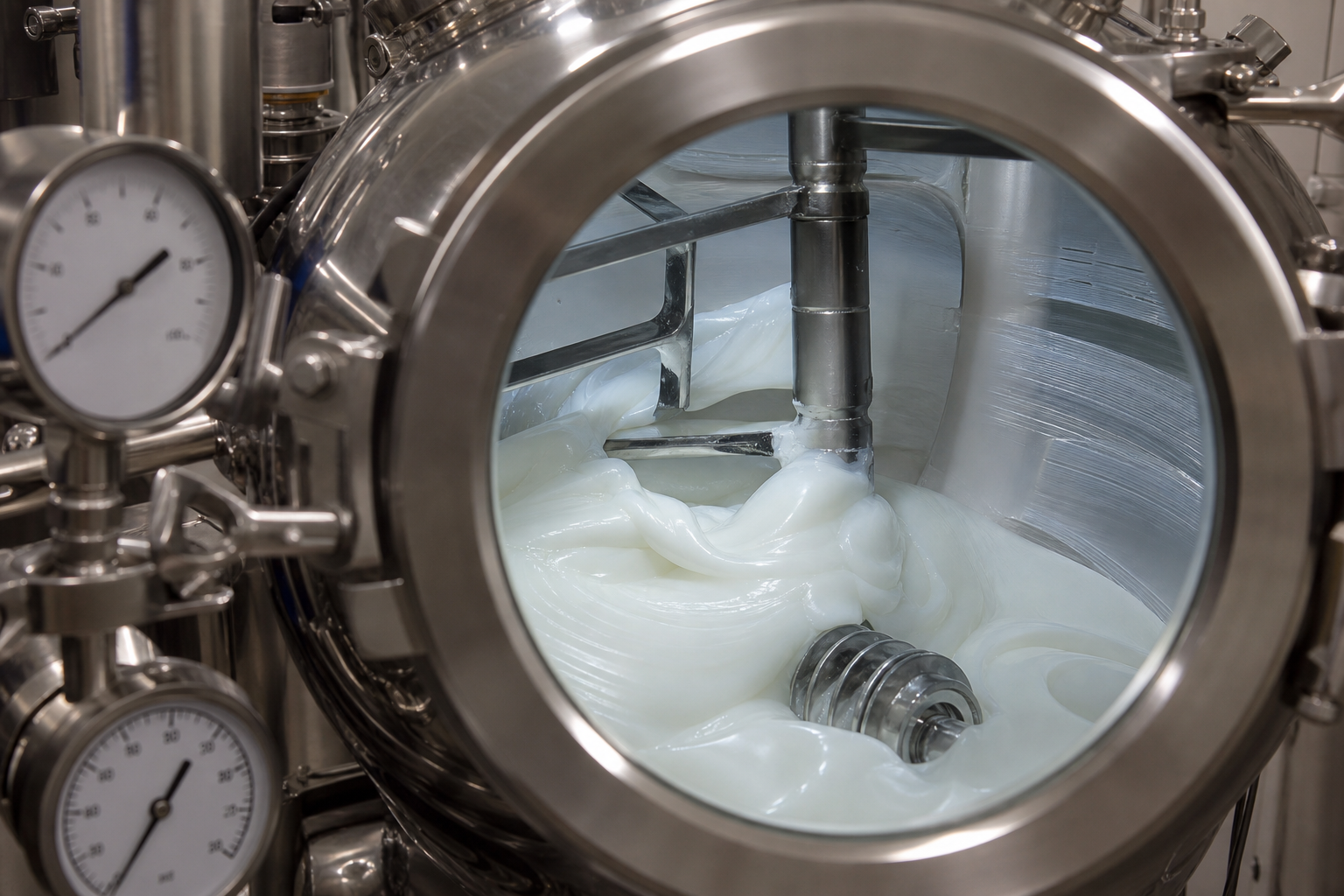
A veterinary ointment vacuum emulsifying mixer is not selected by tank volume and motor power alone. Product quality can be affected by phase preparation, addition order, bulk circulation, local shear, temperature history, vacuum timing, cooling rate and the way the finished batch leaves the vessel. A powerful homogenizer cannot correct unmelted phase material, poor wall turnover, an uncontrolled air leak or a transfer line that strips the batch from its validated condition.
The equipment specification should begin with the formulation process map and its quality attributes. Define the phases, raw-material state, melting and hydration needs, addition sequence, allowable shear and temperature exposure, batch range, expected viscosity curve, air limit, endpoint tests, hold time, cleaning method and downstream package. Then allocate each duty to phase vessels, main vessel, homogenizer, anchor, scraper, vacuum system, jacket and transfer system.
This page is deliberately narrower than the existing uneven pharmaceutical mixing troubleshooting article. That article remains the broad mixing parent. This page owns veterinary ointment emulsification, deaeration and batch-transfer decisions and does not claim that every topical animal product is sterile or requires the same process window.
Quick answer: Design veterinary ointment emulsifying from the formulation and downstream fill backward. Prepare phases under controlled conditions, use the anchor and scraper for bulk turnover and heat transfer, apply rotor-stator shear only where dispersion or droplet reduction requires it, control vacuum without pulling volatile or foaming material, cool under continued uniform circulation, and transfer through a short, drainable product path using pressure and pump conditions proven not to add air or change the ointment. Validate the process with defined endpoints and representative batches rather than fixed generic settings.
Build a Process Map before Freezing the Mixer
Direct answer: A useful user requirement maps every formulation step to a vessel function, measurable endpoint and downstream consequence.
Start with each raw material’s physical form, addition location, temperature or hydration requirement, dust or charging risk, compatibility and sensitivity to air or shear. Identify oil and aqueous phases, powders, waxes, emulsifiers, preservatives, active ingredients and late additions without placing confidential formula percentages in an RFQ when they are not needed. The supplier still needs enough information to reproduce process behavior with a justified product or simulant.
Record the expected viscosity and density through heating, emulsification, cooling and hold—not only at final release. The hardest operating point may occur during cool-down or discharge rather than during high-shear mixing. Define minimum and maximum batch because the liquid level affects agitator coverage, homogenizer circulation, temperature sensing and vacuum behavior.
Use a process map that connects each step to a quality or operating check. This also separates equipment responsibilities from formulation development. The machine supplier can propose geometry and controls; the product owner defines acceptable quality attributes, sampling, release and regulatory commitments.
| Process stage | Primary equipment duty | Evidence to collect | Risk if disconnected |
|---|---|---|---|
| Phase preparation | Melt, dissolve, hydrate or disperse consistently | Temperature profile, visual state, addition record, endpoint | Lumps, incomplete hydration or phase inconsistency |
| Phase combination | Controlled addition plus immediate bulk distribution | Addition rate/order, circulation, temperature and sample trend | Local overconcentration or premature setting |
| Homogenization | Apply justified local shear and recirculation | Time, speed/energy proxy, product response and endpoint | Over-processing, heat, poor droplet or particle distribution |
| Vacuum deaeration | Remove entrained air without uncontrolled boiling or carryover | Vacuum profile, foam behavior, endpoint and leak check | Voids, density shift, oxidation or product loss |
| Cooling and hold | Maintain turnover and heat transfer as viscosity rises | Temperature uniformity, viscosity trend, hold condition | Hot/cold zones, skinning or nonuniform structure |
| Batch transfer | Move product without air intake or unacceptable shear/heat | Pressure, flow behavior, residual, receiving condition | Air re-entry, yield loss, fill instability or texture change |
Define the Product, Batch Range and Quality Endpoints
Direct answer: The mixer configuration should be based on the ointment’s development knowledge and approved endpoint strategy, not a supplier’s universal recipe.
Describe whether the product is an anhydrous ointment, emulsion cream, gel-like system or suspension, and identify the route of administration and intended market. Record rheology using method, geometry or spindle, temperature, shear history and sample age. Include density, particle or droplet attributes where relevant, appearance, air content or another justified deaeration indicator, pH for aqueous systems, and microbiological controls defined by the product program.
Confirm the batch working range, including the minimum level at which the anchor, scraper and homogenizer perform as intended. A nominal vessel capacity does not show whether a small batch covers the homogenizer inlet or temperature probe. Likewise, a high fill level can reduce headspace available for foaming and vacuum control.
FDA’s Process Validation guidance applies general lifecycle principles to human and animal drugs. It frames process design, process qualification and continued process verification as connected stages. That does not prescribe a mixer setting; it supports developing process knowledge, qualifying the commercial process and monitoring performance over time.
Prepare Oil, Water and Solid Phases Deliberately
Direct answer: Reliable emulsification begins with correctly prepared phases, because the main homogenizer should not be used to compensate for incomplete melting, wetting or hydration.
Decide which materials require separate heating or preparation vessels and which can enter the main vessel safely. Define raw-material addition order, sieve or premix needs, charging method, agitation during heating, covered or vacuum charging where justified, and the condition that releases each phase for combination. Record actual phase temperature rather than relying only on a jacket setpoint.
Powders can float, clump or trap air if added too quickly to an unsuitable surface pattern. Waxes or oils can solidify on a cold wall or line. Water-soluble polymers may require controlled wetting and time before high shear. These are formulation-specific behaviors, so the trial should reproduce materials, sequence and scale-sensitive steps rather than replacing everything with water and oil that merely look similar.
Where separate phase vessels are used, review drainability, transfer temperature, dead legs, line tracing or insulation where justified, and the amount left behind. A batch record should make phase identity, addition, timing and endpoint traceable without depending on operator memory.
Assign Different Jobs to Homogenizer, Anchor and Scraper
Direct answer: The homogenizer creates intense local shear, while the anchor and scraper maintain bulk turnover and wall heat transfer; neither system replaces the other.
A rotor-stator or comparable homogenizer can support dispersion, deagglomeration and droplet-size reduction when the formulation needs it. Its position, inlet condition and circulation path determine whether material repeatedly passes through the shear zone. A high displayed speed does not prove uniform treatment throughout the vessel, especially as viscosity rises.
The anchor moves the bulk product and should sweep the vessel geometry without leaving stagnant regions. A wall scraper can improve heat transfer and reduce product buildup, but scraper material, pressure, wear and cleanability must be considered. Baffles, counter-rotating elements or recirculation may help some systems and interfere with others; select them from trials and computational or engineering evidence where appropriate.
The KING PACK guide to vacuum emulsifying mixer types explains broad configuration families. For a veterinary ointment, require the supplier to show how the proposed arrangement covers the batch range and how the bulk flow reaches the homogenizer, temperature probe, vacuum surface and discharge.
Control Phase Addition and Shear History
Direct answer: Addition order, rate, temperature and mixer state create the emulsion pathway; final appearance alone cannot show whether that pathway was controlled.
Define which phase enters which, the vessel pressure condition, the starting anchor and homogenizer states, addition location and the endpoint that permits the next step. A narrow addition point can create local overconcentration, while uncontrolled vacuum transfer can pull a phase too quickly. The control concept should allow the operator to reproduce the developed sequence.
Track cumulative shear exposure rather than treating homogenizer speed as the only variable. Time, recirculation, batch temperature, viscosity and scale affect the product’s experience. Excessive shear may heat the batch, alter structure or introduce risk without improving the required attribute; insufficient shear may leave poor dispersion or unstable droplets.
Collect samples using a defined location and timing strategy. Surface appearance can differ from the outlet or bulk. During development, compare samples across the process map and relate them to the same analytical method so the endpoint becomes transferable to qualification and routine manufacture.
Use Vacuum for Deaeration without Creating New Problems
Direct answer: Vacuum should be applied as a controlled profile that removes entrained air while protecting volatile components, preventing uncontrolled foam and maintaining mixer circulation.
Decide whether vacuum is needed during charging, emulsification, post-homogenization, cooling or a dedicated finishing step. Pulling vacuum too early can make an aqueous phase foam or boil; pulling it too quickly can carry product into the filter or trap. Applying it after viscosity becomes too high may make bubbles difficult to release. Develop the sequence from the formulation response.
The system should include appropriate pressure measurement, control, break-vacuum method, condenser or trap where justified, protection against product carryover and a way to verify leakage. Inspect lid seals, shaft seals, valves, sight glasses and transfer connections. A vessel that reaches a vacuum setpoint empty may behave differently when warm, foaming product is present.
Define the deaeration endpoint with a product-appropriate test: density trend, visual or microscopic air assessment, mass-volume relationship, filled-package void check or another validated measure. Do not claim the batch is bubble-free solely because the gauge reached a number.
Develop Heating and Cooling as Product Processes
Direct answer: Jacket and agitation design must deliver the required product temperature history uniformly as viscosity and heat-transfer behavior change.
Specify heating medium, available utilities, allowable product and wall temperatures, phase-melting needs, cooling endpoint, cycle objective and control sensor locations. Compare actual product temperatures at justified points rather than assuming one probe represents the complete batch. The jacket setpoint is an equipment input, not the product result.
During cooling, viscosity can rise rapidly and reduce wall renewal. Maintain suitable anchor and scraper operation, but confirm that continued shear does not change the intended structure. Cooling too quickly at the wall can create a skin or localized crystallization; cooling too slowly can extend exposure or delay filling. The acceptable profile must come from development data.
FDA-hosted VICH GL61 draft guidance emphasizes identifying critical process parameters and monitoring critical attributes during process development. Apply that principle by linking temperature, time, mixer state and product endpoints instead of using an undocumented operator judgment such as ‘cool until ready.’
Design the Outlet and Transfer for High Viscosity
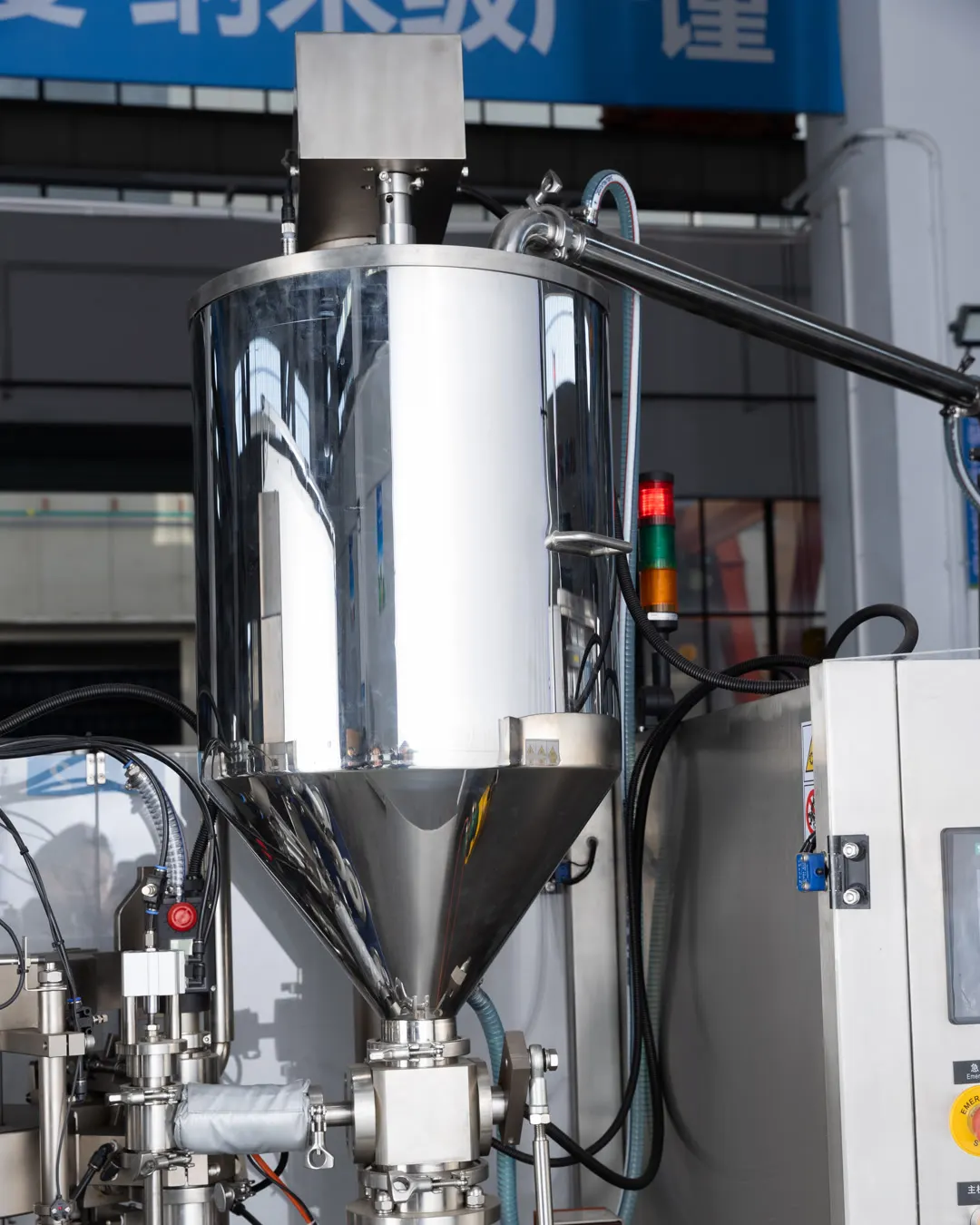
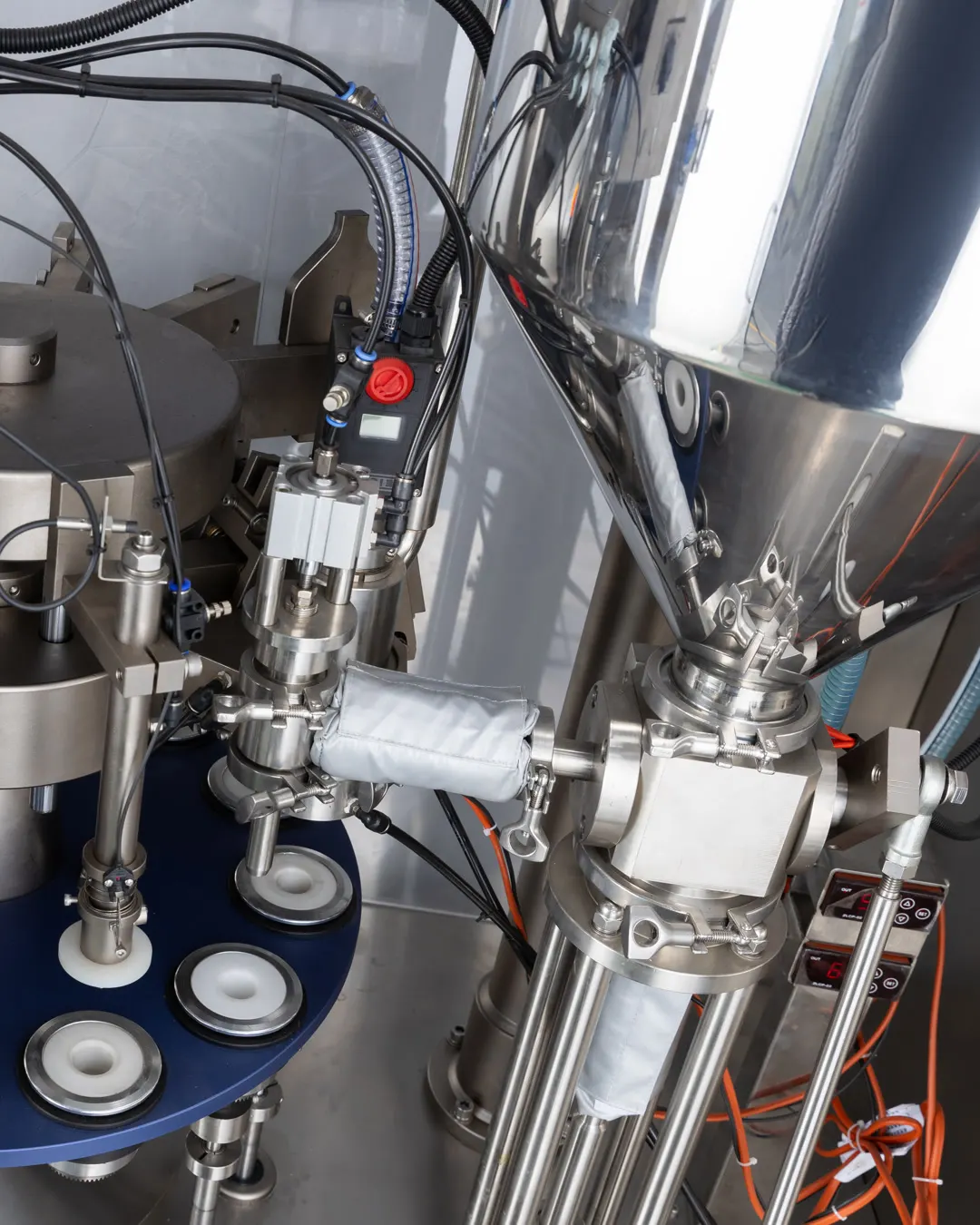
Direct answer: The finished batch needs a short, cleanable, low-air transfer path sized and operated for its viscosity at the actual discharge temperature.
Review bottom outlet geometry, valve bore, internal obstructions, drainability and access. A small outlet or sharp restriction can create high pressure and leave significant residue. A flush-bottom valve may improve discharge for some designs, but seal, maintenance and cleaning requirements must be evaluated with the user.
Compare gravity, vessel pressure, positive-displacement pump, follower or other assisted transfer methods using the ointment’s behavior and facility constraints. Protect the product from air leaks at suction connections and from dry running at the end of the batch. Define maximum allowable pressure, temperature and shear from product data, not a pump catalog alone.
Transfer distance, elevation, hose or pipe diameter, bends, insulation, receiving-vessel pressure and downstream filler feed all matter. Sample at the vessel and receiving point to check whether density, air, appearance or rheology changes. Connect the transfer study to the downstream package plan, including the KING PACK animal-health application page when the ointment belongs to the broader veterinary line.
Engineer Cleaning, Inspection and Changeover
Direct answer: Cleaning design should eliminate inaccessible residue, define disassembly and inspection, and support the user’s validated procedure across the product family.
Map the main vessel, phase vessels, homogenizer, anchor, scraper, shaft seals, vacuum line, spray devices, probes, valves, outlet and transfer path. Identify the hardest-to-clean locations and worst-case products using the user’s risk assessment. Determine whether cleaning is manual, clean-in-place, clean-out-of-place or hybrid, and what evidence will confirm coverage and removal.
If 21 CFR Part 211 applies, sections 211.65 and 211.67 address suitable product-contact construction and written cleaning and maintenance procedures and records. Those provisions do not prove that a generic polished tank is cleanable. The installed geometry, soils, cleaning chemistry, flow, time, temperature, disassembly and inspection must be developed and validated as applicable.
For campaign or multi-product use, define line clearance, part identification, recipe access, seal and scraper inspection, replacement criteria and reassembly verification. A changeover should include the transfer path and downstream connection, not stop at the vessel outlet.
Scale Up with Dimensionless Thinking and Product Evidence
Direct answer: Scale-up should preserve the mechanisms that matter—bulk circulation, local shear, heat transfer, addition and deaeration—not copy speed or time from a small vessel.
Identify which quality attributes are sensitive to shear, phase-addition history, temperature, air and hold. Compare vessel geometry, impeller-to-vessel relationship, working level, homogenizer circulation, jacket area, vacuum headspace and discharge path between scales. No single scale-up ratio preserves every mechanism, so priorities must be explicit.
Use pilot or development batches to establish parameter ranges and endpoints, then confirm them during process qualification. FDA Process Validation guidance describes process design, qualification and continued verification as a lifecycle. Continued monitoring can reveal drift in raw materials, heating, vacuum leakage, mixing load, cooling or transfer that a one-time FAT cannot capture.
Where 21 CFR 211.110 applies, in-process control procedures should monitor processes that may cause variability and include appropriate control of parameters such as mixing. The product owner should select sampling points, tests and limits based on process understanding and approved specifications.
Run a Representative Trial and FAT
Direct answer: A good trial proves product response; FAT proves the agreed equipment functions and documentation under defined, representative conditions.
- Provide the real formulation where permitted or a justified simulant with documented phase, rheology, air, heat and cleaning behavior.
- Challenge minimum, nominal and maximum working batches where project scope allows, especially homogenizer coverage and temperature sensing at the minimum.
- Record phase preparation, addition, mixer states, temperature profile, vacuum profile, cooling and every sample time against an approved run sheet.
- Verify bulk turnover, homogenizer circulation, wall scraping, alarm behavior, vacuum protection, heating/cooling control and safe recovery from planned stops.
- Transfer the finished product through the proposed path and compare vessel and receiving samples for air, appearance, rheology or other justified attributes.
- Demonstrate cleaning access, spray or manual coverage, drainage, disassembly, reassembly, inspection, recipe control and required documentation.
- Log deviations and unresolved product risks; do not convert an equipment demonstration into an unsupported product-validation claim.
How to Evaluate a Veterinary Ointment Mixer Supplier
Direct answer: Select a supplier that can translate formulation and downstream fill needs into vessel geometry, controls, trials and lifecycle support.
- Ask for comparable applications matched by ointment type, batch range, rheology, phase process and transfer challenge rather than tank size alone.
- Request a process-flow and instrumentation review covering phase vessels, main vessel, homogenizer, anchor, scraper, vacuum, jacket, outlet and transfer.
- Require sample-trial results with raw process profiles and endpoints; avoid relying on a short video or a water run.
- Review materials, surface and weld documentation, seals, elastomers, instruments, calibration scope, manuals, spare parts and preventive maintenance.
- Define FAT, SAT, training, commissioning and IQ/OQ support in the supply scope, while keeping product process validation with the manufacturer.
- Tie guarantees to specified batch, product or simulant, utilities, process sequence and acceptance methods rather than universal cycle or quality claims.
How KING PACK Approaches Veterinary Ointment Processing
Direct answer: KING PACK works from the batch process and downstream package backward, then configures phase preparation, emulsification, vacuum and transfer for sample testing.
KING PACK Machinery is a China-based manufacturer of pharmaceutical, veterinary, cosmetic and liquid filling and packaging equipment, with core solutions covering tube filling and sealing, vacuum emulsifying, liquid filling, pet spot-on filling and prefilled syringe production systems.
A veterinary ointment project may combine phase vessels, a vacuum emulsifying main vessel, rotor-stator homogenization, anchor and wall scraping, controlled heating and cooling, vacuum deaeration and an assisted transfer to tube, jar or syringe filling. The final arrangement depends on the formulation process, batch range, utilities, cleaning strategy, transfer distance and downstream package.
Review the KING PACK emulsifier mixer machine platform for equipment context. To request a process review, send batch sizes, phase list and sequence, viscosity versus temperature, product limits, target endpoints, cooling utilities, transfer route, downstream fill format and cleaning method through the KING PACK contact page.
Frequently Asked Questions
Is a higher homogenizer speed always better for veterinary ointment?
No. The required local shear depends on dispersion, droplet or particle objectives, formulation sensitivity, circulation and scale. Develop a justified range and endpoint instead of maximizing the displayed speed.
Why are the anchor and wall scraper needed if the vessel has a homogenizer?
The homogenizer treats a local flow path. The anchor and scraper support bulk turnover, uniform temperature and wall renewal, especially as viscosity rises during cooling.
When should vacuum be applied?
The timing depends on phase behavior, foam, volatile components, viscosity and air-removal needs. Develop a controlled vacuum profile and endpoint; do not pull maximum vacuum by default.
How can deaeration be verified?
Use a product-appropriate method such as density trend, microscopic or visual assessment, mass-volume comparison or filled-package void checks. A vacuum gauge alone does not prove the product condition.
Can the pilot mixer settings be copied directly to production scale?
Usually not. Vessel geometry, circulation, shear, heat transfer, headspace and transfer change with scale. Preserve the critical mechanisms and confirm endpoints at the commercial scale.
What causes air to return during transfer?
Loose connections, restricted suction, dry running, trapped high points, an unsuitable pump or an unvented receiving vessel can add air. Compare product at the mixer outlet and receiving point.
Does FAT validate the veterinary ointment process?
FAT can verify agreed machine functions and representative trials. Product process validation remains a lifecycle responsibility of the manufacturer and includes qualification and continued verification.
What should be sent for a mixer review?
Send batch range, phase list and addition sequence, viscosity and density methods, temperature profile and limits, deaeration endpoint, transfer distance, downstream package, cleaning strategy, utilities and acceptance criteria.