
Last reviewed: August 29, 2026.
A pet oral liquid filling line succeeds or fails at the interfaces between product, bottle, dropper insert and cap. A filler can meter a stable dose yet still produce rejects if the insert does not seat consistently, the bottle neck varies, the cap drives the insert deeper, or product remains on the sealing surface. Selecting each station separately creates a line that looks complete on a layout but is difficult to validate as a package system.
The buyer should therefore freeze the intended package architecture before fixing the machine concept. That means identifying the route of administration, nominal and boundary doses, bottle and neck-finish drawings, insert geometry, cap thread and liner, tamper-evidence arrangement, label and code area, and all justified market variants. Product viscosity, density, foaming, surface tension, preservative strategy and temperature window must be connected to those package inputs.
This article is narrower than the existing pet drop filling machine buying guide. It owns non-sterile pet oral-liquid bottle, insert and cap integration. It excludes spot-on pipettes and does not assume sterile ophthalmic processing. The product owner remains responsible for classification, registration, stability, label claims and applicable market requirements.
Quick answer: Configure a pet oral liquid filling line by treating the formulation, bottle neck, dose, dropper insert and cap as one verified package system. Freeze drawings and tolerances, select a filling principle from actual liquid behavior, prove insert orientation and seating, develop a documented capping window, add presence and reject controls, and run compatibility, cleaning, changeover and FAT studies with production-intent components. Do not approve the line from empty-machine speed or a water test alone.
Map the Complete Package before Selecting Machines
Direct answer: Start with one controlled package map that links every component attribute to a machine action and an acceptance check.
List every commercial and development format: bottle size and material, color or light-protection feature, neck-finish drawing, dropper or flow-reducer style, cap material and thread, liner or seal, tamper-evident feature, measuring device, label and code position. Record approved drawings, revision status, supplier, sampling condition and expected tolerance rather than relying on a sample bag marked only with a nominal size.
The package map should show the sequence from bottle infeed to filled and closed unit. For many projects that sequence includes unscrambling or feeding, cleaning where justified, filling, insert placement, cap feeding, capping, coding, inspection, rejection, labeling and accumulation. The KING PACK veterinary filling application page provides the broader animal-health application context; the project map must still be built from the actual oral-liquid package.
Assign ownership for each interface. The component supplier owns dimensional evidence, the formulation team owns product limits, quality owns specifications and sampling, and the equipment supplier owns the agreed handling and process capability within defined inputs. This prevents an unclear tolerance from becoming a commissioning argument after the line is built.
| Interface | Freeze before design review | Machine consequence | FAT evidence |
|---|---|---|---|
| Liquid to filler | Viscosity method, density, foam, temperature, particles, compatibility | Product path, pump, nozzle, agitation and cleaning | Dose trend, cutoff and product-condition checks |
| Bottle to handling | Material, geometry, neck drawing, stability, center of gravity | Guides, starwheels, sensors and support | Boundary samples without scuffing, jams or mis-detection |
| Insert to neck | Orientation, seating datum, retention and acceptable position | Feeder, pick/place or press, force and inspection | Presence, orientation, seated-position and reject challenges |
| Cap to bottle | Thread, liner, tamper feature, application window | Feeder, chuck/head, torque or force control | Correct application, verification method and opening performance |
| Pack to downstream | Label panel, code area, reject logic and accumulation limit | Coding, vision, rejection, labeling and line balance | Traceable rejects and controlled stop/restart |
Define the Oral Liquid and Its Regulatory Scope
Direct answer: Machine selection needs measured product behavior and a confirmed product category; the term ‘pet oral liquid’ is not a sufficient engineering specification.
Record viscosity with the method and temperature, density, surface tension where relevant, foaming tendency, suspended particles, sedimentation behavior, shear sensitivity, oxygen or light sensitivity, cleaning solubility, hold-time limits and the lowest and highest justified filling temperatures. A solution, suspension and emulsion can require different agitation, transfer and nozzle decisions even when all three use the same bottle volume.
Confirm whether the product is a veterinary medicinal product, animal food, supplement-like product or another regulated category in each destination market. That classification affects quality-system, microbiological, stability, label and validation expectations. An equipment supplier can design to the owner’s user requirements but should not determine legal classification or claim that a generic hygienic machine makes the process compliant.
For veterinary medicinal products, FDA’s VICH GL61 draft development guidance says the formulation, manufacturing process, container-closure system, intended use and dose-delivery device should be considered together. It is a nonbinding draft framework, not a substitute for an approved application or local regulatory advice. Use it to structure questions, then confirm the applicable requirements with the product owner and authority.
Select the Bottle and Neck Finish as Functional Equipment Inputs
Direct answer: The bottle must protect the product and run through the line, while its neck finish must consistently accept both the insert and the cap.
Compare glass and plastic candidates using stability and compatibility evidence, light and moisture protection, dimensional consistency, breakage or deformation risk, transport conditions, label adhesion, recyclability obligations where applicable and the way the consumer dispenses the dose. Do not infer product compatibility from resin name alone. Colorants, additives, surface treatment, wall distribution and supplier process can matter.
Translate the bottle drawing into line checks: overall height and diameter range, neck center relative to body, neck ovality, support ledge, thread start, sealing land, bottle stability and acceptable cosmetic condition. A narrow or top-heavy bottle may need positive support through filling and closure stations. An opaque bottle may require a sensor selected and tested for that material rather than a standard photoelectric assumption.
Use boundary and deliberately mixed samples in handling trials. The goal is not to find one ideal bottle that runs perfectly; it is to demonstrate reliable handling across the released component population and to define what incoming defects the line can detect or must prevent through supplier control.
Choose the Filling Principle from Product and Dose Behavior
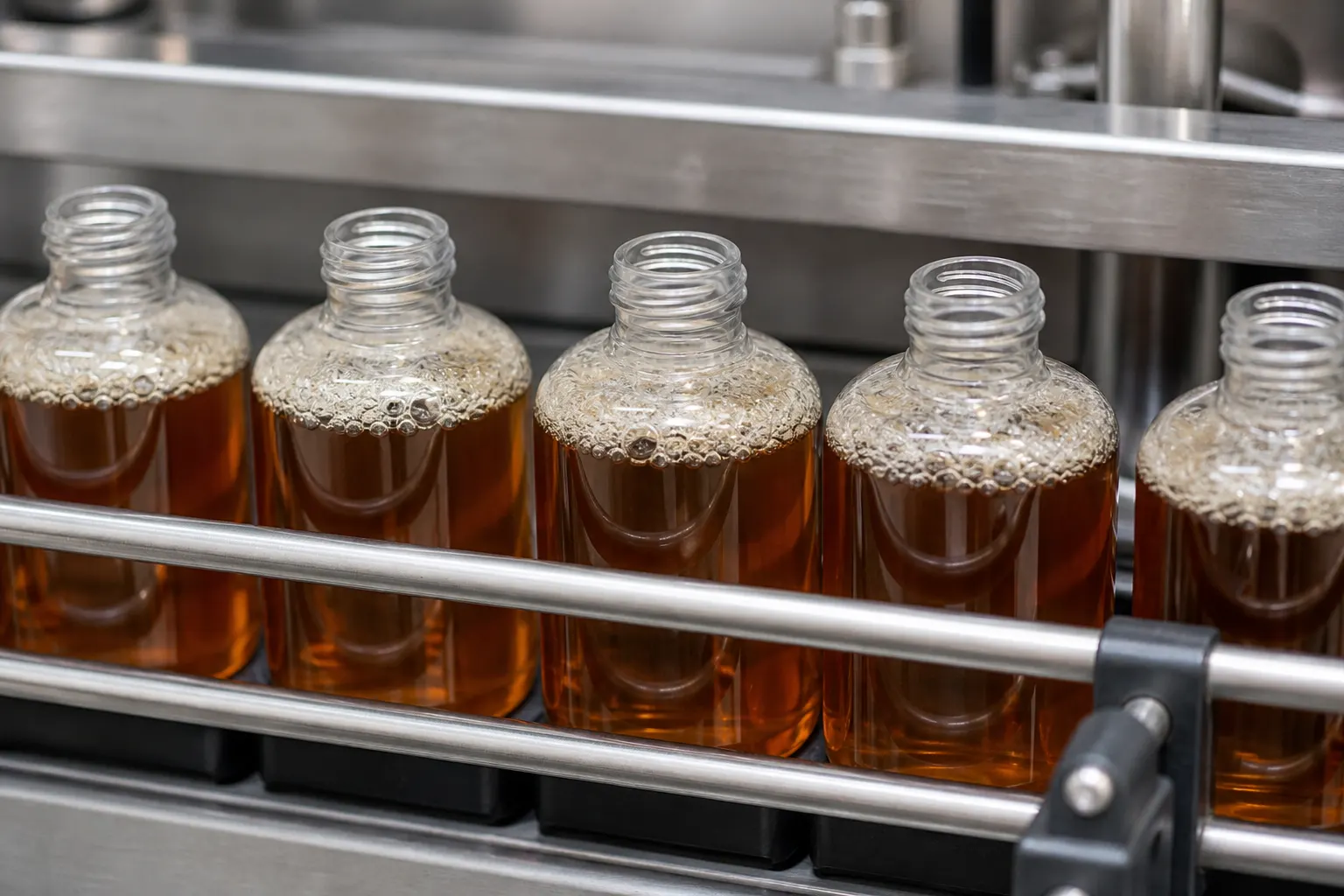
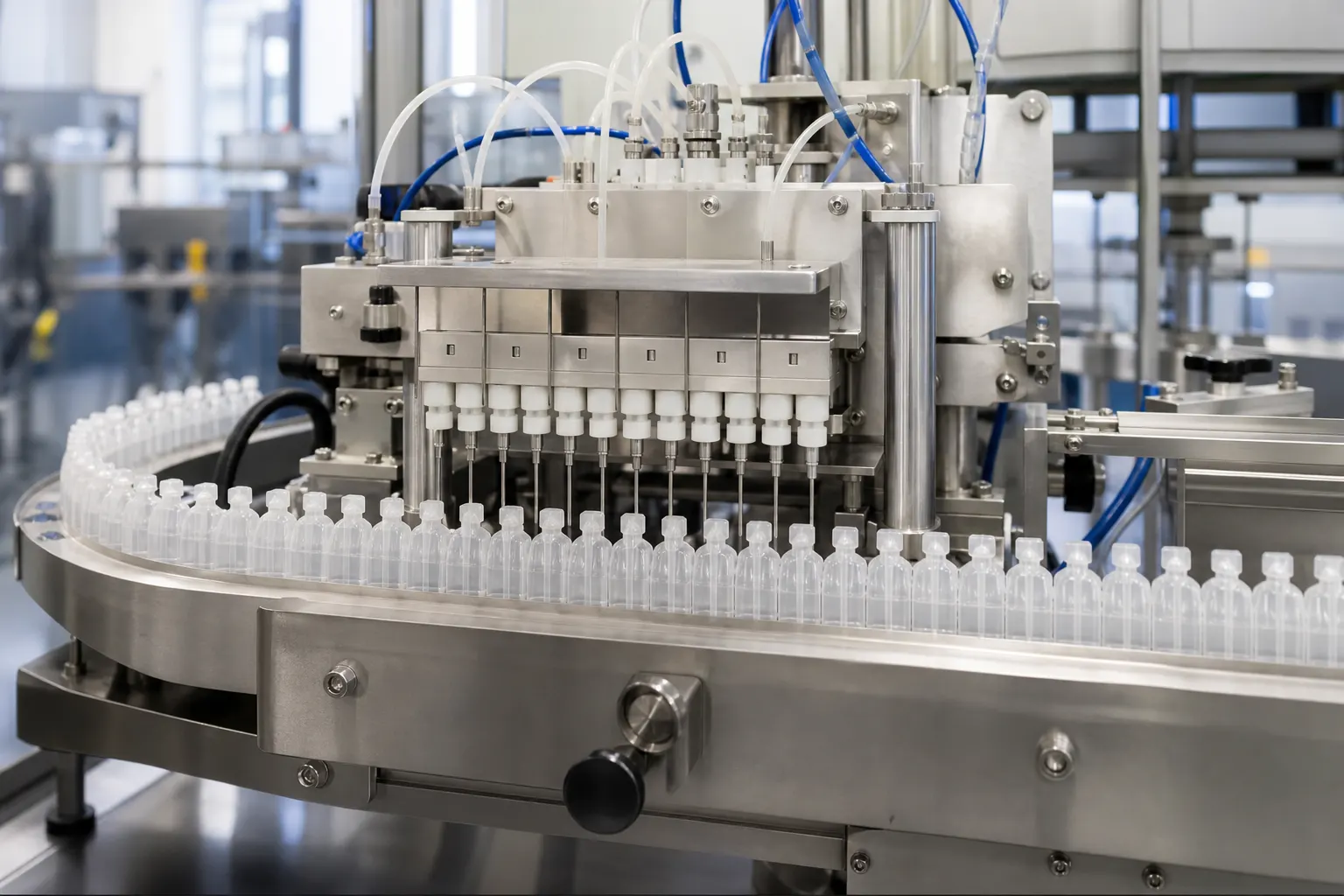
Direct answer: Select the metering system from the liquid’s flow, foam, particles, dose range, contact-material and cleaning needs rather than from a generic speed table.
Peristaltic, piston, time-pressure, flow-meter, gear or other filling principles each create different product paths, wear points, cleaning tasks and operating windows. A low-viscosity solution may favor a simple, low-hold-up path, while a suspension may need controlled agitation and a product path that does not allow settling. A more viscous oral liquid may need positive displacement and a nozzle that closes cleanly without excessive pressure.
Foam control begins upstream. Avoid unnecessary air entrainment during mixing and transfer, maintain a stable feed condition and consider bottom-up or controlled nozzle motion only when trials show it helps. Diving too deeply can wet the bottle neck or create contact risk; moving too early can stretch a liquid filament. The correct profile must be proven with the formulation and bottle.
The KING PACK liquid filling machine overview can be used to compare core dosing families. For the purchase specification, require the supplier to explain why the proposed product path, pump, nozzle, feed method and control strategy fit the measured formulation and cleaning procedure.
Control Dropper Insert Feeding, Seating and Verification
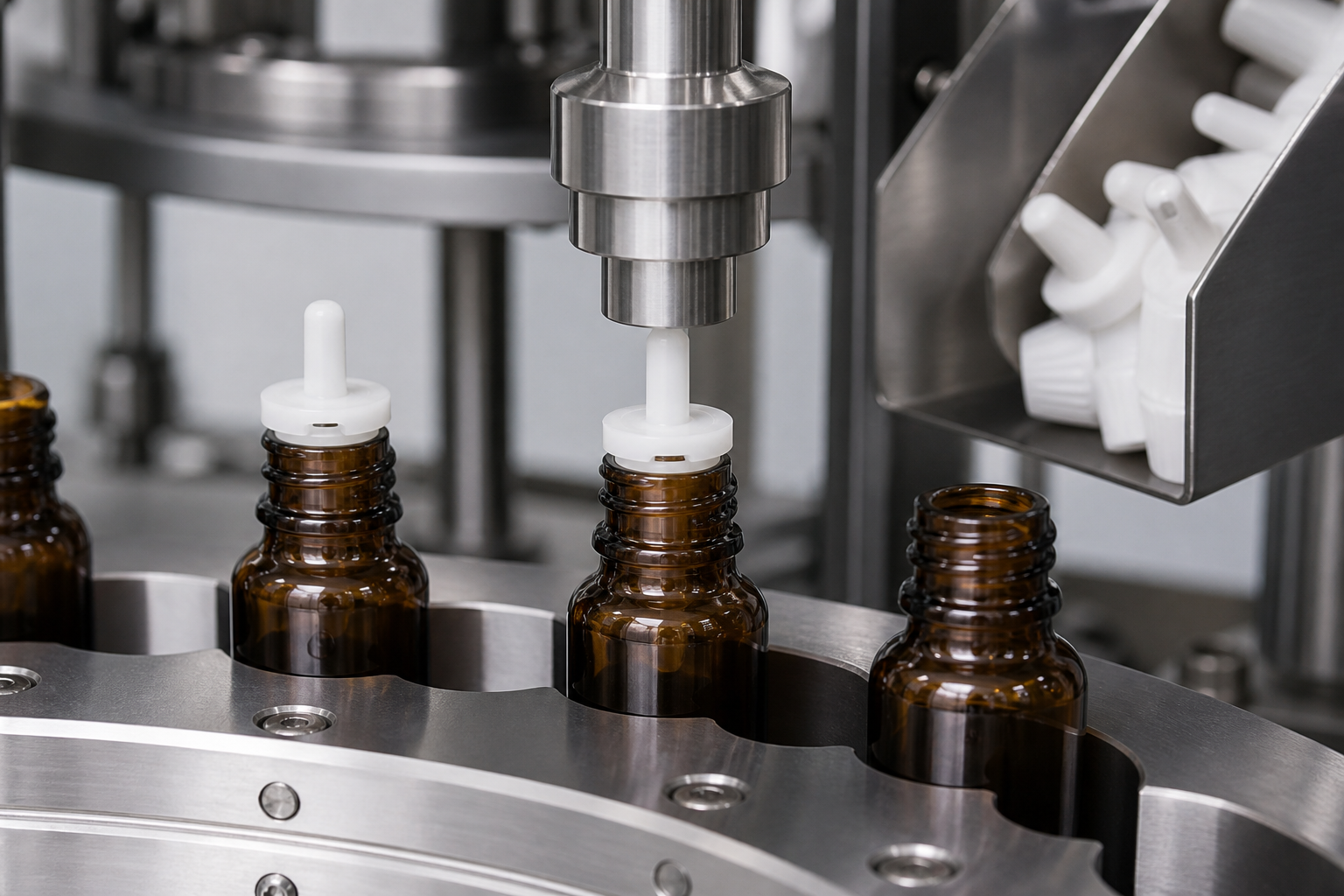
Direct answer: An insert station must orient the component, present it without damage, seat it to a defined datum and verify the result before capping.
First define what ‘seated’ means. Use a drawing datum, approved height or another measurable condition, plus functional criteria such as retention and dispensing performance. A visual impression that the insert looks level is not enough. Determine whether the cap completes seating by design or whether the insert must be fully placed before the bottle reaches the capper.
Evaluate insert material, flexibility, flange geometry, orientation features, static behavior, nesting, dust and deformation. The feeding concept may use a bowl, centrifugal system, elevator or controlled tray presentation depending on component behavior and contamination risk. Any feeder must avoid scratching, folding or silently passing doubled or inverted components.
Inspection should cover the failure modes that matter: missing, inverted, doubled, tilted, high, damaged or otherwise unacceptable inserts. Define how the sensor or vision system is challenged, how a failed unit is tracked through the capper and how reject confirmation is recorded. If a cap can hide an insert defect, the check belongs before that defect becomes invisible.
Develop Cap Application and Torque as a Package Window
Direct answer: Capping is a controlled bottle-cap-insert interaction, so torque or application force must be developed with the complete package and verified by a defined method.
Confirm cap orientation, thread engagement, liner or seal behavior, tamper-evident feature and any relationship between cap travel and insert seating. Cross-threading, cocked caps, loose caps, over-tightening, damaged bridges and bottle spin are different failures. The capper should control or detect the relevant mechanisms rather than report only a nominal head setting.
Create an application window using production-intent bottles, inserts and caps from justified component ranges. Record machine setting, applied result, removal or opening measurement method, time between application and test, sample conditioning and observed defects. Application torque and later removal behavior are related but not identical; the product owner must define the appropriate acceptance method.
A complete KING PACK filling and capping line can integrate plug or insert placement, closure handling and inspection. Integration is valuable only when reject tracking, recipe control and mechanical interfaces are verified as one sequence rather than as isolated stations.
Add Coding, Inspection, Rejection and Line-Balance Logic
Direct answer: The line should detect critical package failures, preserve traceability and remove the correct unit without creating an uncontrolled backup upstream.
Define the required checks from the package risk assessment: bottle presence and orientation, fill result where feasible, insert presence and position, cap presence and application, tamper feature, code presence and readability, label presence and any serialization or market-specific data. Avoid adding a camera because it appears advanced; every inspection needs a defined defect, challenge set and response.
Track the bottle from inspection to rejection with a documented method. Challenge missing and bad components at startup, nominal running, stop-restart and line-clearance conditions. Confirm that the reject bin is secure where required, full-bin or reject-confirmation signals are handled, and the line does not quietly continue after losing reject capability.
Line balance matters because an upstream filler can flood the insert station or a downstream labeler can cause bottles to queue under a cap head. Define accumulation, controlled stop logic, product hold limits and restart rules. The best nominal speed is not useful if frequent micro-stops create wet necks, double feeds or untraceable rejects.
Design Cleaning and Changeover around the Product Path
Direct answer: Cleaning and changeover should be engineered from the wetted path, component-contact parts and product residue, with written procedures and inspection points.
Map every wetted hose, manifold, pump chamber, valve, nozzle, hopper and drain point. Decide which parts are cleaned in place, cleaned out of place, replaced as single-use items or manually disassembled. The choice depends on product, facility and validation strategy. A short visible path can simplify inspection, but only representative residue studies can demonstrate cleanability.
For a multi-format line, identify all bottle, insert and cap change parts; label them, protect product-contact status where relevant and make incorrect assembly difficult. Recipe controls should not replace mechanical verification. A format checklist should include guides, sensors, feeder tooling, capping head, nozzle position, reject timing and inspection recipes.
If 21 CFR Part 211 applies, section 211.67 requires written procedures and records for equipment cleaning and maintenance. The regulation does not prescribe one universal cleaning cycle. The manufacturer must establish procedures, responsibilities, schedules, inspection and records appropriate to the equipment and products.
Prove Container-Closure Compatibility and Stability
Direct answer: Line trials prove machinability; compatibility, integrity, dispensing and stability studies prove that the selected package can protect and deliver the product.
VICH GL3(R) states that stability testing for a veterinary medicinal product should use the container-closure system proposed for marketing and should include functionality testing when relevant to a dose-delivery system. VICH GL61 draft guidance also highlights protection, material compatibility, sorption, leaching, integrity and reproducible dose delivery under conditions that simulate use.
Build a package evidence plan that considers formulation-contact materials, light and moisture protection, solvent or water loss, oxygen exposure where relevant, preservative performance, insert and liner interaction, closure integrity, transport, repeated opening and consumer dosing. These studies belong to the product-development and quality program; a machine FAT cannot replace them.
Under 21 CFR 211.94, when applicable, drug-product containers and closures must not be reactive, additive or absorptive to an extent that alters product safety, identity, strength, quality or purity, and they must protect against foreseeable external factors. Use the current eCFR text and market-specific requirements rather than a supplier’s generic compliance statement.
Run Compatibility Trials and FAT as Separate but Connected Studies
Direct answer: Use development studies to qualify the package and FAT to prove the agreed machine functions with representative product and components.
- Provide controlled product information, approved or development component drawings, representative samples and known boundary conditions.
- Run low, nominal and high justified dose formats and product-temperature conditions without substituting a thin liquid for performance conclusions.
- Challenge bottle handling, fill cutoff, insert orientation and seating, cap application, inspection, reject tracking, stop-restart and line clearance.
- Trend results by filling head, insertion station and capping head so an average cannot hide a station-specific problem.
- Demonstrate cleaning access, disassembly, reassembly, format change, recipe selection, alarm recovery and documentation required by the user specification.
- Record deviations and open items against the approved protocol; do not accept a short best-case run as proof of production capability.
- Keep package compatibility and stability responsibilities visible after FAT so successful machine handling is not mistaken for product approval.
How to Evaluate a Pet Oral-Liquid Line Supplier
Direct answer: Choose a supplier that can explain and test every liquid-package interface and provide traceable engineering and qualification evidence.
- Ask for references matched by product behavior, dose, bottle neck, insert and cap architecture rather than by the word ‘liquid’ alone.
- Review the product path, component feeders, placement datum, capper, sensors, reject logic and accumulation as one control sequence.
- Require sample-trial data by head and condition, including boundary components and stop-restart challenges.
- Confirm layout, utilities, electrical and pneumatic documentation, materials and certificates, manuals, spare-parts scope and change-part lists.
- Define FAT, SAT and any IQ/OQ support in the commercial scope, including who supplies product, components, measurement systems and acceptance criteria.
- Avoid unsupported universal speed, accuracy, torque or compliance claims; tie performance to named product, package and test conditions.
How KING PACK Approaches Pet Oral-Liquid Projects
Direct answer: KING PACK starts with the formulation and full closure stack, then configures filling, insert placement, capping and inspection around sample testing.
KING PACK Machinery is a China-based manufacturer of pharmaceutical, veterinary, cosmetic and liquid filling and packaging equipment, with core solutions covering tube filling and sealing, vacuum emulsifying, liquid filling, pet spot-on filling and prefilled syringe production systems.
For a pet oral-liquid project, the line concept may include bottle feeding, product-matched dosing, controlled nozzle motion, insert feeding and seating, capping, coding, inspection, rejection and downstream labeling. The actual configuration depends on product category, formulation behavior, package drawings, hygiene strategy, format range and required evidence.
To request a review, send formulation properties and temperature window, dose range, bottle/neck drawing, insert and cap drawings and samples, cleaning procedure, required output, layout constraints and acceptance criteria through the KING PACK contact page. The review should identify missing package inputs before a quotation is treated as a final line specification.
Frequently Asked Questions
Should the filler be selected before the bottle and closure?
No. Freeze the intended package architecture and critical tolerances first. Filling, insert seating, cap application, inspection and handling all depend on the bottle neck and closure stack.
Can water be used for the sample trial?
Water can verify basic motion, but it may not reproduce viscosity, foam, wetting, cutoff, suspension behavior or cleaning. Use the product or a justified representative liquid for performance conclusions.
How is a dropper insert seating defect defined?
Define a drawing datum or approved position plus functional retention and dispensing criteria. Include missing, inverted, tilted, high, damaged and doubled inserts in the inspection challenge set where relevant.
Does the capper control final package integrity by itself?
No. Integrity depends on bottle, insert, cap, liner or seal, application conditions, product contact and storage. Capping is one controlled step within the complete package system.
What causes liquid on the bottle neck before capping?
Possible causes include nozzle drip, foam rise, splash during indexing, overfill, poor bottle support or a wet component path. Inspect the neck immediately after filling to locate the first appearance.
Do all pet oral liquids need sterile filling?
No. Sterility and hygiene requirements depend on product classification, formulation, route, registration and market. Do not apply ophthalmic or aseptic assumptions to a non-sterile oral liquid without a justified requirement.
What should be verified during FAT?
Verify representative filling, insert feeding and seating, capping, inspection and reject tracking, stop-restart, line clearance, cleaning access, changeover and documentation against an approved protocol.
What information is needed for an RFQ?
Provide product category, formulation properties, dose range, bottle/neck, insert and cap drawings and samples, format list, cleaning method, output target, inspection needs, layout, utilities and acceptance criteria.